🔥
Contracting
Explore the new contractor management module
🔥
Contracting
Explore the new contractor management module
🔥
Contracting
Explore the new contractor management module
🔥
Contracting
Explore the new contractor management module

Last updated:
Why hiring managers no longer trust a “good shortlist.”

Innovations

Iwo Paliszewski
For a long time, a good shortlist meant progress.
It meant that the recruiter had done the hard work of narrowing the field, filtering out noise, and bringing forward the strongest candidates. A shortlist was not just a list of names. It was a signal. It reassured hiring managers that the process was moving in the right direction and that the next stage of decision-making could begin with confidence.
That feeling is becoming less common.
In many organizations today, even a strong shortlist no longer creates the same sense of certainty it once did. Hiring managers ask for more interviews, more context, more evidence, and more validation. They hesitate longer. They revisit decisions. They ask to “see one more option” even when the shortlist already looks solid.
At first glance, this can look like indecision or unnecessary complexity. In reality, it points to something more important: trust in early-stage hiring signals is weakening.
A polished shortlist is no longer enough
One reason for this shift is simple. Candidates are getting better at presentation.
Applications are more polished than they used to be. CVs are clearer, better structured, and more closely aligned with job descriptions. LinkedIn profiles are more complete. Interview answers are more refined. In many cases, this is the result of better preparation, stronger self-awareness, and the wider availability of tools that help candidates present themselves more effectively.
That should be a good thing, and in many ways it is.
But it also changes the meaning of what hiring teams see in the early stages of the process. When many candidates appear strong on paper, the shortlist itself becomes less conclusive. A good shortlist no longer guarantees confidence, because the quality of presentation has become easier to manufacture than the quality of capability.
The issue is not that the shortlist is bad. The issue is that it no longer feels definitive.
The hidden tension between presentation and proof
This is where many hiring processes begin to slow down.
A shortlist is supposed to simplify the decision. But in an environment where more candidates look credible, it often does the opposite. It raises a new set of questions.
Is this person genuinely a strong fit, or simply well presented? Does this experience reflect real depth, or just an effective narrative? Is the recruiter bringing us the best candidates, or the best-documented ones?
These questions are not always spoken aloud, but they shape behavior. They explain why hiring managers ask for another round, another stakeholder interview, another task, or another layer of validation. They are not always reacting to weakness. Often, they are reacting to uncertainty.
And uncertainty changes how people behave inside a process.
Why more validation now feels necessary
In many hiring teams, additional stages are no longer about rigor for its own sake. They are compensating for reduced trust in the earlier parts of the funnel.
A few years ago, a shortlist carried more authority. It represented a level of filtering that felt meaningful. The recruiter had found the right people, and now it was time to decide. Today, the same shortlist often feels more like a starting point for further verification.
That does not necessarily mean the recruiter is doing a worse job. In fact, recruiters are often working with better tools, more data, and more information than ever before. The problem is that more information has not automatically produced more confidence. In many cases, it has created more ambiguity.
When several candidates look equally strong, the hiring manager does not feel reassured. They feel exposed. The cost of making the wrong choice feels higher, so the process expands in response.
The shortlist is no longer the answer. It is a question.
This may be the most important shift.
In many organizations, the shortlist used to answer the question: “Who should we seriously consider?” Now it increasingly asks a different one: “How much of what we are seeing can we actually trust?”
That is a much harder question to resolve.
It cannot be solved simply through more sourcing. It cannot be solved by adding more candidates into the funnel. In fact, more candidates often make it worse, because they increase the number of plausible options without improving certainty.
And this is where many hiring teams become trapped. The shortlist looks strong, but nobody feels fully comfortable acting on it. The process continues, not because there is no talent, but because there is not enough confidence.
What this means for recruiters
For recruiters, this is a subtle but profound change in role.
The job is no longer only about bringing strong candidates to the table. It is increasingly about helping hiring managers trust what they are seeing. That means providing more than names, CVs, and summaries. It means creating context. Explaining not just who a candidate is, but why they matter, what evidence supports the assessment, and where the real strengths or risks lie.
In other words, the recruiter is no longer only a talent finder. They are becoming a confidence-builder.
And that is a very different kind of work.
It requires stronger calibration with hiring managers, clearer evaluation criteria, and better ways of documenting why someone is on the shortlist in the first place. Without that, even a well-selected group of candidates can feel uncertain.
The cost of mistrusting a shortlist
There is also a practical consequence to all of this.
When hiring managers stop trusting a good shortlist, the process gets heavier. More interviews are added. More people become involved. Decision-making slows down. Candidates wait longer. Some lose interest. Some drop out. Some accept another offer before the company reaches a conclusion.
Ironically, the attempt to reduce the risk of a bad decision can increase the risk of losing a very good one.
This is why mistrust in the shortlist is not just a psychological issue. It is an operational one. It affects hiring speed, candidate experience, team capacity, and ultimately the quality of the final outcome.
A quieter change in hiring
One of the reasons this topic matters is that it often goes unnoticed.
Organizations talk openly about AI, skills shortages, employer branding, and hiring efficiency. They talk less often about confidence. Yet confidence is increasingly what determines whether a process moves forward or stalls.
A shortlist can still look excellent. But if it does not create trust, it no longer serves its original purpose.
That may be one of the biggest quiet shifts in recruitment today.
Hiring managers are not necessarily becoming more demanding for the sake of it. In many cases, they are responding to a market where polished candidates are easier to find, but genuine certainty is harder to reach.
And that changes what a “good shortlist” really means.


News & Updates
Stay up-to-date with the latest innovations, features, and tips about Recruitify!
By providing your email address within the newsletter sign-up form, you confirm its processing to send marketing information regarding the Administrator’s products and services. The Administrator of your personal data processed for the abovementioned purposes is Recruitify Spółka z o.o., based in Warsaw, Poland (KRS 0000709889). For more information on the principles of personal data processing and the rights of data subjects, please check the Privacy Policy.

Last updated:
Why hiring managers no longer trust a “good shortlist.”
Innovations
Iwo Paliszewski
For a long time, a good shortlist meant progress.
It meant that the recruiter had done the hard work of narrowing the field, filtering out noise, and bringing forward the strongest candidates. A shortlist was not just a list of names. It was a signal. It reassured hiring managers that the process was moving in the right direction and that the next stage of decision-making could begin with confidence.
That feeling is becoming less common.
In many organizations today, even a strong shortlist no longer creates the same sense of certainty it once did. Hiring managers ask for more interviews, more context, more evidence, and more validation. They hesitate longer. They revisit decisions. They ask to “see one more option” even when the shortlist already looks solid.
At first glance, this can look like indecision or unnecessary complexity. In reality, it points to something more important: trust in early-stage hiring signals is weakening.
A polished shortlist is no longer enough
One reason for this shift is simple. Candidates are getting better at presentation.
Applications are more polished than they used to be. CVs are clearer, better structured, and more closely aligned with job descriptions. LinkedIn profiles are more complete. Interview answers are more refined. In many cases, this is the result of better preparation, stronger self-awareness, and the wider availability of tools that help candidates present themselves more effectively.
That should be a good thing, and in many ways it is.
But it also changes the meaning of what hiring teams see in the early stages of the process. When many candidates appear strong on paper, the shortlist itself becomes less conclusive. A good shortlist no longer guarantees confidence, because the quality of presentation has become easier to manufacture than the quality of capability.
The issue is not that the shortlist is bad. The issue is that it no longer feels definitive.
The hidden tension between presentation and proof
This is where many hiring processes begin to slow down.
A shortlist is supposed to simplify the decision. But in an environment where more candidates look credible, it often does the opposite. It raises a new set of questions.
Is this person genuinely a strong fit, or simply well presented? Does this experience reflect real depth, or just an effective narrative? Is the recruiter bringing us the best candidates, or the best-documented ones?
These questions are not always spoken aloud, but they shape behavior. They explain why hiring managers ask for another round, another stakeholder interview, another task, or another layer of validation. They are not always reacting to weakness. Often, they are reacting to uncertainty.
And uncertainty changes how people behave inside a process.
Why more validation now feels necessary
In many hiring teams, additional stages are no longer about rigor for its own sake. They are compensating for reduced trust in the earlier parts of the funnel.
A few years ago, a shortlist carried more authority. It represented a level of filtering that felt meaningful. The recruiter had found the right people, and now it was time to decide. Today, the same shortlist often feels more like a starting point for further verification.
That does not necessarily mean the recruiter is doing a worse job. In fact, recruiters are often working with better tools, more data, and more information than ever before. The problem is that more information has not automatically produced more confidence. In many cases, it has created more ambiguity.
When several candidates look equally strong, the hiring manager does not feel reassured. They feel exposed. The cost of making the wrong choice feels higher, so the process expands in response.
The shortlist is no longer the answer. It is a question.
This may be the most important shift.
In many organizations, the shortlist used to answer the question: “Who should we seriously consider?” Now it increasingly asks a different one: “How much of what we are seeing can we actually trust?”
That is a much harder question to resolve.
It cannot be solved simply through more sourcing. It cannot be solved by adding more candidates into the funnel. In fact, more candidates often make it worse, because they increase the number of plausible options without improving certainty.
And this is where many hiring teams become trapped. The shortlist looks strong, but nobody feels fully comfortable acting on it. The process continues, not because there is no talent, but because there is not enough confidence.
What this means for recruiters
For recruiters, this is a subtle but profound change in role.
The job is no longer only about bringing strong candidates to the table. It is increasingly about helping hiring managers trust what they are seeing. That means providing more than names, CVs, and summaries. It means creating context. Explaining not just who a candidate is, but why they matter, what evidence supports the assessment, and where the real strengths or risks lie.
In other words, the recruiter is no longer only a talent finder. They are becoming a confidence-builder.
And that is a very different kind of work.
It requires stronger calibration with hiring managers, clearer evaluation criteria, and better ways of documenting why someone is on the shortlist in the first place. Without that, even a well-selected group of candidates can feel uncertain.
The cost of mistrusting a shortlist
There is also a practical consequence to all of this.
When hiring managers stop trusting a good shortlist, the process gets heavier. More interviews are added. More people become involved. Decision-making slows down. Candidates wait longer. Some lose interest. Some drop out. Some accept another offer before the company reaches a conclusion.
Ironically, the attempt to reduce the risk of a bad decision can increase the risk of losing a very good one.
This is why mistrust in the shortlist is not just a psychological issue. It is an operational one. It affects hiring speed, candidate experience, team capacity, and ultimately the quality of the final outcome.
A quieter change in hiring
One of the reasons this topic matters is that it often goes unnoticed.
Organizations talk openly about AI, skills shortages, employer branding, and hiring efficiency. They talk less often about confidence. Yet confidence is increasingly what determines whether a process moves forward or stalls.
A shortlist can still look excellent. But if it does not create trust, it no longer serves its original purpose.
That may be one of the biggest quiet shifts in recruitment today.
Hiring managers are not necessarily becoming more demanding for the sake of it. In many cases, they are responding to a market where polished candidates are easier to find, but genuine certainty is harder to reach.
And that changes what a “good shortlist” really means.
News & Updates
Stay up-to-date with the latest innovations, features, and tips about Recruitify!
By providing your email address within the newsletter sign-up form, you confirm its processing to send marketing information regarding the Administrator’s products and services. The Administrator of your personal data processed for the abovementioned purposes is Recruitify Spółka z o.o., based in Warsaw, Poland (KRS 0000709889). For more information on the principles of personal data processing and the rights of data subjects, please check the Privacy Policy.
Last updated:
Why hiring managers no longer trust a “good shortlist.”
Innovations
Iwo Paliszewski
For a long time, a good shortlist meant progress.
It meant that the recruiter had done the hard work of narrowing the field, filtering out noise, and bringing forward the strongest candidates. A shortlist was not just a list of names. It was a signal. It reassured hiring managers that the process was moving in the right direction and that the next stage of decision-making could begin with confidence.
That feeling is becoming less common.
In many organizations today, even a strong shortlist no longer creates the same sense of certainty it once did. Hiring managers ask for more interviews, more context, more evidence, and more validation. They hesitate longer. They revisit decisions. They ask to “see one more option” even when the shortlist already looks solid.
At first glance, this can look like indecision or unnecessary complexity. In reality, it points to something more important: trust in early-stage hiring signals is weakening.
A polished shortlist is no longer enough
One reason for this shift is simple. Candidates are getting better at presentation.
Applications are more polished than they used to be. CVs are clearer, better structured, and more closely aligned with job descriptions. LinkedIn profiles are more complete. Interview answers are more refined. In many cases, this is the result of better preparation, stronger self-awareness, and the wider availability of tools that help candidates present themselves more effectively.
That should be a good thing, and in many ways it is.
But it also changes the meaning of what hiring teams see in the early stages of the process. When many candidates appear strong on paper, the shortlist itself becomes less conclusive. A good shortlist no longer guarantees confidence, because the quality of presentation has become easier to manufacture than the quality of capability.
The issue is not that the shortlist is bad. The issue is that it no longer feels definitive.
The hidden tension between presentation and proof
This is where many hiring processes begin to slow down.
A shortlist is supposed to simplify the decision. But in an environment where more candidates look credible, it often does the opposite. It raises a new set of questions.
Is this person genuinely a strong fit, or simply well presented? Does this experience reflect real depth, or just an effective narrative? Is the recruiter bringing us the best candidates, or the best-documented ones?
These questions are not always spoken aloud, but they shape behavior. They explain why hiring managers ask for another round, another stakeholder interview, another task, or another layer of validation. They are not always reacting to weakness. Often, they are reacting to uncertainty.
And uncertainty changes how people behave inside a process.
Why more validation now feels necessary
In many hiring teams, additional stages are no longer about rigor for its own sake. They are compensating for reduced trust in the earlier parts of the funnel.
A few years ago, a shortlist carried more authority. It represented a level of filtering that felt meaningful. The recruiter had found the right people, and now it was time to decide. Today, the same shortlist often feels more like a starting point for further verification.
That does not necessarily mean the recruiter is doing a worse job. In fact, recruiters are often working with better tools, more data, and more information than ever before. The problem is that more information has not automatically produced more confidence. In many cases, it has created more ambiguity.
When several candidates look equally strong, the hiring manager does not feel reassured. They feel exposed. The cost of making the wrong choice feels higher, so the process expands in response.
The shortlist is no longer the answer. It is a question.
This may be the most important shift.
In many organizations, the shortlist used to answer the question: “Who should we seriously consider?” Now it increasingly asks a different one: “How much of what we are seeing can we actually trust?”
That is a much harder question to resolve.
It cannot be solved simply through more sourcing. It cannot be solved by adding more candidates into the funnel. In fact, more candidates often make it worse, because they increase the number of plausible options without improving certainty.
And this is where many hiring teams become trapped. The shortlist looks strong, but nobody feels fully comfortable acting on it. The process continues, not because there is no talent, but because there is not enough confidence.
What this means for recruiters
For recruiters, this is a subtle but profound change in role.
The job is no longer only about bringing strong candidates to the table. It is increasingly about helping hiring managers trust what they are seeing. That means providing more than names, CVs, and summaries. It means creating context. Explaining not just who a candidate is, but why they matter, what evidence supports the assessment, and where the real strengths or risks lie.
In other words, the recruiter is no longer only a talent finder. They are becoming a confidence-builder.
And that is a very different kind of work.
It requires stronger calibration with hiring managers, clearer evaluation criteria, and better ways of documenting why someone is on the shortlist in the first place. Without that, even a well-selected group of candidates can feel uncertain.
The cost of mistrusting a shortlist
There is also a practical consequence to all of this.
When hiring managers stop trusting a good shortlist, the process gets heavier. More interviews are added. More people become involved. Decision-making slows down. Candidates wait longer. Some lose interest. Some drop out. Some accept another offer before the company reaches a conclusion.
Ironically, the attempt to reduce the risk of a bad decision can increase the risk of losing a very good one.
This is why mistrust in the shortlist is not just a psychological issue. It is an operational one. It affects hiring speed, candidate experience, team capacity, and ultimately the quality of the final outcome.
A quieter change in hiring
One of the reasons this topic matters is that it often goes unnoticed.
Organizations talk openly about AI, skills shortages, employer branding, and hiring efficiency. They talk less often about confidence. Yet confidence is increasingly what determines whether a process moves forward or stalls.
A shortlist can still look excellent. But if it does not create trust, it no longer serves its original purpose.
That may be one of the biggest quiet shifts in recruitment today.
Hiring managers are not necessarily becoming more demanding for the sake of it. In many cases, they are responding to a market where polished candidates are easier to find, but genuine certainty is harder to reach.
And that changes what a “good shortlist” really means.
News & Updates
Stay up-to-date with the latest innovations, features, and tips about Recruitify!
By providing your email address within the newsletter sign-up form, you confirm its processing to send marketing information regarding the Administrator’s products and services. The Administrator of your personal data processed for the abovementioned purposes is Recruitify Spółka z o.o., based in Warsaw, Poland (KRS 0000709889). For more information on the principles of personal data processing and the rights of data subjects, please check the Privacy Policy.

Discover More
Applicant Tracking System
6 Aug 2026
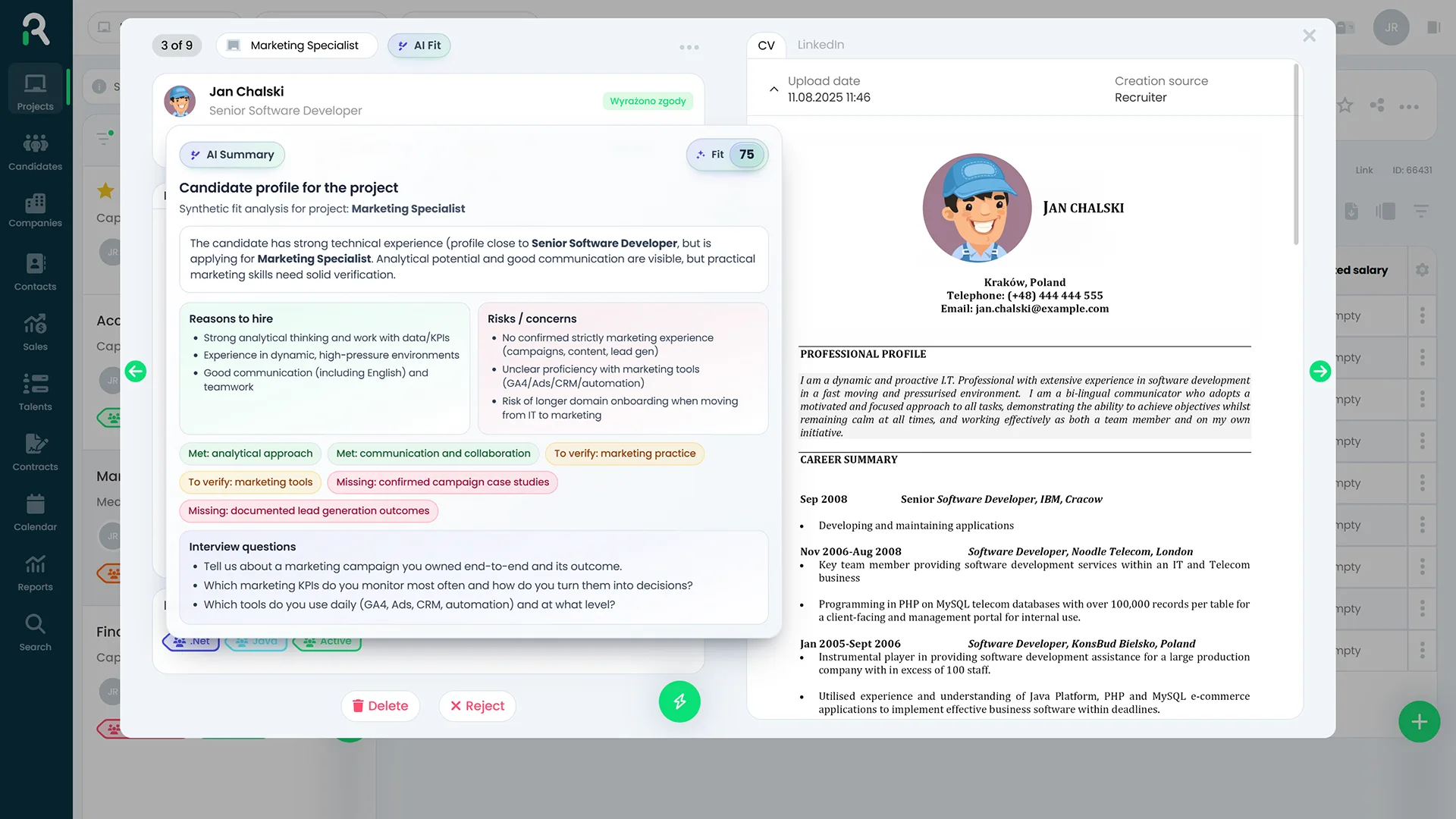
AI Candidate Scoring: What is it, how does it work, and how to use it responsibly? The ultimate guide (2026)
AI Candidate Scoring: What is it, how does it work, and how to use it responsibly? The ultimate guide (2026)
Discover More
Innovations
25 Jul 2026
AI Agent of the Week: The Screening Agent – Transforming high application volumes into razor-sharp recruiter focus
AI Agent of the Week: The Screening Agent – Transforming high application volumes into razor-sharp recruiter focus
Discover More

Applicant Tracking System
12 Jul 2026
AI Agent of the Week: The Sourcing Agent – Your 24/7 talent radar that never sleeps
AI Agent of the Week: The Sourcing Agent – Your 24/7 talent radar that never sleeps
Discover More
Applicant Tracking System
6 Aug 2026
AI Candidate Scoring: What is it, how does it work, and how to use it responsibly? The ultimate guide (2026)
AI Candidate Scoring: What is it, how does it work, and how to use it responsibly? The ultimate guide (2026)
Discover More
Innovations
25 Jul 2026
AI Agent of the Week: The Screening Agent – Transforming high application volumes into razor-sharp recruiter focus
AI Agent of the Week: The Screening Agent – Transforming high application volumes into razor-sharp recruiter focus
Discover More