Last updated:
Contextual Matching in Recruitment: How It Works and Why It Beats Keywords

Recruitment Process
Recruitment Process
Applicant Tracking System
Applicant Tracking System

The Recruitify Team
Contextual matching is a way of comparing candidates with a job by meaning rather than by exact words: the system understands that Linux and Ubuntu are related, that “Sales Agent” and “Sales Representative” describe the same role, and that a keyword in the wrong context is not a match. For agencies and HR teams drowning in CVs, it turns a pile of profiles into a ranked shortlist. Recruitify is built around this idea: our Contextual Matching AI and scoring engine evaluates applications against project requirements and delivers shortlists with a percentage match score, inside an ATS and CRM that live in one tab.
Key Takeaways
Keyword search misses qualified people who phrase their experience differently and surfaces people who mention a term without having done the work. Contextual matching addresses both failures.
A good system compares parsed CV data with job requirements, recognizes related skills and combines weighted criteria into one score.
Treat the score as a ranking a recruiter can inspect and overrule, not as an automatic rejection.
Measure it on your own data: pilot it, track fill rates and retention, and watch for drift and bias over time.
It works best when it sits on clean, structured data, which is why parsing, deduplication and matching belong in one platform.
Table of Contents
What contextual matching means in recruitment
Traditional sourcing is lexical: the search engine looks for the characters you typed. Boolean strings improve precision, but they still depend on the candidate having used the same words as the recruiter.
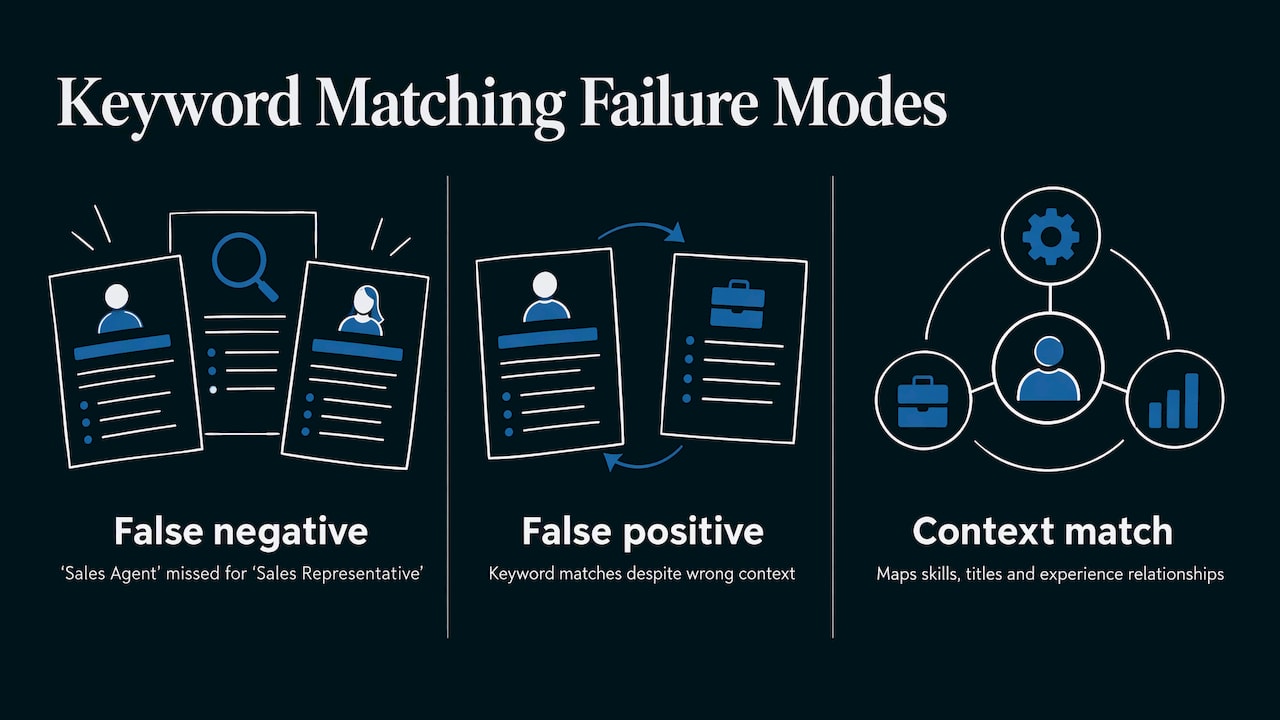
Sergio Rio describes two failure modes of this approach. False negatives happen when a qualified candidate is missed because the wording differs, for example “Sales Agent” versus “Sales Representative”. False positives happen when the keyword matches but the context is wrong. Semantic and contextual approaches address both by mapping relationships between skills, titles and experience.
In IT recruitment the problem is sharper than elsewhere. Stacks overlap, tools are renamed, and a developer who lists “Kubernetes” and “Helm” may never write “container orchestration”. A matching engine that understands the relationships inside a tech stack finds that person without a hand-built search string.
How much better is it than keywords?
Academic work gives a sense of the gap. In a 2026 Brunel University framework, a similarity model outperformed keyword matching: simulated Software Engineer scores reached 0.74 against 0.35, and real-world scores were 0.83 for Hadoop, 0.76 for Data Science and 0.74 for PMP, while keyword scores stayed below 0.17. These are research results on specific datasets, not a promise for any one agency, but the direction is clear.

How a matching system evaluates a candidate
Under the hood, most systems follow the same sequence. The Smart-Hiring paper (2025) describes it well:
Parse the CV. Structured attributes such as location, years of experience and education are extracted from the document.
Compare with requirements. Those attributes are checked against what the job asks for.
Encode skills by meaning. A sentence-embedding model lets related skills, such as Linux and Ubuntu, be recognized as compatible.
Score. Pairwise similarities and weighted criteria are combined into a single compatibility score.
The first step decides the quality of everything after it. If a scan is read badly or the same person exists three times in your database, the score is built on noise. That is why we pair matching with the Recruitify CV parser, which extracts data from PDFs, DOCX files, scans and photos in about 3 seconds, builds a structured profile and detects duplicates automatically.
What the score looks like in practice
Imagine a client needs a senior Java developer with Spring, Kafka and experience in payments. A keyword search for “Kafka” returns every profile that mentions it, including a project manager who attended a workshop. A contextual engine weighs the stack as a whole, sees that the strongest candidate has event-streaming and payment-processing experience under different job titles, and ranks that person first with a percentage match. The recruiter then reads the top ten profiles instead of scrolling through four hundred.
Where it pays off for agencies and HR teams
High-volume applications
Volume is the clearest case. Hays, a global recruiter, processes around 15,000 CVs a day and built an AI matching engine so consultants could surface suitable candidates and jobs from its knowledge base. Consultants evaluate results, flag drift and tune weights, so the model keeps improving. You do not need Hays-scale volume to feel the same pressure: an in-house HR department with a few hundred applications per opening faces the same triage problem.
Your existing database
Most agencies hold thousands of candidates who were never placed with the right client at the right moment. Keyword search rarely resurfaces them. Contextual matching can read old profiles against a new brief and return people you already paid to source. This is the database monetization we build toward in Recruitify: intelligent indexing that helps recover lost candidates and generate revenue from assets you already own.
Sourcing and presenting
Matching is one link in a chain. Our X-RAY search and Boolean engine generates advanced Boolean strings in one click and scans both the open web and your internal database. Once you have the right person, Blind CV AI produces an anonymized, professional profile ready to show the end client. Together with the ATS and agency CRM, the sales pipeline and the recruitment pipeline sit together instead of in separate spreadsheets.
How to measure whether it works
Vendors promise speed and quality, but the OECD notes in its 2023 report that AI matching tools claim efficiency gains and better-quality matching, while independent estimates of effectiveness are scarce. The practical answer is to measure on your own pipeline.
The OECD’s 2026 guidance on matching tools in Belgium and Greece suggests outcome indicators such as vacancy fill rates, retention, job quality and employer satisfaction, plus a pilot phase before scaling and monitoring of whether users act on recommendations. Translated to a recruitment team:
Metric | What it tells you |
|---|---|
Time to first shortlist | Whether matching removes manual screening |
Shortlist-to-interview rate | Whether top-ranked candidates are genuinely relevant |
Interview-to-placement rate | Whether the score predicts real fit |
Fill rate and retention | Whether quality holds after the hire |
Share of recruiter overrides | Whether the weighting needs tuning |
Run the same role through your old process and the new one for a few weeks, then compare. Repeat the review periodically, because performance can change as your roles and data change.
Using it responsibly: bias, transparency and human oversight
A matching score is only as fair as the data and design behind it. The FINDHR technical report notes that recruitment algorithms can reflect bias in existing data, and that features such as years of experience can act as a proxy for age. A 2023 literature review recommends unbiased datasets, greater transparency, internal ethical governance and external oversight.
The safeguards that follow from this are practical:
Use the score to rank, not to reject. A ranking can be inspected and overruled by the recruiter.
Tell candidates how their data is used and obtain consent. The OECD recommends informing jobseekers, keeping a human involved and allowing decisions to be contested.
Let candidates correct auto-extracted data, and avoid sensitive attributes and proxies, as FINDHR advises.
Pilot and monitor. The UK government’s Responsible AI in Recruitment guide recommends piloting with diverse users, testing in your real environment and monitoring for drift through regular bias audits.
On the compliance side, Recruitify includes a GDPR consent management module with a total audit trail, and our GDPR and anonymization page explains how this works for agency data. If you hire in the EU, our guide to the EU AI Act and recruitment covers what hiring teams must do, and our article on AI bias in recruiting explains how to plan an audit.
Keeping the recruiter in the loop
The Hays case is summed up as human in the loop: consultants review results and tune the model. The same logic holds for any team. The engine handles the first pass, which is the slow, repetitive part, and the recruiter spends the saved hours on what a model does not know: the client’s culture, the candidate’s motivation, the negotiation. The OECD adds that staff should be trained so they understand the tool, and that teams should watch whether users ignore recommendations, a sign the targeting or the rationale is unclear.
Implementation checklist
Clean the data first. Parse and deduplicate your existing candidates before you rely on any score.
Define the criteria per role. Decide which skills, seniority and domain experience carry the most weight.
Pilot on two or three live roles. Compare against your current process.
Review the top and bottom of the ranking. Check that strong candidates are not buried.
Record overrides and outcomes. Use them to adjust weighting.
Audit regularly. Test for adverse impact and drift on a fixed schedule.
Recruitify plans for matching
Contextual Matching AI and scoring is part of the Recruitify platform, together with the ATS, CRM and the contracting and body leasing module. The HR Team plan costs 61 EUR per month per user and the Agency plan costs 67 EUR per month per user; Enterprise is available without a published price. You can compare them on the pricing page, or see the AI features behind the matching engine.
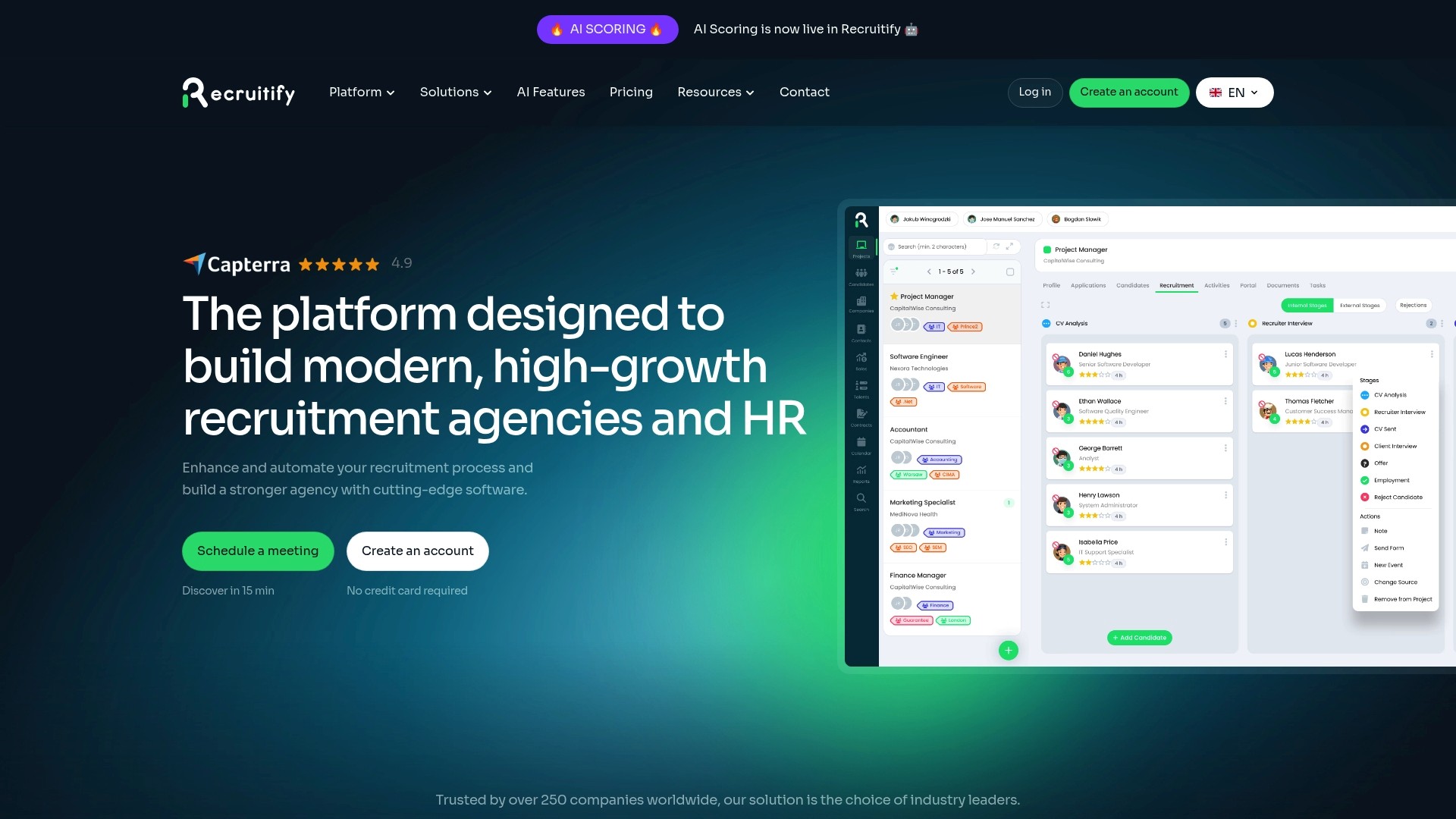
If your agency places IT specialists on contract, the contracting and body leasing module keeps talent pools and B2B contract generation in the same system as matching, so a shortlist can become a signed placement without leaving the tab.
Our perspective
We think the future of matching is not a smarter search box but a shared view of the whole process. A score is useful only when the data behind it is clean, when the recruiter can see and change it, and when the result flows straight into the pipeline that earns revenue.
That is why Recruitify combines parsing, contextual matching, sourcing, CRM and contracting in one system. Our aim is to reduce administrative work by up to 70% and let agencies close more placements without growing the team.
Recruiters have always looked for signals, not just names. Contextual matching gives those signals a structure, and leaves the judgment where it belongs: with you. We explore this idea further in our article on signals and real matching.
Recruitify Team
FAQ
What is the difference between keyword, semantic and contextual matching?
Keyword matching looks for the exact words you typed. Semantic matching understands that different words can mean the same thing. Contextual matching goes a step further by weighing the whole profile against the whole job, including the tech stack, seniority and experience, to produce a ranked score.
Does contextual matching replace recruiters?
No. It handles the first pass of screening and ranking so recruiters can spend time on interviews, client relationships and negotiation. Research and government guidance both stress keeping a human involved who can review and overrule recommendations.
What data does a matching engine need?
It needs structured candidate data and a clear job description. Parsed fields such as skills, years of experience, education and location are compared with the requirements. Clean, deduplicated records give the most reliable scores.
Is it suitable for small agencies and freelancers?
Yes. The problem it solves, too many profiles and too little time, is not limited to large firms. A per-user subscription lets a small team or a single recruiter use the same matching, parsing and sourcing tools as a larger agency.
Sources
AI-driven semantic similarity-based job matching framework (Brunel University)
Smart-Hiring: An Explainable end-to-end Pipeline for CV Information Extraction
OECD: Implementing AI-enabled matching tools requires more than technology alone
Ethics and discrimination in artificial intelligence-enabled recruitment practices
Recommended
Recruiters: Save Up to 70% Admin Time with Resume Database Search
Resume Ranking Algorithms: How They Score and Rank Candidates


News & Updates
Stay up-to-date with the latest innovations, features, and tips about Recruitify!
By providing your email address within the newsletter sign-up form, you confirm its processing to send marketing information regarding the Administrator’s products and services. The Administrator of your personal data processed for the abovementioned purposes is Recruitify Spółka z o.o., based in Warsaw, Poland (KRS 0000709889). For more information on the principles of personal data processing and the rights of data subjects, please check the Privacy Policy.

Last updated:
Contextual Matching in Recruitment: How It Works and Why It Beats Keywords
Recruitment Process
Applicant Tracking System
The Recruitify Team
Contextual matching is a way of comparing candidates with a job by meaning rather than by exact words: the system understands that Linux and Ubuntu are related, that “Sales Agent” and “Sales Representative” describe the same role, and that a keyword in the wrong context is not a match. For agencies and HR teams drowning in CVs, it turns a pile of profiles into a ranked shortlist. Recruitify is built around this idea: our Contextual Matching AI and scoring engine evaluates applications against project requirements and delivers shortlists with a percentage match score, inside an ATS and CRM that live in one tab.
Key Takeaways
Keyword search misses qualified people who phrase their experience differently and surfaces people who mention a term without having done the work. Contextual matching addresses both failures.
A good system compares parsed CV data with job requirements, recognizes related skills and combines weighted criteria into one score.
Treat the score as a ranking a recruiter can inspect and overrule, not as an automatic rejection.
Measure it on your own data: pilot it, track fill rates and retention, and watch for drift and bias over time.
It works best when it sits on clean, structured data, which is why parsing, deduplication and matching belong in one platform.
Table of Contents
What contextual matching means in recruitment
Traditional sourcing is lexical: the search engine looks for the characters you typed. Boolean strings improve precision, but they still depend on the candidate having used the same words as the recruiter.
Sergio Rio describes two failure modes of this approach. False negatives happen when a qualified candidate is missed because the wording differs, for example “Sales Agent” versus “Sales Representative”. False positives happen when the keyword matches but the context is wrong. Semantic and contextual approaches address both by mapping relationships between skills, titles and experience.
In IT recruitment the problem is sharper than elsewhere. Stacks overlap, tools are renamed, and a developer who lists “Kubernetes” and “Helm” may never write “container orchestration”. A matching engine that understands the relationships inside a tech stack finds that person without a hand-built search string.
How much better is it than keywords?
Academic work gives a sense of the gap. In a 2026 Brunel University framework, a similarity model outperformed keyword matching: simulated Software Engineer scores reached 0.74 against 0.35, and real-world scores were 0.83 for Hadoop, 0.76 for Data Science and 0.74 for PMP, while keyword scores stayed below 0.17. These are research results on specific datasets, not a promise for any one agency, but the direction is clear.
How a matching system evaluates a candidate
Under the hood, most systems follow the same sequence. The Smart-Hiring paper (2025) describes it well:
Parse the CV. Structured attributes such as location, years of experience and education are extracted from the document.
Compare with requirements. Those attributes are checked against what the job asks for.
Encode skills by meaning. A sentence-embedding model lets related skills, such as Linux and Ubuntu, be recognized as compatible.
Score. Pairwise similarities and weighted criteria are combined into a single compatibility score.
The first step decides the quality of everything after it. If a scan is read badly or the same person exists three times in your database, the score is built on noise. That is why we pair matching with the Recruitify CV parser, which extracts data from PDFs, DOCX files, scans and photos in about 3 seconds, builds a structured profile and detects duplicates automatically.
What the score looks like in practice
Imagine a client needs a senior Java developer with Spring, Kafka and experience in payments. A keyword search for “Kafka” returns every profile that mentions it, including a project manager who attended a workshop. A contextual engine weighs the stack as a whole, sees that the strongest candidate has event-streaming and payment-processing experience under different job titles, and ranks that person first with a percentage match. The recruiter then reads the top ten profiles instead of scrolling through four hundred.
Where it pays off for agencies and HR teams
High-volume applications
Volume is the clearest case. Hays, a global recruiter, processes around 15,000 CVs a day and built an AI matching engine so consultants could surface suitable candidates and jobs from its knowledge base. Consultants evaluate results, flag drift and tune weights, so the model keeps improving. You do not need Hays-scale volume to feel the same pressure: an in-house HR department with a few hundred applications per opening faces the same triage problem.
Your existing database
Most agencies hold thousands of candidates who were never placed with the right client at the right moment. Keyword search rarely resurfaces them. Contextual matching can read old profiles against a new brief and return people you already paid to source. This is the database monetization we build toward in Recruitify: intelligent indexing that helps recover lost candidates and generate revenue from assets you already own.
Sourcing and presenting
Matching is one link in a chain. Our X-RAY search and Boolean engine generates advanced Boolean strings in one click and scans both the open web and your internal database. Once you have the right person, Blind CV AI produces an anonymized, professional profile ready to show the end client. Together with the ATS and agency CRM, the sales pipeline and the recruitment pipeline sit together instead of in separate spreadsheets.
How to measure whether it works
Vendors promise speed and quality, but the OECD notes in its 2023 report that AI matching tools claim efficiency gains and better-quality matching, while independent estimates of effectiveness are scarce. The practical answer is to measure on your own pipeline.
The OECD’s 2026 guidance on matching tools in Belgium and Greece suggests outcome indicators such as vacancy fill rates, retention, job quality and employer satisfaction, plus a pilot phase before scaling and monitoring of whether users act on recommendations. Translated to a recruitment team:
Metric | What it tells you |
|---|---|
Time to first shortlist | Whether matching removes manual screening |
Shortlist-to-interview rate | Whether top-ranked candidates are genuinely relevant |
Interview-to-placement rate | Whether the score predicts real fit |
Fill rate and retention | Whether quality holds after the hire |
Share of recruiter overrides | Whether the weighting needs tuning |
Run the same role through your old process and the new one for a few weeks, then compare. Repeat the review periodically, because performance can change as your roles and data change.
Using it responsibly: bias, transparency and human oversight
A matching score is only as fair as the data and design behind it. The FINDHR technical report notes that recruitment algorithms can reflect bias in existing data, and that features such as years of experience can act as a proxy for age. A 2023 literature review recommends unbiased datasets, greater transparency, internal ethical governance and external oversight.
The safeguards that follow from this are practical:
Use the score to rank, not to reject. A ranking can be inspected and overruled by the recruiter.
Tell candidates how their data is used and obtain consent. The OECD recommends informing jobseekers, keeping a human involved and allowing decisions to be contested.
Let candidates correct auto-extracted data, and avoid sensitive attributes and proxies, as FINDHR advises.
Pilot and monitor. The UK government’s Responsible AI in Recruitment guide recommends piloting with diverse users, testing in your real environment and monitoring for drift through regular bias audits.
On the compliance side, Recruitify includes a GDPR consent management module with a total audit trail, and our GDPR and anonymization page explains how this works for agency data. If you hire in the EU, our guide to the EU AI Act and recruitment covers what hiring teams must do, and our article on AI bias in recruiting explains how to plan an audit.
Keeping the recruiter in the loop
The Hays case is summed up as human in the loop: consultants review results and tune the model. The same logic holds for any team. The engine handles the first pass, which is the slow, repetitive part, and the recruiter spends the saved hours on what a model does not know: the client’s culture, the candidate’s motivation, the negotiation. The OECD adds that staff should be trained so they understand the tool, and that teams should watch whether users ignore recommendations, a sign the targeting or the rationale is unclear.
Implementation checklist
Clean the data first. Parse and deduplicate your existing candidates before you rely on any score.
Define the criteria per role. Decide which skills, seniority and domain experience carry the most weight.
Pilot on two or three live roles. Compare against your current process.
Review the top and bottom of the ranking. Check that strong candidates are not buried.
Record overrides and outcomes. Use them to adjust weighting.
Audit regularly. Test for adverse impact and drift on a fixed schedule.
Recruitify plans for matching
Contextual Matching AI and scoring is part of the Recruitify platform, together with the ATS, CRM and the contracting and body leasing module. The HR Team plan costs 61 EUR per month per user and the Agency plan costs 67 EUR per month per user; Enterprise is available without a published price. You can compare them on the pricing page, or see the AI features behind the matching engine.
If your agency places IT specialists on contract, the contracting and body leasing module keeps talent pools and B2B contract generation in the same system as matching, so a shortlist can become a signed placement without leaving the tab.
Our perspective
We think the future of matching is not a smarter search box but a shared view of the whole process. A score is useful only when the data behind it is clean, when the recruiter can see and change it, and when the result flows straight into the pipeline that earns revenue.
That is why Recruitify combines parsing, contextual matching, sourcing, CRM and contracting in one system. Our aim is to reduce administrative work by up to 70% and let agencies close more placements without growing the team.
Recruiters have always looked for signals, not just names. Contextual matching gives those signals a structure, and leaves the judgment where it belongs: with you. We explore this idea further in our article on signals and real matching.
Recruitify Team
FAQ
What is the difference between keyword, semantic and contextual matching?
Keyword matching looks for the exact words you typed. Semantic matching understands that different words can mean the same thing. Contextual matching goes a step further by weighing the whole profile against the whole job, including the tech stack, seniority and experience, to produce a ranked score.
Does contextual matching replace recruiters?
No. It handles the first pass of screening and ranking so recruiters can spend time on interviews, client relationships and negotiation. Research and government guidance both stress keeping a human involved who can review and overrule recommendations.
What data does a matching engine need?
It needs structured candidate data and a clear job description. Parsed fields such as skills, years of experience, education and location are compared with the requirements. Clean, deduplicated records give the most reliable scores.
Is it suitable for small agencies and freelancers?
Yes. The problem it solves, too many profiles and too little time, is not limited to large firms. A per-user subscription lets a small team or a single recruiter use the same matching, parsing and sourcing tools as a larger agency.
Sources
AI-driven semantic similarity-based job matching framework (Brunel University)
Smart-Hiring: An Explainable end-to-end Pipeline for CV Information Extraction
OECD: Implementing AI-enabled matching tools requires more than technology alone
Ethics and discrimination in artificial intelligence-enabled recruitment practices
Recommended
Recruiters: Save Up to 70% Admin Time with Resume Database Search
Resume Ranking Algorithms: How They Score and Rank Candidates
News & Updates
Stay up-to-date with the latest innovations, features, and tips about Recruitify!
By providing your email address within the newsletter sign-up form, you confirm its processing to send marketing information regarding the Administrator’s products and services. The Administrator of your personal data processed for the abovementioned purposes is Recruitify Spółka z o.o., based in Warsaw, Poland (KRS 0000709889). For more information on the principles of personal data processing and the rights of data subjects, please check the Privacy Policy.

Discover More

Recruitment Process
Application Routing Rules for Recruiting Teams
How to set application routing rules in recruiting: send each CV to the right recruiter, pipeline or client by skills, source, score and consent, without manual sorting.
24 Nov 2026
Discover More

Recruitment Process
SOW vs MSA in Staffing: How the Two Documents Work Together
SOW vs MSA in staffing: what each document covers, which one wins in a conflict, and how to structure placements so terms are set once and reused.
22 Nov 2026
Discover More

Applicant Tracking System
Data Subject Requests in Recruitment: A Handling Guide
How recruitment agencies and HR teams should receive, verify and answer data subject requests from candidates: deadlines in the UK, EU and US states, plus a workflow.
21 Nov 2026
Discover More
Recruitment Process
Application Routing Rules for Recruiting Teams
How to set application routing rules in recruiting: send each CV to the right recruiter, pipeline or client by skills, source, score and consent, without manual sorting.
24 Nov 2026
Discover More
Recruitment Process
SOW vs MSA in Staffing: How the Two Documents Work Together
SOW vs MSA in staffing: what each document covers, which one wins in a conflict, and how to structure placements so terms are set once and reused.
22 Nov 2026
Discover More