Last updated:
Data Retention in Recruitment: How Long to Keep Candidate Data

Recruitment Process

The Recruitify Team
Data retention in recruitment means deciding, in writing, how long you keep each type of candidate record, why, and what happens when the period ends. In the US, the baseline for most private employers is one year from the date a hiring record was made, and federal contractors generally keep records for two years. If you recruit in Europe or the UK, you also need a defined purpose and period for every record, and talent-pool data needs renewable consent. The practical answer is one schedule, applied by system rather than by memory. That is why we built consent tracking and an audit trail into the same platform where candidates live.
Key Takeaways
US federal rules set a floor: one year for most covered employers under EEOC regulations, two years for federal contractors. Many organizations choose two to three years to be safe.
Under GDPR-style rules, “just in case” storage is not a valid basis. Every category needs a purpose, a period and a deletion or anonymization step.
Unsuccessful candidates, hired candidates, and talent-pool contacts need three different retention rules, not one.
A schedule only works if it is enforced in the system where the data sits, with consent dates and an audit trail you can show.
Data quality and retention are the same project: duplicates, stale profiles and scattered spreadsheets are where retention rules fail.
Table of Contents
What data retention means in recruitment
A recruitment retention policy answers three questions for every record you hold: what is it, how long do we keep it, and what happens after that. The records include CVs, application forms, cover letters, interview notes, assessment scores, references, offers and the correspondence around them.
The European Data Protection Supervisor states that organizations must not keep personal information indefinitely. It also says files of unsuccessful candidates should not be kept as long as files of successful ones, and that information collected only as a condition of recruitment should not be kept once recruitment has taken place. That last point is easy to miss: a copy of an ID checked at the offer stage has a shorter justified life than the application itself.
The reason to have a policy is practical as much as legal. Without one, databases fill with outdated profiles, recruiters cannot tell which consent is still valid, and a single deletion request turns into a manual hunt through inboxes, spreadsheets and exports.
The US baseline: federal minimums
US law does not have one general data retention statute for candidates. It has recordkeeping rules that set minimum periods, and privacy laws that limit how long you may keep data without a reason.
EEOC rules. Under the EEOC’s recordkeeping regulation, covered employers must keep personnel and employment records, including application forms and records dealing with hiring, for one year from the date the record was made or the personnel action was taken.
Federal contractors. The Department of Labor explains that OFCCP regulations require contractors to keep job postings and application-related records for two years from the making of the record or the personnel action. The regulation text at 41 CFR 60-1.12 is where the exact scope and the rules for smaller contractors are set out.
Why many teams choose longer periods. The one-year and two-year figures are minimums for preservation, not recommendations for how long to hold everything. Organizations with more exposure often choose longer. The University of Washington, for example, requires recruitment and selection records for hired and non-selected candidates to be kept at least three years after recruitment concludes, and lists job descriptions, advertisements, applications, resumes, screening questions, interview notes, tests, references and selection correspondence among them.
State law, sector rules and any pending claim can extend these periods, so confirm the final schedule with your employment counsel. What you can settle yourself is the structure.
How retention periods differ by jurisdiction
If you place candidates across borders, as many IT agencies do, you will meet shorter and more purpose-bound periods than the US floor. The examples below are drawn from official guidance and published schedules, and each applies to its own country or organization only.
Source | Record type | Stated period |
|---|---|---|
Unsuccessful application forms | 12 months after campaign closure, automatic deletion | |
Unsuccessful applications; successful applicants | Generally 12 months; employment plus seven years | |
Rejected materials; successful applications | 12 months after the decision; employment plus six years | |
Rejected applicant data | No longer than two years from rejection, unless the applicant consents or a subsisting reason applies | |
ICO case study (UK) | Unsuccessful candidates; all ATS data | Anonymized six months after the outcome; deleted after two years |
Two patterns stand out. First, twelve months is the common period for unsuccessful applicants in the published UK schedules, which sits close to the US federal one-year floor. Second, successful candidates move into the personnel file and follow employment-record rules, which run for years after employment ends.
If your team operates in several countries, the safest design is not a single global number. It is one schedule with a country column, so each record carries the period that applies to the candidate’s location.
What a retention schedule should include
A useful schedule lists categories, not just “candidate data.” Start from the records you actually create, then group them by how long you can justify keeping them.
Identifiers and contact details. Name, email, phone, address and profile links.
Application materials. CVs, cover letters, application forms and supporting statements.
Evaluation records. Screening answers, interview notes, test and assessment scores.
Process data. The role, application source, stage movements, offers, acceptance and, later, tenure. The ICO’s recruitment analytics case study lists direct identifiers, demographic information, scores and process metrics among the data to be handled.
Verification records. References, right-to-work documents, qualification checks, background checks and medical clearances. Published schedules, such as Blackpool Council’s, treat these as separate categories rather than part of the application.
Accommodation requests. Keep these apart from general notes, since they may contain health information.
Consent records. When consent was given, for what purpose, for how long, and whether it was renewed or withdrawn.
For each category, add four columns: the trigger that starts the clock (campaign closure, rejection date, hire date), the period, the legal or business reason, and the end action (delete, anonymize or move to the personnel file).
Three groups, three rules
Unsuccessful candidates. Keep for the regulatory minimum plus a modest margin for disputes, then delete or anonymize.
Hired candidates. Transfer what belongs in the personnel file and apply employment-record periods to it. Remove what does not belong there, such as unused application extras.
Talent pool contacts. Keep only with a stated purpose and a defined period, as covered below.
Talent pools: keeping candidates for future roles
Future-role retention is where agencies earn value and carry the most risk. It is also where the clearest regulator guidance exists.
The Hamburg data protection authority says talent-pool consent should state the purpose, data categories, storage duration, withdrawal option and the information notices that apply. Consent with no defined period can lead to effectively indefinite storage, and it is not valid indefinitely. If a candidate does not respond when consent is renewed, the same authority says the data must be deleted immediately and irretrievably. It adds that appropriate periods may range from months to years depending on how long roles take to fill, limitation periods for claims, and GDPR exceptions.
The Hong Kong code points the same way: unsuccessful applicants should be told about retention for future recruitment and given a chance to ask for destruction, and the practice needs a general policy and a stated period.
A workable talent-pool routine has five parts:
Ask for consent at the point of application, with the purpose and period stated plainly.
Record the date and the wording the candidate saw.
Set a renewal reminder before the period ends.
Delete or anonymize the record if there is no reply.
Honor a withdrawal at any time, and apply it to every copy.
The weak point is step 2 and step 3 when they live in a spreadsheet. A consent date that nobody can find is, in practice, no consent.
Secure deletion and anonymization

When the period ends, the record has to actually leave. Official guidance is consistent on this. The UK government says employers should dispose of recruitment information securely once the clear business need ends, and should not reuse it for unrelated marketing without an appropriate basis. The Australian Information Commissioner says entities must take reasonable steps to destroy or de-identify personal information that is no longer needed, unless an exception applies.
There are three end actions to choose from:
Hard deletion. The record is removed from every system, including exports and backups on their own cycle.
Anonymization. Identifiers are removed so the record can no longer be tied to a person. Useful for keeping hiring statistics.
Pseudonymization as an interim step. The ICO case study shows identifying information separated so analysts cannot attribute records to candidates without additional data held elsewhere, followed by anonymization or deletion at defined milestones.
A staged model is also in use at large employers. ENI’s recruitment notice describes putting expired data beyond operational use, limiting restoration to exceptional, authorized staff, and then performing a hard delete once legal periods expire. The lesson for a smaller team is the order of operations: restrict first, delete second, and record both steps.
Data quality and governance: why retention fails in practice
Retention rules are applied to records, so they are only as good as the records. Duplicate profiles mean a candidate deleted in one place survives in another. Missing dates mean the clock cannot start. Unlabeled sources mean you cannot tell which consent applies.
ISO 30435:2023 frames workforce data quality around accuracy, timeliness, completeness, consistency and relevance, and describes the work as determining, capturing, maintaining and reviewing data. Applied to recruiting, that gives you a short governance routine:
Determine which fields you truly need for each stage, and stop collecting the rest.
Capture them once, at the source, with a date and a source label.
Maintain them in one system of record rather than in parallel files.
Review on a schedule, with a named person responsible.
HR data-governance practitioners add that a versioned data dictionary and defined validation samples make reviews repeatable, and that a single source-of-truth system keeps the repository current. That advice maps directly onto recruitment: agree what “consent date” and “campaign closed” mean, and make every user enter them the same way.
How to audit and automate retention across your systems
An audit does not need to be large. Run it once, then repeat it twice a year.
Map where candidate data lives. ATS, CRM, email, shared drives, spreadsheets, job boards, messaging apps, and local downloads.
Count the records by age. How many candidates have had no activity for 12, 24 and 36 months?
Match each record to a category and a clock. Records without a start date are the first problem to solve.
Check consent. For every talent-pool contact, can you show when and for what purpose consent was given?
Remove duplicates. One person, one profile, so a deletion request has a single target.
Run the end actions and log them. Keep evidence of what was deleted or anonymized, and when.
Automation matters most at steps 3 to 6, because they repeat and because people forget them. The stronger the link between the schedule and the system holding the candidates, the less your compliance depends on individual recruiters.
Where Recruitify fits
Most of the failures above come from data scattered across tools. Recruitify combines an ATS, a sales CRM and a contracting module in one platform, so candidate records sit in one place instead of across spreadsheets. Our AI CV parser builds a structured profile from PDFs, DOCX files, scans and photos in about three seconds and automatically detects duplicates, which gives a retention schedule one profile per person to act on. The platform includes a GDPR consent management module designed to provide a full audit trail, and Blind CV AI generates anonymized candidate profiles for presenting to end clients. You can read how this works on our GDPR and anonymization page, and in our article on GDPR-compliant analytics for recruitment teams.
Our HR Team plan costs €61 per month per user and the Agency plan €67 per month per user. Enterprise pricing is available on request through the pricing page. Agencies that want to turn lawful, consented talent pools into placements can see how the candidate management module organizes them.
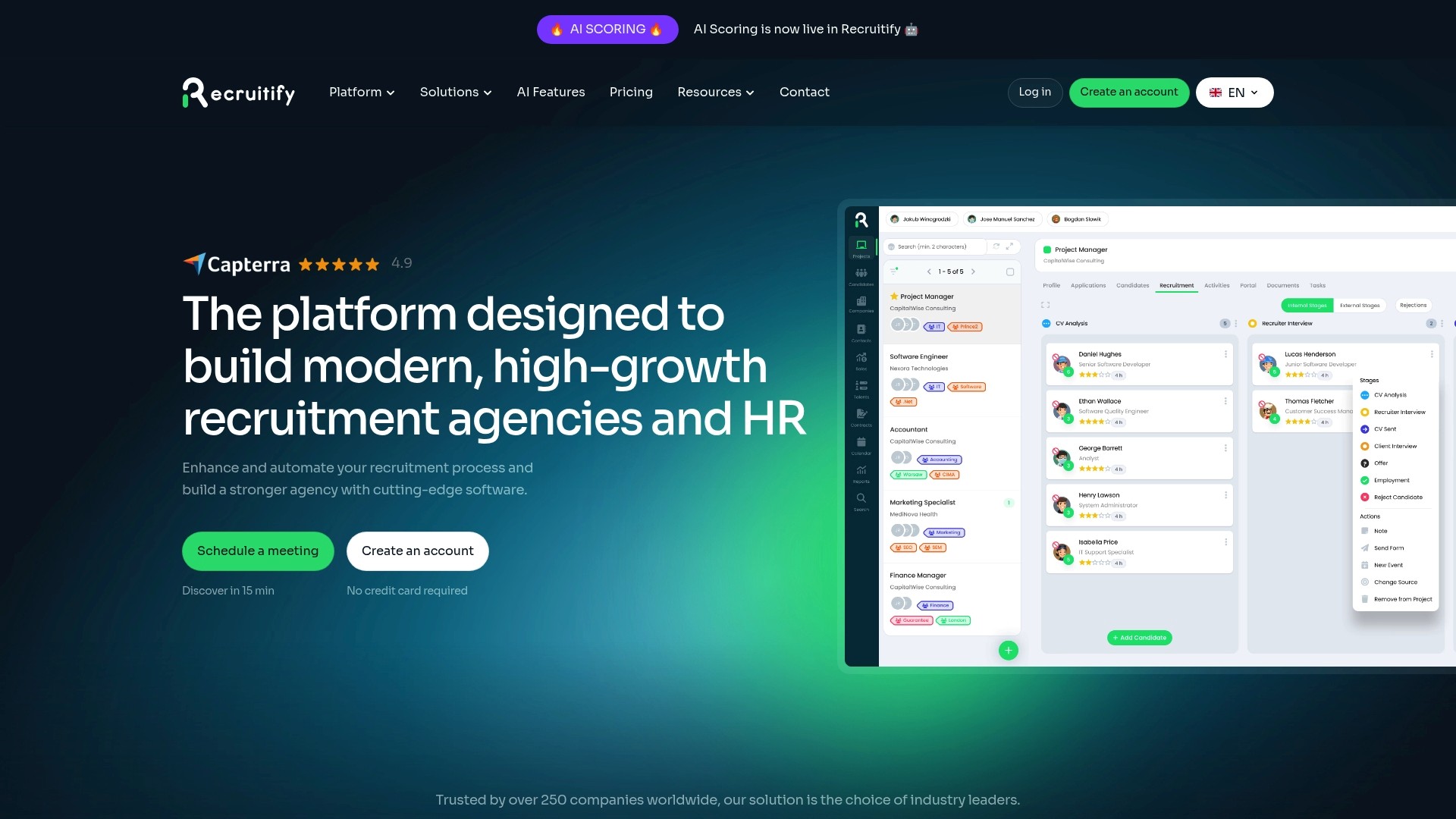
If you are choosing where to run the schedule, start with the question of whether one system can hold the candidate, the consent and the history. Our write-up on why an ATS should remember what recruiters forget covers the same point from the recruiter’s side.
Our perspective
Retention is usually discussed as a deletion problem. We see it as a memory problem. A recruiter who cannot find the consent date, the source of a CV or the second copy of a profile cannot apply any schedule, however well it is written.
That is why we built Recruitify as one ecosystem rather than a set of connected tools. When the ATS, the CRM and the contracting module share one candidate record, with consent management and a total audit trail alongside it, a retention rule has one place to act and one place to prove it was followed.
We also believe retention and revenue are not opposites. A talent pool that is consented, current and well indexed is an asset an agency can recover value from, which reduces reliance on expensive external platform licenses. A pool that is unmanaged is a liability. The difference is the discipline described in this article.
Recruitify Team
FAQ
How long should you keep rejected candidates’ resumes in the US?
Federal rules set a floor of one year from the date of the record or the hiring action for employers covered by EEOC regulations, and two years for federal contractors. Many employers keep records somewhat longer, and state law or a pending claim can extend the period. Confirm your final period with employment counsel.
Do GDPR rules apply to a US company recruiting in Europe?
GDPR rules can apply when you process the data of candidates located in the EU, so the safest approach is to apply a purpose, a defined period and a deletion step to those records. Regulators such as the EDPS state that personal information must not be kept indefinitely. Ask a privacy lawyer how the rules apply to your specific operations.
Can you keep candidates in a talent pool without asking them?
Under GDPR-style rules, talent-pool storage generally needs consent that states the purpose, data categories, storage period and how to withdraw. The Hamburg authority says consent without a defined period is not valid indefinitely, and that non-response to a renewal request means deletion.
What is the difference between deletion and anonymization?
Deletion removes the record. Anonymization strips identifiers so the data can no longer be linked to a person, which lets you keep aggregate hiring statistics. Pseudonymization is an interim step where identifiers are held separately, and the data remains personal until anonymized or deleted.
What should a recruitment data retention policy contain?
It should list the record categories, the trigger that starts each clock, the retention period, the reason, and the end action. It should also cover consent records, deletion requests and who is responsible for the periodic review.
Sources
Selection and recruitment of staff, European Data Protection Supervisor
Summary of Selected Recordkeeping Obligations in 29 CFR Part 1602, EEOC
Documenting the recruiting and hiring process, University of Washington
Case study: pseudonymising employee data for recruitment analytics, ICO
Applicant data protection and recruiting, Hamburg Commissioner for Data Protection
Data protection and your business: recruitment and managing staff records, GOV.UK
Guide to securing personal information, Australian Information Commissioner
Recommended


News & Updates
Stay up-to-date with the latest innovations, features, and tips about Recruitify!
By providing your email address within the newsletter sign-up form, you confirm its processing to send marketing information regarding the Administrator’s products and services. The Administrator of your personal data processed for the abovementioned purposes is Recruitify Spółka z o.o., based in Warsaw, Poland (KRS 0000709889). For more information on the principles of personal data processing and the rights of data subjects, please check the Privacy Policy.

Last updated:
Data Retention in Recruitment: How Long to Keep Candidate Data
Recruitment Process
The Recruitify Team
Data retention in recruitment means deciding, in writing, how long you keep each type of candidate record, why, and what happens when the period ends. In the US, the baseline for most private employers is one year from the date a hiring record was made, and federal contractors generally keep records for two years. If you recruit in Europe or the UK, you also need a defined purpose and period for every record, and talent-pool data needs renewable consent. The practical answer is one schedule, applied by system rather than by memory. That is why we built consent tracking and an audit trail into the same platform where candidates live.
Key Takeaways
US federal rules set a floor: one year for most covered employers under EEOC regulations, two years for federal contractors. Many organizations choose two to three years to be safe.
Under GDPR-style rules, “just in case” storage is not a valid basis. Every category needs a purpose, a period and a deletion or anonymization step.
Unsuccessful candidates, hired candidates, and talent-pool contacts need three different retention rules, not one.
A schedule only works if it is enforced in the system where the data sits, with consent dates and an audit trail you can show.
Data quality and retention are the same project: duplicates, stale profiles and scattered spreadsheets are where retention rules fail.
Table of Contents
What data retention means in recruitment
A recruitment retention policy answers three questions for every record you hold: what is it, how long do we keep it, and what happens after that. The records include CVs, application forms, cover letters, interview notes, assessment scores, references, offers and the correspondence around them.
The European Data Protection Supervisor states that organizations must not keep personal information indefinitely. It also says files of unsuccessful candidates should not be kept as long as files of successful ones, and that information collected only as a condition of recruitment should not be kept once recruitment has taken place. That last point is easy to miss: a copy of an ID checked at the offer stage has a shorter justified life than the application itself.
The reason to have a policy is practical as much as legal. Without one, databases fill with outdated profiles, recruiters cannot tell which consent is still valid, and a single deletion request turns into a manual hunt through inboxes, spreadsheets and exports.
The US baseline: federal minimums
US law does not have one general data retention statute for candidates. It has recordkeeping rules that set minimum periods, and privacy laws that limit how long you may keep data without a reason.
EEOC rules. Under the EEOC’s recordkeeping regulation, covered employers must keep personnel and employment records, including application forms and records dealing with hiring, for one year from the date the record was made or the personnel action was taken.
Federal contractors. The Department of Labor explains that OFCCP regulations require contractors to keep job postings and application-related records for two years from the making of the record or the personnel action. The regulation text at 41 CFR 60-1.12 is where the exact scope and the rules for smaller contractors are set out.
Why many teams choose longer periods. The one-year and two-year figures are minimums for preservation, not recommendations for how long to hold everything. Organizations with more exposure often choose longer. The University of Washington, for example, requires recruitment and selection records for hired and non-selected candidates to be kept at least three years after recruitment concludes, and lists job descriptions, advertisements, applications, resumes, screening questions, interview notes, tests, references and selection correspondence among them.
State law, sector rules and any pending claim can extend these periods, so confirm the final schedule with your employment counsel. What you can settle yourself is the structure.
How retention periods differ by jurisdiction
If you place candidates across borders, as many IT agencies do, you will meet shorter and more purpose-bound periods than the US floor. The examples below are drawn from official guidance and published schedules, and each applies to its own country or organization only.
Source | Record type | Stated period |
|---|---|---|
Unsuccessful application forms | 12 months after campaign closure, automatic deletion | |
Unsuccessful applications; successful applicants | Generally 12 months; employment plus seven years | |
Rejected materials; successful applications | 12 months after the decision; employment plus six years | |
Rejected applicant data | No longer than two years from rejection, unless the applicant consents or a subsisting reason applies | |
ICO case study (UK) | Unsuccessful candidates; all ATS data | Anonymized six months after the outcome; deleted after two years |
Two patterns stand out. First, twelve months is the common period for unsuccessful applicants in the published UK schedules, which sits close to the US federal one-year floor. Second, successful candidates move into the personnel file and follow employment-record rules, which run for years after employment ends.
If your team operates in several countries, the safest design is not a single global number. It is one schedule with a country column, so each record carries the period that applies to the candidate’s location.
What a retention schedule should include
A useful schedule lists categories, not just “candidate data.” Start from the records you actually create, then group them by how long you can justify keeping them.
Identifiers and contact details. Name, email, phone, address and profile links.
Application materials. CVs, cover letters, application forms and supporting statements.
Evaluation records. Screening answers, interview notes, test and assessment scores.
Process data. The role, application source, stage movements, offers, acceptance and, later, tenure. The ICO’s recruitment analytics case study lists direct identifiers, demographic information, scores and process metrics among the data to be handled.
Verification records. References, right-to-work documents, qualification checks, background checks and medical clearances. Published schedules, such as Blackpool Council’s, treat these as separate categories rather than part of the application.
Accommodation requests. Keep these apart from general notes, since they may contain health information.
Consent records. When consent was given, for what purpose, for how long, and whether it was renewed or withdrawn.
For each category, add four columns: the trigger that starts the clock (campaign closure, rejection date, hire date), the period, the legal or business reason, and the end action (delete, anonymize or move to the personnel file).
Three groups, three rules
Unsuccessful candidates. Keep for the regulatory minimum plus a modest margin for disputes, then delete or anonymize.
Hired candidates. Transfer what belongs in the personnel file and apply employment-record periods to it. Remove what does not belong there, such as unused application extras.
Talent pool contacts. Keep only with a stated purpose and a defined period, as covered below.
Talent pools: keeping candidates for future roles
Future-role retention is where agencies earn value and carry the most risk. It is also where the clearest regulator guidance exists.
The Hamburg data protection authority says talent-pool consent should state the purpose, data categories, storage duration, withdrawal option and the information notices that apply. Consent with no defined period can lead to effectively indefinite storage, and it is not valid indefinitely. If a candidate does not respond when consent is renewed, the same authority says the data must be deleted immediately and irretrievably. It adds that appropriate periods may range from months to years depending on how long roles take to fill, limitation periods for claims, and GDPR exceptions.
The Hong Kong code points the same way: unsuccessful applicants should be told about retention for future recruitment and given a chance to ask for destruction, and the practice needs a general policy and a stated period.
A workable talent-pool routine has five parts:
Ask for consent at the point of application, with the purpose and period stated plainly.
Record the date and the wording the candidate saw.
Set a renewal reminder before the period ends.
Delete or anonymize the record if there is no reply.
Honor a withdrawal at any time, and apply it to every copy.
The weak point is step 2 and step 3 when they live in a spreadsheet. A consent date that nobody can find is, in practice, no consent.
Secure deletion and anonymization
When the period ends, the record has to actually leave. Official guidance is consistent on this. The UK government says employers should dispose of recruitment information securely once the clear business need ends, and should not reuse it for unrelated marketing without an appropriate basis. The Australian Information Commissioner says entities must take reasonable steps to destroy or de-identify personal information that is no longer needed, unless an exception applies.
There are three end actions to choose from:
Hard deletion. The record is removed from every system, including exports and backups on their own cycle.
Anonymization. Identifiers are removed so the record can no longer be tied to a person. Useful for keeping hiring statistics.
Pseudonymization as an interim step. The ICO case study shows identifying information separated so analysts cannot attribute records to candidates without additional data held elsewhere, followed by anonymization or deletion at defined milestones.
A staged model is also in use at large employers. ENI’s recruitment notice describes putting expired data beyond operational use, limiting restoration to exceptional, authorized staff, and then performing a hard delete once legal periods expire. The lesson for a smaller team is the order of operations: restrict first, delete second, and record both steps.
Data quality and governance: why retention fails in practice
Retention rules are applied to records, so they are only as good as the records. Duplicate profiles mean a candidate deleted in one place survives in another. Missing dates mean the clock cannot start. Unlabeled sources mean you cannot tell which consent applies.
ISO 30435:2023 frames workforce data quality around accuracy, timeliness, completeness, consistency and relevance, and describes the work as determining, capturing, maintaining and reviewing data. Applied to recruiting, that gives you a short governance routine:
Determine which fields you truly need for each stage, and stop collecting the rest.
Capture them once, at the source, with a date and a source label.
Maintain them in one system of record rather than in parallel files.
Review on a schedule, with a named person responsible.
HR data-governance practitioners add that a versioned data dictionary and defined validation samples make reviews repeatable, and that a single source-of-truth system keeps the repository current. That advice maps directly onto recruitment: agree what “consent date” and “campaign closed” mean, and make every user enter them the same way.
How to audit and automate retention across your systems
An audit does not need to be large. Run it once, then repeat it twice a year.
Map where candidate data lives. ATS, CRM, email, shared drives, spreadsheets, job boards, messaging apps, and local downloads.
Count the records by age. How many candidates have had no activity for 12, 24 and 36 months?
Match each record to a category and a clock. Records without a start date are the first problem to solve.
Check consent. For every talent-pool contact, can you show when and for what purpose consent was given?
Remove duplicates. One person, one profile, so a deletion request has a single target.
Run the end actions and log them. Keep evidence of what was deleted or anonymized, and when.
Automation matters most at steps 3 to 6, because they repeat and because people forget them. The stronger the link between the schedule and the system holding the candidates, the less your compliance depends on individual recruiters.
Where Recruitify fits
Most of the failures above come from data scattered across tools. Recruitify combines an ATS, a sales CRM and a contracting module in one platform, so candidate records sit in one place instead of across spreadsheets. Our AI CV parser builds a structured profile from PDFs, DOCX files, scans and photos in about three seconds and automatically detects duplicates, which gives a retention schedule one profile per person to act on. The platform includes a GDPR consent management module designed to provide a full audit trail, and Blind CV AI generates anonymized candidate profiles for presenting to end clients. You can read how this works on our GDPR and anonymization page, and in our article on GDPR-compliant analytics for recruitment teams.
Our HR Team plan costs €61 per month per user and the Agency plan €67 per month per user. Enterprise pricing is available on request through the pricing page. Agencies that want to turn lawful, consented talent pools into placements can see how the candidate management module organizes them.
If you are choosing where to run the schedule, start with the question of whether one system can hold the candidate, the consent and the history. Our write-up on why an ATS should remember what recruiters forget covers the same point from the recruiter’s side.
Our perspective
Retention is usually discussed as a deletion problem. We see it as a memory problem. A recruiter who cannot find the consent date, the source of a CV or the second copy of a profile cannot apply any schedule, however well it is written.
That is why we built Recruitify as one ecosystem rather than a set of connected tools. When the ATS, the CRM and the contracting module share one candidate record, with consent management and a total audit trail alongside it, a retention rule has one place to act and one place to prove it was followed.
We also believe retention and revenue are not opposites. A talent pool that is consented, current and well indexed is an asset an agency can recover value from, which reduces reliance on expensive external platform licenses. A pool that is unmanaged is a liability. The difference is the discipline described in this article.
Recruitify Team
FAQ
How long should you keep rejected candidates’ resumes in the US?
Federal rules set a floor of one year from the date of the record or the hiring action for employers covered by EEOC regulations, and two years for federal contractors. Many employers keep records somewhat longer, and state law or a pending claim can extend the period. Confirm your final period with employment counsel.
Do GDPR rules apply to a US company recruiting in Europe?
GDPR rules can apply when you process the data of candidates located in the EU, so the safest approach is to apply a purpose, a defined period and a deletion step to those records. Regulators such as the EDPS state that personal information must not be kept indefinitely. Ask a privacy lawyer how the rules apply to your specific operations.
Can you keep candidates in a talent pool without asking them?
Under GDPR-style rules, talent-pool storage generally needs consent that states the purpose, data categories, storage period and how to withdraw. The Hamburg authority says consent without a defined period is not valid indefinitely, and that non-response to a renewal request means deletion.
What is the difference between deletion and anonymization?
Deletion removes the record. Anonymization strips identifiers so the data can no longer be linked to a person, which lets you keep aggregate hiring statistics. Pseudonymization is an interim step where identifiers are held separately, and the data remains personal until anonymized or deleted.
What should a recruitment data retention policy contain?
It should list the record categories, the trigger that starts each clock, the retention period, the reason, and the end action. It should also cover consent records, deletion requests and who is responsible for the periodic review.
Sources
Selection and recruitment of staff, European Data Protection Supervisor
Summary of Selected Recordkeeping Obligations in 29 CFR Part 1602, EEOC
Documenting the recruiting and hiring process, University of Washington
Case study: pseudonymising employee data for recruitment analytics, ICO
Applicant data protection and recruiting, Hamburg Commissioner for Data Protection
Data protection and your business: recruitment and managing staff records, GOV.UK
Guide to securing personal information, Australian Information Commissioner
Recommended
News & Updates
Stay up-to-date with the latest innovations, features, and tips about Recruitify!
By providing your email address within the newsletter sign-up form, you confirm its processing to send marketing information regarding the Administrator’s products and services. The Administrator of your personal data processed for the abovementioned purposes is Recruitify Spółka z o.o., based in Warsaw, Poland (KRS 0000709889). For more information on the principles of personal data processing and the rights of data subjects, please check the Privacy Policy.

Discover More

Recruitment Process
Contract Extension Workflow for Staffing Agencies
A step-by-step contract extension workflow for staffing agencies: timeline, approvals, amendment terms, compliance checks and how to automate tracking.
15 Nov 2026
Discover More

Innovations
Sales and Recruiting Alignment: A Practical Guide for Agencies
How staffing agencies and HR teams align sales and recruiting: shared intake, clear handoffs, one pipeline and the metrics that show whether it works.
14 Nov 2026
Discover More

Innovations
Sourcing Channel Mix: How to Build One That Delivers Hires
Build a sourcing channel mix by role and market: how to pick three to five channels, judge job board fit, and measure which ones deliver hires.
12 Nov 2026
Discover More
Recruitment Process
Contract Extension Workflow for Staffing Agencies
A step-by-step contract extension workflow for staffing agencies: timeline, approvals, amendment terms, compliance checks and how to automate tracking.
15 Nov 2026
Discover More
Innovations
Sales and Recruiting Alignment: A Practical Guide for Agencies
How staffing agencies and HR teams align sales and recruiting: shared intake, clear handoffs, one pipeline and the metrics that show whether it works.
14 Nov 2026
Discover More