Last updated:
8 Applicant Tracking System Features HR Leaders Must Prioritize

Acquiring Talent

The Recruitify Team
Every serious applicant tracking system now runs on eight core capabilities: resume parsing, multiposting, pipeline automation, AI candidate scoring, interview scheduling, reporting, integrations, and compliance controls. Together, these applicant tracking system features cut administrative time, sharpen shortlist quality, and keep hiring decisions defensible under audit. The rest of this guide breaks down what each feature actually does, how to judge whether a vendor’s version is any good, and where to draw the line between must-have and nice-to-have.
TL;DR:
Most ATS platforms automate sourcing with multiposting and career site builders to boost application volume and employer branding, but niche roles benefit from targeted job board posting and direct sourcing instead.
Resume parsing extracts candidate data using OCR, but AI scoring requires transparency and bias checks to avoid unfair filtering, especially in regulated industries.
Pipeline automation with stage triggers and bulk actions can save recruiters dozens of hours weekly, but proper configuration and training are essential for maximum efficiency.
Collaboration tools like integrated scorecards, self-scheduling, and shared views speed hiring decisions and improve manager adoption, reducing time-to-hire.
Prioritizing ATS features involves assessing hiring volume, compliance risks, and integration needs, with transparency and auditability now more critical than feature count alone.
Recruitifyrecruitify.aiPrioritize More Than Basic ATS FeaturesRecruitify combines ATS, Sales CRM, and IT contracting tools with AI matching, CV parsing, sourcing, and GDPR audit trails.Explore Recruitify
Table of Contents
What Are the Core Applicant Tracking System Features?
How Does Job Distribution and Sourcing Work in an ATS?
What’s the Difference Between Resume Parsing and AI Scoring?
How Does Pipeline Automation Reduce Manual Recruiting Work?
What Collaboration Features Speed Up Hiring Decisions?
Which Features Reduce Candidate Drop-off During Applications?
What Reporting and DEI Metrics Should an ATS Track?
What Integrations and Security Controls Does an ATS Need?
How Should You Prioritize ATS Features Before Buying?
What’s a Realistic Implementation Timeline for an ATS?
How Recruitify Delivers These Feature Outcomes in Practice
What HR Leaders Should Prioritize Going Into 2026
See Recruitify’s Applicant Tracking System Features in Action
Sources
FAQ
What Are the Core Applicant Tracking System Features?
Before comparing vendors, it helps to see the full map. Industry roundups from sources like TechnologyAdvice and Workday converge on the same nine functional groups, even when the marketing names differ.
Sourcing: job multiposting, career site builders, and talent database search that widen the top of the funnel.
Screening: resume parsing, knockout questions, and AI-driven scoring that filter volume into a workable shortlist.
Workflow: custom pipeline stages, automated routing, and bulk actions that move candidates without manual nudging.
Collaboration: scheduling tools, scorecards, and shared notes that keep hiring teams aligned.
Reporting: dashboards covering time-to-fill, cost-per-hire, and diversity metrics.
Integrations: connections to HRIS, payroll, calendars, and background-check vendors.
Compliance: consent management, audit trails, and data retention controls.
Candidate experience: mobile application flows, status updates, and communication tools.
Offer and onboarding: digital offer letters and handoff data that feed the next HR system.
Sourcing and screening features mainly buy you speed. Compliance and reporting features buy you defensibility. Collaboration and candidate experience sit in the middle, protecting quality on both sides of the hire.
How Does Job Distribution and Sourcing Work in an ATS?
Multiposting pushes a single job requisition to dozens of boards and social channels at once, instead of a recruiter manually re-entering the listing on each site. Broad distribution earns its keep on high-volume, lower-specialization roles where reach matters more than precision. For niche technical searches, targeted posting to a handful of specialist boards, paired with direct sourcing, usually outperforms a scattershot blast.
A career site builder is the other half of sourcing, and it deserves more attention than most HR teams give it. A branded, mobile-optimized career page does two things at once: it reinforces employer brand and it reduces the friction that causes candidates to abandon an application halfway through. Industry comparisons tie longer, clunkier forms to higher abandonment rates, which makes career page usability a direct lever on applicant volume, not just a design preference.
Sourcing databases and candidate enrichment tools add a third layer. Rather than starting every search from zero, a searchable internal database with enrichment (updated contact details, work history, skills tagging) lets recruiters resurface candidates who applied months ago but were never the right fit at the time. That alone can shrink time-to-hire on repeat roles.
Metrics worth watching here include applications per posting, source-of-hire breakdown, and career page completion rate.
Pro Tip: Before adding a new job board integration, check your source-of-hire report from the last two quarters. If most hires already come from a few channels, adding another job board rarely justifies the added noise in your pipeline.
What’s the Difference Between Resume Parsing and AI Scoring?
Parsing and scoring solve different problems, and vendors that blur the line between them tend to oversell both. Parsing extracts data. Scoring interprets it. Confusing the two leads buyers to expect judgment from a tool that’s only doing data entry.
Modern parsers use optical character recognition (OCR) to read scanned PDFs, photographs of printed resumes, and DOCX files, then convert that raw text into a structured profile: name, contact details, employment history, education, and skills. A parser’s job ends there. It doesn’t judge fit; it just organizes information a recruiter would otherwise type by hand.
Knockout questions sit one layer up. These are yes/no or threshold-based questions (“Do you have an active nursing license?”) that auto-reject candidates who fail a hard requirement before a human ever opens the file. They’re blunt but effective for high-volume roles with non-negotiable qualifications.
AI scoring is where things get more interesting, and more contested. Rather than matching keywords, contextual scoring engines evaluate relationships within a candidate’s experience, for example recognizing that five years working with a specific cloud platform implies adjacent skills a keyword search would miss entirely. That’s a meaningful jump over simple string matching, but it comes with a responsibility: MIT Sloan’s explainer on machine learning notes that models are only as good as their training data, and results can be opaque without deliberate effort to keep them explainable.
Public wariness compounds the stakes here. Pew Research found substantial public concern about AI making hiring decisions, which means transparency toward candidates isn’t optional polish, it’s risk management.
Ask any vendor these questions before you trust their AI scoring:
Can you explain, in plain language, why a specific candidate scored the way they did?
What training data built the model, and has it been checked for skewed outcomes across demographic groups?
Does the tool score skills and experience, or does it also weight proxies like university name or job titles in ways that could introduce bias?
The U.S. Department of Labor’s guidance on discrimination is a useful baseline here: any screening step, automated or human, has to avoid criteria that disproportionately filter out protected groups. That standard applies to your ATS configuration just as much as to a hiring manager’s gut call.
How Does Pipeline Automation Reduce Manual Recruiting Work?
Pipeline automation replaces the dozens of small manual actions a recruiter repeats for every candidate, in every role, every day. Instead of dragging each resume through folders and firing off status emails by hand, you set rules once and let the system apply them at scale.
Custom pipeline stages are the foundation. A typical setup runs candidates through applied, screened, interview, offer, and hired, but technical or high-volume roles often add stages like technical assessment or reference check. Automation rules attach to each stage transition: move a candidate to “interview” and a scheduling email fires automatically; reject a candidate and a templated, courteous rejection note goes out without anyone drafting it fresh.
Email drips and nurture sequences extend this further for candidates who aren’t quite right today but might be in six months. Rather than losing them to an inbox nobody revisits, automated touchpoints keep warm candidates engaged until a matching role opens.
Bulk actions matter more than they sound. Moving 40 candidates out of a closed requisition, tagging an entire batch after a job fair, or mass-rejecting applicants who failed a knockout question, these are minutes of tedium multiplied by every requisition a recruiter runs. Time-based fallback rules add a safety net: if nobody reviews a candidate within a set window, the system escalates or reassigns automatically instead of letting someone stall silently in the pipeline.
Stage-triggered emails and scheduling links
Automated routing based on role, location, or skill tag
Bulk status changes and batch tagging
Time-based escalation when a candidate sits untouched
Recruiters who configure these well often describe reclaiming hours per week that used to go into repetitive status updates, freeing that time for actual candidate conversations instead.
What Collaboration Features Speed Up Hiring Decisions?
Hiring stalls most often at the handoff between recruiter and hiring manager, not at the sourcing stage. The features that fix this are less flashy than AI scoring, but they close gaps that quietly add weeks to a hiring timeline.
Calendar integrations that allow candidate self-scheduling remove the multi-email back-and-forth that used to eat a full day per interview. A candidate picks an open slot directly from a hiring manager’s synced calendar, and the invite, video link, and reminder all generate automatically.
Structured scorecards standardize what would otherwise be inconsistent, memory-based feedback. Every interviewer answers the same core prompts tied to the role’s actual requirements, which makes comparing four candidates against each other far faster than reading four freeform email summaries. Private notes and tagging let interviewers flag concerns candidly without those comments becoming visible to the candidate or to other departments.
Self-service scheduling synced to real calendar availability
Standardized scorecards tied to role-specific competencies
Private, role-restricted notes and internal tagging
Side-by-side candidate comparison views for panel decisions
When hiring managers can see scorecards and comments in one shared view instead of chasing them across email threads, decision speed improves and adoption of the ATS itself tends to climb, since managers experience real time savings rather than just another login to maintain.
Which Features Reduce Candidate Drop-off During Applications?
Candidates abandon applications for reasons entirely within an employer’s control, and the data backs that up plainly: complex, lengthy forms measurably increase abandonment rates. Mobile-first design and one-click apply (pulling from a LinkedIn profile or a previously stored resume) address the single biggest friction point, since a large share of applicants now start the process on a phone.
Two-way SMS and email communication keeps candidates informed without requiring them to log into a portal to check status. Chatbots handle routine questions (interview format, expected timeline) instantly instead of leaving candidates guessing. Asynchronous video interviews let candidates record responses on their own schedule, which particularly helps roles with a global or shift-work applicant pool where live scheduling across time zones becomes a genuine obstacle.
Transparent status updates and a respectful rejection process matter more to employer brand than most HR teams assume. A candidate who is told clearly and promptly that they weren’t selected, rather than left in silence for months, is far more likely to apply again for a future role or refer someone else.
Mobile-optimized, one-click application flow
Two-way SMS and email updates through the hiring process
Asynchronous video interview options for flexible scheduling
Automated but personalized rejection and status messaging
Pro Tip: Time your own application flow with a stopwatch on a phone. If it takes more than four minutes to submit for an entry-level role, you’re likely losing qualified candidates before they finish.
What Reporting and DEI Metrics Should an ATS Track?
Reporting is where an applicant tracking system earns its keep as a management tool, not just a recruiting tool. The essential KPIs are time-to-fill (days from requisition open to accepted offer), cost-per-hire (total recruiting spend divided by hires made), and source effectiveness (which channels actually convert to hires, not just applications).
DEI tracking requires anonymized review capability, meaning hiring teams can evaluate applications with identifying details like name and photo stripped out during early screening stages, reducing the chance that unconscious bias shapes who advances. Pairing that with demographic funnel reporting (not to influence individual decisions, but to spot patterns across the full pipeline) gives HR leadership a defensible, data-backed answer when asked whether hiring is fair.
Custom, exportable reports matter for a mundane but critical reason: stakeholder reviews rarely happen inside the ATS dashboard. Finance wants cost-per-hire in a spreadsheet; the board wants a slide deck. If your reporting tool can’t export cleanly, someone ends up rebuilding the numbers manually every quarter.
Time-to-fill and time-to-hire broken out by role and department
Cost-per-hire with channel-level source attribution
Anonymized review stages for early-funnel screening
Custom, exportable dashboards for non-ATS stakeholders
Predictive pipeline health alerts round this out. A well-configured system flags a requisition that’s stalling before it becomes a six-month vacancy, giving recruiters a chance to adjust sourcing or reopen the requisition scope early rather than discovering the problem after a hiring manager escalates.
What Integrations and Security Controls Does an ATS Need?
Integration depth determines whether an ATS becomes the single source of truth or just another silo that requires duplicate data entry. Native connectors to HRIS platforms, payroll systems, calendar tools, and background-check vendors mean a candidate’s data flows through the hire without anyone retyping it. Single sign-on (SSO) reduces password fatigue and closes an easy security gap. API and webhook access matter for larger teams that need custom connections beyond what pre-built integrations cover.
Compliance features carry legal weight, not just operational convenience. Consent management tracks exactly when and how a candidate agreed to have their data stored and processed, which becomes essential under regulations like GDPR. Audit trails record every action taken on a candidate’s file, who viewed it, what changed, and when, giving HR a defensible record if a hiring decision is ever challenged. OFCCP guidance for federal contractors makes clear that recordkeeping isn’t optional for organizations under that jurisdiction, and even outside it, audit trails are quickly becoming standard due diligence.
Native HRIS, payroll, and background-check integrations
SSO and role-based API access
Documented consent capture with timestamped records
Full audit trails covering access, edits, and deletions
Ask any vendor for their data processing agreement (DPA), their security certifications, and where candidate data is physically stored. Data residency matters more than most buyers realize when hiring across multiple countries with different privacy regimes.
How Should You Prioritize ATS Features Before Buying?
Not every feature deserves equal weight on day one. A simple prioritization matrix, scoring each capability against your hiring volume, process complexity, compliance exposure, and budget, keeps evaluation from turning into a feature checklist where everything looks equally urgent.
Map your hiring volume first. A team making 15 hires a year has different automation needs than one making 300. High volume justifies heavier automation and bulk-action tooling immediately.
Rank compliance exposure. Federal contractors, multinational teams, or regulated industries should treat audit trails and consent management as non-negotiable, not a phase-two upgrade.
Test the demo with your actual data. Ask the vendor to run a real job requisition and a sample resume batch through parsing and scoring live, not a scripted showcase.
Ask about data migration explicitly. How long does it take to import your existing candidate database, and does historical data stay searchable afterward?
Get pricing in writing before the final call. Watch for vendors who won’t quote per-user costs upfront, that’s usually a sign of a longer sales negotiation than you want.
Red flags worth walking away from include opaque, negotiate-to-find-out pricing, no clear answer on audit trail capability, and integration lists that sound comprehensive but turn out to require costly custom development for anything beyond the two most popular HRIS platforms.
Pro Tip: Bring one hiring manager into the vendor demo, not just recruiters. Their reaction to the scheduling and scorecard experience often predicts adoption better than any feature checklist.
What’s a Realistic Implementation Timeline for an ATS?
Implementation speed depends heavily on organization size and how much historical data needs migrating. Deployment typically moves through five phases: discovery (mapping your current workflow), data import, configuration (pipeline stages, permissions, templates), a pilot with one hiring team, and full rollout.
Timelines vary widely by scale. Smaller teams with straightforward workflows can go live within days of signing, according to industry implementation benchmarks. Mid-market organizations with multiple departments and existing candidate data to migrate usually take a few weeks. Enterprise rollouts, especially those integrating with legacy HRIS systems and multiple regional compliance requirements, often stretch into months.
Measuring ROI honestly means tracking a small set of before-and-after numbers: administrative hours saved per recruiter per week, change in average time-to-fill, and shift in offer acceptance rate. These are the numbers that justify the investment to leadership beyond a general sense that “the new system feels faster.”
Pilot with a single hiring team before organization-wide rollout
Track admin hours saved weekly during the first quarter
Compare time-to-fill for the same role type, pre- and post-launch
Schedule short refresher training at 30 and 90 days, not just at launch
Change management often gets skipped in favor of technical setup, but a short second training session a month after go-live catches the habits people quietly reverted to under deadline pressure.
How Recruitify Delivers These Feature Outcomes in Practice
Recruitify was built around the same feature taxonomy this article walks through, but with the sourcing, screening, and pipeline layers running on one shared database instead of stitched-together tools.
Contextual Matching AI & Scoring goes beyond keyword search, evaluating relationships within a candidate’s tech stack and returning ranked shortlists with a percentage match score, addressing the explainability gap discussed in the AI scoring section above.
AI CV Parser with OCR builds a structured candidate profile from PDFs, DOCX files, scans, or photos in about three seconds, and flags duplicates automatically.
X-RAY Search & Boolean Engine scans the open web and your internal database, generating advanced Boolean strings with one click to accelerate sourcing.
GDPR consent management provides a total audit trail, giving HR teams documented proof for every candidate record.
Agencies running the full automation suite report up to a 70% reduction in administrative tasks, spanning everything from lead contact through final contract generation, a figure consistent with what well-configured integrated platforms deliver when parsing, scoring, and workflow automation work from the same data instead of three disconnected systems.
What HR Leaders Should Prioritize Going Into 2026
The conventional advice to “buy the ATS with the most features” gets this backward. Feature count means nothing if the AI scoring behind it can’t explain its own decisions, or if your compliance team can’t produce an audit trail when a candidate disputes a rejection. Prioritize explainability and audit capability before you prioritize breadth. A system with fewer bells and whistles but full transparency into how candidates get scored will save you more legal and reputational risk than a flashier competitor ever will.
Governance isn’t a separate project from AI scoring, it’s a condition of using it responsibly. Any team deploying scoring or matching should be able to answer a candidate’s question about why they weren’t selected, in plain language, on the spot. If your vendor can’t give you that answer during a demo, you won’t get it during a real dispute either.
On the integration question, we’d argue integration-first beats best-of-breed for most agencies and mid-sized HR teams. Stitching together five specialist tools creates more data reconciliation work than it saves in individual feature quality, particularly once sales and recruiting pipelines need to talk to each other.
- Recruitify Team
See Recruitify’s Applicant Tracking System Features in Action
A modern applicant tracking system brings AI scoring, OCR-based CV parsing, multiposting, and GDPR consent management into one connected system to help recruiters avoid losing candidates to spreadsheet gaps between tools.
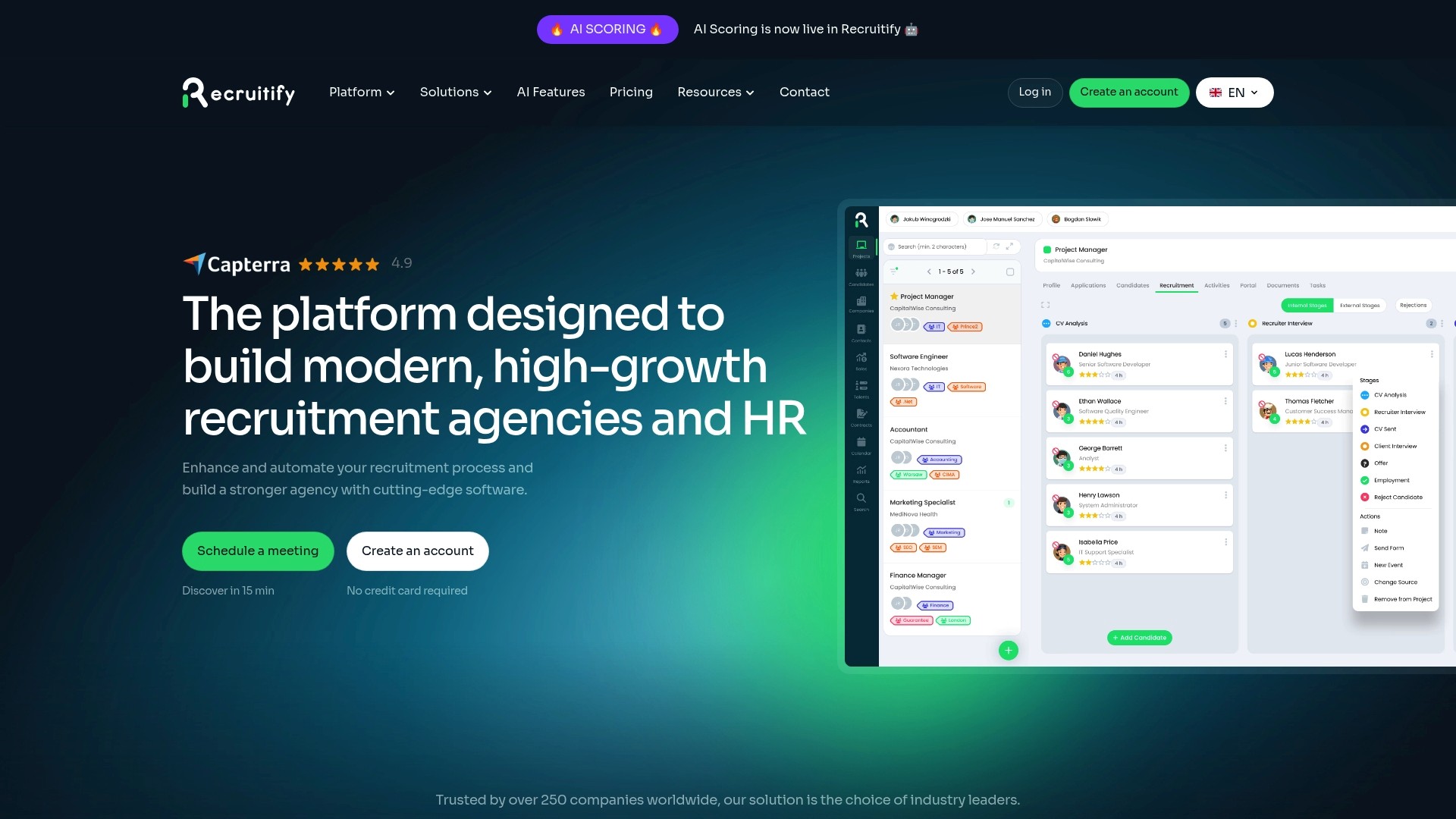
A live demo walks through exactly what this article covered: how the Contextual Matching AI scores a real batch of candidates, how the OCR parser builds a structured profile in seconds, and how the audit trail behind every record holds up under compliance review. You’ll also see how the sales pipeline and recruiting pipeline sit in the same tab, so a placement doesn’t require three logins to close. If you’re evaluating recruitment projects or comparing platforms against the feature taxonomy above, book a Recruitify demo and bring one real requisition to test live against your own data.
Sources
The core feature taxonomy in this guide draws on convergent industry roundups from TechnologyAdvice and Workday, both of which list similar essential ATS capabilities across job distribution, parsing, and automation. For AI scoring governance, MIT Sloan’s explainer on machine learning covers why explainability matters, while Pew Research documents public sentiment toward AI in hiring decisions. Legal context on discrimination and recordkeeping comes from the U.S. Department of Labor and OFCCP.
FAQ
What are the key features of an applicant tracking system?
The core features are resume parsing, job multiposting, pipeline automation, AI candidate scoring, interview scheduling, reporting and analytics, third-party integrations, and compliance controls such as audit trails and consent management.
Why is my resume getting rejected by an ATS?
Most rejections come from parsing errors (unusual formatting the OCR can’t read cleanly) or knockout questions filtering out a hard requirement, rather than the AI scoring itself; simple, standard formatting improves parsing accuracy significantly.
What should I look for when comparing ATS software features?
Focus on parsing accuracy, scoring explainability, integration depth with your existing HRIS and payroll tools, and documented compliance features like GDPR consent management and audit trails, rather than raw feature count alone.
How long does it take to implement a new ATS?
Smaller teams can often go live within days, mid-market organizations typically need a few weeks for data migration and configuration, and enterprise rollouts with legacy system integrations can take several months.
Recommended


News & Updates
Stay up-to-date with the latest innovations, features, and tips about Recruitify!
By providing your email address within the newsletter sign-up form, you confirm its processing to send marketing information regarding the Administrator’s products and services. The Administrator of your personal data processed for the abovementioned purposes is Recruitify Spółka z o.o., based in Warsaw, Poland (KRS 0000709889). For more information on the principles of personal data processing and the rights of data subjects, please check the Privacy Policy.

Last updated:
8 Applicant Tracking System Features HR Leaders Must Prioritize
Acquiring Talent
The Recruitify Team
Every serious applicant tracking system now runs on eight core capabilities: resume parsing, multiposting, pipeline automation, AI candidate scoring, interview scheduling, reporting, integrations, and compliance controls. Together, these applicant tracking system features cut administrative time, sharpen shortlist quality, and keep hiring decisions defensible under audit. The rest of this guide breaks down what each feature actually does, how to judge whether a vendor’s version is any good, and where to draw the line between must-have and nice-to-have.
TL;DR:
Most ATS platforms automate sourcing with multiposting and career site builders to boost application volume and employer branding, but niche roles benefit from targeted job board posting and direct sourcing instead.
Resume parsing extracts candidate data using OCR, but AI scoring requires transparency and bias checks to avoid unfair filtering, especially in regulated industries.
Pipeline automation with stage triggers and bulk actions can save recruiters dozens of hours weekly, but proper configuration and training are essential for maximum efficiency.
Collaboration tools like integrated scorecards, self-scheduling, and shared views speed hiring decisions and improve manager adoption, reducing time-to-hire.
Prioritizing ATS features involves assessing hiring volume, compliance risks, and integration needs, with transparency and auditability now more critical than feature count alone.
Recruitifyrecruitify.aiPrioritize More Than Basic ATS FeaturesRecruitify combines ATS, Sales CRM, and IT contracting tools with AI matching, CV parsing, sourcing, and GDPR audit trails.Explore Recruitify
Table of Contents
What Are the Core Applicant Tracking System Features?
How Does Job Distribution and Sourcing Work in an ATS?
What’s the Difference Between Resume Parsing and AI Scoring?
How Does Pipeline Automation Reduce Manual Recruiting Work?
What Collaboration Features Speed Up Hiring Decisions?
Which Features Reduce Candidate Drop-off During Applications?
What Reporting and DEI Metrics Should an ATS Track?
What Integrations and Security Controls Does an ATS Need?
How Should You Prioritize ATS Features Before Buying?
What’s a Realistic Implementation Timeline for an ATS?
How Recruitify Delivers These Feature Outcomes in Practice
What HR Leaders Should Prioritize Going Into 2026
See Recruitify’s Applicant Tracking System Features in Action
Sources
FAQ
What Are the Core Applicant Tracking System Features?
Before comparing vendors, it helps to see the full map. Industry roundups from sources like TechnologyAdvice and Workday converge on the same nine functional groups, even when the marketing names differ.
Sourcing: job multiposting, career site builders, and talent database search that widen the top of the funnel.
Screening: resume parsing, knockout questions, and AI-driven scoring that filter volume into a workable shortlist.
Workflow: custom pipeline stages, automated routing, and bulk actions that move candidates without manual nudging.
Collaboration: scheduling tools, scorecards, and shared notes that keep hiring teams aligned.
Reporting: dashboards covering time-to-fill, cost-per-hire, and diversity metrics.
Integrations: connections to HRIS, payroll, calendars, and background-check vendors.
Compliance: consent management, audit trails, and data retention controls.
Candidate experience: mobile application flows, status updates, and communication tools.
Offer and onboarding: digital offer letters and handoff data that feed the next HR system.
Sourcing and screening features mainly buy you speed. Compliance and reporting features buy you defensibility. Collaboration and candidate experience sit in the middle, protecting quality on both sides of the hire.
How Does Job Distribution and Sourcing Work in an ATS?
Multiposting pushes a single job requisition to dozens of boards and social channels at once, instead of a recruiter manually re-entering the listing on each site. Broad distribution earns its keep on high-volume, lower-specialization roles where reach matters more than precision. For niche technical searches, targeted posting to a handful of specialist boards, paired with direct sourcing, usually outperforms a scattershot blast.
A career site builder is the other half of sourcing, and it deserves more attention than most HR teams give it. A branded, mobile-optimized career page does two things at once: it reinforces employer brand and it reduces the friction that causes candidates to abandon an application halfway through. Industry comparisons tie longer, clunkier forms to higher abandonment rates, which makes career page usability a direct lever on applicant volume, not just a design preference.
Sourcing databases and candidate enrichment tools add a third layer. Rather than starting every search from zero, a searchable internal database with enrichment (updated contact details, work history, skills tagging) lets recruiters resurface candidates who applied months ago but were never the right fit at the time. That alone can shrink time-to-hire on repeat roles.
Metrics worth watching here include applications per posting, source-of-hire breakdown, and career page completion rate.
Pro Tip: Before adding a new job board integration, check your source-of-hire report from the last two quarters. If most hires already come from a few channels, adding another job board rarely justifies the added noise in your pipeline.
What’s the Difference Between Resume Parsing and AI Scoring?
Parsing and scoring solve different problems, and vendors that blur the line between them tend to oversell both. Parsing extracts data. Scoring interprets it. Confusing the two leads buyers to expect judgment from a tool that’s only doing data entry.
Modern parsers use optical character recognition (OCR) to read scanned PDFs, photographs of printed resumes, and DOCX files, then convert that raw text into a structured profile: name, contact details, employment history, education, and skills. A parser’s job ends there. It doesn’t judge fit; it just organizes information a recruiter would otherwise type by hand.
Knockout questions sit one layer up. These are yes/no or threshold-based questions (“Do you have an active nursing license?”) that auto-reject candidates who fail a hard requirement before a human ever opens the file. They’re blunt but effective for high-volume roles with non-negotiable qualifications.
AI scoring is where things get more interesting, and more contested. Rather than matching keywords, contextual scoring engines evaluate relationships within a candidate’s experience, for example recognizing that five years working with a specific cloud platform implies adjacent skills a keyword search would miss entirely. That’s a meaningful jump over simple string matching, but it comes with a responsibility: MIT Sloan’s explainer on machine learning notes that models are only as good as their training data, and results can be opaque without deliberate effort to keep them explainable.
Public wariness compounds the stakes here. Pew Research found substantial public concern about AI making hiring decisions, which means transparency toward candidates isn’t optional polish, it’s risk management.
Ask any vendor these questions before you trust their AI scoring:
Can you explain, in plain language, why a specific candidate scored the way they did?
What training data built the model, and has it been checked for skewed outcomes across demographic groups?
Does the tool score skills and experience, or does it also weight proxies like university name or job titles in ways that could introduce bias?
The U.S. Department of Labor’s guidance on discrimination is a useful baseline here: any screening step, automated or human, has to avoid criteria that disproportionately filter out protected groups. That standard applies to your ATS configuration just as much as to a hiring manager’s gut call.
How Does Pipeline Automation Reduce Manual Recruiting Work?
Pipeline automation replaces the dozens of small manual actions a recruiter repeats for every candidate, in every role, every day. Instead of dragging each resume through folders and firing off status emails by hand, you set rules once and let the system apply them at scale.
Custom pipeline stages are the foundation. A typical setup runs candidates through applied, screened, interview, offer, and hired, but technical or high-volume roles often add stages like technical assessment or reference check. Automation rules attach to each stage transition: move a candidate to “interview” and a scheduling email fires automatically; reject a candidate and a templated, courteous rejection note goes out without anyone drafting it fresh.
Email drips and nurture sequences extend this further for candidates who aren’t quite right today but might be in six months. Rather than losing them to an inbox nobody revisits, automated touchpoints keep warm candidates engaged until a matching role opens.
Bulk actions matter more than they sound. Moving 40 candidates out of a closed requisition, tagging an entire batch after a job fair, or mass-rejecting applicants who failed a knockout question, these are minutes of tedium multiplied by every requisition a recruiter runs. Time-based fallback rules add a safety net: if nobody reviews a candidate within a set window, the system escalates or reassigns automatically instead of letting someone stall silently in the pipeline.
Stage-triggered emails and scheduling links
Automated routing based on role, location, or skill tag
Bulk status changes and batch tagging
Time-based escalation when a candidate sits untouched
Recruiters who configure these well often describe reclaiming hours per week that used to go into repetitive status updates, freeing that time for actual candidate conversations instead.
What Collaboration Features Speed Up Hiring Decisions?
Hiring stalls most often at the handoff between recruiter and hiring manager, not at the sourcing stage. The features that fix this are less flashy than AI scoring, but they close gaps that quietly add weeks to a hiring timeline.
Calendar integrations that allow candidate self-scheduling remove the multi-email back-and-forth that used to eat a full day per interview. A candidate picks an open slot directly from a hiring manager’s synced calendar, and the invite, video link, and reminder all generate automatically.
Structured scorecards standardize what would otherwise be inconsistent, memory-based feedback. Every interviewer answers the same core prompts tied to the role’s actual requirements, which makes comparing four candidates against each other far faster than reading four freeform email summaries. Private notes and tagging let interviewers flag concerns candidly without those comments becoming visible to the candidate or to other departments.
Self-service scheduling synced to real calendar availability
Standardized scorecards tied to role-specific competencies
Private, role-restricted notes and internal tagging
Side-by-side candidate comparison views for panel decisions
When hiring managers can see scorecards and comments in one shared view instead of chasing them across email threads, decision speed improves and adoption of the ATS itself tends to climb, since managers experience real time savings rather than just another login to maintain.
Which Features Reduce Candidate Drop-off During Applications?
Candidates abandon applications for reasons entirely within an employer’s control, and the data backs that up plainly: complex, lengthy forms measurably increase abandonment rates. Mobile-first design and one-click apply (pulling from a LinkedIn profile or a previously stored resume) address the single biggest friction point, since a large share of applicants now start the process on a phone.
Two-way SMS and email communication keeps candidates informed without requiring them to log into a portal to check status. Chatbots handle routine questions (interview format, expected timeline) instantly instead of leaving candidates guessing. Asynchronous video interviews let candidates record responses on their own schedule, which particularly helps roles with a global or shift-work applicant pool where live scheduling across time zones becomes a genuine obstacle.
Transparent status updates and a respectful rejection process matter more to employer brand than most HR teams assume. A candidate who is told clearly and promptly that they weren’t selected, rather than left in silence for months, is far more likely to apply again for a future role or refer someone else.
Mobile-optimized, one-click application flow
Two-way SMS and email updates through the hiring process
Asynchronous video interview options for flexible scheduling
Automated but personalized rejection and status messaging
Pro Tip: Time your own application flow with a stopwatch on a phone. If it takes more than four minutes to submit for an entry-level role, you’re likely losing qualified candidates before they finish.
What Reporting and DEI Metrics Should an ATS Track?
Reporting is where an applicant tracking system earns its keep as a management tool, not just a recruiting tool. The essential KPIs are time-to-fill (days from requisition open to accepted offer), cost-per-hire (total recruiting spend divided by hires made), and source effectiveness (which channels actually convert to hires, not just applications).
DEI tracking requires anonymized review capability, meaning hiring teams can evaluate applications with identifying details like name and photo stripped out during early screening stages, reducing the chance that unconscious bias shapes who advances. Pairing that with demographic funnel reporting (not to influence individual decisions, but to spot patterns across the full pipeline) gives HR leadership a defensible, data-backed answer when asked whether hiring is fair.
Custom, exportable reports matter for a mundane but critical reason: stakeholder reviews rarely happen inside the ATS dashboard. Finance wants cost-per-hire in a spreadsheet; the board wants a slide deck. If your reporting tool can’t export cleanly, someone ends up rebuilding the numbers manually every quarter.
Time-to-fill and time-to-hire broken out by role and department
Cost-per-hire with channel-level source attribution
Anonymized review stages for early-funnel screening
Custom, exportable dashboards for non-ATS stakeholders
Predictive pipeline health alerts round this out. A well-configured system flags a requisition that’s stalling before it becomes a six-month vacancy, giving recruiters a chance to adjust sourcing or reopen the requisition scope early rather than discovering the problem after a hiring manager escalates.
What Integrations and Security Controls Does an ATS Need?
Integration depth determines whether an ATS becomes the single source of truth or just another silo that requires duplicate data entry. Native connectors to HRIS platforms, payroll systems, calendar tools, and background-check vendors mean a candidate’s data flows through the hire without anyone retyping it. Single sign-on (SSO) reduces password fatigue and closes an easy security gap. API and webhook access matter for larger teams that need custom connections beyond what pre-built integrations cover.
Compliance features carry legal weight, not just operational convenience. Consent management tracks exactly when and how a candidate agreed to have their data stored and processed, which becomes essential under regulations like GDPR. Audit trails record every action taken on a candidate’s file, who viewed it, what changed, and when, giving HR a defensible record if a hiring decision is ever challenged. OFCCP guidance for federal contractors makes clear that recordkeeping isn’t optional for organizations under that jurisdiction, and even outside it, audit trails are quickly becoming standard due diligence.
Native HRIS, payroll, and background-check integrations
SSO and role-based API access
Documented consent capture with timestamped records
Full audit trails covering access, edits, and deletions
Ask any vendor for their data processing agreement (DPA), their security certifications, and where candidate data is physically stored. Data residency matters more than most buyers realize when hiring across multiple countries with different privacy regimes.
How Should You Prioritize ATS Features Before Buying?
Not every feature deserves equal weight on day one. A simple prioritization matrix, scoring each capability against your hiring volume, process complexity, compliance exposure, and budget, keeps evaluation from turning into a feature checklist where everything looks equally urgent.
Map your hiring volume first. A team making 15 hires a year has different automation needs than one making 300. High volume justifies heavier automation and bulk-action tooling immediately.
Rank compliance exposure. Federal contractors, multinational teams, or regulated industries should treat audit trails and consent management as non-negotiable, not a phase-two upgrade.
Test the demo with your actual data. Ask the vendor to run a real job requisition and a sample resume batch through parsing and scoring live, not a scripted showcase.
Ask about data migration explicitly. How long does it take to import your existing candidate database, and does historical data stay searchable afterward?
Get pricing in writing before the final call. Watch for vendors who won’t quote per-user costs upfront, that’s usually a sign of a longer sales negotiation than you want.
Red flags worth walking away from include opaque, negotiate-to-find-out pricing, no clear answer on audit trail capability, and integration lists that sound comprehensive but turn out to require costly custom development for anything beyond the two most popular HRIS platforms.
Pro Tip: Bring one hiring manager into the vendor demo, not just recruiters. Their reaction to the scheduling and scorecard experience often predicts adoption better than any feature checklist.
What’s a Realistic Implementation Timeline for an ATS?
Implementation speed depends heavily on organization size and how much historical data needs migrating. Deployment typically moves through five phases: discovery (mapping your current workflow), data import, configuration (pipeline stages, permissions, templates), a pilot with one hiring team, and full rollout.
Timelines vary widely by scale. Smaller teams with straightforward workflows can go live within days of signing, according to industry implementation benchmarks. Mid-market organizations with multiple departments and existing candidate data to migrate usually take a few weeks. Enterprise rollouts, especially those integrating with legacy HRIS systems and multiple regional compliance requirements, often stretch into months.
Measuring ROI honestly means tracking a small set of before-and-after numbers: administrative hours saved per recruiter per week, change in average time-to-fill, and shift in offer acceptance rate. These are the numbers that justify the investment to leadership beyond a general sense that “the new system feels faster.”
Pilot with a single hiring team before organization-wide rollout
Track admin hours saved weekly during the first quarter
Compare time-to-fill for the same role type, pre- and post-launch
Schedule short refresher training at 30 and 90 days, not just at launch
Change management often gets skipped in favor of technical setup, but a short second training session a month after go-live catches the habits people quietly reverted to under deadline pressure.
How Recruitify Delivers These Feature Outcomes in Practice
Recruitify was built around the same feature taxonomy this article walks through, but with the sourcing, screening, and pipeline layers running on one shared database instead of stitched-together tools.
Contextual Matching AI & Scoring goes beyond keyword search, evaluating relationships within a candidate’s tech stack and returning ranked shortlists with a percentage match score, addressing the explainability gap discussed in the AI scoring section above.
AI CV Parser with OCR builds a structured candidate profile from PDFs, DOCX files, scans, or photos in about three seconds, and flags duplicates automatically.
X-RAY Search & Boolean Engine scans the open web and your internal database, generating advanced Boolean strings with one click to accelerate sourcing.
GDPR consent management provides a total audit trail, giving HR teams documented proof for every candidate record.
Agencies running the full automation suite report up to a 70% reduction in administrative tasks, spanning everything from lead contact through final contract generation, a figure consistent with what well-configured integrated platforms deliver when parsing, scoring, and workflow automation work from the same data instead of three disconnected systems.
What HR Leaders Should Prioritize Going Into 2026
The conventional advice to “buy the ATS with the most features” gets this backward. Feature count means nothing if the AI scoring behind it can’t explain its own decisions, or if your compliance team can’t produce an audit trail when a candidate disputes a rejection. Prioritize explainability and audit capability before you prioritize breadth. A system with fewer bells and whistles but full transparency into how candidates get scored will save you more legal and reputational risk than a flashier competitor ever will.
Governance isn’t a separate project from AI scoring, it’s a condition of using it responsibly. Any team deploying scoring or matching should be able to answer a candidate’s question about why they weren’t selected, in plain language, on the spot. If your vendor can’t give you that answer during a demo, you won’t get it during a real dispute either.
On the integration question, we’d argue integration-first beats best-of-breed for most agencies and mid-sized HR teams. Stitching together five specialist tools creates more data reconciliation work than it saves in individual feature quality, particularly once sales and recruiting pipelines need to talk to each other.
- Recruitify Team
See Recruitify’s Applicant Tracking System Features in Action
A modern applicant tracking system brings AI scoring, OCR-based CV parsing, multiposting, and GDPR consent management into one connected system to help recruiters avoid losing candidates to spreadsheet gaps between tools.
A live demo walks through exactly what this article covered: how the Contextual Matching AI scores a real batch of candidates, how the OCR parser builds a structured profile in seconds, and how the audit trail behind every record holds up under compliance review. You’ll also see how the sales pipeline and recruiting pipeline sit in the same tab, so a placement doesn’t require three logins to close. If you’re evaluating recruitment projects or comparing platforms against the feature taxonomy above, book a Recruitify demo and bring one real requisition to test live against your own data.
Sources
The core feature taxonomy in this guide draws on convergent industry roundups from TechnologyAdvice and Workday, both of which list similar essential ATS capabilities across job distribution, parsing, and automation. For AI scoring governance, MIT Sloan’s explainer on machine learning covers why explainability matters, while Pew Research documents public sentiment toward AI in hiring decisions. Legal context on discrimination and recordkeeping comes from the U.S. Department of Labor and OFCCP.
FAQ
What are the key features of an applicant tracking system?
The core features are resume parsing, job multiposting, pipeline automation, AI candidate scoring, interview scheduling, reporting and analytics, third-party integrations, and compliance controls such as audit trails and consent management.
Why is my resume getting rejected by an ATS?
Most rejections come from parsing errors (unusual formatting the OCR can’t read cleanly) or knockout questions filtering out a hard requirement, rather than the AI scoring itself; simple, standard formatting improves parsing accuracy significantly.
What should I look for when comparing ATS software features?
Focus on parsing accuracy, scoring explainability, integration depth with your existing HRIS and payroll tools, and documented compliance features like GDPR consent management and audit trails, rather than raw feature count alone.
How long does it take to implement a new ATS?
Smaller teams can often go live within days, mid-market organizations typically need a few weeks for data migration and configuration, and enterprise rollouts with legacy system integrations can take several months.
Recommended
News & Updates
Stay up-to-date with the latest innovations, features, and tips about Recruitify!
By providing your email address within the newsletter sign-up form, you confirm its processing to send marketing information regarding the Administrator’s products and services. The Administrator of your personal data processed for the abovementioned purposes is Recruitify Spółka z o.o., based in Warsaw, Poland (KRS 0000709889). For more information on the principles of personal data processing and the rights of data subjects, please check the Privacy Policy.
Last updated:
8 Applicant Tracking System Features HR Leaders Must Prioritize
Acquiring Talent
The Recruitify Team
Every serious applicant tracking system now runs on eight core capabilities: resume parsing, multiposting, pipeline automation, AI candidate scoring, interview scheduling, reporting, integrations, and compliance controls. Together, these applicant tracking system features cut administrative time, sharpen shortlist quality, and keep hiring decisions defensible under audit. The rest of this guide breaks down what each feature actually does, how to judge whether a vendor’s version is any good, and where to draw the line between must-have and nice-to-have.
TL;DR:
Most ATS platforms automate sourcing with multiposting and career site builders to boost application volume and employer branding, but niche roles benefit from targeted job board posting and direct sourcing instead.
Resume parsing extracts candidate data using OCR, but AI scoring requires transparency and bias checks to avoid unfair filtering, especially in regulated industries.
Pipeline automation with stage triggers and bulk actions can save recruiters dozens of hours weekly, but proper configuration and training are essential for maximum efficiency.
Collaboration tools like integrated scorecards, self-scheduling, and shared views speed hiring decisions and improve manager adoption, reducing time-to-hire.
Prioritizing ATS features involves assessing hiring volume, compliance risks, and integration needs, with transparency and auditability now more critical than feature count alone.
Recruitifyrecruitify.aiPrioritize More Than Basic ATS FeaturesRecruitify combines ATS, Sales CRM, and IT contracting tools with AI matching, CV parsing, sourcing, and GDPR audit trails.Explore Recruitify
Table of Contents
What Are the Core Applicant Tracking System Features?
How Does Job Distribution and Sourcing Work in an ATS?
What’s the Difference Between Resume Parsing and AI Scoring?
How Does Pipeline Automation Reduce Manual Recruiting Work?
What Collaboration Features Speed Up Hiring Decisions?
Which Features Reduce Candidate Drop-off During Applications?
What Reporting and DEI Metrics Should an ATS Track?
What Integrations and Security Controls Does an ATS Need?
How Should You Prioritize ATS Features Before Buying?
What’s a Realistic Implementation Timeline for an ATS?
How Recruitify Delivers These Feature Outcomes in Practice
What HR Leaders Should Prioritize Going Into 2026
See Recruitify’s Applicant Tracking System Features in Action
Sources
FAQ
What Are the Core Applicant Tracking System Features?
Before comparing vendors, it helps to see the full map. Industry roundups from sources like TechnologyAdvice and Workday converge on the same nine functional groups, even when the marketing names differ.
Sourcing: job multiposting, career site builders, and talent database search that widen the top of the funnel.
Screening: resume parsing, knockout questions, and AI-driven scoring that filter volume into a workable shortlist.
Workflow: custom pipeline stages, automated routing, and bulk actions that move candidates without manual nudging.
Collaboration: scheduling tools, scorecards, and shared notes that keep hiring teams aligned.
Reporting: dashboards covering time-to-fill, cost-per-hire, and diversity metrics.
Integrations: connections to HRIS, payroll, calendars, and background-check vendors.
Compliance: consent management, audit trails, and data retention controls.
Candidate experience: mobile application flows, status updates, and communication tools.
Offer and onboarding: digital offer letters and handoff data that feed the next HR system.
Sourcing and screening features mainly buy you speed. Compliance and reporting features buy you defensibility. Collaboration and candidate experience sit in the middle, protecting quality on both sides of the hire.
How Does Job Distribution and Sourcing Work in an ATS?
Multiposting pushes a single job requisition to dozens of boards and social channels at once, instead of a recruiter manually re-entering the listing on each site. Broad distribution earns its keep on high-volume, lower-specialization roles where reach matters more than precision. For niche technical searches, targeted posting to a handful of specialist boards, paired with direct sourcing, usually outperforms a scattershot blast.
A career site builder is the other half of sourcing, and it deserves more attention than most HR teams give it. A branded, mobile-optimized career page does two things at once: it reinforces employer brand and it reduces the friction that causes candidates to abandon an application halfway through. Industry comparisons tie longer, clunkier forms to higher abandonment rates, which makes career page usability a direct lever on applicant volume, not just a design preference.
Sourcing databases and candidate enrichment tools add a third layer. Rather than starting every search from zero, a searchable internal database with enrichment (updated contact details, work history, skills tagging) lets recruiters resurface candidates who applied months ago but were never the right fit at the time. That alone can shrink time-to-hire on repeat roles.
Metrics worth watching here include applications per posting, source-of-hire breakdown, and career page completion rate.
Pro Tip: Before adding a new job board integration, check your source-of-hire report from the last two quarters. If most hires already come from a few channels, adding another job board rarely justifies the added noise in your pipeline.
What’s the Difference Between Resume Parsing and AI Scoring?
Parsing and scoring solve different problems, and vendors that blur the line between them tend to oversell both. Parsing extracts data. Scoring interprets it. Confusing the two leads buyers to expect judgment from a tool that’s only doing data entry.
Modern parsers use optical character recognition (OCR) to read scanned PDFs, photographs of printed resumes, and DOCX files, then convert that raw text into a structured profile: name, contact details, employment history, education, and skills. A parser’s job ends there. It doesn’t judge fit; it just organizes information a recruiter would otherwise type by hand.
Knockout questions sit one layer up. These are yes/no or threshold-based questions (“Do you have an active nursing license?”) that auto-reject candidates who fail a hard requirement before a human ever opens the file. They’re blunt but effective for high-volume roles with non-negotiable qualifications.
AI scoring is where things get more interesting, and more contested. Rather than matching keywords, contextual scoring engines evaluate relationships within a candidate’s experience, for example recognizing that five years working with a specific cloud platform implies adjacent skills a keyword search would miss entirely. That’s a meaningful jump over simple string matching, but it comes with a responsibility: MIT Sloan’s explainer on machine learning notes that models are only as good as their training data, and results can be opaque without deliberate effort to keep them explainable.
Public wariness compounds the stakes here. Pew Research found substantial public concern about AI making hiring decisions, which means transparency toward candidates isn’t optional polish, it’s risk management.
Ask any vendor these questions before you trust their AI scoring:
Can you explain, in plain language, why a specific candidate scored the way they did?
What training data built the model, and has it been checked for skewed outcomes across demographic groups?
Does the tool score skills and experience, or does it also weight proxies like university name or job titles in ways that could introduce bias?
The U.S. Department of Labor’s guidance on discrimination is a useful baseline here: any screening step, automated or human, has to avoid criteria that disproportionately filter out protected groups. That standard applies to your ATS configuration just as much as to a hiring manager’s gut call.
How Does Pipeline Automation Reduce Manual Recruiting Work?
Pipeline automation replaces the dozens of small manual actions a recruiter repeats for every candidate, in every role, every day. Instead of dragging each resume through folders and firing off status emails by hand, you set rules once and let the system apply them at scale.
Custom pipeline stages are the foundation. A typical setup runs candidates through applied, screened, interview, offer, and hired, but technical or high-volume roles often add stages like technical assessment or reference check. Automation rules attach to each stage transition: move a candidate to “interview” and a scheduling email fires automatically; reject a candidate and a templated, courteous rejection note goes out without anyone drafting it fresh.
Email drips and nurture sequences extend this further for candidates who aren’t quite right today but might be in six months. Rather than losing them to an inbox nobody revisits, automated touchpoints keep warm candidates engaged until a matching role opens.
Bulk actions matter more than they sound. Moving 40 candidates out of a closed requisition, tagging an entire batch after a job fair, or mass-rejecting applicants who failed a knockout question, these are minutes of tedium multiplied by every requisition a recruiter runs. Time-based fallback rules add a safety net: if nobody reviews a candidate within a set window, the system escalates or reassigns automatically instead of letting someone stall silently in the pipeline.
Stage-triggered emails and scheduling links
Automated routing based on role, location, or skill tag
Bulk status changes and batch tagging
Time-based escalation when a candidate sits untouched
Recruiters who configure these well often describe reclaiming hours per week that used to go into repetitive status updates, freeing that time for actual candidate conversations instead.
What Collaboration Features Speed Up Hiring Decisions?
Hiring stalls most often at the handoff between recruiter and hiring manager, not at the sourcing stage. The features that fix this are less flashy than AI scoring, but they close gaps that quietly add weeks to a hiring timeline.
Calendar integrations that allow candidate self-scheduling remove the multi-email back-and-forth that used to eat a full day per interview. A candidate picks an open slot directly from a hiring manager’s synced calendar, and the invite, video link, and reminder all generate automatically.
Structured scorecards standardize what would otherwise be inconsistent, memory-based feedback. Every interviewer answers the same core prompts tied to the role’s actual requirements, which makes comparing four candidates against each other far faster than reading four freeform email summaries. Private notes and tagging let interviewers flag concerns candidly without those comments becoming visible to the candidate or to other departments.
Self-service scheduling synced to real calendar availability
Standardized scorecards tied to role-specific competencies
Private, role-restricted notes and internal tagging
Side-by-side candidate comparison views for panel decisions
When hiring managers can see scorecards and comments in one shared view instead of chasing them across email threads, decision speed improves and adoption of the ATS itself tends to climb, since managers experience real time savings rather than just another login to maintain.
Which Features Reduce Candidate Drop-off During Applications?
Candidates abandon applications for reasons entirely within an employer’s control, and the data backs that up plainly: complex, lengthy forms measurably increase abandonment rates. Mobile-first design and one-click apply (pulling from a LinkedIn profile or a previously stored resume) address the single biggest friction point, since a large share of applicants now start the process on a phone.
Two-way SMS and email communication keeps candidates informed without requiring them to log into a portal to check status. Chatbots handle routine questions (interview format, expected timeline) instantly instead of leaving candidates guessing. Asynchronous video interviews let candidates record responses on their own schedule, which particularly helps roles with a global or shift-work applicant pool where live scheduling across time zones becomes a genuine obstacle.
Transparent status updates and a respectful rejection process matter more to employer brand than most HR teams assume. A candidate who is told clearly and promptly that they weren’t selected, rather than left in silence for months, is far more likely to apply again for a future role or refer someone else.
Mobile-optimized, one-click application flow
Two-way SMS and email updates through the hiring process
Asynchronous video interview options for flexible scheduling
Automated but personalized rejection and status messaging
Pro Tip: Time your own application flow with a stopwatch on a phone. If it takes more than four minutes to submit for an entry-level role, you’re likely losing qualified candidates before they finish.
What Reporting and DEI Metrics Should an ATS Track?
Reporting is where an applicant tracking system earns its keep as a management tool, not just a recruiting tool. The essential KPIs are time-to-fill (days from requisition open to accepted offer), cost-per-hire (total recruiting spend divided by hires made), and source effectiveness (which channels actually convert to hires, not just applications).
DEI tracking requires anonymized review capability, meaning hiring teams can evaluate applications with identifying details like name and photo stripped out during early screening stages, reducing the chance that unconscious bias shapes who advances. Pairing that with demographic funnel reporting (not to influence individual decisions, but to spot patterns across the full pipeline) gives HR leadership a defensible, data-backed answer when asked whether hiring is fair.
Custom, exportable reports matter for a mundane but critical reason: stakeholder reviews rarely happen inside the ATS dashboard. Finance wants cost-per-hire in a spreadsheet; the board wants a slide deck. If your reporting tool can’t export cleanly, someone ends up rebuilding the numbers manually every quarter.
Time-to-fill and time-to-hire broken out by role and department
Cost-per-hire with channel-level source attribution
Anonymized review stages for early-funnel screening
Custom, exportable dashboards for non-ATS stakeholders
Predictive pipeline health alerts round this out. A well-configured system flags a requisition that’s stalling before it becomes a six-month vacancy, giving recruiters a chance to adjust sourcing or reopen the requisition scope early rather than discovering the problem after a hiring manager escalates.
What Integrations and Security Controls Does an ATS Need?
Integration depth determines whether an ATS becomes the single source of truth or just another silo that requires duplicate data entry. Native connectors to HRIS platforms, payroll systems, calendar tools, and background-check vendors mean a candidate’s data flows through the hire without anyone retyping it. Single sign-on (SSO) reduces password fatigue and closes an easy security gap. API and webhook access matter for larger teams that need custom connections beyond what pre-built integrations cover.
Compliance features carry legal weight, not just operational convenience. Consent management tracks exactly when and how a candidate agreed to have their data stored and processed, which becomes essential under regulations like GDPR. Audit trails record every action taken on a candidate’s file, who viewed it, what changed, and when, giving HR a defensible record if a hiring decision is ever challenged. OFCCP guidance for federal contractors makes clear that recordkeeping isn’t optional for organizations under that jurisdiction, and even outside it, audit trails are quickly becoming standard due diligence.
Native HRIS, payroll, and background-check integrations
SSO and role-based API access
Documented consent capture with timestamped records
Full audit trails covering access, edits, and deletions
Ask any vendor for their data processing agreement (DPA), their security certifications, and where candidate data is physically stored. Data residency matters more than most buyers realize when hiring across multiple countries with different privacy regimes.
How Should You Prioritize ATS Features Before Buying?
Not every feature deserves equal weight on day one. A simple prioritization matrix, scoring each capability against your hiring volume, process complexity, compliance exposure, and budget, keeps evaluation from turning into a feature checklist where everything looks equally urgent.
Map your hiring volume first. A team making 15 hires a year has different automation needs than one making 300. High volume justifies heavier automation and bulk-action tooling immediately.
Rank compliance exposure. Federal contractors, multinational teams, or regulated industries should treat audit trails and consent management as non-negotiable, not a phase-two upgrade.
Test the demo with your actual data. Ask the vendor to run a real job requisition and a sample resume batch through parsing and scoring live, not a scripted showcase.
Ask about data migration explicitly. How long does it take to import your existing candidate database, and does historical data stay searchable afterward?
Get pricing in writing before the final call. Watch for vendors who won’t quote per-user costs upfront, that’s usually a sign of a longer sales negotiation than you want.
Red flags worth walking away from include opaque, negotiate-to-find-out pricing, no clear answer on audit trail capability, and integration lists that sound comprehensive but turn out to require costly custom development for anything beyond the two most popular HRIS platforms.
Pro Tip: Bring one hiring manager into the vendor demo, not just recruiters. Their reaction to the scheduling and scorecard experience often predicts adoption better than any feature checklist.
What’s a Realistic Implementation Timeline for an ATS?
Implementation speed depends heavily on organization size and how much historical data needs migrating. Deployment typically moves through five phases: discovery (mapping your current workflow), data import, configuration (pipeline stages, permissions, templates), a pilot with one hiring team, and full rollout.
Timelines vary widely by scale. Smaller teams with straightforward workflows can go live within days of signing, according to industry implementation benchmarks. Mid-market organizations with multiple departments and existing candidate data to migrate usually take a few weeks. Enterprise rollouts, especially those integrating with legacy HRIS systems and multiple regional compliance requirements, often stretch into months.
Measuring ROI honestly means tracking a small set of before-and-after numbers: administrative hours saved per recruiter per week, change in average time-to-fill, and shift in offer acceptance rate. These are the numbers that justify the investment to leadership beyond a general sense that “the new system feels faster.”
Pilot with a single hiring team before organization-wide rollout
Track admin hours saved weekly during the first quarter
Compare time-to-fill for the same role type, pre- and post-launch
Schedule short refresher training at 30 and 90 days, not just at launch
Change management often gets skipped in favor of technical setup, but a short second training session a month after go-live catches the habits people quietly reverted to under deadline pressure.
How Recruitify Delivers These Feature Outcomes in Practice
Recruitify was built around the same feature taxonomy this article walks through, but with the sourcing, screening, and pipeline layers running on one shared database instead of stitched-together tools.
Contextual Matching AI & Scoring goes beyond keyword search, evaluating relationships within a candidate’s tech stack and returning ranked shortlists with a percentage match score, addressing the explainability gap discussed in the AI scoring section above.
AI CV Parser with OCR builds a structured candidate profile from PDFs, DOCX files, scans, or photos in about three seconds, and flags duplicates automatically.
X-RAY Search & Boolean Engine scans the open web and your internal database, generating advanced Boolean strings with one click to accelerate sourcing.
GDPR consent management provides a total audit trail, giving HR teams documented proof for every candidate record.
Agencies running the full automation suite report up to a 70% reduction in administrative tasks, spanning everything from lead contact through final contract generation, a figure consistent with what well-configured integrated platforms deliver when parsing, scoring, and workflow automation work from the same data instead of three disconnected systems.
What HR Leaders Should Prioritize Going Into 2026
The conventional advice to “buy the ATS with the most features” gets this backward. Feature count means nothing if the AI scoring behind it can’t explain its own decisions, or if your compliance team can’t produce an audit trail when a candidate disputes a rejection. Prioritize explainability and audit capability before you prioritize breadth. A system with fewer bells and whistles but full transparency into how candidates get scored will save you more legal and reputational risk than a flashier competitor ever will.
Governance isn’t a separate project from AI scoring, it’s a condition of using it responsibly. Any team deploying scoring or matching should be able to answer a candidate’s question about why they weren’t selected, in plain language, on the spot. If your vendor can’t give you that answer during a demo, you won’t get it during a real dispute either.
On the integration question, we’d argue integration-first beats best-of-breed for most agencies and mid-sized HR teams. Stitching together five specialist tools creates more data reconciliation work than it saves in individual feature quality, particularly once sales and recruiting pipelines need to talk to each other.
- Recruitify Team
See Recruitify’s Applicant Tracking System Features in Action
A modern applicant tracking system brings AI scoring, OCR-based CV parsing, multiposting, and GDPR consent management into one connected system to help recruiters avoid losing candidates to spreadsheet gaps between tools.
A live demo walks through exactly what this article covered: how the Contextual Matching AI scores a real batch of candidates, how the OCR parser builds a structured profile in seconds, and how the audit trail behind every record holds up under compliance review. You’ll also see how the sales pipeline and recruiting pipeline sit in the same tab, so a placement doesn’t require three logins to close. If you’re evaluating recruitment projects or comparing platforms against the feature taxonomy above, book a Recruitify demo and bring one real requisition to test live against your own data.
Sources
The core feature taxonomy in this guide draws on convergent industry roundups from TechnologyAdvice and Workday, both of which list similar essential ATS capabilities across job distribution, parsing, and automation. For AI scoring governance, MIT Sloan’s explainer on machine learning covers why explainability matters, while Pew Research documents public sentiment toward AI in hiring decisions. Legal context on discrimination and recordkeeping comes from the U.S. Department of Labor and OFCCP.
FAQ
What are the key features of an applicant tracking system?
The core features are resume parsing, job multiposting, pipeline automation, AI candidate scoring, interview scheduling, reporting and analytics, third-party integrations, and compliance controls such as audit trails and consent management.
Why is my resume getting rejected by an ATS?
Most rejections come from parsing errors (unusual formatting the OCR can’t read cleanly) or knockout questions filtering out a hard requirement, rather than the AI scoring itself; simple, standard formatting improves parsing accuracy significantly.
What should I look for when comparing ATS software features?
Focus on parsing accuracy, scoring explainability, integration depth with your existing HRIS and payroll tools, and documented compliance features like GDPR consent management and audit trails, rather than raw feature count alone.
How long does it take to implement a new ATS?
Smaller teams can often go live within days, mid-market organizations typically need a few weeks for data migration and configuration, and enterprise rollouts with legacy system integrations can take several months.
Recommended
News & Updates
Stay up-to-date with the latest innovations, features, and tips about Recruitify!
By providing your email address within the newsletter sign-up form, you confirm its processing to send marketing information regarding the Administrator’s products and services. The Administrator of your personal data processed for the abovementioned purposes is Recruitify Spółka z o.o., based in Warsaw, Poland (KRS 0000709889). For more information on the principles of personal data processing and the rights of data subjects, please check the Privacy Policy.

Discover More

Applicant Tracking System
Hit 80+ Scores: Automated Resume Screening for HR & Job Seekers
Learn resume formatting fixes that raise ATS scores above 80, plus recruiter steps for calibration, bias audits, and defensible, fair screening workflows.
9 Sept 2026
Discover More

Recruitment Process
Track 5 Recruitment Funnel Metrics That Predict Hires for TA Teams
Learn the five recruitment funnel metrics recruiters should track weekly, how to find and fix your earliest bottleneck, and a KPI template.
8 Sept 2026
Discover More

Applicant Tracking System
Recruiters: Stage Organized Recruiting Email Templates You Can Automate
Stage organized recruiting email templates for every hiring stage, a 4-message follow-up that doubles replies, plus a customization checklist and...
7 Sept 2026
Discover More
Applicant Tracking System
Hit 80+ Scores: Automated Resume Screening for HR & Job Seekers
Learn resume formatting fixes that raise ATS scores above 80, plus recruiter steps for calibration, bias audits, and defensible, fair screening workflows.
9 Sept 2026
Discover More
Recruitment Process
Track 5 Recruitment Funnel Metrics That Predict Hires for TA Teams
Learn the five recruitment funnel metrics recruiters should track weekly, how to find and fix your earliest bottleneck, and a KPI template.
8 Sept 2026
Discover More