Last updated:
Programmatic Job Advertising: How It Works and When to Use It

Recruitment Process

The Recruitify Team
Programmatic job advertising is the use of software to buy, place, and optimize job ads automatically across job boards, search engines, social platforms, and niche sites, instead of a recruiter purchasing fixed slots by hand. Algorithms watch how each ad performs and move budget toward the sources that produce applications, which makes the method most useful for teams that hire at volume or run many open roles at once. This guide explains the mechanics, the pricing models, the realistic results, the mistakes that waste budget, and the role your ATS plays in making any of it measurable.
Key takeaways
Programmatic job advertising automates the buying, placement, and optimization of job ads. Budget shifts continuously toward the channels that deliver applicants, rather than being locked into a 30-day posting.
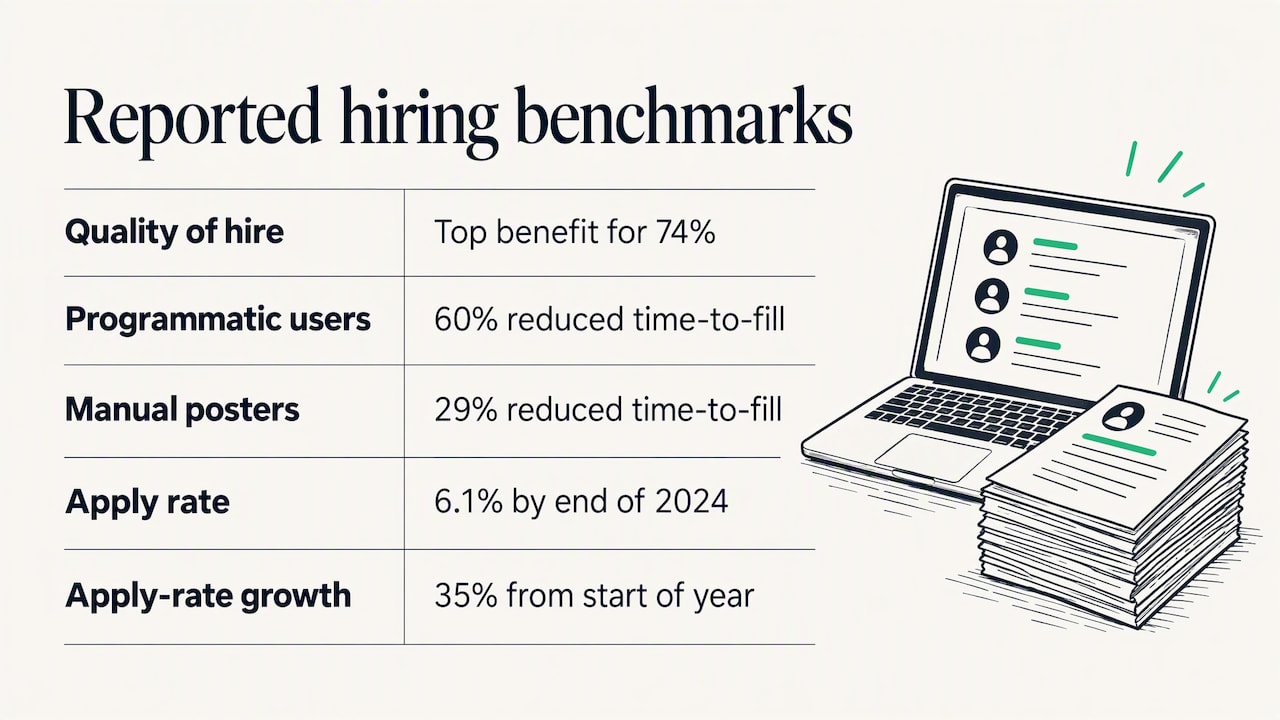
Industry research links the approach to better hiring outcomes: in a 2025 Aptitude Research report, 74% of companies cited improved quality of hire as the top benefit, and 60% of programmatic users reduced time-to-fill, against 29% of those posting manually.
Results depend on data quality. ATS synchronization latency, budget control per job, and a patient first two weeks matter more than the choice of dashboard.
Advertising only fills the top of the funnel. Screening, scoring, and follow-up in your ATS decide whether the extra applications become placements.
Table of Contents
What programmatic job advertising actually is
The term borrows from programmatic advertising in marketing, where software buys ad inventory in real time. In recruiting, the inventory is visibility for a vacancy: a sponsored listing on a job board, a search ad, a social post, a niche community placement. The Aptitude Research report defines it as technology that automates and streamlines the buying, placement, and optimization of job advertisements across major and niche job boards and other platforms.
The contrast with the traditional model is simple. Traditionally, a recruiter buys a posting on a board for a fixed period, pays the same price whether it attracts ten applicants or none, and often forgets to review it until the period ends. Under a programmatic model, the platform takes your job feed, assigns bids, watches clicks and applications, and rebalances spend while the campaign is running.
What it is not
A few misconceptions come up repeatedly:
It is not a job board. It is a layer that buys placements on many boards and sites.
It is not a sourcing tool. It attracts applicants to a job; it does not search for individual candidates.
It is not hands-off forever. The algorithm optimizes inside the limits you set, and someone must still own goals, budgets, and the quality of the job content.
It does not replace an ATS. Without an ATS recording what happens after the click, the platform sees only clicks and applications, never hires.
How the process works step by step
Although vendors differ in interface, the workflow is similar across the market.
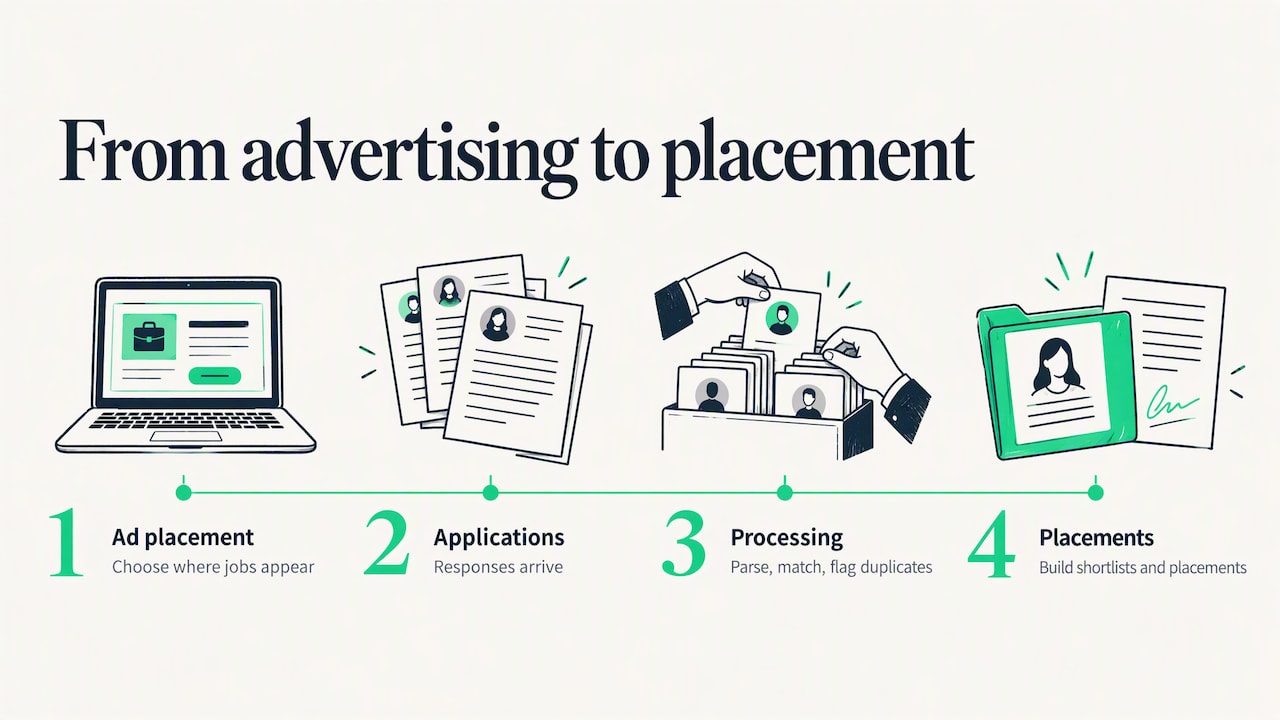
Job feed. Your open roles flow from your ATS or career site to the platform, usually as an XML feed or an integration. Titles, locations, and descriptions in this feed determine where ads can appear.
Budget and goals. You set a total budget and a target, such as cost per click, cost per application, or applications per week.
Distribution. The platform places ads on publishers that fit the role, location, and audience, using historical performance data.
Bidding and optimization. Bids rise on sources that deliver qualified traffic and fall on those that do not. Budget moves away from a job that has been filled or is no longer performing.
Reporting. You see impressions, clicks, applications, and costs by job, source, and market. The better setups also feed hire data back to the platform.
Two practical points from a talent acquisition guide on programmatic advertising are worth keeping in mind. First, avoid manual overrides during the first two weeks, because the models have not yet gathered enough history to bid accurately and early interference often degrades performance. Second, check how quickly your ATS and the platform synchronize. A few hours is standard, but some systems lag by two days or more, which means you keep paying to advertise jobs that have already been filled.
How programmatic job advertising is priced
The pricing model changes who carries the risk, so it deserves attention before any contract is signed. One overview of job advertising pricing describes four meters: pay per click, pay per started application, pay per application, and media spend plus a fee. Each is summarized below.
Model | You pay when | Main risk for you |
|---|---|---|
Pay per click | Someone clicks the ad | A click is not a candidate; low-quality traffic still costs money |
Pay per started application | Someone begins applying | Abandoned applications are billed |
Pay per application | Someone completes an application | Volume may rise while quality does not |
Media spend plus fee | Media costs plus a management fee | You need transparent reporting to verify the spend |
Whichever model you choose, judge it by the cost of a completed, relevant application and, ultimately, by the cost of a hire. Clicks are an input, not an outcome.
The fee structure matters for agencies as well. According to a recruitment marketing industry article, agencies adopted programmatic buying partly to protect margins: automated bid adjustment lowers blended costs for clients while the agency keeps a transparent management fee, which is more sustainable than manual media buying.
What results to expect
Vendor claims tend to be optimistic, so it helps to separate independent research from marketing figures.
Independent research. The Aptitude Research figures cited above are the most useful benchmark: 74% of companies named quality of hire as the top benefit, and 60% of programmatic users reduced time-to-fill compared with 29% of manual posters. The same report cites research tracking more than 379 million clicks, in which apply rates reached 6.1% by the end of 2024, a 35% increase from the start of that year.
Vendor claims. One platform provider’s guide says users often see cost per application fall by more than 50% and can source up to twice as many qualified candidates. These numbers describe what its customers report, not what any given employer should expect. Your results depend on role type, location, employer brand, and the quality of your application flow.
A reasonable approach is to treat the upside as plausible but unproven for your case, and to run a defined pilot before committing a full budget.
When programmatic advertising makes sense
Programmatic buying pays off most under these conditions:
You hire at volume or have many concurrent roles. Manual posting across many boards does not scale, and automated rebalancing has more to optimize.
You have no dedicated recruitment marketer. Aptitude Research found that only 20% of companies have a specialized person responsible for recruitment marketing, which forces generalist TA staff to manage ad spend reactively. Automation fills part of that gap.
You advertise for several clients. Agencies placing jobs for multiple employers need consolidated buying and reporting. A staffing agency case study describes one global firm consolidating its media buying on a single platform while letting local teams shape country-specific strategy.
It is a weaker fit when you fill one or two niche roles a year. For senior technical roles with a small pool of candidates, direct sourcing and referrals will usually outperform paid placements, because the right people rarely respond to job ads at all.
Mistakes that waste programmatic budget
One cost-per-application target for every job
Expert advice in the guide cited earlier is to require budget control at the individual job level, not only at the campaign level. Roles convert at very different rates. A single target across a broad portfolio means overpaying for the roles that are easy to fill and starving those that are hard.
Ignoring what happens after the application
A platform optimizing for applications will happily deliver applicants who do not meet your requirements. Unless qualified-candidate and hire data return to the platform, optimization stops at the application. This is where your ATS and screening process determine the real return.
Starting the security review late
The same guide notes that the security and compliance review is the most frequent cause of project derailment at larger organizations. Involve IT and information security during the first week of vendor evaluation. If you advertise to candidates in the EU or process their data there, ask where application data is stored and how consent is recorded.
Poor job content
Automation amplifies what you give it. A vague title, a missing salary range, or a long application form lowers conversion on every channel at once. Fix the job page before increasing budget.
Connecting advertising to your ATS and funnel
Advertising generates volume, and volume is only valuable if you can process it. Three connections determine whether the investment pays back.
Feed accuracy. Closed roles must leave the feed promptly. Test this on day one by closing a dummy job and timing how long ads stay live.
Application intake. Applications arrive as PDFs, Word documents, and sometimes photos or scans. Manual entry turns a successful campaign into a backlog. Automated parsing and duplicate detection keep the pipeline clean.
Funnel measurement. Track conversion from application to screen, interview, offer, and placement per source. Our guide to recruitment funnel metrics that predict hires covers which ratios deserve a place on your dashboard, and our piece on shortening time-to-hire shows where delays typically occur after the application lands.
If you want a broader view on how automation is reshaping hiring, our analysis of AI in recruitment separates practical gains from hype.
A simple 30-day pilot plan
Week 0: choose the roles. Pick five to ten open positions with different difficulty levels, including at least one hard-to-fill role.
Week 0: audit the feed. Check titles, locations, descriptions, and the speed at which closed jobs disappear.
Weeks 1 and 2: hands off. Let the models learn. Monitor for errors, not for optimization opportunities.
Weeks 3 and 4: review by job. Compare cost per application, the share of applicants who pass screening, and the source of each shortlisted candidate.
Day 30: decide. Extend, adjust job-level budgets, or stop, based on cost per qualified candidate rather than cost per click.
For agencies, add one more measure: the margin on each placement that originated from paid advertising. If the cost per hire from paid channels exceeds the fee you earn, no amount of optimization will make the channel viable for that kind of role.
Our perspective: advertising is only half of the funnel
We build recruitment software for IT agencies and headhunters, and we see the same pattern in the teams we work with. A campaign succeeds at the top of the funnel and then stalls, because applications pile up in inboxes, candidate data sits in separate spreadsheets, and nobody can tell which source led to which placement.
Programmatic buying solves the question of where to show a job. It does not answer what to do with the people who respond. In our view, that second question decides the return. A platform that consolidates the ATS, the sales CRM, and contracting in one place lets an agency see a lead, a vacancy, a candidate, and a contract as a single chain. Our AI features, including CV parsing from PDFs, DOCX files, scans, and photos, contextual matching with a percentage match score, and duplicate detection, are designed for the moment when applications arrive faster than a team can read them.
We would also add a note about the candidate database. Agencies often pay repeatedly to attract people who already sit in their own records, unfound because the data is badly indexed. Before expanding paid reach, it is worth asking whether an existing database, searched by context rather than keyword, can fill the role. That is the reasoning behind our approach to database monetization, and it is why we treat advertising spend and database quality as one budget conversation.
Our software is not a programmatic bidding engine, and we do not present it as one. It is the system of record that receives what advertising produces and turns it into shortlists, outreach, and placements.
- Recruitify Team
Turning applications into placements with Recruitify
If your advertising works but processing applications is the bottleneck, our platform covers the steps that follow. The HR Team plan costs €69 per month per user and the Recruitment Agencies plan costs €79 per month per user, and an Enterprise plan is available without a published price. Details are on our pricing page. Agencies that also run business development can see how our agency CRM connects the sales pipeline to the recruitment pipeline, and our recruitment automation page describes the workflows that reduce manual administration.
FAQ
What is programmatic job advertising?
It is the automated buying, placement, and optimization of job ads across job boards, search engines, social media, and niche sites. Software adjusts bids and moves budget toward the sources that deliver applicants, so recruiters do not need to manage each posting by hand.
Is programmatic job advertising difficult to set up?
The technical setup is usually manageable, because most platforms work from a job feed or an ATS integration. The harder parts are internal: agreeing on goals, setting job-level budgets, involving IT and security early, and making sure closed jobs leave the feed quickly.
How much does programmatic job advertising cost?
Pricing follows one of four meters: pay per click, pay per started application, pay per application, or media spend plus a management fee. The right choice depends on who you want to carry the risk and how transparent the reporting is. Compare vendors on cost per qualified application and cost per hire, not cost per click.
Is programmatic advertising worth it for staffing agencies?
Often yes, when an agency advertises many roles for several clients and needs consolidated buying and reporting. The model also protects margins by lowering blended costs while keeping management fees transparent. It is less useful for scarce senior specialists, who are better reached through direct sourcing.
Sources
Recommended
5x faster: step-by-step job description generation for agencies and HR
Is Your Job Posting Deterring Candidates? Craft Listings That Truly Convert
Recruiters: Job Posting Automation, Safe Pilot and No Duplicate Posts


News & Updates
Stay up-to-date with the latest innovations, features, and tips about Recruitify!
By providing your email address within the newsletter sign-up form, you confirm its processing to send marketing information regarding the Administrator’s products and services. The Administrator of your personal data processed for the abovementioned purposes is Recruitify Spółka z o.o., based in Warsaw, Poland (KRS 0000709889). For more information on the principles of personal data processing and the rights of data subjects, please check the Privacy Policy.

Last updated:
Programmatic Job Advertising: How It Works and When to Use It
Recruitment Process
The Recruitify Team
Programmatic job advertising is the use of software to buy, place, and optimize job ads automatically across job boards, search engines, social platforms, and niche sites, instead of a recruiter purchasing fixed slots by hand. Algorithms watch how each ad performs and move budget toward the sources that produce applications, which makes the method most useful for teams that hire at volume or run many open roles at once. This guide explains the mechanics, the pricing models, the realistic results, the mistakes that waste budget, and the role your ATS plays in making any of it measurable.
Key takeaways
Programmatic job advertising automates the buying, placement, and optimization of job ads. Budget shifts continuously toward the channels that deliver applicants, rather than being locked into a 30-day posting.
Industry research links the approach to better hiring outcomes: in a 2025 Aptitude Research report, 74% of companies cited improved quality of hire as the top benefit, and 60% of programmatic users reduced time-to-fill, against 29% of those posting manually.
Results depend on data quality. ATS synchronization latency, budget control per job, and a patient first two weeks matter more than the choice of dashboard.
Advertising only fills the top of the funnel. Screening, scoring, and follow-up in your ATS decide whether the extra applications become placements.
Table of Contents
What programmatic job advertising actually is
The term borrows from programmatic advertising in marketing, where software buys ad inventory in real time. In recruiting, the inventory is visibility for a vacancy: a sponsored listing on a job board, a search ad, a social post, a niche community placement. The Aptitude Research report defines it as technology that automates and streamlines the buying, placement, and optimization of job advertisements across major and niche job boards and other platforms.
The contrast with the traditional model is simple. Traditionally, a recruiter buys a posting on a board for a fixed period, pays the same price whether it attracts ten applicants or none, and often forgets to review it until the period ends. Under a programmatic model, the platform takes your job feed, assigns bids, watches clicks and applications, and rebalances spend while the campaign is running.
What it is not
A few misconceptions come up repeatedly:
It is not a job board. It is a layer that buys placements on many boards and sites.
It is not a sourcing tool. It attracts applicants to a job; it does not search for individual candidates.
It is not hands-off forever. The algorithm optimizes inside the limits you set, and someone must still own goals, budgets, and the quality of the job content.
It does not replace an ATS. Without an ATS recording what happens after the click, the platform sees only clicks and applications, never hires.
How the process works step by step
Although vendors differ in interface, the workflow is similar across the market.
Job feed. Your open roles flow from your ATS or career site to the platform, usually as an XML feed or an integration. Titles, locations, and descriptions in this feed determine where ads can appear.
Budget and goals. You set a total budget and a target, such as cost per click, cost per application, or applications per week.
Distribution. The platform places ads on publishers that fit the role, location, and audience, using historical performance data.
Bidding and optimization. Bids rise on sources that deliver qualified traffic and fall on those that do not. Budget moves away from a job that has been filled or is no longer performing.
Reporting. You see impressions, clicks, applications, and costs by job, source, and market. The better setups also feed hire data back to the platform.
Two practical points from a talent acquisition guide on programmatic advertising are worth keeping in mind. First, avoid manual overrides during the first two weeks, because the models have not yet gathered enough history to bid accurately and early interference often degrades performance. Second, check how quickly your ATS and the platform synchronize. A few hours is standard, but some systems lag by two days or more, which means you keep paying to advertise jobs that have already been filled.
How programmatic job advertising is priced
The pricing model changes who carries the risk, so it deserves attention before any contract is signed. One overview of job advertising pricing describes four meters: pay per click, pay per started application, pay per application, and media spend plus a fee. Each is summarized below.
Model | You pay when | Main risk for you |
|---|---|---|
Pay per click | Someone clicks the ad | A click is not a candidate; low-quality traffic still costs money |
Pay per started application | Someone begins applying | Abandoned applications are billed |
Pay per application | Someone completes an application | Volume may rise while quality does not |
Media spend plus fee | Media costs plus a management fee | You need transparent reporting to verify the spend |
Whichever model you choose, judge it by the cost of a completed, relevant application and, ultimately, by the cost of a hire. Clicks are an input, not an outcome.
The fee structure matters for agencies as well. According to a recruitment marketing industry article, agencies adopted programmatic buying partly to protect margins: automated bid adjustment lowers blended costs for clients while the agency keeps a transparent management fee, which is more sustainable than manual media buying.
What results to expect
Vendor claims tend to be optimistic, so it helps to separate independent research from marketing figures.
Independent research. The Aptitude Research figures cited above are the most useful benchmark: 74% of companies named quality of hire as the top benefit, and 60% of programmatic users reduced time-to-fill compared with 29% of manual posters. The same report cites research tracking more than 379 million clicks, in which apply rates reached 6.1% by the end of 2024, a 35% increase from the start of that year.
Vendor claims. One platform provider’s guide says users often see cost per application fall by more than 50% and can source up to twice as many qualified candidates. These numbers describe what its customers report, not what any given employer should expect. Your results depend on role type, location, employer brand, and the quality of your application flow.
A reasonable approach is to treat the upside as plausible but unproven for your case, and to run a defined pilot before committing a full budget.
When programmatic advertising makes sense
Programmatic buying pays off most under these conditions:
You hire at volume or have many concurrent roles. Manual posting across many boards does not scale, and automated rebalancing has more to optimize.
You have no dedicated recruitment marketer. Aptitude Research found that only 20% of companies have a specialized person responsible for recruitment marketing, which forces generalist TA staff to manage ad spend reactively. Automation fills part of that gap.
You advertise for several clients. Agencies placing jobs for multiple employers need consolidated buying and reporting. A staffing agency case study describes one global firm consolidating its media buying on a single platform while letting local teams shape country-specific strategy.
It is a weaker fit when you fill one or two niche roles a year. For senior technical roles with a small pool of candidates, direct sourcing and referrals will usually outperform paid placements, because the right people rarely respond to job ads at all.
Mistakes that waste programmatic budget
One cost-per-application target for every job
Expert advice in the guide cited earlier is to require budget control at the individual job level, not only at the campaign level. Roles convert at very different rates. A single target across a broad portfolio means overpaying for the roles that are easy to fill and starving those that are hard.
Ignoring what happens after the application
A platform optimizing for applications will happily deliver applicants who do not meet your requirements. Unless qualified-candidate and hire data return to the platform, optimization stops at the application. This is where your ATS and screening process determine the real return.
Starting the security review late
The same guide notes that the security and compliance review is the most frequent cause of project derailment at larger organizations. Involve IT and information security during the first week of vendor evaluation. If you advertise to candidates in the EU or process their data there, ask where application data is stored and how consent is recorded.
Poor job content
Automation amplifies what you give it. A vague title, a missing salary range, or a long application form lowers conversion on every channel at once. Fix the job page before increasing budget.
Connecting advertising to your ATS and funnel
Advertising generates volume, and volume is only valuable if you can process it. Three connections determine whether the investment pays back.
Feed accuracy. Closed roles must leave the feed promptly. Test this on day one by closing a dummy job and timing how long ads stay live.
Application intake. Applications arrive as PDFs, Word documents, and sometimes photos or scans. Manual entry turns a successful campaign into a backlog. Automated parsing and duplicate detection keep the pipeline clean.
Funnel measurement. Track conversion from application to screen, interview, offer, and placement per source. Our guide to recruitment funnel metrics that predict hires covers which ratios deserve a place on your dashboard, and our piece on shortening time-to-hire shows where delays typically occur after the application lands.
If you want a broader view on how automation is reshaping hiring, our analysis of AI in recruitment separates practical gains from hype.
A simple 30-day pilot plan
Week 0: choose the roles. Pick five to ten open positions with different difficulty levels, including at least one hard-to-fill role.
Week 0: audit the feed. Check titles, locations, descriptions, and the speed at which closed jobs disappear.
Weeks 1 and 2: hands off. Let the models learn. Monitor for errors, not for optimization opportunities.
Weeks 3 and 4: review by job. Compare cost per application, the share of applicants who pass screening, and the source of each shortlisted candidate.
Day 30: decide. Extend, adjust job-level budgets, or stop, based on cost per qualified candidate rather than cost per click.
For agencies, add one more measure: the margin on each placement that originated from paid advertising. If the cost per hire from paid channels exceeds the fee you earn, no amount of optimization will make the channel viable for that kind of role.
Our perspective: advertising is only half of the funnel
We build recruitment software for IT agencies and headhunters, and we see the same pattern in the teams we work with. A campaign succeeds at the top of the funnel and then stalls, because applications pile up in inboxes, candidate data sits in separate spreadsheets, and nobody can tell which source led to which placement.
Programmatic buying solves the question of where to show a job. It does not answer what to do with the people who respond. In our view, that second question decides the return. A platform that consolidates the ATS, the sales CRM, and contracting in one place lets an agency see a lead, a vacancy, a candidate, and a contract as a single chain. Our AI features, including CV parsing from PDFs, DOCX files, scans, and photos, contextual matching with a percentage match score, and duplicate detection, are designed for the moment when applications arrive faster than a team can read them.
We would also add a note about the candidate database. Agencies often pay repeatedly to attract people who already sit in their own records, unfound because the data is badly indexed. Before expanding paid reach, it is worth asking whether an existing database, searched by context rather than keyword, can fill the role. That is the reasoning behind our approach to database monetization, and it is why we treat advertising spend and database quality as one budget conversation.
Our software is not a programmatic bidding engine, and we do not present it as one. It is the system of record that receives what advertising produces and turns it into shortlists, outreach, and placements.
- Recruitify Team
Turning applications into placements with Recruitify
If your advertising works but processing applications is the bottleneck, our platform covers the steps that follow. The HR Team plan costs €69 per month per user and the Recruitment Agencies plan costs €79 per month per user, and an Enterprise plan is available without a published price. Details are on our pricing page. Agencies that also run business development can see how our agency CRM connects the sales pipeline to the recruitment pipeline, and our recruitment automation page describes the workflows that reduce manual administration.
FAQ
What is programmatic job advertising?
It is the automated buying, placement, and optimization of job ads across job boards, search engines, social media, and niche sites. Software adjusts bids and moves budget toward the sources that deliver applicants, so recruiters do not need to manage each posting by hand.
Is programmatic job advertising difficult to set up?
The technical setup is usually manageable, because most platforms work from a job feed or an ATS integration. The harder parts are internal: agreeing on goals, setting job-level budgets, involving IT and security early, and making sure closed jobs leave the feed quickly.
How much does programmatic job advertising cost?
Pricing follows one of four meters: pay per click, pay per started application, pay per application, or media spend plus a management fee. The right choice depends on who you want to carry the risk and how transparent the reporting is. Compare vendors on cost per qualified application and cost per hire, not cost per click.
Is programmatic advertising worth it for staffing agencies?
Often yes, when an agency advertises many roles for several clients and needs consolidated buying and reporting. The model also protects margins by lowering blended costs while keeping management fees transparent. It is less useful for scarce senior specialists, who are better reached through direct sourcing.
Sources
Recommended
5x faster: step-by-step job description generation for agencies and HR
Is Your Job Posting Deterring Candidates? Craft Listings That Truly Convert
Recruiters: Job Posting Automation, Safe Pilot and No Duplicate Posts
News & Updates
Stay up-to-date with the latest innovations, features, and tips about Recruitify!
By providing your email address within the newsletter sign-up form, you confirm its processing to send marketing information regarding the Administrator’s products and services. The Administrator of your personal data processed for the abovementioned purposes is Recruitify Spółka z o.o., based in Warsaw, Poland (KRS 0000709889). For more information on the principles of personal data processing and the rights of data subjects, please check the Privacy Policy.

Discover More

Applicant Tracking System
Contractor Onboarding Checklist for IT Staffing Agencies
A contractor onboarding checklist for agencies and HR teams: classification, US tax forms, GDPR, least-privilege access and gates that stop work before approval.
20 Oct 2026
Discover More

Acquiring Talent
Boolean Search Strings: Operators, Examples and Templates
Learn how to write Boolean search strings for recruiting: operators, LinkedIn and Google X-ray examples, developer templates and mistakes to avoid.
19 Oct 2026
Discover More

Recruitment Process
Recruiter Productivity Metrics: 3 Measures That Expose Funnel Leaks
Choose recruiter productivity metrics that expose funnel leaks, track hiring quality and candidate experience, and show where stage delays hurt results.
18 Oct 2026
Discover More
Applicant Tracking System
Contractor Onboarding Checklist for IT Staffing Agencies
A contractor onboarding checklist for agencies and HR teams: classification, US tax forms, GDPR, least-privilege access and gates that stop work before approval.
20 Oct 2026
Discover More
Acquiring Talent
Boolean Search Strings: Operators, Examples and Templates
Learn how to write Boolean search strings for recruiting: operators, LinkedIn and Google X-ray examples, developer templates and mistakes to avoid.
19 Oct 2026
Discover More