
Last updated:
Reclaim 300 Recruiter Hours, Move HR from Spreadsheets to an ATS

Acquiring Talent

The Recruitify Team
Spreadsheets work fine for a single open role with one hiring manager and a handful of applicants, but they break down once volume, multiple collaborators, automation needs, or compliance obligations enter the picture. An applicant tracking system replaces manual tracking with centralized records, automated workflows, and audit trails, at the cost of a license fee and a short implementation period. This guide walks through the failure points, the feature mapping, the ROI math, and the procurement and migration steps that make the switch safe.
TL;DR:
Spreadsheets become inefficient when multiple recruiters collaborate, leading to conflicts, duplicates, lost feedback, and manual reporting delays.
An applicant tracking system centralizes candidate records, offers automated workflows, activity logs, and role-based permissions to address spreadsheet limitations.
Transitioning requires evaluating operational, compliance, and strategic triggers, with a focus on automating manual tasks and improving data accuracy.
A solid ROI calculation considers saved hours, faster hiring, reduced candidate loss, and compliance risk mitigation, offsetting implementation costs.
Vendors should be assessed based on integration, data protection, AI transparency, support, and a comprehensive migration process with a clear rollback plan.
Move Recruitment Beyond Spreadsheets
Recruitify.ai brings ATS, Sales CRM, and IT contracting into one ecosystem, with automation, AI matching, and GDPR audit trails.
Tasble of Contents
What an ATS provides: feature mapping to each spreadsheet problem
When to switch: practical triggers and a short diagnostic checklist
Cost and ROI: an approachable model to justify an ATS purchase
How to choose an ATS: procurement checklist and data-protection questions
Why teams start with spreadsheets and where they break
Spreadsheets are the default starting point for a reason. They cost nothing extra since most teams already have Excel or Google Sheets, everyone already knows how to use them, and columns can be rearranged in seconds to fit whatever a hiring manager wants to track that week. For a company hiring one or two roles a year, this flexibility is a genuine advantage.
The trouble starts when hiring scales past that simple case. Multiple recruiters editing the same file introduce collaboration and version-control problems, with conflicting edits and orphaned copies emailed back and forth. Interview feedback gets typed into a random cell or lost in a separate email thread, duplicate candidate entries pile up across different job tabs, and there is no timeline showing who contacted a candidate or when. Scheduling still happens by hand through calendar invites and follow-up emails, and reporting on time-to-hire or pipeline health means someone manually counting rows.
Common warning signs include:
Recruiters spending hours each week reconciling duplicate candidate rows across tabs.
Hiring managers asking "where did we leave off with this candidate" because feedback lives in someone's inbox.
No one able to answer, in under a minute, how many candidates are active in each open role.
These same failure modes show up consistently across industry explainers) on recruitment software, which point to the same core issues: lost history, weak reporting, and manual follow-ups that eat recruiter time.
What an ATS provides: feature mapping to each spreadsheet problem
An applicant tracking system is built around a single candidate record rather than a row in a shared file. Each candidate gets a profile with an activity timeline, attached resumes and notes, and a status that updates automatically as they move through the pipeline. That structure alone solves the "where did we leave off" problem that plagues spreadsheet-based tracking.
Beyond the record itself, most platforms add:
Templated outreach and interview scheduling that trigger automatically on status change, removing manual email drafting.
Search and tagging across the full candidate database, so past applicants can be resurfaced instead of re-sourced.
Role-based permissions that let multiple recruiters and hiring managers work the same pipeline without overwriting each other's edits.
Dashboards for pipeline volume, time-to-hire, and diversity metrics, generated automatically rather than counted by hand.
Consent management and audit trails that log who accessed or changed a candidate record and when.
Some platforms now layer AI scoring or contextual matching on top of search, ranking candidates against a role's requirements. That capability is genuinely useful for narrowing a large applicant pool, but transparency matters: the ICO's guidance on AI in recruitment recommends treating AI scoring as an assistive filter rather than an automated decision, with a human reviewing the output before anyone is rejected.
A well-run ATS migration can meaningfully reduce the administrative time recruiters spend on manual data entry and follow-up scheduling. For teams weighing the switch, that time reduction is often the single biggest line in the business case, more so than any individual feature.
When to switch: practical triggers and a short diagnostic checklist
Three categories of signal tend to point toward switching. Operational triggers show up as recruiter hours lost to manual updates, more than a couple of collaborators editing the same file, or several roles open at once. Risk and compliance triggers appear when the team cannot quickly show what consent a candidate gave, cannot produce an audit log on request, or would struggle to respond to a subject access request within the legal timeframe. Strategic triggers include a need to post jobs across multiple boards at once, integrate with a company website or HRIS, or build a searchable talent database instead of starting from zero on every search.
A short diagnostic to run in a review meeting:
Count how many people currently edit the candidate spreadsheet and how often conflicts happen.
Estimate the hours per week recruiters spend on manual scheduling, status updates, or reconciling duplicates.
Ask whether the team could produce a candidate's consent history and contact log within a day if requested.
Check whether reporting on time-to-hire currently requires manual counting.
Confirm whether more than one role is open concurrently, and for how long that is expected to continue.
Pro Tip: If the answer to question three takes longer than a day to figure out, treat that alone as a strong signal to move off spreadsheets, regardless of the other answers.
Cost and ROI: an approachable model to justify an ATS purchase
Building the business case starts with time. Say a recruiter spends 6 hours a week on manual scheduling, status updates, and reconciling duplicate rows: over a year, that is roughly 300 hours that automation could reclaim, even if only half of it is recovered in practice. Multiply that recovered time by the recruiter's hourly cost to get a rough annual value, then compare it against the license fee for the number of seats needed.
Time savings are not the only return. Other forms of ROI worth including in the case:
Fewer lost candidates, since a searchable database resurfaces past applicants instead of losing them in an old spreadsheet tab.
Faster time-to-offer, which reduces the odds of losing a strong candidate to a competing offer.
Lower compliance exposure, since audit trails and consent logs reduce the risk and cost of responding to a data request.
Budget for implementation costs too: data cleanup before migration, training time for the team, and a short adjustment period where output may dip slightly. Amortizing those one-time costs over the first year, alongside the recovered recruiter hours, gives finance or leadership a clean, defensible number rather than a vague productivity claim.
How to choose an ATS: procurement checklist and data-protection questions
Evaluating vendors goes faster with a fixed checklist rather than a feature-by-feature demo tour. Cover four areas:
Functional fit: integrations with existing HR tools, search quality across the candidate database, automation depth, role-based permissions, and the ability to export full data on request.
Data protection: ask the vendor for evidence of a completed Data Protection Impact Assessment, clarity on which party is the data controller and which is the processor, and documented retention and anonymization practices. The ICO's recruitment guidance outlines these responsibilities across the full hiring lifecycle, from advertising a vacancy to deleting candidate data.
AI transparency: if the platform includes AI scoring or matching, ask how bias is monitored, whether match scores can be audited by a human, and whether model behavior is documented anywhere a buyer can review.
Operational support: migration assistance, deduplication routines, service-level agreements, training resources, and admin-level controls over data access.
Pro Tip: Ask every shortlisted vendor for a live demo of their deduplication routine on a sample file. It reveals more about data quality than any feature list.
Red flags include no API for integrations, an AI feature the vendor cannot explain in plain terms, or no ability to export the full candidate database and audit log on request.
Migration and transition best practices
Moving from spreadsheets to an ATS goes smoothly with a short, disciplined plan rather than a single big-bang cutover.
Inventory existing fields, consent records, duplicate entries, and any privacy flags before touching the new system.
Pilot the migration on one hiring lane first, and run a short hybrid period where both systems are checked before fully retiring the spreadsheet.
Assign clear roles for who owns data entry during cutover, and train the team on the new workflow before the pilot ends.
Verify the migrated data against the original spreadsheet, keep a backup, and confirm a rollback plan exists if something goes wrong.
Set an ongoing hygiene schedule for deduplication and data retention once the system is live.
A consolidated platform as an example of the shift
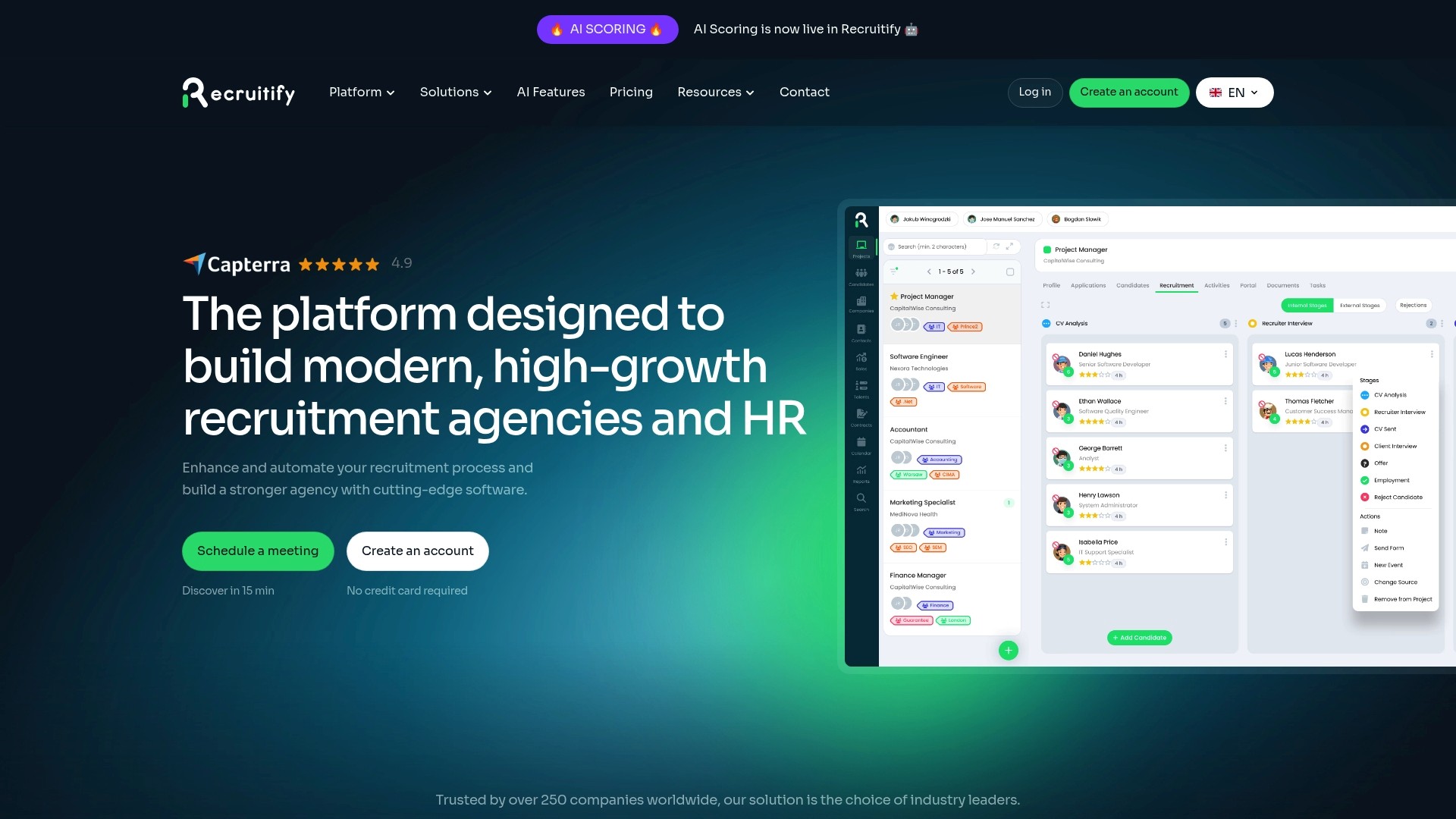
The platform consolidates ATS, CRM, and contracting modules into one system and claims to cut administrative tasks substantially through workflow automation. It also states that features like contextual matching AI and OCR-based CV parsing speed up shortlisting, that a blind CV module can anonymize candidate profiles, and that a consent management module provides a full audit trail for compliance reporting.

Each of these maps to a decision criterion above: audit trails support the compliance check, AI matching supports faster shortlisting, and consolidation supports the "one system instead of scattered tools" strategic trigger. In a live demo, ask any vendor, including Recruitify, to show a deduplication run, DPIA documentation, sample match scores, and a full data export.
Balancing automation with human judgment
Spreadsheets are a reasonable starting point for early-stage hiring, not a mistake. The shift to an ATS pays off when volume and compliance risk grow, but buying one deserves the same DPIA-first discipline as any other data system: pilot it, question the AI, and keep a human reviewing every automated decision.
- Recruitify Team
A direct path if you decide it's time
The platform is positioned as a consolidated solution built for recruitment agencies and HR teams that need ATS, CRM, and contracting pieces working from a unified system instead of disconnected tools.
Plan | Price | Best for |
|---|---|---|
HR Team | 69 EUR per month per user | Internal HR teams centralizing hiring |
Recruitment Agencies | 79 EUR per month per user | Agencies running multiple client pipelines |
Enterprise | Available on request | Large-scale, multi-team deployments |
Full details sit on the pricing page, and teams wanting a closer look at the automation layer before a demo can review the recruitment automation features directly.
FAQ
Which one is better, a spreadsheet or Excel?
Excel and Google Sheets are both spreadsheet tools, so the comparison that matters is spreadsheets versus an applicant tracking system rather than one spreadsheet program against another. For low-volume, single-role hiring, either spreadsheet tool works fine.
What is an ATS example?
An applicant tracking system is software that centralizes candidate records, automates outreach and scheduling, and generates pipeline reports in one place.
Why use a database instead of a spreadsheet?
A structured database, the kind an ATS runs on, supports multiple simultaneous users without version conflicts, keeps a full activity history per candidate, and enforces consistent fields for reliable reporting. A spreadsheet has none of those safeguards built in, which is why collaboration and duplicate-record issues grow as hiring volume increases.
What are two types of spreadsheets?
The two most common spreadsheet tools used in recruitment are Microsoft Excel and Google Sheets, both of which let teams build manual candidate trackers with custom columns. Neither includes built-in automation, audit trails, or role-based permissions, which is the functional gap an ATS is designed to close.
Recommended


News & Updates
Stay up-to-date with the latest innovations, features, and tips about Recruitify!
By providing your email address within the newsletter sign-up form, you confirm its processing to send marketing information regarding the Administrator’s products and services. The Administrator of your personal data processed for the abovementioned purposes is Recruitify Spółka z o.o., based in Warsaw, Poland (KRS 0000709889). For more information on the principles of personal data processing and the rights of data subjects, please check the Privacy Policy.

Last updated:
Reclaim 300 Recruiter Hours, Move HR from Spreadsheets to an ATS
Acquiring Talent
The Recruitify Team
Spreadsheets work fine for a single open role with one hiring manager and a handful of applicants, but they break down once volume, multiple collaborators, automation needs, or compliance obligations enter the picture. An applicant tracking system replaces manual tracking with centralized records, automated workflows, and audit trails, at the cost of a license fee and a short implementation period. This guide walks through the failure points, the feature mapping, the ROI math, and the procurement and migration steps that make the switch safe.
TL;DR:
Spreadsheets become inefficient when multiple recruiters collaborate, leading to conflicts, duplicates, lost feedback, and manual reporting delays.
An applicant tracking system centralizes candidate records, offers automated workflows, activity logs, and role-based permissions to address spreadsheet limitations.
Transitioning requires evaluating operational, compliance, and strategic triggers, with a focus on automating manual tasks and improving data accuracy.
A solid ROI calculation considers saved hours, faster hiring, reduced candidate loss, and compliance risk mitigation, offsetting implementation costs.
Vendors should be assessed based on integration, data protection, AI transparency, support, and a comprehensive migration process with a clear rollback plan.
Move Recruitment Beyond Spreadsheets
Recruitify.ai brings ATS, Sales CRM, and IT contracting into one ecosystem, with automation, AI matching, and GDPR audit trails.
Tasble of Contents
What an ATS provides: feature mapping to each spreadsheet problem
When to switch: practical triggers and a short diagnostic checklist
Cost and ROI: an approachable model to justify an ATS purchase
How to choose an ATS: procurement checklist and data-protection questions
Why teams start with spreadsheets and where they break
Spreadsheets are the default starting point for a reason. They cost nothing extra since most teams already have Excel or Google Sheets, everyone already knows how to use them, and columns can be rearranged in seconds to fit whatever a hiring manager wants to track that week. For a company hiring one or two roles a year, this flexibility is a genuine advantage.
The trouble starts when hiring scales past that simple case. Multiple recruiters editing the same file introduce collaboration and version-control problems, with conflicting edits and orphaned copies emailed back and forth. Interview feedback gets typed into a random cell or lost in a separate email thread, duplicate candidate entries pile up across different job tabs, and there is no timeline showing who contacted a candidate or when. Scheduling still happens by hand through calendar invites and follow-up emails, and reporting on time-to-hire or pipeline health means someone manually counting rows.
Common warning signs include:
Recruiters spending hours each week reconciling duplicate candidate rows across tabs.
Hiring managers asking "where did we leave off with this candidate" because feedback lives in someone's inbox.
No one able to answer, in under a minute, how many candidates are active in each open role.
These same failure modes show up consistently across industry explainers) on recruitment software, which point to the same core issues: lost history, weak reporting, and manual follow-ups that eat recruiter time.
What an ATS provides: feature mapping to each spreadsheet problem
An applicant tracking system is built around a single candidate record rather than a row in a shared file. Each candidate gets a profile with an activity timeline, attached resumes and notes, and a status that updates automatically as they move through the pipeline. That structure alone solves the "where did we leave off" problem that plagues spreadsheet-based tracking.
Beyond the record itself, most platforms add:
Templated outreach and interview scheduling that trigger automatically on status change, removing manual email drafting.
Search and tagging across the full candidate database, so past applicants can be resurfaced instead of re-sourced.
Role-based permissions that let multiple recruiters and hiring managers work the same pipeline without overwriting each other's edits.
Dashboards for pipeline volume, time-to-hire, and diversity metrics, generated automatically rather than counted by hand.
Consent management and audit trails that log who accessed or changed a candidate record and when.
Some platforms now layer AI scoring or contextual matching on top of search, ranking candidates against a role's requirements. That capability is genuinely useful for narrowing a large applicant pool, but transparency matters: the ICO's guidance on AI in recruitment recommends treating AI scoring as an assistive filter rather than an automated decision, with a human reviewing the output before anyone is rejected.
A well-run ATS migration can meaningfully reduce the administrative time recruiters spend on manual data entry and follow-up scheduling. For teams weighing the switch, that time reduction is often the single biggest line in the business case, more so than any individual feature.
When to switch: practical triggers and a short diagnostic checklist
Three categories of signal tend to point toward switching. Operational triggers show up as recruiter hours lost to manual updates, more than a couple of collaborators editing the same file, or several roles open at once. Risk and compliance triggers appear when the team cannot quickly show what consent a candidate gave, cannot produce an audit log on request, or would struggle to respond to a subject access request within the legal timeframe. Strategic triggers include a need to post jobs across multiple boards at once, integrate with a company website or HRIS, or build a searchable talent database instead of starting from zero on every search.
A short diagnostic to run in a review meeting:
Count how many people currently edit the candidate spreadsheet and how often conflicts happen.
Estimate the hours per week recruiters spend on manual scheduling, status updates, or reconciling duplicates.
Ask whether the team could produce a candidate's consent history and contact log within a day if requested.
Check whether reporting on time-to-hire currently requires manual counting.
Confirm whether more than one role is open concurrently, and for how long that is expected to continue.
Pro Tip: If the answer to question three takes longer than a day to figure out, treat that alone as a strong signal to move off spreadsheets, regardless of the other answers.
Cost and ROI: an approachable model to justify an ATS purchase
Building the business case starts with time. Say a recruiter spends 6 hours a week on manual scheduling, status updates, and reconciling duplicate rows: over a year, that is roughly 300 hours that automation could reclaim, even if only half of it is recovered in practice. Multiply that recovered time by the recruiter's hourly cost to get a rough annual value, then compare it against the license fee for the number of seats needed.
Time savings are not the only return. Other forms of ROI worth including in the case:
Fewer lost candidates, since a searchable database resurfaces past applicants instead of losing them in an old spreadsheet tab.
Faster time-to-offer, which reduces the odds of losing a strong candidate to a competing offer.
Lower compliance exposure, since audit trails and consent logs reduce the risk and cost of responding to a data request.
Budget for implementation costs too: data cleanup before migration, training time for the team, and a short adjustment period where output may dip slightly. Amortizing those one-time costs over the first year, alongside the recovered recruiter hours, gives finance or leadership a clean, defensible number rather than a vague productivity claim.
How to choose an ATS: procurement checklist and data-protection questions
Evaluating vendors goes faster with a fixed checklist rather than a feature-by-feature demo tour. Cover four areas:
Functional fit: integrations with existing HR tools, search quality across the candidate database, automation depth, role-based permissions, and the ability to export full data on request.
Data protection: ask the vendor for evidence of a completed Data Protection Impact Assessment, clarity on which party is the data controller and which is the processor, and documented retention and anonymization practices. The ICO's recruitment guidance outlines these responsibilities across the full hiring lifecycle, from advertising a vacancy to deleting candidate data.
AI transparency: if the platform includes AI scoring or matching, ask how bias is monitored, whether match scores can be audited by a human, and whether model behavior is documented anywhere a buyer can review.
Operational support: migration assistance, deduplication routines, service-level agreements, training resources, and admin-level controls over data access.
Pro Tip: Ask every shortlisted vendor for a live demo of their deduplication routine on a sample file. It reveals more about data quality than any feature list.
Red flags include no API for integrations, an AI feature the vendor cannot explain in plain terms, or no ability to export the full candidate database and audit log on request.
Migration and transition best practices
Moving from spreadsheets to an ATS goes smoothly with a short, disciplined plan rather than a single big-bang cutover.
Inventory existing fields, consent records, duplicate entries, and any privacy flags before touching the new system.
Pilot the migration on one hiring lane first, and run a short hybrid period where both systems are checked before fully retiring the spreadsheet.
Assign clear roles for who owns data entry during cutover, and train the team on the new workflow before the pilot ends.
Verify the migrated data against the original spreadsheet, keep a backup, and confirm a rollback plan exists if something goes wrong.
Set an ongoing hygiene schedule for deduplication and data retention once the system is live.
A consolidated platform as an example of the shift
The platform consolidates ATS, CRM, and contracting modules into one system and claims to cut administrative tasks substantially through workflow automation. It also states that features like contextual matching AI and OCR-based CV parsing speed up shortlisting, that a blind CV module can anonymize candidate profiles, and that a consent management module provides a full audit trail for compliance reporting.
Each of these maps to a decision criterion above: audit trails support the compliance check, AI matching supports faster shortlisting, and consolidation supports the "one system instead of scattered tools" strategic trigger. In a live demo, ask any vendor, including Recruitify, to show a deduplication run, DPIA documentation, sample match scores, and a full data export.
Balancing automation with human judgment
Spreadsheets are a reasonable starting point for early-stage hiring, not a mistake. The shift to an ATS pays off when volume and compliance risk grow, but buying one deserves the same DPIA-first discipline as any other data system: pilot it, question the AI, and keep a human reviewing every automated decision.
- Recruitify Team
A direct path if you decide it's time
The platform is positioned as a consolidated solution built for recruitment agencies and HR teams that need ATS, CRM, and contracting pieces working from a unified system instead of disconnected tools.
Plan | Price | Best for |
|---|---|---|
HR Team | 69 EUR per month per user | Internal HR teams centralizing hiring |
Recruitment Agencies | 79 EUR per month per user | Agencies running multiple client pipelines |
Enterprise | Available on request | Large-scale, multi-team deployments |
Full details sit on the pricing page, and teams wanting a closer look at the automation layer before a demo can review the recruitment automation features directly.
FAQ
Which one is better, a spreadsheet or Excel?
Excel and Google Sheets are both spreadsheet tools, so the comparison that matters is spreadsheets versus an applicant tracking system rather than one spreadsheet program against another. For low-volume, single-role hiring, either spreadsheet tool works fine.
What is an ATS example?
An applicant tracking system is software that centralizes candidate records, automates outreach and scheduling, and generates pipeline reports in one place.
Why use a database instead of a spreadsheet?
A structured database, the kind an ATS runs on, supports multiple simultaneous users without version conflicts, keeps a full activity history per candidate, and enforces consistent fields for reliable reporting. A spreadsheet has none of those safeguards built in, which is why collaboration and duplicate-record issues grow as hiring volume increases.
What are two types of spreadsheets?
The two most common spreadsheet tools used in recruitment are Microsoft Excel and Google Sheets, both of which let teams build manual candidate trackers with custom columns. Neither includes built-in automation, audit trails, or role-based permissions, which is the functional gap an ATS is designed to close.
Recommended
News & Updates
Stay up-to-date with the latest innovations, features, and tips about Recruitify!
By providing your email address within the newsletter sign-up form, you confirm its processing to send marketing information regarding the Administrator’s products and services. The Administrator of your personal data processed for the abovementioned purposes is Recruitify Spółka z o.o., based in Warsaw, Poland (KRS 0000709889). For more information on the principles of personal data processing and the rights of data subjects, please check the Privacy Policy.
Last updated:
Reclaim 300 Recruiter Hours, Move HR from Spreadsheets to an ATS
Acquiring Talent
The Recruitify Team
Spreadsheets work fine for a single open role with one hiring manager and a handful of applicants, but they break down once volume, multiple collaborators, automation needs, or compliance obligations enter the picture. An applicant tracking system replaces manual tracking with centralized records, automated workflows, and audit trails, at the cost of a license fee and a short implementation period. This guide walks through the failure points, the feature mapping, the ROI math, and the procurement and migration steps that make the switch safe.
TL;DR:
Spreadsheets become inefficient when multiple recruiters collaborate, leading to conflicts, duplicates, lost feedback, and manual reporting delays.
An applicant tracking system centralizes candidate records, offers automated workflows, activity logs, and role-based permissions to address spreadsheet limitations.
Transitioning requires evaluating operational, compliance, and strategic triggers, with a focus on automating manual tasks and improving data accuracy.
A solid ROI calculation considers saved hours, faster hiring, reduced candidate loss, and compliance risk mitigation, offsetting implementation costs.
Vendors should be assessed based on integration, data protection, AI transparency, support, and a comprehensive migration process with a clear rollback plan.
Move Recruitment Beyond Spreadsheets
Recruitify.ai brings ATS, Sales CRM, and IT contracting into one ecosystem, with automation, AI matching, and GDPR audit trails.
Tasble of Contents
What an ATS provides: feature mapping to each spreadsheet problem
When to switch: practical triggers and a short diagnostic checklist
Cost and ROI: an approachable model to justify an ATS purchase
How to choose an ATS: procurement checklist and data-protection questions
Why teams start with spreadsheets and where they break
Spreadsheets are the default starting point for a reason. They cost nothing extra since most teams already have Excel or Google Sheets, everyone already knows how to use them, and columns can be rearranged in seconds to fit whatever a hiring manager wants to track that week. For a company hiring one or two roles a year, this flexibility is a genuine advantage.
The trouble starts when hiring scales past that simple case. Multiple recruiters editing the same file introduce collaboration and version-control problems, with conflicting edits and orphaned copies emailed back and forth. Interview feedback gets typed into a random cell or lost in a separate email thread, duplicate candidate entries pile up across different job tabs, and there is no timeline showing who contacted a candidate or when. Scheduling still happens by hand through calendar invites and follow-up emails, and reporting on time-to-hire or pipeline health means someone manually counting rows.
Common warning signs include:
Recruiters spending hours each week reconciling duplicate candidate rows across tabs.
Hiring managers asking "where did we leave off with this candidate" because feedback lives in someone's inbox.
No one able to answer, in under a minute, how many candidates are active in each open role.
These same failure modes show up consistently across industry explainers) on recruitment software, which point to the same core issues: lost history, weak reporting, and manual follow-ups that eat recruiter time.
What an ATS provides: feature mapping to each spreadsheet problem
An applicant tracking system is built around a single candidate record rather than a row in a shared file. Each candidate gets a profile with an activity timeline, attached resumes and notes, and a status that updates automatically as they move through the pipeline. That structure alone solves the "where did we leave off" problem that plagues spreadsheet-based tracking.
Beyond the record itself, most platforms add:
Templated outreach and interview scheduling that trigger automatically on status change, removing manual email drafting.
Search and tagging across the full candidate database, so past applicants can be resurfaced instead of re-sourced.
Role-based permissions that let multiple recruiters and hiring managers work the same pipeline without overwriting each other's edits.
Dashboards for pipeline volume, time-to-hire, and diversity metrics, generated automatically rather than counted by hand.
Consent management and audit trails that log who accessed or changed a candidate record and when.
Some platforms now layer AI scoring or contextual matching on top of search, ranking candidates against a role's requirements. That capability is genuinely useful for narrowing a large applicant pool, but transparency matters: the ICO's guidance on AI in recruitment recommends treating AI scoring as an assistive filter rather than an automated decision, with a human reviewing the output before anyone is rejected.
A well-run ATS migration can meaningfully reduce the administrative time recruiters spend on manual data entry and follow-up scheduling. For teams weighing the switch, that time reduction is often the single biggest line in the business case, more so than any individual feature.
When to switch: practical triggers and a short diagnostic checklist
Three categories of signal tend to point toward switching. Operational triggers show up as recruiter hours lost to manual updates, more than a couple of collaborators editing the same file, or several roles open at once. Risk and compliance triggers appear when the team cannot quickly show what consent a candidate gave, cannot produce an audit log on request, or would struggle to respond to a subject access request within the legal timeframe. Strategic triggers include a need to post jobs across multiple boards at once, integrate with a company website or HRIS, or build a searchable talent database instead of starting from zero on every search.
A short diagnostic to run in a review meeting:
Count how many people currently edit the candidate spreadsheet and how often conflicts happen.
Estimate the hours per week recruiters spend on manual scheduling, status updates, or reconciling duplicates.
Ask whether the team could produce a candidate's consent history and contact log within a day if requested.
Check whether reporting on time-to-hire currently requires manual counting.
Confirm whether more than one role is open concurrently, and for how long that is expected to continue.
Pro Tip: If the answer to question three takes longer than a day to figure out, treat that alone as a strong signal to move off spreadsheets, regardless of the other answers.
Cost and ROI: an approachable model to justify an ATS purchase
Building the business case starts with time. Say a recruiter spends 6 hours a week on manual scheduling, status updates, and reconciling duplicate rows: over a year, that is roughly 300 hours that automation could reclaim, even if only half of it is recovered in practice. Multiply that recovered time by the recruiter's hourly cost to get a rough annual value, then compare it against the license fee for the number of seats needed.
Time savings are not the only return. Other forms of ROI worth including in the case:
Fewer lost candidates, since a searchable database resurfaces past applicants instead of losing them in an old spreadsheet tab.
Faster time-to-offer, which reduces the odds of losing a strong candidate to a competing offer.
Lower compliance exposure, since audit trails and consent logs reduce the risk and cost of responding to a data request.
Budget for implementation costs too: data cleanup before migration, training time for the team, and a short adjustment period where output may dip slightly. Amortizing those one-time costs over the first year, alongside the recovered recruiter hours, gives finance or leadership a clean, defensible number rather than a vague productivity claim.
How to choose an ATS: procurement checklist and data-protection questions
Evaluating vendors goes faster with a fixed checklist rather than a feature-by-feature demo tour. Cover four areas:
Functional fit: integrations with existing HR tools, search quality across the candidate database, automation depth, role-based permissions, and the ability to export full data on request.
Data protection: ask the vendor for evidence of a completed Data Protection Impact Assessment, clarity on which party is the data controller and which is the processor, and documented retention and anonymization practices. The ICO's recruitment guidance outlines these responsibilities across the full hiring lifecycle, from advertising a vacancy to deleting candidate data.
AI transparency: if the platform includes AI scoring or matching, ask how bias is monitored, whether match scores can be audited by a human, and whether model behavior is documented anywhere a buyer can review.
Operational support: migration assistance, deduplication routines, service-level agreements, training resources, and admin-level controls over data access.
Pro Tip: Ask every shortlisted vendor for a live demo of their deduplication routine on a sample file. It reveals more about data quality than any feature list.
Red flags include no API for integrations, an AI feature the vendor cannot explain in plain terms, or no ability to export the full candidate database and audit log on request.
Migration and transition best practices
Moving from spreadsheets to an ATS goes smoothly with a short, disciplined plan rather than a single big-bang cutover.
Inventory existing fields, consent records, duplicate entries, and any privacy flags before touching the new system.
Pilot the migration on one hiring lane first, and run a short hybrid period where both systems are checked before fully retiring the spreadsheet.
Assign clear roles for who owns data entry during cutover, and train the team on the new workflow before the pilot ends.
Verify the migrated data against the original spreadsheet, keep a backup, and confirm a rollback plan exists if something goes wrong.
Set an ongoing hygiene schedule for deduplication and data retention once the system is live.
A consolidated platform as an example of the shift
The platform consolidates ATS, CRM, and contracting modules into one system and claims to cut administrative tasks substantially through workflow automation. It also states that features like contextual matching AI and OCR-based CV parsing speed up shortlisting, that a blind CV module can anonymize candidate profiles, and that a consent management module provides a full audit trail for compliance reporting.
Each of these maps to a decision criterion above: audit trails support the compliance check, AI matching supports faster shortlisting, and consolidation supports the "one system instead of scattered tools" strategic trigger. In a live demo, ask any vendor, including Recruitify, to show a deduplication run, DPIA documentation, sample match scores, and a full data export.
Balancing automation with human judgment
Spreadsheets are a reasonable starting point for early-stage hiring, not a mistake. The shift to an ATS pays off when volume and compliance risk grow, but buying one deserves the same DPIA-first discipline as any other data system: pilot it, question the AI, and keep a human reviewing every automated decision.
- Recruitify Team
A direct path if you decide it's time
The platform is positioned as a consolidated solution built for recruitment agencies and HR teams that need ATS, CRM, and contracting pieces working from a unified system instead of disconnected tools.
Plan | Price | Best for |
|---|---|---|
HR Team | 69 EUR per month per user | Internal HR teams centralizing hiring |
Recruitment Agencies | 79 EUR per month per user | Agencies running multiple client pipelines |
Enterprise | Available on request | Large-scale, multi-team deployments |
Full details sit on the pricing page, and teams wanting a closer look at the automation layer before a demo can review the recruitment automation features directly.
FAQ
Which one is better, a spreadsheet or Excel?
Excel and Google Sheets are both spreadsheet tools, so the comparison that matters is spreadsheets versus an applicant tracking system rather than one spreadsheet program against another. For low-volume, single-role hiring, either spreadsheet tool works fine.
What is an ATS example?
An applicant tracking system is software that centralizes candidate records, automates outreach and scheduling, and generates pipeline reports in one place.
Why use a database instead of a spreadsheet?
A structured database, the kind an ATS runs on, supports multiple simultaneous users without version conflicts, keeps a full activity history per candidate, and enforces consistent fields for reliable reporting. A spreadsheet has none of those safeguards built in, which is why collaboration and duplicate-record issues grow as hiring volume increases.
What are two types of spreadsheets?
The two most common spreadsheet tools used in recruitment are Microsoft Excel and Google Sheets, both of which let teams build manual candidate trackers with custom columns. Neither includes built-in automation, audit trails, or role-based permissions, which is the functional gap an ATS is designed to close.
Recommended
News & Updates
Stay up-to-date with the latest innovations, features, and tips about Recruitify!
By providing your email address within the newsletter sign-up form, you confirm its processing to send marketing information regarding the Administrator’s products and services. The Administrator of your personal data processed for the abovementioned purposes is Recruitify Spółka z o.o., based in Warsaw, Poland (KRS 0000709889). For more information on the principles of personal data processing and the rights of data subjects, please check the Privacy Policy.

Discover More

Applicant Tracking System
Pass EEOC's 80% Check: Diversity Recruiting Analytics for HR Teams
For HR teams: instrument hiring funnels, run a three month pilot, and use the EEOC four fifths check to spot and fix hiring bias.
29 Sept 2026
Discover More

Applicant Tracking System
HR Teams: Build Recruitment Dashboards Fast With 3–5 KPIs
HR teams: design recruitment dashboards that drive decisions. Pick 3–5 KPIs, map each to the hiring decision it should trigger, and build fast.
28 Sept 2026
Discover More

Applicant Tracking System
Cut Screening Time 70%: Six Phase Remote Hiring Process for HR Teams
Redesign your remote hiring process with an async first six phase workflow, practical templates, and automation that can cut screening time 70%.
27 Sept 2026
Discover More
Applicant Tracking System
Pass EEOC's 80% Check: Diversity Recruiting Analytics for HR Teams
For HR teams: instrument hiring funnels, run a three month pilot, and use the EEOC four fifths check to spot and fix hiring bias.
29 Sept 2026
Discover More
Applicant Tracking System
HR Teams: Build Recruitment Dashboards Fast With 3–5 KPIs
HR teams: design recruitment dashboards that drive decisions. Pick 3–5 KPIs, map each to the hiring decision it should trigger, and build fast.
28 Sept 2026
Discover More