Last updated:
Body Leasing Explained: Model, Contracts and Risks

Applicant Tracking System

The Recruitify Team
Body leasing is an arrangement in which a company takes specialists, most often IT professionals, from a provider for a fixed period and directs their daily work, while the provider remains their formal employer. The client gets skills quickly and without a permanent hire. The provider handles contracts, payroll and employment formalities. This guide explains how the model works, how it differs from outsourcing, what a contract should contain, where the legal risks sit, and what a provider needs in its tooling to run it well.
Key Takeaways
Body leasing is a triangular relationship: the provider employs and pays the specialist, the client assigns and supervises the work.
The decisive difference from outsourcing is who manages the work: in body leasing the client does, in outsourcing the provider takes responsibility for the result.
A contract should fix the term, notice periods, pricing, liability, confidentiality and intellectual-property ownership, and it must describe the real working relationship, not only carry a label.
Rules differ sharply by country, so a model that is routine in one market can be regulated or restricted in another.
For providers, margin and bench control depend on one clean view of candidates, clients, placements and contract end dates.
Table of Contents
What body leasing means
The term is common in Central and Eastern Europe and in the IT sector, and it is often used interchangeably with staff augmentation or contract staffing. In the US, the nearest everyday vocabulary is contract staffing, staff augmentation and, for the HR-administration variant, employee leasing. The core idea is the same everywhere: a company rents capacity in the form of people, not a finished product.
The pattern has three parties:
The provider (the leasing agency or body leasing company) recruits the specialist, signs the employment or contractor agreement, pays wages or fees, and handles the related administration.
The client needs skills for a defined period, assigns tasks and supervises how they are carried out.
The specialist works inside the client’s team, often with the client’s tools and processes, but is not on the client’s payroll.
The International Labour Organization describes agency work in just these terms: an agency employs workers and makes them available to a user enterprise, which assigns their tasks and supervises execution (ILO, Agencies in South Africa). The same paper stresses that this is a triangular relationship in which the agency stays responsible for paying the worker and meeting human-resources requirements while the user enterprise directs the work.
How the body leasing model works step by step
An engagement usually follows the same sequence, whether it lasts three months or three years.
Request. The client describes the role: tech stack, seniority, language, start date, expected duration and working arrangement (remote, hybrid or on site).
Sourcing and matching. The provider searches its database and the open market, shortlists candidates and checks them against the requirements. The quality of this step depends on how well the provider’s records are structured, because a specialist who worked on a similar stack two years ago is often the fastest match.
Presentation. Profiles go to the client, frequently as anonymized or branded CVs so that the client cannot bypass the provider.
Interview and selection. The client interviews and chooses, which is itself a sign that the client will manage the person.
Contracting. A framework or service agreement with the client, and an employment or B2B contract with the specialist, are signed. The rate the client pays and the rate the specialist receives define the provider’s margin.
Onboarding. Access, equipment, security briefings and confidentiality undertakings are completed. A written checklist avoids the delays that cost billable days; our contractor onboarding checklist for IT staffing agencies covers the steps.
Delivery and billing. The specialist works under the client’s direction, timesheets are approved and the provider invoices, typically by hours or days worked.
Extension, replacement or end. Notice periods apply, and the provider either extends, replaces the specialist or moves them to another assignment.
When companies use body leasing
The model fits situations where the need is real but temporary or hard to staff quickly:
A skill gap on a project, such as a cloud migration that needs a specific certification for six months.
A peak in workload, for example a product launch or a release deadline.
A pilot or a new market where a permanent team would be premature.
Continuity during long recruitment cycles for permanent roles.
The usual advantages are speed, flexibility in scaling up and down, and access to specialists the client could not find alone. The usual limitations are a higher short-term cost than a permanent hire, a risk that the specialist does not fit the client’s culture, and knowledge that leaves with the person at the end of the contract. Companies that use the model well plan for integration, communication and monitoring from the first week rather than treating the specialist as an external vendor who will work in isolation.
Body leasing vs. outsourcing
The two are often confused because both bring outside people into a project. The difference lies in who is responsible for the work.
Criterion | Body leasing (staff augmentation) | Outsourcing (statement of work) |
|---|---|---|
Who directs the work | The client’s managers | The provider’s project manager |
What the client buys | Time and skills of individuals | A defined result or service |
Billing | Usually hours or days worked | Usually an agreed amount for deliverables |
Scope definition | Looser, can change across assignments | Specified work products and acceptance criteria |
Typical duration | Shorter-term or flexible | Tied to the project |
Main risk for the client | Management load and integration | Dependence on the provider and scope disputes |
Public procurement guidance makes the same distinction. The Virginia Information Technologies Agency explains that with staff augmentation, customer managers direct resources across assignments and pay for hours worked, while a statement of work shifts project management to the consulting firm, which delivers specified work products for an agreed amount upon delivery and acceptance (VITA, Staff Augmentation or SOW).
A practical test: if you need to tell the person what to do tomorrow morning, you are in a body leasing arrangement. If you only need to check that the agreed result arrives, you are in outsourcing.
What a body leasing contract should cover
There are normally two layers of paperwork, and each has its own checklist.
The agreement between provider and client
Term and renewal. Start date, minimum commitment, extension mechanism.
Notice periods. How quickly either side can end or replace the specialist, and any minimum billing after notice.
Rates and invoicing. Hourly or daily rate, overtime, expenses, indexation, payment terms.
Role description. Skills, seniority and tasks, written precisely enough to judge whether the specialist meets them.
Replacement and substitution. What happens if the specialist leaves, is ill or does not meet the profile.
Liability and insurance. Who is responsible for errors and for damage, and up to what amount.
Confidentiality. Obligations that bind both the provider and the individual.
Intellectual property. Ownership of code and documents created during the assignment, assigned to the client in writing.
Non-solicitation or conversion terms. What the client pays if it wants to hire the specialist directly.
The agreement between provider and specialist
This covers remuneration, benefits, working time, confidentiality, assignment of IP to the provider so that it can pass it on, and the specialist’s duties toward the client. Where the specialist is engaged as a contractor through a company rather than as an employee, the classification of that relationship needs its own review in the country concerned.
Check the real relationship, not only the label
A contract that calls the arrangement a service project but places the person inside the client’s team under its instructions can be reclassified. The German IT association Bitkom explains that, under German law, employee leasing is indicated when the worker is integrated into the client’s organization and subject to its instructions, and that the contract must correctly identify the arrangement (Bitkom, Fremdpersonaleinsatz im IT-Sourcing). That is German law, not a worldwide rule, but the principle travels: parties should assess how people actually work, and write the contract to match.

Legal and compliance risks by country
Body leasing sits at the border of employment law, tax law and commercial contracting, so the same arrangement is treated differently from one jurisdiction to the next. Three examples show the range.
South Africa. A client can be jointly and severally liable for compliance with minimum employment standards, including amounts owed to workers if a labour broker fails to pay (ILO, Law and practice of private employment agency work in South Africa). The same study notes that workers may be unsure whether the agency or the client is their legal employer.
Sweden. An agency must guarantee agency workers at least the basic working and employment conditions that would apply if the user undertaking had recruited them directly for the same job, for the duration of the assignment (Swedish Code of Statutes, as published by the ILO).
United Kingdom. Government guidance on the Agency Workers Regulations 2010 says hirers should provide up-to-date terms and conditions, and agencies should request that information, so that workers receive equal treatment after 12 weeks in the same job (GOV.UK).
In the United States, the picture depends on the state and on the type of arrangement, and worker classification, tax and benefits questions are decided case by case. Before a cross-border engagement, ask a labour lawyer in the country where the work is performed, and a tax adviser where the specialist is a resident. If a specialist works in one country for a client in another, check both sets of rules.
Practical safeguards
Keep direction of work consistent with the contract type. Do not manage a service-project team as if it were your staff.
Put confidentiality and IP clauses in place before access is granted, not after.
Keep an auditable record of consents and personal data you process about specialists and candidates, including under GDPR where it applies.
Review long-running assignments periodically, because an engagement that began as a short project can drift into something that looks like permanent employment.
What providers need to run body leasing profitably
For an agency, the model is a margin business with a long tail of administration: every active contract has an end date, a rate, a client approver and a specialist who may be available again in a few months. The failure points are predictable.
Spreadsheets for contracts. End dates are missed, extensions are late and the margin per specialist is calculated by hand.
Disconnected sales and recruitment. The person who knows the client’s next requirement is not the person who knows the available bench.
Lost candidates. Specialists who finished an assignment disappear from view and are paid for again through external platforms when the next request arrives.
Slow shortlisting. Reading unstructured CVs and building profiles for the client takes hours that could go to selling.
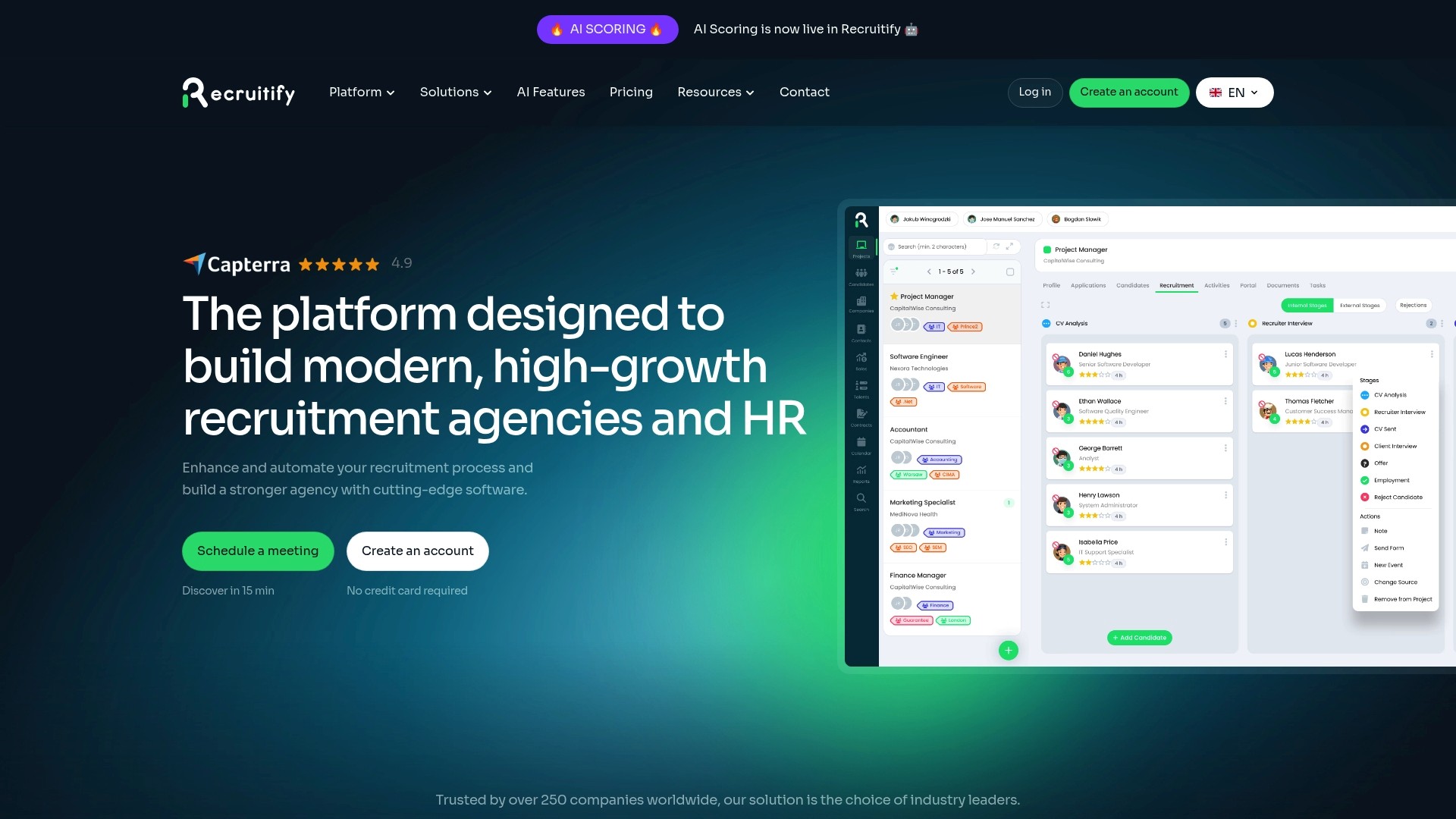
Those are the problems we built Recruitify to address. Our contracting and body leasing module keeps specialists, client contracts, rates and end dates in one place alongside the ATS and CRM, so the sales pipeline and the recruitment pipeline are the same view. You can see how this plays out for a real agency in our case study on moving body leasing and reporting from Excel, and in our overview of IT body leasing software.
Our perspective: where body leasing agencies lose time and money
We work with IT recruitment agencies and headhunters, and the same pattern appears in almost every body leasing business that struggles. The problem is rarely demand. It is information scattered across a mailbox, a spreadsheet, a CRM and a separate applicant system, so that nobody sees the whole process at once.
From our work, three conclusions follow:
The database is the asset. Every specialist who has ever been placed, interviewed or screened is a possible future placement. Indexing that history by tech stack and availability lets an agency answer a new request from its own records, which reduces reliance on expensive external licenses.
Matching should understand context. A keyword search treats two stacks as unrelated when an experienced recruiter would see an obvious step between them. Contextual matching with a percentage score gives the recruiter a shortlist to verify, not a pile to read.
Administration should be automated, not hired. We aim for a reduction of administrative work of up to 70% by automating the path from first contact and candidate categorization to the generation of B2B contracts, so the same team can close more placements without growing.
Compliance belongs inside the process as well. Consent management and a complete audit trail are easier to maintain when records live in one system than when they are reconstructed after a request from a candidate or a client.
— Recruitify Team
Choosing software for a body leasing business
When you compare tools, look at how well they support the model described above, not only generic recruiting.
Need | What to look for |
|---|---|
Candidate records | Automatic CV parsing from PDFs, DOCX, scans and photos, with duplicate detection |
Shortlisting | Matching that scores candidates against project requirements |
Client presentation | Anonymized profile generation |
Sourcing | Boolean string generation and search across your own database |
Contracts | End dates, rates, margins and renewals tracked per assignment |
Sales | A CRM linked to the recruitment pipeline |
Compliance | Consent management and an audit trail |
Plans for agencies and in-house teams are listed on our pricing page: the HR Team plan is €61 per user per month, the Agency plan is €67 per user per month, and Enterprise is priced on request. If you run a body leasing business and want to see your own contracts and bench in one view, start with the Agency plan.
Frequently asked questions
What is body leasing in simple terms?
Body leasing means renting specialists from a provider for a set period. The provider employs and pays them, while the client assigns the tasks and supervises the work. It is most common in IT, where companies need specific skills quickly.
How is body leasing different from outsourcing?
In body leasing, you manage the person and pay for time worked. In outsourcing, the provider manages the project and the team and you pay for agreed results. Public IT procurement guidance, such as that from Virginia, draws the same line between staff augmentation and a statement of work.
What should a body leasing contract include?
At minimum: the term and notice periods, rates and invoicing, a clear role description, liability, confidentiality, intellectual-property ownership and replacement terms. Have a lawyer in the country where the work is done review it, because employment rules differ by jurisdiction.
Is body leasing legal everywhere?
It is permitted in many countries but regulated, and the conditions vary. Sweden, the United Kingdom, Germany and South Africa, for example, each set their own rules on equal treatment, liability and how the arrangement must be documented. Check the law of the country where the specialist works.
What are the main drawbacks for the client?
Short-term costs can be higher than a permanent hire, the specialist may not fit the team culture, and knowledge can leave at the end of the contract. Planning integration, regular communication and a handover process reduces these risks.
Sources
Recommended


News & Updates
Stay up-to-date with the latest innovations, features, and tips about Recruitify!
By providing your email address within the newsletter sign-up form, you confirm its processing to send marketing information regarding the Administrator’s products and services. The Administrator of your personal data processed for the abovementioned purposes is Recruitify Spółka z o.o., based in Warsaw, Poland (KRS 0000709889). For more information on the principles of personal data processing and the rights of data subjects, please check the Privacy Policy.

Last updated:
Body Leasing Explained: Model, Contracts and Risks
Applicant Tracking System
The Recruitify Team
Body leasing is an arrangement in which a company takes specialists, most often IT professionals, from a provider for a fixed period and directs their daily work, while the provider remains their formal employer. The client gets skills quickly and without a permanent hire. The provider handles contracts, payroll and employment formalities. This guide explains how the model works, how it differs from outsourcing, what a contract should contain, where the legal risks sit, and what a provider needs in its tooling to run it well.
Key Takeaways
Body leasing is a triangular relationship: the provider employs and pays the specialist, the client assigns and supervises the work.
The decisive difference from outsourcing is who manages the work: in body leasing the client does, in outsourcing the provider takes responsibility for the result.
A contract should fix the term, notice periods, pricing, liability, confidentiality and intellectual-property ownership, and it must describe the real working relationship, not only carry a label.
Rules differ sharply by country, so a model that is routine in one market can be regulated or restricted in another.
For providers, margin and bench control depend on one clean view of candidates, clients, placements and contract end dates.
Table of Contents
What body leasing means
The term is common in Central and Eastern Europe and in the IT sector, and it is often used interchangeably with staff augmentation or contract staffing. In the US, the nearest everyday vocabulary is contract staffing, staff augmentation and, for the HR-administration variant, employee leasing. The core idea is the same everywhere: a company rents capacity in the form of people, not a finished product.
The pattern has three parties:
The provider (the leasing agency or body leasing company) recruits the specialist, signs the employment or contractor agreement, pays wages or fees, and handles the related administration.
The client needs skills for a defined period, assigns tasks and supervises how they are carried out.
The specialist works inside the client’s team, often with the client’s tools and processes, but is not on the client’s payroll.
The International Labour Organization describes agency work in just these terms: an agency employs workers and makes them available to a user enterprise, which assigns their tasks and supervises execution (ILO, Agencies in South Africa). The same paper stresses that this is a triangular relationship in which the agency stays responsible for paying the worker and meeting human-resources requirements while the user enterprise directs the work.
How the body leasing model works step by step
An engagement usually follows the same sequence, whether it lasts three months or three years.
Request. The client describes the role: tech stack, seniority, language, start date, expected duration and working arrangement (remote, hybrid or on site).
Sourcing and matching. The provider searches its database and the open market, shortlists candidates and checks them against the requirements. The quality of this step depends on how well the provider’s records are structured, because a specialist who worked on a similar stack two years ago is often the fastest match.
Presentation. Profiles go to the client, frequently as anonymized or branded CVs so that the client cannot bypass the provider.
Interview and selection. The client interviews and chooses, which is itself a sign that the client will manage the person.
Contracting. A framework or service agreement with the client, and an employment or B2B contract with the specialist, are signed. The rate the client pays and the rate the specialist receives define the provider’s margin.
Onboarding. Access, equipment, security briefings and confidentiality undertakings are completed. A written checklist avoids the delays that cost billable days; our contractor onboarding checklist for IT staffing agencies covers the steps.
Delivery and billing. The specialist works under the client’s direction, timesheets are approved and the provider invoices, typically by hours or days worked.
Extension, replacement or end. Notice periods apply, and the provider either extends, replaces the specialist or moves them to another assignment.
When companies use body leasing
The model fits situations where the need is real but temporary or hard to staff quickly:
A skill gap on a project, such as a cloud migration that needs a specific certification for six months.
A peak in workload, for example a product launch or a release deadline.
A pilot or a new market where a permanent team would be premature.
Continuity during long recruitment cycles for permanent roles.
The usual advantages are speed, flexibility in scaling up and down, and access to specialists the client could not find alone. The usual limitations are a higher short-term cost than a permanent hire, a risk that the specialist does not fit the client’s culture, and knowledge that leaves with the person at the end of the contract. Companies that use the model well plan for integration, communication and monitoring from the first week rather than treating the specialist as an external vendor who will work in isolation.
Body leasing vs. outsourcing
The two are often confused because both bring outside people into a project. The difference lies in who is responsible for the work.
Criterion | Body leasing (staff augmentation) | Outsourcing (statement of work) |
|---|---|---|
Who directs the work | The client’s managers | The provider’s project manager |
What the client buys | Time and skills of individuals | A defined result or service |
Billing | Usually hours or days worked | Usually an agreed amount for deliverables |
Scope definition | Looser, can change across assignments | Specified work products and acceptance criteria |
Typical duration | Shorter-term or flexible | Tied to the project |
Main risk for the client | Management load and integration | Dependence on the provider and scope disputes |
Public procurement guidance makes the same distinction. The Virginia Information Technologies Agency explains that with staff augmentation, customer managers direct resources across assignments and pay for hours worked, while a statement of work shifts project management to the consulting firm, which delivers specified work products for an agreed amount upon delivery and acceptance (VITA, Staff Augmentation or SOW).
A practical test: if you need to tell the person what to do tomorrow morning, you are in a body leasing arrangement. If you only need to check that the agreed result arrives, you are in outsourcing.
What a body leasing contract should cover
There are normally two layers of paperwork, and each has its own checklist.
The agreement between provider and client
Term and renewal. Start date, minimum commitment, extension mechanism.
Notice periods. How quickly either side can end or replace the specialist, and any minimum billing after notice.
Rates and invoicing. Hourly or daily rate, overtime, expenses, indexation, payment terms.
Role description. Skills, seniority and tasks, written precisely enough to judge whether the specialist meets them.
Replacement and substitution. What happens if the specialist leaves, is ill or does not meet the profile.
Liability and insurance. Who is responsible for errors and for damage, and up to what amount.
Confidentiality. Obligations that bind both the provider and the individual.
Intellectual property. Ownership of code and documents created during the assignment, assigned to the client in writing.
Non-solicitation or conversion terms. What the client pays if it wants to hire the specialist directly.
The agreement between provider and specialist
This covers remuneration, benefits, working time, confidentiality, assignment of IP to the provider so that it can pass it on, and the specialist’s duties toward the client. Where the specialist is engaged as a contractor through a company rather than as an employee, the classification of that relationship needs its own review in the country concerned.
Check the real relationship, not only the label
A contract that calls the arrangement a service project but places the person inside the client’s team under its instructions can be reclassified. The German IT association Bitkom explains that, under German law, employee leasing is indicated when the worker is integrated into the client’s organization and subject to its instructions, and that the contract must correctly identify the arrangement (Bitkom, Fremdpersonaleinsatz im IT-Sourcing). That is German law, not a worldwide rule, but the principle travels: parties should assess how people actually work, and write the contract to match.
Legal and compliance risks by country
Body leasing sits at the border of employment law, tax law and commercial contracting, so the same arrangement is treated differently from one jurisdiction to the next. Three examples show the range.
South Africa. A client can be jointly and severally liable for compliance with minimum employment standards, including amounts owed to workers if a labour broker fails to pay (ILO, Law and practice of private employment agency work in South Africa). The same study notes that workers may be unsure whether the agency or the client is their legal employer.
Sweden. An agency must guarantee agency workers at least the basic working and employment conditions that would apply if the user undertaking had recruited them directly for the same job, for the duration of the assignment (Swedish Code of Statutes, as published by the ILO).
United Kingdom. Government guidance on the Agency Workers Regulations 2010 says hirers should provide up-to-date terms and conditions, and agencies should request that information, so that workers receive equal treatment after 12 weeks in the same job (GOV.UK).
In the United States, the picture depends on the state and on the type of arrangement, and worker classification, tax and benefits questions are decided case by case. Before a cross-border engagement, ask a labour lawyer in the country where the work is performed, and a tax adviser where the specialist is a resident. If a specialist works in one country for a client in another, check both sets of rules.
Practical safeguards
Keep direction of work consistent with the contract type. Do not manage a service-project team as if it were your staff.
Put confidentiality and IP clauses in place before access is granted, not after.
Keep an auditable record of consents and personal data you process about specialists and candidates, including under GDPR where it applies.
Review long-running assignments periodically, because an engagement that began as a short project can drift into something that looks like permanent employment.
What providers need to run body leasing profitably
For an agency, the model is a margin business with a long tail of administration: every active contract has an end date, a rate, a client approver and a specialist who may be available again in a few months. The failure points are predictable.
Spreadsheets for contracts. End dates are missed, extensions are late and the margin per specialist is calculated by hand.
Disconnected sales and recruitment. The person who knows the client’s next requirement is not the person who knows the available bench.
Lost candidates. Specialists who finished an assignment disappear from view and are paid for again through external platforms when the next request arrives.
Slow shortlisting. Reading unstructured CVs and building profiles for the client takes hours that could go to selling.
Those are the problems we built Recruitify to address. Our contracting and body leasing module keeps specialists, client contracts, rates and end dates in one place alongside the ATS and CRM, so the sales pipeline and the recruitment pipeline are the same view. You can see how this plays out for a real agency in our case study on moving body leasing and reporting from Excel, and in our overview of IT body leasing software.
Our perspective: where body leasing agencies lose time and money
We work with IT recruitment agencies and headhunters, and the same pattern appears in almost every body leasing business that struggles. The problem is rarely demand. It is information scattered across a mailbox, a spreadsheet, a CRM and a separate applicant system, so that nobody sees the whole process at once.
From our work, three conclusions follow:
The database is the asset. Every specialist who has ever been placed, interviewed or screened is a possible future placement. Indexing that history by tech stack and availability lets an agency answer a new request from its own records, which reduces reliance on expensive external licenses.
Matching should understand context. A keyword search treats two stacks as unrelated when an experienced recruiter would see an obvious step between them. Contextual matching with a percentage score gives the recruiter a shortlist to verify, not a pile to read.
Administration should be automated, not hired. We aim for a reduction of administrative work of up to 70% by automating the path from first contact and candidate categorization to the generation of B2B contracts, so the same team can close more placements without growing.
Compliance belongs inside the process as well. Consent management and a complete audit trail are easier to maintain when records live in one system than when they are reconstructed after a request from a candidate or a client.
— Recruitify Team
Choosing software for a body leasing business
When you compare tools, look at how well they support the model described above, not only generic recruiting.
Need | What to look for |
|---|---|
Candidate records | Automatic CV parsing from PDFs, DOCX, scans and photos, with duplicate detection |
Shortlisting | Matching that scores candidates against project requirements |
Client presentation | Anonymized profile generation |
Sourcing | Boolean string generation and search across your own database |
Contracts | End dates, rates, margins and renewals tracked per assignment |
Sales | A CRM linked to the recruitment pipeline |
Compliance | Consent management and an audit trail |
Plans for agencies and in-house teams are listed on our pricing page: the HR Team plan is €61 per user per month, the Agency plan is €67 per user per month, and Enterprise is priced on request. If you run a body leasing business and want to see your own contracts and bench in one view, start with the Agency plan.
Frequently asked questions
What is body leasing in simple terms?
Body leasing means renting specialists from a provider for a set period. The provider employs and pays them, while the client assigns the tasks and supervises the work. It is most common in IT, where companies need specific skills quickly.
How is body leasing different from outsourcing?
In body leasing, you manage the person and pay for time worked. In outsourcing, the provider manages the project and the team and you pay for agreed results. Public IT procurement guidance, such as that from Virginia, draws the same line between staff augmentation and a statement of work.
What should a body leasing contract include?
At minimum: the term and notice periods, rates and invoicing, a clear role description, liability, confidentiality, intellectual-property ownership and replacement terms. Have a lawyer in the country where the work is done review it, because employment rules differ by jurisdiction.
Is body leasing legal everywhere?
It is permitted in many countries but regulated, and the conditions vary. Sweden, the United Kingdom, Germany and South Africa, for example, each set their own rules on equal treatment, liability and how the arrangement must be documented. Check the law of the country where the specialist works.
What are the main drawbacks for the client?
Short-term costs can be higher than a permanent hire, the specialist may not fit the team culture, and knowledge can leave at the end of the contract. Planning integration, regular communication and a handover process reduces these risks.
Sources
Recommended
News & Updates
Stay up-to-date with the latest innovations, features, and tips about Recruitify!
By providing your email address within the newsletter sign-up form, you confirm its processing to send marketing information regarding the Administrator’s products and services. The Administrator of your personal data processed for the abovementioned purposes is Recruitify Spółka z o.o., based in Warsaw, Poland (KRS 0000709889). For more information on the principles of personal data processing and the rights of data subjects, please check the Privacy Policy.

Discover More

Applicant Tracking System
Intake Meeting in Recruiting: How to Run One That Works
How to run a recruiting intake meeting: preparation, the questions to ask a hiring manager, red flags and the follow-up that keeps the search on track.
1 Nov 2026
Discover More

Recruitment Process
How to Automate B2B Contracts for Staffing Agencies
Learn how to automate B2B contracts: templates, clause rules, CRM data, approvals, e-signatures and compliance checks, with a staffing-agency workflow you can copy.
31 Oct 2026
Discover More

Recruitment Process
Shortlisting Criteria in Recruiting: How to Build a Fair Shortlist
Learn which shortlisting criteria to define before you review applications, how to score candidates consistently, and how many to put forward for interview.
29 Oct 2026
Discover More
Applicant Tracking System
Intake Meeting in Recruiting: How to Run One That Works
How to run a recruiting intake meeting: preparation, the questions to ask a hiring manager, red flags and the follow-up that keeps the search on track.
1 Nov 2026
Discover More
Recruitment Process
How to Automate B2B Contracts for Staffing Agencies
Learn how to automate B2B contracts: templates, clause rules, CRM data, approvals, e-signatures and compliance checks, with a staffing-agency workflow you can copy.
31 Oct 2026
Discover More