Last updated:
Intake Meeting in Recruiting: How to Run One That Works

Applicant Tracking System

The Recruitify Team
A recruiting intake meeting is the first structured conversation between a recruiter and a hiring manager, held before sourcing starts, in which both sides agree on the role, the ideal candidate, the compensation, the interview process and the timeline. A well-run intake takes roughly 30 to 45 minutes, rests on market data the recruiter brings, and ends with written decisions both sides can check later. This guide covers how to prepare, which questions to ask, which red flags to watch for and what to do afterward.
Key Takeaways
An intake meeting aligns the recruiter and the hiring manager on the role, the ideal candidate, the attraction strategy and the process before any candidate is contacted.
Preparation decides the quality of the meeting: review the job description, bring market data on pay and talent supply, and prepare sample profiles.
The most useful questions separate must-haves from nice-to-haves and deal-breakers, and also cover compensation, interview stages, decision-makers and timing.
The meeting is not finished when the call ends: a written summary and a short calibration after the first profiles keep the search from drifting.
Table of Contents
What an Intake Meeting Is and When It Happens
An intake meeting (also called an intake session, a kick-off meeting or a job intake) is a working conversation between the person who recruits and the person who will manage the new hire. In its hiring guidance, Northwestern University describes its intake conversation as taking place immediately before or after the position is posted, and as aligning the recruiter and hiring manager on the role, the ideal candidate, the attraction strategy and the recruiting process.
The same logic applies in an agency, where the “hiring manager” is a client contact, and in an in-house HR team, where it is a department head. In both cases the aim is identical: replace assumptions with agreed facts before the search consumes time.
One point is worth stating early. An intake is a discussion, not a data dump. A recruiting firm’s kick-off meeting guidance stresses that search quality depends on a collaborative conversation that needs input and decisiveness from both sides. If the manager simply forwards an old job description, the intake has not happened.

Why Skipping or Rushing It Costs Time
Without an intake, the first shortlist becomes the intake. The recruiter sends profiles, the manager reacts, hidden requirements appear, and the search restarts with weeks already spent. Most of the downstream problems that slow hiring, such as extra interview stages, changing criteria and silent managers, can be traced to criteria that were never made explicit. We discuss the wider pattern in our article on why hiring slows down even with AI.
A good intake produces four things:
A role definition narrow enough to search for.
Criteria ranked by importance, so profiles can be judged consistently.
A realistic view of the market, including pay and talent supply.
Agreed roles, response times and communication habits.
How to Prepare as the Recruiter
The recruiter’s preparation is what turns the meeting from an interview of the manager into a calibration of the market. According to a practical intake guide for recruiters, the recruiter should review the current job description, note recommended updates, pull market data on salary ranges, labor supply and competitor benchmarks, and prepare sample profiles.
This matters because SHRM’s cited recruiting experts treat intake as a market-calibration conversation. Preliminary research lets the recruiter challenge unrealistic requirements with evidence rather than opinion, which improves the likely talent pool.
A preparation checklist that fits in ten to fifteen minutes:
Read the existing job description and mark vague phrases (“strong communicator”, “fast-paced”) that need a concrete definition.
Run a quick search for the likely title, location and core skills, and note how many profiles appear.
Collect pay ranges for similar roles from at least two reliable sources.
Pick three to five anonymized sample profiles at different levels of fit.
Check whether the company or client has filled similar roles before and how long it took.
Send the manager a short agenda and a request for 30 to 45 minutes.
Teams that keep candidate history in one system can pull these inputs faster. A searchable candidate database and ATS lets you check in minutes whether you already know people who resemble the role, and bring them as sample profiles.
How the Hiring Manager Should Prepare
The manager’s preparation is shorter but just as influential. The same intake guide suggests that managers review the previous person’s performance in the role, update the org chart and define key goals for the new hire before the meeting.
Recruiters can send three requests in the calendar invitation:
Think about what the best person in this role has delivered, and what the weakest one missed.
List the decision-makers and every person who will interview.
Bring a compensation range that has already been approved.
These three items remove the most common causes of mid-search delays: vague success criteria, unknown approvers and budgets that change once finalists appear.
The Questions to Ask, in Order
The order matters. Start with why the role exists, move to the person, then to the practical mechanics. Moving from context to constraints keeps the manager thinking about outcomes before they start listing tools and years of experience.
Purpose and success
Why is the role open, and what problem will the hire solve?
Is it a backfill or a new position, and what happens if it stays empty for another quarter?
What should this person have achieved after 90 days and after a year?
What did the previous person do well, and where did the role fall short?
The candidate
One hiring manager intake guide recommends asking what three things the candidate should bring from an experience standpoint, what personality is desired, and how the team or department culture and dynamics are described.
The SHRM recruiting advice adds that the meeting is the moment to narrow an overly broad job description and to distinguish must-haves from nice-to-haves and deal-breakers. It also covers why the role is open, how the manager would sell it and when the hire is needed.
A useful test for each must-have is simple: “Would you reject an otherwise excellent candidate without it?” If the answer is no, it moves to the nice-to-have column. A recruiter intake template suggests keeping must-haves to a maximum of four, which forces real prioritization.
Compensation, sourcing, stages, decision-makers and timeline
This is where many intakes stay thin. Cover each of the following explicitly:
Topic | Questions to ask |
|---|---|
Compensation | What is the base range, and what is the bonus or equity? Is there flexibility for a stronger candidate, and who approves it? Is sponsorship or relocation available? |
Sourcing | Which companies do you admire as talent sources? Which companies are off limits? Are there internal referrals or past applicants to revisit? |
Interview stages | How many rounds, with whom, and what does each round assess? Is there a technical task, and who reviews it? |
Decision-makers | Who makes the final call? Who can veto? Does anyone outside the team need to sign off? |
Timeline | When do you want the first shortlist? How quickly will you give feedback? When must the person start? Are there dates when interviewers are unavailable? |
Selling points | What are the three strongest reasons for a candidate to join, and which honest challenges should be mentioned early? |
Agency recruiters add commercial questions: fee terms, exclusivity, guarantee period, feedback expectations and whether other agencies work on the same role. These questions protect both sides because they surface disagreements before the first invoice or the first rejected shortlist.
Agreeing on Expectations and Communication
The intake is also a working agreement. SHRM’s guidance says recruiters and managers should clarify responsibilities, agree on timeframes for reviewing resumes and conducting interviews, and discuss communication preferences.
In practice, settle these points before the call ends:
How quickly will the manager respond to each batch of profiles (for example, within two business days)?
Which channel is used for quick questions, and which for formal feedback?
How often will the recruiter report progress, and in what form?
What happens when the manager misses the agreed response time?
Slow feedback is one of the most common reasons good candidates drop out. Agreeing on a response time is far easier at the start of a search than after a strong candidate has already accepted another offer. For more on this theme, see our guide on how recruiters can shorten time-to-hire.
Red Flags During the Intake
Some warning signs appear within the first ten minutes:
An unrealistic wishlist. SHRM identifies this as a common problem and advises recruiters to push back using real market data. Showing how few profiles match the full list is more persuasive than arguing.
No clear success definition. If the manager cannot describe what good looks like at 90 days, interviews will be inconsistent.
Unknown decision-makers. A hidden approver who appears at the final stage can reset the search.
No approved compensation range. Searching without a budget wastes sourcing time and damages candidate trust.
Reluctance to commit to feedback times. It predicts delays throughout the process.
Adding stages as doubt grows. When managers keep adding interviews, the cause is often unclear criteria rather than a lack of data. We examine this in why hiring managers add more stages.
The SHRM article also notes that the most successful recruiters confidently challenge hiring managers and decline to be treated as order-takers, offering market-based expertise instead. Challenge is a service to the manager, not an obstacle.
What to Do After the Meeting
The real value of an intake is created in the hours after it. A sound follow-up has four parts.
Send a written summary the same day. Include the role definition, ranked must-haves, nice-to-haves, deal-breakers, compensation range, interview stages, decision-makers and timeline. Ask the manager to confirm or correct it in writing.
Update the job description and search strategy. Translate agreed criteria into a scorecard, a list of target companies and search strings.
Start sourcing against the scorecard. Score every profile with the same criteria, so feedback can be compared across candidates.
Book a calibration call. One intake template recommends a short call once the manager has reviewed the first three to five profiles, asking for a yes or no on each plus the reason. The reasons reveal the real requirements. If someone who meets every must-have is rejected, a hidden requirement exists and belongs on the scorecard.
Writing the summary into the same system where the search runs prevents the notes from living in a separate document nobody opens again. A recruitment project workspace keeps the brief, the pipeline and the feedback together for the whole search.
A Sample 40-Minute Agenda
Minutes | Focus | Output |
|---|---|---|
0 to 5 | Purpose of the role and business context | Shared problem statement |
5 to 15 | Success at 90 days and one year; must-haves and nice-to-haves | Ranked criteria |
15 to 22 | Compensation, selling points, target and excluded companies | Budget and sourcing map |
22 to 30 | Interview stages, decision-makers, feedback times | Process and responsibilities |
30 to 36 | Review of sample profiles against the criteria | First calibration |
36 to 40 | Next steps and calibration date | Confirmed follow-up |
The sample profiles are the most underused part. Reactions to real people uncover preferences that abstract lists miss.
Where Software Fits Into the Intake

An intake is a human conversation, and software cannot replace it. It can, however, remove the manual work around it. Once criteria are agreed, they need to be applied consistently to every incoming profile, and recruiters need to find relevant people already in their database. Recruitify’s AI features include contextual matching with a percentage match score, an AI CV parser that builds a structured candidate profile from PDFs, DOCX files, scans and photos, and an X-RAY and Boolean search engine that generates search strings in one click. The clearer the intake, the better these tools perform, because scoring can only be as precise as the requirements it is given. Our article on how recruiters look for signals rather than keywords explains the idea in more detail.
Our Perspective: The Intake Is the Specification for the Whole Search
We see the intake meeting as the specification for everything that follows. Every later step, from search strings to scoring to the shortlist a client receives, inherits the quality of the criteria agreed in this one conversation.
In our experience building tools for IT recruitment agencies and headhunters, the biggest time losses rarely come from sourcing itself. They come from information scattered across calendars, spreadsheets and inboxes, so that the brief a recruiter heard on Monday is not the brief the pipeline uses on Friday. That is why we designed Recruitify to keep the sales pipeline and the recruitment pipeline in one place, so the client conversation, the role definition and the candidates stay connected.
Our approach is to treat the agreed intake criteria as the input for automation: matching that understands relationships within a candidate’s tech stack, shortlists with a match score, and workflows that remove repetitive administration. Our platform is designed to reduce administrative tasks by up to 70%, which gives recruiters more time for the conversations that software cannot hold, such as challenging an unrealistic wishlist with market evidence.
Recruitify Team
Run Your Next Search From One Place
Recruitify brings an ATS, a sales CRM and an IT contracting module into one platform, so the intake notes, the pipeline and the candidates sit together. Plans are priced per user per month: HR Team at €61 and Agency at €67, with Enterprise available on request. See the pricing page to compare plans, or explore recruitment workflow automation to see how repetitive steps after the intake can run on their own.
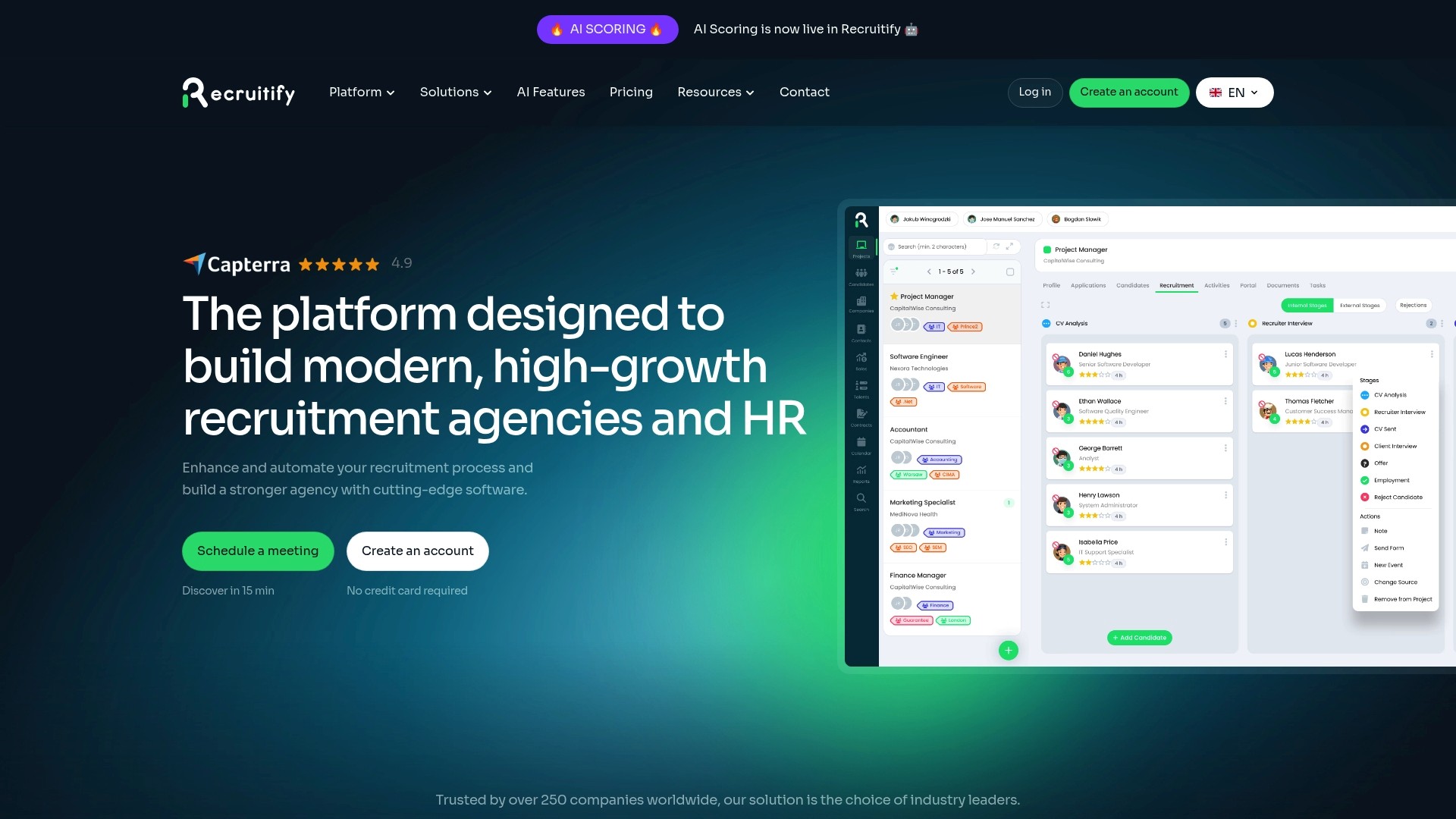
For agencies that handle client conversations as well as candidates, the agency CRM keeps the client brief and the open role linked.
Common Mistakes to Avoid
Treating the intake as a form. A questionnaire can supplement the meeting but cannot replace the discussion.
Copying the old job description. Roles change, and the previous description often lists tools and years of experience that no longer matter.
Letting the manager dominate or the recruiter simply take notes. The value comes from two-way challenge.
Skipping the written summary. Verbal agreements fade quickly, especially across several roles.
Never calibrating. The first shortlist is the cheapest moment to correct course.
Holding one intake for several different roles. Each role deserves its own criteria and scorecard.
FAQ
What happens in an intake meeting?
The recruiter and hiring manager agree on why the role is open, what success looks like, which skills are essential, what the role pays and how interviews will run. They also set response times and a timeline. The meeting usually ends with next steps and a date to review the first profiles.
How long should a recruiting intake meeting last?
Plan for 30 to 45 minutes for a standard role. Senior or highly specialized searches may need longer or a second session. A short follow-up calibration call after the first few profiles is more effective than extending the first meeting.
Who should attend?
The recruiter and the hiring manager are essential. For roles where several people shape the decision, such as a team lead or a department head, it helps to include them, or at least to name them and their role in the process. Unclear decision-makers are a common cause of late changes.
What if the hiring manager does not have time for an intake?
Shorten the ask. Offer a 15-minute call, send a draft brief with your best assumptions already filled in and ask the manager only to correct it. If time is still scarce, send a few sample profiles and ask which is closest to what they want.
What is the difference between an intake form and an intake meeting?
A form collects facts in a fixed format, while a meeting allows the recruiter to question, challenge and prioritize. The best practice is to use a form or template as the agenda and capture structure, and to hold the conversation to test every answer against market reality.
Sources
Recruiting 101: 5 Tips for Better Communication with Hiring Managers, SHRM
How to Conduct an Effective Hiring Manager Intake Session, ML6
Recommended
7 Tactics to Optimize the Recruitment Process for TA Leaders
High Volume Recruiting for TA Leaders: Scale Without More Recruiters
Track 5 Recruitment Funnel Metrics That Predict Hires for TA Teams
90 Day Recruitment Marketing Strategy With Funnel Math for Recruiters


News & Updates
Stay up-to-date with the latest innovations, features, and tips about Recruitify!
By providing your email address within the newsletter sign-up form, you confirm its processing to send marketing information regarding the Administrator’s products and services. The Administrator of your personal data processed for the abovementioned purposes is Recruitify Spółka z o.o., based in Warsaw, Poland (KRS 0000709889). For more information on the principles of personal data processing and the rights of data subjects, please check the Privacy Policy.

Last updated:
Intake Meeting in Recruiting: How to Run One That Works
Applicant Tracking System
The Recruitify Team
A recruiting intake meeting is the first structured conversation between a recruiter and a hiring manager, held before sourcing starts, in which both sides agree on the role, the ideal candidate, the compensation, the interview process and the timeline. A well-run intake takes roughly 30 to 45 minutes, rests on market data the recruiter brings, and ends with written decisions both sides can check later. This guide covers how to prepare, which questions to ask, which red flags to watch for and what to do afterward.
Key Takeaways
An intake meeting aligns the recruiter and the hiring manager on the role, the ideal candidate, the attraction strategy and the process before any candidate is contacted.
Preparation decides the quality of the meeting: review the job description, bring market data on pay and talent supply, and prepare sample profiles.
The most useful questions separate must-haves from nice-to-haves and deal-breakers, and also cover compensation, interview stages, decision-makers and timing.
The meeting is not finished when the call ends: a written summary and a short calibration after the first profiles keep the search from drifting.
Table of Contents
What an Intake Meeting Is and When It Happens
An intake meeting (also called an intake session, a kick-off meeting or a job intake) is a working conversation between the person who recruits and the person who will manage the new hire. In its hiring guidance, Northwestern University describes its intake conversation as taking place immediately before or after the position is posted, and as aligning the recruiter and hiring manager on the role, the ideal candidate, the attraction strategy and the recruiting process.
The same logic applies in an agency, where the “hiring manager” is a client contact, and in an in-house HR team, where it is a department head. In both cases the aim is identical: replace assumptions with agreed facts before the search consumes time.
One point is worth stating early. An intake is a discussion, not a data dump. A recruiting firm’s kick-off meeting guidance stresses that search quality depends on a collaborative conversation that needs input and decisiveness from both sides. If the manager simply forwards an old job description, the intake has not happened.
Why Skipping or Rushing It Costs Time
Without an intake, the first shortlist becomes the intake. The recruiter sends profiles, the manager reacts, hidden requirements appear, and the search restarts with weeks already spent. Most of the downstream problems that slow hiring, such as extra interview stages, changing criteria and silent managers, can be traced to criteria that were never made explicit. We discuss the wider pattern in our article on why hiring slows down even with AI.
A good intake produces four things:
A role definition narrow enough to search for.
Criteria ranked by importance, so profiles can be judged consistently.
A realistic view of the market, including pay and talent supply.
Agreed roles, response times and communication habits.
How to Prepare as the Recruiter
The recruiter’s preparation is what turns the meeting from an interview of the manager into a calibration of the market. According to a practical intake guide for recruiters, the recruiter should review the current job description, note recommended updates, pull market data on salary ranges, labor supply and competitor benchmarks, and prepare sample profiles.
This matters because SHRM’s cited recruiting experts treat intake as a market-calibration conversation. Preliminary research lets the recruiter challenge unrealistic requirements with evidence rather than opinion, which improves the likely talent pool.
A preparation checklist that fits in ten to fifteen minutes:
Read the existing job description and mark vague phrases (“strong communicator”, “fast-paced”) that need a concrete definition.
Run a quick search for the likely title, location and core skills, and note how many profiles appear.
Collect pay ranges for similar roles from at least two reliable sources.
Pick three to five anonymized sample profiles at different levels of fit.
Check whether the company or client has filled similar roles before and how long it took.
Send the manager a short agenda and a request for 30 to 45 minutes.
Teams that keep candidate history in one system can pull these inputs faster. A searchable candidate database and ATS lets you check in minutes whether you already know people who resemble the role, and bring them as sample profiles.
How the Hiring Manager Should Prepare
The manager’s preparation is shorter but just as influential. The same intake guide suggests that managers review the previous person’s performance in the role, update the org chart and define key goals for the new hire before the meeting.
Recruiters can send three requests in the calendar invitation:
Think about what the best person in this role has delivered, and what the weakest one missed.
List the decision-makers and every person who will interview.
Bring a compensation range that has already been approved.
These three items remove the most common causes of mid-search delays: vague success criteria, unknown approvers and budgets that change once finalists appear.
The Questions to Ask, in Order
The order matters. Start with why the role exists, move to the person, then to the practical mechanics. Moving from context to constraints keeps the manager thinking about outcomes before they start listing tools and years of experience.
Purpose and success
Why is the role open, and what problem will the hire solve?
Is it a backfill or a new position, and what happens if it stays empty for another quarter?
What should this person have achieved after 90 days and after a year?
What did the previous person do well, and where did the role fall short?
The candidate
One hiring manager intake guide recommends asking what three things the candidate should bring from an experience standpoint, what personality is desired, and how the team or department culture and dynamics are described.
The SHRM recruiting advice adds that the meeting is the moment to narrow an overly broad job description and to distinguish must-haves from nice-to-haves and deal-breakers. It also covers why the role is open, how the manager would sell it and when the hire is needed.
A useful test for each must-have is simple: “Would you reject an otherwise excellent candidate without it?” If the answer is no, it moves to the nice-to-have column. A recruiter intake template suggests keeping must-haves to a maximum of four, which forces real prioritization.
Compensation, sourcing, stages, decision-makers and timeline
This is where many intakes stay thin. Cover each of the following explicitly:
Topic | Questions to ask |
|---|---|
Compensation | What is the base range, and what is the bonus or equity? Is there flexibility for a stronger candidate, and who approves it? Is sponsorship or relocation available? |
Sourcing | Which companies do you admire as talent sources? Which companies are off limits? Are there internal referrals or past applicants to revisit? |
Interview stages | How many rounds, with whom, and what does each round assess? Is there a technical task, and who reviews it? |
Decision-makers | Who makes the final call? Who can veto? Does anyone outside the team need to sign off? |
Timeline | When do you want the first shortlist? How quickly will you give feedback? When must the person start? Are there dates when interviewers are unavailable? |
Selling points | What are the three strongest reasons for a candidate to join, and which honest challenges should be mentioned early? |
Agency recruiters add commercial questions: fee terms, exclusivity, guarantee period, feedback expectations and whether other agencies work on the same role. These questions protect both sides because they surface disagreements before the first invoice or the first rejected shortlist.
Agreeing on Expectations and Communication
The intake is also a working agreement. SHRM’s guidance says recruiters and managers should clarify responsibilities, agree on timeframes for reviewing resumes and conducting interviews, and discuss communication preferences.
In practice, settle these points before the call ends:
How quickly will the manager respond to each batch of profiles (for example, within two business days)?
Which channel is used for quick questions, and which for formal feedback?
How often will the recruiter report progress, and in what form?
What happens when the manager misses the agreed response time?
Slow feedback is one of the most common reasons good candidates drop out. Agreeing on a response time is far easier at the start of a search than after a strong candidate has already accepted another offer. For more on this theme, see our guide on how recruiters can shorten time-to-hire.
Red Flags During the Intake
Some warning signs appear within the first ten minutes:
An unrealistic wishlist. SHRM identifies this as a common problem and advises recruiters to push back using real market data. Showing how few profiles match the full list is more persuasive than arguing.
No clear success definition. If the manager cannot describe what good looks like at 90 days, interviews will be inconsistent.
Unknown decision-makers. A hidden approver who appears at the final stage can reset the search.
No approved compensation range. Searching without a budget wastes sourcing time and damages candidate trust.
Reluctance to commit to feedback times. It predicts delays throughout the process.
Adding stages as doubt grows. When managers keep adding interviews, the cause is often unclear criteria rather than a lack of data. We examine this in why hiring managers add more stages.
The SHRM article also notes that the most successful recruiters confidently challenge hiring managers and decline to be treated as order-takers, offering market-based expertise instead. Challenge is a service to the manager, not an obstacle.
What to Do After the Meeting
The real value of an intake is created in the hours after it. A sound follow-up has four parts.
Send a written summary the same day. Include the role definition, ranked must-haves, nice-to-haves, deal-breakers, compensation range, interview stages, decision-makers and timeline. Ask the manager to confirm or correct it in writing.
Update the job description and search strategy. Translate agreed criteria into a scorecard, a list of target companies and search strings.
Start sourcing against the scorecard. Score every profile with the same criteria, so feedback can be compared across candidates.
Book a calibration call. One intake template recommends a short call once the manager has reviewed the first three to five profiles, asking for a yes or no on each plus the reason. The reasons reveal the real requirements. If someone who meets every must-have is rejected, a hidden requirement exists and belongs on the scorecard.
Writing the summary into the same system where the search runs prevents the notes from living in a separate document nobody opens again. A recruitment project workspace keeps the brief, the pipeline and the feedback together for the whole search.
A Sample 40-Minute Agenda
Minutes | Focus | Output |
|---|---|---|
0 to 5 | Purpose of the role and business context | Shared problem statement |
5 to 15 | Success at 90 days and one year; must-haves and nice-to-haves | Ranked criteria |
15 to 22 | Compensation, selling points, target and excluded companies | Budget and sourcing map |
22 to 30 | Interview stages, decision-makers, feedback times | Process and responsibilities |
30 to 36 | Review of sample profiles against the criteria | First calibration |
36 to 40 | Next steps and calibration date | Confirmed follow-up |
The sample profiles are the most underused part. Reactions to real people uncover preferences that abstract lists miss.
Where Software Fits Into the Intake
An intake is a human conversation, and software cannot replace it. It can, however, remove the manual work around it. Once criteria are agreed, they need to be applied consistently to every incoming profile, and recruiters need to find relevant people already in their database. Recruitify’s AI features include contextual matching with a percentage match score, an AI CV parser that builds a structured candidate profile from PDFs, DOCX files, scans and photos, and an X-RAY and Boolean search engine that generates search strings in one click. The clearer the intake, the better these tools perform, because scoring can only be as precise as the requirements it is given. Our article on how recruiters look for signals rather than keywords explains the idea in more detail.
Our Perspective: The Intake Is the Specification for the Whole Search
We see the intake meeting as the specification for everything that follows. Every later step, from search strings to scoring to the shortlist a client receives, inherits the quality of the criteria agreed in this one conversation.
In our experience building tools for IT recruitment agencies and headhunters, the biggest time losses rarely come from sourcing itself. They come from information scattered across calendars, spreadsheets and inboxes, so that the brief a recruiter heard on Monday is not the brief the pipeline uses on Friday. That is why we designed Recruitify to keep the sales pipeline and the recruitment pipeline in one place, so the client conversation, the role definition and the candidates stay connected.
Our approach is to treat the agreed intake criteria as the input for automation: matching that understands relationships within a candidate’s tech stack, shortlists with a match score, and workflows that remove repetitive administration. Our platform is designed to reduce administrative tasks by up to 70%, which gives recruiters more time for the conversations that software cannot hold, such as challenging an unrealistic wishlist with market evidence.
Recruitify Team
Run Your Next Search From One Place
Recruitify brings an ATS, a sales CRM and an IT contracting module into one platform, so the intake notes, the pipeline and the candidates sit together. Plans are priced per user per month: HR Team at €61 and Agency at €67, with Enterprise available on request. See the pricing page to compare plans, or explore recruitment workflow automation to see how repetitive steps after the intake can run on their own.
For agencies that handle client conversations as well as candidates, the agency CRM keeps the client brief and the open role linked.
Common Mistakes to Avoid
Treating the intake as a form. A questionnaire can supplement the meeting but cannot replace the discussion.
Copying the old job description. Roles change, and the previous description often lists tools and years of experience that no longer matter.
Letting the manager dominate or the recruiter simply take notes. The value comes from two-way challenge.
Skipping the written summary. Verbal agreements fade quickly, especially across several roles.
Never calibrating. The first shortlist is the cheapest moment to correct course.
Holding one intake for several different roles. Each role deserves its own criteria and scorecard.
FAQ
What happens in an intake meeting?
The recruiter and hiring manager agree on why the role is open, what success looks like, which skills are essential, what the role pays and how interviews will run. They also set response times and a timeline. The meeting usually ends with next steps and a date to review the first profiles.
How long should a recruiting intake meeting last?
Plan for 30 to 45 minutes for a standard role. Senior or highly specialized searches may need longer or a second session. A short follow-up calibration call after the first few profiles is more effective than extending the first meeting.
Who should attend?
The recruiter and the hiring manager are essential. For roles where several people shape the decision, such as a team lead or a department head, it helps to include them, or at least to name them and their role in the process. Unclear decision-makers are a common cause of late changes.
What if the hiring manager does not have time for an intake?
Shorten the ask. Offer a 15-minute call, send a draft brief with your best assumptions already filled in and ask the manager only to correct it. If time is still scarce, send a few sample profiles and ask which is closest to what they want.
What is the difference between an intake form and an intake meeting?
A form collects facts in a fixed format, while a meeting allows the recruiter to question, challenge and prioritize. The best practice is to use a form or template as the agenda and capture structure, and to hold the conversation to test every answer against market reality.
Sources
Recruiting 101: 5 Tips for Better Communication with Hiring Managers, SHRM
How to Conduct an Effective Hiring Manager Intake Session, ML6
Recommended
7 Tactics to Optimize the Recruitment Process for TA Leaders
High Volume Recruiting for TA Leaders: Scale Without More Recruiters
Track 5 Recruitment Funnel Metrics That Predict Hires for TA Teams
90 Day Recruitment Marketing Strategy With Funnel Math for Recruiters
News & Updates
Stay up-to-date with the latest innovations, features, and tips about Recruitify!
By providing your email address within the newsletter sign-up form, you confirm its processing to send marketing information regarding the Administrator’s products and services. The Administrator of your personal data processed for the abovementioned purposes is Recruitify Spółka z o.o., based in Warsaw, Poland (KRS 0000709889). For more information on the principles of personal data processing and the rights of data subjects, please check the Privacy Policy.

Discover More

Recruitment Process
How to Automate B2B Contracts for Staffing Agencies
Learn how to automate B2B contracts: templates, clause rules, CRM data, approvals, e-signatures and compliance checks, with a staffing-agency workflow you can copy.
31 Oct 2026
Discover More

Applicant Tracking System
Body Leasing Explained: Model, Contracts and Risks
Body leasing explained: how the IT staffing model works, how it differs from outsourcing, what contracts should cover, and where legal risks appear by country.
30 Oct 2026
Discover More

Recruitment Process
Shortlisting Criteria in Recruiting: How to Build a Fair Shortlist
Learn which shortlisting criteria to define before you review applications, how to score candidates consistently, and how many to put forward for interview.
29 Oct 2026
Discover More
Recruitment Process
How to Automate B2B Contracts for Staffing Agencies
Learn how to automate B2B contracts: templates, clause rules, CRM data, approvals, e-signatures and compliance checks, with a staffing-agency workflow you can copy.
31 Oct 2026
Discover More
Applicant Tracking System
Body Leasing Explained: Model, Contracts and Risks
Body leasing explained: how the IT staffing model works, how it differs from outsourcing, what contracts should cover, and where legal risks appear by country.
30 Oct 2026
Discover More