Last updated:
Recruiters: Build a Talent Pool That Fills Roles in 90 Days

Recruitment Process

The Recruitify Team
The fastest way to build a talent pool is to define three priority roles, assign a single owner to the pool, and create a searchable segment for immediate sourcing before you add a single candidate. That order matters: skills and ownership first, volume second. Teams that follow this sequence typically cut time-to-hire and improve match quality, because every candidate entering the pool already has a purpose. Start this week with a one-hour workshop where hiring managers name their three hardest-to-fill roles.
TL;DR:
Building a talent pool requires defining three priority roles, assigning an owner, and creating a searchable database before sourcing candidates to ensure purpose-driven entries.
An integrated ATS and CRM system is essential for maintaining a usable pool, capturing key data like skills, availability, contact status, and next actions to prevent data decay.
Prioritize sourcing from internal mobility, alumni networks, and referrals, segment candidates immediately by role and skill, then nurture them with tailored outreach based on readiness.
Regular governance through scheduled reviews, consent management, and tracking engagement metrics like time-to-fill and contactability ensures the pool remains effective and compliant.
Using a centralized platform with AI-powered matching, OCR parsing, and automated GDPR workflows significantly reduces administrative workload and enhances long-term pool viability.
Recruitifyrecruitify.aiTurn Your Talent Pool Into PlacementsRecruitify.ai combines candidate data, sourcing, matching, and GDPR workflows to help IT recruitment teams manage talent pools in one platform.Explore Recruitify.ai
Table of Contents
What Is a Talent Pool, and Why Build One?
What Infrastructure Do You Need to Build a Talent Pool?
Which Sourcing Channels Should You Prioritize First?
How Do You Nurture a Talent Pool Without Overdoing It?
What Metrics Prove Your Talent Pool Is Working?
How Do You Keep a Talent Pool Compliant with Data Protection Rules?
Your 90-Day Plan to Build and Launch a Talent Pool
How Does a Consolidated Platform Operationalize This Guide?
A Perspective on Building Talent Pools That Actually Work
Ready to Put This Guide into Practice?
Sources
FAQ
What Is a Talent Pool, and Why Build One?
A talent pool is a curated, searchable database of candidates you have not hired yet but plan to consider for future roles. A talent pipeline is narrower: it holds candidates already moving through an active process for a specific requisition. Confusing the two is the most common structural mistake in talent acquisition. Pools feed pipelines; pipelines close roles.
The business case is straightforward. When you already have vetted, categorized candidates, you skip weeks of cold sourcing every time a role opens. SHRM’s talent architecture framing recommends recruiters act as “Talent Architects,” aligning with hiring managers on skills-based success factors before sourcing even starts, rather than reacting to a job description after the fact.
The CIPD’s 2024 resourcing report backs this with practitioner data: multi-channel attraction outperforms single-source recruiting, though effectiveness varies. A minority of practitioners rated direct outreach to passive candidates as effective, and fewer found programmatic advertising effective, which tells you channel choice needs testing, not assumption. A well-run pool reduces cost per hire because you are not paying for job board exposure every single time.
What Infrastructure Do You Need to Build a Talent Pool?
You cannot build a usable talent pool in a spreadsheet, and you should stop trying after your second recruiter joins. A centralized system, ideally an applicant tracking system integrated with a candidate relationship management tool, is the baseline. Without that integration, candidates get lost between “applied” and “worth calling in six months,” which is exactly where most pools quietly die.
Your data model needs to answer one question instantly: who can we call today, and why? That means capturing, at minimum:
Skills and seniority level, tagged consistently across recruiters
Availability and notice period
Consent status and date of last contact
Readiness (active, semi-active, dormant, do-not-contact)
Reason for inclusion (past applicant, sourced, referral, alumnus)
Next action date
That last field is the one most teams skip, and it is the one the CIPD’s resourcing research flags as essential. Without a searchable “next action” and “reason for inclusion,” pools decay into unreadable archives within a year.
Assign one accountable owner for pool hygiene, not a committee. Schedule a recurring monthly review to catch stale records before they pile up.
Pro Tip: Tag candidates by the tech stack or capability cluster they actually match, not just job title. A “Senior Java Developer” and a “Backend Engineer, Java/Kafka” might be the same person your search misses if titles are inconsistent.
Which Sourcing Channels Should You Prioritize First?
Filling a pool with the right people, in the right categories, matters more than filling it fast. Prioritize channels in this order:
Internal mobility and past applicants. These candidates already know your organization, and reskilling pathways are one of the most overlooked sources of future capability, according to SHRM’s talent pipeline guidance.
Alumni networks. Former employees who left on good terms often return with new skills.
Referrals. Consistently the highest quality-to-effort ratio for most agencies and internal teams.
Passive sourcing and campus or event pipelines. Slower to convert but critical for hard-to-fill or future-facing skill sets.
Once candidates enter the pool, segment them immediately. A useful taxonomy combines:
Role family (engineering, sales, operations)
Skill cluster (specific technologies, certifications, languages)
Readiness (active job seeker vs. passively open)
EDI considerations, applied proportionately and transparently, per CIPD’s inclusive recruitment guidance, which warns that targeted outreach must be designed carefully so it doesn’t disadvantage other groups
A campaign template for each segment might be as simple as: dormant senior engineers get a quarterly “what’s new on the roadmap” email, while active mid-level candidates get a role-specific alert within 48 hours of a matching opening. Avoid dumping every candidate into one undifferentiated list. A single 4,000-person spreadsheet with no segments is not a talent pool. It’s an unsearchable liability that nobody, including the person who built it, will ever use again.
How Do You Nurture a Talent Pool Without Overdoing It?
Nurturing is where most talent pools fail quietly. Recruiters build the list, send one blast email, and never touch it again. Cadence needs to match segment readiness: monthly touches for active candidates in priority roles, quarterly for dormant or passive contacts, and immediate outreach when a matching role opens.
Content should vary by segment:
Role previews for candidates close to readiness
Project spotlights or team culture notes for mid-funnel passive candidates
Short skill micro-course invitations for candidates one certification away from qualifying
AI scoring can help prioritize who gets contacted first, especially in large pools where a recruiter cannot manually rank hundreds of profiles. SHRM’s research on AI-enabled CRM systems notes that AI can expand a pool for niche, hard-to-fill skills or narrow it for high-volume roles, but it needs human oversight to avoid over-filtering good candidates or over-contacting the same people repeatedly. Tools that combine AI scoring with human review tend to perform better than fully automated sequences.
Pro Tip: Track “contact fatigue” the same way you track engagement. If a candidate has received four messages with zero opens, pause outreach before you burn the relationship for a future role.
What Metrics Prove Your Talent Pool Is Working?
Five KPIs tell you whether a pool is earning its keep: time-to-fill-from-pool, conversion-to-hire rate, contactability (percentage of records with valid, current contact information), data staleness (average days since last verification), and consent rate.
Set service-level agreements between recruiters and hiring managers covering search turnaround time, expected outreach windows, and feedback loops so candidates aren’t left waiting weeks for a response.
Governance should run on a calendar, not on memory:
Monthly: segment review and stale-record cleanup
Quarterly: adverse-impact check on pool composition
Annually: retention policy review
SHRM’s talent architecture framing supports stakeholder alignment before sourcing begins, and that same alignment makes ROI conversations with leadership far easier. When you can show a specific role filled in half the usual time because the candidate was already warm in the pool, the budget conversation writes itself.
One governance number worth tracking closely: the CIPD’s 2024 report found only 14% of practitioners rated direct passive-candidate outreach as effective. If your pool relies heavily on that single channel without measuring conversion, you may be overestimating its return.
How Do You Keep a Talent Pool Compliant with Data Protection Rules?
Every candidate record needs a documented lawful basis for storage, and that basis varies by jurisdiction, so never assume one country’s consent standard applies globally. The ICO’s recruitment and selection guidance requires organizations to map consent, notice, access, correction, deletion, and retention across the full candidate lifecycle, not just at the point of application.
Practical steps to build into your workflow:
Set a retention trigger, such as a two-year review for candidates never recruited, after which records are deleted or anonymized
Build access, correction, and deletion request workflows that a candidate can actually use, and involve your data protection officer in reviewing them
Log consent changes and contact history in an auditable trail, not a side notebook
Flag cross-border data transfers early and get legal advice before storing candidate data across jurisdictions with different privacy regimes
Your 90-Day Plan to Build and Launch a Talent Pool
Building a functioning pool in three months is realistic if you timebox the work and assign clear owners at each stage.
Days 1 to 30: Run the priority-roles workshop with hiring managers, assign a pool owner, and stand up the data model in your ATS or CRM. Deliverable: a live, searchable structure with the core fields defined.
Days 31 to 60: Launch sourcing across your top two or three channels, tag and segment every incoming candidate, and start a monthly data-quality review. Deliverable: first 100 to 200 segmented candidates with consent status recorded.
Days 61 to 90: Run your first nurture campaigns by segment, track contactability and conversion, and present early ROI to stakeholders. Deliverable: a governance calendar embedded into standing recruiting meetings.
Common pitfalls at this stage include skipping the consent audit until “later” and letting one enthusiastic recruiter build the pool alone. Quick wins come from reusing candidates you already have. Every recruitment project that starts from scratch instead of searching existing records is a cost most agencies underestimate.
How Does a Consolidated Platform Operationalize This Guide?
Every requirement in this guide, the data model, segmentation, consent tracking, and nurture automation, maps directly to specific platform features, and this is where the right software choice separates a pool that works from one that quietly rots.
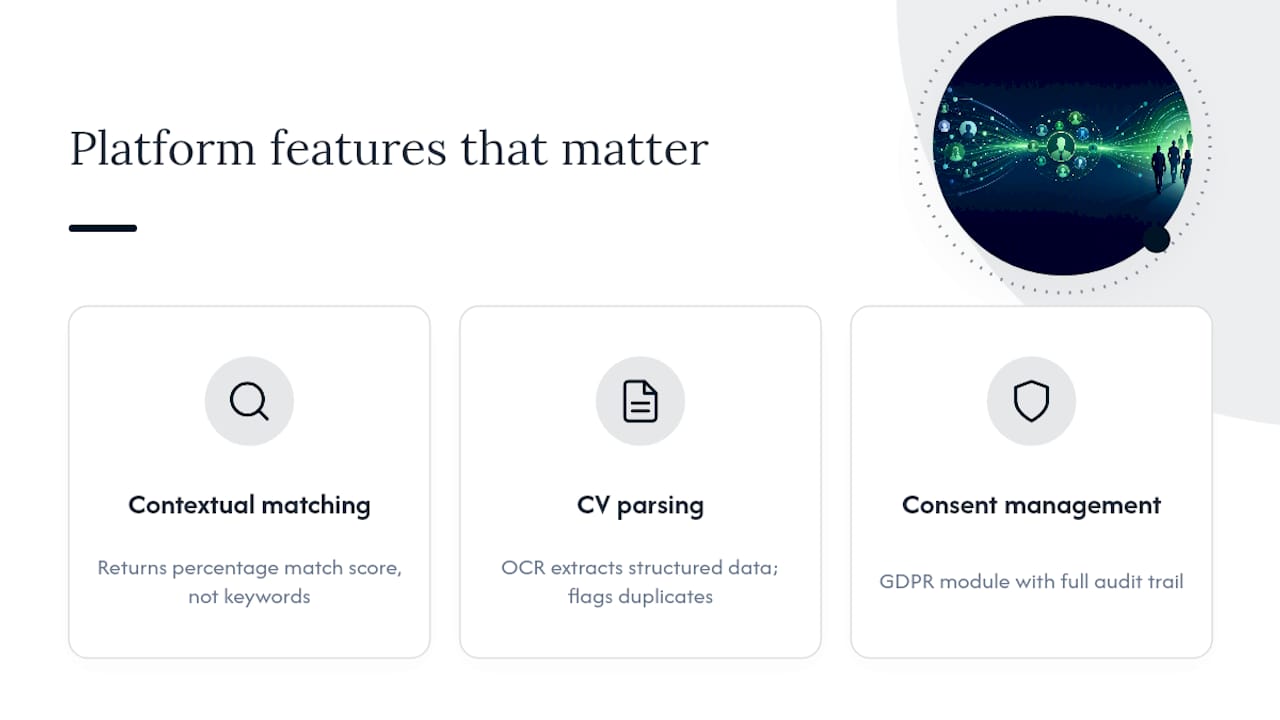
A centralized ATS and CRM system eliminates the split between sourcing data and sales pipeline data that causes so many pools to fragment across tools. Recruitify’s contextual matching AI evaluates candidates against project requirements and returns a percentage match score, rather than a plain keyword list. Its CV parser uses OCR to extract structured data from PDFs, scans, and photos in seconds, automatically flagging duplicates, which directly solves the data-decay problem this guide keeps returning to.
Recruitify also builds in a GDPR consent management module with a full audit trail, addressing the ICO’s lifecycle requirements described above. This level of automation aims to cut administrative workload, but results may vary depending on your workflow.
Pro Tip: When evaluating any vendor against this guide, ask specifically how it handles next-action dates, consent audit trails, and duplicate detection. Those three features predict whether a pool stays usable eighteen months from now.
A Perspective on Building Talent Pools That Actually Work
Three priorities matter more than any other advice in this guide: assign one accountable owner before you source a single candidate, make every segment skills-first rather than title-first, and communicate transparently with candidates about why they’re in your pool and what happens next. Culture beats process here. A pool owned by everyone is owned by no one, and it decays within a year regardless of the software behind it.
We’d welcome practitioner case studies and candidate testimonials that show this playbook working in different agency sizes and sectors, and we’ll continue updating this guide as that evidence comes in.
- Recruitify Team
Ready to Put This Guide into Practice?
Everything in this guide, from searchable data fields to consent audit trails to segment-based nurture campaigns, requires infrastructure most spreadsheets and disconnected tools simply cannot deliver. Recruitify consolidates the ATS, CRM, and contracting workflow into one system, so recruiters stop rebuilding candidate history every time a new role opens and start monetizing the database they already have.
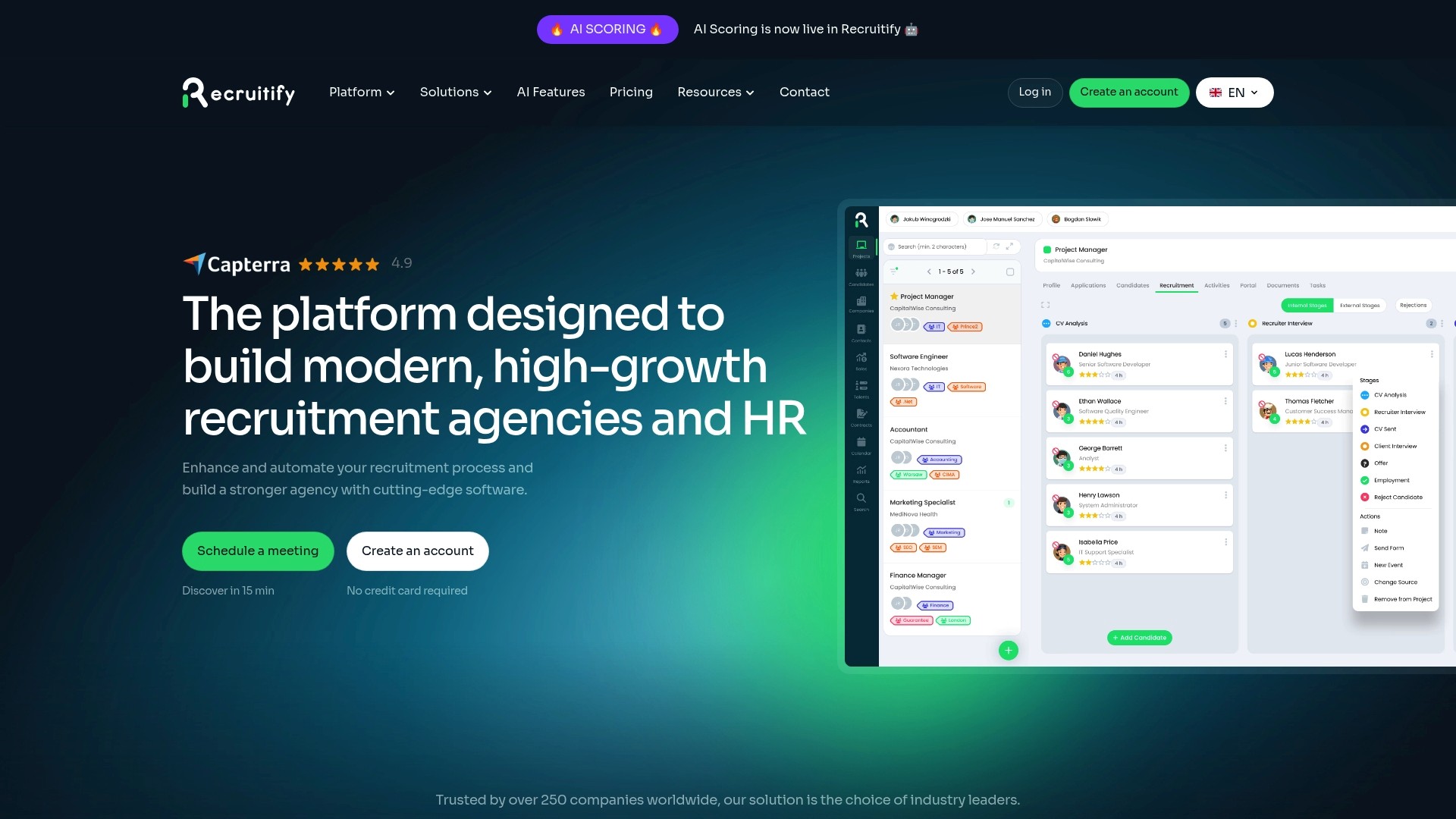
The platform’s contextual matching AI, OCR-based CV parsing, and built-in GDPR audit trail map directly to the infrastructure and compliance sections above, and Recruitify states its automation reduces administrative workload by 70% across lead contact, candidate categorization, and contract generation. Recruitify’s pricing runs on tiered plans: the HR Team plan starts at €69 per month per user, and the Recruitment Agencies plan starts at €79 per month per user, both detailed on the Recruitify pricing page. Enterprise pricing is available on request. If you’re ready to see how your existing candidate data could work harder, review the plans and request a demo today.
Sources
FAQ
What Are Examples of Talent Pools?
Common examples include internal mobility pools of employees ready for promotion, alumni networks of former employees, referral pools built from employee recommendations, and passive candidate pools sourced through targeted outreach or campus events. Agencies often also maintain skill-specific pools, such as a segment of certified project managers or cloud engineers, ready for rapid matching against future roles.
What Is Talent Pooling, and How Does It Work?
Talent pooling is the practice of proactively identifying, categorizing, and maintaining contact with potential candidates before a specific role opens, rather than sourcing from scratch every time. It works by segmenting candidates by skill, readiness, and reason for inclusion, then nurturing each segment with tailored communication until a matching opportunity arises.
What Are Common Talent Pool Mistakes?
The most common mistake is building one undifferentiated list with no segmentation, which becomes unsearchable within months. Close behind are skipping consent tracking, per ICO guidance, and leaving pool ownership to no single accountable person, which causes data to go stale.
What Is Trader Joe’s Talent Pool?
There is no independently verified public detail describing a specific internal talent pool structure at Trader Joe’s, and this article cannot state one without a credible source. Companies of that scale typically rely on internal mobility programs and referral networks, consistent with the broader retail sector’s talent-pooling practices.
Can Software Help Build and Maintain a Talent Pool?
Yes. A platform like Recruitify centralizes candidate data, applies AI matching against future role requirements, and tracks consent through an audit trail, which addresses the data-decay and compliance challenges that undermine most manually managed pools.
Recommended


News & Updates
Stay up-to-date with the latest innovations, features, and tips about Recruitify!
By providing your email address within the newsletter sign-up form, you confirm its processing to send marketing information regarding the Administrator’s products and services. The Administrator of your personal data processed for the abovementioned purposes is Recruitify Spółka z o.o., based in Warsaw, Poland (KRS 0000709889). For more information on the principles of personal data processing and the rights of data subjects, please check the Privacy Policy.

Last updated:
Recruiters: Build a Talent Pool That Fills Roles in 90 Days
Recruitment Process
The Recruitify Team
The fastest way to build a talent pool is to define three priority roles, assign a single owner to the pool, and create a searchable segment for immediate sourcing before you add a single candidate. That order matters: skills and ownership first, volume second. Teams that follow this sequence typically cut time-to-hire and improve match quality, because every candidate entering the pool already has a purpose. Start this week with a one-hour workshop where hiring managers name their three hardest-to-fill roles.
TL;DR:
Building a talent pool requires defining three priority roles, assigning an owner, and creating a searchable database before sourcing candidates to ensure purpose-driven entries.
An integrated ATS and CRM system is essential for maintaining a usable pool, capturing key data like skills, availability, contact status, and next actions to prevent data decay.
Prioritize sourcing from internal mobility, alumni networks, and referrals, segment candidates immediately by role and skill, then nurture them with tailored outreach based on readiness.
Regular governance through scheduled reviews, consent management, and tracking engagement metrics like time-to-fill and contactability ensures the pool remains effective and compliant.
Using a centralized platform with AI-powered matching, OCR parsing, and automated GDPR workflows significantly reduces administrative workload and enhances long-term pool viability.
Recruitifyrecruitify.aiTurn Your Talent Pool Into PlacementsRecruitify.ai combines candidate data, sourcing, matching, and GDPR workflows to help IT recruitment teams manage talent pools in one platform.Explore Recruitify.ai
Table of Contents
What Is a Talent Pool, and Why Build One?
What Infrastructure Do You Need to Build a Talent Pool?
Which Sourcing Channels Should You Prioritize First?
How Do You Nurture a Talent Pool Without Overdoing It?
What Metrics Prove Your Talent Pool Is Working?
How Do You Keep a Talent Pool Compliant with Data Protection Rules?
Your 90-Day Plan to Build and Launch a Talent Pool
How Does a Consolidated Platform Operationalize This Guide?
A Perspective on Building Talent Pools That Actually Work
Ready to Put This Guide into Practice?
Sources
FAQ
What Is a Talent Pool, and Why Build One?
A talent pool is a curated, searchable database of candidates you have not hired yet but plan to consider for future roles. A talent pipeline is narrower: it holds candidates already moving through an active process for a specific requisition. Confusing the two is the most common structural mistake in talent acquisition. Pools feed pipelines; pipelines close roles.
The business case is straightforward. When you already have vetted, categorized candidates, you skip weeks of cold sourcing every time a role opens. SHRM’s talent architecture framing recommends recruiters act as “Talent Architects,” aligning with hiring managers on skills-based success factors before sourcing even starts, rather than reacting to a job description after the fact.
The CIPD’s 2024 resourcing report backs this with practitioner data: multi-channel attraction outperforms single-source recruiting, though effectiveness varies. A minority of practitioners rated direct outreach to passive candidates as effective, and fewer found programmatic advertising effective, which tells you channel choice needs testing, not assumption. A well-run pool reduces cost per hire because you are not paying for job board exposure every single time.
What Infrastructure Do You Need to Build a Talent Pool?
You cannot build a usable talent pool in a spreadsheet, and you should stop trying after your second recruiter joins. A centralized system, ideally an applicant tracking system integrated with a candidate relationship management tool, is the baseline. Without that integration, candidates get lost between “applied” and “worth calling in six months,” which is exactly where most pools quietly die.
Your data model needs to answer one question instantly: who can we call today, and why? That means capturing, at minimum:
Skills and seniority level, tagged consistently across recruiters
Availability and notice period
Consent status and date of last contact
Readiness (active, semi-active, dormant, do-not-contact)
Reason for inclusion (past applicant, sourced, referral, alumnus)
Next action date
That last field is the one most teams skip, and it is the one the CIPD’s resourcing research flags as essential. Without a searchable “next action” and “reason for inclusion,” pools decay into unreadable archives within a year.
Assign one accountable owner for pool hygiene, not a committee. Schedule a recurring monthly review to catch stale records before they pile up.
Pro Tip: Tag candidates by the tech stack or capability cluster they actually match, not just job title. A “Senior Java Developer” and a “Backend Engineer, Java/Kafka” might be the same person your search misses if titles are inconsistent.
Which Sourcing Channels Should You Prioritize First?
Filling a pool with the right people, in the right categories, matters more than filling it fast. Prioritize channels in this order:
Internal mobility and past applicants. These candidates already know your organization, and reskilling pathways are one of the most overlooked sources of future capability, according to SHRM’s talent pipeline guidance.
Alumni networks. Former employees who left on good terms often return with new skills.
Referrals. Consistently the highest quality-to-effort ratio for most agencies and internal teams.
Passive sourcing and campus or event pipelines. Slower to convert but critical for hard-to-fill or future-facing skill sets.
Once candidates enter the pool, segment them immediately. A useful taxonomy combines:
Role family (engineering, sales, operations)
Skill cluster (specific technologies, certifications, languages)
Readiness (active job seeker vs. passively open)
EDI considerations, applied proportionately and transparently, per CIPD’s inclusive recruitment guidance, which warns that targeted outreach must be designed carefully so it doesn’t disadvantage other groups
A campaign template for each segment might be as simple as: dormant senior engineers get a quarterly “what’s new on the roadmap” email, while active mid-level candidates get a role-specific alert within 48 hours of a matching opening. Avoid dumping every candidate into one undifferentiated list. A single 4,000-person spreadsheet with no segments is not a talent pool. It’s an unsearchable liability that nobody, including the person who built it, will ever use again.
How Do You Nurture a Talent Pool Without Overdoing It?
Nurturing is where most talent pools fail quietly. Recruiters build the list, send one blast email, and never touch it again. Cadence needs to match segment readiness: monthly touches for active candidates in priority roles, quarterly for dormant or passive contacts, and immediate outreach when a matching role opens.
Content should vary by segment:
Role previews for candidates close to readiness
Project spotlights or team culture notes for mid-funnel passive candidates
Short skill micro-course invitations for candidates one certification away from qualifying
AI scoring can help prioritize who gets contacted first, especially in large pools where a recruiter cannot manually rank hundreds of profiles. SHRM’s research on AI-enabled CRM systems notes that AI can expand a pool for niche, hard-to-fill skills or narrow it for high-volume roles, but it needs human oversight to avoid over-filtering good candidates or over-contacting the same people repeatedly. Tools that combine AI scoring with human review tend to perform better than fully automated sequences.
Pro Tip: Track “contact fatigue” the same way you track engagement. If a candidate has received four messages with zero opens, pause outreach before you burn the relationship for a future role.
What Metrics Prove Your Talent Pool Is Working?
Five KPIs tell you whether a pool is earning its keep: time-to-fill-from-pool, conversion-to-hire rate, contactability (percentage of records with valid, current contact information), data staleness (average days since last verification), and consent rate.
Set service-level agreements between recruiters and hiring managers covering search turnaround time, expected outreach windows, and feedback loops so candidates aren’t left waiting weeks for a response.
Governance should run on a calendar, not on memory:
Monthly: segment review and stale-record cleanup
Quarterly: adverse-impact check on pool composition
Annually: retention policy review
SHRM’s talent architecture framing supports stakeholder alignment before sourcing begins, and that same alignment makes ROI conversations with leadership far easier. When you can show a specific role filled in half the usual time because the candidate was already warm in the pool, the budget conversation writes itself.
One governance number worth tracking closely: the CIPD’s 2024 report found only 14% of practitioners rated direct passive-candidate outreach as effective. If your pool relies heavily on that single channel without measuring conversion, you may be overestimating its return.
How Do You Keep a Talent Pool Compliant with Data Protection Rules?
Every candidate record needs a documented lawful basis for storage, and that basis varies by jurisdiction, so never assume one country’s consent standard applies globally. The ICO’s recruitment and selection guidance requires organizations to map consent, notice, access, correction, deletion, and retention across the full candidate lifecycle, not just at the point of application.
Practical steps to build into your workflow:
Set a retention trigger, such as a two-year review for candidates never recruited, after which records are deleted or anonymized
Build access, correction, and deletion request workflows that a candidate can actually use, and involve your data protection officer in reviewing them
Log consent changes and contact history in an auditable trail, not a side notebook
Flag cross-border data transfers early and get legal advice before storing candidate data across jurisdictions with different privacy regimes
Your 90-Day Plan to Build and Launch a Talent Pool
Building a functioning pool in three months is realistic if you timebox the work and assign clear owners at each stage.
Days 1 to 30: Run the priority-roles workshop with hiring managers, assign a pool owner, and stand up the data model in your ATS or CRM. Deliverable: a live, searchable structure with the core fields defined.
Days 31 to 60: Launch sourcing across your top two or three channels, tag and segment every incoming candidate, and start a monthly data-quality review. Deliverable: first 100 to 200 segmented candidates with consent status recorded.
Days 61 to 90: Run your first nurture campaigns by segment, track contactability and conversion, and present early ROI to stakeholders. Deliverable: a governance calendar embedded into standing recruiting meetings.
Common pitfalls at this stage include skipping the consent audit until “later” and letting one enthusiastic recruiter build the pool alone. Quick wins come from reusing candidates you already have. Every recruitment project that starts from scratch instead of searching existing records is a cost most agencies underestimate.
How Does a Consolidated Platform Operationalize This Guide?
Every requirement in this guide, the data model, segmentation, consent tracking, and nurture automation, maps directly to specific platform features, and this is where the right software choice separates a pool that works from one that quietly rots.
A centralized ATS and CRM system eliminates the split between sourcing data and sales pipeline data that causes so many pools to fragment across tools. Recruitify’s contextual matching AI evaluates candidates against project requirements and returns a percentage match score, rather than a plain keyword list. Its CV parser uses OCR to extract structured data from PDFs, scans, and photos in seconds, automatically flagging duplicates, which directly solves the data-decay problem this guide keeps returning to.
Recruitify also builds in a GDPR consent management module with a full audit trail, addressing the ICO’s lifecycle requirements described above. This level of automation aims to cut administrative workload, but results may vary depending on your workflow.
Pro Tip: When evaluating any vendor against this guide, ask specifically how it handles next-action dates, consent audit trails, and duplicate detection. Those three features predict whether a pool stays usable eighteen months from now.
A Perspective on Building Talent Pools That Actually Work
Three priorities matter more than any other advice in this guide: assign one accountable owner before you source a single candidate, make every segment skills-first rather than title-first, and communicate transparently with candidates about why they’re in your pool and what happens next. Culture beats process here. A pool owned by everyone is owned by no one, and it decays within a year regardless of the software behind it.
We’d welcome practitioner case studies and candidate testimonials that show this playbook working in different agency sizes and sectors, and we’ll continue updating this guide as that evidence comes in.
- Recruitify Team
Ready to Put This Guide into Practice?
Everything in this guide, from searchable data fields to consent audit trails to segment-based nurture campaigns, requires infrastructure most spreadsheets and disconnected tools simply cannot deliver. Recruitify consolidates the ATS, CRM, and contracting workflow into one system, so recruiters stop rebuilding candidate history every time a new role opens and start monetizing the database they already have.
The platform’s contextual matching AI, OCR-based CV parsing, and built-in GDPR audit trail map directly to the infrastructure and compliance sections above, and Recruitify states its automation reduces administrative workload by 70% across lead contact, candidate categorization, and contract generation. Recruitify’s pricing runs on tiered plans: the HR Team plan starts at €69 per month per user, and the Recruitment Agencies plan starts at €79 per month per user, both detailed on the Recruitify pricing page. Enterprise pricing is available on request. If you’re ready to see how your existing candidate data could work harder, review the plans and request a demo today.
Sources
FAQ
What Are Examples of Talent Pools?
Common examples include internal mobility pools of employees ready for promotion, alumni networks of former employees, referral pools built from employee recommendations, and passive candidate pools sourced through targeted outreach or campus events. Agencies often also maintain skill-specific pools, such as a segment of certified project managers or cloud engineers, ready for rapid matching against future roles.
What Is Talent Pooling, and How Does It Work?
Talent pooling is the practice of proactively identifying, categorizing, and maintaining contact with potential candidates before a specific role opens, rather than sourcing from scratch every time. It works by segmenting candidates by skill, readiness, and reason for inclusion, then nurturing each segment with tailored communication until a matching opportunity arises.
What Are Common Talent Pool Mistakes?
The most common mistake is building one undifferentiated list with no segmentation, which becomes unsearchable within months. Close behind are skipping consent tracking, per ICO guidance, and leaving pool ownership to no single accountable person, which causes data to go stale.
What Is Trader Joe’s Talent Pool?
There is no independently verified public detail describing a specific internal talent pool structure at Trader Joe’s, and this article cannot state one without a credible source. Companies of that scale typically rely on internal mobility programs and referral networks, consistent with the broader retail sector’s talent-pooling practices.
Can Software Help Build and Maintain a Talent Pool?
Yes. A platform like Recruitify centralizes candidate data, applies AI matching against future role requirements, and tracks consent through an audit trail, which addresses the data-decay and compliance challenges that undermine most manually managed pools.
Recommended
News & Updates
Stay up-to-date with the latest innovations, features, and tips about Recruitify!
By providing your email address within the newsletter sign-up form, you confirm its processing to send marketing information regarding the Administrator’s products and services. The Administrator of your personal data processed for the abovementioned purposes is Recruitify Spółka z o.o., based in Warsaw, Poland (KRS 0000709889). For more information on the principles of personal data processing and the rights of data subjects, please check the Privacy Policy.
Last updated:
Recruiters: Build a Talent Pool That Fills Roles in 90 Days
Recruitment Process
The Recruitify Team
The fastest way to build a talent pool is to define three priority roles, assign a single owner to the pool, and create a searchable segment for immediate sourcing before you add a single candidate. That order matters: skills and ownership first, volume second. Teams that follow this sequence typically cut time-to-hire and improve match quality, because every candidate entering the pool already has a purpose. Start this week with a one-hour workshop where hiring managers name their three hardest-to-fill roles.
TL;DR:
Building a talent pool requires defining three priority roles, assigning an owner, and creating a searchable database before sourcing candidates to ensure purpose-driven entries.
An integrated ATS and CRM system is essential for maintaining a usable pool, capturing key data like skills, availability, contact status, and next actions to prevent data decay.
Prioritize sourcing from internal mobility, alumni networks, and referrals, segment candidates immediately by role and skill, then nurture them with tailored outreach based on readiness.
Regular governance through scheduled reviews, consent management, and tracking engagement metrics like time-to-fill and contactability ensures the pool remains effective and compliant.
Using a centralized platform with AI-powered matching, OCR parsing, and automated GDPR workflows significantly reduces administrative workload and enhances long-term pool viability.
Recruitifyrecruitify.aiTurn Your Talent Pool Into PlacementsRecruitify.ai combines candidate data, sourcing, matching, and GDPR workflows to help IT recruitment teams manage talent pools in one platform.Explore Recruitify.ai
Table of Contents
What Is a Talent Pool, and Why Build One?
What Infrastructure Do You Need to Build a Talent Pool?
Which Sourcing Channels Should You Prioritize First?
How Do You Nurture a Talent Pool Without Overdoing It?
What Metrics Prove Your Talent Pool Is Working?
How Do You Keep a Talent Pool Compliant with Data Protection Rules?
Your 90-Day Plan to Build and Launch a Talent Pool
How Does a Consolidated Platform Operationalize This Guide?
A Perspective on Building Talent Pools That Actually Work
Ready to Put This Guide into Practice?
Sources
FAQ
What Is a Talent Pool, and Why Build One?
A talent pool is a curated, searchable database of candidates you have not hired yet but plan to consider for future roles. A talent pipeline is narrower: it holds candidates already moving through an active process for a specific requisition. Confusing the two is the most common structural mistake in talent acquisition. Pools feed pipelines; pipelines close roles.
The business case is straightforward. When you already have vetted, categorized candidates, you skip weeks of cold sourcing every time a role opens. SHRM’s talent architecture framing recommends recruiters act as “Talent Architects,” aligning with hiring managers on skills-based success factors before sourcing even starts, rather than reacting to a job description after the fact.
The CIPD’s 2024 resourcing report backs this with practitioner data: multi-channel attraction outperforms single-source recruiting, though effectiveness varies. A minority of practitioners rated direct outreach to passive candidates as effective, and fewer found programmatic advertising effective, which tells you channel choice needs testing, not assumption. A well-run pool reduces cost per hire because you are not paying for job board exposure every single time.
What Infrastructure Do You Need to Build a Talent Pool?
You cannot build a usable talent pool in a spreadsheet, and you should stop trying after your second recruiter joins. A centralized system, ideally an applicant tracking system integrated with a candidate relationship management tool, is the baseline. Without that integration, candidates get lost between “applied” and “worth calling in six months,” which is exactly where most pools quietly die.
Your data model needs to answer one question instantly: who can we call today, and why? That means capturing, at minimum:
Skills and seniority level, tagged consistently across recruiters
Availability and notice period
Consent status and date of last contact
Readiness (active, semi-active, dormant, do-not-contact)
Reason for inclusion (past applicant, sourced, referral, alumnus)
Next action date
That last field is the one most teams skip, and it is the one the CIPD’s resourcing research flags as essential. Without a searchable “next action” and “reason for inclusion,” pools decay into unreadable archives within a year.
Assign one accountable owner for pool hygiene, not a committee. Schedule a recurring monthly review to catch stale records before they pile up.
Pro Tip: Tag candidates by the tech stack or capability cluster they actually match, not just job title. A “Senior Java Developer” and a “Backend Engineer, Java/Kafka” might be the same person your search misses if titles are inconsistent.
Which Sourcing Channels Should You Prioritize First?
Filling a pool with the right people, in the right categories, matters more than filling it fast. Prioritize channels in this order:
Internal mobility and past applicants. These candidates already know your organization, and reskilling pathways are one of the most overlooked sources of future capability, according to SHRM’s talent pipeline guidance.
Alumni networks. Former employees who left on good terms often return with new skills.
Referrals. Consistently the highest quality-to-effort ratio for most agencies and internal teams.
Passive sourcing and campus or event pipelines. Slower to convert but critical for hard-to-fill or future-facing skill sets.
Once candidates enter the pool, segment them immediately. A useful taxonomy combines:
Role family (engineering, sales, operations)
Skill cluster (specific technologies, certifications, languages)
Readiness (active job seeker vs. passively open)
EDI considerations, applied proportionately and transparently, per CIPD’s inclusive recruitment guidance, which warns that targeted outreach must be designed carefully so it doesn’t disadvantage other groups
A campaign template for each segment might be as simple as: dormant senior engineers get a quarterly “what’s new on the roadmap” email, while active mid-level candidates get a role-specific alert within 48 hours of a matching opening. Avoid dumping every candidate into one undifferentiated list. A single 4,000-person spreadsheet with no segments is not a talent pool. It’s an unsearchable liability that nobody, including the person who built it, will ever use again.
How Do You Nurture a Talent Pool Without Overdoing It?
Nurturing is where most talent pools fail quietly. Recruiters build the list, send one blast email, and never touch it again. Cadence needs to match segment readiness: monthly touches for active candidates in priority roles, quarterly for dormant or passive contacts, and immediate outreach when a matching role opens.
Content should vary by segment:
Role previews for candidates close to readiness
Project spotlights or team culture notes for mid-funnel passive candidates
Short skill micro-course invitations for candidates one certification away from qualifying
AI scoring can help prioritize who gets contacted first, especially in large pools where a recruiter cannot manually rank hundreds of profiles. SHRM’s research on AI-enabled CRM systems notes that AI can expand a pool for niche, hard-to-fill skills or narrow it for high-volume roles, but it needs human oversight to avoid over-filtering good candidates or over-contacting the same people repeatedly. Tools that combine AI scoring with human review tend to perform better than fully automated sequences.
Pro Tip: Track “contact fatigue” the same way you track engagement. If a candidate has received four messages with zero opens, pause outreach before you burn the relationship for a future role.
What Metrics Prove Your Talent Pool Is Working?
Five KPIs tell you whether a pool is earning its keep: time-to-fill-from-pool, conversion-to-hire rate, contactability (percentage of records with valid, current contact information), data staleness (average days since last verification), and consent rate.
Set service-level agreements between recruiters and hiring managers covering search turnaround time, expected outreach windows, and feedback loops so candidates aren’t left waiting weeks for a response.
Governance should run on a calendar, not on memory:
Monthly: segment review and stale-record cleanup
Quarterly: adverse-impact check on pool composition
Annually: retention policy review
SHRM’s talent architecture framing supports stakeholder alignment before sourcing begins, and that same alignment makes ROI conversations with leadership far easier. When you can show a specific role filled in half the usual time because the candidate was already warm in the pool, the budget conversation writes itself.
One governance number worth tracking closely: the CIPD’s 2024 report found only 14% of practitioners rated direct passive-candidate outreach as effective. If your pool relies heavily on that single channel without measuring conversion, you may be overestimating its return.
How Do You Keep a Talent Pool Compliant with Data Protection Rules?
Every candidate record needs a documented lawful basis for storage, and that basis varies by jurisdiction, so never assume one country’s consent standard applies globally. The ICO’s recruitment and selection guidance requires organizations to map consent, notice, access, correction, deletion, and retention across the full candidate lifecycle, not just at the point of application.
Practical steps to build into your workflow:
Set a retention trigger, such as a two-year review for candidates never recruited, after which records are deleted or anonymized
Build access, correction, and deletion request workflows that a candidate can actually use, and involve your data protection officer in reviewing them
Log consent changes and contact history in an auditable trail, not a side notebook
Flag cross-border data transfers early and get legal advice before storing candidate data across jurisdictions with different privacy regimes
Your 90-Day Plan to Build and Launch a Talent Pool
Building a functioning pool in three months is realistic if you timebox the work and assign clear owners at each stage.
Days 1 to 30: Run the priority-roles workshop with hiring managers, assign a pool owner, and stand up the data model in your ATS or CRM. Deliverable: a live, searchable structure with the core fields defined.
Days 31 to 60: Launch sourcing across your top two or three channels, tag and segment every incoming candidate, and start a monthly data-quality review. Deliverable: first 100 to 200 segmented candidates with consent status recorded.
Days 61 to 90: Run your first nurture campaigns by segment, track contactability and conversion, and present early ROI to stakeholders. Deliverable: a governance calendar embedded into standing recruiting meetings.
Common pitfalls at this stage include skipping the consent audit until “later” and letting one enthusiastic recruiter build the pool alone. Quick wins come from reusing candidates you already have. Every recruitment project that starts from scratch instead of searching existing records is a cost most agencies underestimate.
How Does a Consolidated Platform Operationalize This Guide?
Every requirement in this guide, the data model, segmentation, consent tracking, and nurture automation, maps directly to specific platform features, and this is where the right software choice separates a pool that works from one that quietly rots.
A centralized ATS and CRM system eliminates the split between sourcing data and sales pipeline data that causes so many pools to fragment across tools. Recruitify’s contextual matching AI evaluates candidates against project requirements and returns a percentage match score, rather than a plain keyword list. Its CV parser uses OCR to extract structured data from PDFs, scans, and photos in seconds, automatically flagging duplicates, which directly solves the data-decay problem this guide keeps returning to.
Recruitify also builds in a GDPR consent management module with a full audit trail, addressing the ICO’s lifecycle requirements described above. This level of automation aims to cut administrative workload, but results may vary depending on your workflow.
Pro Tip: When evaluating any vendor against this guide, ask specifically how it handles next-action dates, consent audit trails, and duplicate detection. Those three features predict whether a pool stays usable eighteen months from now.
A Perspective on Building Talent Pools That Actually Work
Three priorities matter more than any other advice in this guide: assign one accountable owner before you source a single candidate, make every segment skills-first rather than title-first, and communicate transparently with candidates about why they’re in your pool and what happens next. Culture beats process here. A pool owned by everyone is owned by no one, and it decays within a year regardless of the software behind it.
We’d welcome practitioner case studies and candidate testimonials that show this playbook working in different agency sizes and sectors, and we’ll continue updating this guide as that evidence comes in.
- Recruitify Team
Ready to Put This Guide into Practice?
Everything in this guide, from searchable data fields to consent audit trails to segment-based nurture campaigns, requires infrastructure most spreadsheets and disconnected tools simply cannot deliver. Recruitify consolidates the ATS, CRM, and contracting workflow into one system, so recruiters stop rebuilding candidate history every time a new role opens and start monetizing the database they already have.
The platform’s contextual matching AI, OCR-based CV parsing, and built-in GDPR audit trail map directly to the infrastructure and compliance sections above, and Recruitify states its automation reduces administrative workload by 70% across lead contact, candidate categorization, and contract generation. Recruitify’s pricing runs on tiered plans: the HR Team plan starts at €69 per month per user, and the Recruitment Agencies plan starts at €79 per month per user, both detailed on the Recruitify pricing page. Enterprise pricing is available on request. If you’re ready to see how your existing candidate data could work harder, review the plans and request a demo today.
Sources
FAQ
What Are Examples of Talent Pools?
Common examples include internal mobility pools of employees ready for promotion, alumni networks of former employees, referral pools built from employee recommendations, and passive candidate pools sourced through targeted outreach or campus events. Agencies often also maintain skill-specific pools, such as a segment of certified project managers or cloud engineers, ready for rapid matching against future roles.
What Is Talent Pooling, and How Does It Work?
Talent pooling is the practice of proactively identifying, categorizing, and maintaining contact with potential candidates before a specific role opens, rather than sourcing from scratch every time. It works by segmenting candidates by skill, readiness, and reason for inclusion, then nurturing each segment with tailored communication until a matching opportunity arises.
What Are Common Talent Pool Mistakes?
The most common mistake is building one undifferentiated list with no segmentation, which becomes unsearchable within months. Close behind are skipping consent tracking, per ICO guidance, and leaving pool ownership to no single accountable person, which causes data to go stale.
What Is Trader Joe’s Talent Pool?
There is no independently verified public detail describing a specific internal talent pool structure at Trader Joe’s, and this article cannot state one without a credible source. Companies of that scale typically rely on internal mobility programs and referral networks, consistent with the broader retail sector’s talent-pooling practices.
Can Software Help Build and Maintain a Talent Pool?
Yes. A platform like Recruitify centralizes candidate data, applies AI matching against future role requirements, and tracks consent through an audit trail, which addresses the data-decay and compliance challenges that undermine most manually managed pools.
Recommended
News & Updates
Stay up-to-date with the latest innovations, features, and tips about Recruitify!
By providing your email address within the newsletter sign-up form, you confirm its processing to send marketing information regarding the Administrator’s products and services. The Administrator of your personal data processed for the abovementioned purposes is Recruitify Spółka z o.o., based in Warsaw, Poland (KRS 0000709889). For more information on the principles of personal data processing and the rights of data subjects, please check the Privacy Policy.

Discover More

Recruitment Process
Cut Apply Time to 90 Seconds: Mobile Recruiting Strategy for TA Teams
Mobile recruiting strategy for TA teams: cut apply time under 90 seconds, track device level metrics, and fix your funnel in three sprints.
25 Sept 2026
Discover More

Recruitment Process
Shortlists in Days With Signal Driven Talent Pools for Recruiters
A signal first playbook for recruiters to build GDPR compliant talent pools that deliver shortlists in days. Includes five practical steps, tagging, and...
24 Sept 2026
Discover More

Applicant Tracking System
Cut Screening Time 70%: Six Phase Remote Hiring Process for HR Teams
Redesign your remote hiring process with an async first six phase workflow, practical templates, and automation that can cut screening time 70%.
23 Sept 2026
Discover More
Recruitment Process
Cut Apply Time to 90 Seconds: Mobile Recruiting Strategy for TA Teams
Mobile recruiting strategy for TA teams: cut apply time under 90 seconds, track device level metrics, and fix your funnel in three sprints.
25 Sept 2026
Discover More
Recruitment Process
Shortlists in Days With Signal Driven Talent Pools for Recruiters
A signal first playbook for recruiters to build GDPR compliant talent pools that deliver shortlists in days. Includes five practical steps, tagging, and...
24 Sept 2026
Discover More