Last updated:
Full Desk Recruiting: How the 360 Model Works and What It Takes

Recruitment Process

The Recruitify Team
Full desk recruiting is an agency model in which one recruiter handles the whole business cycle: finding and winning the client, taking the job order, sourcing and screening candidates, managing interviews, negotiating the offer and closing the placement. It is often called the 360 model, and it contrasts with split-desk recruiting, where business development and candidate delivery belong to different people. This guide explains how the model works, how many requisitions one recruiter can realistically carry, how to plan capacity, and where software changes the arithmetic.
Key takeaways
A full desk recruiter acts as both salesperson and delivery specialist, which makes the model mainly an agency concept rather than an in-house talent acquisition one.
There is no universal number of requisitions per recruiter. Published averages range widely, and role difficulty matters more than the raw count.
Capacity should be planned from your own data (time-to-fill, offer acceptance, workload history) and modeled forward, not corrected after the team is already overloaded.
Administrative work, not sourcing skill, is usually what limits a full desk recruiter, so automation and a single system for sales and recruiting decide how far the model scales.
Full desk suits specialist, relationship-driven niches. Split desk tends to suit high-volume work and larger firms.
Table of Contents
What full desk recruiting means
In a full desk model, the recruiter owns a desk, which is a niche, a client list and a set of searches, from first call to signed offer. The same person who pitches a hiring manager on a retained or contingent search also builds the shortlist, prepares the candidate and handles the counteroffer.
The terminology overlaps, so it helps to separate three terms:
Full desk recruiting is the agency version: the recruiter covers both the client side (business development, job orders, account management) and the candidate side.
360 recruiting is a common synonym for full desk, used in agency job postings and interview questions.
Full cycle recruiting is the wider end-to-end idea. Indeed describes it as one recruiter completing every action needed to fill a position, from identifying talent to onboarding. In-house teams use it for candidate-side work only, because their client is their own employer and nobody sells to them.
In practice, “full desk” tells you the recruiter also generates business. “Full cycle” tells you the recruiter owns every hiring stage, whether or not selling is part of the job.
What a full desk recruiter does, stage by stage
The work falls into two halves that run in parallel, which is exactly why the role is demanding.
The client side
Business development. Identifying target companies, contacting hiring managers and agreeing terms.
Job intake. Turning a vague request into a scorecard: must-have skills, compensation range, interview process and timeline.
Account management. Feedback loops, status updates and managing expectations when a market is tight.
Closing. Offer negotiation, invoicing triggers and post-placement follow-up.
The candidate side
Sourcing. Searching the internal database, job boards and the open web, often with Boolean strings.
Screening. Reading CVs, calling candidates, checking motivation and compensation fit.
Presentation. Formatting profiles for the client, sometimes anonymized.
Process management. Scheduling, preparing candidates for interviews, collecting feedback and handling offers.
The owner of the desk is accountable for all eight activities. When one of them slips, the others tend to follow, because a recruiter who stops prospecting this month has fewer job orders next quarter.
Full desk versus split desk
The split-desk alternative separates the roles: account managers or business developers bring in the work, and recruiters deliver it. Neither model is universally better. The choice depends on your niche, your average fee, your hiring volume and how your people are paid.
Criterion | Full desk (360) | Split desk |
|---|---|---|
Ownership | One person, from client to candidate | Handoff between sellers and deliverers |
Client relationship | Deep, one point of contact | Spread across two or more people |
Candidate experience | Consistent, same recruiter throughout | Can feel fragmented at handoffs |
Specialization | Broad skill set per person | Each person masters one function |
Scalability | Limited by one person’s hours | Easier to add capacity to one side |
Best fit | Niche, senior, relationship-led searches | High-volume or repeatable roles, larger firms |
Main risk | Business development gets dropped when delivery gets busy | Information lost at handoff, friction over credit |
A few observations from the table matter in practice. Full desk gives you stronger relationships, but it concentrates risk in individuals. Split desk gives you specialization, but it needs clean processes, because a handoff is only as good as the notes attached to it. Many agencies end up with a hybrid: full desk for experienced recruiters in a niche, split for juniors or for volume work.
How many requisitions can one recruiter handle?
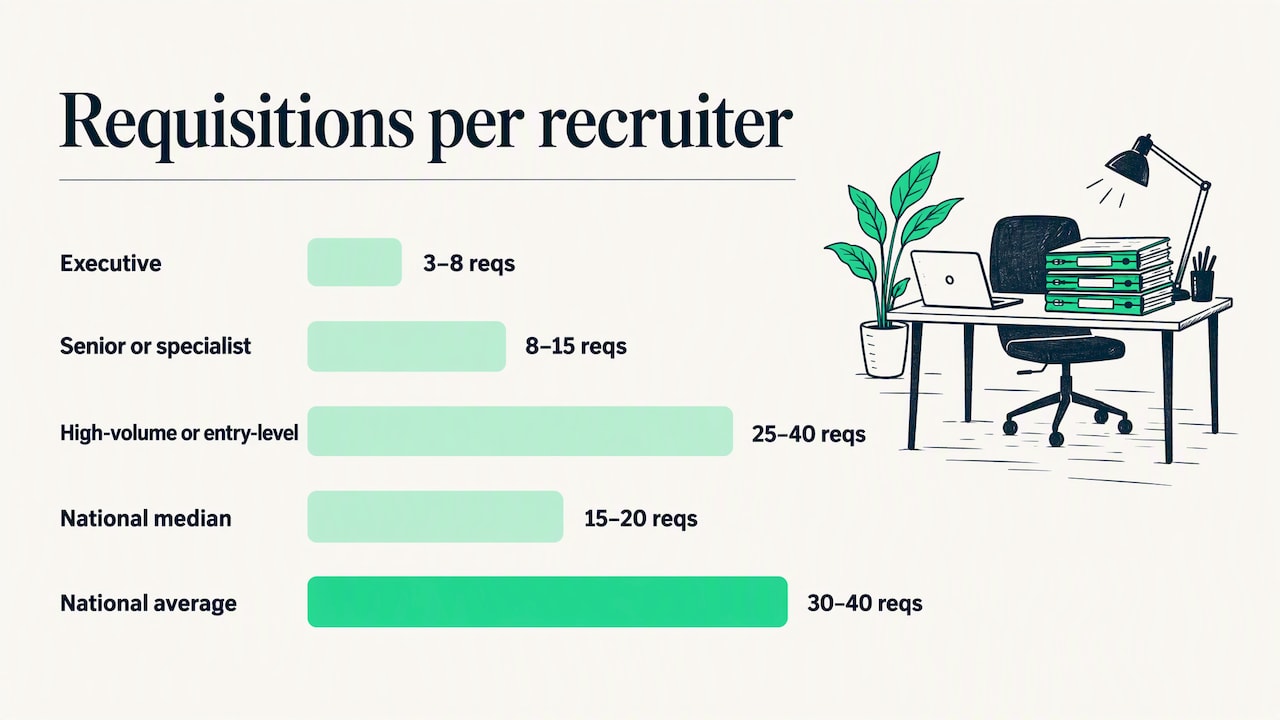
This is the question behind most capacity planning, and the honest answer is that no standard exists. SHRM’s analysis of open requisitions per in-house recruiter found individual recruiters carrying anywhere from a single-digit number to well over 100. National averages tend to sit between 30 and 40, while medians are closer to 15 to 20, which tells you that a minority of very heavy loads pulls the average up.
Two points follow from that.
Raw counts mislead. Ten executive searches and forty entry-level warehouse roles are not comparable workloads. A rough way to think about it is in role buckets:
Role type | Typical load per recruiter (rule of thumb) |
|---|---|
High-volume or entry-level | 25 to 40 reqs |
Senior or specialist | 8 to 15 reqs |
Executive | 3 to 8 reqs |
These ranges come from a free capacity planning tool rather than a study, so treat them as a starting hypothesis to test against your own results.
Full desk adds work that in-house figures leave out. The benchmarks above describe candidate-side work. A full desk recruiter also prospects, negotiates terms and manages accounts, so a safe assumption is that the same person should carry fewer open searches than an in-house colleague handling comparable roles. For IT specialist searches, where each role may need a deep technical conversation and a scarce candidate pool, the lower buckets are the realistic ones.
SHRM identifies the factors that move the number: the effort each role requires, applicant flow, how much outside sourcing is needed, screening and interviewing load, recruiter experience and the tools available. That last factor is the only one a manager can change quickly.
How to plan recruiter capacity
Capacity planning for a full desk team does not need a complex model. It needs your own data and a habit of revisiting it.
1. Segment your roles
SHRM suggests grouping requisitions into buckets such as high-volume, midcareer professional and hard-to-fill roles, then assessing workload for each. For an IT agency, useful buckets might be commodity roles with plenty of candidates, mid-level developers, and scarce specialists such as security or data engineers.
2. Pull your historical numbers
Use what your recruiters actually carried and delivered: open reqs per person, time-to-fill, offer acceptance rate and turnover. SHRM recommends reviewing this data alongside recruiter feedback, because the numbers show the outcome and the people show the cause. Our guide to recruiter productivity metrics covers three measures that expose where a funnel leaks.
3. Set a utilization band
Capacity planners commonly use a utilization scale. According to the same capacity planning tool, 0 to 70% is under-utilized, 71 to 90% is the optimal range, 91 to 100% needs close monitoring and anything above 100% means over-capacity. Aiming for roughly 80% leaves room for the unplanned: a candidate who withdraws, a client who reopens a search, a counteroffer.
4. Count the invisible work
A model that tracks only requisitions underestimates the real load, because scheduling, data entry, chasing feedback and CV formatting do not appear in the req count. In a full desk role they also compete with business development. If a recruiter spends the first two hours of every day on administration, that is capacity you can measure and recover.
5. Model forward
SocialTalent recommends modeling capacity across a 12-month horizon aligned with the hiring plan instead of reacting once a team is at the point of burnout. For an agency, that means looking at the client pipeline: which job orders are likely to land, and when, and whether your desks can absorb them. Our articles on recruitment forecasting and pipeline forecasting for recruiting walk through how to do this with real numbers.
A worked example
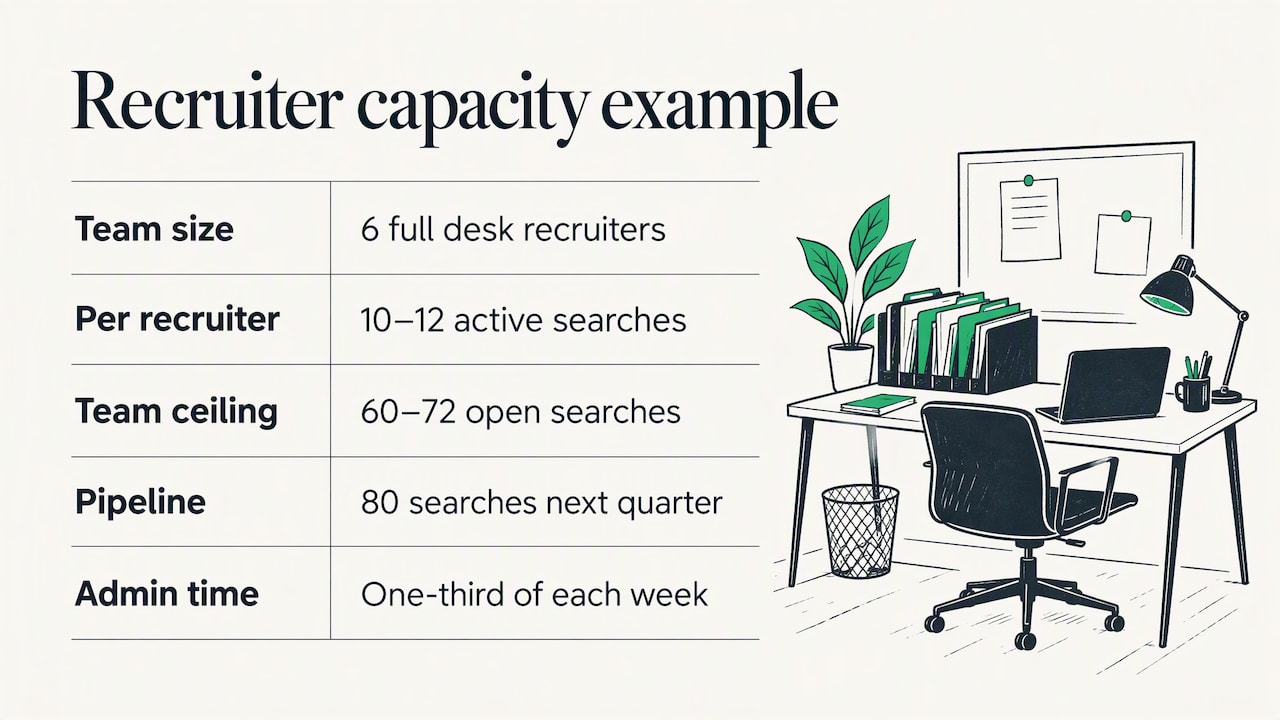
Imagine an IT agency with six full desk recruiters, each handling a mix of mid-level and specialist roles. Using the rule-of-thumb ranges above, a reasonable target might be 10 to 12 active searches per person. That gives a team ceiling of roughly 60 to 72 open searches.
Now suppose the pipeline suggests 80 searches over the next quarter. There are three honest options: hire, turn work down, or reduce the hours consumed per search. The third is the one many owners overlook. If administration, CV formatting and duplicate checking take a third of each recruiter’s week, recovering even half of that time raises effective capacity without a new salary. The figures here are illustrative, so replace them with your own time tracking before making a decision.
Advantages and challenges of the model
Advantages
One accountable owner for each client and candidate, with no information lost between teams.
Strong relationships on both sides, which matters most in niche and senior searches.
Clear economics: the recruiter sees how their own selling and delivery produce fees.
Faster decisions, because nobody waits for a handoff.
Challenges
Two jobs compete for the same hours, and the urgent one (delivery) usually beats the important one (prospecting).
Results vary heavily with individual skill, so performance and succession are riskier.
Quality can degrade as load grows. One industry analysis puts that threshold in the band of 20 to 30 requisitions per recruiter, though it is a vendor’s view and depends on role difficulty.
Tooling gaps hurt more, because data lives in a recruiter’s head, spreadsheet or inbox instead of in a shared system.
Where tools change the equation
The limit on a full desk recruiter is rarely talent. It is the number of context switches in a day: from a prospecting call to a CV, to a scheduling email, to an invoice. Software helps most when it removes those switches.
Four areas deserve attention:
One system for sales and recruiting. When the client pipeline and the candidate pipeline sit in separate tools, the recruiter re-enters information and loses the thread. A CRM built for recruitment agencies keeps the client conversation next to the search it produced.
Automated intake of candidate data. Parsing CVs from PDFs, DOCX files, scans and photos into structured profiles, with duplicate detection, removes manual data entry.
Matching and shortlisting. Contextual scoring that compares a candidate’s stack to project requirements turns an hour of reading into a ranked list to verify.
Workflow automation. Reminders, status changes and document generation take over the repetitive steps. If you are moving from spreadsheets, our piece on moving from manual processes to a modern recruitment workflow describes a sensible sequence.
It also helps to ground decisions in measurement, which our overview of data-driven recruitment addresses.
Our perspective
We build Recruitify for IT recruitment agencies and headhunters, and the same pattern appears again and again: the full desk model does not fail because recruiters cannot recruit. It fails because the administrative layer grows faster than the desk can absorb it.
For that reason we treat capacity as a systems question as much as a headcount question. When the ATS, the sales CRM and the contracting module live in one place, a recruiter does not have to rebuild context every time they switch between a client and a candidate. When CVs are parsed in seconds, duplicates are detected automatically and shortlists arrive with a percentage match score, hours move from data handling to conversations. Our aim is to reduce administrative tasks by up to 70%, so that an agency can close more placements without enlarging the team.
We also think agencies undervalue what they already own. A database indexed intelligently can bring back candidates who were lost months ago, which adds revenue without adding sourcing cost. And for firms that place IT specialists on contracts, keeping contracting in the same system as recruitment removes one more handoff.
Our advice is to measure first, automate the repeatable steps second, and only then decide whether to hire.
— Recruitify Team
Supporting a full desk team with Recruitify
Recruitify combines an ATS, a sales CRM and an IT contracting (body leasing) module in one platform, built around the way agency desks actually work. Recruiters get AI features for CV parsing, matching and Boolean sourcing, an agency CRM for the client side and workflow automation for the repetitive steps in between. Agencies working with contractors can also manage talent pools through the contracting and body leasing module.
Plans are priced per user: HR Team is €61 per user per month and Agency is €67 per user per month, while Enterprise pricing is available from our team. You can compare them on the pricing page.
Is full desk right for your agency?
A short checklist helps decide.
Is your niche specialist? If every search needs deep market knowledge, full desk usually wins on relationships.
Is your fee level high enough to justify long searches? Full desk rewards depth over volume.
Can you protect prospecting time? If not, consider a hybrid: dedicated business development support, with recruiters still owning delivery.
Do your recruiters share a system or work in private spreadsheets? The model scales only on shared data.
Do you know your utilization? If you cannot say whether recruiters sit at 70% or 110%, begin with measurement.
If you answer yes to the first three and no to the fourth, the problem is probably tooling and not the model.
FAQ
What does a full desk recruiter do?
A full desk recruiter handles both sides of an agency placement. They find and manage clients, take job orders, source and screen candidates, run interviews and negotiate the offer. It is the same as 360 recruiting.
Is full desk recruiting the same as full cycle recruiting?
They overlap but are not identical. Full cycle describes one person owning every hiring stage, and in-house teams use it for candidate-side work only. Full desk adds the client-facing sales side, so it is mostly an agency term.
How many reqs per recruiter is too many?
There is no fixed limit. SHRM reports national averages of 30 to 40 requisitions and medians of 15 to 20 for in-house recruiters, but role difficulty changes the picture. For a full desk specialist handling senior or technical searches, a single-digit to low-teens load is more realistic, and your own time-to-fill and offer-acceptance data should set the ceiling.
How do I plan recruiter capacity?
Segment roles by difficulty, collect historical workload, time-to-fill and offer-acceptance data, and set a target utilization band. Include administrative and coordination work, and model the next 12 months against your expected pipeline rather than reacting to overload.
Sources
Recommended
50+ Roles? Use a 4P Control Tower for Enterprise Recruiting at Scale
High Volume Recruiting for TA Leaders: Scale Without More Recruiters
Recruiter Productivity Metrics: 3 Measures That Expose Funnel Leaks


News & Updates
Stay up-to-date with the latest innovations, features, and tips about Recruitify!
By providing your email address within the newsletter sign-up form, you confirm its processing to send marketing information regarding the Administrator’s products and services. The Administrator of your personal data processed for the abovementioned purposes is Recruitify Spółka z o.o., based in Warsaw, Poland (KRS 0000709889). For more information on the principles of personal data processing and the rights of data subjects, please check the Privacy Policy.

Last updated:
Full Desk Recruiting: How the 360 Model Works and What It Takes
Recruitment Process
The Recruitify Team
Full desk recruiting is an agency model in which one recruiter handles the whole business cycle: finding and winning the client, taking the job order, sourcing and screening candidates, managing interviews, negotiating the offer and closing the placement. It is often called the 360 model, and it contrasts with split-desk recruiting, where business development and candidate delivery belong to different people. This guide explains how the model works, how many requisitions one recruiter can realistically carry, how to plan capacity, and where software changes the arithmetic.
Key takeaways
A full desk recruiter acts as both salesperson and delivery specialist, which makes the model mainly an agency concept rather than an in-house talent acquisition one.
There is no universal number of requisitions per recruiter. Published averages range widely, and role difficulty matters more than the raw count.
Capacity should be planned from your own data (time-to-fill, offer acceptance, workload history) and modeled forward, not corrected after the team is already overloaded.
Administrative work, not sourcing skill, is usually what limits a full desk recruiter, so automation and a single system for sales and recruiting decide how far the model scales.
Full desk suits specialist, relationship-driven niches. Split desk tends to suit high-volume work and larger firms.
Table of Contents
What full desk recruiting means
In a full desk model, the recruiter owns a desk, which is a niche, a client list and a set of searches, from first call to signed offer. The same person who pitches a hiring manager on a retained or contingent search also builds the shortlist, prepares the candidate and handles the counteroffer.
The terminology overlaps, so it helps to separate three terms:
Full desk recruiting is the agency version: the recruiter covers both the client side (business development, job orders, account management) and the candidate side.
360 recruiting is a common synonym for full desk, used in agency job postings and interview questions.
Full cycle recruiting is the wider end-to-end idea. Indeed describes it as one recruiter completing every action needed to fill a position, from identifying talent to onboarding. In-house teams use it for candidate-side work only, because their client is their own employer and nobody sells to them.
In practice, “full desk” tells you the recruiter also generates business. “Full cycle” tells you the recruiter owns every hiring stage, whether or not selling is part of the job.
What a full desk recruiter does, stage by stage
The work falls into two halves that run in parallel, which is exactly why the role is demanding.
The client side
Business development. Identifying target companies, contacting hiring managers and agreeing terms.
Job intake. Turning a vague request into a scorecard: must-have skills, compensation range, interview process and timeline.
Account management. Feedback loops, status updates and managing expectations when a market is tight.
Closing. Offer negotiation, invoicing triggers and post-placement follow-up.
The candidate side
Sourcing. Searching the internal database, job boards and the open web, often with Boolean strings.
Screening. Reading CVs, calling candidates, checking motivation and compensation fit.
Presentation. Formatting profiles for the client, sometimes anonymized.
Process management. Scheduling, preparing candidates for interviews, collecting feedback and handling offers.
The owner of the desk is accountable for all eight activities. When one of them slips, the others tend to follow, because a recruiter who stops prospecting this month has fewer job orders next quarter.
Full desk versus split desk
The split-desk alternative separates the roles: account managers or business developers bring in the work, and recruiters deliver it. Neither model is universally better. The choice depends on your niche, your average fee, your hiring volume and how your people are paid.
Criterion | Full desk (360) | Split desk |
|---|---|---|
Ownership | One person, from client to candidate | Handoff between sellers and deliverers |
Client relationship | Deep, one point of contact | Spread across two or more people |
Candidate experience | Consistent, same recruiter throughout | Can feel fragmented at handoffs |
Specialization | Broad skill set per person | Each person masters one function |
Scalability | Limited by one person’s hours | Easier to add capacity to one side |
Best fit | Niche, senior, relationship-led searches | High-volume or repeatable roles, larger firms |
Main risk | Business development gets dropped when delivery gets busy | Information lost at handoff, friction over credit |
A few observations from the table matter in practice. Full desk gives you stronger relationships, but it concentrates risk in individuals. Split desk gives you specialization, but it needs clean processes, because a handoff is only as good as the notes attached to it. Many agencies end up with a hybrid: full desk for experienced recruiters in a niche, split for juniors or for volume work.
How many requisitions can one recruiter handle?
This is the question behind most capacity planning, and the honest answer is that no standard exists. SHRM’s analysis of open requisitions per in-house recruiter found individual recruiters carrying anywhere from a single-digit number to well over 100. National averages tend to sit between 30 and 40, while medians are closer to 15 to 20, which tells you that a minority of very heavy loads pulls the average up.
Two points follow from that.
Raw counts mislead. Ten executive searches and forty entry-level warehouse roles are not comparable workloads. A rough way to think about it is in role buckets:
Role type | Typical load per recruiter (rule of thumb) |
|---|---|
High-volume or entry-level | 25 to 40 reqs |
Senior or specialist | 8 to 15 reqs |
Executive | 3 to 8 reqs |
These ranges come from a free capacity planning tool rather than a study, so treat them as a starting hypothesis to test against your own results.
Full desk adds work that in-house figures leave out. The benchmarks above describe candidate-side work. A full desk recruiter also prospects, negotiates terms and manages accounts, so a safe assumption is that the same person should carry fewer open searches than an in-house colleague handling comparable roles. For IT specialist searches, where each role may need a deep technical conversation and a scarce candidate pool, the lower buckets are the realistic ones.
SHRM identifies the factors that move the number: the effort each role requires, applicant flow, how much outside sourcing is needed, screening and interviewing load, recruiter experience and the tools available. That last factor is the only one a manager can change quickly.
How to plan recruiter capacity
Capacity planning for a full desk team does not need a complex model. It needs your own data and a habit of revisiting it.
1. Segment your roles
SHRM suggests grouping requisitions into buckets such as high-volume, midcareer professional and hard-to-fill roles, then assessing workload for each. For an IT agency, useful buckets might be commodity roles with plenty of candidates, mid-level developers, and scarce specialists such as security or data engineers.
2. Pull your historical numbers
Use what your recruiters actually carried and delivered: open reqs per person, time-to-fill, offer acceptance rate and turnover. SHRM recommends reviewing this data alongside recruiter feedback, because the numbers show the outcome and the people show the cause. Our guide to recruiter productivity metrics covers three measures that expose where a funnel leaks.
3. Set a utilization band
Capacity planners commonly use a utilization scale. According to the same capacity planning tool, 0 to 70% is under-utilized, 71 to 90% is the optimal range, 91 to 100% needs close monitoring and anything above 100% means over-capacity. Aiming for roughly 80% leaves room for the unplanned: a candidate who withdraws, a client who reopens a search, a counteroffer.
4. Count the invisible work
A model that tracks only requisitions underestimates the real load, because scheduling, data entry, chasing feedback and CV formatting do not appear in the req count. In a full desk role they also compete with business development. If a recruiter spends the first two hours of every day on administration, that is capacity you can measure and recover.
5. Model forward
SocialTalent recommends modeling capacity across a 12-month horizon aligned with the hiring plan instead of reacting once a team is at the point of burnout. For an agency, that means looking at the client pipeline: which job orders are likely to land, and when, and whether your desks can absorb them. Our articles on recruitment forecasting and pipeline forecasting for recruiting walk through how to do this with real numbers.
A worked example
Imagine an IT agency with six full desk recruiters, each handling a mix of mid-level and specialist roles. Using the rule-of-thumb ranges above, a reasonable target might be 10 to 12 active searches per person. That gives a team ceiling of roughly 60 to 72 open searches.
Now suppose the pipeline suggests 80 searches over the next quarter. There are three honest options: hire, turn work down, or reduce the hours consumed per search. The third is the one many owners overlook. If administration, CV formatting and duplicate checking take a third of each recruiter’s week, recovering even half of that time raises effective capacity without a new salary. The figures here are illustrative, so replace them with your own time tracking before making a decision.
Advantages and challenges of the model
Advantages
One accountable owner for each client and candidate, with no information lost between teams.
Strong relationships on both sides, which matters most in niche and senior searches.
Clear economics: the recruiter sees how their own selling and delivery produce fees.
Faster decisions, because nobody waits for a handoff.
Challenges
Two jobs compete for the same hours, and the urgent one (delivery) usually beats the important one (prospecting).
Results vary heavily with individual skill, so performance and succession are riskier.
Quality can degrade as load grows. One industry analysis puts that threshold in the band of 20 to 30 requisitions per recruiter, though it is a vendor’s view and depends on role difficulty.
Tooling gaps hurt more, because data lives in a recruiter’s head, spreadsheet or inbox instead of in a shared system.
Where tools change the equation
The limit on a full desk recruiter is rarely talent. It is the number of context switches in a day: from a prospecting call to a CV, to a scheduling email, to an invoice. Software helps most when it removes those switches.
Four areas deserve attention:
One system for sales and recruiting. When the client pipeline and the candidate pipeline sit in separate tools, the recruiter re-enters information and loses the thread. A CRM built for recruitment agencies keeps the client conversation next to the search it produced.
Automated intake of candidate data. Parsing CVs from PDFs, DOCX files, scans and photos into structured profiles, with duplicate detection, removes manual data entry.
Matching and shortlisting. Contextual scoring that compares a candidate’s stack to project requirements turns an hour of reading into a ranked list to verify.
Workflow automation. Reminders, status changes and document generation take over the repetitive steps. If you are moving from spreadsheets, our piece on moving from manual processes to a modern recruitment workflow describes a sensible sequence.
It also helps to ground decisions in measurement, which our overview of data-driven recruitment addresses.
Our perspective
We build Recruitify for IT recruitment agencies and headhunters, and the same pattern appears again and again: the full desk model does not fail because recruiters cannot recruit. It fails because the administrative layer grows faster than the desk can absorb it.
For that reason we treat capacity as a systems question as much as a headcount question. When the ATS, the sales CRM and the contracting module live in one place, a recruiter does not have to rebuild context every time they switch between a client and a candidate. When CVs are parsed in seconds, duplicates are detected automatically and shortlists arrive with a percentage match score, hours move from data handling to conversations. Our aim is to reduce administrative tasks by up to 70%, so that an agency can close more placements without enlarging the team.
We also think agencies undervalue what they already own. A database indexed intelligently can bring back candidates who were lost months ago, which adds revenue without adding sourcing cost. And for firms that place IT specialists on contracts, keeping contracting in the same system as recruitment removes one more handoff.
Our advice is to measure first, automate the repeatable steps second, and only then decide whether to hire.
— Recruitify Team
Supporting a full desk team with Recruitify
Recruitify combines an ATS, a sales CRM and an IT contracting (body leasing) module in one platform, built around the way agency desks actually work. Recruiters get AI features for CV parsing, matching and Boolean sourcing, an agency CRM for the client side and workflow automation for the repetitive steps in between. Agencies working with contractors can also manage talent pools through the contracting and body leasing module.
Plans are priced per user: HR Team is €61 per user per month and Agency is €67 per user per month, while Enterprise pricing is available from our team. You can compare them on the pricing page.
Is full desk right for your agency?
A short checklist helps decide.
Is your niche specialist? If every search needs deep market knowledge, full desk usually wins on relationships.
Is your fee level high enough to justify long searches? Full desk rewards depth over volume.
Can you protect prospecting time? If not, consider a hybrid: dedicated business development support, with recruiters still owning delivery.
Do your recruiters share a system or work in private spreadsheets? The model scales only on shared data.
Do you know your utilization? If you cannot say whether recruiters sit at 70% or 110%, begin with measurement.
If you answer yes to the first three and no to the fourth, the problem is probably tooling and not the model.
FAQ
What does a full desk recruiter do?
A full desk recruiter handles both sides of an agency placement. They find and manage clients, take job orders, source and screen candidates, run interviews and negotiate the offer. It is the same as 360 recruiting.
Is full desk recruiting the same as full cycle recruiting?
They overlap but are not identical. Full cycle describes one person owning every hiring stage, and in-house teams use it for candidate-side work only. Full desk adds the client-facing sales side, so it is mostly an agency term.
How many reqs per recruiter is too many?
There is no fixed limit. SHRM reports national averages of 30 to 40 requisitions and medians of 15 to 20 for in-house recruiters, but role difficulty changes the picture. For a full desk specialist handling senior or technical searches, a single-digit to low-teens load is more realistic, and your own time-to-fill and offer-acceptance data should set the ceiling.
How do I plan recruiter capacity?
Segment roles by difficulty, collect historical workload, time-to-fill and offer-acceptance data, and set a target utilization band. Include administrative and coordination work, and model the next 12 months against your expected pipeline rather than reacting to overload.
Sources
Recommended
50+ Roles? Use a 4P Control Tower for Enterprise Recruiting at Scale
High Volume Recruiting for TA Leaders: Scale Without More Recruiters
Recruiter Productivity Metrics: 3 Measures That Expose Funnel Leaks
News & Updates
Stay up-to-date with the latest innovations, features, and tips about Recruitify!
By providing your email address within the newsletter sign-up form, you confirm its processing to send marketing information regarding the Administrator’s products and services. The Administrator of your personal data processed for the abovementioned purposes is Recruitify Spółka z o.o., based in Warsaw, Poland (KRS 0000709889). For more information on the principles of personal data processing and the rights of data subjects, please check the Privacy Policy.

Discover More

Recruitment Process
Shortlisting Criteria in Recruiting: How to Build a Fair Shortlist
Learn which shortlisting criteria to define before you review applications, how to score candidates consistently, and how many to put forward for interview.
29 Oct 2026
Discover More

Recruitment Process
Recruitment Software ROI: How to Calculate It and What to Count
Learn how to calculate recruitment software ROI and ATS total cost of ownership, with a worked example, the metrics to track and the mistakes that skew results.
28 Oct 2026
Discover More

Recruitment Process
Resume Ranking Algorithms: How They Score and Rank Candidates
How a resume ranking algorithm works, which criteria and weights to use, how to validate scores, and how to pair them with interview scorecards and rubrics.
26 Oct 2026
Discover More
Recruitment Process
Shortlisting Criteria in Recruiting: How to Build a Fair Shortlist
Learn which shortlisting criteria to define before you review applications, how to score candidates consistently, and how many to put forward for interview.
29 Oct 2026
Discover More
Recruitment Process
Recruitment Software ROI: How to Calculate It and What to Count
Learn how to calculate recruitment software ROI and ATS total cost of ownership, with a worked example, the metrics to track and the mistakes that skew results.
28 Oct 2026
Discover More