
Last updated:
Resume Ranking Algorithms: How They Score and Rank Candidates

Recruitment Process

The Recruitify Team
A resume ranking algorithm reads each application, compares it with the requirements of a role, and orders candidates by a relative score so that recruiters review the strongest matches first. The best systems do more than count keywords: they compare meaning, weight several criteria, and show the reasoning behind every score. This guide explains how that works, which criteria and weights are reasonable, how to check that rankings are job-related and fair, and how to connect the ranking to interview scorecards and scoring rubrics.
Key takeaways
A modern ranking algorithm compares the meaning of a resume and a job description, not only shared words, so equivalent skills described in different terms can still match.
Weighted scoring across skills, experience, education, certifications and semantic similarity lets a hiring team decide what the system prioritizes for each role.
A ranking is a decision aid, not a verdict: it needs documented evidence that scores relate to job performance, periodic bias checks and a human who can override it.
Interview scorecards with anchored rating scales extend the same logic to the interview stage, and the two sets of scores are most useful when they are stored together and reviewed over time.
Table of Contents
What a resume ranking algorithm actually does
The process has three stages. First, the system extracts structured data from each resume: roles, dates, skills, education, certifications. Second, it maps that data to the criteria set for the vacancy. Third, it computes a score for each candidate and sorts the list.
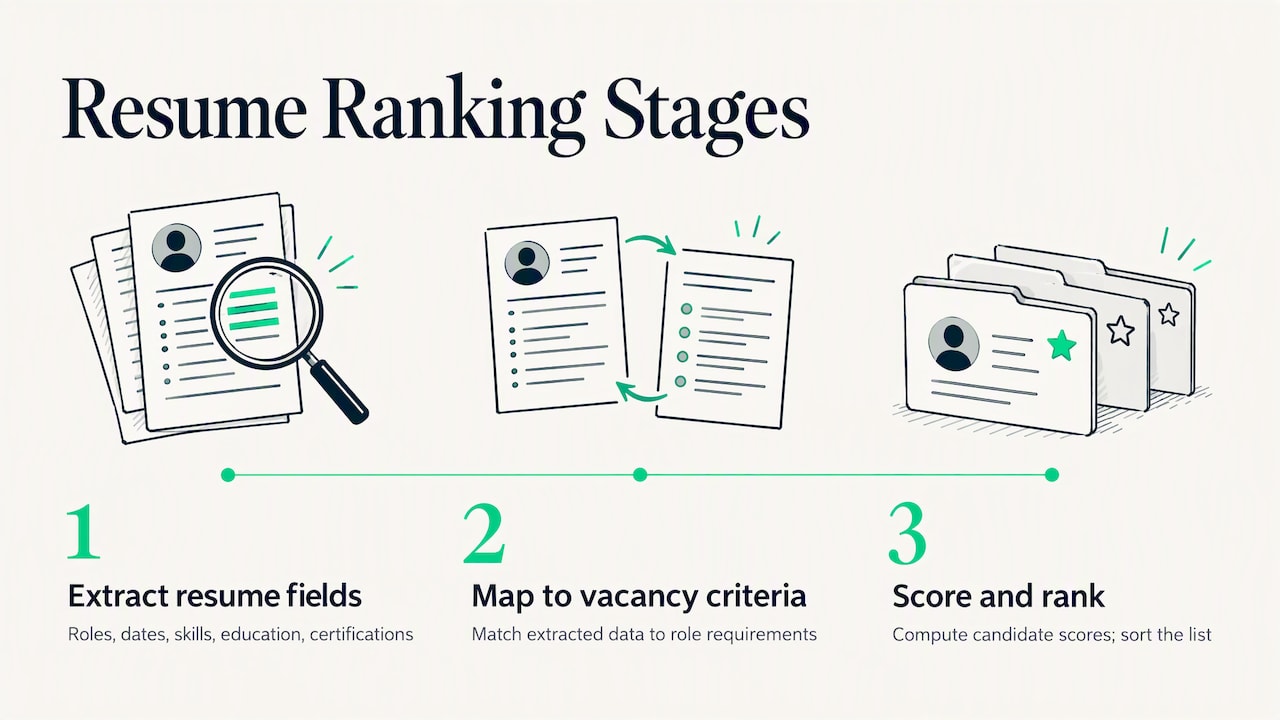
An academic description of a CV-ranking tool follows exactly this pattern: it extracts information, maps it to employer-defined criteria for skills, education and experience, applies weighted scoring, and can rank candidates with relative scores such as z-scores. The z-score detail matters, because it means the output is a position relative to the other applicants in the pool, not an absolute grade. A candidate who scores 77 in a weak pool and a candidate who scores 77 in a strong pool are not equivalent, which is also why a single “ATS score” quoted out of context says little about quality.
The first stage is where many rankings quietly fail. If a parser misreads a two-column PDF, a scan or a photo, the best-matching candidate may never reach the scoring step. Parsing accuracy and duplicate detection therefore belong in any evaluation of a ranking system, not only the scoring model itself.
Keyword screening versus semantic matching
The question “resume screening vs matching” comes down to what is being compared. Keyword screening checks whether specific terms from the job description appear in the resume. It is transparent and fast, but it rewards candidates who copy the vocabulary of the posting and penalizes those who describe the same work differently.
Semantic matching converts text into numerical representations and compares them. The 2025 Resume2Vec study transforms resumes and job descriptions into transformer-based embeddings and compares them with cosine similarity. Encoders such as BERT, RoBERTa and DistilBERT capture relationships between phrases, so competencies expressed in varied wording can still be recognized as equivalent.
A practical example from IT recruitment: a vacancy asks for “container orchestration.” A keyword filter rejects a resume that lists only “Kubernetes, Helm, EKS.” A semantic model treats these as closely related. For technical roles, where the same skill has many names and stacks overlap, this difference is substantial.
Evidence that semantic approaches can outperform lexical ones exists but is bounded. A CEUR-WS case study on IT vacancies found that its character n-gram representation ranked resumes better than BM25, a standard lexical retrieval method, on an English IT-resume dataset. The authors limit that conclusion to their dataset and domain, and it should be read the same way: promising, not universal.
Approach | What it compares | Strength | Typical weakness |
|---|---|---|---|
Keyword screening | Exact terms and phrases | Simple, easy to explain | Misses synonyms and related skills, rewards keyword stuffing |
Lexical ranking (for example BM25) | Weighted term frequency | Better ordering than a yes/no filter | Still depends on shared vocabulary |
Semantic matching | Meaning, through embeddings | Recognizes equivalent competencies | Harder to explain without factor-level scores |
Learned ranking models | Patterns across labeled examples | Can combine many signals | Needs good training data and ongoing validation |
Learning to rank: what the research reports
Some systems go a step further and learn how to order candidates. A 2024 study extracted semantic resume attributes with NLP and applied RankSVM to distinguish candidates and assign relative suitability scores. It reported accuracy up to 92% and selected the top ten from 228 technical-specialist resumes.
Those figures describe an experiment on one dataset. They are useful for understanding what is technically possible, and they are not a performance promise for your roles, your candidate pool or your vendor’s product. Treat any accuracy percentage, in a paper or on a sales page, as a claim to be tested on your own historical data.
Criteria and weights: what to score and how much
Weighted scoring is the most practical design for a hiring team, because it turns a black box into a set of dials. Research on automated screening recommends weighted scores for skills, experience, education, certifications and semantic similarity, with committees tuning the weights to the role. The same work describes weighted multi-factor scoring as both a ranking mechanism and a governance interface, since the weights state openly what the team values in a given round.
The weights below are an illustration of the logic, not a recommended standard. They show how the same five factors shift between two different vacancies.
Factor | Senior backend engineer (example) | Junior support analyst (example) |
|---|---|---|
Skills and tech stack | 35% | 20% |
Relevant experience | 30% | 15% |
Semantic similarity to the job description | 20% | 25% |
Education | 5% | 25% |
Certifications | 10% | 15% |
A few rules make weights work in practice:
Define must-haves separately from nice-to-haves. A legal work authorization or a mandatory license should be a gate, not a weighted point.
Weight what predicts performance, not what is easy to extract. University names and job-title prestige are easy to parse and often weak predictors.
Write the weights down before screening starts. Changing them after seeing the top candidates turns the model into a rationalization tool.
Expose factor-level scores. A reviewer who sees that a candidate scored high on skills and low on experience can challenge the result. A single opaque number cannot be challenged.
AI scoring built on this logic is covered in more depth in our guide to AI candidate scoring and how to use it responsibly.
How to check that rankings are accurate, job-related and fair
A ranking that looks sensible is not the same as a ranking that is valid. The professional standard is documentation: the Principles for the Validation and Use of Personnel Selection Procedures call for evidence that a selection procedure is job-related, typically by showing that scores predict important work outcomes. That expectation applies to AI-based tools as much as to tests.
There is a second trap. A U.S. technical advisory report from the Sedona Conference notes that an absence of statistically significant adverse impact does not mean a tool is necessarily appropriate, job-related or valid. A clean adverse-impact check is one test, not a certificate.
The same report observes that dynamic machine-learning tools may strain traditional validation frameworks, and that employers may consider version-control policies and guardrails around substantive changes. In plain terms: if the model is updated, the validation may no longer apply.
A workable checklist for a hiring team or agency:
State the job-relevant criteria and record why each one matters for the role.
Run a pilot on past hires. Check whether higher-ranked candidates went on to perform better, using whatever performance evidence you hold.
Review selection rates by group at each stage, and treat the result as a prompt for investigation, not as proof either way.
Keep reviewers able to override. Factor-level scores and a logged reason for each override make this auditable.
Log model and weight changes with dates, so you know which version produced which shortlist.
Re-check periodically, particularly after the role, the market or the model changes.
If you hire in the United States, consult employment counsel about requirements in your state or city, since several jurisdictions regulate automated employment decision tools. For a deeper look at audit planning, see our article on AI bias in recruiting and a per-job audit plan.
From ranking to interview: candidate scorecards
A resume ranking answers “who should we talk to first.” It says nothing reliable about how a person performs when asked to solve a problem or describe past behavior. That is the job of the interview, and the interview needs the same discipline as the ranking: predefined criteria, a consistent scale, and written evidence.
Candidate scorecards solve a comparison problem. Without them, three interviewers return three impressions in three formats, and the debrief becomes a contest of confidence. With them, every interviewer rates the same competencies on the same scale, so results can be compared across interviewers and across hiring stages.
What an interview scorecard template should include
The Behavioural Insights Team’s guide to structured interviewing describes the essentials: job-relevant questions, predefined scoring criteria and a consistent scale, with a 0 to 3 scale as its example. A usable template therefore has these fields:
Candidate name, role, interviewer, date and interview stage
The competency being assessed, one row per question
The question asked
Notes recording what the candidate actually said or did
A score on the agreed scale
A space for an overall recommendation, completed only after the individual scores
If you want ready-made structures for your applicant tracking system, we publish interview feedback forms recruiters can copy.
Building an interview scoring rubric with behavioral anchors
A scorecard tells interviewers what to rate. A rubric tells them what each rating means. The same guide recommends identifying the 5 to 7 core competencies for the role and defining, for each, what poor, target and excellent performance looks like through specific behavioral anchors. Anchors keep a “2” from meaning one thing to one interviewer and something else to another.
An example for the competency “troubleshooting a production incident” on a 0 to 3 scale:
Score | Anchor (example) |
|---|---|
0 | Cannot describe a concrete incident, or describes only what others did |
1 | Describes an incident but not how the cause was isolated |
2 | Explains a structured diagnosis and the fix they implemented |
3 | Explains diagnosis, fix, and the change made afterward to prevent recurrence |
The same structure serves as a candidate scoring model for any interview stage: competency, question, anchors, evidence, score.
Using scorecards consistently
Consistency comes from process more than from the form. The guide’s approach is that interviewers score and note each response independently, and only discuss after every score is assigned. That order prevents the loudest or most senior voice from setting the group’s view. Where several interviewers see the same candidate, each should record scores based on evidence from the session, then compare.
Combining resume ranking and interview scores
The two scoring layers are most valuable when they can be examined together. Store the screening rank and the anchored interview scores in fields that can be joined, so that you can later ask whether higher-ranked candidates also scored higher in interviews, and whether either predicted performance after hire. One practitioner write-up suggests reviewing that relationship quarterly and using the loop to inform decisions rather than make them; that is a process suggestion, not a validated standard, so apply the validation principles above before relying on it.
Three cautions apply:
Do not let the rank anchor the interviewer. Some teams hide the screening score from interviewers until their own scorecard is submitted.
Look for disagreement. A candidate ranked low but interviewed strongly is a signal that the ranking criteria may be missing something.
Keep the final decision human. Scores organize evidence, and a person weighs it.
Perspective: what we see in practice
We build recruitment software for IT agencies and in-house teams, and our view is that the ranking algorithm is the least interesting part of the problem. A model that places the right candidate first is useless if the CV was never parsed correctly, if the same person sits in the database three times, or if the shortlist cannot be explained to the client who asked for it.
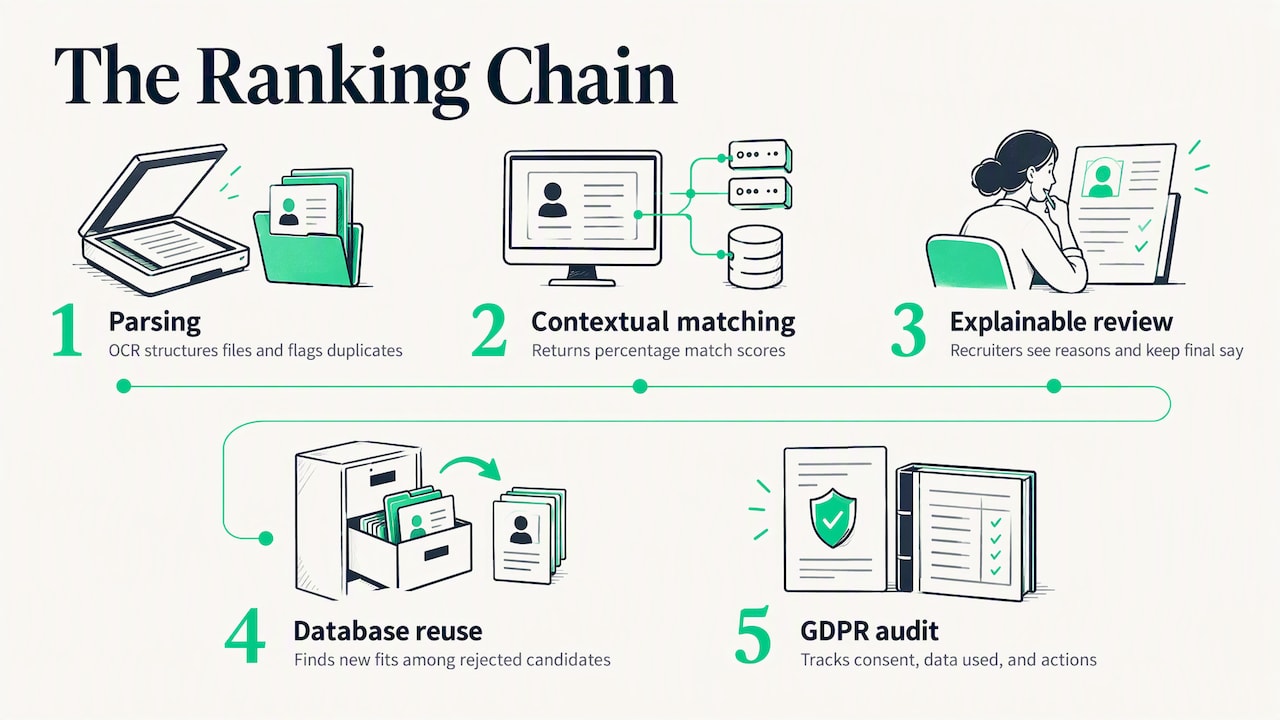
For that reason, we treat ranking as a chain. Parsing with OCR turns PDFs, scans and photos into structured profiles in seconds and flags duplicates. Contextual matching then looks at relationships inside a candidate’s tech stack, not only keywords, and returns a percentage match score against project requirements. Recruiters see why a candidate scored as they did, and they keep the final say.
We also think agencies undervalue their own databases. Candidates who were rejected for one project are often the right fit for the next, and a ranking engine that searches your existing records makes that reuse routine instead of accidental. Finally, GDPR consent management and a full audit trail are not add-ons to scoring: if you cannot show what data was used and who acted on it, you cannot defend the ranking.
- Recruitify Team
Where Recruitify fits
If you run an agency or an internal hiring team and want ranking, parsing and pipeline management in one place, Recruitify combines an ATS, a sales CRM and a contracting module. Its AI recruitment features cover CV parsing, contextual matching with scoring and ready-made shortlists, and you can see how candidates and vacancies connect in the candidate database and ATS. Published plans on the pricing page are HR Team at €61 per month per user and Agency at €67 per month per user, while Enterprise has no published price.
FAQ
Is 77% a good ATS resume score?
There is no universal threshold. Scores depend on how a particular system weights criteria, and many rankings are relative to the other applicants in the pool, so the same number can mean different things in different searches. Use a score to decide who to review first, not to decide who is good.
What is the difference between resume screening and resume matching?
Screening filters candidates in or out, often by checking for required terms or qualifications. Matching compares the overall meaning of a resume and a job description and produces a graded score, which allows equivalent skills in different wording to be recognized. Many teams use screening for hard requirements and matching for ordering the remainder.
How many criteria should a candidate scoring rubric have?
Structured interviewing guidance suggests 5 to 7 core competencies per role, each with behavioral anchors for poor, target and excellent performance. More than that tends to dilute attention and slow the debrief. Choose the competencies that most clearly separate strong from average performers in that role.
Can a resume ranking algorithm be biased?
Yes. Any model can reflect patterns in its criteria or training data, and a lack of measured adverse impact does not prove a tool is valid for the job. Document job-related criteria, check outcomes by group, log model changes and keep humans able to override the ranking.
Sources
Resume2Vec: Transforming Applicant Tracking Systems with Intelligent Resume Embeddings
Improved Candidate-Career Matching Using Comparative Analysis
Automated CV Analyzing and Ranking Tool to Select Candidates
Principles for the Validation and Use of Personnel Selection Procedures
The Behavioural Insights Team: How to run structured interviews
Recommended
AI Scoring in Recruitment: The smarter way to screen talent without losing the human touch
Hit 80+ Scores: Automated Resume Screening for HR & Job Seekers


News & Updates
Stay up-to-date with the latest innovations, features, and tips about Recruitify!
By providing your email address within the newsletter sign-up form, you confirm its processing to send marketing information regarding the Administrator’s products and services. The Administrator of your personal data processed for the abovementioned purposes is Recruitify Spółka z o.o., based in Warsaw, Poland (KRS 0000709889). For more information on the principles of personal data processing and the rights of data subjects, please check the Privacy Policy.

Last updated:
Resume Ranking Algorithms: How They Score and Rank Candidates
Recruitment Process
The Recruitify Team
A resume ranking algorithm reads each application, compares it with the requirements of a role, and orders candidates by a relative score so that recruiters review the strongest matches first. The best systems do more than count keywords: they compare meaning, weight several criteria, and show the reasoning behind every score. This guide explains how that works, which criteria and weights are reasonable, how to check that rankings are job-related and fair, and how to connect the ranking to interview scorecards and scoring rubrics.
Key takeaways
A modern ranking algorithm compares the meaning of a resume and a job description, not only shared words, so equivalent skills described in different terms can still match.
Weighted scoring across skills, experience, education, certifications and semantic similarity lets a hiring team decide what the system prioritizes for each role.
A ranking is a decision aid, not a verdict: it needs documented evidence that scores relate to job performance, periodic bias checks and a human who can override it.
Interview scorecards with anchored rating scales extend the same logic to the interview stage, and the two sets of scores are most useful when they are stored together and reviewed over time.
Table of Contents
What a resume ranking algorithm actually does
The process has three stages. First, the system extracts structured data from each resume: roles, dates, skills, education, certifications. Second, it maps that data to the criteria set for the vacancy. Third, it computes a score for each candidate and sorts the list.
An academic description of a CV-ranking tool follows exactly this pattern: it extracts information, maps it to employer-defined criteria for skills, education and experience, applies weighted scoring, and can rank candidates with relative scores such as z-scores. The z-score detail matters, because it means the output is a position relative to the other applicants in the pool, not an absolute grade. A candidate who scores 77 in a weak pool and a candidate who scores 77 in a strong pool are not equivalent, which is also why a single “ATS score” quoted out of context says little about quality.
The first stage is where many rankings quietly fail. If a parser misreads a two-column PDF, a scan or a photo, the best-matching candidate may never reach the scoring step. Parsing accuracy and duplicate detection therefore belong in any evaluation of a ranking system, not only the scoring model itself.
Keyword screening versus semantic matching
The question “resume screening vs matching” comes down to what is being compared. Keyword screening checks whether specific terms from the job description appear in the resume. It is transparent and fast, but it rewards candidates who copy the vocabulary of the posting and penalizes those who describe the same work differently.
Semantic matching converts text into numerical representations and compares them. The 2025 Resume2Vec study transforms resumes and job descriptions into transformer-based embeddings and compares them with cosine similarity. Encoders such as BERT, RoBERTa and DistilBERT capture relationships between phrases, so competencies expressed in varied wording can still be recognized as equivalent.
A practical example from IT recruitment: a vacancy asks for “container orchestration.” A keyword filter rejects a resume that lists only “Kubernetes, Helm, EKS.” A semantic model treats these as closely related. For technical roles, where the same skill has many names and stacks overlap, this difference is substantial.
Evidence that semantic approaches can outperform lexical ones exists but is bounded. A CEUR-WS case study on IT vacancies found that its character n-gram representation ranked resumes better than BM25, a standard lexical retrieval method, on an English IT-resume dataset. The authors limit that conclusion to their dataset and domain, and it should be read the same way: promising, not universal.
Approach | What it compares | Strength | Typical weakness |
|---|---|---|---|
Keyword screening | Exact terms and phrases | Simple, easy to explain | Misses synonyms and related skills, rewards keyword stuffing |
Lexical ranking (for example BM25) | Weighted term frequency | Better ordering than a yes/no filter | Still depends on shared vocabulary |
Semantic matching | Meaning, through embeddings | Recognizes equivalent competencies | Harder to explain without factor-level scores |
Learned ranking models | Patterns across labeled examples | Can combine many signals | Needs good training data and ongoing validation |
Learning to rank: what the research reports
Some systems go a step further and learn how to order candidates. A 2024 study extracted semantic resume attributes with NLP and applied RankSVM to distinguish candidates and assign relative suitability scores. It reported accuracy up to 92% and selected the top ten from 228 technical-specialist resumes.
Those figures describe an experiment on one dataset. They are useful for understanding what is technically possible, and they are not a performance promise for your roles, your candidate pool or your vendor’s product. Treat any accuracy percentage, in a paper or on a sales page, as a claim to be tested on your own historical data.
Criteria and weights: what to score and how much
Weighted scoring is the most practical design for a hiring team, because it turns a black box into a set of dials. Research on automated screening recommends weighted scores for skills, experience, education, certifications and semantic similarity, with committees tuning the weights to the role. The same work describes weighted multi-factor scoring as both a ranking mechanism and a governance interface, since the weights state openly what the team values in a given round.
The weights below are an illustration of the logic, not a recommended standard. They show how the same five factors shift between two different vacancies.
Factor | Senior backend engineer (example) | Junior support analyst (example) |
|---|---|---|
Skills and tech stack | 35% | 20% |
Relevant experience | 30% | 15% |
Semantic similarity to the job description | 20% | 25% |
Education | 5% | 25% |
Certifications | 10% | 15% |
A few rules make weights work in practice:
Define must-haves separately from nice-to-haves. A legal work authorization or a mandatory license should be a gate, not a weighted point.
Weight what predicts performance, not what is easy to extract. University names and job-title prestige are easy to parse and often weak predictors.
Write the weights down before screening starts. Changing them after seeing the top candidates turns the model into a rationalization tool.
Expose factor-level scores. A reviewer who sees that a candidate scored high on skills and low on experience can challenge the result. A single opaque number cannot be challenged.
AI scoring built on this logic is covered in more depth in our guide to AI candidate scoring and how to use it responsibly.
How to check that rankings are accurate, job-related and fair
A ranking that looks sensible is not the same as a ranking that is valid. The professional standard is documentation: the Principles for the Validation and Use of Personnel Selection Procedures call for evidence that a selection procedure is job-related, typically by showing that scores predict important work outcomes. That expectation applies to AI-based tools as much as to tests.
There is a second trap. A U.S. technical advisory report from the Sedona Conference notes that an absence of statistically significant adverse impact does not mean a tool is necessarily appropriate, job-related or valid. A clean adverse-impact check is one test, not a certificate.
The same report observes that dynamic machine-learning tools may strain traditional validation frameworks, and that employers may consider version-control policies and guardrails around substantive changes. In plain terms: if the model is updated, the validation may no longer apply.
A workable checklist for a hiring team or agency:
State the job-relevant criteria and record why each one matters for the role.
Run a pilot on past hires. Check whether higher-ranked candidates went on to perform better, using whatever performance evidence you hold.
Review selection rates by group at each stage, and treat the result as a prompt for investigation, not as proof either way.
Keep reviewers able to override. Factor-level scores and a logged reason for each override make this auditable.
Log model and weight changes with dates, so you know which version produced which shortlist.
Re-check periodically, particularly after the role, the market or the model changes.
If you hire in the United States, consult employment counsel about requirements in your state or city, since several jurisdictions regulate automated employment decision tools. For a deeper look at audit planning, see our article on AI bias in recruiting and a per-job audit plan.
From ranking to interview: candidate scorecards
A resume ranking answers “who should we talk to first.” It says nothing reliable about how a person performs when asked to solve a problem or describe past behavior. That is the job of the interview, and the interview needs the same discipline as the ranking: predefined criteria, a consistent scale, and written evidence.
Candidate scorecards solve a comparison problem. Without them, three interviewers return three impressions in three formats, and the debrief becomes a contest of confidence. With them, every interviewer rates the same competencies on the same scale, so results can be compared across interviewers and across hiring stages.
What an interview scorecard template should include
The Behavioural Insights Team’s guide to structured interviewing describes the essentials: job-relevant questions, predefined scoring criteria and a consistent scale, with a 0 to 3 scale as its example. A usable template therefore has these fields:
Candidate name, role, interviewer, date and interview stage
The competency being assessed, one row per question
The question asked
Notes recording what the candidate actually said or did
A score on the agreed scale
A space for an overall recommendation, completed only after the individual scores
If you want ready-made structures for your applicant tracking system, we publish interview feedback forms recruiters can copy.
Building an interview scoring rubric with behavioral anchors
A scorecard tells interviewers what to rate. A rubric tells them what each rating means. The same guide recommends identifying the 5 to 7 core competencies for the role and defining, for each, what poor, target and excellent performance looks like through specific behavioral anchors. Anchors keep a “2” from meaning one thing to one interviewer and something else to another.
An example for the competency “troubleshooting a production incident” on a 0 to 3 scale:
Score | Anchor (example) |
|---|---|
0 | Cannot describe a concrete incident, or describes only what others did |
1 | Describes an incident but not how the cause was isolated |
2 | Explains a structured diagnosis and the fix they implemented |
3 | Explains diagnosis, fix, and the change made afterward to prevent recurrence |
The same structure serves as a candidate scoring model for any interview stage: competency, question, anchors, evidence, score.
Using scorecards consistently
Consistency comes from process more than from the form. The guide’s approach is that interviewers score and note each response independently, and only discuss after every score is assigned. That order prevents the loudest or most senior voice from setting the group’s view. Where several interviewers see the same candidate, each should record scores based on evidence from the session, then compare.
Combining resume ranking and interview scores
The two scoring layers are most valuable when they can be examined together. Store the screening rank and the anchored interview scores in fields that can be joined, so that you can later ask whether higher-ranked candidates also scored higher in interviews, and whether either predicted performance after hire. One practitioner write-up suggests reviewing that relationship quarterly and using the loop to inform decisions rather than make them; that is a process suggestion, not a validated standard, so apply the validation principles above before relying on it.
Three cautions apply:
Do not let the rank anchor the interviewer. Some teams hide the screening score from interviewers until their own scorecard is submitted.
Look for disagreement. A candidate ranked low but interviewed strongly is a signal that the ranking criteria may be missing something.
Keep the final decision human. Scores organize evidence, and a person weighs it.
Perspective: what we see in practice
We build recruitment software for IT agencies and in-house teams, and our view is that the ranking algorithm is the least interesting part of the problem. A model that places the right candidate first is useless if the CV was never parsed correctly, if the same person sits in the database three times, or if the shortlist cannot be explained to the client who asked for it.
For that reason, we treat ranking as a chain. Parsing with OCR turns PDFs, scans and photos into structured profiles in seconds and flags duplicates. Contextual matching then looks at relationships inside a candidate’s tech stack, not only keywords, and returns a percentage match score against project requirements. Recruiters see why a candidate scored as they did, and they keep the final say.
We also think agencies undervalue their own databases. Candidates who were rejected for one project are often the right fit for the next, and a ranking engine that searches your existing records makes that reuse routine instead of accidental. Finally, GDPR consent management and a full audit trail are not add-ons to scoring: if you cannot show what data was used and who acted on it, you cannot defend the ranking.
- Recruitify Team
Where Recruitify fits
If you run an agency or an internal hiring team and want ranking, parsing and pipeline management in one place, Recruitify combines an ATS, a sales CRM and a contracting module. Its AI recruitment features cover CV parsing, contextual matching with scoring and ready-made shortlists, and you can see how candidates and vacancies connect in the candidate database and ATS. Published plans on the pricing page are HR Team at €61 per month per user and Agency at €67 per month per user, while Enterprise has no published price.
FAQ
Is 77% a good ATS resume score?
There is no universal threshold. Scores depend on how a particular system weights criteria, and many rankings are relative to the other applicants in the pool, so the same number can mean different things in different searches. Use a score to decide who to review first, not to decide who is good.
What is the difference between resume screening and resume matching?
Screening filters candidates in or out, often by checking for required terms or qualifications. Matching compares the overall meaning of a resume and a job description and produces a graded score, which allows equivalent skills in different wording to be recognized. Many teams use screening for hard requirements and matching for ordering the remainder.
How many criteria should a candidate scoring rubric have?
Structured interviewing guidance suggests 5 to 7 core competencies per role, each with behavioral anchors for poor, target and excellent performance. More than that tends to dilute attention and slow the debrief. Choose the competencies that most clearly separate strong from average performers in that role.
Can a resume ranking algorithm be biased?
Yes. Any model can reflect patterns in its criteria or training data, and a lack of measured adverse impact does not prove a tool is valid for the job. Document job-related criteria, check outcomes by group, log model changes and keep humans able to override the ranking.
Sources
Resume2Vec: Transforming Applicant Tracking Systems with Intelligent Resume Embeddings
Improved Candidate-Career Matching Using Comparative Analysis
Automated CV Analyzing and Ranking Tool to Select Candidates
Principles for the Validation and Use of Personnel Selection Procedures
The Behavioural Insights Team: How to run structured interviews
Recommended
AI Scoring in Recruitment: The smarter way to screen talent without losing the human touch
Hit 80+ Scores: Automated Resume Screening for HR & Job Seekers
News & Updates
Stay up-to-date with the latest innovations, features, and tips about Recruitify!
By providing your email address within the newsletter sign-up form, you confirm its processing to send marketing information regarding the Administrator’s products and services. The Administrator of your personal data processed for the abovementioned purposes is Recruitify Spółka z o.o., based in Warsaw, Poland (KRS 0000709889). For more information on the principles of personal data processing and the rights of data subjects, please check the Privacy Policy.

Discover More

Recruitment Process
Shortlisting Criteria in Recruiting: How to Build a Fair Shortlist
Learn which shortlisting criteria to define before you review applications, how to score candidates consistently, and how many to put forward for interview.
29 Oct 2026
Discover More

Recruitment Process
Recruitment Software ROI: How to Calculate It and What to Count
Learn how to calculate recruitment software ROI and ATS total cost of ownership, with a worked example, the metrics to track and the mistakes that skew results.
28 Oct 2026
Discover More

Recruitment Process
Full Desk Recruiting: How the 360 Model Works and What It Takes
Full desk recruiting explained: what a 360 recruiter does, how many reqs one person can carry, and how to plan capacity so the model scales without burnout.
27 Oct 2026
Discover More
Recruitment Process
Shortlisting Criteria in Recruiting: How to Build a Fair Shortlist
Learn which shortlisting criteria to define before you review applications, how to score candidates consistently, and how many to put forward for interview.
29 Oct 2026
Discover More
Recruitment Process
Recruitment Software ROI: How to Calculate It and What to Count
Learn how to calculate recruitment software ROI and ATS total cost of ownership, with a worked example, the metrics to track and the mistakes that skew results.
28 Oct 2026
Discover More