🔥
Contracting
Explore the new contractor management module
🔥
Contracting
Explore the new contractor management module
🔥
Contracting
Explore the new contractor management module
🔥
Contracting
Explore the new contractor management module
Last updated:
Comprehensive Guide to ATS: Everything You Need to Know About Recruitment Systems

Innovations

Iwo Paliszewski
Chapter 1: What is ATS?
Definition, history, and comparison with advanced recruitment systems and HRM
Definition of ATS
ATS, or Applicant Tracking System or Application Tracking System (translation: application tracking system), is software designed to manage recruitment processes. ATS enables the collection, organization, and analysis of candidate applications in one place. With automation features and data analysis, ATS systems allow faster and more efficient handling of recruitment processes.
In short, ATS is a tool that:
Automates repetitive tasks such as CV filtering or sending messages.
Facilitates communication with candidates at every stage of recruitment.
Centralizes candidate data, enabling quick search and analysis.
Supports compliance with regulations such as GDPR.
Brief history of ATS
The history of ATS systems dates back to the 1990s when computer technologies began to be used to manage candidate applications. Early versions of ATS primarily served as databases where applicant information was stored. These were local tools requiring installation on company computers.
With the turn of the century and the development of the internet, ATS began to evolve. Online recruitment systems emerged, integrating with job portals and emails. During this period, automation functions such as keyword-based filtering were also developed.
In the last decade, ATS has become more advanced thanks to cloud technologies and artificial intelligence. Today's systems offer not only application management but also data analysis features, recruitment outcomes prediction, and integration with other HR tools.
Differences between ATS, advanced recruitment systems, and HRM
ATS (Applicant Tracking System)
Scope: Focuses on managing recruitment processes.
Main functions: Job posting, application management, candidate filtering, automatic responses, recruitment metrics reporting.
Users: Recruiters and HR departments responsible for recruitment.
Advanced recruitment systems
Scope: Combines ATS functions with additional tools, such as CRM, recruitment automation, or predictive analysis.
Main functions: All ATS functions plus client relationship management (CRM), building long-term talent pools, analysis of recruitment effectiveness, and marketing tools supporting recruitment.
Users: Recruitment agencies and companies undertaking comprehensive recruitment projects.
HRM (Human Resource Management System)
Scope: Covers the entire life cycle of an employee within the company - from recruitment to HR management.
Main functions: Recruitment (often as an ATS module), onboarding, work time management, employee evaluations, learning and development (L&D), payroll and benefits management.
Users: HR departments responsible for all processes related to employment and employee management.
Comparison of functions
Function | ATS | Advanced | HRM |
Job posting | ✅ | ✅ | ❌ (optional) |
Application management | ✅ | ✅ | ✅ (often limited) |
Recruitment automation | ✅ | ✅ | ❌ |
CRM | ❌ | ✅ | ❌ |
Building talent pools | ❌ | ✅ | ❌ |
Onboarding | ❌ | ❌ | ✅ |
Learning and development (L&D) | ❌ | ❌ | ✅ |
Work time management | ❌ | ❌ | ✅ |
GDPR compliance | ✅ | ✅ | ✅ |
Summary
ATS is the foundation of modern recruitment processes, enabling the automation and centralization of actions related to hiring employees. Compared to more advanced recruitment systems and HRM, ATS focuses solely on recruitment, offering specialized tools tailored to recruiters' needs. However, depending on the scale and specificity of the organization, it may be worth considering integrating ATS with other systems to maximize their potential. In the following chapters, we will look at how ATS works and what benefits it brings.
Chapter 2: How does the ATS system work?
What is ATS in practice?
The ATS (Applicant Tracking System) is an advanced tool that organizes and automates key stages of the recruitment process. From the moment of job posting, to application analysis, until the finalization of hiring, ATS acts as a central management point for the entire process.
By automating repetitive tasks, these systems significantly enhance the work of recruiters, while increasing the efficiency of the entire recruitment process. Below is a detailed description of ATS functions and a typical workflow supported by this software.
Key functionalities of the ATS system
1. Sourcing candidates from multiple sources
ATS integrates with recruitment portals, social media, and the company career site, enabling simultaneous job posting in many places.
This allows reaching a wider audience of potential candidates and increasing the number of applications.
2. Centralization of candidate data
All applications go to one place where the system creates detailed candidate profiles.
The system stores information such as personal data, CVs, recruiter notes, and communication history.
Automatic candidate selection
ATS uses algorithms to filter applications based on defined criteria such as skills, experience, or location.
Top-matched candidates are automatically highlighted, saving recruiters time.
Managing communication with candidates
The system allows sending personalized emails at various stages of recruitment, such as application confirmations or interview invitations.
GDPR compliance
ATS automates managing consents for personal data processing and provides the ability to delete them at the candidate's request.
Reporting and recruitment analysis
The system generates reports on recruitment effectiveness, such as time to hire, effectiveness of candidate sources, or process costs.
How does the recruitment process supported by ATS look?
1. Creating and posting a recruitment announcement
A recruiter creates an announcement in ATS, which can automatically pull data from the job description.
The announcement is posted simultaneously on selected recruitment portals, social media, and the company career page.
2. Collecting candidate applications
All applications go to the system where they are automatically assigned to the appropriate recruitment project.
Candidates can apply using the online form integrated with ATS.
3. Automatic application selection
ATS analyzes applications based on defined criteria (e.g., keywords in CV, experience, or location).
Candidates meeting the requirements are highlighted in the system, enabling a quick move to the next stage.
4. Assessment and selection of candidates
Recruiter reviews candidate profiles, adds notes, and ratings.
The system allows comparing candidates and creating priority lists.
5. Communication with candidates
Candidates receive automatic notifications about progress in the recruitment process.
Recruiters can also send personalized messages, such as interview invitations.
6. Organization of interviews
ATS integrates with calendars, enabling quick scheduling of meetings and assigning dates to candidates.
7. Decision and hiring
After conducting interviews, the recruiter selects the best candidate.
ATS enables generating documents related to employment, such as employment contracts or onboarding information.
8. Reporting and analysis
After completing the recruitment process, the system generates a detailed report that may include data such as the number of candidates, source effectiveness, or recruitment duration.
ATS operation diagram - step by step
Job posting: ATS automates posting job ads on multiple portals and channels simultaneously.
Application gathering: Candidates submit their CVs, which are centralized in the system.
Automatic selection: The system analyzes applications based on established criteria.
Candidate assessment: Recruiters review candidate data and make selections.
Communication: Candidates are informed of progress in the recruitment process.
Interviews: The system allows planning and managing interview schedules.
Hiring: The chosen candidate proceeds to finalize the process, with data transferred to HR or onboarding systems.
Reporting: The system generates analyses and reports summarizing the recruitment process.
Summary
The ATS system operates as a comprehensive tool supporting every stage of recruitment. By automating repetitive tasks and centralizing data management, ATS enables organizations to save time, reduce costs, and improve the quality of recruitment processes. In the following chapters, we will explore the differences between ATS and other systems and highlight how to choose the best solution for your organization.
Chapter 3: Key benefits of using the ATS system
Why is ATS an indispensable recruitment tool?
ATS systems are not just tools for tracking applications — they are comprehensive solutions that revolutionize the way companies conduct recruitment processes. Their application brings benefits to recruiters, organizations, and candidates, improving their experience at every stage of recruitment. Below are the main advantages of using ATS.
1. Financial and time savings
ATS significantly contributes to lowering recruitment costs by automating time-consuming tasks and optimizing processes. Thanks to this, recruiters can:
Quickly search for candidates in the existing database, reducing costs associated with posting job ads on external portals.
Shorten recruitment time, which reduces operational expenses.
Increase recruitment efficiency, avoiding costs associated with unsuccessful hires.
Example: Automatic CV filtering eliminates the need to manually review hundreds of applications, significantly reducing recruiters' work time.
2. Increase in recruitment process efficiency
Thanks to features such as automatic candidate selection, communication management, and reporting, ATS allows recruiters to:
Execute more recruitments in less time.
Precisely match candidates based on their qualifications and fit for the position.
Effectively manage process stages, eliminating the risk of chaos and mistakes.
Benefit for the organization: Better process management leads to recruiting the right employees, contributing to the company's success.
3. Building and managing a candidate database
One of the greatest advantages of ATS is the ability to build long-term talent pools that can be used in future recruitment processes. ATS systems enable:
Collecting and storing candidate information in one place.
Quickly searching for candidates based on skills, location, or keywords.
Creating segmented talent pools, facilitating the organization of candidate data.
Example: A recruitment agency can quickly find candidates who applied in the past and are suitable for newly opened positions.
4. Improvement of Candidate Experience
ATS systems automate communication with candidates, significantly enhancing their satisfaction with the recruitment process. As a result:
Candidates receive quick responses to their applications.
Can monitor the status of their application in real-time.
Experience professionalism and engagement from the recruiter.
Effect: Satisfied candidates build a positive employer image, facilitating talent attraction in the future.
5. Automation of compliance with regulations (e.g., GDPR)
Adhering to regulations regarding personal data protection, such as GDPR, is crucial today. ATS ensures compliance with regulations by automating:
Managing consents for personal data processing.
Deleting candidate data after a specified time.
Creating compliance reports for audit purposes.
Example: When a candidate requests the deletion of their data, ATS can do this automatically, minimizing the risk of errors.
6. Automated reporting and analysis
ATS provides detailed reports that enable organizations to make better recruitment decisions. By analyzing data, companies can:
Identify the most effective candidate sources.
Monitor the duration of recruitment at various stages.
Analyze conversion metrics, such as the number of candidates moving from one stage to the next.
Effect: Better planning of future recruitments and efficient budget utilization.
7. Team collaboration
ATS systems facilitate collaboration between recruitment team members with features like:
Assigning roles and data access.
The ability to jointly evaluate candidates.
Integrated calendars for organizing interviews.
Benefit: Better communication and collaboration accelerate decision-making.
8. Higher chances of hiring the right candidates
ATS enhances recruitment processes efficiency, enabling companies to:
Reach a larger number of candidates in less time.
Make quicker decisions, reducing the risk of losing top talent.
Offer more personalized approaches, attracting top candidates.
Example: ATS automatically sorts candidates by best fit, speeding up the selection process.
Summary of benefits
ATS is not just a tool for managing recruitments, but also a way to optimize costs, improve candidate experience, and increase HR team work efficiency. In the following chapters, we will discuss how to choose the best ATS system and what features to consider when making a choice.
Chapter 4: What the ATS system looks like and available modules
The ATS system is a complex tool designed to simplify and automate recruitment processes. Each system may differ in appearance and functionality, but most offer sets of modules and functions that allow comprehensive management of the recruitment process. With intuitive interfaces and advanced options, modern ATSs are easy to use and effective.
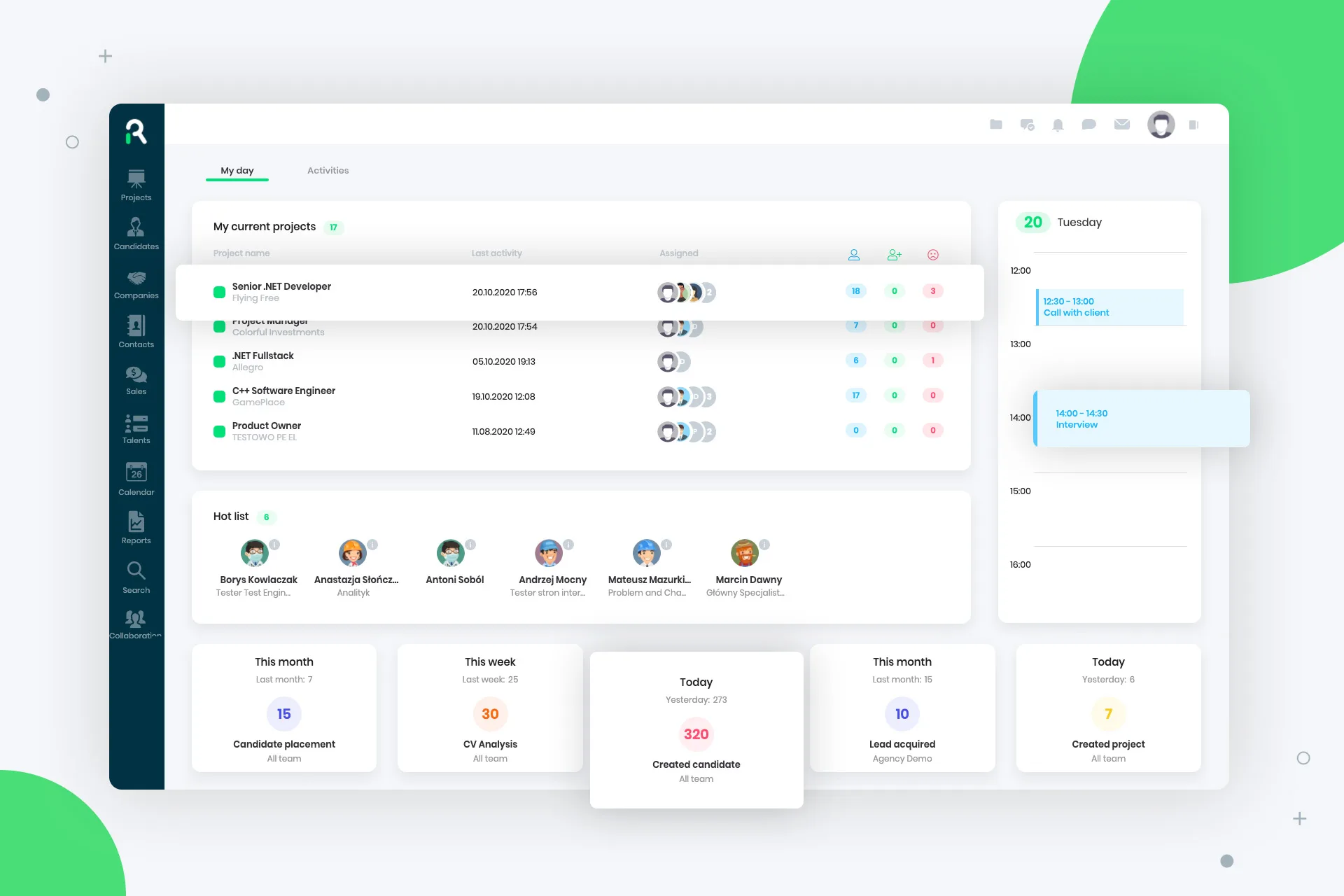
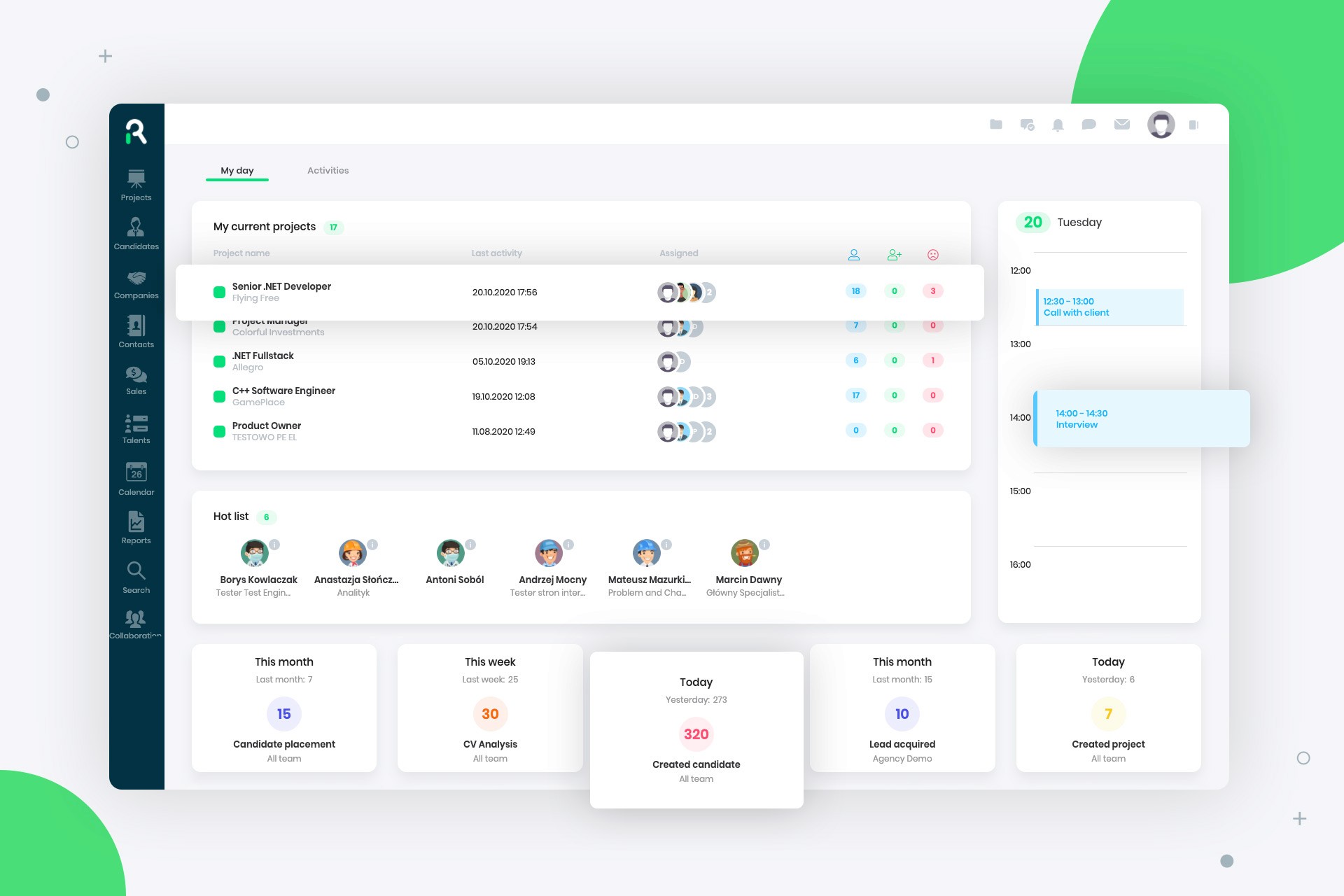
Basic interface of the ATS system:
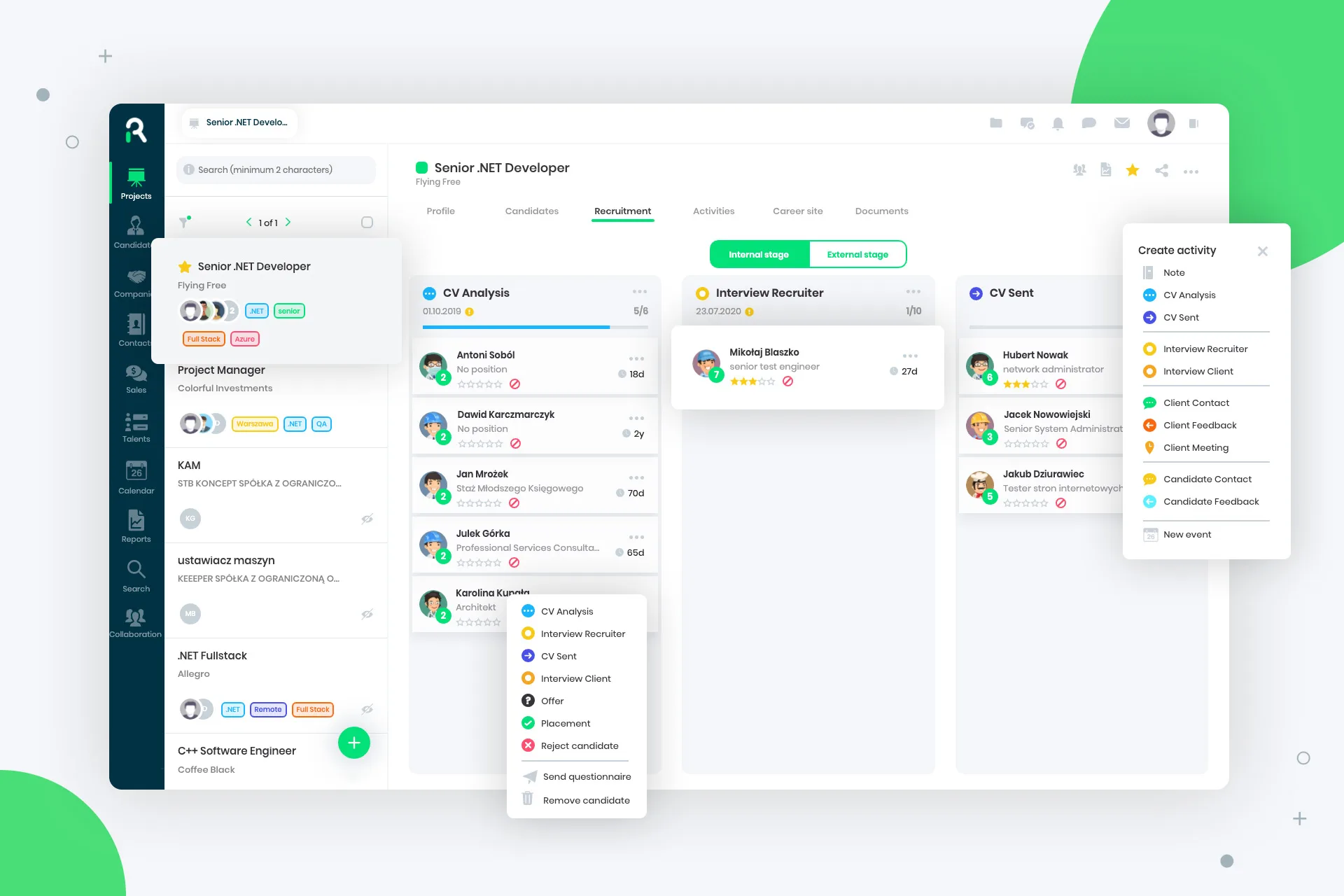
Most modern ATS systems rely on an intuitive graphical interface consisting of:
Kanban board:
Divided into recruitment process stages such as "New applications," "Interview," or "Hiring."
Candidates are presented in visual "cards" that can be easily moved between stages using the "drag and drop" method.
Candidate database:
Where users can view detailed candidate profiles, filter them by various criteria such as skills, location, or experience, and add notes and documents.
Project view:
A panel that allows managing multiple recruitment processes simultaneously.
Available modules in the ATS system
Modern ATSs are equipped with a range of modules that increase their functionality and tailor to organizational needs. Here are the most important ones:
1. Recruitment projects
Project module allows:
Creating and managing multiple recruitment processes simultaneously.
Assigning roles to team members to facilitate collaboration.
Tracking progress in recruitment for various positions.
2. Multiposting
Automation of posting recruitment announcements on multiple platforms simultaneously, such as job boards, career sites, or social media. The multiposting feature:
Saves time by eliminating the need for manual posting.
Allows monitoring the effectiveness of each recruitment channel.
3. Advanced search (Advanced Search)
Thanks to search module, recruiters can:
Use filters such as keywords, location, experience level, or skills.
Search databases for candidate matches to specific criteria.
Use artificial intelligence algorithms that automatically suggest the best profiles.
4. Talent Pools
Talent Pools module allows creating and managing talent pools, which:
Organizes candidates into groups based on skills, experience, or interests.
Facilitates quick access to suitable candidates in future recruitment processes.
Supports long-term relationship building with candidates.
5. Task management and calendars
ATSenables planning tasks and meetings, offering:
A calendar integrated with systems like Outlook or Google Calendar.
Notification and reminder functions for interview appointments or other key events.
The ability to delegate tasks among team members.
6. Email message handling
ATS systems integrate with email, allowing:
Sending and receiving messages directly from the system.
Automatic assignment of messages to candidate profiles.
Creating and using message templates for routine communication.
7. CV parsing (CV parsing)
CV parsing feature allows:
Automatic transformation of CV data into structured information in the candidate profile.
Reading data from various document formats, including PDF and Word.
Reducing time needed for manual data entry.
8. GDPR compliance management
GDPR modules provide:
Automatic collection of consents for personal data processing.
Managing candidate data retention periods.
Automatic data deletion after a specified time or upon request.
9. Reporting and analytics
Reporting modules offer:
Detailed data on recruitment process effectiveness, including conversion rates or stage durations.
Ability to generate reports for audit and board purposes.
Analysis of candidate sources to optimize recruitment expenses.
Personalization of modules
Modern ATS systems allow organizations to choose only the modules that are most relevant to them. This way, companies can:
Adjust tools to their needs and budget.
Expand the system as the organization grows and requirements change.
Summary
ATS is a tool not only supporting recruitment but also a platform centralizing all processes related to candidate management. The availability of a wide range of modules, such as multiposting, advanced search, and TalentPools, makes these systems flexible and scalable, adapting to the needs of small businesses, corporations, and recruitment agencies. Users can enjoy an intuitive interface that maximizes work convenience and operational efficiency.
Chapter 5: Implementation of the recruitment system
Implementing an ATS (Applicant Tracking System) is a key step in transforming recruitment processes. Although at first glance it may seem complicated, the process is increasingly intuitive and tailored to the needs of companies of varying size and industry. Implementation includes configuration, user training, and, if necessary, data migration from existing tools.
1. Implementing ATS in a new company
If a company has not previously used a recruitment system, implementing ATS is relatively straightforward. This process can be divided into several basic stages:
System configuration:
Creating user accounts with appropriate access levels.
Personalizing the system, including adding the company logo, setting language preferences, and customizing the interface.
Preparing document templates such as consent for personal data processing (GDPR), recruitment ad templates, and email templates.
External integrations:
Connecting ATS with recruitment portals such as LinkedIn, Pracuj.pl, or Indeed.
Integrating with calendars, email systems, and other tools used by the HR team.
User training:
Introducing the recruitment team to system functionalities, including interface operation, candidate search, and report generation.
Discussing best practices in using the system to fully exploit its potential.
2. Implementing ATS in a company previously using other tools
For companies that previously conducted recruitment processes manually or used another system, implementing ATS requires additional actions related to data migration. This is a crucial step to ensure work continuity and preserve recruitment history.
Data migration planning:
Assessing the scope of data to be transferred, such as candidate profiles, notes, documents, or communication history.
Verifying data compatibility with the new ATS system.
Migration process:
Exporting data from the existing system in formats compatible with the new tool.
Importing data to ATS, preserving its structure and accuracy.
Testing migration accuracy:
Checking whether all data has been transferred without errors.
Verifying the functionality of integrations with other tools and services.
3. ATS system in the cloud or locally?
Most modern recruitment systems are offered in a SaaS (Software as a Service) model and operate in the cloud. This solution has many advantages:
Availability: Users can access the system from anywhere in the world using only a web browser.
Security: SaaS providers invest in advanced data protection technologies, ensuring compliance with regulations such as GDPR.
Updates: Cloud systems are regularly updated, providing users access to the latest features.
For companies preferring local installation, on-premises solutions are also available, although their implementation and maintenance may involve higher costs and greater responsibility for IT infrastructure.
4. Alternative approaches: from Excel to ATS
For small companies and startups just beginning their recruitment journey, ATS may seem like an advanced solution. Some companies start with simpler tools like spreadsheets (e.g., Excel), where the recruitment stages are represented by columns and candidates by rows.
Disadvantages of this approach:
Lack of automation and integration.
Limited analysis and reporting capabilities.
Risk of non-compliance with personal data protection regulations.
Conclusion: Transitioning to a professional ATS system is inevitable when a company starts feeling the limitations of manual tools.
5. How to choose the right ATS system?
The implementation process begins with choosing the right system. Key factors to consider include:
Fit to needs: Does the system meet your company's requirements? For example, does it offer integration with preferred recruitment portals?
Scalability: Can the system handle an increasing number of recruitments as the company grows?
Cost: Does the licensing model (e.g., per user or per project) match the company's budget?
Summary
Implementing an ATS recruitment system is an investment that brings measurable benefits to both small and large organizations. Whether a company is just beginning to use recruitment technology or migrating from another tool, a well-planned implementation process ensures smooth transition and maximum utilization of the new system's capabilities.
Want to know more about recruitment systems? Check out our related articles:
How does the ATS system work? The biggest myths about ATS systems - Facts vs. Fiction.
The Evolution of ATS Systems: From Manual Processes to AI-Driven Recruitment
Change ATS systems without risking data loss! Migration with Recruitify.


News & Updates
Stay up-to-date with the latest innovations, features, and tips about Recruitify!
By providing your email address within the newsletter sign-up form, you confirm its processing to send marketing information regarding the Administrator’s products and services. The Administrator of your personal data processed for the abovementioned purposes is Recruitify Spółka z o.o., based in Warsaw, Poland (KRS 0000709889). For more information on the principles of personal data processing and the rights of data subjects, please check the Privacy Policy.

Last updated:
Comprehensive Guide to ATS: Everything You Need to Know About Recruitment Systems
Innovations
Iwo Paliszewski
Chapter 1: What is ATS?
Definition, history, and comparison with advanced recruitment systems and HRM
Definition of ATS
ATS, or Applicant Tracking System or Application Tracking System (translation: application tracking system), is software designed to manage recruitment processes. ATS enables the collection, organization, and analysis of candidate applications in one place. With automation features and data analysis, ATS systems allow faster and more efficient handling of recruitment processes.
In short, ATS is a tool that:
Automates repetitive tasks such as CV filtering or sending messages.
Facilitates communication with candidates at every stage of recruitment.
Centralizes candidate data, enabling quick search and analysis.
Supports compliance with regulations such as GDPR.
Brief history of ATS
The history of ATS systems dates back to the 1990s when computer technologies began to be used to manage candidate applications. Early versions of ATS primarily served as databases where applicant information was stored. These were local tools requiring installation on company computers.
With the turn of the century and the development of the internet, ATS began to evolve. Online recruitment systems emerged, integrating with job portals and emails. During this period, automation functions such as keyword-based filtering were also developed.
In the last decade, ATS has become more advanced thanks to cloud technologies and artificial intelligence. Today's systems offer not only application management but also data analysis features, recruitment outcomes prediction, and integration with other HR tools.
Differences between ATS, advanced recruitment systems, and HRM
ATS (Applicant Tracking System)
Scope: Focuses on managing recruitment processes.
Main functions: Job posting, application management, candidate filtering, automatic responses, recruitment metrics reporting.
Users: Recruiters and HR departments responsible for recruitment.
Advanced recruitment systems
Scope: Combines ATS functions with additional tools, such as CRM, recruitment automation, or predictive analysis.
Main functions: All ATS functions plus client relationship management (CRM), building long-term talent pools, analysis of recruitment effectiveness, and marketing tools supporting recruitment.
Users: Recruitment agencies and companies undertaking comprehensive recruitment projects.
HRM (Human Resource Management System)
Scope: Covers the entire life cycle of an employee within the company - from recruitment to HR management.
Main functions: Recruitment (often as an ATS module), onboarding, work time management, employee evaluations, learning and development (L&D), payroll and benefits management.
Users: HR departments responsible for all processes related to employment and employee management.
Comparison of functions
Function | ATS | Advanced | HRM |
Job posting | ✅ | ✅ | ❌ (optional) |
Application management | ✅ | ✅ | ✅ (often limited) |
Recruitment automation | ✅ | ✅ | ❌ |
CRM | ❌ | ✅ | ❌ |
Building talent pools | ❌ | ✅ | ❌ |
Onboarding | ❌ | ❌ | ✅ |
Learning and development (L&D) | ❌ | ❌ | ✅ |
Work time management | ❌ | ❌ | ✅ |
GDPR compliance | ✅ | ✅ | ✅ |
Summary
ATS is the foundation of modern recruitment processes, enabling the automation and centralization of actions related to hiring employees. Compared to more advanced recruitment systems and HRM, ATS focuses solely on recruitment, offering specialized tools tailored to recruiters' needs. However, depending on the scale and specificity of the organization, it may be worth considering integrating ATS with other systems to maximize their potential. In the following chapters, we will look at how ATS works and what benefits it brings.
Chapter 2: How does the ATS system work?
What is ATS in practice?
The ATS (Applicant Tracking System) is an advanced tool that organizes and automates key stages of the recruitment process. From the moment of job posting, to application analysis, until the finalization of hiring, ATS acts as a central management point for the entire process.
By automating repetitive tasks, these systems significantly enhance the work of recruiters, while increasing the efficiency of the entire recruitment process. Below is a detailed description of ATS functions and a typical workflow supported by this software.
Key functionalities of the ATS system
1. Sourcing candidates from multiple sources
ATS integrates with recruitment portals, social media, and the company career site, enabling simultaneous job posting in many places.
This allows reaching a wider audience of potential candidates and increasing the number of applications.
2. Centralization of candidate data
All applications go to one place where the system creates detailed candidate profiles.
The system stores information such as personal data, CVs, recruiter notes, and communication history.
Automatic candidate selection
ATS uses algorithms to filter applications based on defined criteria such as skills, experience, or location.
Top-matched candidates are automatically highlighted, saving recruiters time.
Managing communication with candidates
The system allows sending personalized emails at various stages of recruitment, such as application confirmations or interview invitations.
GDPR compliance
ATS automates managing consents for personal data processing and provides the ability to delete them at the candidate's request.
Reporting and recruitment analysis
The system generates reports on recruitment effectiveness, such as time to hire, effectiveness of candidate sources, or process costs.
How does the recruitment process supported by ATS look?
1. Creating and posting a recruitment announcement
A recruiter creates an announcement in ATS, which can automatically pull data from the job description.
The announcement is posted simultaneously on selected recruitment portals, social media, and the company career page.
2. Collecting candidate applications
All applications go to the system where they are automatically assigned to the appropriate recruitment project.
Candidates can apply using the online form integrated with ATS.
3. Automatic application selection
ATS analyzes applications based on defined criteria (e.g., keywords in CV, experience, or location).
Candidates meeting the requirements are highlighted in the system, enabling a quick move to the next stage.
4. Assessment and selection of candidates
Recruiter reviews candidate profiles, adds notes, and ratings.
The system allows comparing candidates and creating priority lists.
5. Communication with candidates
Candidates receive automatic notifications about progress in the recruitment process.
Recruiters can also send personalized messages, such as interview invitations.
6. Organization of interviews
ATS integrates with calendars, enabling quick scheduling of meetings and assigning dates to candidates.
7. Decision and hiring
After conducting interviews, the recruiter selects the best candidate.
ATS enables generating documents related to employment, such as employment contracts or onboarding information.
8. Reporting and analysis
After completing the recruitment process, the system generates a detailed report that may include data such as the number of candidates, source effectiveness, or recruitment duration.
ATS operation diagram - step by step
Job posting: ATS automates posting job ads on multiple portals and channels simultaneously.
Application gathering: Candidates submit their CVs, which are centralized in the system.
Automatic selection: The system analyzes applications based on established criteria.
Candidate assessment: Recruiters review candidate data and make selections.
Communication: Candidates are informed of progress in the recruitment process.
Interviews: The system allows planning and managing interview schedules.
Hiring: The chosen candidate proceeds to finalize the process, with data transferred to HR or onboarding systems.
Reporting: The system generates analyses and reports summarizing the recruitment process.
Summary
The ATS system operates as a comprehensive tool supporting every stage of recruitment. By automating repetitive tasks and centralizing data management, ATS enables organizations to save time, reduce costs, and improve the quality of recruitment processes. In the following chapters, we will explore the differences between ATS and other systems and highlight how to choose the best solution for your organization.
Chapter 3: Key benefits of using the ATS system
Why is ATS an indispensable recruitment tool?
ATS systems are not just tools for tracking applications — they are comprehensive solutions that revolutionize the way companies conduct recruitment processes. Their application brings benefits to recruiters, organizations, and candidates, improving their experience at every stage of recruitment. Below are the main advantages of using ATS.
1. Financial and time savings
ATS significantly contributes to lowering recruitment costs by automating time-consuming tasks and optimizing processes. Thanks to this, recruiters can:
Quickly search for candidates in the existing database, reducing costs associated with posting job ads on external portals.
Shorten recruitment time, which reduces operational expenses.
Increase recruitment efficiency, avoiding costs associated with unsuccessful hires.
Example: Automatic CV filtering eliminates the need to manually review hundreds of applications, significantly reducing recruiters' work time.
2. Increase in recruitment process efficiency
Thanks to features such as automatic candidate selection, communication management, and reporting, ATS allows recruiters to:
Execute more recruitments in less time.
Precisely match candidates based on their qualifications and fit for the position.
Effectively manage process stages, eliminating the risk of chaos and mistakes.
Benefit for the organization: Better process management leads to recruiting the right employees, contributing to the company's success.
3. Building and managing a candidate database
One of the greatest advantages of ATS is the ability to build long-term talent pools that can be used in future recruitment processes. ATS systems enable:
Collecting and storing candidate information in one place.
Quickly searching for candidates based on skills, location, or keywords.
Creating segmented talent pools, facilitating the organization of candidate data.
Example: A recruitment agency can quickly find candidates who applied in the past and are suitable for newly opened positions.
4. Improvement of Candidate Experience
ATS systems automate communication with candidates, significantly enhancing their satisfaction with the recruitment process. As a result:
Candidates receive quick responses to their applications.
Can monitor the status of their application in real-time.
Experience professionalism and engagement from the recruiter.
Effect: Satisfied candidates build a positive employer image, facilitating talent attraction in the future.
5. Automation of compliance with regulations (e.g., GDPR)
Adhering to regulations regarding personal data protection, such as GDPR, is crucial today. ATS ensures compliance with regulations by automating:
Managing consents for personal data processing.
Deleting candidate data after a specified time.
Creating compliance reports for audit purposes.
Example: When a candidate requests the deletion of their data, ATS can do this automatically, minimizing the risk of errors.
6. Automated reporting and analysis
ATS provides detailed reports that enable organizations to make better recruitment decisions. By analyzing data, companies can:
Identify the most effective candidate sources.
Monitor the duration of recruitment at various stages.
Analyze conversion metrics, such as the number of candidates moving from one stage to the next.
Effect: Better planning of future recruitments and efficient budget utilization.
7. Team collaboration
ATS systems facilitate collaboration between recruitment team members with features like:
Assigning roles and data access.
The ability to jointly evaluate candidates.
Integrated calendars for organizing interviews.
Benefit: Better communication and collaboration accelerate decision-making.
8. Higher chances of hiring the right candidates
ATS enhances recruitment processes efficiency, enabling companies to:
Reach a larger number of candidates in less time.
Make quicker decisions, reducing the risk of losing top talent.
Offer more personalized approaches, attracting top candidates.
Example: ATS automatically sorts candidates by best fit, speeding up the selection process.
Summary of benefits
ATS is not just a tool for managing recruitments, but also a way to optimize costs, improve candidate experience, and increase HR team work efficiency. In the following chapters, we will discuss how to choose the best ATS system and what features to consider when making a choice.
Chapter 4: What the ATS system looks like and available modules
The ATS system is a complex tool designed to simplify and automate recruitment processes. Each system may differ in appearance and functionality, but most offer sets of modules and functions that allow comprehensive management of the recruitment process. With intuitive interfaces and advanced options, modern ATSs are easy to use and effective.
Basic interface of the ATS system:
Most modern ATS systems rely on an intuitive graphical interface consisting of:
Kanban board:
Divided into recruitment process stages such as "New applications," "Interview," or "Hiring."
Candidates are presented in visual "cards" that can be easily moved between stages using the "drag and drop" method.
Candidate database:
Where users can view detailed candidate profiles, filter them by various criteria such as skills, location, or experience, and add notes and documents.
Project view:
A panel that allows managing multiple recruitment processes simultaneously.
Available modules in the ATS system
Modern ATSs are equipped with a range of modules that increase their functionality and tailor to organizational needs. Here are the most important ones:
1. Recruitment projects
Project module allows:
Creating and managing multiple recruitment processes simultaneously.
Assigning roles to team members to facilitate collaboration.
Tracking progress in recruitment for various positions.
2. Multiposting
Automation of posting recruitment announcements on multiple platforms simultaneously, such as job boards, career sites, or social media. The multiposting feature:
Saves time by eliminating the need for manual posting.
Allows monitoring the effectiveness of each recruitment channel.
3. Advanced search (Advanced Search)
Thanks to search module, recruiters can:
Use filters such as keywords, location, experience level, or skills.
Search databases for candidate matches to specific criteria.
Use artificial intelligence algorithms that automatically suggest the best profiles.
4. Talent Pools
Talent Pools module allows creating and managing talent pools, which:
Organizes candidates into groups based on skills, experience, or interests.
Facilitates quick access to suitable candidates in future recruitment processes.
Supports long-term relationship building with candidates.
5. Task management and calendars
ATSenables planning tasks and meetings, offering:
A calendar integrated with systems like Outlook or Google Calendar.
Notification and reminder functions for interview appointments or other key events.
The ability to delegate tasks among team members.
6. Email message handling
ATS systems integrate with email, allowing:
Sending and receiving messages directly from the system.
Automatic assignment of messages to candidate profiles.
Creating and using message templates for routine communication.
7. CV parsing (CV parsing)
CV parsing feature allows:
Automatic transformation of CV data into structured information in the candidate profile.
Reading data from various document formats, including PDF and Word.
Reducing time needed for manual data entry.
8. GDPR compliance management
GDPR modules provide:
Automatic collection of consents for personal data processing.
Managing candidate data retention periods.
Automatic data deletion after a specified time or upon request.
9. Reporting and analytics
Reporting modules offer:
Detailed data on recruitment process effectiveness, including conversion rates or stage durations.
Ability to generate reports for audit and board purposes.
Analysis of candidate sources to optimize recruitment expenses.
Personalization of modules
Modern ATS systems allow organizations to choose only the modules that are most relevant to them. This way, companies can:
Adjust tools to their needs and budget.
Expand the system as the organization grows and requirements change.
Summary
ATS is a tool not only supporting recruitment but also a platform centralizing all processes related to candidate management. The availability of a wide range of modules, such as multiposting, advanced search, and TalentPools, makes these systems flexible and scalable, adapting to the needs of small businesses, corporations, and recruitment agencies. Users can enjoy an intuitive interface that maximizes work convenience and operational efficiency.
Chapter 5: Implementation of the recruitment system
Implementing an ATS (Applicant Tracking System) is a key step in transforming recruitment processes. Although at first glance it may seem complicated, the process is increasingly intuitive and tailored to the needs of companies of varying size and industry. Implementation includes configuration, user training, and, if necessary, data migration from existing tools.
1. Implementing ATS in a new company
If a company has not previously used a recruitment system, implementing ATS is relatively straightforward. This process can be divided into several basic stages:
System configuration:
Creating user accounts with appropriate access levels.
Personalizing the system, including adding the company logo, setting language preferences, and customizing the interface.
Preparing document templates such as consent for personal data processing (GDPR), recruitment ad templates, and email templates.
External integrations:
Connecting ATS with recruitment portals such as LinkedIn, Pracuj.pl, or Indeed.
Integrating with calendars, email systems, and other tools used by the HR team.
User training:
Introducing the recruitment team to system functionalities, including interface operation, candidate search, and report generation.
Discussing best practices in using the system to fully exploit its potential.
2. Implementing ATS in a company previously using other tools
For companies that previously conducted recruitment processes manually or used another system, implementing ATS requires additional actions related to data migration. This is a crucial step to ensure work continuity and preserve recruitment history.
Data migration planning:
Assessing the scope of data to be transferred, such as candidate profiles, notes, documents, or communication history.
Verifying data compatibility with the new ATS system.
Migration process:
Exporting data from the existing system in formats compatible with the new tool.
Importing data to ATS, preserving its structure and accuracy.
Testing migration accuracy:
Checking whether all data has been transferred without errors.
Verifying the functionality of integrations with other tools and services.
3. ATS system in the cloud or locally?
Most modern recruitment systems are offered in a SaaS (Software as a Service) model and operate in the cloud. This solution has many advantages:
Availability: Users can access the system from anywhere in the world using only a web browser.
Security: SaaS providers invest in advanced data protection technologies, ensuring compliance with regulations such as GDPR.
Updates: Cloud systems are regularly updated, providing users access to the latest features.
For companies preferring local installation, on-premises solutions are also available, although their implementation and maintenance may involve higher costs and greater responsibility for IT infrastructure.
4. Alternative approaches: from Excel to ATS
For small companies and startups just beginning their recruitment journey, ATS may seem like an advanced solution. Some companies start with simpler tools like spreadsheets (e.g., Excel), where the recruitment stages are represented by columns and candidates by rows.
Disadvantages of this approach:
Lack of automation and integration.
Limited analysis and reporting capabilities.
Risk of non-compliance with personal data protection regulations.
Conclusion: Transitioning to a professional ATS system is inevitable when a company starts feeling the limitations of manual tools.
5. How to choose the right ATS system?
The implementation process begins with choosing the right system. Key factors to consider include:
Fit to needs: Does the system meet your company's requirements? For example, does it offer integration with preferred recruitment portals?
Scalability: Can the system handle an increasing number of recruitments as the company grows?
Cost: Does the licensing model (e.g., per user or per project) match the company's budget?
Summary
Implementing an ATS recruitment system is an investment that brings measurable benefits to both small and large organizations. Whether a company is just beginning to use recruitment technology or migrating from another tool, a well-planned implementation process ensures smooth transition and maximum utilization of the new system's capabilities.
Want to know more about recruitment systems? Check out our related articles:
How does the ATS system work? The biggest myths about ATS systems - Facts vs. Fiction.
The Evolution of ATS Systems: From Manual Processes to AI-Driven Recruitment
Change ATS systems without risking data loss! Migration with Recruitify.
News & Updates
Stay up-to-date with the latest innovations, features, and tips about Recruitify!
By providing your email address within the newsletter sign-up form, you confirm its processing to send marketing information regarding the Administrator’s products and services. The Administrator of your personal data processed for the abovementioned purposes is Recruitify Spółka z o.o., based in Warsaw, Poland (KRS 0000709889). For more information on the principles of personal data processing and the rights of data subjects, please check the Privacy Policy.
Last updated:
Comprehensive Guide to ATS: Everything You Need to Know About Recruitment Systems
Innovations
Iwo Paliszewski
Chapter 1: What is ATS?
Definition, history, and comparison with advanced recruitment systems and HRM
Definition of ATS
ATS, or Applicant Tracking System or Application Tracking System (translation: application tracking system), is software designed to manage recruitment processes. ATS enables the collection, organization, and analysis of candidate applications in one place. With automation features and data analysis, ATS systems allow faster and more efficient handling of recruitment processes.
In short, ATS is a tool that:
Automates repetitive tasks such as CV filtering or sending messages.
Facilitates communication with candidates at every stage of recruitment.
Centralizes candidate data, enabling quick search and analysis.
Supports compliance with regulations such as GDPR.
Brief history of ATS
The history of ATS systems dates back to the 1990s when computer technologies began to be used to manage candidate applications. Early versions of ATS primarily served as databases where applicant information was stored. These were local tools requiring installation on company computers.
With the turn of the century and the development of the internet, ATS began to evolve. Online recruitment systems emerged, integrating with job portals and emails. During this period, automation functions such as keyword-based filtering were also developed.
In the last decade, ATS has become more advanced thanks to cloud technologies and artificial intelligence. Today's systems offer not only application management but also data analysis features, recruitment outcomes prediction, and integration with other HR tools.
Differences between ATS, advanced recruitment systems, and HRM
ATS (Applicant Tracking System)
Scope: Focuses on managing recruitment processes.
Main functions: Job posting, application management, candidate filtering, automatic responses, recruitment metrics reporting.
Users: Recruiters and HR departments responsible for recruitment.
Advanced recruitment systems
Scope: Combines ATS functions with additional tools, such as CRM, recruitment automation, or predictive analysis.
Main functions: All ATS functions plus client relationship management (CRM), building long-term talent pools, analysis of recruitment effectiveness, and marketing tools supporting recruitment.
Users: Recruitment agencies and companies undertaking comprehensive recruitment projects.
HRM (Human Resource Management System)
Scope: Covers the entire life cycle of an employee within the company - from recruitment to HR management.
Main functions: Recruitment (often as an ATS module), onboarding, work time management, employee evaluations, learning and development (L&D), payroll and benefits management.
Users: HR departments responsible for all processes related to employment and employee management.
Comparison of functions
Function | ATS | Advanced | HRM |
Job posting | ✅ | ✅ | ❌ (optional) |
Application management | ✅ | ✅ | ✅ (often limited) |
Recruitment automation | ✅ | ✅ | ❌ |
CRM | ❌ | ✅ | ❌ |
Building talent pools | ❌ | ✅ | ❌ |
Onboarding | ❌ | ❌ | ✅ |
Learning and development (L&D) | ❌ | ❌ | ✅ |
Work time management | ❌ | ❌ | ✅ |
GDPR compliance | ✅ | ✅ | ✅ |
Summary
ATS is the foundation of modern recruitment processes, enabling the automation and centralization of actions related to hiring employees. Compared to more advanced recruitment systems and HRM, ATS focuses solely on recruitment, offering specialized tools tailored to recruiters' needs. However, depending on the scale and specificity of the organization, it may be worth considering integrating ATS with other systems to maximize their potential. In the following chapters, we will look at how ATS works and what benefits it brings.
Chapter 2: How does the ATS system work?
What is ATS in practice?
The ATS (Applicant Tracking System) is an advanced tool that organizes and automates key stages of the recruitment process. From the moment of job posting, to application analysis, until the finalization of hiring, ATS acts as a central management point for the entire process.
By automating repetitive tasks, these systems significantly enhance the work of recruiters, while increasing the efficiency of the entire recruitment process. Below is a detailed description of ATS functions and a typical workflow supported by this software.
Key functionalities of the ATS system
1. Sourcing candidates from multiple sources
ATS integrates with recruitment portals, social media, and the company career site, enabling simultaneous job posting in many places.
This allows reaching a wider audience of potential candidates and increasing the number of applications.
2. Centralization of candidate data
All applications go to one place where the system creates detailed candidate profiles.
The system stores information such as personal data, CVs, recruiter notes, and communication history.
Automatic candidate selection
ATS uses algorithms to filter applications based on defined criteria such as skills, experience, or location.
Top-matched candidates are automatically highlighted, saving recruiters time.
Managing communication with candidates
The system allows sending personalized emails at various stages of recruitment, such as application confirmations or interview invitations.
GDPR compliance
ATS automates managing consents for personal data processing and provides the ability to delete them at the candidate's request.
Reporting and recruitment analysis
The system generates reports on recruitment effectiveness, such as time to hire, effectiveness of candidate sources, or process costs.
How does the recruitment process supported by ATS look?
1. Creating and posting a recruitment announcement
A recruiter creates an announcement in ATS, which can automatically pull data from the job description.
The announcement is posted simultaneously on selected recruitment portals, social media, and the company career page.
2. Collecting candidate applications
All applications go to the system where they are automatically assigned to the appropriate recruitment project.
Candidates can apply using the online form integrated with ATS.
3. Automatic application selection
ATS analyzes applications based on defined criteria (e.g., keywords in CV, experience, or location).
Candidates meeting the requirements are highlighted in the system, enabling a quick move to the next stage.
4. Assessment and selection of candidates
Recruiter reviews candidate profiles, adds notes, and ratings.
The system allows comparing candidates and creating priority lists.
5. Communication with candidates
Candidates receive automatic notifications about progress in the recruitment process.
Recruiters can also send personalized messages, such as interview invitations.
6. Organization of interviews
ATS integrates with calendars, enabling quick scheduling of meetings and assigning dates to candidates.
7. Decision and hiring
After conducting interviews, the recruiter selects the best candidate.
ATS enables generating documents related to employment, such as employment contracts or onboarding information.
8. Reporting and analysis
After completing the recruitment process, the system generates a detailed report that may include data such as the number of candidates, source effectiveness, or recruitment duration.
ATS operation diagram - step by step
Job posting: ATS automates posting job ads on multiple portals and channels simultaneously.
Application gathering: Candidates submit their CVs, which are centralized in the system.
Automatic selection: The system analyzes applications based on established criteria.
Candidate assessment: Recruiters review candidate data and make selections.
Communication: Candidates are informed of progress in the recruitment process.
Interviews: The system allows planning and managing interview schedules.
Hiring: The chosen candidate proceeds to finalize the process, with data transferred to HR or onboarding systems.
Reporting: The system generates analyses and reports summarizing the recruitment process.
Summary
The ATS system operates as a comprehensive tool supporting every stage of recruitment. By automating repetitive tasks and centralizing data management, ATS enables organizations to save time, reduce costs, and improve the quality of recruitment processes. In the following chapters, we will explore the differences between ATS and other systems and highlight how to choose the best solution for your organization.
Chapter 3: Key benefits of using the ATS system
Why is ATS an indispensable recruitment tool?
ATS systems are not just tools for tracking applications — they are comprehensive solutions that revolutionize the way companies conduct recruitment processes. Their application brings benefits to recruiters, organizations, and candidates, improving their experience at every stage of recruitment. Below are the main advantages of using ATS.
1. Financial and time savings
ATS significantly contributes to lowering recruitment costs by automating time-consuming tasks and optimizing processes. Thanks to this, recruiters can:
Quickly search for candidates in the existing database, reducing costs associated with posting job ads on external portals.
Shorten recruitment time, which reduces operational expenses.
Increase recruitment efficiency, avoiding costs associated with unsuccessful hires.
Example: Automatic CV filtering eliminates the need to manually review hundreds of applications, significantly reducing recruiters' work time.
2. Increase in recruitment process efficiency
Thanks to features such as automatic candidate selection, communication management, and reporting, ATS allows recruiters to:
Execute more recruitments in less time.
Precisely match candidates based on their qualifications and fit for the position.
Effectively manage process stages, eliminating the risk of chaos and mistakes.
Benefit for the organization: Better process management leads to recruiting the right employees, contributing to the company's success.
3. Building and managing a candidate database
One of the greatest advantages of ATS is the ability to build long-term talent pools that can be used in future recruitment processes. ATS systems enable:
Collecting and storing candidate information in one place.
Quickly searching for candidates based on skills, location, or keywords.
Creating segmented talent pools, facilitating the organization of candidate data.
Example: A recruitment agency can quickly find candidates who applied in the past and are suitable for newly opened positions.
4. Improvement of Candidate Experience
ATS systems automate communication with candidates, significantly enhancing their satisfaction with the recruitment process. As a result:
Candidates receive quick responses to their applications.
Can monitor the status of their application in real-time.
Experience professionalism and engagement from the recruiter.
Effect: Satisfied candidates build a positive employer image, facilitating talent attraction in the future.
5. Automation of compliance with regulations (e.g., GDPR)
Adhering to regulations regarding personal data protection, such as GDPR, is crucial today. ATS ensures compliance with regulations by automating:
Managing consents for personal data processing.
Deleting candidate data after a specified time.
Creating compliance reports for audit purposes.
Example: When a candidate requests the deletion of their data, ATS can do this automatically, minimizing the risk of errors.
6. Automated reporting and analysis
ATS provides detailed reports that enable organizations to make better recruitment decisions. By analyzing data, companies can:
Identify the most effective candidate sources.
Monitor the duration of recruitment at various stages.
Analyze conversion metrics, such as the number of candidates moving from one stage to the next.
Effect: Better planning of future recruitments and efficient budget utilization.
7. Team collaboration
ATS systems facilitate collaboration between recruitment team members with features like:
Assigning roles and data access.
The ability to jointly evaluate candidates.
Integrated calendars for organizing interviews.
Benefit: Better communication and collaboration accelerate decision-making.
8. Higher chances of hiring the right candidates
ATS enhances recruitment processes efficiency, enabling companies to:
Reach a larger number of candidates in less time.
Make quicker decisions, reducing the risk of losing top talent.
Offer more personalized approaches, attracting top candidates.
Example: ATS automatically sorts candidates by best fit, speeding up the selection process.
Summary of benefits
ATS is not just a tool for managing recruitments, but also a way to optimize costs, improve candidate experience, and increase HR team work efficiency. In the following chapters, we will discuss how to choose the best ATS system and what features to consider when making a choice.
Chapter 4: What the ATS system looks like and available modules
The ATS system is a complex tool designed to simplify and automate recruitment processes. Each system may differ in appearance and functionality, but most offer sets of modules and functions that allow comprehensive management of the recruitment process. With intuitive interfaces and advanced options, modern ATSs are easy to use and effective.
Basic interface of the ATS system:
Most modern ATS systems rely on an intuitive graphical interface consisting of:
Kanban board:
Divided into recruitment process stages such as "New applications," "Interview," or "Hiring."
Candidates are presented in visual "cards" that can be easily moved between stages using the "drag and drop" method.
Candidate database:
Where users can view detailed candidate profiles, filter them by various criteria such as skills, location, or experience, and add notes and documents.
Project view:
A panel that allows managing multiple recruitment processes simultaneously.
Available modules in the ATS system
Modern ATSs are equipped with a range of modules that increase their functionality and tailor to organizational needs. Here are the most important ones:
1. Recruitment projects
Project module allows:
Creating and managing multiple recruitment processes simultaneously.
Assigning roles to team members to facilitate collaboration.
Tracking progress in recruitment for various positions.
2. Multiposting
Automation of posting recruitment announcements on multiple platforms simultaneously, such as job boards, career sites, or social media. The multiposting feature:
Saves time by eliminating the need for manual posting.
Allows monitoring the effectiveness of each recruitment channel.
3. Advanced search (Advanced Search)
Thanks to search module, recruiters can:
Use filters such as keywords, location, experience level, or skills.
Search databases for candidate matches to specific criteria.
Use artificial intelligence algorithms that automatically suggest the best profiles.
4. Talent Pools
Talent Pools module allows creating and managing talent pools, which:
Organizes candidates into groups based on skills, experience, or interests.
Facilitates quick access to suitable candidates in future recruitment processes.
Supports long-term relationship building with candidates.
5. Task management and calendars
ATSenables planning tasks and meetings, offering:
A calendar integrated with systems like Outlook or Google Calendar.
Notification and reminder functions for interview appointments or other key events.
The ability to delegate tasks among team members.
6. Email message handling
ATS systems integrate with email, allowing:
Sending and receiving messages directly from the system.
Automatic assignment of messages to candidate profiles.
Creating and using message templates for routine communication.
7. CV parsing (CV parsing)
CV parsing feature allows:
Automatic transformation of CV data into structured information in the candidate profile.
Reading data from various document formats, including PDF and Word.
Reducing time needed for manual data entry.
8. GDPR compliance management
GDPR modules provide:
Automatic collection of consents for personal data processing.
Managing candidate data retention periods.
Automatic data deletion after a specified time or upon request.
9. Reporting and analytics
Reporting modules offer:
Detailed data on recruitment process effectiveness, including conversion rates or stage durations.
Ability to generate reports for audit and board purposes.
Analysis of candidate sources to optimize recruitment expenses.
Personalization of modules
Modern ATS systems allow organizations to choose only the modules that are most relevant to them. This way, companies can:
Adjust tools to their needs and budget.
Expand the system as the organization grows and requirements change.
Summary
ATS is a tool not only supporting recruitment but also a platform centralizing all processes related to candidate management. The availability of a wide range of modules, such as multiposting, advanced search, and TalentPools, makes these systems flexible and scalable, adapting to the needs of small businesses, corporations, and recruitment agencies. Users can enjoy an intuitive interface that maximizes work convenience and operational efficiency.
Chapter 5: Implementation of the recruitment system
Implementing an ATS (Applicant Tracking System) is a key step in transforming recruitment processes. Although at first glance it may seem complicated, the process is increasingly intuitive and tailored to the needs of companies of varying size and industry. Implementation includes configuration, user training, and, if necessary, data migration from existing tools.
1. Implementing ATS in a new company
If a company has not previously used a recruitment system, implementing ATS is relatively straightforward. This process can be divided into several basic stages:
System configuration:
Creating user accounts with appropriate access levels.
Personalizing the system, including adding the company logo, setting language preferences, and customizing the interface.
Preparing document templates such as consent for personal data processing (GDPR), recruitment ad templates, and email templates.
External integrations:
Connecting ATS with recruitment portals such as LinkedIn, Pracuj.pl, or Indeed.
Integrating with calendars, email systems, and other tools used by the HR team.
User training:
Introducing the recruitment team to system functionalities, including interface operation, candidate search, and report generation.
Discussing best practices in using the system to fully exploit its potential.
2. Implementing ATS in a company previously using other tools
For companies that previously conducted recruitment processes manually or used another system, implementing ATS requires additional actions related to data migration. This is a crucial step to ensure work continuity and preserve recruitment history.
Data migration planning:
Assessing the scope of data to be transferred, such as candidate profiles, notes, documents, or communication history.
Verifying data compatibility with the new ATS system.
Migration process:
Exporting data from the existing system in formats compatible with the new tool.
Importing data to ATS, preserving its structure and accuracy.
Testing migration accuracy:
Checking whether all data has been transferred without errors.
Verifying the functionality of integrations with other tools and services.
3. ATS system in the cloud or locally?
Most modern recruitment systems are offered in a SaaS (Software as a Service) model and operate in the cloud. This solution has many advantages:
Availability: Users can access the system from anywhere in the world using only a web browser.
Security: SaaS providers invest in advanced data protection technologies, ensuring compliance with regulations such as GDPR.
Updates: Cloud systems are regularly updated, providing users access to the latest features.
For companies preferring local installation, on-premises solutions are also available, although their implementation and maintenance may involve higher costs and greater responsibility for IT infrastructure.
4. Alternative approaches: from Excel to ATS
For small companies and startups just beginning their recruitment journey, ATS may seem like an advanced solution. Some companies start with simpler tools like spreadsheets (e.g., Excel), where the recruitment stages are represented by columns and candidates by rows.
Disadvantages of this approach:
Lack of automation and integration.
Limited analysis and reporting capabilities.
Risk of non-compliance with personal data protection regulations.
Conclusion: Transitioning to a professional ATS system is inevitable when a company starts feeling the limitations of manual tools.
5. How to choose the right ATS system?
The implementation process begins with choosing the right system. Key factors to consider include:
Fit to needs: Does the system meet your company's requirements? For example, does it offer integration with preferred recruitment portals?
Scalability: Can the system handle an increasing number of recruitments as the company grows?
Cost: Does the licensing model (e.g., per user or per project) match the company's budget?
Summary
Implementing an ATS recruitment system is an investment that brings measurable benefits to both small and large organizations. Whether a company is just beginning to use recruitment technology or migrating from another tool, a well-planned implementation process ensures smooth transition and maximum utilization of the new system's capabilities.
Want to know more about recruitment systems? Check out our related articles:
How does the ATS system work? The biggest myths about ATS systems - Facts vs. Fiction.
The Evolution of ATS Systems: From Manual Processes to AI-Driven Recruitment
Change ATS systems without risking data loss! Migration with Recruitify.
News & Updates
Stay up-to-date with the latest innovations, features, and tips about Recruitify!
By providing your email address within the newsletter sign-up form, you confirm its processing to send marketing information regarding the Administrator’s products and services. The Administrator of your personal data processed for the abovementioned purposes is Recruitify Spółka z o.o., based in Warsaw, Poland (KRS 0000709889). For more information on the principles of personal data processing and the rights of data subjects, please check the Privacy Policy.

Discover More

Recruitment Process
27 Mar 2026
A Fresh Challenge in Recruitment: From Sourcing to Verification
How can you find more candidates? How can you reach passive talent? How can you increase the number of applications?
Discover More

Recruitment Process
26 Mar 2026
Recruiters are no longer searching for candidates. They're seeking signals, which means true alignment.
Not long ago, one of the main challenges in recruitment was reaching candidates. Companies invested in advertisements, sourcing, and building talent pools, striving to increase the number of applications and expand the pool of potential hires.
Discover More

Innovations
24 Mar 2026
In your recruitment process, it's all about the numbers, not the authenticity.
Most contemporary recruitment processes are crafted with one goal in mind: scale. More applications. Faster selection. Reduced time to hire.
Discover More
Recruitment Process
27 Mar 2026
A Fresh Challenge in Recruitment: From Sourcing to Verification
How can you find more candidates? How can you reach passive talent? How can you increase the number of applications?
Discover More
Recruitment Process
26 Mar 2026
Recruiters are no longer searching for candidates. They're seeking signals, which means true alignment.
Not long ago, one of the main challenges in recruitment was reaching candidates. Companies invested in advertisements, sourcing, and building talent pools, striving to increase the number of applications and expand the pool of potential hires.
Discover More