🔥
Contracting
Explore the new contractor management module
🔥
Contracting
Explore the new contractor management module
🔥
Contracting
Explore the new contractor management module
🔥
Contracting
Explore the new contractor management module

Last updated:
50+ Roles? Use a 4P Control Tower for Enterprise Recruiting at Scale

Innovations

The Recruitify Team
50+ Roles? Use a 4P Control Tower for Enterprise Recruiting at Scale
Enterprise recruiting at scale succeeds only when talent acquisition runs as an operating system, not a string of disconnected requisitions. That means one owner for workforce planning and data continuity, one framework tying people, process, platform, and partners together, and one control tower to orchestrate decisions. Recruitify’s playbook builds on that structure. The first move: audit who owns your workforce planning data today, and whether it survives contact with a hundred simultaneous roles.
TL;DR:
A unified talent acquisition operating system should own data continuity, workforce planning, and decision orchestration to prevent costly failures at scale.
Critical cracks include requisition resets caused by turnover, fragmented decision-making, and poor reuse of past applicant data, leading to longer hiring cycles and increased costs.
The 4P framework assigns clear ownership of people, process, platform, and partners, with a control tower coordinating priorities and data integrity across the enterprise.
Enterprise platforms must provide persistent, integrated candidate data, configurable workflows, auditable AI scoring, and comprehensive visibility to support scalable recruiting.
Successful high-volume hiring relies on structured campaigns, cohort onboarding, continuous metrics tracking, and sequenced technology and process implementation.
Table of Contents
Why Enterprise Recruiting at Scale Breaks Down
An Operating Model That Scales: 4P Plus Control Tower
Technology and Data Architecture: What Enterprise Platforms Must Deliver
High-Volume Hiring Playbook: Campaign Flow, Timelines, and KPIs
Metrics, Dashboards, and Continuous Improvement for Enterprise TA
How Recruitify Puts the Operating Model Into Practice
Onboarding and Retention: Closing the Loop After the Hire
Recruitify Team Perspective: Implementation Pitfalls and Pragmatic Sequencing
See the 4P Model Running Inside a Real Platform
Sources
Why Enterprise Recruiting at Scale Breaks Down
Most enterprise TA functions do not fail because recruiters are slow. They fail because the system underneath them was never built for volume, distribution, or turnover among the people running it.
The first crack shows up as a requisition reset. A hiring manager changes roles, a recruiter moves teams, or a business unit reorganizes, and the context attached to an open req evaporates with them. Interview notes live in someone’s inbox. Sourcing history sits in a spreadsheet nobody else can find. The replacement recruiter starts from zero on a role that was three weeks into a search, and the clock resets while the business keeps waiting.
The second crack is what Everest Group’s research on next-generation TA describes as a fragmented decision structure: dozens of hiring managers, regional HR leads, and business unit heads making independent calls about sourcing channels, interview panels, and offer terms, with no shared standard connecting any of it. Each decision might be locally sensible. Collectively, they produce twelve versions of “how we screen a candidate” across one company, which is precisely the disorder Everest Group’s 4P and control-tower model is designed to correct.
The third crack is loss of talent continuity. Enterprises sitting on years of prior applicant data routinely fail to reuse it, so a strong finalist from last year’s search for a role in Chicago never resurfaces when an identical role opens in Denver. The candidate re-enters the funnel as a stranger.
These cracks carry a measurable cost, even where the exact multiplier varies by company. Time-to-hire stretches because every reset means relearning a role’s context. Offer-drop rates climb because slow, inconsistent processes push candidates toward employers who move faster. Compliance exposure grows because inconsistent screening across business units and countries creates uneven documentation trails, a real problem given how much labor rights and enforcement vary across 142 countries the World Justice Project studied. Layered together, these effects act as a hidden enterprise tax on cost-per-hire that never shows up as a single line item, only as a persistent drag on every recruiting metric leadership cares about.
Audit your own organization against this list of failure modes:
Recruiter or hiring manager turnover routinely triggers a full requisition restart rather than a handoff.
Sourcing, screening, and interview data live in disconnected tools or personal files rather than a shared system.
Regional or business-unit leaders each define their own hiring workflow with no shared baseline.
Past applicant data is rarely, if ever, resurfaced for new openings.
No single role or team is accountable for the health of the pipeline across the whole enterprise.
If three or more of these describe your organization, the problem is not effort. It is architecture.
An Operating Model That Scales: 4P Plus Control Tower
Everest Group’s research on operationalizing next-generation talent acquisition offers a structure worth adopting almost intact: the 4P framework, made up of people, process, platform, and partners, coordinated through a control tower that owns orchestration across all four.
Each P needs a named owner, not a committee:
People. This covers the TA org chart itself: recruiters, sourcers, coordinators, and the hiring managers who sit outside TA but shape every outcome. Ownership sits with a TA leadership role responsible for capacity planning and skill coverage, not just headcount.
Process. This is the actual lifecycle: intake, sourcing, screening, assessment, offer, and onboarding, plus the escalation paths when something breaks. A process owner, typically a TA operations lead, codifies these steps so they do not vary by region or recruiter mood.
Platform. The technology stack, from the applicant tracking system through CRM, assessment tools, and analytics, needs an owner accountable for integration health and data governance, usually a TA technology or RevOps lead.
Partners. External agencies, RPO providers, and specialized sourcing vendors need a relationship owner who tracks performance against the same KPIs internal recruiters are measured on, so partner-sourced hires are held to a consistent bar.
The control tower sits above all four, and its job is orchestration, not execution. It prioritizes which roles get resourced first when demand spikes, resolves conflicts between regional autonomy and central standards, and acts as the steward of shared data so a candidate’s history follows them across the organization instead of disappearing at a business unit boundary.
Adoption follows a sequence rather than a simultaneous rollout:
Assign the four owners explicitly, in writing, with clear accountability for their P.
Define shared KPIs before touching any tooling, so every owner is measured against the same definitions of quality-of-hire, time-to-fill, and pipeline health.
Codify the lifecycle, documenting each stage of the requisition-to-hire journey and where escalation happens when a stage stalls.
Stand up the control tower as a recurring function, not a one-time project, with a standing cadence for prioritization decisions.
Layer in partner governance last, once internal process and data ownership are stable enough to hold external vendors to the same standard.
Pro Tip: Do not appoint the control tower owner from whichever team already has the most political capital. Appoint the person closest to the data, because orchestration lives or dies on whether the underlying pipeline information is accurate and current.
Technology and Data Architecture: What Enterprise Platforms Must Deliver
The 4P model only works if the platform layer actually holds state. Too many enterprise TA stacks rely on point-in-time syncs between systems rather than genuinely persistent, shared candidate and requisition records, and that distinction is the difference between a control tower with real visibility and one guessing from stale exports.
Persistent data means a candidate’s full history, sourcing channel, screening scores, interview feedback, and prior application outcomes, stays attached to their profile regardless of which recruiter, region, or requisition touches it next. Sync-only integrations, where two systems periodically exchange snapshots, break this continuity every time a sync window misses an update or a field mapping drifts. Gartner’s research on 2026 talent acquisition trends points to AI adoption and cost pressure as the two forces reshaping enterprise TA, and neither force pays off without an architecture that can actually sustain automated decisions on trustworthy, current data.
A workable integration pattern connects four systems as one logical fabric rather than four silos: the ATS as the system of record for requisitions and candidates, the HRIS for workforce planning and org structure, the CRM for talent pool nurturing, and assessment tools feeding structured scores back into the candidate record automatically. Governance sits on top of that fabric, not bolted onto individual tools.
Before selecting or renewing an enterprise platform, check it against this list:
Configurable workflows that let each business unit adapt stages without forking the underlying process the control tower relies on.
Auditable AI scoring, meaning every automated recommendation can be traced back to the inputs that produced it, not a black-box output.
Multi-entity visibility, so the control tower sees pipeline health across regions and business units in one view rather than stitching together local reports.
Audit logs covering who changed what, when, across the full candidate lifecycle.
Adverse-impact testing built into the assessment and scoring layer, not run as a separate manual exercise after the fact.
The candidate-experience stakes for getting this wrong are concrete. SHRM’s research on online job applications found that a large share of applicants never finish the process they started, and clunky, disconnected systems are a primary driver of that drop-off. An architecture that cannot hold a candidate’s data across one seamless flow is losing talent before a recruiter ever sees the applicant.
High-Volume Hiring Playbook: Campaign Flow, Timelines, and KPIs
Mass hiring is not “normal recruiting, faster.” It requires distinct process architecture, and the National Recruiting Authority’s guidance on high-volume recruiting treats roughly 50 or more simultaneous open roles as the threshold where different tooling and risk controls become necessary rather than optional.
A campaign should trigger off workforce planning signals, not react to a sudden hiring-manager request. When manpower planning data flags a seasonal ramp, a new facility opening, or a product launch requiring a defined headcount, that is the moment to activate mass-hiring mode rather than after requisitions have already started piling up unfilled.
The playbook runs in four stages:
Intake and channel selection. Consolidate all roles into a single campaign brief and select a sourcing mix across job boards, programmatic advertising, referral pushes, and talent pool reactivation, distributing multi-channel job postings simultaneously rather than staggering them.
Automated pre-screening. Apply consistent, structured screening criteria at the top of the funnel so recruiters only spend time on candidates who clear a defined bar, cutting manual review volume dramatically.
Structured assessment. Standardize the evaluation format across every candidate in the campaign so cohorts can be compared fairly, which also supports the adverse-impact monitoring outlined in the World Economic Forum’s guidance on DEI lighthouse practices.
Batch offers and cohort onboarding. Extend offers in coordinated waves tied to defined start dates, and onboard new hires as cohorts rather than individually, which simplifies training logistics and gives HR a predictable rhythm.
Conversion rates vary by industry and role type, but high-volume campaigns typically follow a recognizable funnel shape:
Funnel stage | Typical conversion range |
|---|---|
Applicants to screened candidates | A substantial share |
Screened to assessed candidates | A large proportion |
Assessed to offer | Around half to two thirds |
Offer to accepted, cohort onboarded | Most |
Recruitify’s project and pipeline management tools support this kind of campaign structure by keeping every stage visible in one place instead of scattered across spreadsheets built for a single req at a time.
Metrics, Dashboards, and Continuous Improvement for Enterprise TA
Enterprise TA at scale needs a small set of metrics tracked consistently, not a sprawling dashboard nobody actually reads. The core set includes pipeline health, time-in-stage, conversion at each funnel step, quality-of-hire, time-to-fill, and adverse-impact checks run against every completed assessment cycle.
Pipeline health matters because a healthy top-of-funnel number hides nothing if candidates are stalling three stages deep. Time-in-stage isolates exactly where that stalling happens, whether it is a slow interview scheduling step or a bottleneck at offer approval. Quality-of-hire, though harder to measure cleanly, is the metric that keeps volume from becoming the only goal, and Everest Group’s control-tower model treats it as a first-class KPI precisely because throughput without quality just moves the enterprise tax downstream into turnover.
Different stakeholders need different views of the same data:
TA coordinators need stage-level, near-real-time detail: which requisitions are stalled and why.
HR business partners need weekly rollups by business unit, tied to headcount plans they are accountable for.
Executives need monthly trend lines on cost-per-hire, time-to-fill, and diversity of the pipeline against targets, without the operational noise underneath.
A workable cadence has three layers. A weekly takt meeting reviews stalled requisitions and immediate blockers among the recruiting team itself. A monthly ops review brings in HR business partners to assess trends against headcount plans and flag emerging risk. A quarterly strategy audit brings the control tower and executive sponsors together to reassess whether the operating model itself, not just individual campaigns, is still fit for the business’s direction.
How Recruitify Puts the Operating Model Into Practice
Recruitify maps directly onto the 4P and control-tower structure rather than asking you to build orchestration on top of a disconnected tool stack. The platform layer combines AI candidate scoring, CV parsing, and an applicant tracking system unified with CRM, so requisition and candidate data persist in one record instead of scattering across disconnected exports. Recruitment automation handles the repetitive screening and scheduling work that otherwise consumes recruiter time during high-volume campaigns, supporting the process layer with consistent, auditable steps. Analytics dashboards give the control tower the multi-entity visibility it needs to prioritize across business units rather than guessing from siloed reports.
Recruitify is trusted by more than 250 companies, and its automation features are built specifically to relieve teams from administrative burden so recruiters spend more time on relationship-building and closing roles, which is exactly the shift the 4P model asks the people layer to make.
Before adopting any platform for enterprise-scale recruiting, run it through this checklist:
Does candidate and requisition data persist across every stage without manual re-entry?
Can workflows be configured per business unit without forking the core process?
Is AI scoring auditable, so you can explain a recommendation to a compliance reviewer?
Do analytics surface pipeline health across regions in one unified view?
Does onboarding automation carry through from offer acceptance into day-one readiness?
Pro Tip: Run any platform evaluation against a live, active campaign rather than a demo dataset. A tool that looks clean with fifty sample records can behave very differently once five thousand real candidates are moving through it simultaneously.
Onboarding and Retention: Closing the Loop After the Hire
A mass-hiring campaign that fills every seat and then loses a third of those hires within ninety days has not actually solved the enterprise’s problem. Onboarding and retention are not a separate workstream from recruiting at scale. They are the back half of the same pipeline.
Cohort onboarding, introduced during the high-volume playbook, does double duty here. Training new hires in structured groups rather than one-by-one gives HR a predictable, repeatable orientation experience and gives new employees a peer cohort from day one, which consistently correlates with stronger early retention than isolated onboarding does.

Retention data should feed back into the same dashboards used for recruiting metrics, not sit in a separate HR system nobody on the TA side ever checks. If ninety-day attrition spikes for hires sourced through a particular channel or screened with a particular assessment, that is a signal the control tower needs to see, because it may point to a sourcing mix or screening criterion that is filling seats with candidates who are a poor fit.
Manager readiness matters as much as candidate readiness. Enterprises that scale hiring volume without also preparing hiring managers to onboard larger cohorts consistently see retention suffer, regardless of how strong the initial screening process was. Building manager onboarding checklists into the same operating model that governs recruiting keeps the two halves of the talent lifecycle from drifting apart.
Recruitify Team Perspective: Implementation Pitfalls and Pragmatic Sequencing
The most common mistake enterprises make is bolting new technology onto an ungoverned process and calling it transformation. A powerful AI scoring tool layered onto inconsistent screening criteria just automates inconsistency faster. The second most common mistake is skipping workforce planning integration entirely, so recruiting reacts to headcount requests instead of anticipating them. The third is treating adverse-impact analysis as an annual compliance exercise rather than something checked after every assessment cycle.
Sequence the rollout as technology, then process, then capability, in that order, and start with a single business unit running a constrained pilot before scaling cross-entity. Move to a full rollout only once integrations, scoring thresholds, and adverse-impact monitoring hold steady under real volume. If internal bandwidth cannot sustain that pilot discipline, bringing in a partner to run the first cycle beats skipping governance to hit a deadline.
— Recruitify Team
See the 4P Model Running Inside a Real Platform
Everest Group’s control-tower model and the 4P framework are only useful once they are running inside a system that can actually hold the data and enforce the process, and that is the gap Recruitify closes. Rather than asking your team to stitch together an ATS, a CRM, and a scoring tool from three vendors, Recruitify unifies people, process, and platform ownership into one system built for exactly the continuity enterprise recruiting at scale requires.
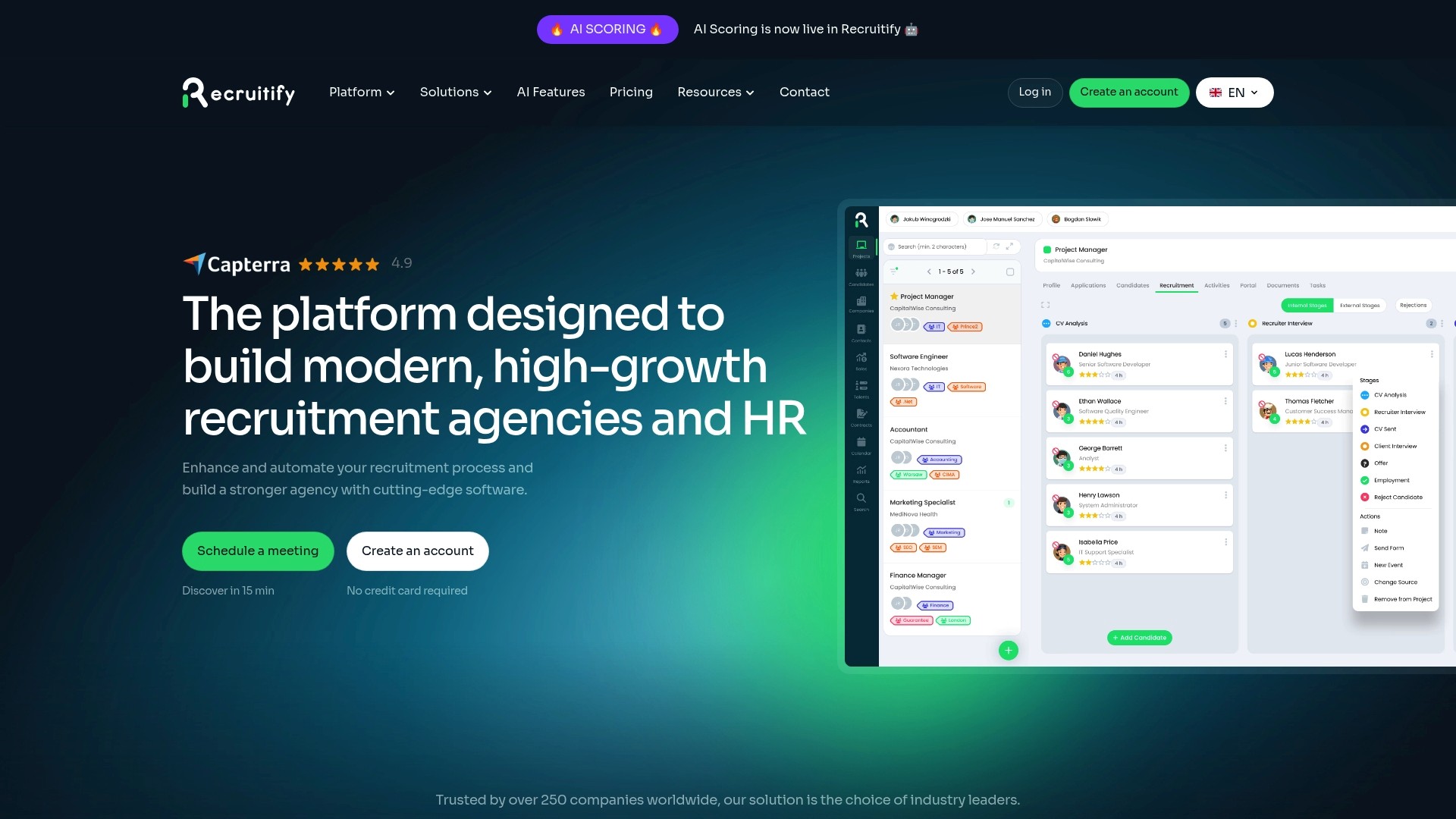
A Recruitify demo or pilot is built to validate five things directly against your own data, not a sample dataset:
Whether candidate and requisition data persist across a real, active campaign.
Whether workflows can be configured per business unit without duplicating your process.
Whether AI scoring decisions are auditable enough to satisfy a compliance reviewer.
Whether analytics give your control tower true multi-entity visibility.
Whether onboarding automation carries hires cleanly from offer acceptance to day one.
Start by reviewing Recruitify’s platform overview and requesting a demo scoped to one of your active high-volume campaigns, so the evaluation reflects your actual pipeline rather than a generic walkthrough.
Sources
For readers who want to go deeper on the research behind this playbook: Gartner’s 2026 talent acquisition trends covers the AI and cost forces reshaping TA. Everest Group’s 4P and control-tower report is the primary source for the operating model. SHRM’s applicant abandonment research quantifies candidate-experience risk, and the World Economic Forum’s DEI lighthouse report informs assessment design.
Gartner press release: AI revolution and cost pressures driving top TA trends for 2026
Operationalizing next-generation Talent Acquisition (Everest Group, 2026)
High-Volume Recruiting: Managing Large-Scale Hiring Campaigns | National Recruiting Authority
Recommended


News & Updates
Stay up-to-date with the latest innovations, features, and tips about Recruitify!
By providing your email address within the newsletter sign-up form, you confirm its processing to send marketing information regarding the Administrator’s products and services. The Administrator of your personal data processed for the abovementioned purposes is Recruitify Spółka z o.o., based in Warsaw, Poland (KRS 0000709889). For more information on the principles of personal data processing and the rights of data subjects, please check the Privacy Policy.

Last updated:
50+ Roles? Use a 4P Control Tower for Enterprise Recruiting at Scale
Innovations
The Recruitify Team
50+ Roles? Use a 4P Control Tower for Enterprise Recruiting at Scale
Enterprise recruiting at scale succeeds only when talent acquisition runs as an operating system, not a string of disconnected requisitions. That means one owner for workforce planning and data continuity, one framework tying people, process, platform, and partners together, and one control tower to orchestrate decisions. Recruitify’s playbook builds on that structure. The first move: audit who owns your workforce planning data today, and whether it survives contact with a hundred simultaneous roles.
TL;DR:
A unified talent acquisition operating system should own data continuity, workforce planning, and decision orchestration to prevent costly failures at scale.
Critical cracks include requisition resets caused by turnover, fragmented decision-making, and poor reuse of past applicant data, leading to longer hiring cycles and increased costs.
The 4P framework assigns clear ownership of people, process, platform, and partners, with a control tower coordinating priorities and data integrity across the enterprise.
Enterprise platforms must provide persistent, integrated candidate data, configurable workflows, auditable AI scoring, and comprehensive visibility to support scalable recruiting.
Successful high-volume hiring relies on structured campaigns, cohort onboarding, continuous metrics tracking, and sequenced technology and process implementation.
Table of Contents
Why Enterprise Recruiting at Scale Breaks Down
An Operating Model That Scales: 4P Plus Control Tower
Technology and Data Architecture: What Enterprise Platforms Must Deliver
High-Volume Hiring Playbook: Campaign Flow, Timelines, and KPIs
Metrics, Dashboards, and Continuous Improvement for Enterprise TA
How Recruitify Puts the Operating Model Into Practice
Onboarding and Retention: Closing the Loop After the Hire
Recruitify Team Perspective: Implementation Pitfalls and Pragmatic Sequencing
See the 4P Model Running Inside a Real Platform
Sources
Why Enterprise Recruiting at Scale Breaks Down
Most enterprise TA functions do not fail because recruiters are slow. They fail because the system underneath them was never built for volume, distribution, or turnover among the people running it.
The first crack shows up as a requisition reset. A hiring manager changes roles, a recruiter moves teams, or a business unit reorganizes, and the context attached to an open req evaporates with them. Interview notes live in someone’s inbox. Sourcing history sits in a spreadsheet nobody else can find. The replacement recruiter starts from zero on a role that was three weeks into a search, and the clock resets while the business keeps waiting.
The second crack is what Everest Group’s research on next-generation TA describes as a fragmented decision structure: dozens of hiring managers, regional HR leads, and business unit heads making independent calls about sourcing channels, interview panels, and offer terms, with no shared standard connecting any of it. Each decision might be locally sensible. Collectively, they produce twelve versions of “how we screen a candidate” across one company, which is precisely the disorder Everest Group’s 4P and control-tower model is designed to correct.
The third crack is loss of talent continuity. Enterprises sitting on years of prior applicant data routinely fail to reuse it, so a strong finalist from last year’s search for a role in Chicago never resurfaces when an identical role opens in Denver. The candidate re-enters the funnel as a stranger.
These cracks carry a measurable cost, even where the exact multiplier varies by company. Time-to-hire stretches because every reset means relearning a role’s context. Offer-drop rates climb because slow, inconsistent processes push candidates toward employers who move faster. Compliance exposure grows because inconsistent screening across business units and countries creates uneven documentation trails, a real problem given how much labor rights and enforcement vary across 142 countries the World Justice Project studied. Layered together, these effects act as a hidden enterprise tax on cost-per-hire that never shows up as a single line item, only as a persistent drag on every recruiting metric leadership cares about.
Audit your own organization against this list of failure modes:
Recruiter or hiring manager turnover routinely triggers a full requisition restart rather than a handoff.
Sourcing, screening, and interview data live in disconnected tools or personal files rather than a shared system.
Regional or business-unit leaders each define their own hiring workflow with no shared baseline.
Past applicant data is rarely, if ever, resurfaced for new openings.
No single role or team is accountable for the health of the pipeline across the whole enterprise.
If three or more of these describe your organization, the problem is not effort. It is architecture.
An Operating Model That Scales: 4P Plus Control Tower
Everest Group’s research on operationalizing next-generation talent acquisition offers a structure worth adopting almost intact: the 4P framework, made up of people, process, platform, and partners, coordinated through a control tower that owns orchestration across all four.
Each P needs a named owner, not a committee:
People. This covers the TA org chart itself: recruiters, sourcers, coordinators, and the hiring managers who sit outside TA but shape every outcome. Ownership sits with a TA leadership role responsible for capacity planning and skill coverage, not just headcount.
Process. This is the actual lifecycle: intake, sourcing, screening, assessment, offer, and onboarding, plus the escalation paths when something breaks. A process owner, typically a TA operations lead, codifies these steps so they do not vary by region or recruiter mood.
Platform. The technology stack, from the applicant tracking system through CRM, assessment tools, and analytics, needs an owner accountable for integration health and data governance, usually a TA technology or RevOps lead.
Partners. External agencies, RPO providers, and specialized sourcing vendors need a relationship owner who tracks performance against the same KPIs internal recruiters are measured on, so partner-sourced hires are held to a consistent bar.
The control tower sits above all four, and its job is orchestration, not execution. It prioritizes which roles get resourced first when demand spikes, resolves conflicts between regional autonomy and central standards, and acts as the steward of shared data so a candidate’s history follows them across the organization instead of disappearing at a business unit boundary.
Adoption follows a sequence rather than a simultaneous rollout:
Assign the four owners explicitly, in writing, with clear accountability for their P.
Define shared KPIs before touching any tooling, so every owner is measured against the same definitions of quality-of-hire, time-to-fill, and pipeline health.
Codify the lifecycle, documenting each stage of the requisition-to-hire journey and where escalation happens when a stage stalls.
Stand up the control tower as a recurring function, not a one-time project, with a standing cadence for prioritization decisions.
Layer in partner governance last, once internal process and data ownership are stable enough to hold external vendors to the same standard.
Pro Tip: Do not appoint the control tower owner from whichever team already has the most political capital. Appoint the person closest to the data, because orchestration lives or dies on whether the underlying pipeline information is accurate and current.
Technology and Data Architecture: What Enterprise Platforms Must Deliver
The 4P model only works if the platform layer actually holds state. Too many enterprise TA stacks rely on point-in-time syncs between systems rather than genuinely persistent, shared candidate and requisition records, and that distinction is the difference between a control tower with real visibility and one guessing from stale exports.
Persistent data means a candidate’s full history, sourcing channel, screening scores, interview feedback, and prior application outcomes, stays attached to their profile regardless of which recruiter, region, or requisition touches it next. Sync-only integrations, where two systems periodically exchange snapshots, break this continuity every time a sync window misses an update or a field mapping drifts. Gartner’s research on 2026 talent acquisition trends points to AI adoption and cost pressure as the two forces reshaping enterprise TA, and neither force pays off without an architecture that can actually sustain automated decisions on trustworthy, current data.
A workable integration pattern connects four systems as one logical fabric rather than four silos: the ATS as the system of record for requisitions and candidates, the HRIS for workforce planning and org structure, the CRM for talent pool nurturing, and assessment tools feeding structured scores back into the candidate record automatically. Governance sits on top of that fabric, not bolted onto individual tools.
Before selecting or renewing an enterprise platform, check it against this list:
Configurable workflows that let each business unit adapt stages without forking the underlying process the control tower relies on.
Auditable AI scoring, meaning every automated recommendation can be traced back to the inputs that produced it, not a black-box output.
Multi-entity visibility, so the control tower sees pipeline health across regions and business units in one view rather than stitching together local reports.
Audit logs covering who changed what, when, across the full candidate lifecycle.
Adverse-impact testing built into the assessment and scoring layer, not run as a separate manual exercise after the fact.
The candidate-experience stakes for getting this wrong are concrete. SHRM’s research on online job applications found that a large share of applicants never finish the process they started, and clunky, disconnected systems are a primary driver of that drop-off. An architecture that cannot hold a candidate’s data across one seamless flow is losing talent before a recruiter ever sees the applicant.
High-Volume Hiring Playbook: Campaign Flow, Timelines, and KPIs
Mass hiring is not “normal recruiting, faster.” It requires distinct process architecture, and the National Recruiting Authority’s guidance on high-volume recruiting treats roughly 50 or more simultaneous open roles as the threshold where different tooling and risk controls become necessary rather than optional.
A campaign should trigger off workforce planning signals, not react to a sudden hiring-manager request. When manpower planning data flags a seasonal ramp, a new facility opening, or a product launch requiring a defined headcount, that is the moment to activate mass-hiring mode rather than after requisitions have already started piling up unfilled.
The playbook runs in four stages:
Intake and channel selection. Consolidate all roles into a single campaign brief and select a sourcing mix across job boards, programmatic advertising, referral pushes, and talent pool reactivation, distributing multi-channel job postings simultaneously rather than staggering them.
Automated pre-screening. Apply consistent, structured screening criteria at the top of the funnel so recruiters only spend time on candidates who clear a defined bar, cutting manual review volume dramatically.
Structured assessment. Standardize the evaluation format across every candidate in the campaign so cohorts can be compared fairly, which also supports the adverse-impact monitoring outlined in the World Economic Forum’s guidance on DEI lighthouse practices.
Batch offers and cohort onboarding. Extend offers in coordinated waves tied to defined start dates, and onboard new hires as cohorts rather than individually, which simplifies training logistics and gives HR a predictable rhythm.
Conversion rates vary by industry and role type, but high-volume campaigns typically follow a recognizable funnel shape:
Funnel stage | Typical conversion range |
|---|---|
Applicants to screened candidates | A substantial share |
Screened to assessed candidates | A large proportion |
Assessed to offer | Around half to two thirds |
Offer to accepted, cohort onboarded | Most |
Recruitify’s project and pipeline management tools support this kind of campaign structure by keeping every stage visible in one place instead of scattered across spreadsheets built for a single req at a time.
Metrics, Dashboards, and Continuous Improvement for Enterprise TA
Enterprise TA at scale needs a small set of metrics tracked consistently, not a sprawling dashboard nobody actually reads. The core set includes pipeline health, time-in-stage, conversion at each funnel step, quality-of-hire, time-to-fill, and adverse-impact checks run against every completed assessment cycle.
Pipeline health matters because a healthy top-of-funnel number hides nothing if candidates are stalling three stages deep. Time-in-stage isolates exactly where that stalling happens, whether it is a slow interview scheduling step or a bottleneck at offer approval. Quality-of-hire, though harder to measure cleanly, is the metric that keeps volume from becoming the only goal, and Everest Group’s control-tower model treats it as a first-class KPI precisely because throughput without quality just moves the enterprise tax downstream into turnover.
Different stakeholders need different views of the same data:
TA coordinators need stage-level, near-real-time detail: which requisitions are stalled and why.
HR business partners need weekly rollups by business unit, tied to headcount plans they are accountable for.
Executives need monthly trend lines on cost-per-hire, time-to-fill, and diversity of the pipeline against targets, without the operational noise underneath.
A workable cadence has three layers. A weekly takt meeting reviews stalled requisitions and immediate blockers among the recruiting team itself. A monthly ops review brings in HR business partners to assess trends against headcount plans and flag emerging risk. A quarterly strategy audit brings the control tower and executive sponsors together to reassess whether the operating model itself, not just individual campaigns, is still fit for the business’s direction.
How Recruitify Puts the Operating Model Into Practice
Recruitify maps directly onto the 4P and control-tower structure rather than asking you to build orchestration on top of a disconnected tool stack. The platform layer combines AI candidate scoring, CV parsing, and an applicant tracking system unified with CRM, so requisition and candidate data persist in one record instead of scattering across disconnected exports. Recruitment automation handles the repetitive screening and scheduling work that otherwise consumes recruiter time during high-volume campaigns, supporting the process layer with consistent, auditable steps. Analytics dashboards give the control tower the multi-entity visibility it needs to prioritize across business units rather than guessing from siloed reports.
Recruitify is trusted by more than 250 companies, and its automation features are built specifically to relieve teams from administrative burden so recruiters spend more time on relationship-building and closing roles, which is exactly the shift the 4P model asks the people layer to make.
Before adopting any platform for enterprise-scale recruiting, run it through this checklist:
Does candidate and requisition data persist across every stage without manual re-entry?
Can workflows be configured per business unit without forking the core process?
Is AI scoring auditable, so you can explain a recommendation to a compliance reviewer?
Do analytics surface pipeline health across regions in one unified view?
Does onboarding automation carry through from offer acceptance into day-one readiness?
Pro Tip: Run any platform evaluation against a live, active campaign rather than a demo dataset. A tool that looks clean with fifty sample records can behave very differently once five thousand real candidates are moving through it simultaneously.
Onboarding and Retention: Closing the Loop After the Hire
A mass-hiring campaign that fills every seat and then loses a third of those hires within ninety days has not actually solved the enterprise’s problem. Onboarding and retention are not a separate workstream from recruiting at scale. They are the back half of the same pipeline.
Cohort onboarding, introduced during the high-volume playbook, does double duty here. Training new hires in structured groups rather than one-by-one gives HR a predictable, repeatable orientation experience and gives new employees a peer cohort from day one, which consistently correlates with stronger early retention than isolated onboarding does.
Retention data should feed back into the same dashboards used for recruiting metrics, not sit in a separate HR system nobody on the TA side ever checks. If ninety-day attrition spikes for hires sourced through a particular channel or screened with a particular assessment, that is a signal the control tower needs to see, because it may point to a sourcing mix or screening criterion that is filling seats with candidates who are a poor fit.
Manager readiness matters as much as candidate readiness. Enterprises that scale hiring volume without also preparing hiring managers to onboard larger cohorts consistently see retention suffer, regardless of how strong the initial screening process was. Building manager onboarding checklists into the same operating model that governs recruiting keeps the two halves of the talent lifecycle from drifting apart.
Recruitify Team Perspective: Implementation Pitfalls and Pragmatic Sequencing
The most common mistake enterprises make is bolting new technology onto an ungoverned process and calling it transformation. A powerful AI scoring tool layered onto inconsistent screening criteria just automates inconsistency faster. The second most common mistake is skipping workforce planning integration entirely, so recruiting reacts to headcount requests instead of anticipating them. The third is treating adverse-impact analysis as an annual compliance exercise rather than something checked after every assessment cycle.
Sequence the rollout as technology, then process, then capability, in that order, and start with a single business unit running a constrained pilot before scaling cross-entity. Move to a full rollout only once integrations, scoring thresholds, and adverse-impact monitoring hold steady under real volume. If internal bandwidth cannot sustain that pilot discipline, bringing in a partner to run the first cycle beats skipping governance to hit a deadline.
— Recruitify Team
See the 4P Model Running Inside a Real Platform
Everest Group’s control-tower model and the 4P framework are only useful once they are running inside a system that can actually hold the data and enforce the process, and that is the gap Recruitify closes. Rather than asking your team to stitch together an ATS, a CRM, and a scoring tool from three vendors, Recruitify unifies people, process, and platform ownership into one system built for exactly the continuity enterprise recruiting at scale requires.
A Recruitify demo or pilot is built to validate five things directly against your own data, not a sample dataset:
Whether candidate and requisition data persist across a real, active campaign.
Whether workflows can be configured per business unit without duplicating your process.
Whether AI scoring decisions are auditable enough to satisfy a compliance reviewer.
Whether analytics give your control tower true multi-entity visibility.
Whether onboarding automation carries hires cleanly from offer acceptance to day one.
Start by reviewing Recruitify’s platform overview and requesting a demo scoped to one of your active high-volume campaigns, so the evaluation reflects your actual pipeline rather than a generic walkthrough.
Sources
For readers who want to go deeper on the research behind this playbook: Gartner’s 2026 talent acquisition trends covers the AI and cost forces reshaping TA. Everest Group’s 4P and control-tower report is the primary source for the operating model. SHRM’s applicant abandonment research quantifies candidate-experience risk, and the World Economic Forum’s DEI lighthouse report informs assessment design.
Gartner press release: AI revolution and cost pressures driving top TA trends for 2026
Operationalizing next-generation Talent Acquisition (Everest Group, 2026)
High-Volume Recruiting: Managing Large-Scale Hiring Campaigns | National Recruiting Authority
Recommended
News & Updates
Stay up-to-date with the latest innovations, features, and tips about Recruitify!
By providing your email address within the newsletter sign-up form, you confirm its processing to send marketing information regarding the Administrator’s products and services. The Administrator of your personal data processed for the abovementioned purposes is Recruitify Spółka z o.o., based in Warsaw, Poland (KRS 0000709889). For more information on the principles of personal data processing and the rights of data subjects, please check the Privacy Policy.
Last updated:
50+ Roles? Use a 4P Control Tower for Enterprise Recruiting at Scale
Innovations
The Recruitify Team
50+ Roles? Use a 4P Control Tower for Enterprise Recruiting at Scale
Enterprise recruiting at scale succeeds only when talent acquisition runs as an operating system, not a string of disconnected requisitions. That means one owner for workforce planning and data continuity, one framework tying people, process, platform, and partners together, and one control tower to orchestrate decisions. Recruitify’s playbook builds on that structure. The first move: audit who owns your workforce planning data today, and whether it survives contact with a hundred simultaneous roles.
TL;DR:
A unified talent acquisition operating system should own data continuity, workforce planning, and decision orchestration to prevent costly failures at scale.
Critical cracks include requisition resets caused by turnover, fragmented decision-making, and poor reuse of past applicant data, leading to longer hiring cycles and increased costs.
The 4P framework assigns clear ownership of people, process, platform, and partners, with a control tower coordinating priorities and data integrity across the enterprise.
Enterprise platforms must provide persistent, integrated candidate data, configurable workflows, auditable AI scoring, and comprehensive visibility to support scalable recruiting.
Successful high-volume hiring relies on structured campaigns, cohort onboarding, continuous metrics tracking, and sequenced technology and process implementation.
Table of Contents
Why Enterprise Recruiting at Scale Breaks Down
An Operating Model That Scales: 4P Plus Control Tower
Technology and Data Architecture: What Enterprise Platforms Must Deliver
High-Volume Hiring Playbook: Campaign Flow, Timelines, and KPIs
Metrics, Dashboards, and Continuous Improvement for Enterprise TA
How Recruitify Puts the Operating Model Into Practice
Onboarding and Retention: Closing the Loop After the Hire
Recruitify Team Perspective: Implementation Pitfalls and Pragmatic Sequencing
See the 4P Model Running Inside a Real Platform
Sources
Why Enterprise Recruiting at Scale Breaks Down
Most enterprise TA functions do not fail because recruiters are slow. They fail because the system underneath them was never built for volume, distribution, or turnover among the people running it.
The first crack shows up as a requisition reset. A hiring manager changes roles, a recruiter moves teams, or a business unit reorganizes, and the context attached to an open req evaporates with them. Interview notes live in someone’s inbox. Sourcing history sits in a spreadsheet nobody else can find. The replacement recruiter starts from zero on a role that was three weeks into a search, and the clock resets while the business keeps waiting.
The second crack is what Everest Group’s research on next-generation TA describes as a fragmented decision structure: dozens of hiring managers, regional HR leads, and business unit heads making independent calls about sourcing channels, interview panels, and offer terms, with no shared standard connecting any of it. Each decision might be locally sensible. Collectively, they produce twelve versions of “how we screen a candidate” across one company, which is precisely the disorder Everest Group’s 4P and control-tower model is designed to correct.
The third crack is loss of talent continuity. Enterprises sitting on years of prior applicant data routinely fail to reuse it, so a strong finalist from last year’s search for a role in Chicago never resurfaces when an identical role opens in Denver. The candidate re-enters the funnel as a stranger.
These cracks carry a measurable cost, even where the exact multiplier varies by company. Time-to-hire stretches because every reset means relearning a role’s context. Offer-drop rates climb because slow, inconsistent processes push candidates toward employers who move faster. Compliance exposure grows because inconsistent screening across business units and countries creates uneven documentation trails, a real problem given how much labor rights and enforcement vary across 142 countries the World Justice Project studied. Layered together, these effects act as a hidden enterprise tax on cost-per-hire that never shows up as a single line item, only as a persistent drag on every recruiting metric leadership cares about.
Audit your own organization against this list of failure modes:
Recruiter or hiring manager turnover routinely triggers a full requisition restart rather than a handoff.
Sourcing, screening, and interview data live in disconnected tools or personal files rather than a shared system.
Regional or business-unit leaders each define their own hiring workflow with no shared baseline.
Past applicant data is rarely, if ever, resurfaced for new openings.
No single role or team is accountable for the health of the pipeline across the whole enterprise.
If three or more of these describe your organization, the problem is not effort. It is architecture.
An Operating Model That Scales: 4P Plus Control Tower
Everest Group’s research on operationalizing next-generation talent acquisition offers a structure worth adopting almost intact: the 4P framework, made up of people, process, platform, and partners, coordinated through a control tower that owns orchestration across all four.
Each P needs a named owner, not a committee:
People. This covers the TA org chart itself: recruiters, sourcers, coordinators, and the hiring managers who sit outside TA but shape every outcome. Ownership sits with a TA leadership role responsible for capacity planning and skill coverage, not just headcount.
Process. This is the actual lifecycle: intake, sourcing, screening, assessment, offer, and onboarding, plus the escalation paths when something breaks. A process owner, typically a TA operations lead, codifies these steps so they do not vary by region or recruiter mood.
Platform. The technology stack, from the applicant tracking system through CRM, assessment tools, and analytics, needs an owner accountable for integration health and data governance, usually a TA technology or RevOps lead.
Partners. External agencies, RPO providers, and specialized sourcing vendors need a relationship owner who tracks performance against the same KPIs internal recruiters are measured on, so partner-sourced hires are held to a consistent bar.
The control tower sits above all four, and its job is orchestration, not execution. It prioritizes which roles get resourced first when demand spikes, resolves conflicts between regional autonomy and central standards, and acts as the steward of shared data so a candidate’s history follows them across the organization instead of disappearing at a business unit boundary.
Adoption follows a sequence rather than a simultaneous rollout:
Assign the four owners explicitly, in writing, with clear accountability for their P.
Define shared KPIs before touching any tooling, so every owner is measured against the same definitions of quality-of-hire, time-to-fill, and pipeline health.
Codify the lifecycle, documenting each stage of the requisition-to-hire journey and where escalation happens when a stage stalls.
Stand up the control tower as a recurring function, not a one-time project, with a standing cadence for prioritization decisions.
Layer in partner governance last, once internal process and data ownership are stable enough to hold external vendors to the same standard.
Pro Tip: Do not appoint the control tower owner from whichever team already has the most political capital. Appoint the person closest to the data, because orchestration lives or dies on whether the underlying pipeline information is accurate and current.
Technology and Data Architecture: What Enterprise Platforms Must Deliver
The 4P model only works if the platform layer actually holds state. Too many enterprise TA stacks rely on point-in-time syncs between systems rather than genuinely persistent, shared candidate and requisition records, and that distinction is the difference between a control tower with real visibility and one guessing from stale exports.
Persistent data means a candidate’s full history, sourcing channel, screening scores, interview feedback, and prior application outcomes, stays attached to their profile regardless of which recruiter, region, or requisition touches it next. Sync-only integrations, where two systems periodically exchange snapshots, break this continuity every time a sync window misses an update or a field mapping drifts. Gartner’s research on 2026 talent acquisition trends points to AI adoption and cost pressure as the two forces reshaping enterprise TA, and neither force pays off without an architecture that can actually sustain automated decisions on trustworthy, current data.
A workable integration pattern connects four systems as one logical fabric rather than four silos: the ATS as the system of record for requisitions and candidates, the HRIS for workforce planning and org structure, the CRM for talent pool nurturing, and assessment tools feeding structured scores back into the candidate record automatically. Governance sits on top of that fabric, not bolted onto individual tools.
Before selecting or renewing an enterprise platform, check it against this list:
Configurable workflows that let each business unit adapt stages without forking the underlying process the control tower relies on.
Auditable AI scoring, meaning every automated recommendation can be traced back to the inputs that produced it, not a black-box output.
Multi-entity visibility, so the control tower sees pipeline health across regions and business units in one view rather than stitching together local reports.
Audit logs covering who changed what, when, across the full candidate lifecycle.
Adverse-impact testing built into the assessment and scoring layer, not run as a separate manual exercise after the fact.
The candidate-experience stakes for getting this wrong are concrete. SHRM’s research on online job applications found that a large share of applicants never finish the process they started, and clunky, disconnected systems are a primary driver of that drop-off. An architecture that cannot hold a candidate’s data across one seamless flow is losing talent before a recruiter ever sees the applicant.
High-Volume Hiring Playbook: Campaign Flow, Timelines, and KPIs
Mass hiring is not “normal recruiting, faster.” It requires distinct process architecture, and the National Recruiting Authority’s guidance on high-volume recruiting treats roughly 50 or more simultaneous open roles as the threshold where different tooling and risk controls become necessary rather than optional.
A campaign should trigger off workforce planning signals, not react to a sudden hiring-manager request. When manpower planning data flags a seasonal ramp, a new facility opening, or a product launch requiring a defined headcount, that is the moment to activate mass-hiring mode rather than after requisitions have already started piling up unfilled.
The playbook runs in four stages:
Intake and channel selection. Consolidate all roles into a single campaign brief and select a sourcing mix across job boards, programmatic advertising, referral pushes, and talent pool reactivation, distributing multi-channel job postings simultaneously rather than staggering them.
Automated pre-screening. Apply consistent, structured screening criteria at the top of the funnel so recruiters only spend time on candidates who clear a defined bar, cutting manual review volume dramatically.
Structured assessment. Standardize the evaluation format across every candidate in the campaign so cohorts can be compared fairly, which also supports the adverse-impact monitoring outlined in the World Economic Forum’s guidance on DEI lighthouse practices.
Batch offers and cohort onboarding. Extend offers in coordinated waves tied to defined start dates, and onboard new hires as cohorts rather than individually, which simplifies training logistics and gives HR a predictable rhythm.
Conversion rates vary by industry and role type, but high-volume campaigns typically follow a recognizable funnel shape:
Funnel stage | Typical conversion range |
|---|---|
Applicants to screened candidates | A substantial share |
Screened to assessed candidates | A large proportion |
Assessed to offer | Around half to two thirds |
Offer to accepted, cohort onboarded | Most |
Recruitify’s project and pipeline management tools support this kind of campaign structure by keeping every stage visible in one place instead of scattered across spreadsheets built for a single req at a time.
Metrics, Dashboards, and Continuous Improvement for Enterprise TA
Enterprise TA at scale needs a small set of metrics tracked consistently, not a sprawling dashboard nobody actually reads. The core set includes pipeline health, time-in-stage, conversion at each funnel step, quality-of-hire, time-to-fill, and adverse-impact checks run against every completed assessment cycle.
Pipeline health matters because a healthy top-of-funnel number hides nothing if candidates are stalling three stages deep. Time-in-stage isolates exactly where that stalling happens, whether it is a slow interview scheduling step or a bottleneck at offer approval. Quality-of-hire, though harder to measure cleanly, is the metric that keeps volume from becoming the only goal, and Everest Group’s control-tower model treats it as a first-class KPI precisely because throughput without quality just moves the enterprise tax downstream into turnover.
Different stakeholders need different views of the same data:
TA coordinators need stage-level, near-real-time detail: which requisitions are stalled and why.
HR business partners need weekly rollups by business unit, tied to headcount plans they are accountable for.
Executives need monthly trend lines on cost-per-hire, time-to-fill, and diversity of the pipeline against targets, without the operational noise underneath.
A workable cadence has three layers. A weekly takt meeting reviews stalled requisitions and immediate blockers among the recruiting team itself. A monthly ops review brings in HR business partners to assess trends against headcount plans and flag emerging risk. A quarterly strategy audit brings the control tower and executive sponsors together to reassess whether the operating model itself, not just individual campaigns, is still fit for the business’s direction.
How Recruitify Puts the Operating Model Into Practice
Recruitify maps directly onto the 4P and control-tower structure rather than asking you to build orchestration on top of a disconnected tool stack. The platform layer combines AI candidate scoring, CV parsing, and an applicant tracking system unified with CRM, so requisition and candidate data persist in one record instead of scattering across disconnected exports. Recruitment automation handles the repetitive screening and scheduling work that otherwise consumes recruiter time during high-volume campaigns, supporting the process layer with consistent, auditable steps. Analytics dashboards give the control tower the multi-entity visibility it needs to prioritize across business units rather than guessing from siloed reports.
Recruitify is trusted by more than 250 companies, and its automation features are built specifically to relieve teams from administrative burden so recruiters spend more time on relationship-building and closing roles, which is exactly the shift the 4P model asks the people layer to make.
Before adopting any platform for enterprise-scale recruiting, run it through this checklist:
Does candidate and requisition data persist across every stage without manual re-entry?
Can workflows be configured per business unit without forking the core process?
Is AI scoring auditable, so you can explain a recommendation to a compliance reviewer?
Do analytics surface pipeline health across regions in one unified view?
Does onboarding automation carry through from offer acceptance into day-one readiness?
Pro Tip: Run any platform evaluation against a live, active campaign rather than a demo dataset. A tool that looks clean with fifty sample records can behave very differently once five thousand real candidates are moving through it simultaneously.
Onboarding and Retention: Closing the Loop After the Hire
A mass-hiring campaign that fills every seat and then loses a third of those hires within ninety days has not actually solved the enterprise’s problem. Onboarding and retention are not a separate workstream from recruiting at scale. They are the back half of the same pipeline.
Cohort onboarding, introduced during the high-volume playbook, does double duty here. Training new hires in structured groups rather than one-by-one gives HR a predictable, repeatable orientation experience and gives new employees a peer cohort from day one, which consistently correlates with stronger early retention than isolated onboarding does.
Retention data should feed back into the same dashboards used for recruiting metrics, not sit in a separate HR system nobody on the TA side ever checks. If ninety-day attrition spikes for hires sourced through a particular channel or screened with a particular assessment, that is a signal the control tower needs to see, because it may point to a sourcing mix or screening criterion that is filling seats with candidates who are a poor fit.
Manager readiness matters as much as candidate readiness. Enterprises that scale hiring volume without also preparing hiring managers to onboard larger cohorts consistently see retention suffer, regardless of how strong the initial screening process was. Building manager onboarding checklists into the same operating model that governs recruiting keeps the two halves of the talent lifecycle from drifting apart.
Recruitify Team Perspective: Implementation Pitfalls and Pragmatic Sequencing
The most common mistake enterprises make is bolting new technology onto an ungoverned process and calling it transformation. A powerful AI scoring tool layered onto inconsistent screening criteria just automates inconsistency faster. The second most common mistake is skipping workforce planning integration entirely, so recruiting reacts to headcount requests instead of anticipating them. The third is treating adverse-impact analysis as an annual compliance exercise rather than something checked after every assessment cycle.
Sequence the rollout as technology, then process, then capability, in that order, and start with a single business unit running a constrained pilot before scaling cross-entity. Move to a full rollout only once integrations, scoring thresholds, and adverse-impact monitoring hold steady under real volume. If internal bandwidth cannot sustain that pilot discipline, bringing in a partner to run the first cycle beats skipping governance to hit a deadline.
— Recruitify Team
See the 4P Model Running Inside a Real Platform
Everest Group’s control-tower model and the 4P framework are only useful once they are running inside a system that can actually hold the data and enforce the process, and that is the gap Recruitify closes. Rather than asking your team to stitch together an ATS, a CRM, and a scoring tool from three vendors, Recruitify unifies people, process, and platform ownership into one system built for exactly the continuity enterprise recruiting at scale requires.
A Recruitify demo or pilot is built to validate five things directly against your own data, not a sample dataset:
Whether candidate and requisition data persist across a real, active campaign.
Whether workflows can be configured per business unit without duplicating your process.
Whether AI scoring decisions are auditable enough to satisfy a compliance reviewer.
Whether analytics give your control tower true multi-entity visibility.
Whether onboarding automation carries hires cleanly from offer acceptance to day one.
Start by reviewing Recruitify’s platform overview and requesting a demo scoped to one of your active high-volume campaigns, so the evaluation reflects your actual pipeline rather than a generic walkthrough.
Sources
For readers who want to go deeper on the research behind this playbook: Gartner’s 2026 talent acquisition trends covers the AI and cost forces reshaping TA. Everest Group’s 4P and control-tower report is the primary source for the operating model. SHRM’s applicant abandonment research quantifies candidate-experience risk, and the World Economic Forum’s DEI lighthouse report informs assessment design.
Gartner press release: AI revolution and cost pressures driving top TA trends for 2026
Operationalizing next-generation Talent Acquisition (Everest Group, 2026)
High-Volume Recruiting: Managing Large-Scale Hiring Campaigns | National Recruiting Authority
Recommended
News & Updates
Stay up-to-date with the latest innovations, features, and tips about Recruitify!
By providing your email address within the newsletter sign-up form, you confirm its processing to send marketing information regarding the Administrator’s products and services. The Administrator of your personal data processed for the abovementioned purposes is Recruitify Spółka z o.o., based in Warsaw, Poland (KRS 0000709889). For more information on the principles of personal data processing and the rights of data subjects, please check the Privacy Policy.

Discover More

Recruitment Process
29 Aug 2026
For recruiters: slash your time-to-hire, powered by Recruitify
For recruiters: slash your time-to-hire, powered by Recruitify
Discover More

Applicant Tracking System
29 Aug 2026
Zero Candidate Loss When Switching ATS: A 6-Step Guide for Recruiters
The ultimate checklist for recruiters and agencies: six phases to a secure ATS migration, covering data export, field mapping, parallel running, and validation.
Discover More

Recruitment Process
28 Aug 2026
10 Steps: How to Implement GDPR-Compliant WhatsApp Recruiting for Your Agency
A practical guide for HR and recruitment agencies, featuring a GDPR checklist, a 10-step deployment plan, chatbot implementation, and key metrics. Here is how to secure your business...
Discover More
Recruitment Process
29 Aug 2026
For recruiters: slash your time-to-hire, powered by Recruitify
For recruiters: slash your time-to-hire, powered by Recruitify
Discover More
Applicant Tracking System
29 Aug 2026
Zero Candidate Loss When Switching ATS: A 6-Step Guide for Recruiters
The ultimate checklist for recruiters and agencies: six phases to a secure ATS migration, covering data export, field mapping, parallel running, and validation.
Discover More