
Last updated:
Rate Card Staffing: How to Build, Price and Manage One

Recruitment Process

The Recruitify Team
A staffing rate card is a table of pre-agreed rates for each role a client buys through an agency, usually broken down by skill, seniority and location. It replaces a fresh price negotiation for every requisition with one reference document, so the client gets cost predictability and the agency gets a defensible margin. This guide explains what a rate card contains, how a bill rate is derived from a pay rate, which methodology fits which segment, and how to keep the card accurate once it is in use.
Key takeaways
A rate card lists approved pay rates, bill rates or maximum bill rates per role, and often markups, overtime rules and conversion fees.
The bill rate is what the client pays per hour. The pay rate is the wage the worker receives. The gap between them must cover payroll costs, overhead and profit.
No single methodology fits every segment: markup-based cards tend to suit lower-skill work, while maximum bill rates tend to suit specialized categories such as IT.
Rate cards go stale. Review them at least quarterly or twice a year, and track the margin on each placement against the card.
Spreadsheets break down once rates, contracts and margins live in different files, which is where an integrated ATS, CRM and contracting system helps.
Table of Contents
What a staffing rate card is and what it contains
A rate card is a standardized price list for contingent labor. The client company, or the agency selling to it, agrees on the hourly figure for each role before any candidate is presented. When a hiring manager needs a mid-level developer or a senior business analyst, the price is already known.
A complete card normally includes the following columns:
Role or job family, for example software engineer, QA analyst, ERP consultant or project manager.
Level, typically junior, mid, senior and lead.
Location or market tier, because the same role costs more in San Francisco than in Omaha.
Rate type: a fixed bill rate, a maximum bill rate (a ceiling), or a pay rate plus a markup.
Overtime and holiday rules, including whether the premium applies to the pay rate, the bill rate or both.
Conversion fee, the charge if the client hires the contractor directly.
Validity period, so both sides know when the card is due for review.
Some clients treat the card as a pure price list. It is more useful to see it as a risk-control tool: standardizing rates by skill set and experience level gives client companies cost predictability, while the agency can still scale labor up or down without the commitments of permanent hiring. For the agency, the same document protects against two failure modes: underpricing a scarce skill and losing money, or overpricing a commodity role and losing the account.
Bill rate vs. pay rate: the arithmetic behind every line
Every row on a rate card rests on the relationship between two numbers. The pay rate is what the worker earns per hour. According to Deltek, the bill rate is the total hourly charge to the client, and it equals the pay rate plus operating costs, legally mandated costs and profit margin. The same source expresses this more simply as the pay rate multiplied by one plus the markup percentage.
What sits between the two numbers
The difference is not profit. Much of it is cost the agency carries for every hour worked:
Employer payroll taxes. In 2026 the combined FICA rate is 7.65%, split between employer and employee: 6.2% for Social Security up to the wage base and 1.45% for Medicare. The employer pays a matching share on every W-2 worker.
Other statutory costs, such as unemployment insurance and workers’ compensation, which vary by state and by job classification.
Benefits and insurance, where the agency offers them or the law requires them.
Overhead: recruiter salaries, software, sourcing costs, back-office payroll and collections.
Margin, the amount left for the business.
The SAP Fieldglass learning materials describe the same logic as an equation: pay rate plus rate components equals bill rate. Each component can be tracked separately, which is how large vendor management systems keep invoicing consistent.
A worked example
The figures below are illustrative, not benchmarks. Suppose an agency places a W-2 contractor at a pay rate of $50 per hour.
Line | Hourly amount | Note |
|---|---|---|
Pay rate | $50.00 | Wage paid to the worker |
Statutory and insurance burden at 12% | $6.00 | Assumed rate, includes the 7.65% employer FICA share |
Total direct cost | $56.00 | What the hour costs before overhead |
Target gross profit | $14.00 | Covers overhead and net profit |
Bill rate | $70.00 | What the client is charged |
Here the markup on the pay rate is 40% ($20 divided by $50), but the gross margin on the bill rate is 20% ($14 divided by $70). Confusing the two is one of the most common pricing errors. A 40% markup does not produce a 40% margin, and an agency that promises a margin target needs to calculate it from the bill rate, not the pay rate.
The spread varies widely. One industry pricing guide puts temporary staffing markups anywhere between 20% and 75%, and the Deltek article similarly notes that specialized temporary roles can reach markups as high as 75%, whereas permanent placement fees typically hover around 20% of first-year salary. Historical data shows the principle is not new: in 1996 temporary workers received about 72 percent of the billable rate, according to the Bureau of Labor Statistics.
Three ways to structure a rate card
The structure you choose determines who carries the pricing risk and how transparent the agency’s margin is.
Fixed bill rate (rate card model)
The client pays one hourly figure for a defined role category, regardless of what the individual worker is paid. This is simple to administer and easy to budget. The agency keeps the difference when it recruits below the card and absorbs the loss when it has to pay above it. This model rewards agencies that know their candidate pool and their true cost per placement.
Maximum bill rate (ceiling)
The card sets the highest rate the client will pay. The agency can bill less, never more. Ceilings are common in vendor-managed programs where a client wants to cap cost without fixing it. They work best when the market for the skill is well understood, because a ceiling set below market simply means qualified candidates are not submitted.
Pay rate plus markup
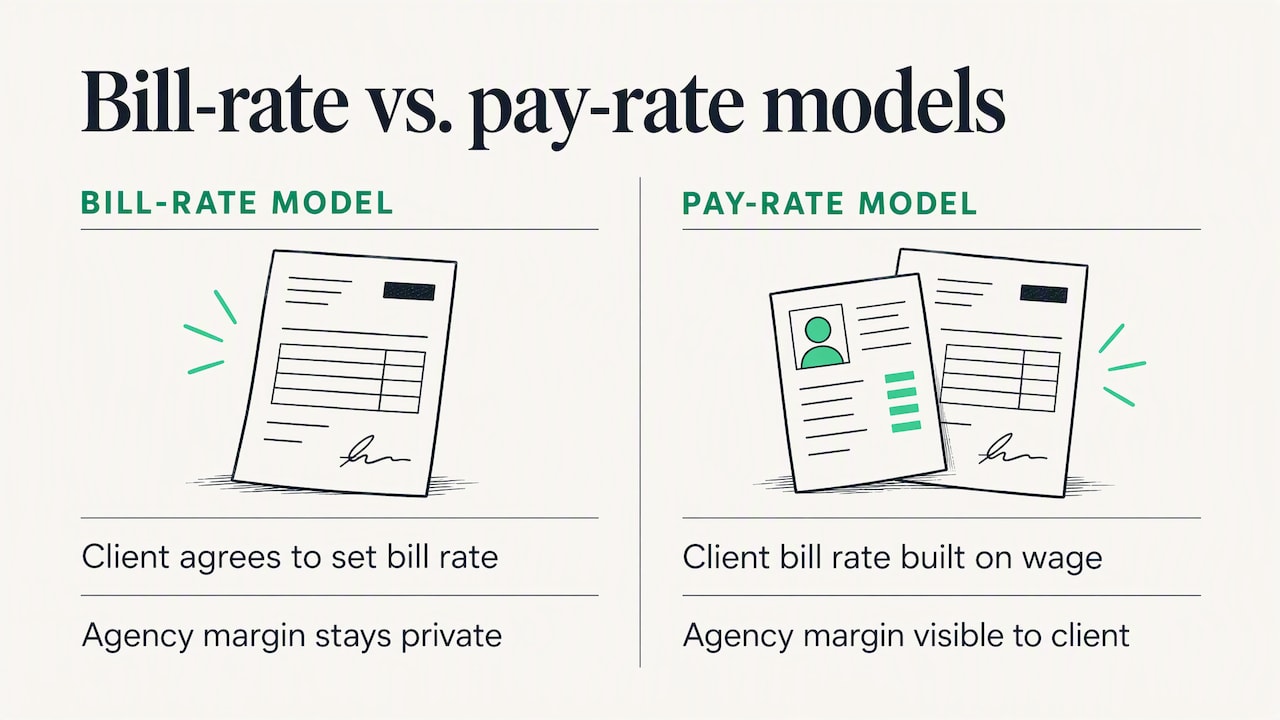
The worker’s wage is set first, and the bill rate is derived by adding components or a percentage. Per the SAP Fieldglass guidance, in bill-rate-based models the client agrees to a set bill rate and the agency’s internal margins stay private, whereas in pay-rate-based models the wage is defined first and the bill rate is built on top of it. That structure is often used where worker pay compliance and transparency requirements are strict, and it makes the agency’s margin visible to the client.
Which one fits which segment
Staffing Industry Analysts reports that a common misconception is that one rate card methodology fits every segment. Successful programs often combine approaches: markups for lower-skill categories such as light industrial, where agency profitability needs protecting, and maximum rate cards for high-demand specialized categories such as IT, where a standardized price reflects market value.
Segment | Common structure | Why |
|---|---|---|
Light industrial, clerical | Pay rate plus markup | Wages are regulated and similar across candidates, so the margin is the variable |
IT, engineering, finance | Fixed or maximum bill rate by level | Individual pay varies widely, so the client controls total cost |
Healthcare, travel nursing | Bill rate by specialty and geography | Rates move with local demand and shift pressure |
Executive or niche projects | Negotiated, often outside the card | Too few comparable placements to standardize |
How to build a rate card step by step
Define the role taxonomy. Group roles into families a hiring manager recognizes. Ten to thirty rows is workable. Hundreds of rows become unmanageable.
Collect your actual data. Pull pay rates, bill rates and gross margin from the last 12 months of placements. Your own history is the best baseline.
Benchmark against the market. Compare against published indexes. For instance, KORE1’s 2026 Contract Rate Index lists hourly bill rates for 22 roles by level and metro in IT, ERP and finance, and its figures put a mid-level software engineer’s median bill rate at $108 per hour. Treat any index as a reference point, not a price, since your market and skill mix differ.
Calculate the burden per classification. Employer taxes, workers’ compensation and insurance differ by state and role, so one burden figure for the whole card hides losses.
Set the margin floor. Decide the minimum gross margin per hour you will accept, expressed on the bill rate, and the discount authority a recruiter has.
Add the rules. Overtime multipliers, holiday premiums, minimum assignment lengths, conversion fees and payment terms belong on the card, not in side emails.
Set a review date. Print the validity period on the document.
Why rate cards need regular review
A card is a snapshot of supply, demand and wage inflation on the day it was signed. Current industry guidance recommends reviewing market rate cards at least quarterly or twice a year, so that pricing stays competitive and vendors are evaluated consistently. Rates can move quickly in either direction. In travel nursing, for example, Staffing Industry Analysts found that the average bill rate fell from $106.63 in 2023 to $89.78 in 2024. A card written at the 2023 peak would have been far above the market a year later.
A practical review covers four questions:
Which roles consistently close below the card, and which above it?
Where is the realized margin below the floor?
Which roles had open requisitions that went unfilled because the ceiling was too low?
Have statutory costs changed, for example payroll tax thresholds or state insurance rates?
Rate card management in practice
Most agencies start with a spreadsheet. It works for a handful of clients and breaks as soon as there are several cards, several markups per client and rates that change mid-contract. The typical symptoms are familiar: a recruiter quotes last year’s rate, an invoice uses the wrong overtime multiplier, or finance cannot say which placements missed the margin floor until month end.
Good rate card management comes down to four disciplines:
One source of truth. Rates live in one system, linked to the client record and the contract, not in a file on someone’s desktop.
Version control. Every change has an effective date, so an invoice can always be reconciled with the card that applied on the day the work was done.
Margin visibility at the point of decision. The recruiter sees the pay rate, the burden and the resulting margin before a candidate is submitted, not afterward.
Reporting by client, role and recruiter. Reviews are only as good as the data behind them.
In an IT contracting business there is an additional point. The rate agreed with the client, the rate agreed with the contractor and the contract documents all have to match. We cover that link in our article on keeping candidates, clients, contracts and compliance in one place.
Our perspective: rates should live next to the pipeline
We build Recruitify for IT recruitment agencies, headhunters and contracting companies, and the pattern we see most often is that pricing sits outside the recruitment process. The candidate is in the ATS, the client conversation is in a CRM or an inbox, and the rate is in a spreadsheet. Each handoff is a chance for the number to change without anyone noticing.
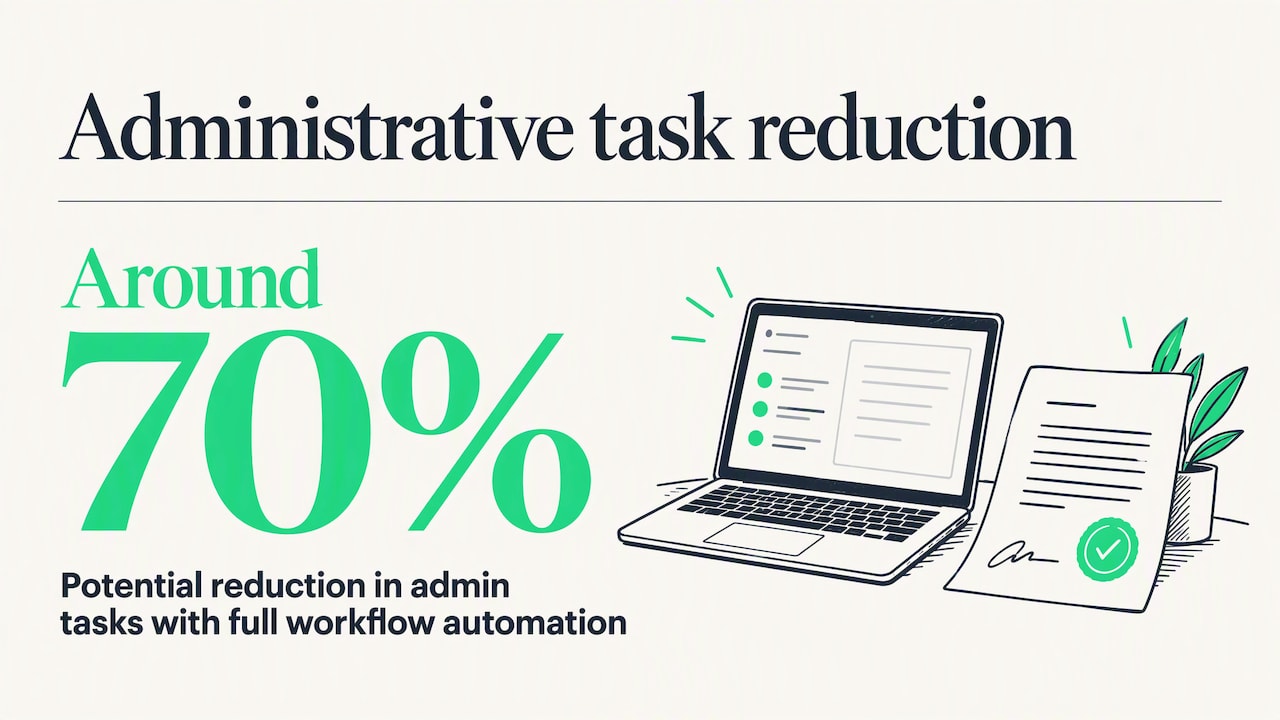
Our view is that a rate card is only as reliable as the system that connects it to the people and contracts it governs. That is why we combine an ATS, a sales CRM and a contracting module in one platform: the sales pipeline and the recruitment pipeline share the same client record, so the rate agreed during business development is the rate that appears when a contractor is placed. Administrative work such as generating B2B contracts can then be automated rather than retyped, which is where our customers see the largest time savings. We describe the potential reduction in administrative tasks at around 70% for agencies that automate the full workflow, from first contact to contract.
We also think margin analysis should be routine rather than a quarterly project. When revenue and margin are visible by client and role, the review of a rate card becomes a short conversation based on data. We would add one caution of our own: software does not set the right rate for you. It makes the rate you chose consistent, visible and auditable, and the choice itself still depends on knowing your market.
- Recruitify Team
Where Recruitify fits
If you run an agency that places IT contractors, the relevant parts of the platform are contracting and body leasing, the agency CRM, and sales reports that analyze margins and revenue. Teams that focus on IT can see how this is set up in the IT body leasing solution, and agencies working with shorter assignments can look at the temporary staffing agency software. For a worked example from a real customer, read how an IT company streamlined staffing and collaboration with contractors.
Published plans are priced per user: HR Team is €61 per month per user and Agency is €67 per month per user, while Enterprise is quoted individually. You can compare them on the pricing page.
Common rate card mistakes
Mixing up markup and margin. As the worked example showed, a 40% markup yields a 20% margin on the bill rate.
One burden figure for every role. Workers’ compensation and unemployment costs differ by classification and state.
No review date. Cards without an expiry quietly turn into legacy contracts.
Ceilings set below the market. The result is not savings but empty shortlists.
Uncontrolled exceptions. Every discount granted by a recruiter that is not recorded makes the next review less reliable.
Forgetting conversion terms. If a client can hire your contractor directly, the fee and the timing of conversion should be on the card.
FAQ
What is the purpose of a rate card in staffing?
Its purpose is to fix the price of each role before the search starts. Clients gain predictable costs and faster approvals, and agencies gain a consistent, defensible margin across recruiters. It also gives both sides a neutral basis for review when the market moves.
What is the difference between a bill rate and a pay rate?
The pay rate is the hourly wage the worker receives. The bill rate is the hourly amount the client is charged, and it covers the pay rate plus employer taxes, operating costs and profit. The bill rate is therefore always higher than the pay rate.
How much do staffing agencies charge per hour?
It depends on the role, the location and the pricing model, so there is no single figure. Published guidance puts temporary staffing markups between 20% and 75% on the pay rate, with specialized roles at the high end. For IT roles, a benchmark such as the KORE1 index above gives a median by level and metro to compare against.
How often should a rate card be reviewed?
At least quarterly or twice a year, according to current industry guidance. Review sooner when a skill category suddenly becomes hard to fill, or when payroll costs change.
Sources
Rate card methodology: Time to review (Staffing Industry Analysts)
SIA NATHO Travel Nurse Benchmarking Survey: Selected Findings 2025
Calculate How To Price Your Staffing Services (Advance Partners)
The changing temporary work force (Bureau of Labor Statistics)
Recommended
60 - 90 Day Pilot to Turn Hiring Signals Into Staffing Lead Generation
2026 ATS Pricing: Monthly & Year 1 Costs for Small to Enterprise Buyers
44 Day Benchmark: Time to Hire Targets and 90 Day Plan for Recruiters


News & Updates
Stay up-to-date with the latest innovations, features, and tips about Recruitify!
By providing your email address within the newsletter sign-up form, you confirm its processing to send marketing information regarding the Administrator’s products and services. The Administrator of your personal data processed for the abovementioned purposes is Recruitify Spółka z o.o., based in Warsaw, Poland (KRS 0000709889). For more information on the principles of personal data processing and the rights of data subjects, please check the Privacy Policy.

Last updated:
Rate Card Staffing: How to Build, Price and Manage One
Recruitment Process
The Recruitify Team
A staffing rate card is a table of pre-agreed rates for each role a client buys through an agency, usually broken down by skill, seniority and location. It replaces a fresh price negotiation for every requisition with one reference document, so the client gets cost predictability and the agency gets a defensible margin. This guide explains what a rate card contains, how a bill rate is derived from a pay rate, which methodology fits which segment, and how to keep the card accurate once it is in use.
Key takeaways
A rate card lists approved pay rates, bill rates or maximum bill rates per role, and often markups, overtime rules and conversion fees.
The bill rate is what the client pays per hour. The pay rate is the wage the worker receives. The gap between them must cover payroll costs, overhead and profit.
No single methodology fits every segment: markup-based cards tend to suit lower-skill work, while maximum bill rates tend to suit specialized categories such as IT.
Rate cards go stale. Review them at least quarterly or twice a year, and track the margin on each placement against the card.
Spreadsheets break down once rates, contracts and margins live in different files, which is where an integrated ATS, CRM and contracting system helps.
Table of Contents
What a staffing rate card is and what it contains
A rate card is a standardized price list for contingent labor. The client company, or the agency selling to it, agrees on the hourly figure for each role before any candidate is presented. When a hiring manager needs a mid-level developer or a senior business analyst, the price is already known.
A complete card normally includes the following columns:
Role or job family, for example software engineer, QA analyst, ERP consultant or project manager.
Level, typically junior, mid, senior and lead.
Location or market tier, because the same role costs more in San Francisco than in Omaha.
Rate type: a fixed bill rate, a maximum bill rate (a ceiling), or a pay rate plus a markup.
Overtime and holiday rules, including whether the premium applies to the pay rate, the bill rate or both.
Conversion fee, the charge if the client hires the contractor directly.
Validity period, so both sides know when the card is due for review.
Some clients treat the card as a pure price list. It is more useful to see it as a risk-control tool: standardizing rates by skill set and experience level gives client companies cost predictability, while the agency can still scale labor up or down without the commitments of permanent hiring. For the agency, the same document protects against two failure modes: underpricing a scarce skill and losing money, or overpricing a commodity role and losing the account.
Bill rate vs. pay rate: the arithmetic behind every line
Every row on a rate card rests on the relationship between two numbers. The pay rate is what the worker earns per hour. According to Deltek, the bill rate is the total hourly charge to the client, and it equals the pay rate plus operating costs, legally mandated costs and profit margin. The same source expresses this more simply as the pay rate multiplied by one plus the markup percentage.
What sits between the two numbers
The difference is not profit. Much of it is cost the agency carries for every hour worked:
Employer payroll taxes. In 2026 the combined FICA rate is 7.65%, split between employer and employee: 6.2% for Social Security up to the wage base and 1.45% for Medicare. The employer pays a matching share on every W-2 worker.
Other statutory costs, such as unemployment insurance and workers’ compensation, which vary by state and by job classification.
Benefits and insurance, where the agency offers them or the law requires them.
Overhead: recruiter salaries, software, sourcing costs, back-office payroll and collections.
Margin, the amount left for the business.
The SAP Fieldglass learning materials describe the same logic as an equation: pay rate plus rate components equals bill rate. Each component can be tracked separately, which is how large vendor management systems keep invoicing consistent.
A worked example
The figures below are illustrative, not benchmarks. Suppose an agency places a W-2 contractor at a pay rate of $50 per hour.
Line | Hourly amount | Note |
|---|---|---|
Pay rate | $50.00 | Wage paid to the worker |
Statutory and insurance burden at 12% | $6.00 | Assumed rate, includes the 7.65% employer FICA share |
Total direct cost | $56.00 | What the hour costs before overhead |
Target gross profit | $14.00 | Covers overhead and net profit |
Bill rate | $70.00 | What the client is charged |
Here the markup on the pay rate is 40% ($20 divided by $50), but the gross margin on the bill rate is 20% ($14 divided by $70). Confusing the two is one of the most common pricing errors. A 40% markup does not produce a 40% margin, and an agency that promises a margin target needs to calculate it from the bill rate, not the pay rate.
The spread varies widely. One industry pricing guide puts temporary staffing markups anywhere between 20% and 75%, and the Deltek article similarly notes that specialized temporary roles can reach markups as high as 75%, whereas permanent placement fees typically hover around 20% of first-year salary. Historical data shows the principle is not new: in 1996 temporary workers received about 72 percent of the billable rate, according to the Bureau of Labor Statistics.
Three ways to structure a rate card
The structure you choose determines who carries the pricing risk and how transparent the agency’s margin is.
Fixed bill rate (rate card model)
The client pays one hourly figure for a defined role category, regardless of what the individual worker is paid. This is simple to administer and easy to budget. The agency keeps the difference when it recruits below the card and absorbs the loss when it has to pay above it. This model rewards agencies that know their candidate pool and their true cost per placement.
Maximum bill rate (ceiling)
The card sets the highest rate the client will pay. The agency can bill less, never more. Ceilings are common in vendor-managed programs where a client wants to cap cost without fixing it. They work best when the market for the skill is well understood, because a ceiling set below market simply means qualified candidates are not submitted.
Pay rate plus markup
The worker’s wage is set first, and the bill rate is derived by adding components or a percentage. Per the SAP Fieldglass guidance, in bill-rate-based models the client agrees to a set bill rate and the agency’s internal margins stay private, whereas in pay-rate-based models the wage is defined first and the bill rate is built on top of it. That structure is often used where worker pay compliance and transparency requirements are strict, and it makes the agency’s margin visible to the client.
Which one fits which segment
Staffing Industry Analysts reports that a common misconception is that one rate card methodology fits every segment. Successful programs often combine approaches: markups for lower-skill categories such as light industrial, where agency profitability needs protecting, and maximum rate cards for high-demand specialized categories such as IT, where a standardized price reflects market value.
Segment | Common structure | Why |
|---|---|---|
Light industrial, clerical | Pay rate plus markup | Wages are regulated and similar across candidates, so the margin is the variable |
IT, engineering, finance | Fixed or maximum bill rate by level | Individual pay varies widely, so the client controls total cost |
Healthcare, travel nursing | Bill rate by specialty and geography | Rates move with local demand and shift pressure |
Executive or niche projects | Negotiated, often outside the card | Too few comparable placements to standardize |
How to build a rate card step by step
Define the role taxonomy. Group roles into families a hiring manager recognizes. Ten to thirty rows is workable. Hundreds of rows become unmanageable.
Collect your actual data. Pull pay rates, bill rates and gross margin from the last 12 months of placements. Your own history is the best baseline.
Benchmark against the market. Compare against published indexes. For instance, KORE1’s 2026 Contract Rate Index lists hourly bill rates for 22 roles by level and metro in IT, ERP and finance, and its figures put a mid-level software engineer’s median bill rate at $108 per hour. Treat any index as a reference point, not a price, since your market and skill mix differ.
Calculate the burden per classification. Employer taxes, workers’ compensation and insurance differ by state and role, so one burden figure for the whole card hides losses.
Set the margin floor. Decide the minimum gross margin per hour you will accept, expressed on the bill rate, and the discount authority a recruiter has.
Add the rules. Overtime multipliers, holiday premiums, minimum assignment lengths, conversion fees and payment terms belong on the card, not in side emails.
Set a review date. Print the validity period on the document.
Why rate cards need regular review
A card is a snapshot of supply, demand and wage inflation on the day it was signed. Current industry guidance recommends reviewing market rate cards at least quarterly or twice a year, so that pricing stays competitive and vendors are evaluated consistently. Rates can move quickly in either direction. In travel nursing, for example, Staffing Industry Analysts found that the average bill rate fell from $106.63 in 2023 to $89.78 in 2024. A card written at the 2023 peak would have been far above the market a year later.
A practical review covers four questions:
Which roles consistently close below the card, and which above it?
Where is the realized margin below the floor?
Which roles had open requisitions that went unfilled because the ceiling was too low?
Have statutory costs changed, for example payroll tax thresholds or state insurance rates?
Rate card management in practice
Most agencies start with a spreadsheet. It works for a handful of clients and breaks as soon as there are several cards, several markups per client and rates that change mid-contract. The typical symptoms are familiar: a recruiter quotes last year’s rate, an invoice uses the wrong overtime multiplier, or finance cannot say which placements missed the margin floor until month end.
Good rate card management comes down to four disciplines:
One source of truth. Rates live in one system, linked to the client record and the contract, not in a file on someone’s desktop.
Version control. Every change has an effective date, so an invoice can always be reconciled with the card that applied on the day the work was done.
Margin visibility at the point of decision. The recruiter sees the pay rate, the burden and the resulting margin before a candidate is submitted, not afterward.
Reporting by client, role and recruiter. Reviews are only as good as the data behind them.
In an IT contracting business there is an additional point. The rate agreed with the client, the rate agreed with the contractor and the contract documents all have to match. We cover that link in our article on keeping candidates, clients, contracts and compliance in one place.
Our perspective: rates should live next to the pipeline
We build Recruitify for IT recruitment agencies, headhunters and contracting companies, and the pattern we see most often is that pricing sits outside the recruitment process. The candidate is in the ATS, the client conversation is in a CRM or an inbox, and the rate is in a spreadsheet. Each handoff is a chance for the number to change without anyone noticing.
Our view is that a rate card is only as reliable as the system that connects it to the people and contracts it governs. That is why we combine an ATS, a sales CRM and a contracting module in one platform: the sales pipeline and the recruitment pipeline share the same client record, so the rate agreed during business development is the rate that appears when a contractor is placed. Administrative work such as generating B2B contracts can then be automated rather than retyped, which is where our customers see the largest time savings. We describe the potential reduction in administrative tasks at around 70% for agencies that automate the full workflow, from first contact to contract.
We also think margin analysis should be routine rather than a quarterly project. When revenue and margin are visible by client and role, the review of a rate card becomes a short conversation based on data. We would add one caution of our own: software does not set the right rate for you. It makes the rate you chose consistent, visible and auditable, and the choice itself still depends on knowing your market.
- Recruitify Team
Where Recruitify fits
If you run an agency that places IT contractors, the relevant parts of the platform are contracting and body leasing, the agency CRM, and sales reports that analyze margins and revenue. Teams that focus on IT can see how this is set up in the IT body leasing solution, and agencies working with shorter assignments can look at the temporary staffing agency software. For a worked example from a real customer, read how an IT company streamlined staffing and collaboration with contractors.
Published plans are priced per user: HR Team is €61 per month per user and Agency is €67 per month per user, while Enterprise is quoted individually. You can compare them on the pricing page.
Common rate card mistakes
Mixing up markup and margin. As the worked example showed, a 40% markup yields a 20% margin on the bill rate.
One burden figure for every role. Workers’ compensation and unemployment costs differ by classification and state.
No review date. Cards without an expiry quietly turn into legacy contracts.
Ceilings set below the market. The result is not savings but empty shortlists.
Uncontrolled exceptions. Every discount granted by a recruiter that is not recorded makes the next review less reliable.
Forgetting conversion terms. If a client can hire your contractor directly, the fee and the timing of conversion should be on the card.
FAQ
What is the purpose of a rate card in staffing?
Its purpose is to fix the price of each role before the search starts. Clients gain predictable costs and faster approvals, and agencies gain a consistent, defensible margin across recruiters. It also gives both sides a neutral basis for review when the market moves.
What is the difference between a bill rate and a pay rate?
The pay rate is the hourly wage the worker receives. The bill rate is the hourly amount the client is charged, and it covers the pay rate plus employer taxes, operating costs and profit. The bill rate is therefore always higher than the pay rate.
How much do staffing agencies charge per hour?
It depends on the role, the location and the pricing model, so there is no single figure. Published guidance puts temporary staffing markups between 20% and 75% on the pay rate, with specialized roles at the high end. For IT roles, a benchmark such as the KORE1 index above gives a median by level and metro to compare against.
How often should a rate card be reviewed?
At least quarterly or twice a year, according to current industry guidance. Review sooner when a skill category suddenly becomes hard to fill, or when payroll costs change.
Sources
Rate card methodology: Time to review (Staffing Industry Analysts)
SIA NATHO Travel Nurse Benchmarking Survey: Selected Findings 2025
Calculate How To Price Your Staffing Services (Advance Partners)
The changing temporary work force (Bureau of Labor Statistics)
Recommended
60 - 90 Day Pilot to Turn Hiring Signals Into Staffing Lead Generation
2026 ATS Pricing: Monthly & Year 1 Costs for Small to Enterprise Buyers
44 Day Benchmark: Time to Hire Targets and 90 Day Plan for Recruiters
News & Updates
Stay up-to-date with the latest innovations, features, and tips about Recruitify!
By providing your email address within the newsletter sign-up form, you confirm its processing to send marketing information regarding the Administrator’s products and services. The Administrator of your personal data processed for the abovementioned purposes is Recruitify Spółka z o.o., based in Warsaw, Poland (KRS 0000709889). For more information on the principles of personal data processing and the rights of data subjects, please check the Privacy Policy.

Discover More

Innovations
Application Conversion Rate: Formula, Benchmarks, Fixes
Application conversion rate explained for recruiters: the formula, stage-by-stage math, real benchmarks, and the fixes that move the number. Includes app-store rates.
24 Oct 2026
Discover More

Recruitment Process
GDPR-Compliant Analytics for Recruitment Teams
What makes analytics GDPR compliant, from cookies to candidate data: a practical framework for recruitment agencies and HR teams, including US firms hiring in the EU.
23 Oct 2026
Discover More

Applicant Tracking System
EU AI Act and Recruitment: What Hiring Teams Must Do
How the EU AI Act treats recruitment AI: high-risk rules, the December 2027 deadline, deployer duties, US reach and a practical checklist for agencies.
22 Oct 2026
Discover More
Innovations
Application Conversion Rate: Formula, Benchmarks, Fixes
Application conversion rate explained for recruiters: the formula, stage-by-stage math, real benchmarks, and the fixes that move the number. Includes app-store rates.
24 Oct 2026
Discover More
Recruitment Process
GDPR-Compliant Analytics for Recruitment Teams
What makes analytics GDPR compliant, from cookies to candidate data: a practical framework for recruitment agencies and HR teams, including US firms hiring in the EU.
23 Oct 2026
Discover More