
Last updated:
5x faster: step-by-step job description generation for agencies and HR

Acquiring Talent

The Recruitify Team
Generating job postings in an ATS means creating a single advertisement template that the system automatically publishes and synchronises across your chosen channels. Instead of copying and pasting the exact same text into ten different forms on ten job boards, a recruiter fills in dynamic fields just once, and the platform distributes the content instantly. The result? Drastically reduced administrative work and an absolutely consistent message wherever your vacancy appears. Recruitify is designed to perfect this very mechanism, seamlessly combining templates, multiposting, and GDPR compliance within a single, intuitive dashboard.
In short:
Automated job post generation in an ATS allows you to fill in dynamic fields once and publish across multiple channels, eliminating repetitive manual work.
Multiposting systems handle integrations with job boards, social media, and career pages, saving hours of work and eliminating human error.
Key features include scheduling, reporting, GDPR compliance, and the ability to create separate templates for different industries and candidate personas.
Automation minimises mistakes, automatically archives outdated listings, and allows you to accurately measure the performance of your recruitment campaigns.
If you are publishing more than a few vacancies a month, adopting these solutions is essential to boost efficiency and slash time spent on repetitive tasks.
Table of Contents
What exactly does job post generation in an ATS involve?
Key features of effective job generation and publishing
How to configure job generation in your ATS step-by-step
Which metrics to track to optimise your job postings
Case study: The impact of job posting automation with Recruitify
Best practices for creating attractive and clear job advertisements
How to tailor job postings to your target candidate persona
Key components and the structure of a high-converting job posting
Tips on language and style for your job ads
Common job posting mistakes and how to avoid them
The Recruitify Team perspective: When does automation deliver the highest ROI?
Recruitify: Streamline your job post generation without the repetitive manual hassle
Sources
What exactly does job post generation in an ATS involve?
A job posting template is the structural backbone of an advert, featuring dynamic fields (merge tags) in sections that change from vacancy to vacancy: job title, location, salary range, and client name. The recruiter simply fills in these fields once, and the system automatically generates the final, polished copy.
Multiposting then maps these fields to the specific formats required by various job boards and publishes the listing simultaneously across multiple channels from a single hub. Modern ATS platforms offer automated publishing, templates, and application forms, removing the need to manually copy content between websites. Your listing goes live on your careers page, job boards, and social media channels all at once.
Furthermore, application forms must include clear, GDPR-compliant consent clauses for processing personal data, complete with opt-out options and clear information regarding data retention periods.
Key features of effective job generation and publishing
Not every ATS handles job generation equally well. Before choosing a platform, ensure it offers these essential capabilities:
Multiposting with native integrations — simultaneous publishing to LinkedIn, Facebook, career sites, and niche job boards without logging into each platform separately.
Templates with dynamic fields — merge tags for job titles, locations, salary brackets, benefits, and client details.
Scheduling and archiving — automated expiry dates for listings and synchronised content editing across all channels at once.
GDPR-compliant forms — fully customisable consent checkboxes, privacy policy links, and retention terms.
Source tracking and A/B testing — easily compare the performance of different job titles or descriptions.
Automated job publishing allows you to synchronise content across multiple channels and archive expired listings without any extra effort from your team. This means a single edit updates every single live copy of the job ad instantly.
Pro Tip: Before purchasing, verify whether the system allows you to build distinct templates for different sectors (e.g., IT, manufacturing, sales) — a one-size-fits-all template rarely works across diverse industries.
How to configure job generation in your ATS step-by-step
Setting up automated job generation is not a "set-and-forget" task. It requires a structured, logical approach to maximise its potential:
Define your required fields — job title, location, contract type, salary range, benefits, recruiter contact info, and GDPR consent clauses.
Build your base template — insert dynamic merge tags where details change with each role, and keep standard elements (company mission, core benefits) as static text.
Configure multiposting channels — connect your recruitment agency’s job board accounts and social media profiles, then run a test to check field mapping.
Establish an approval workflow — define who signs off on the content before it goes live and set the posting duration.
Publish a test post — preview the job listing, verify how it renders on different job boards, and only then hit publish.
Set up automated archiving — configure triggers that notify your team when a role is filled and automatically take down the listing from all platforms.
This efficient workflow can be replicated for every new role, changing only the dynamic details. Learn more about leveraging automation in your daily sourcing routines in our guide to saving time with recruitment automation.
Which metrics to track to optimise your job postings
Automating your job distribution is only valuable if it drives measurable commercial results. Here are four key performance indicators (KPIs) you should track from day one:
Time-to-publish — the quicker you can get a vacancy live, the faster you can deliver candidates to your clients.
Applications per channel — clearly shows which job boards actually deliver candidates and which ones are just draining your budget.
Qualified candidate rate — measures the quality, not just the volume, of incoming CVs.
Cost-per-application and Cost-per-hire — allows you to compare the profitability and ROI of each advertising channel.
Tagging your application links with UTM parameters allows you to precisely attribute every single application to a specific channel and version of an advert. Industry leaders also recommend A/B testing different job titles and benefit packages instead of guessing what will attract top talent.
Key Statistic: Multiposting can significantly reduce your job publishing time by eliminating the tedious process of manual copying. To calculate your agency's potential savings, simply multiply the number of jobs you publish monthly by the time it takes to post on one site, and then by the number of channels you use. We break down the exact formula for measuring your returns in our ATS ROI implementation analysis.
Case study: The impact of job posting automation with Recruitify
A growing recruitment agency partnering with Recruitify implemented multiposting, standardised templates, and a shared talent pool to eliminate time wasted on repetitive manual job advertising. Previously, every single vacancy had to be manually posted across multiple job boards, with expiration dates tracked on spreadsheets.
Following implementation, their recruitment workflow accelerated up to five times, and the number of candidates presented to clients increased by 40%. This was achieved by combining automated publishing with an instantly accessible candidate database. The talent pool proved to be a game-changer: several new vacancies were filled using candidates already in their system, completely eliminating the cost and time of publishing new job ads. Read the full success story in our Recruitify case study.
Best practices for creating attractive and clear job advertisements
A highly effective job advertisement answers three critical questions in the first three seconds: What will I be doing? How much will I earn? Why is this company better than my current employer? The job title must be clear and searchable, not overly creative. "Marketing Specialist" will attract far more qualified candidates than "Marketing Guru".
Disclosing salary ranges in your job descriptions shortens your hiring funnel by filtering out candidates whose expectations exceed your client's budget before they even apply. Agencies that publish salary brackets consistently report fewer drop-outs during the salary negotiation stage.
The structure of your listing should guide the reader seamlessly: start with a brief introduction of the company and team culture, outline the core responsibilities, list the requirements split into "must-haves" and "nice-to-haves", and close with benefits and the hiring process. Candidates scan text rather than reading it line-by-line, which is why bold headings and bullet points are far more effective than heavy paragraphs.
Avoid listing twenty different requirements, half of which are irrelevant to daily operations. Statistically, every additional requirement on your list reduces your application rate, as qualified candidates self-select out if they miss even one point. Keep your list focused on five or six genuinely critical competencies.
How to tailor job postings to your target candidate persona
An advert targeting a Senior Software Engineer requires a completely different tone, channel selection, and value proposition compared to a posting for a warehouse operative. Specialist candidates look for technical details: tech stacks, methodologies, and team structures. Operational and hourly-rate candidates value concrete details: working hours, exact location, contract type, and precise pay rates rather than vague ranges.

The tone of communication should match the audience. A listing for a tech startup can be informal, engaging, and direct from the very first sentence. Conversely, a role within a financial corporation demands a more professional tone, though it must remain engaging and free of dry corporate jargon.
Your choice of distribution channel must align with where your target audience actively spends time. Software engineers rarely browse general job boards; they are far more likely to be reached through tech-specific platforms, professional networks, or industry groups. Blue-collar and operational staff, on the other hand, rely heavily on major local job portals and social media groups.
An ATS with robust multiposting allows you to create variations of the same job description for different platforms without duplicating your workload. Dynamic fields can easily swap out the tone or the highlighted benefits depending on the target audience, whilst keeping the master template intact. This is the difference between a listing that gets read to the end and one that is scrolled past immediately.
Key components and the structure of a high-converting job posting
A high-converting job advert typically consists of seven key components arranged in a logical sequence. Deviating from this proven structure often leads to a drop in application rates.
Start with a searchable Job Title that candidates actually type into search bars. Follow this with a brief company and team introduction (three to four sentences maximum, avoiding lengthy corporate histories). The third element is the key responsibilities, described as active, everyday tasks rather than abstract strategic goals. Fourth are the requirements, clearly separated into essential and desirable. Fifth are the employment terms: contract type, compensation, location, and whether the role is remote, hybrid, or on-site. Sixth are the benefits, listed in order of genuine value to the candidate. Finally, outline the recruitment process: the number of stages, expected timeline, and contact information.
Job Advert Component | Role in the Posting |
|---|---|
Job Title | Search engine and job board visibility |
Company Description | Employer brand context and credibility |
Key Responsibilities | A realistic preview of daily tasks |
Requirements | Candidate filter (must-haves vs. nice-to-haves) |
Employment Terms | Hard decision-making criteria: salary, contract type |
Benefits & Perks | Value propositions that differentiate you from competitors |
Hiring Process | Managing candidate expectations and building trust |
Utilising an ATS template with dynamic fields for each of these sections ensures your agency maintains a consistent, premium brand image across all live listings, regardless of which consultant creates them.
Tips on language and style for your job ads
The language of your job advert should be direct, engaging, and completely free of corporate cliché. Terms like "fast-paced environment" or "wearer of many hats" offer zero value to candidates and take up valuable space that should be used for real, enticing details.
Keep your sentences short and write in the active voice. "You will manage client relations" reads much better and is far more engaging than "Responsibility for client relations will be held by this individual." The active voice instantly connects with readers and speeds up reading time.
Addressing the candidate directly using "you" helps build an immediate personal connection, making them feel like the ad was written specifically for them rather than an anonymous crowd. Be sure to avoid internal company acronyms and jargon that make perfect sense to current employees but are completely confusing to external candidates.
Numbers and hard data always outperform vague adjectives. "A team of ten specialists" is far more compelling than "a small, close-knit team." "An annual advertising budget of £2 million" is infinitely more impressive than "a large marketing budget." Concrete facts help candidates visualise the scale and scope of the challenge.
Length is also a critical factor. A wall of text that takes ages to scroll through will cause candidates to bounce before they ever reach your call to action or salary details. Aim for a concise, punchy layout that fits onto one or two pages if printed, with clear section headers and bullet points for easy scanning.
Common job posting mistakes and how to avoid them
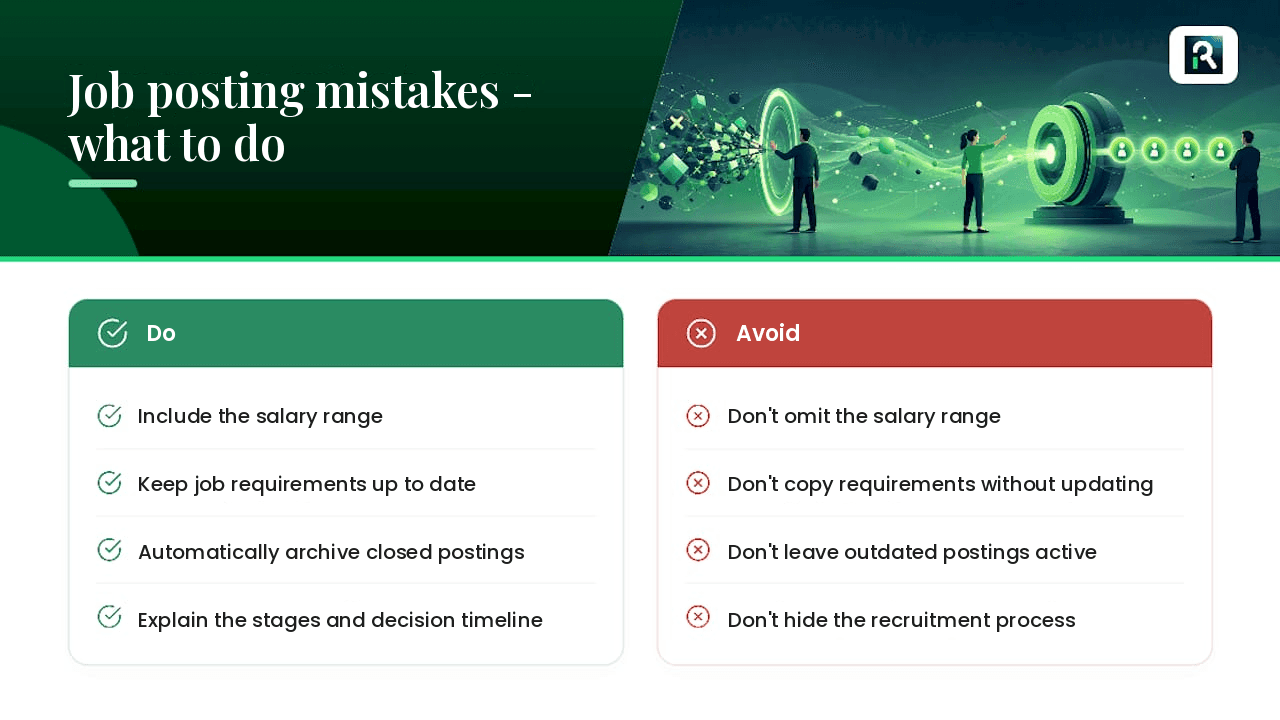
The single biggest mistake recruitment teams make is hiding the salary. Top candidates increasingly ignore listings that do not offer salary transparency, viewing the omission as a red flag that the company pays below market rate.
The second mistake is using outdated requirements copied from old job specs without aligning them with the current demands of the role. This often leads to agencies accidentally filtering out excellent talent over skills they would never actually use on the job.
The third mistake is leaving filled jobs active on external boards. A candidate who applies for a role that has already been closed feels ignored, which actively damages your agency's reputation and candidate experience. Automated archiving via your ATS resolves this issue instantly, removing filled roles across all platforms in one click.
Fourth is failing to outline the recruitment process. When candidates are left in the dark about the number of interview stages or the expected timeline, they are far more likely to drop out of your pipeline to accept faster, more transparent offers from competitors.
The fifth mistake is publishing identical descriptions on every single channel without adjusting them for the platform's audience. A post that performs brilliantly on LinkedIn might require a shorter, sharper version for a general job board. Recruitment automation experts highlight that while multiposting saves valuable time, its real power lies in combining it with well-designed templates and integrated GDPR compliance at the application stage.
The Recruitify Team perspective: When does automation deliver the highest ROI?
Automating your job posting workflow delivers its highest return on investment for recruitment teams that regularly publish several jobs a month across multiple external channels. If you only hire sporadically, manual posting might suffice; however, for active agencies, automation is a necessity.
The most common pitfall is viewing automation as a complete replacement for your sourcing strategy. While multiposting distributes your roles faster, it works best when paired with a robust talent pool and an advanced CRM. These tools ensure you build lasting candidate relationships, enabling you to fill future roles from your existing pipeline rather than paying to advertise every single vacancy.
— Recruitify Team
Recruitify: Streamline your job post generation without the repetitive manual hassle
Recruitify eliminates the most tedious, non-billable hours of the recruitment cycle: manually copying job advertisements between job boards and trying to keep track of which listings are current. Our platform unites dynamic templates, multi-channel posting, and GDPR-compliant application forms in one powerful platform, enabling your recruiters to manage more open requirements while maintaining total control over content.
Furthermore, our native talent pool and CRM integration ensure that every job posting automatically grows your candidate database. This allows you to search and place candidates for future roles without spending a penny on new advertising. Over 250 forward-thinking companies rely on Recruitify, with agency clients achieving up to a 40% increase in candidate presentation rates. Explore our advanced sourcing features on our ATS candidate database page.
If your recruitment team regularly posts across multiple job boards, book a live demo of Recruitify today and discover how much time and budget you will save in your very first month.
Sources
Discover more about key ATS capabilities in our comprehensive guide to recruitment software and explore our dedicated Recruitify multiposting module.
Recommendations


News & Updates
Stay up-to-date with the latest innovations, features, and tips about Recruitify!
By providing your email address within the newsletter sign-up form, you confirm its processing to send marketing information regarding the Administrator’s products and services. The Administrator of your personal data processed for the abovementioned purposes is Recruitify Spółka z o.o., based in Warsaw, Poland (KRS 0000709889). For more information on the principles of personal data processing and the rights of data subjects, please check the Privacy Policy.

Last updated:
5x faster: step-by-step job description generation for agencies and HR
Acquiring Talent
The Recruitify Team
Generating job postings in an ATS means creating a single advertisement template that the system automatically publishes and synchronises across your chosen channels. Instead of copying and pasting the exact same text into ten different forms on ten job boards, a recruiter fills in dynamic fields just once, and the platform distributes the content instantly. The result? Drastically reduced administrative work and an absolutely consistent message wherever your vacancy appears. Recruitify is designed to perfect this very mechanism, seamlessly combining templates, multiposting, and GDPR compliance within a single, intuitive dashboard.
In short:
Automated job post generation in an ATS allows you to fill in dynamic fields once and publish across multiple channels, eliminating repetitive manual work.
Multiposting systems handle integrations with job boards, social media, and career pages, saving hours of work and eliminating human error.
Key features include scheduling, reporting, GDPR compliance, and the ability to create separate templates for different industries and candidate personas.
Automation minimises mistakes, automatically archives outdated listings, and allows you to accurately measure the performance of your recruitment campaigns.
If you are publishing more than a few vacancies a month, adopting these solutions is essential to boost efficiency and slash time spent on repetitive tasks.
Table of Contents
What exactly does job post generation in an ATS involve?
Key features of effective job generation and publishing
How to configure job generation in your ATS step-by-step
Which metrics to track to optimise your job postings
Case study: The impact of job posting automation with Recruitify
Best practices for creating attractive and clear job advertisements
How to tailor job postings to your target candidate persona
Key components and the structure of a high-converting job posting
Tips on language and style for your job ads
Common job posting mistakes and how to avoid them
The Recruitify Team perspective: When does automation deliver the highest ROI?
Recruitify: Streamline your job post generation without the repetitive manual hassle
Sources
What exactly does job post generation in an ATS involve?
A job posting template is the structural backbone of an advert, featuring dynamic fields (merge tags) in sections that change from vacancy to vacancy: job title, location, salary range, and client name. The recruiter simply fills in these fields once, and the system automatically generates the final, polished copy.
Multiposting then maps these fields to the specific formats required by various job boards and publishes the listing simultaneously across multiple channels from a single hub. Modern ATS platforms offer automated publishing, templates, and application forms, removing the need to manually copy content between websites. Your listing goes live on your careers page, job boards, and social media channels all at once.
Furthermore, application forms must include clear, GDPR-compliant consent clauses for processing personal data, complete with opt-out options and clear information regarding data retention periods.
Key features of effective job generation and publishing
Not every ATS handles job generation equally well. Before choosing a platform, ensure it offers these essential capabilities:
Multiposting with native integrations — simultaneous publishing to LinkedIn, Facebook, career sites, and niche job boards without logging into each platform separately.
Templates with dynamic fields — merge tags for job titles, locations, salary brackets, benefits, and client details.
Scheduling and archiving — automated expiry dates for listings and synchronised content editing across all channels at once.
GDPR-compliant forms — fully customisable consent checkboxes, privacy policy links, and retention terms.
Source tracking and A/B testing — easily compare the performance of different job titles or descriptions.
Automated job publishing allows you to synchronise content across multiple channels and archive expired listings without any extra effort from your team. This means a single edit updates every single live copy of the job ad instantly.
Pro Tip: Before purchasing, verify whether the system allows you to build distinct templates for different sectors (e.g., IT, manufacturing, sales) — a one-size-fits-all template rarely works across diverse industries.
How to configure job generation in your ATS step-by-step
Setting up automated job generation is not a "set-and-forget" task. It requires a structured, logical approach to maximise its potential:
Define your required fields — job title, location, contract type, salary range, benefits, recruiter contact info, and GDPR consent clauses.
Build your base template — insert dynamic merge tags where details change with each role, and keep standard elements (company mission, core benefits) as static text.
Configure multiposting channels — connect your recruitment agency’s job board accounts and social media profiles, then run a test to check field mapping.
Establish an approval workflow — define who signs off on the content before it goes live and set the posting duration.
Publish a test post — preview the job listing, verify how it renders on different job boards, and only then hit publish.
Set up automated archiving — configure triggers that notify your team when a role is filled and automatically take down the listing from all platforms.
This efficient workflow can be replicated for every new role, changing only the dynamic details. Learn more about leveraging automation in your daily sourcing routines in our guide to saving time with recruitment automation.
Which metrics to track to optimise your job postings
Automating your job distribution is only valuable if it drives measurable commercial results. Here are four key performance indicators (KPIs) you should track from day one:
Time-to-publish — the quicker you can get a vacancy live, the faster you can deliver candidates to your clients.
Applications per channel — clearly shows which job boards actually deliver candidates and which ones are just draining your budget.
Qualified candidate rate — measures the quality, not just the volume, of incoming CVs.
Cost-per-application and Cost-per-hire — allows you to compare the profitability and ROI of each advertising channel.
Tagging your application links with UTM parameters allows you to precisely attribute every single application to a specific channel and version of an advert. Industry leaders also recommend A/B testing different job titles and benefit packages instead of guessing what will attract top talent.
Key Statistic: Multiposting can significantly reduce your job publishing time by eliminating the tedious process of manual copying. To calculate your agency's potential savings, simply multiply the number of jobs you publish monthly by the time it takes to post on one site, and then by the number of channels you use. We break down the exact formula for measuring your returns in our ATS ROI implementation analysis.
Case study: The impact of job posting automation with Recruitify
A growing recruitment agency partnering with Recruitify implemented multiposting, standardised templates, and a shared talent pool to eliminate time wasted on repetitive manual job advertising. Previously, every single vacancy had to be manually posted across multiple job boards, with expiration dates tracked on spreadsheets.
Following implementation, their recruitment workflow accelerated up to five times, and the number of candidates presented to clients increased by 40%. This was achieved by combining automated publishing with an instantly accessible candidate database. The talent pool proved to be a game-changer: several new vacancies were filled using candidates already in their system, completely eliminating the cost and time of publishing new job ads. Read the full success story in our Recruitify case study.
Best practices for creating attractive and clear job advertisements
A highly effective job advertisement answers three critical questions in the first three seconds: What will I be doing? How much will I earn? Why is this company better than my current employer? The job title must be clear and searchable, not overly creative. "Marketing Specialist" will attract far more qualified candidates than "Marketing Guru".
Disclosing salary ranges in your job descriptions shortens your hiring funnel by filtering out candidates whose expectations exceed your client's budget before they even apply. Agencies that publish salary brackets consistently report fewer drop-outs during the salary negotiation stage.
The structure of your listing should guide the reader seamlessly: start with a brief introduction of the company and team culture, outline the core responsibilities, list the requirements split into "must-haves" and "nice-to-haves", and close with benefits and the hiring process. Candidates scan text rather than reading it line-by-line, which is why bold headings and bullet points are far more effective than heavy paragraphs.
Avoid listing twenty different requirements, half of which are irrelevant to daily operations. Statistically, every additional requirement on your list reduces your application rate, as qualified candidates self-select out if they miss even one point. Keep your list focused on five or six genuinely critical competencies.
How to tailor job postings to your target candidate persona
An advert targeting a Senior Software Engineer requires a completely different tone, channel selection, and value proposition compared to a posting for a warehouse operative. Specialist candidates look for technical details: tech stacks, methodologies, and team structures. Operational and hourly-rate candidates value concrete details: working hours, exact location, contract type, and precise pay rates rather than vague ranges.
The tone of communication should match the audience. A listing for a tech startup can be informal, engaging, and direct from the very first sentence. Conversely, a role within a financial corporation demands a more professional tone, though it must remain engaging and free of dry corporate jargon.
Your choice of distribution channel must align with where your target audience actively spends time. Software engineers rarely browse general job boards; they are far more likely to be reached through tech-specific platforms, professional networks, or industry groups. Blue-collar and operational staff, on the other hand, rely heavily on major local job portals and social media groups.
An ATS with robust multiposting allows you to create variations of the same job description for different platforms without duplicating your workload. Dynamic fields can easily swap out the tone or the highlighted benefits depending on the target audience, whilst keeping the master template intact. This is the difference between a listing that gets read to the end and one that is scrolled past immediately.
Key components and the structure of a high-converting job posting
A high-converting job advert typically consists of seven key components arranged in a logical sequence. Deviating from this proven structure often leads to a drop in application rates.
Start with a searchable Job Title that candidates actually type into search bars. Follow this with a brief company and team introduction (three to four sentences maximum, avoiding lengthy corporate histories). The third element is the key responsibilities, described as active, everyday tasks rather than abstract strategic goals. Fourth are the requirements, clearly separated into essential and desirable. Fifth are the employment terms: contract type, compensation, location, and whether the role is remote, hybrid, or on-site. Sixth are the benefits, listed in order of genuine value to the candidate. Finally, outline the recruitment process: the number of stages, expected timeline, and contact information.
Job Advert Component | Role in the Posting |
|---|---|
Job Title | Search engine and job board visibility |
Company Description | Employer brand context and credibility |
Key Responsibilities | A realistic preview of daily tasks |
Requirements | Candidate filter (must-haves vs. nice-to-haves) |
Employment Terms | Hard decision-making criteria: salary, contract type |
Benefits & Perks | Value propositions that differentiate you from competitors |
Hiring Process | Managing candidate expectations and building trust |
Utilising an ATS template with dynamic fields for each of these sections ensures your agency maintains a consistent, premium brand image across all live listings, regardless of which consultant creates them.
Tips on language and style for your job ads
The language of your job advert should be direct, engaging, and completely free of corporate cliché. Terms like "fast-paced environment" or "wearer of many hats" offer zero value to candidates and take up valuable space that should be used for real, enticing details.
Keep your sentences short and write in the active voice. "You will manage client relations" reads much better and is far more engaging than "Responsibility for client relations will be held by this individual." The active voice instantly connects with readers and speeds up reading time.
Addressing the candidate directly using "you" helps build an immediate personal connection, making them feel like the ad was written specifically for them rather than an anonymous crowd. Be sure to avoid internal company acronyms and jargon that make perfect sense to current employees but are completely confusing to external candidates.
Numbers and hard data always outperform vague adjectives. "A team of ten specialists" is far more compelling than "a small, close-knit team." "An annual advertising budget of £2 million" is infinitely more impressive than "a large marketing budget." Concrete facts help candidates visualise the scale and scope of the challenge.
Length is also a critical factor. A wall of text that takes ages to scroll through will cause candidates to bounce before they ever reach your call to action or salary details. Aim for a concise, punchy layout that fits onto one or two pages if printed, with clear section headers and bullet points for easy scanning.
Common job posting mistakes and how to avoid them
The single biggest mistake recruitment teams make is hiding the salary. Top candidates increasingly ignore listings that do not offer salary transparency, viewing the omission as a red flag that the company pays below market rate.
The second mistake is using outdated requirements copied from old job specs without aligning them with the current demands of the role. This often leads to agencies accidentally filtering out excellent talent over skills they would never actually use on the job.
The third mistake is leaving filled jobs active on external boards. A candidate who applies for a role that has already been closed feels ignored, which actively damages your agency's reputation and candidate experience. Automated archiving via your ATS resolves this issue instantly, removing filled roles across all platforms in one click.
Fourth is failing to outline the recruitment process. When candidates are left in the dark about the number of interview stages or the expected timeline, they are far more likely to drop out of your pipeline to accept faster, more transparent offers from competitors.
The fifth mistake is publishing identical descriptions on every single channel without adjusting them for the platform's audience. A post that performs brilliantly on LinkedIn might require a shorter, sharper version for a general job board. Recruitment automation experts highlight that while multiposting saves valuable time, its real power lies in combining it with well-designed templates and integrated GDPR compliance at the application stage.
The Recruitify Team perspective: When does automation deliver the highest ROI?
Automating your job posting workflow delivers its highest return on investment for recruitment teams that regularly publish several jobs a month across multiple external channels. If you only hire sporadically, manual posting might suffice; however, for active agencies, automation is a necessity.
The most common pitfall is viewing automation as a complete replacement for your sourcing strategy. While multiposting distributes your roles faster, it works best when paired with a robust talent pool and an advanced CRM. These tools ensure you build lasting candidate relationships, enabling you to fill future roles from your existing pipeline rather than paying to advertise every single vacancy.
— Recruitify Team
Recruitify: Streamline your job post generation without the repetitive manual hassle
Recruitify eliminates the most tedious, non-billable hours of the recruitment cycle: manually copying job advertisements between job boards and trying to keep track of which listings are current. Our platform unites dynamic templates, multi-channel posting, and GDPR-compliant application forms in one powerful platform, enabling your recruiters to manage more open requirements while maintaining total control over content.
Furthermore, our native talent pool and CRM integration ensure that every job posting automatically grows your candidate database. This allows you to search and place candidates for future roles without spending a penny on new advertising. Over 250 forward-thinking companies rely on Recruitify, with agency clients achieving up to a 40% increase in candidate presentation rates. Explore our advanced sourcing features on our ATS candidate database page.
If your recruitment team regularly posts across multiple job boards, book a live demo of Recruitify today and discover how much time and budget you will save in your very first month.
Sources
Discover more about key ATS capabilities in our comprehensive guide to recruitment software and explore our dedicated Recruitify multiposting module.
Recommendations
News & Updates
Stay up-to-date with the latest innovations, features, and tips about Recruitify!
By providing your email address within the newsletter sign-up form, you confirm its processing to send marketing information regarding the Administrator’s products and services. The Administrator of your personal data processed for the abovementioned purposes is Recruitify Spółka z o.o., based in Warsaw, Poland (KRS 0000709889). For more information on the principles of personal data processing and the rights of data subjects, please check the Privacy Policy.
Last updated:
5x faster: step-by-step job description generation for agencies and HR
Acquiring Talent
The Recruitify Team
Generating job postings in an ATS means creating a single advertisement template that the system automatically publishes and synchronises across your chosen channels. Instead of copying and pasting the exact same text into ten different forms on ten job boards, a recruiter fills in dynamic fields just once, and the platform distributes the content instantly. The result? Drastically reduced administrative work and an absolutely consistent message wherever your vacancy appears. Recruitify is designed to perfect this very mechanism, seamlessly combining templates, multiposting, and GDPR compliance within a single, intuitive dashboard.
In short:
Automated job post generation in an ATS allows you to fill in dynamic fields once and publish across multiple channels, eliminating repetitive manual work.
Multiposting systems handle integrations with job boards, social media, and career pages, saving hours of work and eliminating human error.
Key features include scheduling, reporting, GDPR compliance, and the ability to create separate templates for different industries and candidate personas.
Automation minimises mistakes, automatically archives outdated listings, and allows you to accurately measure the performance of your recruitment campaigns.
If you are publishing more than a few vacancies a month, adopting these solutions is essential to boost efficiency and slash time spent on repetitive tasks.
Table of Contents
What exactly does job post generation in an ATS involve?
Key features of effective job generation and publishing
How to configure job generation in your ATS step-by-step
Which metrics to track to optimise your job postings
Case study: The impact of job posting automation with Recruitify
Best practices for creating attractive and clear job advertisements
How to tailor job postings to your target candidate persona
Key components and the structure of a high-converting job posting
Tips on language and style for your job ads
Common job posting mistakes and how to avoid them
The Recruitify Team perspective: When does automation deliver the highest ROI?
Recruitify: Streamline your job post generation without the repetitive manual hassle
Sources
What exactly does job post generation in an ATS involve?
A job posting template is the structural backbone of an advert, featuring dynamic fields (merge tags) in sections that change from vacancy to vacancy: job title, location, salary range, and client name. The recruiter simply fills in these fields once, and the system automatically generates the final, polished copy.
Multiposting then maps these fields to the specific formats required by various job boards and publishes the listing simultaneously across multiple channels from a single hub. Modern ATS platforms offer automated publishing, templates, and application forms, removing the need to manually copy content between websites. Your listing goes live on your careers page, job boards, and social media channels all at once.
Furthermore, application forms must include clear, GDPR-compliant consent clauses for processing personal data, complete with opt-out options and clear information regarding data retention periods.
Key features of effective job generation and publishing
Not every ATS handles job generation equally well. Before choosing a platform, ensure it offers these essential capabilities:
Multiposting with native integrations — simultaneous publishing to LinkedIn, Facebook, career sites, and niche job boards without logging into each platform separately.
Templates with dynamic fields — merge tags for job titles, locations, salary brackets, benefits, and client details.
Scheduling and archiving — automated expiry dates for listings and synchronised content editing across all channels at once.
GDPR-compliant forms — fully customisable consent checkboxes, privacy policy links, and retention terms.
Source tracking and A/B testing — easily compare the performance of different job titles or descriptions.
Automated job publishing allows you to synchronise content across multiple channels and archive expired listings without any extra effort from your team. This means a single edit updates every single live copy of the job ad instantly.
Pro Tip: Before purchasing, verify whether the system allows you to build distinct templates for different sectors (e.g., IT, manufacturing, sales) — a one-size-fits-all template rarely works across diverse industries.
How to configure job generation in your ATS step-by-step
Setting up automated job generation is not a "set-and-forget" task. It requires a structured, logical approach to maximise its potential:
Define your required fields — job title, location, contract type, salary range, benefits, recruiter contact info, and GDPR consent clauses.
Build your base template — insert dynamic merge tags where details change with each role, and keep standard elements (company mission, core benefits) as static text.
Configure multiposting channels — connect your recruitment agency’s job board accounts and social media profiles, then run a test to check field mapping.
Establish an approval workflow — define who signs off on the content before it goes live and set the posting duration.
Publish a test post — preview the job listing, verify how it renders on different job boards, and only then hit publish.
Set up automated archiving — configure triggers that notify your team when a role is filled and automatically take down the listing from all platforms.
This efficient workflow can be replicated for every new role, changing only the dynamic details. Learn more about leveraging automation in your daily sourcing routines in our guide to saving time with recruitment automation.
Which metrics to track to optimise your job postings
Automating your job distribution is only valuable if it drives measurable commercial results. Here are four key performance indicators (KPIs) you should track from day one:
Time-to-publish — the quicker you can get a vacancy live, the faster you can deliver candidates to your clients.
Applications per channel — clearly shows which job boards actually deliver candidates and which ones are just draining your budget.
Qualified candidate rate — measures the quality, not just the volume, of incoming CVs.
Cost-per-application and Cost-per-hire — allows you to compare the profitability and ROI of each advertising channel.
Tagging your application links with UTM parameters allows you to precisely attribute every single application to a specific channel and version of an advert. Industry leaders also recommend A/B testing different job titles and benefit packages instead of guessing what will attract top talent.
Key Statistic: Multiposting can significantly reduce your job publishing time by eliminating the tedious process of manual copying. To calculate your agency's potential savings, simply multiply the number of jobs you publish monthly by the time it takes to post on one site, and then by the number of channels you use. We break down the exact formula for measuring your returns in our ATS ROI implementation analysis.
Case study: The impact of job posting automation with Recruitify
A growing recruitment agency partnering with Recruitify implemented multiposting, standardised templates, and a shared talent pool to eliminate time wasted on repetitive manual job advertising. Previously, every single vacancy had to be manually posted across multiple job boards, with expiration dates tracked on spreadsheets.
Following implementation, their recruitment workflow accelerated up to five times, and the number of candidates presented to clients increased by 40%. This was achieved by combining automated publishing with an instantly accessible candidate database. The talent pool proved to be a game-changer: several new vacancies were filled using candidates already in their system, completely eliminating the cost and time of publishing new job ads. Read the full success story in our Recruitify case study.
Best practices for creating attractive and clear job advertisements
A highly effective job advertisement answers three critical questions in the first three seconds: What will I be doing? How much will I earn? Why is this company better than my current employer? The job title must be clear and searchable, not overly creative. "Marketing Specialist" will attract far more qualified candidates than "Marketing Guru".
Disclosing salary ranges in your job descriptions shortens your hiring funnel by filtering out candidates whose expectations exceed your client's budget before they even apply. Agencies that publish salary brackets consistently report fewer drop-outs during the salary negotiation stage.
The structure of your listing should guide the reader seamlessly: start with a brief introduction of the company and team culture, outline the core responsibilities, list the requirements split into "must-haves" and "nice-to-haves", and close with benefits and the hiring process. Candidates scan text rather than reading it line-by-line, which is why bold headings and bullet points are far more effective than heavy paragraphs.
Avoid listing twenty different requirements, half of which are irrelevant to daily operations. Statistically, every additional requirement on your list reduces your application rate, as qualified candidates self-select out if they miss even one point. Keep your list focused on five or six genuinely critical competencies.
How to tailor job postings to your target candidate persona
An advert targeting a Senior Software Engineer requires a completely different tone, channel selection, and value proposition compared to a posting for a warehouse operative. Specialist candidates look for technical details: tech stacks, methodologies, and team structures. Operational and hourly-rate candidates value concrete details: working hours, exact location, contract type, and precise pay rates rather than vague ranges.
The tone of communication should match the audience. A listing for a tech startup can be informal, engaging, and direct from the very first sentence. Conversely, a role within a financial corporation demands a more professional tone, though it must remain engaging and free of dry corporate jargon.
Your choice of distribution channel must align with where your target audience actively spends time. Software engineers rarely browse general job boards; they are far more likely to be reached through tech-specific platforms, professional networks, or industry groups. Blue-collar and operational staff, on the other hand, rely heavily on major local job portals and social media groups.
An ATS with robust multiposting allows you to create variations of the same job description for different platforms without duplicating your workload. Dynamic fields can easily swap out the tone or the highlighted benefits depending on the target audience, whilst keeping the master template intact. This is the difference between a listing that gets read to the end and one that is scrolled past immediately.
Key components and the structure of a high-converting job posting
A high-converting job advert typically consists of seven key components arranged in a logical sequence. Deviating from this proven structure often leads to a drop in application rates.
Start with a searchable Job Title that candidates actually type into search bars. Follow this with a brief company and team introduction (three to four sentences maximum, avoiding lengthy corporate histories). The third element is the key responsibilities, described as active, everyday tasks rather than abstract strategic goals. Fourth are the requirements, clearly separated into essential and desirable. Fifth are the employment terms: contract type, compensation, location, and whether the role is remote, hybrid, or on-site. Sixth are the benefits, listed in order of genuine value to the candidate. Finally, outline the recruitment process: the number of stages, expected timeline, and contact information.
Job Advert Component | Role in the Posting |
|---|---|
Job Title | Search engine and job board visibility |
Company Description | Employer brand context and credibility |
Key Responsibilities | A realistic preview of daily tasks |
Requirements | Candidate filter (must-haves vs. nice-to-haves) |
Employment Terms | Hard decision-making criteria: salary, contract type |
Benefits & Perks | Value propositions that differentiate you from competitors |
Hiring Process | Managing candidate expectations and building trust |
Utilising an ATS template with dynamic fields for each of these sections ensures your agency maintains a consistent, premium brand image across all live listings, regardless of which consultant creates them.
Tips on language and style for your job ads
The language of your job advert should be direct, engaging, and completely free of corporate cliché. Terms like "fast-paced environment" or "wearer of many hats" offer zero value to candidates and take up valuable space that should be used for real, enticing details.
Keep your sentences short and write in the active voice. "You will manage client relations" reads much better and is far more engaging than "Responsibility for client relations will be held by this individual." The active voice instantly connects with readers and speeds up reading time.
Addressing the candidate directly using "you" helps build an immediate personal connection, making them feel like the ad was written specifically for them rather than an anonymous crowd. Be sure to avoid internal company acronyms and jargon that make perfect sense to current employees but are completely confusing to external candidates.
Numbers and hard data always outperform vague adjectives. "A team of ten specialists" is far more compelling than "a small, close-knit team." "An annual advertising budget of £2 million" is infinitely more impressive than "a large marketing budget." Concrete facts help candidates visualise the scale and scope of the challenge.
Length is also a critical factor. A wall of text that takes ages to scroll through will cause candidates to bounce before they ever reach your call to action or salary details. Aim for a concise, punchy layout that fits onto one or two pages if printed, with clear section headers and bullet points for easy scanning.
Common job posting mistakes and how to avoid them
The single biggest mistake recruitment teams make is hiding the salary. Top candidates increasingly ignore listings that do not offer salary transparency, viewing the omission as a red flag that the company pays below market rate.
The second mistake is using outdated requirements copied from old job specs without aligning them with the current demands of the role. This often leads to agencies accidentally filtering out excellent talent over skills they would never actually use on the job.
The third mistake is leaving filled jobs active on external boards. A candidate who applies for a role that has already been closed feels ignored, which actively damages your agency's reputation and candidate experience. Automated archiving via your ATS resolves this issue instantly, removing filled roles across all platforms in one click.
Fourth is failing to outline the recruitment process. When candidates are left in the dark about the number of interview stages or the expected timeline, they are far more likely to drop out of your pipeline to accept faster, more transparent offers from competitors.
The fifth mistake is publishing identical descriptions on every single channel without adjusting them for the platform's audience. A post that performs brilliantly on LinkedIn might require a shorter, sharper version for a general job board. Recruitment automation experts highlight that while multiposting saves valuable time, its real power lies in combining it with well-designed templates and integrated GDPR compliance at the application stage.
The Recruitify Team perspective: When does automation deliver the highest ROI?
Automating your job posting workflow delivers its highest return on investment for recruitment teams that regularly publish several jobs a month across multiple external channels. If you only hire sporadically, manual posting might suffice; however, for active agencies, automation is a necessity.
The most common pitfall is viewing automation as a complete replacement for your sourcing strategy. While multiposting distributes your roles faster, it works best when paired with a robust talent pool and an advanced CRM. These tools ensure you build lasting candidate relationships, enabling you to fill future roles from your existing pipeline rather than paying to advertise every single vacancy.
— Recruitify Team
Recruitify: Streamline your job post generation without the repetitive manual hassle
Recruitify eliminates the most tedious, non-billable hours of the recruitment cycle: manually copying job advertisements between job boards and trying to keep track of which listings are current. Our platform unites dynamic templates, multi-channel posting, and GDPR-compliant application forms in one powerful platform, enabling your recruiters to manage more open requirements while maintaining total control over content.
Furthermore, our native talent pool and CRM integration ensure that every job posting automatically grows your candidate database. This allows you to search and place candidates for future roles without spending a penny on new advertising. Over 250 forward-thinking companies rely on Recruitify, with agency clients achieving up to a 40% increase in candidate presentation rates. Explore our advanced sourcing features on our ATS candidate database page.
If your recruitment team regularly posts across multiple job boards, book a live demo of Recruitify today and discover how much time and budget you will save in your very first month.
Sources
Discover more about key ATS capabilities in our comprehensive guide to recruitment software and explore our dedicated Recruitify multiposting module.
Recommendations
News & Updates
Stay up-to-date with the latest innovations, features, and tips about Recruitify!
By providing your email address within the newsletter sign-up form, you confirm its processing to send marketing information regarding the Administrator’s products and services. The Administrator of your personal data processed for the abovementioned purposes is Recruitify Spółka z o.o., based in Warsaw, Poland (KRS 0000709889). For more information on the principles of personal data processing and the rights of data subjects, please check the Privacy Policy.

Discover More

Applicant Tracking System
Contractor Onboarding Checklist for IT Staffing Agencies
A contractor onboarding checklist for agencies and HR teams: classification, US tax forms, GDPR, least-privilege access and gates that stop work before approval.
20 Oct 2026
Discover More

Acquiring Talent
Boolean Search Strings: Operators, Examples and Templates
Learn how to write Boolean search strings for recruiting: operators, LinkedIn and Google X-ray examples, developer templates and mistakes to avoid.
19 Oct 2026
Discover More

Recruitment Process
Recruiter Productivity Metrics: 3 Measures That Expose Funnel Leaks
Choose recruiter productivity metrics that expose funnel leaks, track hiring quality and candidate experience, and show where stage delays hurt results.
18 Oct 2026
Discover More
Applicant Tracking System
Contractor Onboarding Checklist for IT Staffing Agencies
A contractor onboarding checklist for agencies and HR teams: classification, US tax forms, GDPR, least-privilege access and gates that stop work before approval.
20 Oct 2026
Discover More
Acquiring Talent
Boolean Search Strings: Operators, Examples and Templates
Learn how to write Boolean search strings for recruiting: operators, LinkedIn and Google X-ray examples, developer templates and mistakes to avoid.
19 Oct 2026
Discover More