Last updated:
Recruiters: Job Posting Automation, Safe Pilot and No Duplicate Posts

The Recruitify Team
Job posting automation pays for itself for most teams publishing 10 or more roles a month, mainly through time recovered from manual reposting and cleaner source-of-hire data that shows which boards actually produce hires. Below that volume, the math gets murkier and a native ATS distribution feature may cover the need. The features checklist and rollout plan below tell you exactly what to demand from a vendor and how to pilot it without breaking anything.
Teams posting ten or more jobs monthly generally see a payback within 60 to 90 days from automation, unlike lower-volume teams where ROI is less clear.
A vendor’s automation system must have deep ATS integration, multi-board formatting, and source-of-hire attribution to effectively maximize recruitment efficiency.
Proper rollout involves controlled pilot tests, verifying close commands, and only scaling once key performance metrics remain steady across multiple review cycles.
Failures often occur from duplicate postings, incomplete closure verification, or broken requisition versioning, which harm candidate trust and inflate costs.
Selecting 3 to 7 optimized boards based on proven conversion outperforms blanket posting across dozens of sites, which yields diminishing returns.
Recruitifyrecruitify.aiBring Recruitment Workflows TogetherRecruitify combines ATS, Sales CRM, and IT contracting tools to reduce administrative work and keep recruitment operations in one connected system.Explore Recruitify
Table of Contents
How Does Job Posting Automation Improve ROI?
What Features Should You Demand From a Job Posting Automation Vendor?
How Do You Roll Out Job Posting Automation Safely?
What Should You Measure and How Do You Catch Failures?
Why “Post Everywhere” Usually Backfires
See How Recruitify Handles the Full Checklist
Sources
FAQ
How Does Job Posting Automation Improve ROI?
The return on job posting automation comes from three places: recruiter hours, applicant quality, and smarter spend. Manual multi-board posting eats hours per requisition when a recruiter reformats the same job for five or six sites, tracks which ones are live, and manually pulls each one down when the role closes. Automated distribution collapses that into minutes, and platforms report payback within 60 to 90 days for teams posting 10 or more jobs monthly.
Recruiters recover time that goes straight back into candidate conversations, not job-board logistics.
The quality gains matter just as much as the time savings. Case data across vendors shows 2.5 to 3 times more qualified applicants per role and time-to-fill drops of 8 to 12 days once automated distribution and attribution reporting are in place. That second number, source-of-hire attribution, is what most agencies underuse. Once you know which board actually produced your last five placements, you stop paying for the other twelve out of habit.
What automation actually changes for your team:
Manual formatting and reposting time drops from hours to minutes per requisition.
Source-of-hire reports at closure show which boards drove real hires, not just clicks.
Budget shifts toward boards with proven conversion instead of even splits across every listing.
Time-to-fill and cost-per-hire both improve as qualified-applicant volume rises.
The payback threshold matters here. A team posting two or three roles a month rarely sees enough volume to justify a full automation build. A team posting ten or more, especially across multiple boards per role, usually clears that 60 to 90 day payback window comfortably.
What Features Should You Demand From a Job Posting Automation Vendor?
Not every “automated” job posting tool does the same job. Some just batch-submit to a handful of boards. Others build a full attribution and control layer around the posting itself. Here’s what separates the two, in the order you should verify them during a demo:
ATS integration depth. Look for real webhooks and API access, not a CSV export workaround. The system should read an approved requisition from your ATS, map its fields to each board’s format automatically, and sync status changes back in both directions.
Multi-board formatting. Each job board has its own field limits, character counts, and required categories. A capable multiposting tool builds per-board templates rather than forcing one generic post everywhere, which is where most manual errors creep in.
Source-of-hire attribution. This means UTM tagging, external ID tracking, and pipeline-level conversion reporting that follows a candidate from click to placement, not just to application. Preserving immutable external IDs and UTM parameters on the applicant record is what makes true source-of-hire reporting possible.
Idempotency and duplicate prevention. Retry logic after a network failure should never create a second live posting. Ask vendors directly how they prevent duplicate publishes during a retry.
Automated budget reallocation. Rule-based reallocation (move spend after a fixed threshold) is simpler and easier to audit than programmatic bidding, which optimizes in real time but hides more of the decision logic.
Verified role closure. The system should confirm a “delete” command actually took effect on every board, not just log that it sent one.
Compliance controls. GDPR consent management, a full audit trail, and anonymization options for sensitive candidate data are non-negotiable for any platform touching applicant records across borders.
Pro Tip: Ask any vendor to show you their idempotency key structure during the demo. If they can’t explain how they prevent duplicate posts on a failed retry, assume they haven’t built for it.
How Do You Roll Out Job Posting Automation Safely?
Rolling out automated job listings works best as a controlled pilot, not a full switch-over. Here’s the sequence that avoids the most common failures:
Preflight. Lock down a canonical requisition format with required fields and clear approval gates before anything touches an external board.
Integration testing. Validate webhooks, confirm field mapping against each target board, and test credentials on every account before go-live. Expect uneven setup times. LinkedIn’s partner API often requires longer approval while boards like ZipRecruiter support same-day setup, and some smaller boards still only accept formatted email submissions.
Run a small pilot. Pick 3 to 5 boards and a limited set of active roles. Run a performance review at day 14, not day 30, so you can course-correct fast.
Set automation rules. Define idempotency keys, budget reallocation thresholds, and who approves any reallocation above a set dollar amount.
Build exception handling. A 24-hour verification queue catches roles that stay visible after a close command, plus stale listings that slipped through.
Scale deliberately. Only add boards or automate budget changes after your pilot metrics (qualified applicants, cost-per-apply, time-to-fill) hold steady across two full review cycles.
Before you scale past the pilot, confirm these are working:
Duplicate-free posting across every retry event.
Verified closures on 100% of sampled roles.
Stable or improving cost-per-apply on your top 3 boards.
Requisition versioning that survives a mid-cycle edit without breaking attribution.
What Should You Measure and How Do You Catch Failures?
Six metrics tell you whether job posting automation is actually working: time-to-post, time-to-fill, qualified applicants per role, cost-per-apply, cost-per-hire, and source-to-hire conversion rate. Pull these directly from your ATS and distribution layer rather than each board’s individual dashboard, since board-reported numbers rarely agree with what your pipeline actually converts.
Verification is where most failures hide. A role that shows “closed” in your ATS but stays live on a third-party board creates a ghost job, and that damages candidate trust and wastes application volume on a position nobody is hiring for anymore. Guarding against that means:
Automated confirmation that a close command succeeded on every board it was sent to.
A full audit trail for every posting, edit, and closure, useful for compliance reviews and executive reporting alike.
Sampling checks on a rolling basis rather than trusting every automated confirmation blindly.
A 24-hour verification queue that flags any role still visible after a close request, so a human reviews it before it becomes a compliance problem.
Multi-board automation systems that produce source-of-hire reports at role closure give you the attribution data needed to answer the only question that matters: which boards are paying for themselves.
Why “Post Everywhere” Usually Backfires
The instinct to blast a job to every available board feels like it maximizes reach, but the data doesn’t back it up. Programmatic distribution across dozens of boards produces diminishing returns past a certain point, and attribution-led selection of 3 to 7 boards often outperforms blanket distribution for most role types.
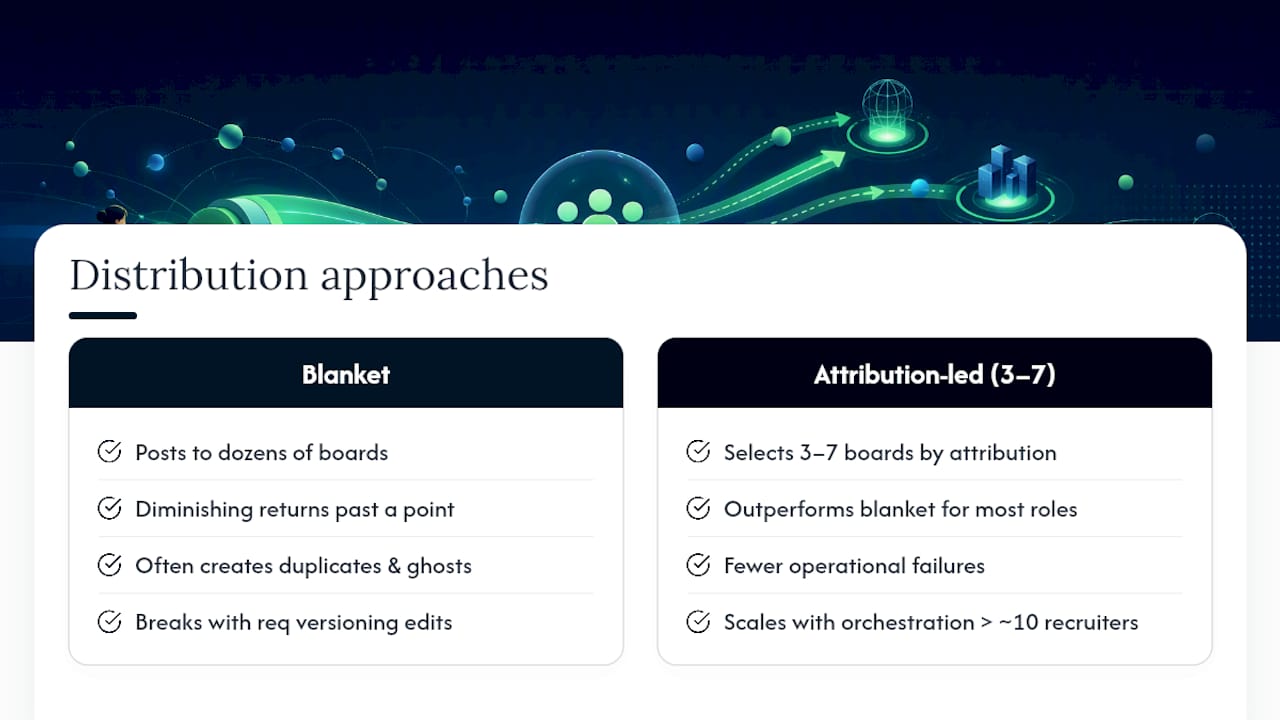
The operational mistakes we see most often aren’t strategic, they’re structural: missing idempotency keys that let a network hiccup create three duplicate listings, weak close verification that leaves ghost jobs live for weeks, and requisition versioning that breaks the moment someone edits a job description mid-cycle. None of these are exotic problems. They’re the predictable result of skipping the boring infrastructure work in favor of shipping the “post to everywhere” button first.
An orchestration layer connecting your ATS, distribution, and analytics earns its keep once you’re managing multiple systems or running more than roughly 10 active recruiters. Below that, a simpler native distribution feature inside your ATS may be all you need. Automation should always stay optional at the closure step. A human reviewing the exception queue for 15 minutes a day is worth more than perfect uptime with no oversight.
- Recruitify Team
See How Recruitify Handles the Full Checklist
The consolidation of ATS, CRM, and contracting workflows into one system matters here because every feature on the checklist above (integration depth, formatting, attribution, compliance) works better when it isn’t stitched together across three disconnected tools. The platform’s automation engine is built to eliminate the manual reformatting and status-tracking work that eats recruiter hours, with data pointing to a significant reduction in administrative tasks across lead intake, candidate categorization, and contract generation.
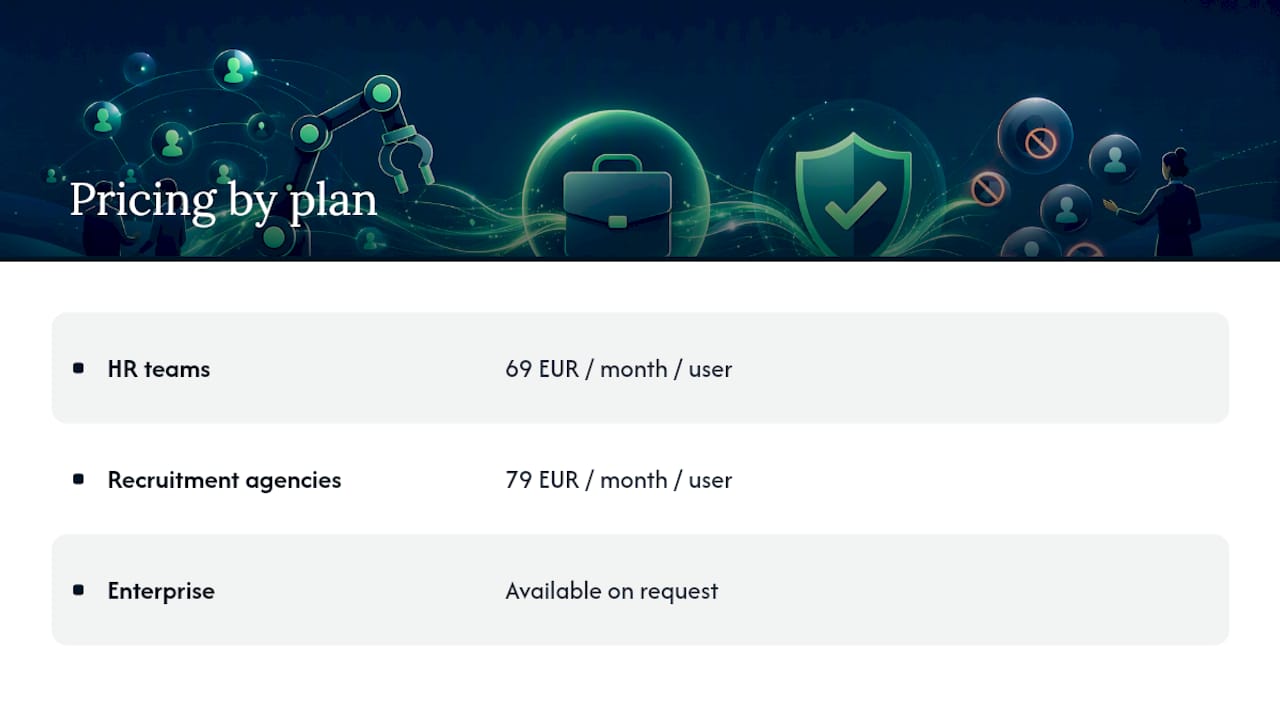
On the compliance side, A GDPR consent management module maintains a full audit trail with anonymization options for sensitive candidate records, which covers the compliance line item most vendors treat as an afterthought. If you’re evaluating a pilot, ask for a demo that walks through multiposting setup, requisition and project controls, and exception handling specifically. Recruitify offers plans for HR teams at 69 EUR per month per user and recruitment agencies at 79 EUR per month per user, with Enterprise pricing available on request. Start with a demo request on the pricing page to see how the platform maps to your own posting volume before committing to a full rollout.
FAQ
What Is Job Posting Automation?
Job posting automation is software that publishes a job from your ATS to multiple job boards at once, formats it correctly for each board, and tracks performance and attribution without manual reposting. It typically includes closure verification and budget controls layered on top of the distribution itself.
How Many Job Postings Justify Automation?
Teams posting 10 or more jobs a month tend to see payback within 60 to 90 days from automation. Below that volume, a native ATS distribution feature usually covers the need without a dedicated automation layer.
What Is Source-Of-Hire Attribution and Why Does It Matter?
Source-of-hire attribution tracks a candidate from the board they applied through all the way to placement, using external IDs and UTM parameters preserved on the applicant record. It shows you which boards actually produce hires so you can stop paying for boards that only generate clicks.
How Much Does Recruitify Cost?
Recruitify’s HR Team plan runs 69 EUR per month per user, and the Recruitment Agencies plan runs 79 EUR per month per user. Enterprise pricing is available on request through the pricing page.
What Causes Duplicate Job Postings and How Do You Prevent Them?
Duplicate postings usually happen when a retry after a network failure resends a job without checking if it already succeeded. The fix is an idempotent key combining requisition ID, approved version, board, and action, which blocks a repeat post from firing during a retry.
Should You Post to Every Available Job Board?
No. Attribution-led selection of 3 to 7 boards that produce the majority of your hires typically outperforms blanket distribution across dozens of boards. Broader coverage increases reach but shows diminishing returns past a certain point, especially for general roles.
Recommended


News & Updates
Stay up-to-date with the latest innovations, features, and tips about Recruitify!
By providing your email address within the newsletter sign-up form, you confirm its processing to send marketing information regarding the Administrator’s products and services. The Administrator of your personal data processed for the abovementioned purposes is Recruitify Spółka z o.o., based in Warsaw, Poland (KRS 0000709889). For more information on the principles of personal data processing and the rights of data subjects, please check the Privacy Policy.

Last updated:
Recruiters: Job Posting Automation, Safe Pilot and No Duplicate Posts
The Recruitify Team
Job posting automation pays for itself for most teams publishing 10 or more roles a month, mainly through time recovered from manual reposting and cleaner source-of-hire data that shows which boards actually produce hires. Below that volume, the math gets murkier and a native ATS distribution feature may cover the need. The features checklist and rollout plan below tell you exactly what to demand from a vendor and how to pilot it without breaking anything.
Teams posting ten or more jobs monthly generally see a payback within 60 to 90 days from automation, unlike lower-volume teams where ROI is less clear.
A vendor’s automation system must have deep ATS integration, multi-board formatting, and source-of-hire attribution to effectively maximize recruitment efficiency.
Proper rollout involves controlled pilot tests, verifying close commands, and only scaling once key performance metrics remain steady across multiple review cycles.
Failures often occur from duplicate postings, incomplete closure verification, or broken requisition versioning, which harm candidate trust and inflate costs.
Selecting 3 to 7 optimized boards based on proven conversion outperforms blanket posting across dozens of sites, which yields diminishing returns.
Recruitifyrecruitify.aiBring Recruitment Workflows TogetherRecruitify combines ATS, Sales CRM, and IT contracting tools to reduce administrative work and keep recruitment operations in one connected system.Explore Recruitify
Table of Contents
How Does Job Posting Automation Improve ROI?
What Features Should You Demand From a Job Posting Automation Vendor?
How Do You Roll Out Job Posting Automation Safely?
What Should You Measure and How Do You Catch Failures?
Why “Post Everywhere” Usually Backfires
See How Recruitify Handles the Full Checklist
Sources
FAQ
How Does Job Posting Automation Improve ROI?
The return on job posting automation comes from three places: recruiter hours, applicant quality, and smarter spend. Manual multi-board posting eats hours per requisition when a recruiter reformats the same job for five or six sites, tracks which ones are live, and manually pulls each one down when the role closes. Automated distribution collapses that into minutes, and platforms report payback within 60 to 90 days for teams posting 10 or more jobs monthly.
Recruiters recover time that goes straight back into candidate conversations, not job-board logistics.
The quality gains matter just as much as the time savings. Case data across vendors shows 2.5 to 3 times more qualified applicants per role and time-to-fill drops of 8 to 12 days once automated distribution and attribution reporting are in place. That second number, source-of-hire attribution, is what most agencies underuse. Once you know which board actually produced your last five placements, you stop paying for the other twelve out of habit.
What automation actually changes for your team:
Manual formatting and reposting time drops from hours to minutes per requisition.
Source-of-hire reports at closure show which boards drove real hires, not just clicks.
Budget shifts toward boards with proven conversion instead of even splits across every listing.
Time-to-fill and cost-per-hire both improve as qualified-applicant volume rises.
The payback threshold matters here. A team posting two or three roles a month rarely sees enough volume to justify a full automation build. A team posting ten or more, especially across multiple boards per role, usually clears that 60 to 90 day payback window comfortably.
What Features Should You Demand From a Job Posting Automation Vendor?
Not every “automated” job posting tool does the same job. Some just batch-submit to a handful of boards. Others build a full attribution and control layer around the posting itself. Here’s what separates the two, in the order you should verify them during a demo:
ATS integration depth. Look for real webhooks and API access, not a CSV export workaround. The system should read an approved requisition from your ATS, map its fields to each board’s format automatically, and sync status changes back in both directions.
Multi-board formatting. Each job board has its own field limits, character counts, and required categories. A capable multiposting tool builds per-board templates rather than forcing one generic post everywhere, which is where most manual errors creep in.
Source-of-hire attribution. This means UTM tagging, external ID tracking, and pipeline-level conversion reporting that follows a candidate from click to placement, not just to application. Preserving immutable external IDs and UTM parameters on the applicant record is what makes true source-of-hire reporting possible.
Idempotency and duplicate prevention. Retry logic after a network failure should never create a second live posting. Ask vendors directly how they prevent duplicate publishes during a retry.
Automated budget reallocation. Rule-based reallocation (move spend after a fixed threshold) is simpler and easier to audit than programmatic bidding, which optimizes in real time but hides more of the decision logic.
Verified role closure. The system should confirm a “delete” command actually took effect on every board, not just log that it sent one.
Compliance controls. GDPR consent management, a full audit trail, and anonymization options for sensitive candidate data are non-negotiable for any platform touching applicant records across borders.
Pro Tip: Ask any vendor to show you their idempotency key structure during the demo. If they can’t explain how they prevent duplicate posts on a failed retry, assume they haven’t built for it.
How Do You Roll Out Job Posting Automation Safely?
Rolling out automated job listings works best as a controlled pilot, not a full switch-over. Here’s the sequence that avoids the most common failures:
Preflight. Lock down a canonical requisition format with required fields and clear approval gates before anything touches an external board.
Integration testing. Validate webhooks, confirm field mapping against each target board, and test credentials on every account before go-live. Expect uneven setup times. LinkedIn’s partner API often requires longer approval while boards like ZipRecruiter support same-day setup, and some smaller boards still only accept formatted email submissions.
Run a small pilot. Pick 3 to 5 boards and a limited set of active roles. Run a performance review at day 14, not day 30, so you can course-correct fast.
Set automation rules. Define idempotency keys, budget reallocation thresholds, and who approves any reallocation above a set dollar amount.
Build exception handling. A 24-hour verification queue catches roles that stay visible after a close command, plus stale listings that slipped through.
Scale deliberately. Only add boards or automate budget changes after your pilot metrics (qualified applicants, cost-per-apply, time-to-fill) hold steady across two full review cycles.
Before you scale past the pilot, confirm these are working:
Duplicate-free posting across every retry event.
Verified closures on 100% of sampled roles.
Stable or improving cost-per-apply on your top 3 boards.
Requisition versioning that survives a mid-cycle edit without breaking attribution.
What Should You Measure and How Do You Catch Failures?
Six metrics tell you whether job posting automation is actually working: time-to-post, time-to-fill, qualified applicants per role, cost-per-apply, cost-per-hire, and source-to-hire conversion rate. Pull these directly from your ATS and distribution layer rather than each board’s individual dashboard, since board-reported numbers rarely agree with what your pipeline actually converts.
Verification is where most failures hide. A role that shows “closed” in your ATS but stays live on a third-party board creates a ghost job, and that damages candidate trust and wastes application volume on a position nobody is hiring for anymore. Guarding against that means:
Automated confirmation that a close command succeeded on every board it was sent to.
A full audit trail for every posting, edit, and closure, useful for compliance reviews and executive reporting alike.
Sampling checks on a rolling basis rather than trusting every automated confirmation blindly.
A 24-hour verification queue that flags any role still visible after a close request, so a human reviews it before it becomes a compliance problem.
Multi-board automation systems that produce source-of-hire reports at role closure give you the attribution data needed to answer the only question that matters: which boards are paying for themselves.
Why “Post Everywhere” Usually Backfires
The instinct to blast a job to every available board feels like it maximizes reach, but the data doesn’t back it up. Programmatic distribution across dozens of boards produces diminishing returns past a certain point, and attribution-led selection of 3 to 7 boards often outperforms blanket distribution for most role types.
The operational mistakes we see most often aren’t strategic, they’re structural: missing idempotency keys that let a network hiccup create three duplicate listings, weak close verification that leaves ghost jobs live for weeks, and requisition versioning that breaks the moment someone edits a job description mid-cycle. None of these are exotic problems. They’re the predictable result of skipping the boring infrastructure work in favor of shipping the “post to everywhere” button first.
An orchestration layer connecting your ATS, distribution, and analytics earns its keep once you’re managing multiple systems or running more than roughly 10 active recruiters. Below that, a simpler native distribution feature inside your ATS may be all you need. Automation should always stay optional at the closure step. A human reviewing the exception queue for 15 minutes a day is worth more than perfect uptime with no oversight.
- Recruitify Team
See How Recruitify Handles the Full Checklist
The consolidation of ATS, CRM, and contracting workflows into one system matters here because every feature on the checklist above (integration depth, formatting, attribution, compliance) works better when it isn’t stitched together across three disconnected tools. The platform’s automation engine is built to eliminate the manual reformatting and status-tracking work that eats recruiter hours, with data pointing to a significant reduction in administrative tasks across lead intake, candidate categorization, and contract generation.
On the compliance side, A GDPR consent management module maintains a full audit trail with anonymization options for sensitive candidate records, which covers the compliance line item most vendors treat as an afterthought. If you’re evaluating a pilot, ask for a demo that walks through multiposting setup, requisition and project controls, and exception handling specifically. Recruitify offers plans for HR teams at 69 EUR per month per user and recruitment agencies at 79 EUR per month per user, with Enterprise pricing available on request. Start with a demo request on the pricing page to see how the platform maps to your own posting volume before committing to a full rollout.
FAQ
What Is Job Posting Automation?
Job posting automation is software that publishes a job from your ATS to multiple job boards at once, formats it correctly for each board, and tracks performance and attribution without manual reposting. It typically includes closure verification and budget controls layered on top of the distribution itself.
How Many Job Postings Justify Automation?
Teams posting 10 or more jobs a month tend to see payback within 60 to 90 days from automation. Below that volume, a native ATS distribution feature usually covers the need without a dedicated automation layer.
What Is Source-Of-Hire Attribution and Why Does It Matter?
Source-of-hire attribution tracks a candidate from the board they applied through all the way to placement, using external IDs and UTM parameters preserved on the applicant record. It shows you which boards actually produce hires so you can stop paying for boards that only generate clicks.
How Much Does Recruitify Cost?
Recruitify’s HR Team plan runs 69 EUR per month per user, and the Recruitment Agencies plan runs 79 EUR per month per user. Enterprise pricing is available on request through the pricing page.
What Causes Duplicate Job Postings and How Do You Prevent Them?
Duplicate postings usually happen when a retry after a network failure resends a job without checking if it already succeeded. The fix is an idempotent key combining requisition ID, approved version, board, and action, which blocks a repeat post from firing during a retry.
Should You Post to Every Available Job Board?
No. Attribution-led selection of 3 to 7 boards that produce the majority of your hires typically outperforms blanket distribution across dozens of boards. Broader coverage increases reach but shows diminishing returns past a certain point, especially for general roles.
Recommended
News & Updates
Stay up-to-date with the latest innovations, features, and tips about Recruitify!
By providing your email address within the newsletter sign-up form, you confirm its processing to send marketing information regarding the Administrator’s products and services. The Administrator of your personal data processed for the abovementioned purposes is Recruitify Spółka z o.o., based in Warsaw, Poland (KRS 0000709889). For more information on the principles of personal data processing and the rights of data subjects, please check the Privacy Policy.
Last updated:
Recruiters: Job Posting Automation, Safe Pilot and No Duplicate Posts
The Recruitify Team
Job posting automation pays for itself for most teams publishing 10 or more roles a month, mainly through time recovered from manual reposting and cleaner source-of-hire data that shows which boards actually produce hires. Below that volume, the math gets murkier and a native ATS distribution feature may cover the need. The features checklist and rollout plan below tell you exactly what to demand from a vendor and how to pilot it without breaking anything.
Teams posting ten or more jobs monthly generally see a payback within 60 to 90 days from automation, unlike lower-volume teams where ROI is less clear.
A vendor’s automation system must have deep ATS integration, multi-board formatting, and source-of-hire attribution to effectively maximize recruitment efficiency.
Proper rollout involves controlled pilot tests, verifying close commands, and only scaling once key performance metrics remain steady across multiple review cycles.
Failures often occur from duplicate postings, incomplete closure verification, or broken requisition versioning, which harm candidate trust and inflate costs.
Selecting 3 to 7 optimized boards based on proven conversion outperforms blanket posting across dozens of sites, which yields diminishing returns.
Recruitifyrecruitify.aiBring Recruitment Workflows TogetherRecruitify combines ATS, Sales CRM, and IT contracting tools to reduce administrative work and keep recruitment operations in one connected system.Explore Recruitify
Table of Contents
How Does Job Posting Automation Improve ROI?
What Features Should You Demand From a Job Posting Automation Vendor?
How Do You Roll Out Job Posting Automation Safely?
What Should You Measure and How Do You Catch Failures?
Why “Post Everywhere” Usually Backfires
See How Recruitify Handles the Full Checklist
Sources
FAQ
How Does Job Posting Automation Improve ROI?
The return on job posting automation comes from three places: recruiter hours, applicant quality, and smarter spend. Manual multi-board posting eats hours per requisition when a recruiter reformats the same job for five or six sites, tracks which ones are live, and manually pulls each one down when the role closes. Automated distribution collapses that into minutes, and platforms report payback within 60 to 90 days for teams posting 10 or more jobs monthly.
Recruiters recover time that goes straight back into candidate conversations, not job-board logistics.
The quality gains matter just as much as the time savings. Case data across vendors shows 2.5 to 3 times more qualified applicants per role and time-to-fill drops of 8 to 12 days once automated distribution and attribution reporting are in place. That second number, source-of-hire attribution, is what most agencies underuse. Once you know which board actually produced your last five placements, you stop paying for the other twelve out of habit.
What automation actually changes for your team:
Manual formatting and reposting time drops from hours to minutes per requisition.
Source-of-hire reports at closure show which boards drove real hires, not just clicks.
Budget shifts toward boards with proven conversion instead of even splits across every listing.
Time-to-fill and cost-per-hire both improve as qualified-applicant volume rises.
The payback threshold matters here. A team posting two or three roles a month rarely sees enough volume to justify a full automation build. A team posting ten or more, especially across multiple boards per role, usually clears that 60 to 90 day payback window comfortably.
What Features Should You Demand From a Job Posting Automation Vendor?
Not every “automated” job posting tool does the same job. Some just batch-submit to a handful of boards. Others build a full attribution and control layer around the posting itself. Here’s what separates the two, in the order you should verify them during a demo:
ATS integration depth. Look for real webhooks and API access, not a CSV export workaround. The system should read an approved requisition from your ATS, map its fields to each board’s format automatically, and sync status changes back in both directions.
Multi-board formatting. Each job board has its own field limits, character counts, and required categories. A capable multiposting tool builds per-board templates rather than forcing one generic post everywhere, which is where most manual errors creep in.
Source-of-hire attribution. This means UTM tagging, external ID tracking, and pipeline-level conversion reporting that follows a candidate from click to placement, not just to application. Preserving immutable external IDs and UTM parameters on the applicant record is what makes true source-of-hire reporting possible.
Idempotency and duplicate prevention. Retry logic after a network failure should never create a second live posting. Ask vendors directly how they prevent duplicate publishes during a retry.
Automated budget reallocation. Rule-based reallocation (move spend after a fixed threshold) is simpler and easier to audit than programmatic bidding, which optimizes in real time but hides more of the decision logic.
Verified role closure. The system should confirm a “delete” command actually took effect on every board, not just log that it sent one.
Compliance controls. GDPR consent management, a full audit trail, and anonymization options for sensitive candidate data are non-negotiable for any platform touching applicant records across borders.
Pro Tip: Ask any vendor to show you their idempotency key structure during the demo. If they can’t explain how they prevent duplicate posts on a failed retry, assume they haven’t built for it.
How Do You Roll Out Job Posting Automation Safely?
Rolling out automated job listings works best as a controlled pilot, not a full switch-over. Here’s the sequence that avoids the most common failures:
Preflight. Lock down a canonical requisition format with required fields and clear approval gates before anything touches an external board.
Integration testing. Validate webhooks, confirm field mapping against each target board, and test credentials on every account before go-live. Expect uneven setup times. LinkedIn’s partner API often requires longer approval while boards like ZipRecruiter support same-day setup, and some smaller boards still only accept formatted email submissions.
Run a small pilot. Pick 3 to 5 boards and a limited set of active roles. Run a performance review at day 14, not day 30, so you can course-correct fast.
Set automation rules. Define idempotency keys, budget reallocation thresholds, and who approves any reallocation above a set dollar amount.
Build exception handling. A 24-hour verification queue catches roles that stay visible after a close command, plus stale listings that slipped through.
Scale deliberately. Only add boards or automate budget changes after your pilot metrics (qualified applicants, cost-per-apply, time-to-fill) hold steady across two full review cycles.
Before you scale past the pilot, confirm these are working:
Duplicate-free posting across every retry event.
Verified closures on 100% of sampled roles.
Stable or improving cost-per-apply on your top 3 boards.
Requisition versioning that survives a mid-cycle edit without breaking attribution.
What Should You Measure and How Do You Catch Failures?
Six metrics tell you whether job posting automation is actually working: time-to-post, time-to-fill, qualified applicants per role, cost-per-apply, cost-per-hire, and source-to-hire conversion rate. Pull these directly from your ATS and distribution layer rather than each board’s individual dashboard, since board-reported numbers rarely agree with what your pipeline actually converts.
Verification is where most failures hide. A role that shows “closed” in your ATS but stays live on a third-party board creates a ghost job, and that damages candidate trust and wastes application volume on a position nobody is hiring for anymore. Guarding against that means:
Automated confirmation that a close command succeeded on every board it was sent to.
A full audit trail for every posting, edit, and closure, useful for compliance reviews and executive reporting alike.
Sampling checks on a rolling basis rather than trusting every automated confirmation blindly.
A 24-hour verification queue that flags any role still visible after a close request, so a human reviews it before it becomes a compliance problem.
Multi-board automation systems that produce source-of-hire reports at role closure give you the attribution data needed to answer the only question that matters: which boards are paying for themselves.
Why “Post Everywhere” Usually Backfires
The instinct to blast a job to every available board feels like it maximizes reach, but the data doesn’t back it up. Programmatic distribution across dozens of boards produces diminishing returns past a certain point, and attribution-led selection of 3 to 7 boards often outperforms blanket distribution for most role types.
The operational mistakes we see most often aren’t strategic, they’re structural: missing idempotency keys that let a network hiccup create three duplicate listings, weak close verification that leaves ghost jobs live for weeks, and requisition versioning that breaks the moment someone edits a job description mid-cycle. None of these are exotic problems. They’re the predictable result of skipping the boring infrastructure work in favor of shipping the “post to everywhere” button first.
An orchestration layer connecting your ATS, distribution, and analytics earns its keep once you’re managing multiple systems or running more than roughly 10 active recruiters. Below that, a simpler native distribution feature inside your ATS may be all you need. Automation should always stay optional at the closure step. A human reviewing the exception queue for 15 minutes a day is worth more than perfect uptime with no oversight.
- Recruitify Team
See How Recruitify Handles the Full Checklist
The consolidation of ATS, CRM, and contracting workflows into one system matters here because every feature on the checklist above (integration depth, formatting, attribution, compliance) works better when it isn’t stitched together across three disconnected tools. The platform’s automation engine is built to eliminate the manual reformatting and status-tracking work that eats recruiter hours, with data pointing to a significant reduction in administrative tasks across lead intake, candidate categorization, and contract generation.
On the compliance side, A GDPR consent management module maintains a full audit trail with anonymization options for sensitive candidate records, which covers the compliance line item most vendors treat as an afterthought. If you’re evaluating a pilot, ask for a demo that walks through multiposting setup, requisition and project controls, and exception handling specifically. Recruitify offers plans for HR teams at 69 EUR per month per user and recruitment agencies at 79 EUR per month per user, with Enterprise pricing available on request. Start with a demo request on the pricing page to see how the platform maps to your own posting volume before committing to a full rollout.
FAQ
What Is Job Posting Automation?
Job posting automation is software that publishes a job from your ATS to multiple job boards at once, formats it correctly for each board, and tracks performance and attribution without manual reposting. It typically includes closure verification and budget controls layered on top of the distribution itself.
How Many Job Postings Justify Automation?
Teams posting 10 or more jobs a month tend to see payback within 60 to 90 days from automation. Below that volume, a native ATS distribution feature usually covers the need without a dedicated automation layer.
What Is Source-Of-Hire Attribution and Why Does It Matter?
Source-of-hire attribution tracks a candidate from the board they applied through all the way to placement, using external IDs and UTM parameters preserved on the applicant record. It shows you which boards actually produce hires so you can stop paying for boards that only generate clicks.
How Much Does Recruitify Cost?
Recruitify’s HR Team plan runs 69 EUR per month per user, and the Recruitment Agencies plan runs 79 EUR per month per user. Enterprise pricing is available on request through the pricing page.
What Causes Duplicate Job Postings and How Do You Prevent Them?
Duplicate postings usually happen when a retry after a network failure resends a job without checking if it already succeeded. The fix is an idempotent key combining requisition ID, approved version, board, and action, which blocks a repeat post from firing during a retry.
Should You Post to Every Available Job Board?
No. Attribution-led selection of 3 to 7 boards that produce the majority of your hires typically outperforms blanket distribution across dozens of boards. Broader coverage increases reach but shows diminishing returns past a certain point, especially for general roles.
Recommended
News & Updates
Stay up-to-date with the latest innovations, features, and tips about Recruitify!
By providing your email address within the newsletter sign-up form, you confirm its processing to send marketing information regarding the Administrator’s products and services. The Administrator of your personal data processed for the abovementioned purposes is Recruitify Spółka z o.o., based in Warsaw, Poland (KRS 0000709889). For more information on the principles of personal data processing and the rights of data subjects, please check the Privacy Policy.

Discover More

Recruitment Process
Win Renewals With 7–10 KPIs: Client Reporting for Agencies
Automate client reporting for agencies around a focused 7 to 10 KPI set, white labeled dashboards, and a vendor agnostic checklist that proves ROI and...
18 Sept 2026
Discover More

Recruitment Process
For Agencies: Orchestrate Stages with Recruitment Workflow Automation
Orchestrate recruitment workflow automation with scorecards and human gates. Pilot safely; agencies report 70% fewer admin tasks.
17 Sept 2026
Discover More

HR Analytics
7 Tactics to Optimize the Recruitment Process for TA Leaders
A metrics-first playbook for TA leaders: shorten time-to-decision, improve shortlist quality, and use AI as decision support rather than a replacement.
16 Sept 2026
Discover More
Recruitment Process
Win Renewals With 7–10 KPIs: Client Reporting for Agencies
Automate client reporting for agencies around a focused 7 to 10 KPI set, white labeled dashboards, and a vendor agnostic checklist that proves ROI and...
18 Sept 2026
Discover More
Recruitment Process
For Agencies: Orchestrate Stages with Recruitment Workflow Automation
Orchestrate recruitment workflow automation with scorecards and human gates. Pilot safely; agencies report 70% fewer admin tasks.
17 Sept 2026
Discover More