🔥
Contracting
Explore the new contractor management module
🔥
Contracting
Explore the new contractor management module
🔥
Contracting
Explore the new contractor management module
🔥
Contracting
Explore the new contractor management module

Last updated:
30 Day SMS Recruiting Pilot for HR Teams and Hiring Managers

Innovations

The Recruitify Team
30 Day SMS Recruiting Pilot for HR Teams and Hiring Managers
SMS recruiting means sending short, consented text messages to move candidates through screening and scheduling faster than email allows. The single biggest payoff is fewer no-shows and a shorter time-to-hire, but only when texting runs alongside documented consent and real ATS integration. Text messaging reaches nearly every smartphone owner, which is why Pew Research treats it as the most universally used phone feature across age groups.
TL;DR:
Consent must be explicitly documented at the moment a candidate opts in to avoid legal and deliverability issues.
Using API or middleware for integration provides full control but requires technical resources, while native plugins are quicker but less flexible.
Automated workflows should include fallback options for unexpected replies to prevent candidates from being ignored and causing compliance risks.
The most effective SMS use cases focus on quick nudges like interview reminders and reconnection, not replacing email for detailed communication.
Proper carrier registration, opt-out handling, and response monitoring are essential to maintain deliverability and protect sender reputation over time.
Table of Contents
What Is SMS Recruiting, and Which Channels Does It Use?
How Does an SMS Recruiting Workflow Actually Run?
What Are the Biggest Benefits of Recruiting via SMS?
What Compliance Rules Apply to Recruiting Text Messages?
What Message Templates Actually Work for Recruiting?
How Do You Choose and Integrate an SMS Recruiting Tool?
How Recruitify Puts SMS Recruiting Into Practice
Your 30-Day SMS Recruiting Pilot, Week by Week
Why We Think Most Teams Get SMS Recruiting Backwards
Recruitify Gives You a Compliant Path From Pilot to Production
Sources
What Is SMS Recruiting, and Which Channels Does It Use?
SMS recruiting covers three distinct technologies, and recruiters who confuse them tend to over-promise on what a campaign can do. SMS is plain text, capped at 160 characters per segment, readable on any phone made in the last two decades. MMS adds images, video, or longer text blocks, useful for sending a branded job flyer or a quick video from the hiring manager. RCS (Rich Communication Services) behaves more like a chat app, supporting read receipts and richer formatting, but it only works when both sender and recipient have compatible devices and carriers, so it’s not yet a safe default for broad candidate outreach.
Beyond the technology, the sending mode matters just as much as the message format. Recruiters typically choose from four approaches:
One-to-one texting: a recruiter messaging an individual candidate directly, ideal for scheduling nuance or answering a specific question.
Peer-to-peer (P2P): a recruiter sends personalized messages one at a time from a shared number, preserving a human tone at moderate volume.
Broadcast messaging: one message goes to a segmented list simultaneously, best for job alerts or event invitations where personalization matters less.
Web-to-SMS opt-in: a candidate texts a keyword to a shortcode from a job ad or career site, which triggers an automated welcome and consent capture sequence.
Matching the mode to the moment keeps campaigns from feeling either robotic or unscalable. A first-round interview reminder works best as one-to-one or P2P messaging, since it needs a personal tone and the ability to answer a quick reply. A new-job-opening alert to 2,000 warm leads in a talent pool is a broadcast job. Web-to-SMS opt-in belongs at the top of the funnel, capturing consent the moment a candidate shows interest, before any human ever gets involved.
How Does an SMS Recruiting Workflow Actually Run?
A working SMS recruiting workflow has four moving parts: consent capture, automation logic, human handoff, and system-of-record integration. Skipping any one of these turns a promising channel into either a compliance risk or a scaling ceiling.
Consent capture comes first, and it needs to be documented, not assumed. A candidate who applies through a job board and later gets a text needs a clear record showing they agreed to receive messages, when they agreed, and through what channel. SenseHQ’s compliance guidance treats this documentation as the foundation of a lawful texting program, not an afterthought bolted on later.
Once consent exists, automation can take over routine touches. A typical sequence looks like this:
Trigger event: a candidate applies, advances a stage, or misses a deadline in the ATS.
Automated message fires: a screening question, a scheduling link, or a status update goes out within minutes.
Candidate responds: the reply routes to a recruiter’s inbox or triggers a branching automation (a “yes” books a slot, a “no” logs a decline).
Human handoff: anything outside a expected response pattern, like a negotiation question or a complaint, escalates to a recruiter directly.
Activity logs to the ATS/CRM: every message and consent event syncs back to the candidate record automatically.
Integration is where most teams stall. Three patterns dominate: a native plugin built into the ATS, a direct API/webhook connection that a technical team maintains, or middleware that sits between the texting platform and the ATS to translate data formats. Native plugins are fastest to deploy but limit flexibility. API connections give full control but require engineering time. Middleware splits the difference, and it’s often the right call for mid-sized teams without a dedicated developer.
Pro Tip: Before launching any automated sequence, map out what happens when a candidate replies with something unexpected, like a joke, a complaint, or a totally unrelated question. If your automation has no fallback, that candidate gets ignored, and ignored candidates talk.
A quick implementation checklist before going live: confirm consent language is documented and stored, test every automated branch with a real phone number, verify ATS sync happens in near real time, and assign clear ownership for monitoring replies during business hours.
What Are the Biggest Benefits of Recruiting via SMS?
The core benefit of SMS recruiting is speed, and the evidence for reduced no-shows is genuinely strong, even if it comes from an adjacent field rather than recruiting itself. A randomized controlled trial in a pediatric clinic found that text reminders cut appointment no-shows from 38.1% down to 23.5%, a mechanism that JoVeo points to as directly applicable to interview scheduling, where a missed slot wastes a recruiter’s calendar the same way a missed appointment wastes a doctor’s.
A well-timed interview reminder is arguably the single highest-return message a recruiting team sends. It costs almost nothing to automate and directly prevents a wasted interview slot.
That single data point anchors a broader pattern across use cases. Here’s where SMS tends to outperform other channels, and why:
Speed to first response: candidates read texts almost immediately, compared to email that can sit unopened for hours or days.
Interview reminders and confirmations: the no-show reduction mechanism above applies directly here.
Screening pre-qualification: a short yes/no or multiple-choice question filters candidates before a recruiter invests time on a call.
Re-engagement of dormant talent pools: a brief “we have a new opening” text often revives candidates who stopped checking email months ago.
Offer-stage nudges: reminding a candidate to sign paperwork or complete a background check step.
CallHub’s analysis of recruiting text campaigns backs the general pattern: response rates and speed both improve compared to email-only outreach, and the firm recommends pairing SMS for quick actions with email for anything requiring documentation, like offer letters or benefits packets.
JoVeo’s own guidance flags this pattern and recommends leaning on sourced, verifiable evidence rather than repeating numbers nobody can trace back to a study. To turn any of these use cases into a KPI, track a baseline before launch (response time, no-show rate, time-to-schedule) and compare it after 30 days of SMS use on the same candidate pool.
What Compliance Rules Apply to Recruiting Text Messages?
Compliance failures in SMS recruiting come from two sources: unclear consent and unregistered sending infrastructure. Both are avoidable with a bit of upfront discipline, and both carry real financial and deliverability consequences if ignored.
The Telephone Consumer Protection Act (TCPA) governs automated texting to US phone numbers, and the safest practice is treating every recipient as needing documented, affirmative consent before the first message goes out. A candidate submitting a resume through a job board is not automatically opted in to text messages. SenseHQ recommends capturing consent through an explicit checkbox or a keyword opt-in, then storing the timestamp and method alongside the candidate record.
Carrier registration is the operational half of compliance, and it’s frequently overlooked until messages start silently failing to deliver. In the US, 10DLC (10-digit long code) registration applies to standard business phone numbers sending application-to-person texts, and unregistered numbers get throttled or filtered by carriers without warning. Verified Toll-Free numbers and dedicated shortcodes are alternative paths for higher-volume programs. Registering under one of these frameworks isn’t optional paperwork; it directly determines whether your messages reach candidates at all.
A few deliverability habits protect your sender reputation over time:
Pace your sends: blasting thousands of messages in a short burst looks like spam to carrier filtering systems.
Avoid shortened or suspicious-looking links: they trigger spam filters more often than a clean, recognizable URL.
Honor opt-outs immediately: a candidate who texts “STOP” needs to be suppressed from all future messages within the same conversation thread, not just that campaign.
Monitor your trust score: most SMS platforms surface a sender reputation score, and a declining score signals a problem before it becomes a full block.
Pro Tip: Keep a simple audit log of opt-outs and consent timestamps separate from your main ATS export. If a compliance question ever comes up, you want that record retrievable in minutes, not buried in a support ticket history.
Record-keeping rounds out the picture. Store consent records, opt-out requests, and message logs for as long as your legal counsel recommends, and review that retention policy annually as carrier rules and state-level texting laws continue to shift.
What Message Templates Actually Work for Recruiting?
Good SMS recruiting copy follows a few consistent rules regardless of the stage: keep it under 300 characters, identify yourself and the company by name in the first message, ask for one action at a time, and always give a clear way to opt out. Sending outside of business hours or texting too frequently are the two fastest ways to trigger opt-outs, so most recruiters cap outreach to no more than one or two texts per candidate per week outside of active interview scheduling.
Here are six templates built around the moments where texting outperforms email:
First contact: “Hi [Name], this is [Recruiter] from [Company]. We saw your application for [Role] and would love to chat. Reply YES to schedule a quick call, or STOP to opt out.”
Screening question: “Quick question, [Name]: are you open to relocating for [Role] in [City]? Reply YES or NO.”
Interview confirmation: “Your interview for [Role] is confirmed for [Date/Time] with [Interviewer]. Reply C to confirm or R to reschedule.”
24-hour reminder: “Reminder: your interview for [Role] is tomorrow at [Time]. Location/link: [Detail]. See you then!”
Reschedule request: “Hi [Name], we need to move your interview for [Role]. What times work for you this week? Reply with your availability.”
Re-engagement: “Hi [Name], we have a new opening for [Role] that matches your background. Interested? Reply YES to learn more.”
Personalization at scale comes down to a short list of merge tags, not a custom message for every candidate. Name, role title, company name, date/time, and location cover the vast majority of use cases. CallHub’s guidance on segmentation recommends grouping candidates by role type or pipeline stage rather than sending one blanket message to an entire database, since a generic broadcast to a mixed audience tends to generate confusion and higher opt-out rates than a targeted one.
How Do You Choose and Integrate an SMS Recruiting Tool?
Evaluating an SMS platform comes down to five feature areas, and skipping any of them tends to surface as a problem three months into a rollout rather than during the demo. Prioritize a vendor that offers consent capture with timestamped logs, native two-way messaging (not just outbound blasts), reusable templates with merge tag support, scheduling automation tied to calendar availability, and analytics that break down response rates by campaign and stage.
Security and privacy questions deserve equal weight to feature checklists. Ask any vendor where candidate data is stored (data residency matters for multinational teams), how long messages and consent records are retained, and whether their privacy policy meets the standard set by major platforms. Reviewing a detailed privacy statement, like Microsoft’s, gives a useful benchmark for the level of specificity a vendor should be willing to provide about data handling.
Native ATS plugins deploy fastest but often limit customization.
API/webhook integrations offer full control at the cost of engineering time.
Middleware tools split the difference for teams without dedicated developer resources.
Pro Tip: Run your pilot on one requisition type, not your whole pipeline. A single high-volume role gives you a clean before-and-after comparison without disrupting recruiters who aren’t part of the test.
A sound pilot design covers 30 days, one role family, and a fixed sample size (50 to 100 candidates is usually enough to see a directional signal). Track deliverability rate, response rate, interview show rate, and opt-out rate before deciding whether to expand the program.
How Recruitify Puts SMS Recruiting Into Practice
Recruitify’s automation engine logs every consent event and message exchange directly against the candidate record, so recruiters never have to reconcile a separate texting platform with the ATS after the fact. That single source of truth is what keeps a texting program compliant as volume scales.
Consent capture ties into the same workflow that handles application intake, so opt-in status is visible the moment a candidate applies.
AI-driven screening can trigger a text-based pre-qualification question automatically once a resume clears an initial score threshold.
Multiposted job ads across channels feed directly into automated SMS follow-ups, shortening the gap between a candidate’s first click and their first conversation.
Your 30-Day SMS Recruiting Pilot, Week by Week
Week one: set up consent capture and pick one role. Weeks two through three: run automated sequences and track response, show, and opt-out rates. Week four: compare against your baseline and decide whether to expand based on qualitative and quantitative feedback.
Why We Think Most Teams Get SMS Recruiting Backwards
The conventional advice treats SMS recruiting as an email replacement, just shorter and faster. That framing misses what actually makes texting valuable: it’s not a better broadcast channel, it’s a better nudge channel. Email still does the heavy lifting for detailed job descriptions, offer letters, and anything a candidate needs to reread. SMS exists to get someone to take one small action right now, like confirming a time or answering a yes/no question.
Where we see teams stumble is treating consent and carrier registration as legal boxes to check rather than infrastructure decisions. A recruiting team that skips 10DLC registration doesn’t get a warning letter; their messages just quietly stop arriving; and by the time someone notices the response rate cratered, weeks of candidate outreach have gone nowhere. Compliance here isn’t a constraint on the strategy. It’s the plumbing that makes the strategy work at all.
The teams that get the most out of SMS recruiting also resist the urge to automate everything. A screening question or a reminder can run on autopilot. A candidate who texts back with a negotiation question or a complaint needs a human within the hour, not a chatbot loop. Recruitify’s approach of logging every touchpoint against the candidate record exists precisely so that handoff between automation and recruiter never drops a conversation.
— Recruitify Team
Recruitify Gives You a Compliant Path From Pilot to Production
Recruitify pairs SMS-ready automation with the consent tracking and ATS integration this article just walked through, so a 30-day pilot doesn’t turn into a compliance headache six months later. Every text, reply, and opt-out logs directly against the candidate record inside the same platform that handles sourcing, screening, and scheduling, which means your recruiters work from one system instead of stitching together a texting tool and a separate database by hand.
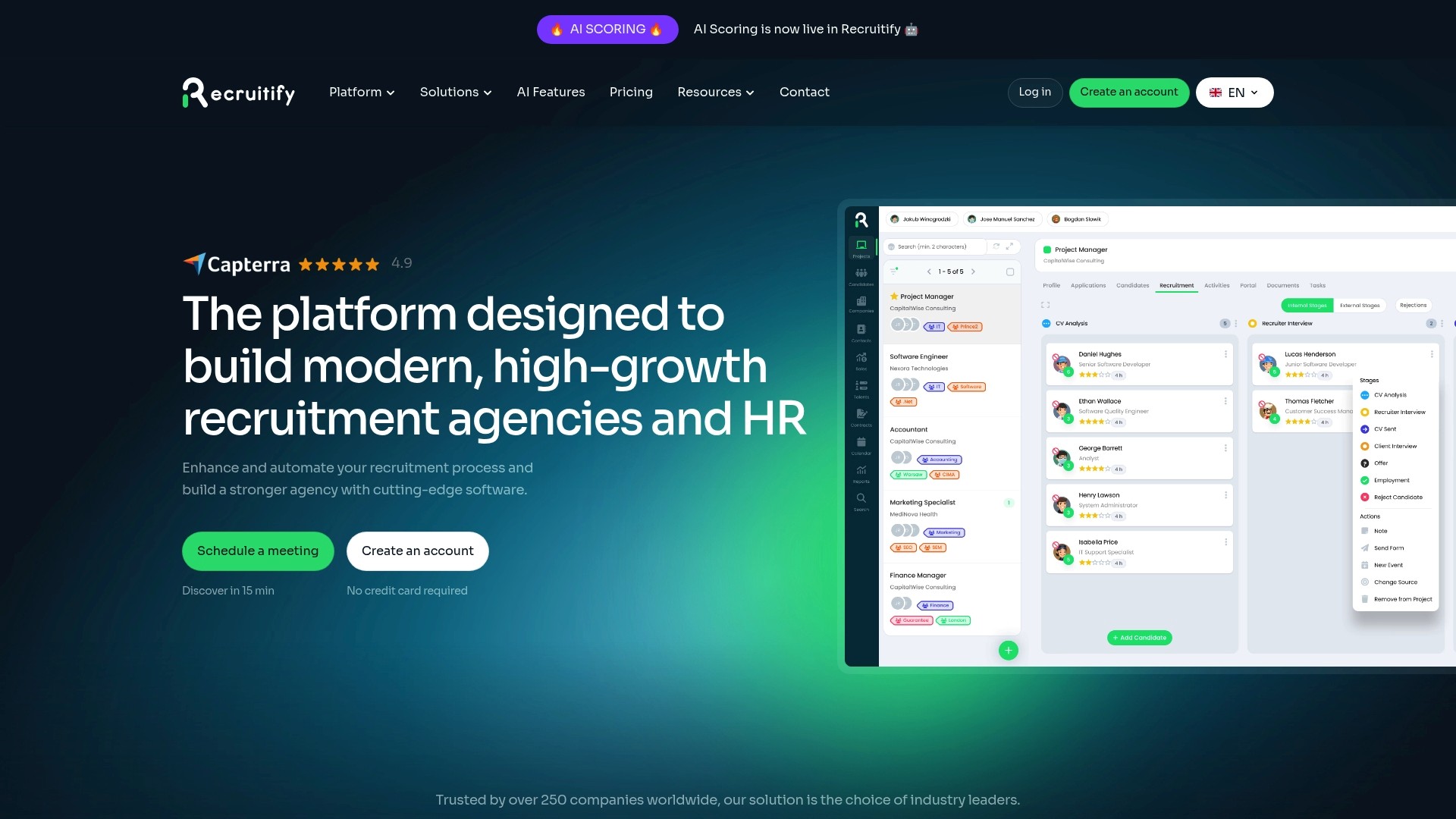
If you’re running the pilot outlined above, Recruitify’s recruitment projects workspace gives you a place to structure that single role family, track your baseline metrics, and compare results after 30 days without building a spreadsheet from scratch. Teams juggling both client-side sales and candidate outreach can also connect texting activity to the agency CRM, keeping consent records and client communication in one view.
See how the automation and consent logging described here work in practice by exploring Recruitify’s platform and starting a trial with your own pilot role.
Sources
Recommended


News & Updates
Stay up-to-date with the latest innovations, features, and tips about Recruitify!
By providing your email address within the newsletter sign-up form, you confirm its processing to send marketing information regarding the Administrator’s products and services. The Administrator of your personal data processed for the abovementioned purposes is Recruitify Spółka z o.o., based in Warsaw, Poland (KRS 0000709889). For more information on the principles of personal data processing and the rights of data subjects, please check the Privacy Policy.

Last updated:
30 Day SMS Recruiting Pilot for HR Teams and Hiring Managers
Innovations
The Recruitify Team
30 Day SMS Recruiting Pilot for HR Teams and Hiring Managers
SMS recruiting means sending short, consented text messages to move candidates through screening and scheduling faster than email allows. The single biggest payoff is fewer no-shows and a shorter time-to-hire, but only when texting runs alongside documented consent and real ATS integration. Text messaging reaches nearly every smartphone owner, which is why Pew Research treats it as the most universally used phone feature across age groups.
TL;DR:
Consent must be explicitly documented at the moment a candidate opts in to avoid legal and deliverability issues.
Using API or middleware for integration provides full control but requires technical resources, while native plugins are quicker but less flexible.
Automated workflows should include fallback options for unexpected replies to prevent candidates from being ignored and causing compliance risks.
The most effective SMS use cases focus on quick nudges like interview reminders and reconnection, not replacing email for detailed communication.
Proper carrier registration, opt-out handling, and response monitoring are essential to maintain deliverability and protect sender reputation over time.
Table of Contents
What Is SMS Recruiting, and Which Channels Does It Use?
How Does an SMS Recruiting Workflow Actually Run?
What Are the Biggest Benefits of Recruiting via SMS?
What Compliance Rules Apply to Recruiting Text Messages?
What Message Templates Actually Work for Recruiting?
How Do You Choose and Integrate an SMS Recruiting Tool?
How Recruitify Puts SMS Recruiting Into Practice
Your 30-Day SMS Recruiting Pilot, Week by Week
Why We Think Most Teams Get SMS Recruiting Backwards
Recruitify Gives You a Compliant Path From Pilot to Production
Sources
What Is SMS Recruiting, and Which Channels Does It Use?
SMS recruiting covers three distinct technologies, and recruiters who confuse them tend to over-promise on what a campaign can do. SMS is plain text, capped at 160 characters per segment, readable on any phone made in the last two decades. MMS adds images, video, or longer text blocks, useful for sending a branded job flyer or a quick video from the hiring manager. RCS (Rich Communication Services) behaves more like a chat app, supporting read receipts and richer formatting, but it only works when both sender and recipient have compatible devices and carriers, so it’s not yet a safe default for broad candidate outreach.
Beyond the technology, the sending mode matters just as much as the message format. Recruiters typically choose from four approaches:
One-to-one texting: a recruiter messaging an individual candidate directly, ideal for scheduling nuance or answering a specific question.
Peer-to-peer (P2P): a recruiter sends personalized messages one at a time from a shared number, preserving a human tone at moderate volume.
Broadcast messaging: one message goes to a segmented list simultaneously, best for job alerts or event invitations where personalization matters less.
Web-to-SMS opt-in: a candidate texts a keyword to a shortcode from a job ad or career site, which triggers an automated welcome and consent capture sequence.
Matching the mode to the moment keeps campaigns from feeling either robotic or unscalable. A first-round interview reminder works best as one-to-one or P2P messaging, since it needs a personal tone and the ability to answer a quick reply. A new-job-opening alert to 2,000 warm leads in a talent pool is a broadcast job. Web-to-SMS opt-in belongs at the top of the funnel, capturing consent the moment a candidate shows interest, before any human ever gets involved.
How Does an SMS Recruiting Workflow Actually Run?
A working SMS recruiting workflow has four moving parts: consent capture, automation logic, human handoff, and system-of-record integration. Skipping any one of these turns a promising channel into either a compliance risk or a scaling ceiling.
Consent capture comes first, and it needs to be documented, not assumed. A candidate who applies through a job board and later gets a text needs a clear record showing they agreed to receive messages, when they agreed, and through what channel. SenseHQ’s compliance guidance treats this documentation as the foundation of a lawful texting program, not an afterthought bolted on later.
Once consent exists, automation can take over routine touches. A typical sequence looks like this:
Trigger event: a candidate applies, advances a stage, or misses a deadline in the ATS.
Automated message fires: a screening question, a scheduling link, or a status update goes out within minutes.
Candidate responds: the reply routes to a recruiter’s inbox or triggers a branching automation (a “yes” books a slot, a “no” logs a decline).
Human handoff: anything outside a expected response pattern, like a negotiation question or a complaint, escalates to a recruiter directly.
Activity logs to the ATS/CRM: every message and consent event syncs back to the candidate record automatically.
Integration is where most teams stall. Three patterns dominate: a native plugin built into the ATS, a direct API/webhook connection that a technical team maintains, or middleware that sits between the texting platform and the ATS to translate data formats. Native plugins are fastest to deploy but limit flexibility. API connections give full control but require engineering time. Middleware splits the difference, and it’s often the right call for mid-sized teams without a dedicated developer.
Pro Tip: Before launching any automated sequence, map out what happens when a candidate replies with something unexpected, like a joke, a complaint, or a totally unrelated question. If your automation has no fallback, that candidate gets ignored, and ignored candidates talk.
A quick implementation checklist before going live: confirm consent language is documented and stored, test every automated branch with a real phone number, verify ATS sync happens in near real time, and assign clear ownership for monitoring replies during business hours.
What Are the Biggest Benefits of Recruiting via SMS?
The core benefit of SMS recruiting is speed, and the evidence for reduced no-shows is genuinely strong, even if it comes from an adjacent field rather than recruiting itself. A randomized controlled trial in a pediatric clinic found that text reminders cut appointment no-shows from 38.1% down to 23.5%, a mechanism that JoVeo points to as directly applicable to interview scheduling, where a missed slot wastes a recruiter’s calendar the same way a missed appointment wastes a doctor’s.
A well-timed interview reminder is arguably the single highest-return message a recruiting team sends. It costs almost nothing to automate and directly prevents a wasted interview slot.
That single data point anchors a broader pattern across use cases. Here’s where SMS tends to outperform other channels, and why:
Speed to first response: candidates read texts almost immediately, compared to email that can sit unopened for hours or days.
Interview reminders and confirmations: the no-show reduction mechanism above applies directly here.
Screening pre-qualification: a short yes/no or multiple-choice question filters candidates before a recruiter invests time on a call.
Re-engagement of dormant talent pools: a brief “we have a new opening” text often revives candidates who stopped checking email months ago.
Offer-stage nudges: reminding a candidate to sign paperwork or complete a background check step.
CallHub’s analysis of recruiting text campaigns backs the general pattern: response rates and speed both improve compared to email-only outreach, and the firm recommends pairing SMS for quick actions with email for anything requiring documentation, like offer letters or benefits packets.
JoVeo’s own guidance flags this pattern and recommends leaning on sourced, verifiable evidence rather than repeating numbers nobody can trace back to a study. To turn any of these use cases into a KPI, track a baseline before launch (response time, no-show rate, time-to-schedule) and compare it after 30 days of SMS use on the same candidate pool.
What Compliance Rules Apply to Recruiting Text Messages?
Compliance failures in SMS recruiting come from two sources: unclear consent and unregistered sending infrastructure. Both are avoidable with a bit of upfront discipline, and both carry real financial and deliverability consequences if ignored.
The Telephone Consumer Protection Act (TCPA) governs automated texting to US phone numbers, and the safest practice is treating every recipient as needing documented, affirmative consent before the first message goes out. A candidate submitting a resume through a job board is not automatically opted in to text messages. SenseHQ recommends capturing consent through an explicit checkbox or a keyword opt-in, then storing the timestamp and method alongside the candidate record.
Carrier registration is the operational half of compliance, and it’s frequently overlooked until messages start silently failing to deliver. In the US, 10DLC (10-digit long code) registration applies to standard business phone numbers sending application-to-person texts, and unregistered numbers get throttled or filtered by carriers without warning. Verified Toll-Free numbers and dedicated shortcodes are alternative paths for higher-volume programs. Registering under one of these frameworks isn’t optional paperwork; it directly determines whether your messages reach candidates at all.
A few deliverability habits protect your sender reputation over time:
Pace your sends: blasting thousands of messages in a short burst looks like spam to carrier filtering systems.
Avoid shortened or suspicious-looking links: they trigger spam filters more often than a clean, recognizable URL.
Honor opt-outs immediately: a candidate who texts “STOP” needs to be suppressed from all future messages within the same conversation thread, not just that campaign.
Monitor your trust score: most SMS platforms surface a sender reputation score, and a declining score signals a problem before it becomes a full block.
Pro Tip: Keep a simple audit log of opt-outs and consent timestamps separate from your main ATS export. If a compliance question ever comes up, you want that record retrievable in minutes, not buried in a support ticket history.
Record-keeping rounds out the picture. Store consent records, opt-out requests, and message logs for as long as your legal counsel recommends, and review that retention policy annually as carrier rules and state-level texting laws continue to shift.
What Message Templates Actually Work for Recruiting?
Good SMS recruiting copy follows a few consistent rules regardless of the stage: keep it under 300 characters, identify yourself and the company by name in the first message, ask for one action at a time, and always give a clear way to opt out. Sending outside of business hours or texting too frequently are the two fastest ways to trigger opt-outs, so most recruiters cap outreach to no more than one or two texts per candidate per week outside of active interview scheduling.
Here are six templates built around the moments where texting outperforms email:
First contact: “Hi [Name], this is [Recruiter] from [Company]. We saw your application for [Role] and would love to chat. Reply YES to schedule a quick call, or STOP to opt out.”
Screening question: “Quick question, [Name]: are you open to relocating for [Role] in [City]? Reply YES or NO.”
Interview confirmation: “Your interview for [Role] is confirmed for [Date/Time] with [Interviewer]. Reply C to confirm or R to reschedule.”
24-hour reminder: “Reminder: your interview for [Role] is tomorrow at [Time]. Location/link: [Detail]. See you then!”
Reschedule request: “Hi [Name], we need to move your interview for [Role]. What times work for you this week? Reply with your availability.”
Re-engagement: “Hi [Name], we have a new opening for [Role] that matches your background. Interested? Reply YES to learn more.”
Personalization at scale comes down to a short list of merge tags, not a custom message for every candidate. Name, role title, company name, date/time, and location cover the vast majority of use cases. CallHub’s guidance on segmentation recommends grouping candidates by role type or pipeline stage rather than sending one blanket message to an entire database, since a generic broadcast to a mixed audience tends to generate confusion and higher opt-out rates than a targeted one.
How Do You Choose and Integrate an SMS Recruiting Tool?
Evaluating an SMS platform comes down to five feature areas, and skipping any of them tends to surface as a problem three months into a rollout rather than during the demo. Prioritize a vendor that offers consent capture with timestamped logs, native two-way messaging (not just outbound blasts), reusable templates with merge tag support, scheduling automation tied to calendar availability, and analytics that break down response rates by campaign and stage.
Security and privacy questions deserve equal weight to feature checklists. Ask any vendor where candidate data is stored (data residency matters for multinational teams), how long messages and consent records are retained, and whether their privacy policy meets the standard set by major platforms. Reviewing a detailed privacy statement, like Microsoft’s, gives a useful benchmark for the level of specificity a vendor should be willing to provide about data handling.
Native ATS plugins deploy fastest but often limit customization.
API/webhook integrations offer full control at the cost of engineering time.
Middleware tools split the difference for teams without dedicated developer resources.
Pro Tip: Run your pilot on one requisition type, not your whole pipeline. A single high-volume role gives you a clean before-and-after comparison without disrupting recruiters who aren’t part of the test.
A sound pilot design covers 30 days, one role family, and a fixed sample size (50 to 100 candidates is usually enough to see a directional signal). Track deliverability rate, response rate, interview show rate, and opt-out rate before deciding whether to expand the program.
How Recruitify Puts SMS Recruiting Into Practice
Recruitify’s automation engine logs every consent event and message exchange directly against the candidate record, so recruiters never have to reconcile a separate texting platform with the ATS after the fact. That single source of truth is what keeps a texting program compliant as volume scales.
Consent capture ties into the same workflow that handles application intake, so opt-in status is visible the moment a candidate applies.
AI-driven screening can trigger a text-based pre-qualification question automatically once a resume clears an initial score threshold.
Multiposted job ads across channels feed directly into automated SMS follow-ups, shortening the gap between a candidate’s first click and their first conversation.
Your 30-Day SMS Recruiting Pilot, Week by Week
Week one: set up consent capture and pick one role. Weeks two through three: run automated sequences and track response, show, and opt-out rates. Week four: compare against your baseline and decide whether to expand based on qualitative and quantitative feedback.
Why We Think Most Teams Get SMS Recruiting Backwards
The conventional advice treats SMS recruiting as an email replacement, just shorter and faster. That framing misses what actually makes texting valuable: it’s not a better broadcast channel, it’s a better nudge channel. Email still does the heavy lifting for detailed job descriptions, offer letters, and anything a candidate needs to reread. SMS exists to get someone to take one small action right now, like confirming a time or answering a yes/no question.
Where we see teams stumble is treating consent and carrier registration as legal boxes to check rather than infrastructure decisions. A recruiting team that skips 10DLC registration doesn’t get a warning letter; their messages just quietly stop arriving; and by the time someone notices the response rate cratered, weeks of candidate outreach have gone nowhere. Compliance here isn’t a constraint on the strategy. It’s the plumbing that makes the strategy work at all.
The teams that get the most out of SMS recruiting also resist the urge to automate everything. A screening question or a reminder can run on autopilot. A candidate who texts back with a negotiation question or a complaint needs a human within the hour, not a chatbot loop. Recruitify’s approach of logging every touchpoint against the candidate record exists precisely so that handoff between automation and recruiter never drops a conversation.
— Recruitify Team
Recruitify Gives You a Compliant Path From Pilot to Production
Recruitify pairs SMS-ready automation with the consent tracking and ATS integration this article just walked through, so a 30-day pilot doesn’t turn into a compliance headache six months later. Every text, reply, and opt-out logs directly against the candidate record inside the same platform that handles sourcing, screening, and scheduling, which means your recruiters work from one system instead of stitching together a texting tool and a separate database by hand.
If you’re running the pilot outlined above, Recruitify’s recruitment projects workspace gives you a place to structure that single role family, track your baseline metrics, and compare results after 30 days without building a spreadsheet from scratch. Teams juggling both client-side sales and candidate outreach can also connect texting activity to the agency CRM, keeping consent records and client communication in one view.
See how the automation and consent logging described here work in practice by exploring Recruitify’s platform and starting a trial with your own pilot role.
Sources
Recommended
News & Updates
Stay up-to-date with the latest innovations, features, and tips about Recruitify!
By providing your email address within the newsletter sign-up form, you confirm its processing to send marketing information regarding the Administrator’s products and services. The Administrator of your personal data processed for the abovementioned purposes is Recruitify Spółka z o.o., based in Warsaw, Poland (KRS 0000709889). For more information on the principles of personal data processing and the rights of data subjects, please check the Privacy Policy.
Last updated:
30 Day SMS Recruiting Pilot for HR Teams and Hiring Managers
Innovations
The Recruitify Team
30 Day SMS Recruiting Pilot for HR Teams and Hiring Managers
SMS recruiting means sending short, consented text messages to move candidates through screening and scheduling faster than email allows. The single biggest payoff is fewer no-shows and a shorter time-to-hire, but only when texting runs alongside documented consent and real ATS integration. Text messaging reaches nearly every smartphone owner, which is why Pew Research treats it as the most universally used phone feature across age groups.
TL;DR:
Consent must be explicitly documented at the moment a candidate opts in to avoid legal and deliverability issues.
Using API or middleware for integration provides full control but requires technical resources, while native plugins are quicker but less flexible.
Automated workflows should include fallback options for unexpected replies to prevent candidates from being ignored and causing compliance risks.
The most effective SMS use cases focus on quick nudges like interview reminders and reconnection, not replacing email for detailed communication.
Proper carrier registration, opt-out handling, and response monitoring are essential to maintain deliverability and protect sender reputation over time.
Table of Contents
What Is SMS Recruiting, and Which Channels Does It Use?
How Does an SMS Recruiting Workflow Actually Run?
What Are the Biggest Benefits of Recruiting via SMS?
What Compliance Rules Apply to Recruiting Text Messages?
What Message Templates Actually Work for Recruiting?
How Do You Choose and Integrate an SMS Recruiting Tool?
How Recruitify Puts SMS Recruiting Into Practice
Your 30-Day SMS Recruiting Pilot, Week by Week
Why We Think Most Teams Get SMS Recruiting Backwards
Recruitify Gives You a Compliant Path From Pilot to Production
Sources
What Is SMS Recruiting, and Which Channels Does It Use?
SMS recruiting covers three distinct technologies, and recruiters who confuse them tend to over-promise on what a campaign can do. SMS is plain text, capped at 160 characters per segment, readable on any phone made in the last two decades. MMS adds images, video, or longer text blocks, useful for sending a branded job flyer or a quick video from the hiring manager. RCS (Rich Communication Services) behaves more like a chat app, supporting read receipts and richer formatting, but it only works when both sender and recipient have compatible devices and carriers, so it’s not yet a safe default for broad candidate outreach.
Beyond the technology, the sending mode matters just as much as the message format. Recruiters typically choose from four approaches:
One-to-one texting: a recruiter messaging an individual candidate directly, ideal for scheduling nuance or answering a specific question.
Peer-to-peer (P2P): a recruiter sends personalized messages one at a time from a shared number, preserving a human tone at moderate volume.
Broadcast messaging: one message goes to a segmented list simultaneously, best for job alerts or event invitations where personalization matters less.
Web-to-SMS opt-in: a candidate texts a keyword to a shortcode from a job ad or career site, which triggers an automated welcome and consent capture sequence.
Matching the mode to the moment keeps campaigns from feeling either robotic or unscalable. A first-round interview reminder works best as one-to-one or P2P messaging, since it needs a personal tone and the ability to answer a quick reply. A new-job-opening alert to 2,000 warm leads in a talent pool is a broadcast job. Web-to-SMS opt-in belongs at the top of the funnel, capturing consent the moment a candidate shows interest, before any human ever gets involved.
How Does an SMS Recruiting Workflow Actually Run?
A working SMS recruiting workflow has four moving parts: consent capture, automation logic, human handoff, and system-of-record integration. Skipping any one of these turns a promising channel into either a compliance risk or a scaling ceiling.
Consent capture comes first, and it needs to be documented, not assumed. A candidate who applies through a job board and later gets a text needs a clear record showing they agreed to receive messages, when they agreed, and through what channel. SenseHQ’s compliance guidance treats this documentation as the foundation of a lawful texting program, not an afterthought bolted on later.
Once consent exists, automation can take over routine touches. A typical sequence looks like this:
Trigger event: a candidate applies, advances a stage, or misses a deadline in the ATS.
Automated message fires: a screening question, a scheduling link, or a status update goes out within minutes.
Candidate responds: the reply routes to a recruiter’s inbox or triggers a branching automation (a “yes” books a slot, a “no” logs a decline).
Human handoff: anything outside a expected response pattern, like a negotiation question or a complaint, escalates to a recruiter directly.
Activity logs to the ATS/CRM: every message and consent event syncs back to the candidate record automatically.
Integration is where most teams stall. Three patterns dominate: a native plugin built into the ATS, a direct API/webhook connection that a technical team maintains, or middleware that sits between the texting platform and the ATS to translate data formats. Native plugins are fastest to deploy but limit flexibility. API connections give full control but require engineering time. Middleware splits the difference, and it’s often the right call for mid-sized teams without a dedicated developer.
Pro Tip: Before launching any automated sequence, map out what happens when a candidate replies with something unexpected, like a joke, a complaint, or a totally unrelated question. If your automation has no fallback, that candidate gets ignored, and ignored candidates talk.
A quick implementation checklist before going live: confirm consent language is documented and stored, test every automated branch with a real phone number, verify ATS sync happens in near real time, and assign clear ownership for monitoring replies during business hours.
What Are the Biggest Benefits of Recruiting via SMS?
The core benefit of SMS recruiting is speed, and the evidence for reduced no-shows is genuinely strong, even if it comes from an adjacent field rather than recruiting itself. A randomized controlled trial in a pediatric clinic found that text reminders cut appointment no-shows from 38.1% down to 23.5%, a mechanism that JoVeo points to as directly applicable to interview scheduling, where a missed slot wastes a recruiter’s calendar the same way a missed appointment wastes a doctor’s.
A well-timed interview reminder is arguably the single highest-return message a recruiting team sends. It costs almost nothing to automate and directly prevents a wasted interview slot.
That single data point anchors a broader pattern across use cases. Here’s where SMS tends to outperform other channels, and why:
Speed to first response: candidates read texts almost immediately, compared to email that can sit unopened for hours or days.
Interview reminders and confirmations: the no-show reduction mechanism above applies directly here.
Screening pre-qualification: a short yes/no or multiple-choice question filters candidates before a recruiter invests time on a call.
Re-engagement of dormant talent pools: a brief “we have a new opening” text often revives candidates who stopped checking email months ago.
Offer-stage nudges: reminding a candidate to sign paperwork or complete a background check step.
CallHub’s analysis of recruiting text campaigns backs the general pattern: response rates and speed both improve compared to email-only outreach, and the firm recommends pairing SMS for quick actions with email for anything requiring documentation, like offer letters or benefits packets.
JoVeo’s own guidance flags this pattern and recommends leaning on sourced, verifiable evidence rather than repeating numbers nobody can trace back to a study. To turn any of these use cases into a KPI, track a baseline before launch (response time, no-show rate, time-to-schedule) and compare it after 30 days of SMS use on the same candidate pool.
What Compliance Rules Apply to Recruiting Text Messages?
Compliance failures in SMS recruiting come from two sources: unclear consent and unregistered sending infrastructure. Both are avoidable with a bit of upfront discipline, and both carry real financial and deliverability consequences if ignored.
The Telephone Consumer Protection Act (TCPA) governs automated texting to US phone numbers, and the safest practice is treating every recipient as needing documented, affirmative consent before the first message goes out. A candidate submitting a resume through a job board is not automatically opted in to text messages. SenseHQ recommends capturing consent through an explicit checkbox or a keyword opt-in, then storing the timestamp and method alongside the candidate record.
Carrier registration is the operational half of compliance, and it’s frequently overlooked until messages start silently failing to deliver. In the US, 10DLC (10-digit long code) registration applies to standard business phone numbers sending application-to-person texts, and unregistered numbers get throttled or filtered by carriers without warning. Verified Toll-Free numbers and dedicated shortcodes are alternative paths for higher-volume programs. Registering under one of these frameworks isn’t optional paperwork; it directly determines whether your messages reach candidates at all.
A few deliverability habits protect your sender reputation over time:
Pace your sends: blasting thousands of messages in a short burst looks like spam to carrier filtering systems.
Avoid shortened or suspicious-looking links: they trigger spam filters more often than a clean, recognizable URL.
Honor opt-outs immediately: a candidate who texts “STOP” needs to be suppressed from all future messages within the same conversation thread, not just that campaign.
Monitor your trust score: most SMS platforms surface a sender reputation score, and a declining score signals a problem before it becomes a full block.
Pro Tip: Keep a simple audit log of opt-outs and consent timestamps separate from your main ATS export. If a compliance question ever comes up, you want that record retrievable in minutes, not buried in a support ticket history.
Record-keeping rounds out the picture. Store consent records, opt-out requests, and message logs for as long as your legal counsel recommends, and review that retention policy annually as carrier rules and state-level texting laws continue to shift.
What Message Templates Actually Work for Recruiting?
Good SMS recruiting copy follows a few consistent rules regardless of the stage: keep it under 300 characters, identify yourself and the company by name in the first message, ask for one action at a time, and always give a clear way to opt out. Sending outside of business hours or texting too frequently are the two fastest ways to trigger opt-outs, so most recruiters cap outreach to no more than one or two texts per candidate per week outside of active interview scheduling.
Here are six templates built around the moments where texting outperforms email:
First contact: “Hi [Name], this is [Recruiter] from [Company]. We saw your application for [Role] and would love to chat. Reply YES to schedule a quick call, or STOP to opt out.”
Screening question: “Quick question, [Name]: are you open to relocating for [Role] in [City]? Reply YES or NO.”
Interview confirmation: “Your interview for [Role] is confirmed for [Date/Time] with [Interviewer]. Reply C to confirm or R to reschedule.”
24-hour reminder: “Reminder: your interview for [Role] is tomorrow at [Time]. Location/link: [Detail]. See you then!”
Reschedule request: “Hi [Name], we need to move your interview for [Role]. What times work for you this week? Reply with your availability.”
Re-engagement: “Hi [Name], we have a new opening for [Role] that matches your background. Interested? Reply YES to learn more.”
Personalization at scale comes down to a short list of merge tags, not a custom message for every candidate. Name, role title, company name, date/time, and location cover the vast majority of use cases. CallHub’s guidance on segmentation recommends grouping candidates by role type or pipeline stage rather than sending one blanket message to an entire database, since a generic broadcast to a mixed audience tends to generate confusion and higher opt-out rates than a targeted one.
How Do You Choose and Integrate an SMS Recruiting Tool?
Evaluating an SMS platform comes down to five feature areas, and skipping any of them tends to surface as a problem three months into a rollout rather than during the demo. Prioritize a vendor that offers consent capture with timestamped logs, native two-way messaging (not just outbound blasts), reusable templates with merge tag support, scheduling automation tied to calendar availability, and analytics that break down response rates by campaign and stage.
Security and privacy questions deserve equal weight to feature checklists. Ask any vendor where candidate data is stored (data residency matters for multinational teams), how long messages and consent records are retained, and whether their privacy policy meets the standard set by major platforms. Reviewing a detailed privacy statement, like Microsoft’s, gives a useful benchmark for the level of specificity a vendor should be willing to provide about data handling.
Native ATS plugins deploy fastest but often limit customization.
API/webhook integrations offer full control at the cost of engineering time.
Middleware tools split the difference for teams without dedicated developer resources.
Pro Tip: Run your pilot on one requisition type, not your whole pipeline. A single high-volume role gives you a clean before-and-after comparison without disrupting recruiters who aren’t part of the test.
A sound pilot design covers 30 days, one role family, and a fixed sample size (50 to 100 candidates is usually enough to see a directional signal). Track deliverability rate, response rate, interview show rate, and opt-out rate before deciding whether to expand the program.
How Recruitify Puts SMS Recruiting Into Practice
Recruitify’s automation engine logs every consent event and message exchange directly against the candidate record, so recruiters never have to reconcile a separate texting platform with the ATS after the fact. That single source of truth is what keeps a texting program compliant as volume scales.
Consent capture ties into the same workflow that handles application intake, so opt-in status is visible the moment a candidate applies.
AI-driven screening can trigger a text-based pre-qualification question automatically once a resume clears an initial score threshold.
Multiposted job ads across channels feed directly into automated SMS follow-ups, shortening the gap between a candidate’s first click and their first conversation.
Your 30-Day SMS Recruiting Pilot, Week by Week
Week one: set up consent capture and pick one role. Weeks two through three: run automated sequences and track response, show, and opt-out rates. Week four: compare against your baseline and decide whether to expand based on qualitative and quantitative feedback.
Why We Think Most Teams Get SMS Recruiting Backwards
The conventional advice treats SMS recruiting as an email replacement, just shorter and faster. That framing misses what actually makes texting valuable: it’s not a better broadcast channel, it’s a better nudge channel. Email still does the heavy lifting for detailed job descriptions, offer letters, and anything a candidate needs to reread. SMS exists to get someone to take one small action right now, like confirming a time or answering a yes/no question.
Where we see teams stumble is treating consent and carrier registration as legal boxes to check rather than infrastructure decisions. A recruiting team that skips 10DLC registration doesn’t get a warning letter; their messages just quietly stop arriving; and by the time someone notices the response rate cratered, weeks of candidate outreach have gone nowhere. Compliance here isn’t a constraint on the strategy. It’s the plumbing that makes the strategy work at all.
The teams that get the most out of SMS recruiting also resist the urge to automate everything. A screening question or a reminder can run on autopilot. A candidate who texts back with a negotiation question or a complaint needs a human within the hour, not a chatbot loop. Recruitify’s approach of logging every touchpoint against the candidate record exists precisely so that handoff between automation and recruiter never drops a conversation.
— Recruitify Team
Recruitify Gives You a Compliant Path From Pilot to Production
Recruitify pairs SMS-ready automation with the consent tracking and ATS integration this article just walked through, so a 30-day pilot doesn’t turn into a compliance headache six months later. Every text, reply, and opt-out logs directly against the candidate record inside the same platform that handles sourcing, screening, and scheduling, which means your recruiters work from one system instead of stitching together a texting tool and a separate database by hand.
If you’re running the pilot outlined above, Recruitify’s recruitment projects workspace gives you a place to structure that single role family, track your baseline metrics, and compare results after 30 days without building a spreadsheet from scratch. Teams juggling both client-side sales and candidate outreach can also connect texting activity to the agency CRM, keeping consent records and client communication in one view.
See how the automation and consent logging described here work in practice by exploring Recruitify’s platform and starting a trial with your own pilot role.
Sources
Recommended
News & Updates
Stay up-to-date with the latest innovations, features, and tips about Recruitify!
By providing your email address within the newsletter sign-up form, you confirm its processing to send marketing information regarding the Administrator’s products and services. The Administrator of your personal data processed for the abovementioned purposes is Recruitify Spółka z o.o., based in Warsaw, Poland (KRS 0000709889). For more information on the principles of personal data processing and the rights of data subjects, please check the Privacy Policy.

Discover More

Recruitment Process
12 trends that HR leaders must prioritise right now for 2026
A practical prioritisation framework for HR leaders: twelve game-changing HR tech trends, a strategic 0-3, 3-9, and 12+ month roadmap, actionable checklists, and...
30 Aug 2026
Discover More

Applicant Tracking System
Stop Duplicate Outreach: 5 ATS vs CRM Questions Recruiters Must Ask
Recruiter’s buyer guide to ATS vs CRM. Match features to hiring needs, use five demo questions for vendors, and avoid integration headaches.
30 Aug 2026
Discover More

Acquiring Talent
5x faster: step-by-step job description generation for agencies and HR
A practical, step-by-step guide: how to set up job post generation in your ATS, measure the results, and save valuable time in your recruitment process.
30 Aug 2026
Discover More
Recruitment Process
12 trends that HR leaders must prioritise right now for 2026
A practical prioritisation framework for HR leaders: twelve game-changing HR tech trends, a strategic 0-3, 3-9, and 12+ month roadmap, actionable checklists, and...
30 Aug 2026
Discover More
Applicant Tracking System
Stop Duplicate Outreach: 5 ATS vs CRM Questions Recruiters Must Ask
Recruiter’s buyer guide to ATS vs CRM. Match features to hiring needs, use five demo questions for vendors, and avoid integration headaches.
30 Aug 2026
Discover More