
Last updated:
Recruiters: Get Hires 5x Faster with Talent Rediscovery

Acquiring Talent

The Recruitify Team
Talent rediscovery means searching your existing applicant tracking system for qualified past candidates before launching a new sourcing campaign. It works because those candidates already applied, were often already vetted, and know your company. The operational rule is simple: run an ATS search first, every time, and only go external when that search comes up empty. Recruiters who follow this sequence routinely fill roles faster and at lower cost per hire.
TL;DR:
Running an ATS search first for each new requisition can significantly reduce time-to-hire and costs by re-engaging qualified candidates already in the database.
AI-driven tools improve rediscovery accuracy by understanding skills relationships, updating candidate profiles, and providing transparent match scores.
Regularly maintaining data hygiene with consistent tags, rejection codes, and contact information is crucial for effective candidate rediscovery.
Prioritizing candidates who reached later interview stages or made final rounds increases the likelihood of closing roles faster.
Automated workflows, role-based alerts, and clear ownership of outreach efforts enable continuous and scalable talent rediscovery practices.
Table of Contents
What Is Talent Rediscovery and When Should You Use It?
How AI and Automation Transform Rediscovery
A Practical Rediscovery Workflow You Can Run Today
Data Hygiene, Tagging, and Compliance for Reliable Rediscovery
Metrics and ROI: What to Measure and Benchmark
How Recruitify Implements Talent Rediscovery in Practice
Recruitify Team Perspective: Why Rediscovery Efforts Stall
Sources
What Is Talent Rediscovery and When Should You Use It?
Talent rediscovery is the practice of resurfacing qualified candidates already sitting in your database, rather than treating every new requisition as a blank slate. It differs from talent pooling in one important way: pooling is a passive holding pattern, a bucket of “maybe later” resumes. Rediscovery is an active, matching-driven process that pulls specific people forward when a specific role opens.
It works best in a few recurring situations:
Silver medalists: candidates who made the final round for a similar role but lost to another finalist.
Timing casualties: strong applicants who were a great fit but applied when there was no open position.
Repeat or hard-to-fill skill sets: recurring roles like DevOps engineers or SAP consultants, where the same qualifications resurface again and again.
Rediscovery tends to beat cold sourcing on both speed and cost because the vetting work, resume review, screening calls, reference checks, has often already happened. You’re not starting from zero. You’re reopening a file that was closed for the wrong reason: timing, not fit.
How AI and Automation Transform Rediscovery
Manual keyword search misses most of the value sitting in an ATS. A recruiter searching for “Java developer” will skip a candidate whose resume says “backend engineer, Spring Boot” even though the skill set overlaps almost entirely. Contextual matching AI closes that gap by understanding relationships within a tech stack or job history, not just matching literal strings.
Three capabilities make the difference:
Skills inference: the system recognizes that experience with related tools or frameworks implies proficiency in adjacent skills, even when the resume never uses your exact search term.
Profile enrichment: automated tools detect promotions, title changes, and new skills a candidate has picked up since applying, which is what turns a two-year-old CV into a current match. SeekOut notes this enrichment step is the real multiplier behind rediscovery accuracy.
Explainable match scores: instead of a black-box ranking, the recruiter sees why a candidate scored 87% against a requisition, which speeds up shortlist review considerably.
Pro Tip: Run a rediscovery scan the moment a requisition opens, not after your external sourcing has stalled. Waiting means you’ve already spent days and budget on a search your own database might have answered.
Industry guides estimate that 75% of candidates in ATS databases are never contacted again after their initial application. That’s not a data problem so much as a process problem, and it’s exactly what automated matching is built to fix.
A Practical Rediscovery Workflow You Can Run Today
Treat rediscovery as a mandatory step in your intake process, not an optional extra. Here’s a workflow you can put in place this week:
Build a rediscovery checklist into intake. Before any job posting goes live, require a documented ATS search against the new requisition’s core criteria.
Run saved searches and set role-based alerts. Configure recurring searches for roles you fill often, so matching candidates surface automatically rather than depending on someone remembering to look.
Prioritize silver medalists first. Sort by interview stage reached, not just resume score. A candidate who made it to a final round carries more signal than one who was auto-rejected at screening.
Personalize outreach with real context. Reference the specific role they interviewed for and what’s different this time. “You interviewed for our backend role in March. We have a similar opening now with more remote flexibility” performs far better than a generic template.
Give every candidate a clear next step. A vague “let us know if interested” gets ignored. Ask for a 15 minute call, name a specific day.
Assign an owner and a deadline. Rediscovery outreach without a named owner and a follow-up date quietly dies in someone’s inbox.
Tag the outcome. Whether the candidate responds, declines, or goes cold, log it so the next recruiter isn’t repeating your work.
This isn’t a one-time cleanup project. Greenhouse’s own rediscovery documentation frames it as a recurring filter, using fields like last active date and interview stage, that should run on every new opening, not just when someone remembers to check.
Data Hygiene, Tagging, and Compliance for Reliable Rediscovery
Rediscovery is only as good as the data behind it. A handful of fields, consistently maintained, make the difference between a searchable database and a graveyard of unstructured resumes:
Interview stage reached (screened, first-round, final-round, offer-declined)
Rejection reason, coded rather than free text, so you can filter for “lost to another finalist” versus “failed technical screen”
Last contact date and candidate owner
Role and skill tags, ideally generated automatically through CV parsing rather than typed by hand
Enrichment practices matter just as much as the fields themselves: email validation to avoid dead outreach, automated duplicate detection so the same person doesn’t exist under three different profiles, and consistent parsing so a resume uploaded as a scan is just as searchable as one uploaded as a Word file. On the compliance side, consent tracking and anonymization options aren’t optional extras. They’re what makes rediscovery defensible under data protection rules, with a clear audit trail showing when and why a candidate was recontacted.
Metrics and ROI: What to Measure and Benchmark
Four KPIs tell you whether rediscovery is actually working: time-to-hire, response rate to outreach, cost-per-hire, and conversion rate from contact to interview. Vendor data suggests rediscovery can move roughly five times faster than sourcing from scratch, and separate analysis links the speed gain to candidates who already know and trust the company from a prior application.
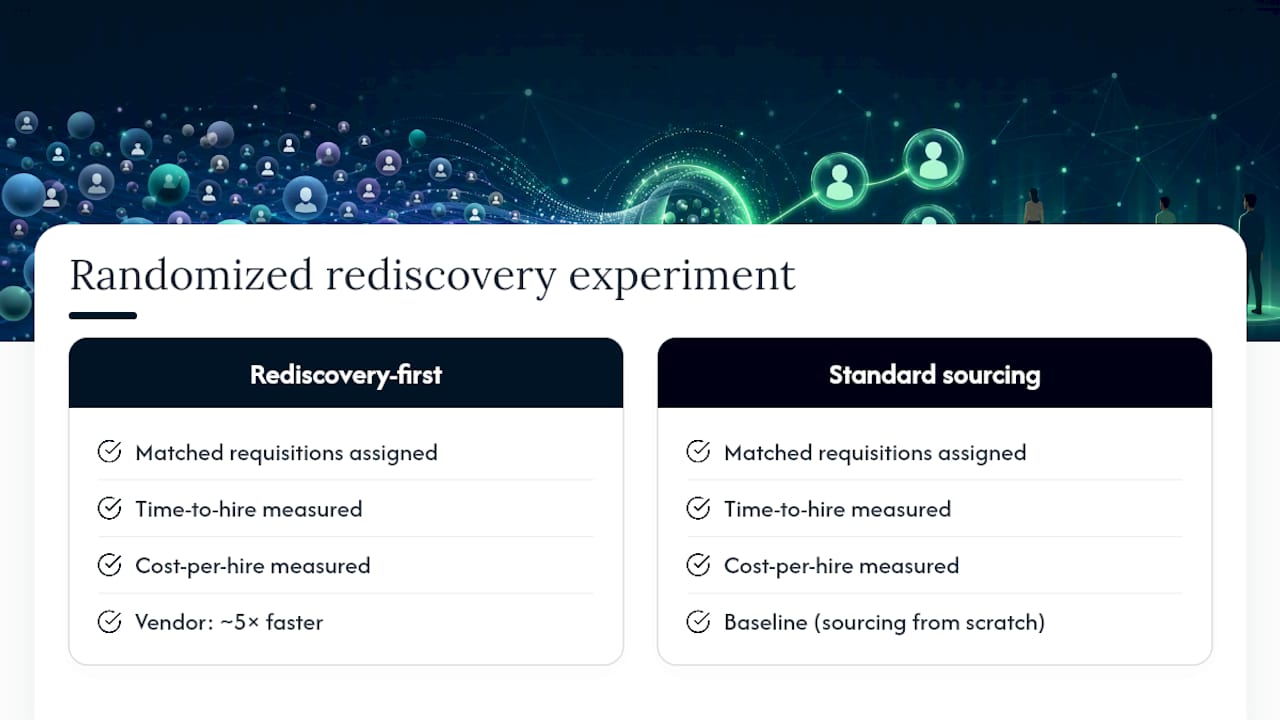
Treat those benchmarks as directional, not guaranteed. Academic work on talent evaluation warns that survivor bias can distort perceived performance when you only measure the candidates who succeeded. The cleaner test: randomize which open requisitions get a rediscovery-first workflow versus standard sourcing, then compare time-to-hire and cost-per-hire across matched role types.
How Recruitify Implements Talent Rediscovery in Practice
Recruitify is built around the operational sequence this article just described: search your own database intelligently before you spend another dollar on external sourcing. Its Contextual Matching AI & Scoring engine reads relationships within a candidate’s tech stack rather than relying on literal keyword hits, and it delivers ranked shortlists with a percentage match score for every open requisition.
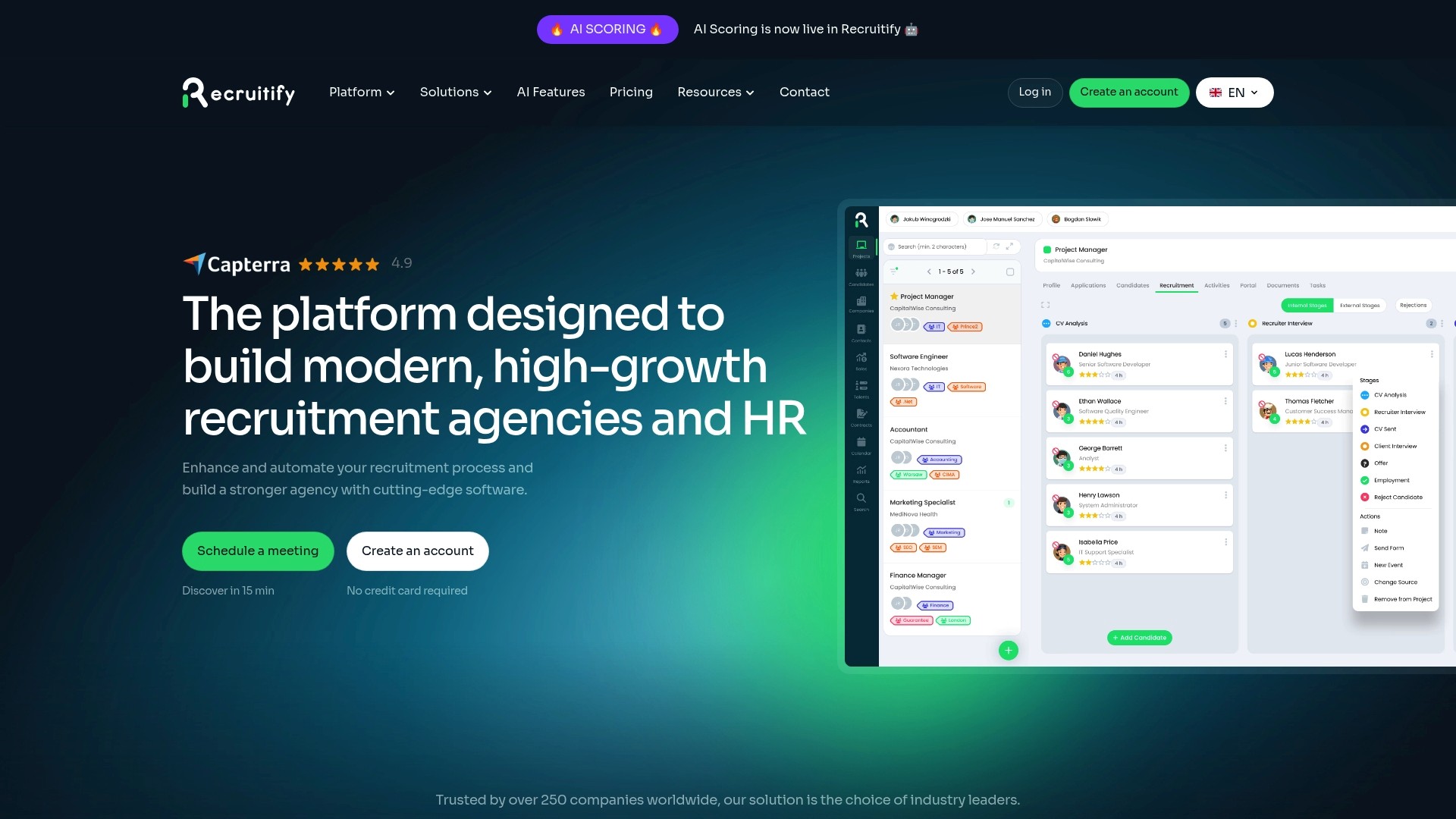
The AI CV Parser with OCR builds a structured profile from any resume format in seconds and flags duplicates automatically, which solves the data hygiene problem most agencies never get around to fixing manually. A GDPR consent management module keeps a full audit trail on every record, so rediscovery outreach stays defensible rather than a compliance gray area. Because the ATS and CRM live in one tab, database monetization isn’t a side project. It’s a byproduct of running your pipeline the way Recruitify’s project management tools are designed for. If your team is still treating every requisition as a cold start, a demo of Recruitify’s automation is the fastest way to see what your existing candidate pool is actually worth.
Recruitify Team Perspective: Why Rediscovery Efforts Stall
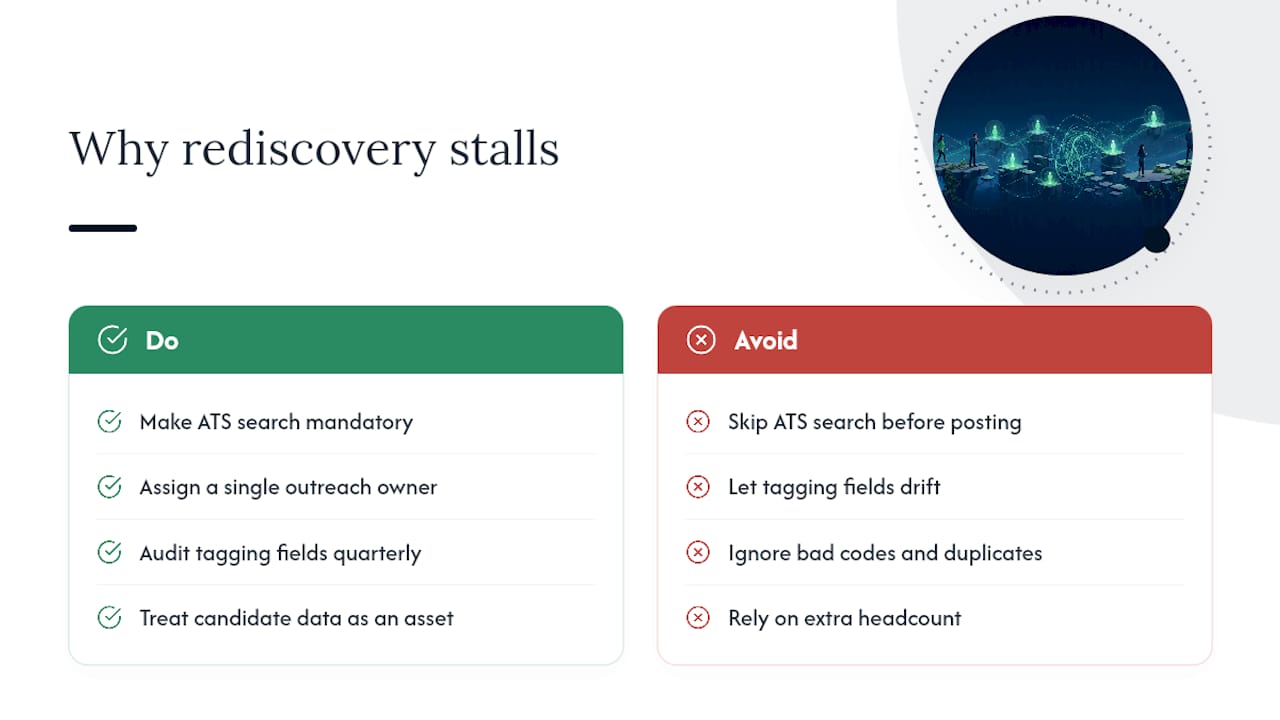
Most rediscovery programs don’t fail because of the technology. They fail because searching the ATS never became a habit, and because the data inside it was too messy to trust. Bad rejection reason codes, missing skill tags, and duplicate profiles all quietly erode confidence until recruiters stop checking altogether.
Three fixes unlock most of the value: make ATS search mandatory before any external posting, assign a single owner to every rediscovery outreach effort, and audit your tagging fields quarterly rather than letting them drift. None of this requires new headcount. It requires treating your existing candidate data as an asset worth maintaining, not a filing cabinet you’ll deal with later.
- Recruitify Team
Sources
Recommended


News & Updates
Stay up-to-date with the latest innovations, features, and tips about Recruitify!
By providing your email address within the newsletter sign-up form, you confirm its processing to send marketing information regarding the Administrator’s products and services. The Administrator of your personal data processed for the abovementioned purposes is Recruitify Spółka z o.o., based in Warsaw, Poland (KRS 0000709889). For more information on the principles of personal data processing and the rights of data subjects, please check the Privacy Policy.

Last updated:
Recruiters: Get Hires 5x Faster with Talent Rediscovery
Acquiring Talent
The Recruitify Team
Talent rediscovery means searching your existing applicant tracking system for qualified past candidates before launching a new sourcing campaign. It works because those candidates already applied, were often already vetted, and know your company. The operational rule is simple: run an ATS search first, every time, and only go external when that search comes up empty. Recruiters who follow this sequence routinely fill roles faster and at lower cost per hire.
TL;DR:
Running an ATS search first for each new requisition can significantly reduce time-to-hire and costs by re-engaging qualified candidates already in the database.
AI-driven tools improve rediscovery accuracy by understanding skills relationships, updating candidate profiles, and providing transparent match scores.
Regularly maintaining data hygiene with consistent tags, rejection codes, and contact information is crucial for effective candidate rediscovery.
Prioritizing candidates who reached later interview stages or made final rounds increases the likelihood of closing roles faster.
Automated workflows, role-based alerts, and clear ownership of outreach efforts enable continuous and scalable talent rediscovery practices.
Table of Contents
What Is Talent Rediscovery and When Should You Use It?
How AI and Automation Transform Rediscovery
A Practical Rediscovery Workflow You Can Run Today
Data Hygiene, Tagging, and Compliance for Reliable Rediscovery
Metrics and ROI: What to Measure and Benchmark
How Recruitify Implements Talent Rediscovery in Practice
Recruitify Team Perspective: Why Rediscovery Efforts Stall
Sources
What Is Talent Rediscovery and When Should You Use It?
Talent rediscovery is the practice of resurfacing qualified candidates already sitting in your database, rather than treating every new requisition as a blank slate. It differs from talent pooling in one important way: pooling is a passive holding pattern, a bucket of “maybe later” resumes. Rediscovery is an active, matching-driven process that pulls specific people forward when a specific role opens.
It works best in a few recurring situations:
Silver medalists: candidates who made the final round for a similar role but lost to another finalist.
Timing casualties: strong applicants who were a great fit but applied when there was no open position.
Repeat or hard-to-fill skill sets: recurring roles like DevOps engineers or SAP consultants, where the same qualifications resurface again and again.
Rediscovery tends to beat cold sourcing on both speed and cost because the vetting work, resume review, screening calls, reference checks, has often already happened. You’re not starting from zero. You’re reopening a file that was closed for the wrong reason: timing, not fit.
How AI and Automation Transform Rediscovery
Manual keyword search misses most of the value sitting in an ATS. A recruiter searching for “Java developer” will skip a candidate whose resume says “backend engineer, Spring Boot” even though the skill set overlaps almost entirely. Contextual matching AI closes that gap by understanding relationships within a tech stack or job history, not just matching literal strings.
Three capabilities make the difference:
Skills inference: the system recognizes that experience with related tools or frameworks implies proficiency in adjacent skills, even when the resume never uses your exact search term.
Profile enrichment: automated tools detect promotions, title changes, and new skills a candidate has picked up since applying, which is what turns a two-year-old CV into a current match. SeekOut notes this enrichment step is the real multiplier behind rediscovery accuracy.
Explainable match scores: instead of a black-box ranking, the recruiter sees why a candidate scored 87% against a requisition, which speeds up shortlist review considerably.
Pro Tip: Run a rediscovery scan the moment a requisition opens, not after your external sourcing has stalled. Waiting means you’ve already spent days and budget on a search your own database might have answered.
Industry guides estimate that 75% of candidates in ATS databases are never contacted again after their initial application. That’s not a data problem so much as a process problem, and it’s exactly what automated matching is built to fix.
A Practical Rediscovery Workflow You Can Run Today
Treat rediscovery as a mandatory step in your intake process, not an optional extra. Here’s a workflow you can put in place this week:
Build a rediscovery checklist into intake. Before any job posting goes live, require a documented ATS search against the new requisition’s core criteria.
Run saved searches and set role-based alerts. Configure recurring searches for roles you fill often, so matching candidates surface automatically rather than depending on someone remembering to look.
Prioritize silver medalists first. Sort by interview stage reached, not just resume score. A candidate who made it to a final round carries more signal than one who was auto-rejected at screening.
Personalize outreach with real context. Reference the specific role they interviewed for and what’s different this time. “You interviewed for our backend role in March. We have a similar opening now with more remote flexibility” performs far better than a generic template.
Give every candidate a clear next step. A vague “let us know if interested” gets ignored. Ask for a 15 minute call, name a specific day.
Assign an owner and a deadline. Rediscovery outreach without a named owner and a follow-up date quietly dies in someone’s inbox.
Tag the outcome. Whether the candidate responds, declines, or goes cold, log it so the next recruiter isn’t repeating your work.
This isn’t a one-time cleanup project. Greenhouse’s own rediscovery documentation frames it as a recurring filter, using fields like last active date and interview stage, that should run on every new opening, not just when someone remembers to check.
Data Hygiene, Tagging, and Compliance for Reliable Rediscovery
Rediscovery is only as good as the data behind it. A handful of fields, consistently maintained, make the difference between a searchable database and a graveyard of unstructured resumes:
Interview stage reached (screened, first-round, final-round, offer-declined)
Rejection reason, coded rather than free text, so you can filter for “lost to another finalist” versus “failed technical screen”
Last contact date and candidate owner
Role and skill tags, ideally generated automatically through CV parsing rather than typed by hand
Enrichment practices matter just as much as the fields themselves: email validation to avoid dead outreach, automated duplicate detection so the same person doesn’t exist under three different profiles, and consistent parsing so a resume uploaded as a scan is just as searchable as one uploaded as a Word file. On the compliance side, consent tracking and anonymization options aren’t optional extras. They’re what makes rediscovery defensible under data protection rules, with a clear audit trail showing when and why a candidate was recontacted.
Metrics and ROI: What to Measure and Benchmark
Four KPIs tell you whether rediscovery is actually working: time-to-hire, response rate to outreach, cost-per-hire, and conversion rate from contact to interview. Vendor data suggests rediscovery can move roughly five times faster than sourcing from scratch, and separate analysis links the speed gain to candidates who already know and trust the company from a prior application.
Treat those benchmarks as directional, not guaranteed. Academic work on talent evaluation warns that survivor bias can distort perceived performance when you only measure the candidates who succeeded. The cleaner test: randomize which open requisitions get a rediscovery-first workflow versus standard sourcing, then compare time-to-hire and cost-per-hire across matched role types.
How Recruitify Implements Talent Rediscovery in Practice
Recruitify is built around the operational sequence this article just described: search your own database intelligently before you spend another dollar on external sourcing. Its Contextual Matching AI & Scoring engine reads relationships within a candidate’s tech stack rather than relying on literal keyword hits, and it delivers ranked shortlists with a percentage match score for every open requisition.
The AI CV Parser with OCR builds a structured profile from any resume format in seconds and flags duplicates automatically, which solves the data hygiene problem most agencies never get around to fixing manually. A GDPR consent management module keeps a full audit trail on every record, so rediscovery outreach stays defensible rather than a compliance gray area. Because the ATS and CRM live in one tab, database monetization isn’t a side project. It’s a byproduct of running your pipeline the way Recruitify’s project management tools are designed for. If your team is still treating every requisition as a cold start, a demo of Recruitify’s automation is the fastest way to see what your existing candidate pool is actually worth.
Recruitify Team Perspective: Why Rediscovery Efforts Stall
Most rediscovery programs don’t fail because of the technology. They fail because searching the ATS never became a habit, and because the data inside it was too messy to trust. Bad rejection reason codes, missing skill tags, and duplicate profiles all quietly erode confidence until recruiters stop checking altogether.
Three fixes unlock most of the value: make ATS search mandatory before any external posting, assign a single owner to every rediscovery outreach effort, and audit your tagging fields quarterly rather than letting them drift. None of this requires new headcount. It requires treating your existing candidate data as an asset worth maintaining, not a filing cabinet you’ll deal with later.
- Recruitify Team
Sources
Recommended
News & Updates
Stay up-to-date with the latest innovations, features, and tips about Recruitify!
By providing your email address within the newsletter sign-up form, you confirm its processing to send marketing information regarding the Administrator’s products and services. The Administrator of your personal data processed for the abovementioned purposes is Recruitify Spółka z o.o., based in Warsaw, Poland (KRS 0000709889). For more information on the principles of personal data processing and the rights of data subjects, please check the Privacy Policy.
Last updated:
Recruiters: Get Hires 5x Faster with Talent Rediscovery
Acquiring Talent
The Recruitify Team
Talent rediscovery means searching your existing applicant tracking system for qualified past candidates before launching a new sourcing campaign. It works because those candidates already applied, were often already vetted, and know your company. The operational rule is simple: run an ATS search first, every time, and only go external when that search comes up empty. Recruiters who follow this sequence routinely fill roles faster and at lower cost per hire.
TL;DR:
Running an ATS search first for each new requisition can significantly reduce time-to-hire and costs by re-engaging qualified candidates already in the database.
AI-driven tools improve rediscovery accuracy by understanding skills relationships, updating candidate profiles, and providing transparent match scores.
Regularly maintaining data hygiene with consistent tags, rejection codes, and contact information is crucial for effective candidate rediscovery.
Prioritizing candidates who reached later interview stages or made final rounds increases the likelihood of closing roles faster.
Automated workflows, role-based alerts, and clear ownership of outreach efforts enable continuous and scalable talent rediscovery practices.
Table of Contents
What Is Talent Rediscovery and When Should You Use It?
How AI and Automation Transform Rediscovery
A Practical Rediscovery Workflow You Can Run Today
Data Hygiene, Tagging, and Compliance for Reliable Rediscovery
Metrics and ROI: What to Measure and Benchmark
How Recruitify Implements Talent Rediscovery in Practice
Recruitify Team Perspective: Why Rediscovery Efforts Stall
Sources
What Is Talent Rediscovery and When Should You Use It?
Talent rediscovery is the practice of resurfacing qualified candidates already sitting in your database, rather than treating every new requisition as a blank slate. It differs from talent pooling in one important way: pooling is a passive holding pattern, a bucket of “maybe later” resumes. Rediscovery is an active, matching-driven process that pulls specific people forward when a specific role opens.
It works best in a few recurring situations:
Silver medalists: candidates who made the final round for a similar role but lost to another finalist.
Timing casualties: strong applicants who were a great fit but applied when there was no open position.
Repeat or hard-to-fill skill sets: recurring roles like DevOps engineers or SAP consultants, where the same qualifications resurface again and again.
Rediscovery tends to beat cold sourcing on both speed and cost because the vetting work, resume review, screening calls, reference checks, has often already happened. You’re not starting from zero. You’re reopening a file that was closed for the wrong reason: timing, not fit.
How AI and Automation Transform Rediscovery
Manual keyword search misses most of the value sitting in an ATS. A recruiter searching for “Java developer” will skip a candidate whose resume says “backend engineer, Spring Boot” even though the skill set overlaps almost entirely. Contextual matching AI closes that gap by understanding relationships within a tech stack or job history, not just matching literal strings.
Three capabilities make the difference:
Skills inference: the system recognizes that experience with related tools or frameworks implies proficiency in adjacent skills, even when the resume never uses your exact search term.
Profile enrichment: automated tools detect promotions, title changes, and new skills a candidate has picked up since applying, which is what turns a two-year-old CV into a current match. SeekOut notes this enrichment step is the real multiplier behind rediscovery accuracy.
Explainable match scores: instead of a black-box ranking, the recruiter sees why a candidate scored 87% against a requisition, which speeds up shortlist review considerably.
Pro Tip: Run a rediscovery scan the moment a requisition opens, not after your external sourcing has stalled. Waiting means you’ve already spent days and budget on a search your own database might have answered.
Industry guides estimate that 75% of candidates in ATS databases are never contacted again after their initial application. That’s not a data problem so much as a process problem, and it’s exactly what automated matching is built to fix.
A Practical Rediscovery Workflow You Can Run Today
Treat rediscovery as a mandatory step in your intake process, not an optional extra. Here’s a workflow you can put in place this week:
Build a rediscovery checklist into intake. Before any job posting goes live, require a documented ATS search against the new requisition’s core criteria.
Run saved searches and set role-based alerts. Configure recurring searches for roles you fill often, so matching candidates surface automatically rather than depending on someone remembering to look.
Prioritize silver medalists first. Sort by interview stage reached, not just resume score. A candidate who made it to a final round carries more signal than one who was auto-rejected at screening.
Personalize outreach with real context. Reference the specific role they interviewed for and what’s different this time. “You interviewed for our backend role in March. We have a similar opening now with more remote flexibility” performs far better than a generic template.
Give every candidate a clear next step. A vague “let us know if interested” gets ignored. Ask for a 15 minute call, name a specific day.
Assign an owner and a deadline. Rediscovery outreach without a named owner and a follow-up date quietly dies in someone’s inbox.
Tag the outcome. Whether the candidate responds, declines, or goes cold, log it so the next recruiter isn’t repeating your work.
This isn’t a one-time cleanup project. Greenhouse’s own rediscovery documentation frames it as a recurring filter, using fields like last active date and interview stage, that should run on every new opening, not just when someone remembers to check.
Data Hygiene, Tagging, and Compliance for Reliable Rediscovery
Rediscovery is only as good as the data behind it. A handful of fields, consistently maintained, make the difference between a searchable database and a graveyard of unstructured resumes:
Interview stage reached (screened, first-round, final-round, offer-declined)
Rejection reason, coded rather than free text, so you can filter for “lost to another finalist” versus “failed technical screen”
Last contact date and candidate owner
Role and skill tags, ideally generated automatically through CV parsing rather than typed by hand
Enrichment practices matter just as much as the fields themselves: email validation to avoid dead outreach, automated duplicate detection so the same person doesn’t exist under three different profiles, and consistent parsing so a resume uploaded as a scan is just as searchable as one uploaded as a Word file. On the compliance side, consent tracking and anonymization options aren’t optional extras. They’re what makes rediscovery defensible under data protection rules, with a clear audit trail showing when and why a candidate was recontacted.
Metrics and ROI: What to Measure and Benchmark
Four KPIs tell you whether rediscovery is actually working: time-to-hire, response rate to outreach, cost-per-hire, and conversion rate from contact to interview. Vendor data suggests rediscovery can move roughly five times faster than sourcing from scratch, and separate analysis links the speed gain to candidates who already know and trust the company from a prior application.
Treat those benchmarks as directional, not guaranteed. Academic work on talent evaluation warns that survivor bias can distort perceived performance when you only measure the candidates who succeeded. The cleaner test: randomize which open requisitions get a rediscovery-first workflow versus standard sourcing, then compare time-to-hire and cost-per-hire across matched role types.
How Recruitify Implements Talent Rediscovery in Practice
Recruitify is built around the operational sequence this article just described: search your own database intelligently before you spend another dollar on external sourcing. Its Contextual Matching AI & Scoring engine reads relationships within a candidate’s tech stack rather than relying on literal keyword hits, and it delivers ranked shortlists with a percentage match score for every open requisition.
The AI CV Parser with OCR builds a structured profile from any resume format in seconds and flags duplicates automatically, which solves the data hygiene problem most agencies never get around to fixing manually. A GDPR consent management module keeps a full audit trail on every record, so rediscovery outreach stays defensible rather than a compliance gray area. Because the ATS and CRM live in one tab, database monetization isn’t a side project. It’s a byproduct of running your pipeline the way Recruitify’s project management tools are designed for. If your team is still treating every requisition as a cold start, a demo of Recruitify’s automation is the fastest way to see what your existing candidate pool is actually worth.
Recruitify Team Perspective: Why Rediscovery Efforts Stall
Most rediscovery programs don’t fail because of the technology. They fail because searching the ATS never became a habit, and because the data inside it was too messy to trust. Bad rejection reason codes, missing skill tags, and duplicate profiles all quietly erode confidence until recruiters stop checking altogether.
Three fixes unlock most of the value: make ATS search mandatory before any external posting, assign a single owner to every rediscovery outreach effort, and audit your tagging fields quarterly rather than letting them drift. None of this requires new headcount. It requires treating your existing candidate data as an asset worth maintaining, not a filing cabinet you’ll deal with later.
- Recruitify Team
Sources
Recommended
News & Updates
Stay up-to-date with the latest innovations, features, and tips about Recruitify!
By providing your email address within the newsletter sign-up form, you confirm its processing to send marketing information regarding the Administrator’s products and services. The Administrator of your personal data processed for the abovementioned purposes is Recruitify Spółka z o.o., based in Warsaw, Poland (KRS 0000709889). For more information on the principles of personal data processing and the rights of data subjects, please check the Privacy Policy.

Discover More

Applicant Tracking System
Contractor Onboarding Checklist for IT Staffing Agencies
A contractor onboarding checklist for agencies and HR teams: classification, US tax forms, GDPR, least-privilege access and gates that stop work before approval.
20 Oct 2026
Discover More

Acquiring Talent
Boolean Search Strings: Operators, Examples and Templates
Learn how to write Boolean search strings for recruiting: operators, LinkedIn and Google X-ray examples, developer templates and mistakes to avoid.
19 Oct 2026
Discover More

Recruitment Process
Recruiter Productivity Metrics: 3 Measures That Expose Funnel Leaks
Choose recruiter productivity metrics that expose funnel leaks, track hiring quality and candidate experience, and show where stage delays hurt results.
18 Oct 2026
Discover More
Applicant Tracking System
Contractor Onboarding Checklist for IT Staffing Agencies
A contractor onboarding checklist for agencies and HR teams: classification, US tax forms, GDPR, least-privilege access and gates that stop work before approval.
20 Oct 2026
Discover More
Acquiring Talent
Boolean Search Strings: Operators, Examples and Templates
Learn how to write Boolean search strings for recruiting: operators, LinkedIn and Google X-ray examples, developer templates and mistakes to avoid.
19 Oct 2026
Discover More