Last updated:
For recruiters: slash your time-to-hire, powered by Recruitify

Innovations

The Recruitify Team
Time to hire measures the number of days between the first touchpoint with a candidate (or their application) and the acceptance of a job offer. While it is an essential metric to track, it only delivers value when evaluated alongside quality of hire, rather than in isolation. Achieving a leaner, faster recruitment process without compromising on the quality of your placements is highly achievable, as demonstrated by the Recruitify case study.
In short:
Reducing your time to hire without sacrificing placement quality is entirely possible by eliminating bottlenecks and automating administrative workflows.
The critical difference between time to hire and time to fill lies in the starting point of the measurement, which heavily influences how you evaluate HR and agency performance.
While the industry benchmark ranges from 20 to 30 days, the true timeline depends heavily on the role's seniority and the complexity of the interview stages.
Best practices require establishing a single, consistent starting point and segmenting reports by department and role seniority.
Implementing Recruitify empowers recruitment agencies to dramatically shorten cycles through automated CV parsing, instant offer generation, and robust talent pooling.
Table of Contents
Definition and Formula: How to Calculate Time to Hire
Time to Hire vs. Time to Fill: Key Differences Explained
What Makes a Good Recruitment Cycle: Industry Benchmarks
How to Track Time to Hire Accurately in Your ATS
How to Shorten Time to Hire Without Compromising Placement Quality
KPI Targets: Avoiding the Speed Trap
Recruitify Case Study: Proven Process Acceleration
Author Perspective: Balancing Speed and Quality
Accelerate Your Time to Hire with Recruitify Automation
Sources
Definition and Formula: How to Calculate Time to Hire
The formula is straightforward: date of offer acceptance minus the date of the candidate's first touchpoint or application. This metric reflects the true efficiency of your recruitment pipeline and directly impacts your candidate experience.
For example, if a candidate applies on 3 March and accepts the offer on 24 March, the time to hire is two and a half weeks. If you make five placements in a month with highly varied cycle times, the median will give you a much more accurate picture than the average. This is because a single complex placement (such as a highly specialised role) can easily skew the average, whereas the median highlights your typical performance.
A few key rules to implement immediately:
Establish a single, consistent starting point definition across your agency and stick to it.
Measure in calendar days rather than working days to ensure consistent comparisons across teams.
Report the median alongside the average when your dataset contains extreme outliers.
Log the offer acceptance date only after a signed contract is secured, not based on a verbal agreement.
Time to Hire vs. Time to Fill: Key Differences Explained
Many recruiters use these terms interchangeably, which distorts your reporting and business decisions. The fundamental difference lies in the starting point.
Time to fill measures the time from when a job vacancy is approved and opened to when a candidate accepts the offer.
Time to hire measures the speed at which a specific candidate moves through your funnel—from their initial application or first outreach to offer acceptance.
This has major practical implications. If a vacancy sat open for three weeks waiting for budget approval before the job ad went live, the time to fill will be significantly longer than the time to hire for the chosen candidate. An agency looking to evaluate the speed of its recruiters' pipeline should focus on time to hire, whereas an agency looking to audit overall client operational efficiency needs to track time to fill.
What Makes a Good Recruitment Cycle: Industry Benchmarks
While there is no single benchmark, it is important to understand the variance across reports. Many industry analyses point to a 20–30 day window as typical for most roles, but aggregated data across all sectors and seniority levels can push this average up to 44 days.
The variance is primarily driven by three factors: the level of technical specialisation required, local talent market dynamics, and the number of stages in your interview process. Recruiting for rare niche skills naturally takes longer than sourcing for entry-level operational roles, and a longer process does not necessarily mean an inefficient one.
Instead of chasing a single generic target, set specific goals for each role category. Sourcing a sales executive and recruiting an IT systems architect require completely different timelines; measuring them with the same metric will only lead to flawed insights.
How to Track Time to Hire Accurately in Your ATS
Reliable measurement begins with data discipline, not just formulas. HR system vendors recommend clearly defining start and end points and deliberately choosing between averages and medians based on your data distribution.
Define the start point as either the application date or the date of the first documented outreach (for active sourcing where no formal application exists).
Log the official offer acceptance date as the final stop point, rather than the candidate's start date.
Configure your ATS to use automatic timestamps for every stage of the recruitment funnel to eliminate manual entry errors.
Audit your data monthly to ensure no records have missing start or end dates.
Segment your reports by department and seniority level instead of relying on a single company-wide average.
Without this level of data discipline, month-on-month comparisons lose their validity, regardless of how advanced your mathematical formula is.
How to Shorten Time to Hire Without Compromising Placement Quality
The greatest time savings do not come from rushing candidate evaluations, but from eliminating administrative friction and communication gaps. Highly effective strategies include pipeline optimisation, strict SLAs, and proactive sourcing.
Consolidate interview stages to the absolute minimum and set firm deadlines for feedback (e.g., maximum 48 hours post-interview).
Establish clear communication SLAs with candidates and hiring managers to ensure no response takes longer than one working day.
Build robust talent pools from past applicants and silver-medallist candidates, rather than starting your sourcing from scratch for every new vacancy.
Automate repetitive administrative tasks like CV parsing and offer letter generation so your recruiters can focus on candidate evaluation instead of paperwork.
Coordinate hiring managers' calendars in advance to secure interview slots and drive swift decisions, rather than chasing stakeholders for weeks.
Delays in recruitment are rarely caused by the recruitment process itself; they are usually the result of fragmented communication between stakeholders.
Professional Tip: Before implementing automation, calculate how many days are lost simply waiting for hiring manager feedback. In many organisations, this bottleneck—not the initial sourcing—is what inflates the time to hire.

Smart automation and warm talent pools improve both speed and the candidate experience—provided your candidate touchpoints remain highly personalised rather than sounding like automated spam.
KPI Targets: Avoiding the Speed Trap
Setting realistic targets for time to hire requires a tailored approach based on the role, rather than imposing a single arbitrary target across the board.
Establish separate time targets for different job categories, taking into account candidate scarcity and market demand.
Compare your time to hire against 90-day retention rates and quality-of-hire metrics to ensure speed isn't leading to bad hiring decisions.
Ensure that pressure to close roles faster doesn't lead to skipping vital screening steps like reference checks or skill assessments.
Monitor your offer rejection rate. A spike in rejections often indicates a process that is fast but disconnected from the candidate's expectations.
Agencies that track speed and quality together avoid the trap of false success, where recruitment KPIs look great on paper but early-stage turnover spikes.
Recruitify Case Study: Proven Process Acceleration
The HR department of a growing professional services firm implemented Recruitify to tackle a bloated recruitment cycle and fragmented communication between recruiters and hiring managers. The results prove that structured process improvements deliver clear, measurable outcomes.
Before implementation, their recruiting relied on scattered spreadsheets and manual candidate tracking.
Post-implementation, automated CV parsing and instant job posting cut administrative overhead at every stage of the funnel.
The introduction of talent pools allowed the team to instantly tap into pre-screened talent for new vacancies.
The team achieved a significant reduction in time to hire alongside a boost in candidate experience scores.
This proves that streamlining your recruitment cycle does not mean cutting corners; it means eliminating administrative friction so you can focus on quality selection.
Author Perspective: Balancing Speed and Quality
Accelerate your process when talent gaps carry real business costs, such as high-volume or shift-based roles. However, maintain absolute rigor for strategic and leadership positions, where a bad hire costs far more than a few extra weeks of searching. A simple test to run is: is a bad hire in this role easy to reverse? If not, speed should not be your primary driver.
— Recruitify Team
Accelerate Your Time to Hire with Recruitify Automation
Recruitify brings your ATS, job posting, candidate management, and recruitment CRM together into a single, high-performance platform, ensuring your recruiters never waste time switching between spreadsheets and inboxes.
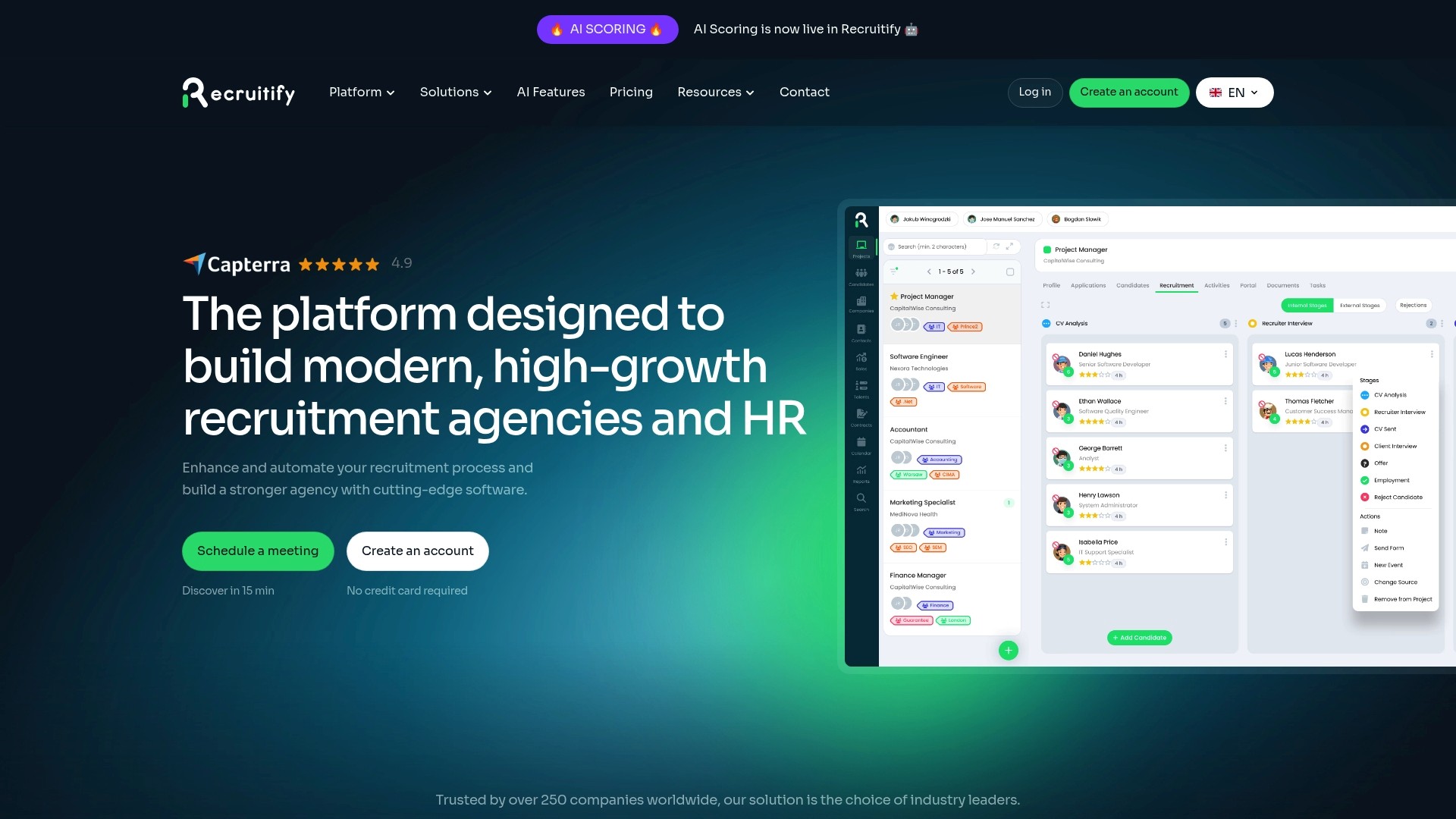
After moving away from spreadsheets and implementing Recruitify, recruitment agencies have gained total control over their candidate database and drastically reduced their time to fill. Automated CV parsing and customizable templates eliminate the manual tasks that often eat up more days than the actual interview process. To see how you can transform your agency's efficiency, explore our ATS solution for HR and recruitment teams and book a free, personalized demo today.
Sources
Recommendations


News & Updates
Stay up-to-date with the latest innovations, features, and tips about Recruitify!
By providing your email address within the newsletter sign-up form, you confirm its processing to send marketing information regarding the Administrator’s products and services. The Administrator of your personal data processed for the abovementioned purposes is Recruitify Spółka z o.o., based in Warsaw, Poland (KRS 0000709889). For more information on the principles of personal data processing and the rights of data subjects, please check the Privacy Policy.

Last updated:
For recruiters: slash your time-to-hire, powered by Recruitify
Innovations
The Recruitify Team
Time to hire measures the number of days between the first touchpoint with a candidate (or their application) and the acceptance of a job offer. While it is an essential metric to track, it only delivers value when evaluated alongside quality of hire, rather than in isolation. Achieving a leaner, faster recruitment process without compromising on the quality of your placements is highly achievable, as demonstrated by the Recruitify case study.
In short:
Reducing your time to hire without sacrificing placement quality is entirely possible by eliminating bottlenecks and automating administrative workflows.
The critical difference between time to hire and time to fill lies in the starting point of the measurement, which heavily influences how you evaluate HR and agency performance.
While the industry benchmark ranges from 20 to 30 days, the true timeline depends heavily on the role's seniority and the complexity of the interview stages.
Best practices require establishing a single, consistent starting point and segmenting reports by department and role seniority.
Implementing Recruitify empowers recruitment agencies to dramatically shorten cycles through automated CV parsing, instant offer generation, and robust talent pooling.
Table of Contents
Definition and Formula: How to Calculate Time to Hire
Time to Hire vs. Time to Fill: Key Differences Explained
What Makes a Good Recruitment Cycle: Industry Benchmarks
How to Track Time to Hire Accurately in Your ATS
How to Shorten Time to Hire Without Compromising Placement Quality
KPI Targets: Avoiding the Speed Trap
Recruitify Case Study: Proven Process Acceleration
Author Perspective: Balancing Speed and Quality
Accelerate Your Time to Hire with Recruitify Automation
Sources
Definition and Formula: How to Calculate Time to Hire
The formula is straightforward: date of offer acceptance minus the date of the candidate's first touchpoint or application. This metric reflects the true efficiency of your recruitment pipeline and directly impacts your candidate experience.
For example, if a candidate applies on 3 March and accepts the offer on 24 March, the time to hire is two and a half weeks. If you make five placements in a month with highly varied cycle times, the median will give you a much more accurate picture than the average. This is because a single complex placement (such as a highly specialised role) can easily skew the average, whereas the median highlights your typical performance.
A few key rules to implement immediately:
Establish a single, consistent starting point definition across your agency and stick to it.
Measure in calendar days rather than working days to ensure consistent comparisons across teams.
Report the median alongside the average when your dataset contains extreme outliers.
Log the offer acceptance date only after a signed contract is secured, not based on a verbal agreement.
Time to Hire vs. Time to Fill: Key Differences Explained
Many recruiters use these terms interchangeably, which distorts your reporting and business decisions. The fundamental difference lies in the starting point.
Time to fill measures the time from when a job vacancy is approved and opened to when a candidate accepts the offer.
Time to hire measures the speed at which a specific candidate moves through your funnel—from their initial application or first outreach to offer acceptance.
This has major practical implications. If a vacancy sat open for three weeks waiting for budget approval before the job ad went live, the time to fill will be significantly longer than the time to hire for the chosen candidate. An agency looking to evaluate the speed of its recruiters' pipeline should focus on time to hire, whereas an agency looking to audit overall client operational efficiency needs to track time to fill.
What Makes a Good Recruitment Cycle: Industry Benchmarks
While there is no single benchmark, it is important to understand the variance across reports. Many industry analyses point to a 20–30 day window as typical for most roles, but aggregated data across all sectors and seniority levels can push this average up to 44 days.
The variance is primarily driven by three factors: the level of technical specialisation required, local talent market dynamics, and the number of stages in your interview process. Recruiting for rare niche skills naturally takes longer than sourcing for entry-level operational roles, and a longer process does not necessarily mean an inefficient one.
Instead of chasing a single generic target, set specific goals for each role category. Sourcing a sales executive and recruiting an IT systems architect require completely different timelines; measuring them with the same metric will only lead to flawed insights.
How to Track Time to Hire Accurately in Your ATS
Reliable measurement begins with data discipline, not just formulas. HR system vendors recommend clearly defining start and end points and deliberately choosing between averages and medians based on your data distribution.
Define the start point as either the application date or the date of the first documented outreach (for active sourcing where no formal application exists).
Log the official offer acceptance date as the final stop point, rather than the candidate's start date.
Configure your ATS to use automatic timestamps for every stage of the recruitment funnel to eliminate manual entry errors.
Audit your data monthly to ensure no records have missing start or end dates.
Segment your reports by department and seniority level instead of relying on a single company-wide average.
Without this level of data discipline, month-on-month comparisons lose their validity, regardless of how advanced your mathematical formula is.
How to Shorten Time to Hire Without Compromising Placement Quality
The greatest time savings do not come from rushing candidate evaluations, but from eliminating administrative friction and communication gaps. Highly effective strategies include pipeline optimisation, strict SLAs, and proactive sourcing.
Consolidate interview stages to the absolute minimum and set firm deadlines for feedback (e.g., maximum 48 hours post-interview).
Establish clear communication SLAs with candidates and hiring managers to ensure no response takes longer than one working day.
Build robust talent pools from past applicants and silver-medallist candidates, rather than starting your sourcing from scratch for every new vacancy.
Automate repetitive administrative tasks like CV parsing and offer letter generation so your recruiters can focus on candidate evaluation instead of paperwork.
Coordinate hiring managers' calendars in advance to secure interview slots and drive swift decisions, rather than chasing stakeholders for weeks.
Delays in recruitment are rarely caused by the recruitment process itself; they are usually the result of fragmented communication between stakeholders.
Professional Tip: Before implementing automation, calculate how many days are lost simply waiting for hiring manager feedback. In many organisations, this bottleneck—not the initial sourcing—is what inflates the time to hire.
Smart automation and warm talent pools improve both speed and the candidate experience—provided your candidate touchpoints remain highly personalised rather than sounding like automated spam.
KPI Targets: Avoiding the Speed Trap
Setting realistic targets for time to hire requires a tailored approach based on the role, rather than imposing a single arbitrary target across the board.
Establish separate time targets for different job categories, taking into account candidate scarcity and market demand.
Compare your time to hire against 90-day retention rates and quality-of-hire metrics to ensure speed isn't leading to bad hiring decisions.
Ensure that pressure to close roles faster doesn't lead to skipping vital screening steps like reference checks or skill assessments.
Monitor your offer rejection rate. A spike in rejections often indicates a process that is fast but disconnected from the candidate's expectations.
Agencies that track speed and quality together avoid the trap of false success, where recruitment KPIs look great on paper but early-stage turnover spikes.
Recruitify Case Study: Proven Process Acceleration
The HR department of a growing professional services firm implemented Recruitify to tackle a bloated recruitment cycle and fragmented communication between recruiters and hiring managers. The results prove that structured process improvements deliver clear, measurable outcomes.
Before implementation, their recruiting relied on scattered spreadsheets and manual candidate tracking.
Post-implementation, automated CV parsing and instant job posting cut administrative overhead at every stage of the funnel.
The introduction of talent pools allowed the team to instantly tap into pre-screened talent for new vacancies.
The team achieved a significant reduction in time to hire alongside a boost in candidate experience scores.
This proves that streamlining your recruitment cycle does not mean cutting corners; it means eliminating administrative friction so you can focus on quality selection.
Author Perspective: Balancing Speed and Quality
Accelerate your process when talent gaps carry real business costs, such as high-volume or shift-based roles. However, maintain absolute rigor for strategic and leadership positions, where a bad hire costs far more than a few extra weeks of searching. A simple test to run is: is a bad hire in this role easy to reverse? If not, speed should not be your primary driver.
— Recruitify Team
Accelerate Your Time to Hire with Recruitify Automation
Recruitify brings your ATS, job posting, candidate management, and recruitment CRM together into a single, high-performance platform, ensuring your recruiters never waste time switching between spreadsheets and inboxes.
After moving away from spreadsheets and implementing Recruitify, recruitment agencies have gained total control over their candidate database and drastically reduced their time to fill. Automated CV parsing and customizable templates eliminate the manual tasks that often eat up more days than the actual interview process. To see how you can transform your agency's efficiency, explore our ATS solution for HR and recruitment teams and book a free, personalized demo today.
Sources
Recommendations
News & Updates
Stay up-to-date with the latest innovations, features, and tips about Recruitify!
By providing your email address within the newsletter sign-up form, you confirm its processing to send marketing information regarding the Administrator’s products and services. The Administrator of your personal data processed for the abovementioned purposes is Recruitify Spółka z o.o., based in Warsaw, Poland (KRS 0000709889). For more information on the principles of personal data processing and the rights of data subjects, please check the Privacy Policy.
Last updated:
For recruiters: slash your time-to-hire, powered by Recruitify
Innovations
The Recruitify Team
Time to hire measures the number of days between the first touchpoint with a candidate (or their application) and the acceptance of a job offer. While it is an essential metric to track, it only delivers value when evaluated alongside quality of hire, rather than in isolation. Achieving a leaner, faster recruitment process without compromising on the quality of your placements is highly achievable, as demonstrated by the Recruitify case study.
In short:
Reducing your time to hire without sacrificing placement quality is entirely possible by eliminating bottlenecks and automating administrative workflows.
The critical difference between time to hire and time to fill lies in the starting point of the measurement, which heavily influences how you evaluate HR and agency performance.
While the industry benchmark ranges from 20 to 30 days, the true timeline depends heavily on the role's seniority and the complexity of the interview stages.
Best practices require establishing a single, consistent starting point and segmenting reports by department and role seniority.
Implementing Recruitify empowers recruitment agencies to dramatically shorten cycles through automated CV parsing, instant offer generation, and robust talent pooling.
Table of Contents
Definition and Formula: How to Calculate Time to Hire
Time to Hire vs. Time to Fill: Key Differences Explained
What Makes a Good Recruitment Cycle: Industry Benchmarks
How to Track Time to Hire Accurately in Your ATS
How to Shorten Time to Hire Without Compromising Placement Quality
KPI Targets: Avoiding the Speed Trap
Recruitify Case Study: Proven Process Acceleration
Author Perspective: Balancing Speed and Quality
Accelerate Your Time to Hire with Recruitify Automation
Sources
Definition and Formula: How to Calculate Time to Hire
The formula is straightforward: date of offer acceptance minus the date of the candidate's first touchpoint or application. This metric reflects the true efficiency of your recruitment pipeline and directly impacts your candidate experience.
For example, if a candidate applies on 3 March and accepts the offer on 24 March, the time to hire is two and a half weeks. If you make five placements in a month with highly varied cycle times, the median will give you a much more accurate picture than the average. This is because a single complex placement (such as a highly specialised role) can easily skew the average, whereas the median highlights your typical performance.
A few key rules to implement immediately:
Establish a single, consistent starting point definition across your agency and stick to it.
Measure in calendar days rather than working days to ensure consistent comparisons across teams.
Report the median alongside the average when your dataset contains extreme outliers.
Log the offer acceptance date only after a signed contract is secured, not based on a verbal agreement.
Time to Hire vs. Time to Fill: Key Differences Explained
Many recruiters use these terms interchangeably, which distorts your reporting and business decisions. The fundamental difference lies in the starting point.
Time to fill measures the time from when a job vacancy is approved and opened to when a candidate accepts the offer.
Time to hire measures the speed at which a specific candidate moves through your funnel—from their initial application or first outreach to offer acceptance.
This has major practical implications. If a vacancy sat open for three weeks waiting for budget approval before the job ad went live, the time to fill will be significantly longer than the time to hire for the chosen candidate. An agency looking to evaluate the speed of its recruiters' pipeline should focus on time to hire, whereas an agency looking to audit overall client operational efficiency needs to track time to fill.
What Makes a Good Recruitment Cycle: Industry Benchmarks
While there is no single benchmark, it is important to understand the variance across reports. Many industry analyses point to a 20–30 day window as typical for most roles, but aggregated data across all sectors and seniority levels can push this average up to 44 days.
The variance is primarily driven by three factors: the level of technical specialisation required, local talent market dynamics, and the number of stages in your interview process. Recruiting for rare niche skills naturally takes longer than sourcing for entry-level operational roles, and a longer process does not necessarily mean an inefficient one.
Instead of chasing a single generic target, set specific goals for each role category. Sourcing a sales executive and recruiting an IT systems architect require completely different timelines; measuring them with the same metric will only lead to flawed insights.
How to Track Time to Hire Accurately in Your ATS
Reliable measurement begins with data discipline, not just formulas. HR system vendors recommend clearly defining start and end points and deliberately choosing between averages and medians based on your data distribution.
Define the start point as either the application date or the date of the first documented outreach (for active sourcing where no formal application exists).
Log the official offer acceptance date as the final stop point, rather than the candidate's start date.
Configure your ATS to use automatic timestamps for every stage of the recruitment funnel to eliminate manual entry errors.
Audit your data monthly to ensure no records have missing start or end dates.
Segment your reports by department and seniority level instead of relying on a single company-wide average.
Without this level of data discipline, month-on-month comparisons lose their validity, regardless of how advanced your mathematical formula is.
How to Shorten Time to Hire Without Compromising Placement Quality
The greatest time savings do not come from rushing candidate evaluations, but from eliminating administrative friction and communication gaps. Highly effective strategies include pipeline optimisation, strict SLAs, and proactive sourcing.
Consolidate interview stages to the absolute minimum and set firm deadlines for feedback (e.g., maximum 48 hours post-interview).
Establish clear communication SLAs with candidates and hiring managers to ensure no response takes longer than one working day.
Build robust talent pools from past applicants and silver-medallist candidates, rather than starting your sourcing from scratch for every new vacancy.
Automate repetitive administrative tasks like CV parsing and offer letter generation so your recruiters can focus on candidate evaluation instead of paperwork.
Coordinate hiring managers' calendars in advance to secure interview slots and drive swift decisions, rather than chasing stakeholders for weeks.
Delays in recruitment are rarely caused by the recruitment process itself; they are usually the result of fragmented communication between stakeholders.
Professional Tip: Before implementing automation, calculate how many days are lost simply waiting for hiring manager feedback. In many organisations, this bottleneck—not the initial sourcing—is what inflates the time to hire.
Smart automation and warm talent pools improve both speed and the candidate experience—provided your candidate touchpoints remain highly personalised rather than sounding like automated spam.
KPI Targets: Avoiding the Speed Trap
Setting realistic targets for time to hire requires a tailored approach based on the role, rather than imposing a single arbitrary target across the board.
Establish separate time targets for different job categories, taking into account candidate scarcity and market demand.
Compare your time to hire against 90-day retention rates and quality-of-hire metrics to ensure speed isn't leading to bad hiring decisions.
Ensure that pressure to close roles faster doesn't lead to skipping vital screening steps like reference checks or skill assessments.
Monitor your offer rejection rate. A spike in rejections often indicates a process that is fast but disconnected from the candidate's expectations.
Agencies that track speed and quality together avoid the trap of false success, where recruitment KPIs look great on paper but early-stage turnover spikes.
Recruitify Case Study: Proven Process Acceleration
The HR department of a growing professional services firm implemented Recruitify to tackle a bloated recruitment cycle and fragmented communication between recruiters and hiring managers. The results prove that structured process improvements deliver clear, measurable outcomes.
Before implementation, their recruiting relied on scattered spreadsheets and manual candidate tracking.
Post-implementation, automated CV parsing and instant job posting cut administrative overhead at every stage of the funnel.
The introduction of talent pools allowed the team to instantly tap into pre-screened talent for new vacancies.
The team achieved a significant reduction in time to hire alongside a boost in candidate experience scores.
This proves that streamlining your recruitment cycle does not mean cutting corners; it means eliminating administrative friction so you can focus on quality selection.
Author Perspective: Balancing Speed and Quality
Accelerate your process when talent gaps carry real business costs, such as high-volume or shift-based roles. However, maintain absolute rigor for strategic and leadership positions, where a bad hire costs far more than a few extra weeks of searching. A simple test to run is: is a bad hire in this role easy to reverse? If not, speed should not be your primary driver.
— Recruitify Team
Accelerate Your Time to Hire with Recruitify Automation
Recruitify brings your ATS, job posting, candidate management, and recruitment CRM together into a single, high-performance platform, ensuring your recruiters never waste time switching between spreadsheets and inboxes.
After moving away from spreadsheets and implementing Recruitify, recruitment agencies have gained total control over their candidate database and drastically reduced their time to fill. Automated CV parsing and customizable templates eliminate the manual tasks that often eat up more days than the actual interview process. To see how you can transform your agency's efficiency, explore our ATS solution for HR and recruitment teams and book a free, personalized demo today.
Sources
Recommendations
News & Updates
Stay up-to-date with the latest innovations, features, and tips about Recruitify!
By providing your email address within the newsletter sign-up form, you confirm its processing to send marketing information regarding the Administrator’s products and services. The Administrator of your personal data processed for the abovementioned purposes is Recruitify Spółka z o.o., based in Warsaw, Poland (KRS 0000709889). For more information on the principles of personal data processing and the rights of data subjects, please check the Privacy Policy.

Discover More

Applicant Tracking System
Contractor Onboarding Checklist for IT Staffing Agencies
A contractor onboarding checklist for agencies and HR teams: classification, US tax forms, GDPR, least-privilege access and gates that stop work before approval.
20 Oct 2026
Discover More

Acquiring Talent
Boolean Search Strings: Operators, Examples and Templates
Learn how to write Boolean search strings for recruiting: operators, LinkedIn and Google X-ray examples, developer templates and mistakes to avoid.
19 Oct 2026
Discover More

Recruitment Process
Recruiter Productivity Metrics: 3 Measures That Expose Funnel Leaks
Choose recruiter productivity metrics that expose funnel leaks, track hiring quality and candidate experience, and show where stage delays hurt results.
18 Oct 2026
Discover More
Applicant Tracking System
Contractor Onboarding Checklist for IT Staffing Agencies
A contractor onboarding checklist for agencies and HR teams: classification, US tax forms, GDPR, least-privilege access and gates that stop work before approval.
20 Oct 2026
Discover More
Acquiring Talent
Boolean Search Strings: Operators, Examples and Templates
Learn how to write Boolean search strings for recruiting: operators, LinkedIn and Google X-ray examples, developer templates and mistakes to avoid.
19 Oct 2026
Discover More