

Last updated:
AI Scoring in Recruitment: The smarter way to screen talent without losing the human touch

Innovations

Iwo Paliszewski
Your ATS should remember what recruiters inevitably forget
For a long time, one of the biggest challenges in recruitment was attracting enough candidates. Today, in many projects, the problem is almost the opposite.
Recruiters are not struggling with a lack of applications. They are struggling with the sheer volume of time required to identify which ones actually deserve their attention. A single job post can easily generate dozens or even hundreds of CVs in a very short space of time. Some are highly relevant. Some are only loosely connected to the role. Some have been meticulously crafted using AI. Others are sent out as part of a mass-applying strategy – without much thought. There are also those where location, experience level, or even the candidate's actual identity require much closer verification.
This does not mean, of course, that applications written with the help of artificial intelligence are automatically bad. Many great professionals use AI simply to polish the structure or language of their CVs. The real issue is the sheer volume of these applications clashing with a recruiter’s finite pool of attention.
The more "polished" CVs become, the harder it is at first glance to distinguish a candidate with a genuinely strong fit from one who simply knows how to present themselves well. This is exactly where the initial application screening (screening) has quietly become one of the most challenging stages of modern recruitment.
Screening used to be simple. In theory, at least
The recruiter opens a CV, checks the candidate's experience, compares it to the job description, glances at skills, seniority, location, language proficiency, and employment history – and decides whether the person moves forward.
Written in a single sentence, it still sounds straightforward. But in practice, it almost never is.
Imagine recruiting for a Finance Manager role with 120 applications. The role requires strong experience in reporting, budgeting, forecasting, business partnering, advanced Excel, SAP knowledge, and fluent English.
The first candidate has ten years of experience in accounting, but there is virtually no trace of forecasting in their CV.
The second worked in FP&A, but only in a junior capacity.
The third looks almost perfect, but their CV is oddly brief about team management.
The fourth uses completely different terminology, even though their practical experience might be exactly what you are looking for.
Now multiply those comparisons by 120.
The recruiter is not just reading documents. They are constantly jumping between criteria, making micro-judgements, trying to keep previous candidates in mind, and fighting to remain consistent throughout the entire process.
After the first 20 CVs, concentration levels are usually still very high. After 60, the process becomes mechanical. Past the hundred mark, even an exceptionally experienced talent acquisition specialist will start to rely more heavily on shortcuts and mental biases.
This is not a criticism of recruiters. This is simply how human attention works.
Why keywords are no longer enough
Traditional screening often relies on keywords, job titles, listed skills, or years of experience. These filters are useful, but they rarely tell the whole story.
A candidate might mention "SAP" just once in their CV, but that does not tell us whether they used it daily for five years or just participated in a single implementation project. Someone might list "Team Management", but this could have meant informally coordinating the work of two people, rather than running a large department. Another candidate might have the perfect technical background but described it using completely different terminology to the company's brief.
This is the biggest weakness of purely keyword-based screening. Keywords only tell us that something appears in the document. They rarely explain what that experience actually means.
Recruitment is not about mechanically matching individual words. It is about interpreting context.
That is why a candidate can look average on paper and yet turn out to be an absolute superstar after the first conversation. Sometimes a CV is simply poorly written. Sometimes a person has great experience but does not know how to "sell" it effectively. Sometimes they come from a different industry, but their hard skills are 100% transferable to your environment.
A great recruiter spots these nuances. And technology should assist them in doing so, rather than hiding them.
What AI Scoring in Recruitify actually does
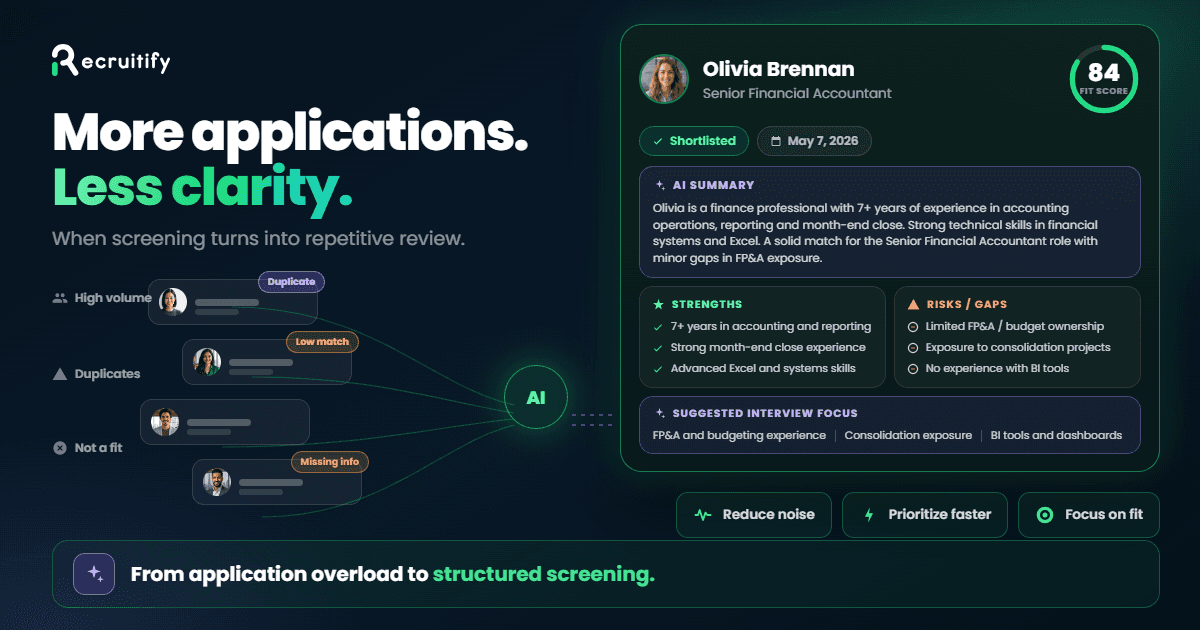
The AI Scoring feature in Recruitify was created to support recruiters exactly at this stage. It evaluates both newly incoming applications and candidates already assigned to a project. It compares the information contained in the CV with the requirements defined for the specific role.
Instead of just a numerical match score, the recruiter receives a contextual summary explaining how the profile aligns with the role. The system highlights strengths, identifies gaps, shows which criteria appear to be met and which are missing, and suggests crucial questions that are absolutely worth asking during the first interview.
Most importantly: the numerical score is not meant to be the final answer. It is designed to be a starting point.
Let us go back to the Finance Manager example. A candidate might receive a score of 78. In itself, this number says almost nothing. The real value lies in the reasoning behind it.
The system might show that the candidate has over ten years of experience in financial reporting, great exposure to an international SSC environment, and solid SAP skills. At the same time, it might flag that the profile lacks solid evidence of experience in budgeting, forecasting, and operational business support.
This offers genuine support to the recruiter. Not a final verdict, but a clear direction. The recruiter instantly knows what looks promising, what might be missing, and what needs to be thoroughly explored during the upcoming interview.
A scoring system should help you ask better questions
One of the most valuable aspects of our AI Scoring is the interview guide it generates.
In traditional screening, the absence of a specific word in a document often leads the recruiter to make a snap judgement. They do not see hard evidence of a skill, so they assume the candidate simply does not have it. Sometimes that assumption is correct. Often, it is the exact opposite.
By definition, a CV is always an incomplete document. It is a summary where candidates naturally focus on what they personally deem most important. They might omit a project that is crucial to you, use an overly general description instead of a specific, concrete example, or simply fail to convey the scope of their decision-making authority.
Therefore, a missing criterion should, in many cases, prompt a question from the recruiter rather than immediate rejection.
For example:
"Could you walk me step-by-step through the budgeting process you were responsible for?"
"How much direct contact did you have with business stakeholders?"
"What was your exact role during the SAP implementation?"
"Did you manage the team formally, or did you only operationally coordinate the work of others?"
These targeted questions can completely shift the recruiter's perspective. And that means a truly useful scoring tool must do much more than blindly categorise candidates. It should assist the recruiter in conducting an intelligent investigation. This is the fundamental difference between automation that simply cuts time, and automation that elevates the qualitative depth of the entire process.
True value is not just about speed
It is easy to market AI Scoring purely as a time-saving feature. And indeed, it delivers that brilliantly.
However, the much more compelling and commercially significant benefit is not that recruiters can browse CVs faster. It is that they can direct their valuable attention much more intelligently. A recruiter who spends less time manually, line-by-line, comparing dozens of CVs can spend much more of it in meaningful conversations with top talent, advising hiring managers, ensuring great communication, and building relationships for future projects.
This is particularly important because productivity in recruitment is often misunderstood. Higher activity does not necessarily translate to higher quality work.
Sending more emails, opening hundreds of PDFs, and relentlessly pushing profiles through system stages looks impressive on activity reports, but it rarely leads to objectively better hiring decisions. Real productivity is simply the optimal allocation of your own attention.
If technology helps a recruiter identify the right profiles sooner, prepare sharp, relevant questions, and bypass repetitive, mechanical assessment, it creates value that goes far beyond raw operational speed.
Application Radar and AI Scoring solve two different problems
AI Scoring reaches its full potential when combined with another key feature in Recruitify – Application Radar. Both features work hand-in-hand, but they serve completely different purposes.
Application Radar assists recruiters in quickly filtering incoming applications based on the candidate's actual location and provides other "soft" context about the applicant. This tool is invaluable when a job post generates massive traffic from regions outside the target location or when the application itself lacks broader context.
On the other hand, AI Scoring evaluates the candidate's specific professional match to the open role. Put simply:
Application Radar answers the question: "Who is applying, and what additional context do we need to know about them?"
AI Scoring answers the question: "How well does this specific candidate match the requirements of our role?"
Together, they create a highly robust, structured evaluation matrix. One tool cuts out the noise and adds market context, while the other assesses core professional suitability. This synergy dramatically elevates recruiter productivity – especially in massive, high-volume recruitment drives.
However, we need to talk about the risks
Technology constantly trains us to work at a faster pace. We expect search results in a fraction of a second. We assume recommendations will be highly personalised instantly. We expect systems to tell us what to read, what to watch, what to buy, and how to structure our priorities.
Applicant Tracking Systems (ATS) are moving in the exact same direction. While highly beneficial, this introduces a new, dangerous risk. The more we rely on scores, recommendations, and raw rankings, the easier it becomes to stop looking beneath the surface.
Imagine a recruiter who starts treating a score of 75 as an unofficial cut-off line. Candidates above this threshold are shortlisted. Those below are instantly rejected.
Initially, this will feel like a breath of fresh air and a huge efficiency boost. Over time, however, they might stop questioning the assessment score altogether. Yet, a candidate with a score of 68 might possess non-traditional, but incredibly relevant experience for the role. Another might come from a completely different industry but bring a set of transferable skills that a hiring manager would value immensely. Someone else might have a poorly structured CV but shine as an absolute powerhouse of intellect and competence in person.
If a recruiter stops looking below a certain score threshold, technology ceases to support their judgment and begins to replace it. And that is not the purpose of AI Scoring. A score is not the ultimate truth. It is simply a mathematical interpretation of available information based on the criteria provided.
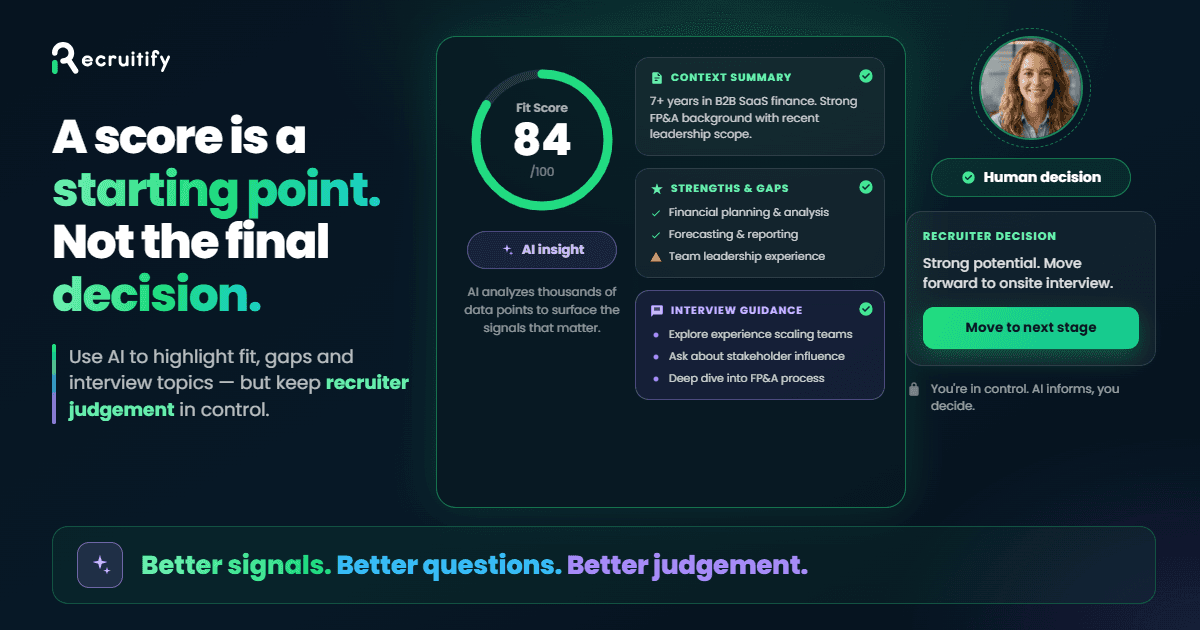
If a CV has gaps, the assessment will likely reflect that. If the requirements in the job post are extremely vague, the system will generate misleading scores. And if a recruiter relies 100% on the score alone, bypassing their own professional instinct, exceptional talent will remain buried in the database without ever receiving a phone call.
That is why recruiters should treat the system as a guiding compass, not a closed gate. Technology is here to sharpen our vision, not to act as blinders.
A great evaluation always starts with a well-defined role
We always emphasize one thing: AI Scoring is only as good as the criteria you feed it. If the job description is vague, detached from reality, or too broad, do not expect a perfect candidate ranking on the other end.
A requirement like "Strong financial experience" is a cliché. What does that actually mean for your business? Reporting? Controlling? Operational budgeting? Audit? Accounting? Acting as a business partner, or raw financial analysis?
The same applies to terms like "Leadership skills", "Commercial acumen", or the highly overused "Excellent communication". They sound great in a job post but are virtually impossible to evaluate until you translate them into concrete details. Does leadership in your company mean managing ten people? Running matrix projects? Influencing stakeholders without formal authority over them?
The more concrete and unambiguous the criteria, the more powerful the Scoring becomes. This also produces a highly valuable side effect: using this feature instantly exposes gaps in the hiring brief provided by the business.
Sometimes the real problem is not that candidates in the market do not fit the role. The problem is that no one in the company has clearly defined what "fit" actually looks like. In this regard, AI can elevate not just CV selection, but the quality and maturity of the conversations between the recruiter and the business before the search even begins.
At the end of the day, the recruiter makes the decision
Every time artificial intelligence is used to evaluate human candidates, the same question arises: "Will the system ultimately decide who we hire?".
With Recruitify, the answer is always a definitive NO. The recruiter remains firmly in control.
AI Scoring organises information amidst the chaos, identifies interesting patterns, and helps prioritise search efforts with great precision. However, it will never understand the deep cultural context of a specific team, the nuances of a hiring manager, a client's complex business situation, or a candidate's genuine human motivation.
No algorithm can evaluate the chemistry between people during a challenging video call. It cannot measure the scale of someone's growth potential. It will not predict that a hiring manager might willingly waive a hard requirement because another skill they spotted in a candidate suddenly became ten times more valuable for the project. It cannot replace the essential curiosity of a skilled recruiter.
A candidate scored at the top of the scale is not guaranteed to be the only right choice. And one with a slightly lower score might still turn out to be the perfect hire for the organization.
That is why the "human element" will always remain the cornerstone of the hiring process. Great technology is designed to eliminate repetitive, manual admin across multiple screens. Its role is not to strip recruiters of their professional judgment.
Consistency is valuable. But flexibility builds great teams
One of the greatest advantages of AI Scoring is its absolute consistency during the screening stage. Candidates are measured against the exact same criteria, creating a much stronger and more objective first layer of comparison. This is a massive asset, as manual screening can often fall short of this ideal.
Two headhunters might interpret the same requirement in completely different ways. The same recruiter might make different decisions depending on how busy their day is, time pressures, or even the order in which they view applications. Rankings provide a solid benchmark, and that is excellent. However, they should never become rigid rules.
Different projects and companies inevitably require different compromises. An ultra-rare, niche skill will often trump ten years of industry experience. A leader's potential to scale a department can carry more weight than years spent in the same seat. A candidate might lack one specific requirement from the job post, yet bring something so remarkable to the table that it completely shifts the direction of the hiring discussion.
A recruitment system's consistency in evaluating applications is essential for fair market comparison. The flexibility of human instinct is the key to securing a great hire. A world-class selection process constantly balances both dimensions.
Better screening does not mean automated rejection
There is a vast difference between using the power of AI to assist with initial selection and using it strictly as an automated gatekeeper. The AI Scoring functionality in Recruitify was built from the ground up to support human decision-making. It is not an automated machine designed to auto-reject CVs.
The core objective was to enable recruiters to decode a candidate's potential faster and more accurately, spot information gaps to address in interviews, and enter discussions exceptionally well-prepared. Every score generated by the engine must be viewed deeply within the specific business context, as even the best-trained algorithm has its limits.
Remember: the machine calculates based precisely on the data it is fed. If an applicant forgot to mention a specific aspect of their career, the machine cannot guess they did it. If a recruiter sets unrealistic or incorrect requirements in the system, the machine will measure candidates against that flawed benchmark. And if the definition of success for a role changes during the hiring process, the evaluation matrix must be rebuilt to maintain accuracy.
This is why nothing can replace absolute transparency from us as software creators. The view the recruiter sees is not just a random generated number. They must see the objective reasons behind the score, a summary of the CV, flagged risks, and the specific competency areas that boosted the score.
A number without clear context quickly creates a blind dependency that can harm your business. A transparently explained score, however, acts as a highly professional, measurable co-pilot in the decision-making process.
Recruitment is accelerating. Let's ensure it doesn't lose its human intelligence
There is no doubt that recruitment technology will continue to advance rapidly. Initial screening will become even faster. Profile-to-job matching will become highly refined, and intelligent automation will handle more administrative, paper-heavy tasks.
And that is brilliant news.
We can all agree that recruiters are not here to drown in Excel spreadsheets or hop between browser tabs for tasks that digital solutions can handle in milliseconds. However, efficiency measured purely by stopwatches and KPIs should never become the end goal.
The complex game of talent acquisition is still played on a chessboard made of people. It relies heavily on incomplete, non-linear streams of information and requires highly mature judgment in ever-changing conditions. The best talent in the market rarely looks perfect on a single sheet of paper. The highest score in an ATS algorithm is not a guarantee of a perfect, long-term hire. And just because a skill was not visible on screen does not mean it does not exist.
The artificial intelligence driving innovation in modern HR was not created to turn hiring into a fully automated, mindless assembly line. Its primary mission is to empower professional recruiters to be as sharp, prepared, and effective as they have always been. The philosophy behind Recruitify's AI Scoring was built precisely around this goal.
It is a powerful tool to optimise selection. It helps evaluate profiles hundreds of times faster and without bias, instantly captures the full context, and maps out key questions, perfectly equipping you before you step into an interview.
But when it comes to deciding what actually matters to the business – recruiters are the ones making the final call. And that is exactly how it should always be. Algorithmic software should never make the final hiring decision for us.
It should simply shine a powerful spotlight on the exact individuals who truly warrant your closest attention.


News & Updates
Stay up-to-date with the latest innovations, features, and tips about Recruitify!
By providing your email address within the newsletter sign-up form, you confirm its processing to send marketing information regarding the Administrator’s products and services. The Administrator of your personal data processed for the abovementioned purposes is Recruitify Spółka z o.o., based in Warsaw, Poland (KRS 0000709889). For more information on the principles of personal data processing and the rights of data subjects, please check the Privacy Policy.

Last updated:
AI Scoring in Recruitment: The smarter way to screen talent without losing the human touch
Innovations
Iwo Paliszewski
Your ATS should remember what recruiters inevitably forget
For a long time, one of the biggest challenges in recruitment was attracting enough candidates. Today, in many projects, the problem is almost the opposite.
Recruiters are not struggling with a lack of applications. They are struggling with the sheer volume of time required to identify which ones actually deserve their attention. A single job post can easily generate dozens or even hundreds of CVs in a very short space of time. Some are highly relevant. Some are only loosely connected to the role. Some have been meticulously crafted using AI. Others are sent out as part of a mass-applying strategy – without much thought. There are also those where location, experience level, or even the candidate's actual identity require much closer verification.
This does not mean, of course, that applications written with the help of artificial intelligence are automatically bad. Many great professionals use AI simply to polish the structure or language of their CVs. The real issue is the sheer volume of these applications clashing with a recruiter’s finite pool of attention.
The more "polished" CVs become, the harder it is at first glance to distinguish a candidate with a genuinely strong fit from one who simply knows how to present themselves well. This is exactly where the initial application screening (screening) has quietly become one of the most challenging stages of modern recruitment.
Screening used to be simple. In theory, at least
The recruiter opens a CV, checks the candidate's experience, compares it to the job description, glances at skills, seniority, location, language proficiency, and employment history – and decides whether the person moves forward.
Written in a single sentence, it still sounds straightforward. But in practice, it almost never is.
Imagine recruiting for a Finance Manager role with 120 applications. The role requires strong experience in reporting, budgeting, forecasting, business partnering, advanced Excel, SAP knowledge, and fluent English.
The first candidate has ten years of experience in accounting, but there is virtually no trace of forecasting in their CV.
The second worked in FP&A, but only in a junior capacity.
The third looks almost perfect, but their CV is oddly brief about team management.
The fourth uses completely different terminology, even though their practical experience might be exactly what you are looking for.
Now multiply those comparisons by 120.
The recruiter is not just reading documents. They are constantly jumping between criteria, making micro-judgements, trying to keep previous candidates in mind, and fighting to remain consistent throughout the entire process.
After the first 20 CVs, concentration levels are usually still very high. After 60, the process becomes mechanical. Past the hundred mark, even an exceptionally experienced talent acquisition specialist will start to rely more heavily on shortcuts and mental biases.
This is not a criticism of recruiters. This is simply how human attention works.
Why keywords are no longer enough
Traditional screening often relies on keywords, job titles, listed skills, or years of experience. These filters are useful, but they rarely tell the whole story.
A candidate might mention "SAP" just once in their CV, but that does not tell us whether they used it daily for five years or just participated in a single implementation project. Someone might list "Team Management", but this could have meant informally coordinating the work of two people, rather than running a large department. Another candidate might have the perfect technical background but described it using completely different terminology to the company's brief.
This is the biggest weakness of purely keyword-based screening. Keywords only tell us that something appears in the document. They rarely explain what that experience actually means.
Recruitment is not about mechanically matching individual words. It is about interpreting context.
That is why a candidate can look average on paper and yet turn out to be an absolute superstar after the first conversation. Sometimes a CV is simply poorly written. Sometimes a person has great experience but does not know how to "sell" it effectively. Sometimes they come from a different industry, but their hard skills are 100% transferable to your environment.
A great recruiter spots these nuances. And technology should assist them in doing so, rather than hiding them.
What AI Scoring in Recruitify actually does
The AI Scoring feature in Recruitify was created to support recruiters exactly at this stage. It evaluates both newly incoming applications and candidates already assigned to a project. It compares the information contained in the CV with the requirements defined for the specific role.
Instead of just a numerical match score, the recruiter receives a contextual summary explaining how the profile aligns with the role. The system highlights strengths, identifies gaps, shows which criteria appear to be met and which are missing, and suggests crucial questions that are absolutely worth asking during the first interview.
Most importantly: the numerical score is not meant to be the final answer. It is designed to be a starting point.
Let us go back to the Finance Manager example. A candidate might receive a score of 78. In itself, this number says almost nothing. The real value lies in the reasoning behind it.
The system might show that the candidate has over ten years of experience in financial reporting, great exposure to an international SSC environment, and solid SAP skills. At the same time, it might flag that the profile lacks solid evidence of experience in budgeting, forecasting, and operational business support.
This offers genuine support to the recruiter. Not a final verdict, but a clear direction. The recruiter instantly knows what looks promising, what might be missing, and what needs to be thoroughly explored during the upcoming interview.
A scoring system should help you ask better questions
One of the most valuable aspects of our AI Scoring is the interview guide it generates.
In traditional screening, the absence of a specific word in a document often leads the recruiter to make a snap judgement. They do not see hard evidence of a skill, so they assume the candidate simply does not have it. Sometimes that assumption is correct. Often, it is the exact opposite.
By definition, a CV is always an incomplete document. It is a summary where candidates naturally focus on what they personally deem most important. They might omit a project that is crucial to you, use an overly general description instead of a specific, concrete example, or simply fail to convey the scope of their decision-making authority.
Therefore, a missing criterion should, in many cases, prompt a question from the recruiter rather than immediate rejection.
For example:
"Could you walk me step-by-step through the budgeting process you were responsible for?"
"How much direct contact did you have with business stakeholders?"
"What was your exact role during the SAP implementation?"
"Did you manage the team formally, or did you only operationally coordinate the work of others?"
These targeted questions can completely shift the recruiter's perspective. And that means a truly useful scoring tool must do much more than blindly categorise candidates. It should assist the recruiter in conducting an intelligent investigation. This is the fundamental difference between automation that simply cuts time, and automation that elevates the qualitative depth of the entire process.
True value is not just about speed
It is easy to market AI Scoring purely as a time-saving feature. And indeed, it delivers that brilliantly.
However, the much more compelling and commercially significant benefit is not that recruiters can browse CVs faster. It is that they can direct their valuable attention much more intelligently. A recruiter who spends less time manually, line-by-line, comparing dozens of CVs can spend much more of it in meaningful conversations with top talent, advising hiring managers, ensuring great communication, and building relationships for future projects.
This is particularly important because productivity in recruitment is often misunderstood. Higher activity does not necessarily translate to higher quality work.
Sending more emails, opening hundreds of PDFs, and relentlessly pushing profiles through system stages looks impressive on activity reports, but it rarely leads to objectively better hiring decisions. Real productivity is simply the optimal allocation of your own attention.
If technology helps a recruiter identify the right profiles sooner, prepare sharp, relevant questions, and bypass repetitive, mechanical assessment, it creates value that goes far beyond raw operational speed.
Application Radar and AI Scoring solve two different problems
AI Scoring reaches its full potential when combined with another key feature in Recruitify – Application Radar. Both features work hand-in-hand, but they serve completely different purposes.
Application Radar assists recruiters in quickly filtering incoming applications based on the candidate's actual location and provides other "soft" context about the applicant. This tool is invaluable when a job post generates massive traffic from regions outside the target location or when the application itself lacks broader context.
On the other hand, AI Scoring evaluates the candidate's specific professional match to the open role. Put simply:
Application Radar answers the question: "Who is applying, and what additional context do we need to know about them?"
AI Scoring answers the question: "How well does this specific candidate match the requirements of our role?"
Together, they create a highly robust, structured evaluation matrix. One tool cuts out the noise and adds market context, while the other assesses core professional suitability. This synergy dramatically elevates recruiter productivity – especially in massive, high-volume recruitment drives.
However, we need to talk about the risks
Technology constantly trains us to work at a faster pace. We expect search results in a fraction of a second. We assume recommendations will be highly personalised instantly. We expect systems to tell us what to read, what to watch, what to buy, and how to structure our priorities.
Applicant Tracking Systems (ATS) are moving in the exact same direction. While highly beneficial, this introduces a new, dangerous risk. The more we rely on scores, recommendations, and raw rankings, the easier it becomes to stop looking beneath the surface.
Imagine a recruiter who starts treating a score of 75 as an unofficial cut-off line. Candidates above this threshold are shortlisted. Those below are instantly rejected.
Initially, this will feel like a breath of fresh air and a huge efficiency boost. Over time, however, they might stop questioning the assessment score altogether. Yet, a candidate with a score of 68 might possess non-traditional, but incredibly relevant experience for the role. Another might come from a completely different industry but bring a set of transferable skills that a hiring manager would value immensely. Someone else might have a poorly structured CV but shine as an absolute powerhouse of intellect and competence in person.
If a recruiter stops looking below a certain score threshold, technology ceases to support their judgment and begins to replace it. And that is not the purpose of AI Scoring. A score is not the ultimate truth. It is simply a mathematical interpretation of available information based on the criteria provided.
If a CV has gaps, the assessment will likely reflect that. If the requirements in the job post are extremely vague, the system will generate misleading scores. And if a recruiter relies 100% on the score alone, bypassing their own professional instinct, exceptional talent will remain buried in the database without ever receiving a phone call.
That is why recruiters should treat the system as a guiding compass, not a closed gate. Technology is here to sharpen our vision, not to act as blinders.
A great evaluation always starts with a well-defined role
We always emphasize one thing: AI Scoring is only as good as the criteria you feed it. If the job description is vague, detached from reality, or too broad, do not expect a perfect candidate ranking on the other end.
A requirement like "Strong financial experience" is a cliché. What does that actually mean for your business? Reporting? Controlling? Operational budgeting? Audit? Accounting? Acting as a business partner, or raw financial analysis?
The same applies to terms like "Leadership skills", "Commercial acumen", or the highly overused "Excellent communication". They sound great in a job post but are virtually impossible to evaluate until you translate them into concrete details. Does leadership in your company mean managing ten people? Running matrix projects? Influencing stakeholders without formal authority over them?
The more concrete and unambiguous the criteria, the more powerful the Scoring becomes. This also produces a highly valuable side effect: using this feature instantly exposes gaps in the hiring brief provided by the business.
Sometimes the real problem is not that candidates in the market do not fit the role. The problem is that no one in the company has clearly defined what "fit" actually looks like. In this regard, AI can elevate not just CV selection, but the quality and maturity of the conversations between the recruiter and the business before the search even begins.
At the end of the day, the recruiter makes the decision
Every time artificial intelligence is used to evaluate human candidates, the same question arises: "Will the system ultimately decide who we hire?".
With Recruitify, the answer is always a definitive NO. The recruiter remains firmly in control.
AI Scoring organises information amidst the chaos, identifies interesting patterns, and helps prioritise search efforts with great precision. However, it will never understand the deep cultural context of a specific team, the nuances of a hiring manager, a client's complex business situation, or a candidate's genuine human motivation.
No algorithm can evaluate the chemistry between people during a challenging video call. It cannot measure the scale of someone's growth potential. It will not predict that a hiring manager might willingly waive a hard requirement because another skill they spotted in a candidate suddenly became ten times more valuable for the project. It cannot replace the essential curiosity of a skilled recruiter.
A candidate scored at the top of the scale is not guaranteed to be the only right choice. And one with a slightly lower score might still turn out to be the perfect hire for the organization.
That is why the "human element" will always remain the cornerstone of the hiring process. Great technology is designed to eliminate repetitive, manual admin across multiple screens. Its role is not to strip recruiters of their professional judgment.
Consistency is valuable. But flexibility builds great teams
One of the greatest advantages of AI Scoring is its absolute consistency during the screening stage. Candidates are measured against the exact same criteria, creating a much stronger and more objective first layer of comparison. This is a massive asset, as manual screening can often fall short of this ideal.
Two headhunters might interpret the same requirement in completely different ways. The same recruiter might make different decisions depending on how busy their day is, time pressures, or even the order in which they view applications. Rankings provide a solid benchmark, and that is excellent. However, they should never become rigid rules.
Different projects and companies inevitably require different compromises. An ultra-rare, niche skill will often trump ten years of industry experience. A leader's potential to scale a department can carry more weight than years spent in the same seat. A candidate might lack one specific requirement from the job post, yet bring something so remarkable to the table that it completely shifts the direction of the hiring discussion.
A recruitment system's consistency in evaluating applications is essential for fair market comparison. The flexibility of human instinct is the key to securing a great hire. A world-class selection process constantly balances both dimensions.
Better screening does not mean automated rejection
There is a vast difference between using the power of AI to assist with initial selection and using it strictly as an automated gatekeeper. The AI Scoring functionality in Recruitify was built from the ground up to support human decision-making. It is not an automated machine designed to auto-reject CVs.
The core objective was to enable recruiters to decode a candidate's potential faster and more accurately, spot information gaps to address in interviews, and enter discussions exceptionally well-prepared. Every score generated by the engine must be viewed deeply within the specific business context, as even the best-trained algorithm has its limits.
Remember: the machine calculates based precisely on the data it is fed. If an applicant forgot to mention a specific aspect of their career, the machine cannot guess they did it. If a recruiter sets unrealistic or incorrect requirements in the system, the machine will measure candidates against that flawed benchmark. And if the definition of success for a role changes during the hiring process, the evaluation matrix must be rebuilt to maintain accuracy.
This is why nothing can replace absolute transparency from us as software creators. The view the recruiter sees is not just a random generated number. They must see the objective reasons behind the score, a summary of the CV, flagged risks, and the specific competency areas that boosted the score.
A number without clear context quickly creates a blind dependency that can harm your business. A transparently explained score, however, acts as a highly professional, measurable co-pilot in the decision-making process.
Recruitment is accelerating. Let's ensure it doesn't lose its human intelligence
There is no doubt that recruitment technology will continue to advance rapidly. Initial screening will become even faster. Profile-to-job matching will become highly refined, and intelligent automation will handle more administrative, paper-heavy tasks.
And that is brilliant news.
We can all agree that recruiters are not here to drown in Excel spreadsheets or hop between browser tabs for tasks that digital solutions can handle in milliseconds. However, efficiency measured purely by stopwatches and KPIs should never become the end goal.
The complex game of talent acquisition is still played on a chessboard made of people. It relies heavily on incomplete, non-linear streams of information and requires highly mature judgment in ever-changing conditions. The best talent in the market rarely looks perfect on a single sheet of paper. The highest score in an ATS algorithm is not a guarantee of a perfect, long-term hire. And just because a skill was not visible on screen does not mean it does not exist.
The artificial intelligence driving innovation in modern HR was not created to turn hiring into a fully automated, mindless assembly line. Its primary mission is to empower professional recruiters to be as sharp, prepared, and effective as they have always been. The philosophy behind Recruitify's AI Scoring was built precisely around this goal.
It is a powerful tool to optimise selection. It helps evaluate profiles hundreds of times faster and without bias, instantly captures the full context, and maps out key questions, perfectly equipping you before you step into an interview.
But when it comes to deciding what actually matters to the business – recruiters are the ones making the final call. And that is exactly how it should always be. Algorithmic software should never make the final hiring decision for us.
It should simply shine a powerful spotlight on the exact individuals who truly warrant your closest attention.
News & Updates
Stay up-to-date with the latest innovations, features, and tips about Recruitify!
By providing your email address within the newsletter sign-up form, you confirm its processing to send marketing information regarding the Administrator’s products and services. The Administrator of your personal data processed for the abovementioned purposes is Recruitify Spółka z o.o., based in Warsaw, Poland (KRS 0000709889). For more information on the principles of personal data processing and the rights of data subjects, please check the Privacy Policy.
Last updated:
AI Scoring in Recruitment: The smarter way to screen talent without losing the human touch
Innovations
Iwo Paliszewski
Your ATS should remember what recruiters inevitably forget
For a long time, one of the biggest challenges in recruitment was attracting enough candidates. Today, in many projects, the problem is almost the opposite.
Recruiters are not struggling with a lack of applications. They are struggling with the sheer volume of time required to identify which ones actually deserve their attention. A single job post can easily generate dozens or even hundreds of CVs in a very short space of time. Some are highly relevant. Some are only loosely connected to the role. Some have been meticulously crafted using AI. Others are sent out as part of a mass-applying strategy – without much thought. There are also those where location, experience level, or even the candidate's actual identity require much closer verification.
This does not mean, of course, that applications written with the help of artificial intelligence are automatically bad. Many great professionals use AI simply to polish the structure or language of their CVs. The real issue is the sheer volume of these applications clashing with a recruiter’s finite pool of attention.
The more "polished" CVs become, the harder it is at first glance to distinguish a candidate with a genuinely strong fit from one who simply knows how to present themselves well. This is exactly where the initial application screening (screening) has quietly become one of the most challenging stages of modern recruitment.
Screening used to be simple. In theory, at least
The recruiter opens a CV, checks the candidate's experience, compares it to the job description, glances at skills, seniority, location, language proficiency, and employment history – and decides whether the person moves forward.
Written in a single sentence, it still sounds straightforward. But in practice, it almost never is.
Imagine recruiting for a Finance Manager role with 120 applications. The role requires strong experience in reporting, budgeting, forecasting, business partnering, advanced Excel, SAP knowledge, and fluent English.
The first candidate has ten years of experience in accounting, but there is virtually no trace of forecasting in their CV.
The second worked in FP&A, but only in a junior capacity.
The third looks almost perfect, but their CV is oddly brief about team management.
The fourth uses completely different terminology, even though their practical experience might be exactly what you are looking for.
Now multiply those comparisons by 120.
The recruiter is not just reading documents. They are constantly jumping between criteria, making micro-judgements, trying to keep previous candidates in mind, and fighting to remain consistent throughout the entire process.
After the first 20 CVs, concentration levels are usually still very high. After 60, the process becomes mechanical. Past the hundred mark, even an exceptionally experienced talent acquisition specialist will start to rely more heavily on shortcuts and mental biases.
This is not a criticism of recruiters. This is simply how human attention works.
Why keywords are no longer enough
Traditional screening often relies on keywords, job titles, listed skills, or years of experience. These filters are useful, but they rarely tell the whole story.
A candidate might mention "SAP" just once in their CV, but that does not tell us whether they used it daily for five years or just participated in a single implementation project. Someone might list "Team Management", but this could have meant informally coordinating the work of two people, rather than running a large department. Another candidate might have the perfect technical background but described it using completely different terminology to the company's brief.
This is the biggest weakness of purely keyword-based screening. Keywords only tell us that something appears in the document. They rarely explain what that experience actually means.
Recruitment is not about mechanically matching individual words. It is about interpreting context.
That is why a candidate can look average on paper and yet turn out to be an absolute superstar after the first conversation. Sometimes a CV is simply poorly written. Sometimes a person has great experience but does not know how to "sell" it effectively. Sometimes they come from a different industry, but their hard skills are 100% transferable to your environment.
A great recruiter spots these nuances. And technology should assist them in doing so, rather than hiding them.
What AI Scoring in Recruitify actually does
The AI Scoring feature in Recruitify was created to support recruiters exactly at this stage. It evaluates both newly incoming applications and candidates already assigned to a project. It compares the information contained in the CV with the requirements defined for the specific role.
Instead of just a numerical match score, the recruiter receives a contextual summary explaining how the profile aligns with the role. The system highlights strengths, identifies gaps, shows which criteria appear to be met and which are missing, and suggests crucial questions that are absolutely worth asking during the first interview.
Most importantly: the numerical score is not meant to be the final answer. It is designed to be a starting point.
Let us go back to the Finance Manager example. A candidate might receive a score of 78. In itself, this number says almost nothing. The real value lies in the reasoning behind it.
The system might show that the candidate has over ten years of experience in financial reporting, great exposure to an international SSC environment, and solid SAP skills. At the same time, it might flag that the profile lacks solid evidence of experience in budgeting, forecasting, and operational business support.
This offers genuine support to the recruiter. Not a final verdict, but a clear direction. The recruiter instantly knows what looks promising, what might be missing, and what needs to be thoroughly explored during the upcoming interview.
A scoring system should help you ask better questions
One of the most valuable aspects of our AI Scoring is the interview guide it generates.
In traditional screening, the absence of a specific word in a document often leads the recruiter to make a snap judgement. They do not see hard evidence of a skill, so they assume the candidate simply does not have it. Sometimes that assumption is correct. Often, it is the exact opposite.
By definition, a CV is always an incomplete document. It is a summary where candidates naturally focus on what they personally deem most important. They might omit a project that is crucial to you, use an overly general description instead of a specific, concrete example, or simply fail to convey the scope of their decision-making authority.
Therefore, a missing criterion should, in many cases, prompt a question from the recruiter rather than immediate rejection.
For example:
"Could you walk me step-by-step through the budgeting process you were responsible for?"
"How much direct contact did you have with business stakeholders?"
"What was your exact role during the SAP implementation?"
"Did you manage the team formally, or did you only operationally coordinate the work of others?"
These targeted questions can completely shift the recruiter's perspective. And that means a truly useful scoring tool must do much more than blindly categorise candidates. It should assist the recruiter in conducting an intelligent investigation. This is the fundamental difference between automation that simply cuts time, and automation that elevates the qualitative depth of the entire process.
True value is not just about speed
It is easy to market AI Scoring purely as a time-saving feature. And indeed, it delivers that brilliantly.
However, the much more compelling and commercially significant benefit is not that recruiters can browse CVs faster. It is that they can direct their valuable attention much more intelligently. A recruiter who spends less time manually, line-by-line, comparing dozens of CVs can spend much more of it in meaningful conversations with top talent, advising hiring managers, ensuring great communication, and building relationships for future projects.
This is particularly important because productivity in recruitment is often misunderstood. Higher activity does not necessarily translate to higher quality work.
Sending more emails, opening hundreds of PDFs, and relentlessly pushing profiles through system stages looks impressive on activity reports, but it rarely leads to objectively better hiring decisions. Real productivity is simply the optimal allocation of your own attention.
If technology helps a recruiter identify the right profiles sooner, prepare sharp, relevant questions, and bypass repetitive, mechanical assessment, it creates value that goes far beyond raw operational speed.
Application Radar and AI Scoring solve two different problems
AI Scoring reaches its full potential when combined with another key feature in Recruitify – Application Radar. Both features work hand-in-hand, but they serve completely different purposes.
Application Radar assists recruiters in quickly filtering incoming applications based on the candidate's actual location and provides other "soft" context about the applicant. This tool is invaluable when a job post generates massive traffic from regions outside the target location or when the application itself lacks broader context.
On the other hand, AI Scoring evaluates the candidate's specific professional match to the open role. Put simply:
Application Radar answers the question: "Who is applying, and what additional context do we need to know about them?"
AI Scoring answers the question: "How well does this specific candidate match the requirements of our role?"
Together, they create a highly robust, structured evaluation matrix. One tool cuts out the noise and adds market context, while the other assesses core professional suitability. This synergy dramatically elevates recruiter productivity – especially in massive, high-volume recruitment drives.
However, we need to talk about the risks
Technology constantly trains us to work at a faster pace. We expect search results in a fraction of a second. We assume recommendations will be highly personalised instantly. We expect systems to tell us what to read, what to watch, what to buy, and how to structure our priorities.
Applicant Tracking Systems (ATS) are moving in the exact same direction. While highly beneficial, this introduces a new, dangerous risk. The more we rely on scores, recommendations, and raw rankings, the easier it becomes to stop looking beneath the surface.
Imagine a recruiter who starts treating a score of 75 as an unofficial cut-off line. Candidates above this threshold are shortlisted. Those below are instantly rejected.
Initially, this will feel like a breath of fresh air and a huge efficiency boost. Over time, however, they might stop questioning the assessment score altogether. Yet, a candidate with a score of 68 might possess non-traditional, but incredibly relevant experience for the role. Another might come from a completely different industry but bring a set of transferable skills that a hiring manager would value immensely. Someone else might have a poorly structured CV but shine as an absolute powerhouse of intellect and competence in person.
If a recruiter stops looking below a certain score threshold, technology ceases to support their judgment and begins to replace it. And that is not the purpose of AI Scoring. A score is not the ultimate truth. It is simply a mathematical interpretation of available information based on the criteria provided.
If a CV has gaps, the assessment will likely reflect that. If the requirements in the job post are extremely vague, the system will generate misleading scores. And if a recruiter relies 100% on the score alone, bypassing their own professional instinct, exceptional talent will remain buried in the database without ever receiving a phone call.
That is why recruiters should treat the system as a guiding compass, not a closed gate. Technology is here to sharpen our vision, not to act as blinders.
A great evaluation always starts with a well-defined role
We always emphasize one thing: AI Scoring is only as good as the criteria you feed it. If the job description is vague, detached from reality, or too broad, do not expect a perfect candidate ranking on the other end.
A requirement like "Strong financial experience" is a cliché. What does that actually mean for your business? Reporting? Controlling? Operational budgeting? Audit? Accounting? Acting as a business partner, or raw financial analysis?
The same applies to terms like "Leadership skills", "Commercial acumen", or the highly overused "Excellent communication". They sound great in a job post but are virtually impossible to evaluate until you translate them into concrete details. Does leadership in your company mean managing ten people? Running matrix projects? Influencing stakeholders without formal authority over them?
The more concrete and unambiguous the criteria, the more powerful the Scoring becomes. This also produces a highly valuable side effect: using this feature instantly exposes gaps in the hiring brief provided by the business.
Sometimes the real problem is not that candidates in the market do not fit the role. The problem is that no one in the company has clearly defined what "fit" actually looks like. In this regard, AI can elevate not just CV selection, but the quality and maturity of the conversations between the recruiter and the business before the search even begins.
At the end of the day, the recruiter makes the decision
Every time artificial intelligence is used to evaluate human candidates, the same question arises: "Will the system ultimately decide who we hire?".
With Recruitify, the answer is always a definitive NO. The recruiter remains firmly in control.
AI Scoring organises information amidst the chaos, identifies interesting patterns, and helps prioritise search efforts with great precision. However, it will never understand the deep cultural context of a specific team, the nuances of a hiring manager, a client's complex business situation, or a candidate's genuine human motivation.
No algorithm can evaluate the chemistry between people during a challenging video call. It cannot measure the scale of someone's growth potential. It will not predict that a hiring manager might willingly waive a hard requirement because another skill they spotted in a candidate suddenly became ten times more valuable for the project. It cannot replace the essential curiosity of a skilled recruiter.
A candidate scored at the top of the scale is not guaranteed to be the only right choice. And one with a slightly lower score might still turn out to be the perfect hire for the organization.
That is why the "human element" will always remain the cornerstone of the hiring process. Great technology is designed to eliminate repetitive, manual admin across multiple screens. Its role is not to strip recruiters of their professional judgment.
Consistency is valuable. But flexibility builds great teams
One of the greatest advantages of AI Scoring is its absolute consistency during the screening stage. Candidates are measured against the exact same criteria, creating a much stronger and more objective first layer of comparison. This is a massive asset, as manual screening can often fall short of this ideal.
Two headhunters might interpret the same requirement in completely different ways. The same recruiter might make different decisions depending on how busy their day is, time pressures, or even the order in which they view applications. Rankings provide a solid benchmark, and that is excellent. However, they should never become rigid rules.
Different projects and companies inevitably require different compromises. An ultra-rare, niche skill will often trump ten years of industry experience. A leader's potential to scale a department can carry more weight than years spent in the same seat. A candidate might lack one specific requirement from the job post, yet bring something so remarkable to the table that it completely shifts the direction of the hiring discussion.
A recruitment system's consistency in evaluating applications is essential for fair market comparison. The flexibility of human instinct is the key to securing a great hire. A world-class selection process constantly balances both dimensions.
Better screening does not mean automated rejection
There is a vast difference between using the power of AI to assist with initial selection and using it strictly as an automated gatekeeper. The AI Scoring functionality in Recruitify was built from the ground up to support human decision-making. It is not an automated machine designed to auto-reject CVs.
The core objective was to enable recruiters to decode a candidate's potential faster and more accurately, spot information gaps to address in interviews, and enter discussions exceptionally well-prepared. Every score generated by the engine must be viewed deeply within the specific business context, as even the best-trained algorithm has its limits.
Remember: the machine calculates based precisely on the data it is fed. If an applicant forgot to mention a specific aspect of their career, the machine cannot guess they did it. If a recruiter sets unrealistic or incorrect requirements in the system, the machine will measure candidates against that flawed benchmark. And if the definition of success for a role changes during the hiring process, the evaluation matrix must be rebuilt to maintain accuracy.
This is why nothing can replace absolute transparency from us as software creators. The view the recruiter sees is not just a random generated number. They must see the objective reasons behind the score, a summary of the CV, flagged risks, and the specific competency areas that boosted the score.
A number without clear context quickly creates a blind dependency that can harm your business. A transparently explained score, however, acts as a highly professional, measurable co-pilot in the decision-making process.
Recruitment is accelerating. Let's ensure it doesn't lose its human intelligence
There is no doubt that recruitment technology will continue to advance rapidly. Initial screening will become even faster. Profile-to-job matching will become highly refined, and intelligent automation will handle more administrative, paper-heavy tasks.
And that is brilliant news.
We can all agree that recruiters are not here to drown in Excel spreadsheets or hop between browser tabs for tasks that digital solutions can handle in milliseconds. However, efficiency measured purely by stopwatches and KPIs should never become the end goal.
The complex game of talent acquisition is still played on a chessboard made of people. It relies heavily on incomplete, non-linear streams of information and requires highly mature judgment in ever-changing conditions. The best talent in the market rarely looks perfect on a single sheet of paper. The highest score in an ATS algorithm is not a guarantee of a perfect, long-term hire. And just because a skill was not visible on screen does not mean it does not exist.
The artificial intelligence driving innovation in modern HR was not created to turn hiring into a fully automated, mindless assembly line. Its primary mission is to empower professional recruiters to be as sharp, prepared, and effective as they have always been. The philosophy behind Recruitify's AI Scoring was built precisely around this goal.
It is a powerful tool to optimise selection. It helps evaluate profiles hundreds of times faster and without bias, instantly captures the full context, and maps out key questions, perfectly equipping you before you step into an interview.
But when it comes to deciding what actually matters to the business – recruiters are the ones making the final call. And that is exactly how it should always be. Algorithmic software should never make the final hiring decision for us.
It should simply shine a powerful spotlight on the exact individuals who truly warrant your closest attention.
News & Updates
Stay up-to-date with the latest innovations, features, and tips about Recruitify!
By providing your email address within the newsletter sign-up form, you confirm its processing to send marketing information regarding the Administrator’s products and services. The Administrator of your personal data processed for the abovementioned purposes is Recruitify Spółka z o.o., based in Warsaw, Poland (KRS 0000709889). For more information on the principles of personal data processing and the rights of data subjects, please check the Privacy Policy.

Discover More

Recruitment Process
Pipeline Forecasting for Recruiting: 8 Steps to Trust the Numbers
Recruiting pipeline forecasting predicts fill dates and hiring odds from pipeline data. See the inputs, limits, and eight steps for a reliable forecast.
10 Oct 2026
Discover More

Innovations
60 - 90 Day Pilot to Turn Hiring Signals Into Staffing Lead Generation
Run a 60 - 90 day pilot to convert hiring signals into qualified conversations. Use LinkedIn, targeted outbound, and ATS/CRM automation to measure cost per...
9 Oct 2026
Discover More

Recruitment Process
HR Teams: 3 Priorities and an RFP Checklist for Branded Career Portals
Three research backed priorities and an RFP checklist HR teams can use to build a branded career portal that converts candidates, meets WCAG 2.1 AA, and...
8 Oct 2026
Discover More
Recruitment Process
Pipeline Forecasting for Recruiting: 8 Steps to Trust the Numbers
Recruiting pipeline forecasting predicts fill dates and hiring odds from pipeline data. See the inputs, limits, and eight steps for a reliable forecast.
10 Oct 2026
Discover More
Innovations
60 - 90 Day Pilot to Turn Hiring Signals Into Staffing Lead Generation
Run a 60 - 90 day pilot to convert hiring signals into qualified conversations. Use LinkedIn, targeted outbound, and ATS/CRM automation to measure cost per...
9 Oct 2026
Discover More