
Last updated:
Pipeline Forecasting for Recruiting: 8 Steps to Trust the Numbers

Recruitment Process

The Recruitify Team
Recruitment pipeline forecasting predicts how many open roles you will fill, by when, and with what probability, provided your pipeline data is standardized and you have enough historical hires to model against. With clean stage-level data, forecasting turns guesswork into a capacity plan: you know which roles need proactive sourcing now and which are on track. Without enough historical hires, the same math produces confident-looking numbers that are not worth trusting.
TL;DR:
Use roughly three historical hires per role as a minimum; when a niche role falls short, pool comparable jobs rather than trust a narrow forecast.
Count time to fill in calendar days from requisition opening to offer acceptance; business day counts can understate the measure by roughly 30%.
Standardize stage names, log candidate moves promptly, remove duplicate records, and retain consent metadata before calculating conversion rates or stage durations.
Pair interpretable candidate predictions with pipeline simulations, and review each score; recruitment research reported an AUC of about 0.73, not a guarantee.
Backtest forecasts against at least two past hiring cycles, then review them weekly and begin proactive sourcing when a role’s fill probability falls below the set threshold.
RecruitifyBuild a Clearer Recruiting PipelineRecruitify brings sales and recruitment pipelines together, with candidate data and workflows in one system to support more consistent forecasting.Explore Recruitify
Table of Contents
Why pipeline forecasting matters for recruiting operations
Core metrics and data you need to feed a forecast
How forecasting models actually work
Data volume, limits, and when to trust the forecast
Building forecasting into daily recruiting workflow
An 8-step checklist for your first reliable forecast
Where predictive recruiting is headed
How Recruitify.ai supports forecasting in practice
FAQ
Sources
Why pipeline forecasting matters for recruiting operations
Hiring teams have run on gut feel for decades, filling roles reactively and discovering bottlenecks only once a hiring manager starts asking questions. The SHRM 2025 benchmarking report puts median time-to-fill at about a month and a half for both executive and nonexecutive positions, measured in calendar days from requisition opening to offer acceptance. That single benchmark already tells you something: any role tracking meaningfully longer than six weeks is a candidate for intervention, not patience.
Forecasting changes the posture from reactive to planned. Instead of waiting for a requisition to stall, you see the expected fill window and probability early enough to act.
Capacity planning improves because recruiters know which roles need more sourcing hours this week.
Prioritization becomes evidence-based instead of based on whoever complains loudest.
Internal talent deployment often shortens time-to-fill and belongs in your forecasting inputs rather than as an afterthought, according to SHRM’s broader 2025 recruiting findings.
Core metrics and data you need to feed a forecast
A forecast is only as good as the inputs behind it. Before any model runs, your applicant tracking data needs five things calculated consistently.
Time-to-fill, counted in calendar days from requisition open to offer acceptance; the SHRM report notes that calculating in business days alone can skew results by roughly 30%.
Stage conversion rates, the share of candidates moving from one pipeline stage to the next.
Duration-in-stage, how long candidates typically sit at each step before advancing or dropping out.
Rate of new applications, tracked per role and per sourcing channel.
Active applicants per stage, a live snapshot that anchors the simulation to current reality.
Standardization matters as much as the math. Stage names need to match across every requisition, timestamps need to be logged the moment a candidate moves, and consent metadata needs to be retained so GDPR obligations do not conflict with reporting needs.
Data quality checks matter too: deduplicate candidate records, attribute every application to a source channel, and decide in advance how you will handle a candidate who skips a stage.
Pro Tip: Run a dry audit of one month’s pipeline data before trusting any forecast output, missing timestamps or duplicate candidate records will quietly distort every rate you calculate.
How forecasting models actually work
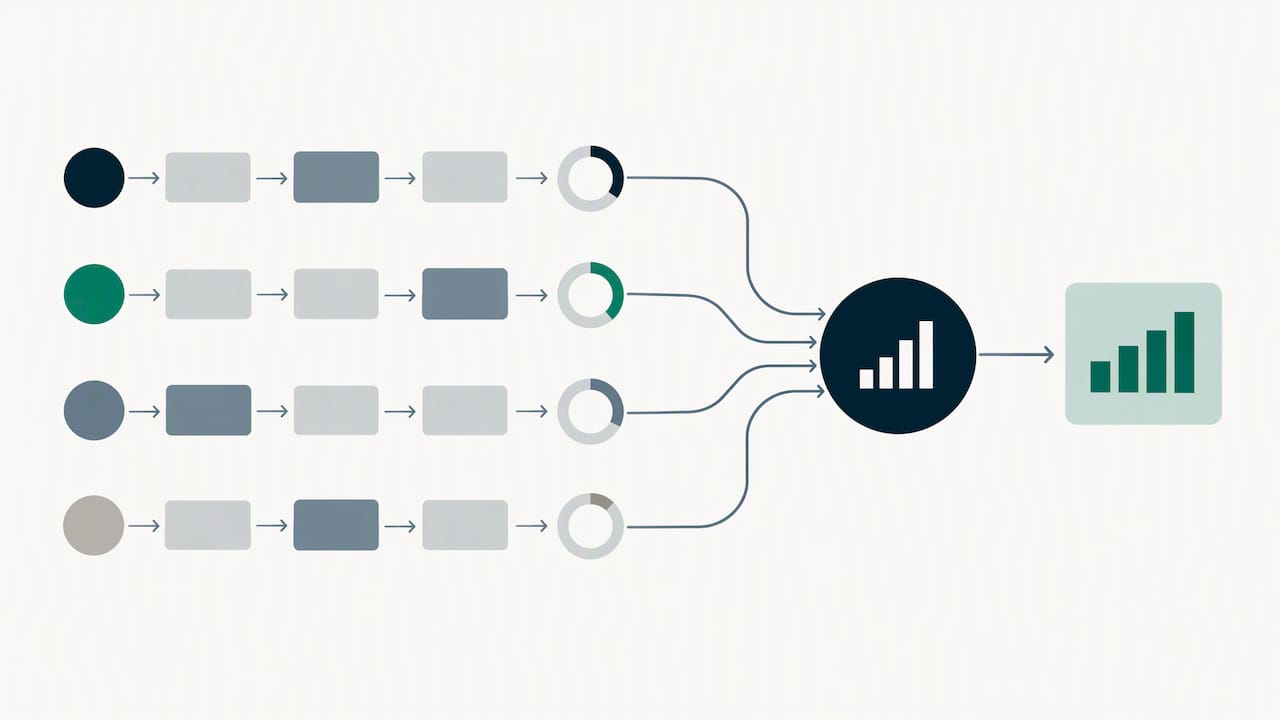
Most working forecasts combine two distinct techniques rather than relying on one black-box model.
The first is local, candidate-level prediction: an interpretable model estimates the probability that a given candidate will succeed at a given stage or role. Research published in PMC on a prescriptive analytics framework for recruitment found that combining interpretable machine learning with a global mathematical optimization layer predicted recruitment success with useful accuracy.
One of the more notable figures from that research is an AUC of approximately 0.73, a measure of how well the model distinguishes successful placements from unsuccessful ones. That is a meaningful signal, not a guarantee, and it is strongest when paired with human review of the reasoning behind each score.
The second technique is global simulation: modeling how an entire pipeline of applicants moves over time. Visier’s documentation on pipeline forecasting describes this as a semi-Markov, Monte Carlo-style simulation that uses conversion rates, duration-in-stage distributions, and the rate of new applications to project outcomes forward.
Together, these outputs translate into business language your hiring managers actually use:
Weeks-to-fill at a stated confidence level, not a single hard date.
Expected number of fills per role over a planning period.
Priority triggers that flag a role for intervention once its probability of filling on time drops below a threshold you set.
Data volume, limits, and when to trust the forecast
Forecasting breaks down fastest where teams skip the data-volume question. Visier’s guidance sets a practical rule of thumb: you need roughly three historical hires per open position for the simulation to be statistically sound. Below that, the model is extrapolating from noise.
Agencies and in-house teams with thin history on a specific role are not out of options. Pooling similar roles into broader buckets, clustering job titles by skill taxonomy, and borrowing conversion rates from comparable requisitions all raise your effective sample size without inventing data.
A single niche role with one past hire cannot be forecast reliably on its own.
A bucket of ten similar backend engineering roles across two years usually can.
Mismatched historical context, like comparing a 2023 hiring freeze period to a 2026 expansion phase, produces forecasts that look precise but are not.
Pro Tip: When in doubt about sample size, widen the role bucket before you trust a confidence interval, a broader bucket with real history beats a narrow one built on guesswork.
Building forecasting into daily recruiting workflow
Turning forecasting from a spreadsheet exercise into an operational habit takes a defined sequence.
Extract pipeline data from your ATS, standardize stage names, and preserve GDPR consent trails and deduplicated candidate records as you go.
Configure or train candidate-level prediction models, then run pipeline simulations across your current open roles.
Backtest every model against past requisitions before trusting it on live roles, comparing predicted fill dates to what actually happened.
Set a weekly cadence owned by a named recruiter or recruiting lead, with a clear trigger: start proactive sourcing the moment a role’s fill probability drops below your chosen threshold.
Track forecast calibration and fill accuracy as ongoing KPIs, not one-time validation metrics.
Teams that follow this sequence tend to see the downstream effects show up in standard recruiting metrics. Research on predictive analytics adoption in tech recruitment found that higher adoption correlated with shorter time-to-hire and improved quality-of-hire, a pattern consistent with what a well-calibrated forecast should produce: fewer surprises, more targeted sourcing, better matches.
Pro Tip: Backtesting against at least two past hiring cycles before go-live catches calibration errors that a single quarter of data will not reveal.
An 8-step checklist for your first reliable forecast
You do not need a data science team to start. A disciplined sequence this quarter gets you a usable first forecast.
Define role buckets and confirm consistent stage timestamps across your ATS.
Check whether each bucket has at least three historical hires, or pool roles until it does.
Compute stage conversion rates and duration-in-stage distributions for each bucket.
Choose an interpretable candidate-level model rather than a black-box one.
Run the pipeline simulation to generate fill-date and probability estimates.
Produce confidence bands alongside every forecast, never a single point estimate.
Backtest against recent closed requisitions and recalibrate where predictions missed.
Fold the outputs into your weekly planning meeting, then revisit and refine monthly.
Where predictive recruiting is headed
Forecasting is not a prediction trick, it is a discipline of better bookkeeping applied to a messy process. The agencies and in-house teams getting real value from it are not the ones with the fanciest model, they are the ones who standardized their stage data two quarters before anyone asked for a forecast.
We think the honest case for predictive recruiting rests on two things: interpretability and compliance. A forecast nobody can explain will not survive contact with a skeptical hiring manager, and a forecast built on candidate data without proper consent trails will not survive contact with a regulator. Start with a small pilot on one role bucket, measure whether the predicted fill dates held up, and expand from there.
- Recruitify Team
How Recruitify.ai supports forecasting in practice
We built our platform around the exact data discipline forecasting requires: standardized pipeline stages, clean candidate records, and an audit trail that holds up to scrutiny. Our contextual matching AI scores candidates against role requirements instead of relying on keyword matching alone, which gives you the candidate-level inputs a forecast depends on. Our CV parser extracts structured data from a resume in three seconds and flags duplicates automatically, closing one of the most common data-quality gaps teams run into.
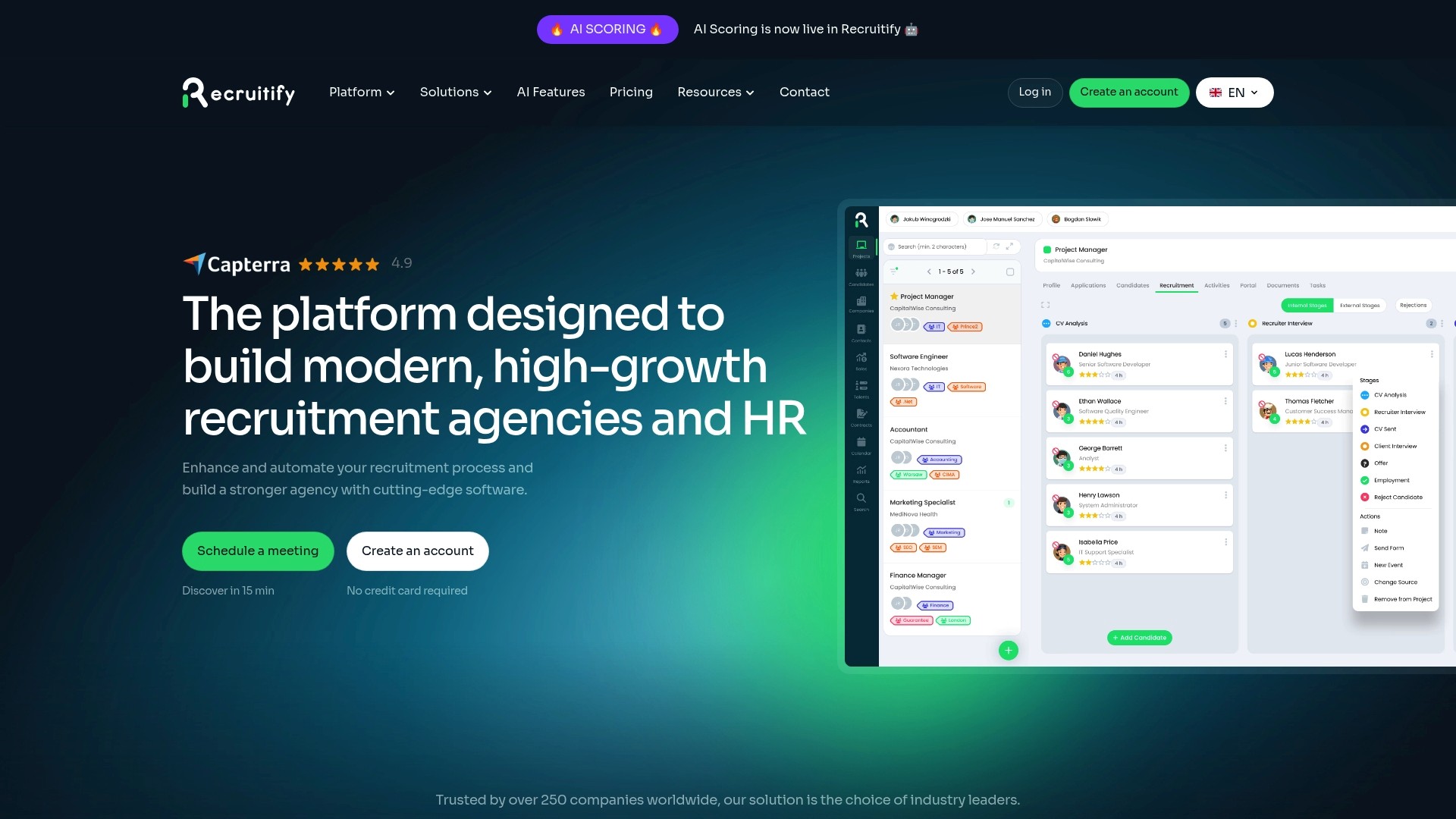
Every record carries GDPR consent metadata and a full audit trail, helping keep forecasting inputs defensible as well as accurate. If you want to see how these pieces work together for your own pipeline, check plan pricing for agencies starting at 79 EUR per month per user and HR teams at 69 EUR per month per user.
FAQ
What does pipeline forecasting actually predict?
Pipeline forecasting predicts expected time-to-fill, the probability a role closes within a given window, and how many candidates are likely to move through each stage. It relies on historical conversion rates and duration-in-stage data rather than guesswork, as described in Visier’s pipeline forecast documentation.
How much historical data do I need before I trust a forecast?
A commonly cited rule of thumb calls for roughly three historical hires per open position for a simulation to be statistically reliable, according to Visier’s guidance. Below that, pooling similar roles into a broader bucket is the more reliable path than forecasting a single thin pipeline.
How is time-to-fill calculated?
Time-to-fill is measured in calendar days from the date a requisition opens to the date an offer is accepted, not business days. The SHRM 2025 benchmarking report found this calculation method matters because business-day-only counts can understate actual time by roughly 30%.
Can forecasting models explain why a candidate is a strong match?
Interpretable models used in recruitment forecasting are designed to surface the reasoning behind a prediction rather than output a bare score. Research published in PMC found that pairing interpretable local predictions with a global optimization layer reached a reported AUC of approximately 0.73 while keeping the prediction logic visible to the recruiter.
Does Recruitify.ai include forecasting analytics?
Recruitify.ai combines contextual matching AI, automated CV parsing, and GDPR-compliant audit trails that supply the clean, structured data forecasting depends on. Pricing is listed on our pricing page for HR Team, Recruitment Agencies, and Enterprise plans.
Sources
Recommended


News & Updates
Stay up-to-date with the latest innovations, features, and tips about Recruitify!
By providing your email address within the newsletter sign-up form, you confirm its processing to send marketing information regarding the Administrator’s products and services. The Administrator of your personal data processed for the abovementioned purposes is Recruitify Spółka z o.o., based in Warsaw, Poland (KRS 0000709889). For more information on the principles of personal data processing and the rights of data subjects, please check the Privacy Policy.

Last updated:
Pipeline Forecasting for Recruiting: 8 Steps to Trust the Numbers
Recruitment Process
The Recruitify Team
Recruitment pipeline forecasting predicts how many open roles you will fill, by when, and with what probability, provided your pipeline data is standardized and you have enough historical hires to model against. With clean stage-level data, forecasting turns guesswork into a capacity plan: you know which roles need proactive sourcing now and which are on track. Without enough historical hires, the same math produces confident-looking numbers that are not worth trusting.
TL;DR:
Use roughly three historical hires per role as a minimum; when a niche role falls short, pool comparable jobs rather than trust a narrow forecast.
Count time to fill in calendar days from requisition opening to offer acceptance; business day counts can understate the measure by roughly 30%.
Standardize stage names, log candidate moves promptly, remove duplicate records, and retain consent metadata before calculating conversion rates or stage durations.
Pair interpretable candidate predictions with pipeline simulations, and review each score; recruitment research reported an AUC of about 0.73, not a guarantee.
Backtest forecasts against at least two past hiring cycles, then review them weekly and begin proactive sourcing when a role’s fill probability falls below the set threshold.
RecruitifyBuild a Clearer Recruiting PipelineRecruitify brings sales and recruitment pipelines together, with candidate data and workflows in one system to support more consistent forecasting.Explore Recruitify
Table of Contents
Why pipeline forecasting matters for recruiting operations
Core metrics and data you need to feed a forecast
How forecasting models actually work
Data volume, limits, and when to trust the forecast
Building forecasting into daily recruiting workflow
An 8-step checklist for your first reliable forecast
Where predictive recruiting is headed
How Recruitify.ai supports forecasting in practice
FAQ
Sources
Why pipeline forecasting matters for recruiting operations
Hiring teams have run on gut feel for decades, filling roles reactively and discovering bottlenecks only once a hiring manager starts asking questions. The SHRM 2025 benchmarking report puts median time-to-fill at about a month and a half for both executive and nonexecutive positions, measured in calendar days from requisition opening to offer acceptance. That single benchmark already tells you something: any role tracking meaningfully longer than six weeks is a candidate for intervention, not patience.
Forecasting changes the posture from reactive to planned. Instead of waiting for a requisition to stall, you see the expected fill window and probability early enough to act.
Capacity planning improves because recruiters know which roles need more sourcing hours this week.
Prioritization becomes evidence-based instead of based on whoever complains loudest.
Internal talent deployment often shortens time-to-fill and belongs in your forecasting inputs rather than as an afterthought, according to SHRM’s broader 2025 recruiting findings.
Core metrics and data you need to feed a forecast
A forecast is only as good as the inputs behind it. Before any model runs, your applicant tracking data needs five things calculated consistently.
Time-to-fill, counted in calendar days from requisition open to offer acceptance; the SHRM report notes that calculating in business days alone can skew results by roughly 30%.
Stage conversion rates, the share of candidates moving from one pipeline stage to the next.
Duration-in-stage, how long candidates typically sit at each step before advancing or dropping out.
Rate of new applications, tracked per role and per sourcing channel.
Active applicants per stage, a live snapshot that anchors the simulation to current reality.
Standardization matters as much as the math. Stage names need to match across every requisition, timestamps need to be logged the moment a candidate moves, and consent metadata needs to be retained so GDPR obligations do not conflict with reporting needs.
Data quality checks matter too: deduplicate candidate records, attribute every application to a source channel, and decide in advance how you will handle a candidate who skips a stage.
Pro Tip: Run a dry audit of one month’s pipeline data before trusting any forecast output, missing timestamps or duplicate candidate records will quietly distort every rate you calculate.
How forecasting models actually work
Most working forecasts combine two distinct techniques rather than relying on one black-box model.
The first is local, candidate-level prediction: an interpretable model estimates the probability that a given candidate will succeed at a given stage or role. Research published in PMC on a prescriptive analytics framework for recruitment found that combining interpretable machine learning with a global mathematical optimization layer predicted recruitment success with useful accuracy.
One of the more notable figures from that research is an AUC of approximately 0.73, a measure of how well the model distinguishes successful placements from unsuccessful ones. That is a meaningful signal, not a guarantee, and it is strongest when paired with human review of the reasoning behind each score.
The second technique is global simulation: modeling how an entire pipeline of applicants moves over time. Visier’s documentation on pipeline forecasting describes this as a semi-Markov, Monte Carlo-style simulation that uses conversion rates, duration-in-stage distributions, and the rate of new applications to project outcomes forward.
Together, these outputs translate into business language your hiring managers actually use:
Weeks-to-fill at a stated confidence level, not a single hard date.
Expected number of fills per role over a planning period.
Priority triggers that flag a role for intervention once its probability of filling on time drops below a threshold you set.
Data volume, limits, and when to trust the forecast
Forecasting breaks down fastest where teams skip the data-volume question. Visier’s guidance sets a practical rule of thumb: you need roughly three historical hires per open position for the simulation to be statistically sound. Below that, the model is extrapolating from noise.
Agencies and in-house teams with thin history on a specific role are not out of options. Pooling similar roles into broader buckets, clustering job titles by skill taxonomy, and borrowing conversion rates from comparable requisitions all raise your effective sample size without inventing data.
A single niche role with one past hire cannot be forecast reliably on its own.
A bucket of ten similar backend engineering roles across two years usually can.
Mismatched historical context, like comparing a 2023 hiring freeze period to a 2026 expansion phase, produces forecasts that look precise but are not.
Pro Tip: When in doubt about sample size, widen the role bucket before you trust a confidence interval, a broader bucket with real history beats a narrow one built on guesswork.
Building forecasting into daily recruiting workflow
Turning forecasting from a spreadsheet exercise into an operational habit takes a defined sequence.
Extract pipeline data from your ATS, standardize stage names, and preserve GDPR consent trails and deduplicated candidate records as you go.
Configure or train candidate-level prediction models, then run pipeline simulations across your current open roles.
Backtest every model against past requisitions before trusting it on live roles, comparing predicted fill dates to what actually happened.
Set a weekly cadence owned by a named recruiter or recruiting lead, with a clear trigger: start proactive sourcing the moment a role’s fill probability drops below your chosen threshold.
Track forecast calibration and fill accuracy as ongoing KPIs, not one-time validation metrics.
Teams that follow this sequence tend to see the downstream effects show up in standard recruiting metrics. Research on predictive analytics adoption in tech recruitment found that higher adoption correlated with shorter time-to-hire and improved quality-of-hire, a pattern consistent with what a well-calibrated forecast should produce: fewer surprises, more targeted sourcing, better matches.
Pro Tip: Backtesting against at least two past hiring cycles before go-live catches calibration errors that a single quarter of data will not reveal.
An 8-step checklist for your first reliable forecast
You do not need a data science team to start. A disciplined sequence this quarter gets you a usable first forecast.
Define role buckets and confirm consistent stage timestamps across your ATS.
Check whether each bucket has at least three historical hires, or pool roles until it does.
Compute stage conversion rates and duration-in-stage distributions for each bucket.
Choose an interpretable candidate-level model rather than a black-box one.
Run the pipeline simulation to generate fill-date and probability estimates.
Produce confidence bands alongside every forecast, never a single point estimate.
Backtest against recent closed requisitions and recalibrate where predictions missed.
Fold the outputs into your weekly planning meeting, then revisit and refine monthly.
Where predictive recruiting is headed
Forecasting is not a prediction trick, it is a discipline of better bookkeeping applied to a messy process. The agencies and in-house teams getting real value from it are not the ones with the fanciest model, they are the ones who standardized their stage data two quarters before anyone asked for a forecast.
We think the honest case for predictive recruiting rests on two things: interpretability and compliance. A forecast nobody can explain will not survive contact with a skeptical hiring manager, and a forecast built on candidate data without proper consent trails will not survive contact with a regulator. Start with a small pilot on one role bucket, measure whether the predicted fill dates held up, and expand from there.
- Recruitify Team
How Recruitify.ai supports forecasting in practice
We built our platform around the exact data discipline forecasting requires: standardized pipeline stages, clean candidate records, and an audit trail that holds up to scrutiny. Our contextual matching AI scores candidates against role requirements instead of relying on keyword matching alone, which gives you the candidate-level inputs a forecast depends on. Our CV parser extracts structured data from a resume in three seconds and flags duplicates automatically, closing one of the most common data-quality gaps teams run into.
Every record carries GDPR consent metadata and a full audit trail, helping keep forecasting inputs defensible as well as accurate. If you want to see how these pieces work together for your own pipeline, check plan pricing for agencies starting at 79 EUR per month per user and HR teams at 69 EUR per month per user.
FAQ
What does pipeline forecasting actually predict?
Pipeline forecasting predicts expected time-to-fill, the probability a role closes within a given window, and how many candidates are likely to move through each stage. It relies on historical conversion rates and duration-in-stage data rather than guesswork, as described in Visier’s pipeline forecast documentation.
How much historical data do I need before I trust a forecast?
A commonly cited rule of thumb calls for roughly three historical hires per open position for a simulation to be statistically reliable, according to Visier’s guidance. Below that, pooling similar roles into a broader bucket is the more reliable path than forecasting a single thin pipeline.
How is time-to-fill calculated?
Time-to-fill is measured in calendar days from the date a requisition opens to the date an offer is accepted, not business days. The SHRM 2025 benchmarking report found this calculation method matters because business-day-only counts can understate actual time by roughly 30%.
Can forecasting models explain why a candidate is a strong match?
Interpretable models used in recruitment forecasting are designed to surface the reasoning behind a prediction rather than output a bare score. Research published in PMC found that pairing interpretable local predictions with a global optimization layer reached a reported AUC of approximately 0.73 while keeping the prediction logic visible to the recruiter.
Does Recruitify.ai include forecasting analytics?
Recruitify.ai combines contextual matching AI, automated CV parsing, and GDPR-compliant audit trails that supply the clean, structured data forecasting depends on. Pricing is listed on our pricing page for HR Team, Recruitment Agencies, and Enterprise plans.
Sources
Recommended
News & Updates
Stay up-to-date with the latest innovations, features, and tips about Recruitify!
By providing your email address within the newsletter sign-up form, you confirm its processing to send marketing information regarding the Administrator’s products and services. The Administrator of your personal data processed for the abovementioned purposes is Recruitify Spółka z o.o., based in Warsaw, Poland (KRS 0000709889). For more information on the principles of personal data processing and the rights of data subjects, please check the Privacy Policy.
Last updated:
Pipeline Forecasting for Recruiting: 8 Steps to Trust the Numbers
Recruitment Process
The Recruitify Team
Recruitment pipeline forecasting predicts how many open roles you will fill, by when, and with what probability, provided your pipeline data is standardized and you have enough historical hires to model against. With clean stage-level data, forecasting turns guesswork into a capacity plan: you know which roles need proactive sourcing now and which are on track. Without enough historical hires, the same math produces confident-looking numbers that are not worth trusting.
TL;DR:
Use roughly three historical hires per role as a minimum; when a niche role falls short, pool comparable jobs rather than trust a narrow forecast.
Count time to fill in calendar days from requisition opening to offer acceptance; business day counts can understate the measure by roughly 30%.
Standardize stage names, log candidate moves promptly, remove duplicate records, and retain consent metadata before calculating conversion rates or stage durations.
Pair interpretable candidate predictions with pipeline simulations, and review each score; recruitment research reported an AUC of about 0.73, not a guarantee.
Backtest forecasts against at least two past hiring cycles, then review them weekly and begin proactive sourcing when a role’s fill probability falls below the set threshold.
RecruitifyBuild a Clearer Recruiting PipelineRecruitify brings sales and recruitment pipelines together, with candidate data and workflows in one system to support more consistent forecasting.Explore Recruitify
Table of Contents
Why pipeline forecasting matters for recruiting operations
Core metrics and data you need to feed a forecast
How forecasting models actually work
Data volume, limits, and when to trust the forecast
Building forecasting into daily recruiting workflow
An 8-step checklist for your first reliable forecast
Where predictive recruiting is headed
How Recruitify.ai supports forecasting in practice
FAQ
Sources
Why pipeline forecasting matters for recruiting operations
Hiring teams have run on gut feel for decades, filling roles reactively and discovering bottlenecks only once a hiring manager starts asking questions. The SHRM 2025 benchmarking report puts median time-to-fill at about a month and a half for both executive and nonexecutive positions, measured in calendar days from requisition opening to offer acceptance. That single benchmark already tells you something: any role tracking meaningfully longer than six weeks is a candidate for intervention, not patience.
Forecasting changes the posture from reactive to planned. Instead of waiting for a requisition to stall, you see the expected fill window and probability early enough to act.
Capacity planning improves because recruiters know which roles need more sourcing hours this week.
Prioritization becomes evidence-based instead of based on whoever complains loudest.
Internal talent deployment often shortens time-to-fill and belongs in your forecasting inputs rather than as an afterthought, according to SHRM’s broader 2025 recruiting findings.
Core metrics and data you need to feed a forecast
A forecast is only as good as the inputs behind it. Before any model runs, your applicant tracking data needs five things calculated consistently.
Time-to-fill, counted in calendar days from requisition open to offer acceptance; the SHRM report notes that calculating in business days alone can skew results by roughly 30%.
Stage conversion rates, the share of candidates moving from one pipeline stage to the next.
Duration-in-stage, how long candidates typically sit at each step before advancing or dropping out.
Rate of new applications, tracked per role and per sourcing channel.
Active applicants per stage, a live snapshot that anchors the simulation to current reality.
Standardization matters as much as the math. Stage names need to match across every requisition, timestamps need to be logged the moment a candidate moves, and consent metadata needs to be retained so GDPR obligations do not conflict with reporting needs.
Data quality checks matter too: deduplicate candidate records, attribute every application to a source channel, and decide in advance how you will handle a candidate who skips a stage.
Pro Tip: Run a dry audit of one month’s pipeline data before trusting any forecast output, missing timestamps or duplicate candidate records will quietly distort every rate you calculate.
How forecasting models actually work
Most working forecasts combine two distinct techniques rather than relying on one black-box model.
The first is local, candidate-level prediction: an interpretable model estimates the probability that a given candidate will succeed at a given stage or role. Research published in PMC on a prescriptive analytics framework for recruitment found that combining interpretable machine learning with a global mathematical optimization layer predicted recruitment success with useful accuracy.
One of the more notable figures from that research is an AUC of approximately 0.73, a measure of how well the model distinguishes successful placements from unsuccessful ones. That is a meaningful signal, not a guarantee, and it is strongest when paired with human review of the reasoning behind each score.
The second technique is global simulation: modeling how an entire pipeline of applicants moves over time. Visier’s documentation on pipeline forecasting describes this as a semi-Markov, Monte Carlo-style simulation that uses conversion rates, duration-in-stage distributions, and the rate of new applications to project outcomes forward.
Together, these outputs translate into business language your hiring managers actually use:
Weeks-to-fill at a stated confidence level, not a single hard date.
Expected number of fills per role over a planning period.
Priority triggers that flag a role for intervention once its probability of filling on time drops below a threshold you set.
Data volume, limits, and when to trust the forecast
Forecasting breaks down fastest where teams skip the data-volume question. Visier’s guidance sets a practical rule of thumb: you need roughly three historical hires per open position for the simulation to be statistically sound. Below that, the model is extrapolating from noise.
Agencies and in-house teams with thin history on a specific role are not out of options. Pooling similar roles into broader buckets, clustering job titles by skill taxonomy, and borrowing conversion rates from comparable requisitions all raise your effective sample size without inventing data.
A single niche role with one past hire cannot be forecast reliably on its own.
A bucket of ten similar backend engineering roles across two years usually can.
Mismatched historical context, like comparing a 2023 hiring freeze period to a 2026 expansion phase, produces forecasts that look precise but are not.
Pro Tip: When in doubt about sample size, widen the role bucket before you trust a confidence interval, a broader bucket with real history beats a narrow one built on guesswork.
Building forecasting into daily recruiting workflow
Turning forecasting from a spreadsheet exercise into an operational habit takes a defined sequence.
Extract pipeline data from your ATS, standardize stage names, and preserve GDPR consent trails and deduplicated candidate records as you go.
Configure or train candidate-level prediction models, then run pipeline simulations across your current open roles.
Backtest every model against past requisitions before trusting it on live roles, comparing predicted fill dates to what actually happened.
Set a weekly cadence owned by a named recruiter or recruiting lead, with a clear trigger: start proactive sourcing the moment a role’s fill probability drops below your chosen threshold.
Track forecast calibration and fill accuracy as ongoing KPIs, not one-time validation metrics.
Teams that follow this sequence tend to see the downstream effects show up in standard recruiting metrics. Research on predictive analytics adoption in tech recruitment found that higher adoption correlated with shorter time-to-hire and improved quality-of-hire, a pattern consistent with what a well-calibrated forecast should produce: fewer surprises, more targeted sourcing, better matches.
Pro Tip: Backtesting against at least two past hiring cycles before go-live catches calibration errors that a single quarter of data will not reveal.
An 8-step checklist for your first reliable forecast
You do not need a data science team to start. A disciplined sequence this quarter gets you a usable first forecast.
Define role buckets and confirm consistent stage timestamps across your ATS.
Check whether each bucket has at least three historical hires, or pool roles until it does.
Compute stage conversion rates and duration-in-stage distributions for each bucket.
Choose an interpretable candidate-level model rather than a black-box one.
Run the pipeline simulation to generate fill-date and probability estimates.
Produce confidence bands alongside every forecast, never a single point estimate.
Backtest against recent closed requisitions and recalibrate where predictions missed.
Fold the outputs into your weekly planning meeting, then revisit and refine monthly.
Where predictive recruiting is headed
Forecasting is not a prediction trick, it is a discipline of better bookkeeping applied to a messy process. The agencies and in-house teams getting real value from it are not the ones with the fanciest model, they are the ones who standardized their stage data two quarters before anyone asked for a forecast.
We think the honest case for predictive recruiting rests on two things: interpretability and compliance. A forecast nobody can explain will not survive contact with a skeptical hiring manager, and a forecast built on candidate data without proper consent trails will not survive contact with a regulator. Start with a small pilot on one role bucket, measure whether the predicted fill dates held up, and expand from there.
- Recruitify Team
How Recruitify.ai supports forecasting in practice
We built our platform around the exact data discipline forecasting requires: standardized pipeline stages, clean candidate records, and an audit trail that holds up to scrutiny. Our contextual matching AI scores candidates against role requirements instead of relying on keyword matching alone, which gives you the candidate-level inputs a forecast depends on. Our CV parser extracts structured data from a resume in three seconds and flags duplicates automatically, closing one of the most common data-quality gaps teams run into.
Every record carries GDPR consent metadata and a full audit trail, helping keep forecasting inputs defensible as well as accurate. If you want to see how these pieces work together for your own pipeline, check plan pricing for agencies starting at 79 EUR per month per user and HR teams at 69 EUR per month per user.
FAQ
What does pipeline forecasting actually predict?
Pipeline forecasting predicts expected time-to-fill, the probability a role closes within a given window, and how many candidates are likely to move through each stage. It relies on historical conversion rates and duration-in-stage data rather than guesswork, as described in Visier’s pipeline forecast documentation.
How much historical data do I need before I trust a forecast?
A commonly cited rule of thumb calls for roughly three historical hires per open position for a simulation to be statistically reliable, according to Visier’s guidance. Below that, pooling similar roles into a broader bucket is the more reliable path than forecasting a single thin pipeline.
How is time-to-fill calculated?
Time-to-fill is measured in calendar days from the date a requisition opens to the date an offer is accepted, not business days. The SHRM 2025 benchmarking report found this calculation method matters because business-day-only counts can understate actual time by roughly 30%.
Can forecasting models explain why a candidate is a strong match?
Interpretable models used in recruitment forecasting are designed to surface the reasoning behind a prediction rather than output a bare score. Research published in PMC found that pairing interpretable local predictions with a global optimization layer reached a reported AUC of approximately 0.73 while keeping the prediction logic visible to the recruiter.
Does Recruitify.ai include forecasting analytics?
Recruitify.ai combines contextual matching AI, automated CV parsing, and GDPR-compliant audit trails that supply the clean, structured data forecasting depends on. Pricing is listed on our pricing page for HR Team, Recruitment Agencies, and Enterprise plans.
Sources
Recommended
News & Updates
Stay up-to-date with the latest innovations, features, and tips about Recruitify!
By providing your email address within the newsletter sign-up form, you confirm its processing to send marketing information regarding the Administrator’s products and services. The Administrator of your personal data processed for the abovementioned purposes is Recruitify Spółka z o.o., based in Warsaw, Poland (KRS 0000709889). For more information on the principles of personal data processing and the rights of data subjects, please check the Privacy Policy.

Discover More

Innovations
60 - 90 Day Pilot to Turn Hiring Signals Into Staffing Lead Generation
Run a 60 - 90 day pilot to convert hiring signals into qualified conversations. Use LinkedIn, targeted outbound, and ATS/CRM automation to measure cost per...
9 Oct 2026
Discover More

Recruitment Process
HR Teams: 3 Priorities and an RFP Checklist for Branded Career Portals
Three research backed priorities and an RFP checklist HR teams can use to build a branded career portal that converts candidates, meets WCAG 2.1 AA, and...
8 Oct 2026
Discover More

Recruitment Process
Stop Syncing Files: ATS and HRIS Integration for HR Teams & Agencies
Implementation steps to sync ATS and HRIS at offer acceptance. Learn field mapping, governance, a 5 phase rollout, and Recruitify's practitioner perspective.
7 Oct 2026
Discover More
Innovations
60 - 90 Day Pilot to Turn Hiring Signals Into Staffing Lead Generation
Run a 60 - 90 day pilot to convert hiring signals into qualified conversations. Use LinkedIn, targeted outbound, and ATS/CRM automation to measure cost per...
9 Oct 2026
Discover More
Recruitment Process
HR Teams: 3 Priorities and an RFP Checklist for Branded Career Portals
Three research backed priorities and an RFP checklist HR teams can use to build a branded career portal that converts candidates, meets WCAG 2.1 AA, and...
8 Oct 2026
Discover More