Last updated:
60 - 90 Day Pilot to Turn Hiring Signals Into Staffing Lead Generation

Innovations

The Recruitify Team
The most reliable approach combines targeted LinkedIn outreach, personalized outbound email, and referral programs, all prioritized by fresh hiring-signal data and run through integrated automation. Agencies that layer these channels report faster qualified conversations and stronger placement conversion than those relying on a single tactic, particularly when verified contact data feeds directly into CRM and ATS workflows rather than sitting in a static spreadsheet.
Start with referrals and hiring signal outreach, then add LinkedIn and email after testing messaging; assess reply and conversation rates during the first 30 days.
Because 92% of B2B buyers already prefer a vendor before formal evaluation, publish niche hiring insights and personalize connection requests around company specific details.
Segment email by hiring signal, personalize the opening, follow up twice over 10 to 12 days, and call prospects who open multiple messages.
Refresh priority contact lists monthly, verify vendor records, and track consent; sample 50 records quarterly to check for bounced emails or changed roles.
Run a 60 to 90 day pilot, tag every lead source, and compare cost per placement across channels before expanding spend or signing annual contracts.
RecruitifyBring Hiring Signals Into One WorkflowRecruitify combines sales CRM, recruitment pipelines, and sourcing tools to help IT recruitment agencies manage leads and candidates in one platform.Explore Recruitify
Table of Contents
Quick-Action Overview: High-Impact Channels and Where to Start
LinkedIn Playbook for Staffing Agencies
High-Converting Outbound Email and Phone Outreach
Referral Programs and Partnerships
Job Boards, Hiring Signals, and Data Freshness
AI and Automation That Scale Staffing Lead Generation
Data Hygiene: Verification, Duplicate Removal, and Consent
How to Measure Success: Metrics and a Simple ROI Checklist
Implementation Checklist: Vendor Questions and a 60-90 Day Pilot Plan
Why Integrated Technology Matters: Recruitify Proof Points
Timeline: Campaign Setup and Ramp-Up Phases
Cost Breakdown: Subscription Tiers, Fees, and Total Investment
Recruitify Team: Recommended Sequencing and Quick Wins
How Recruitify Helps Staffing Agencies Generate and Convert Leads
FAQ
Sources
Reports and Primary Sources Used for This Guide
Quick-Action Overview: High-Impact Channels and Where to Start
Staffing firms rarely win with one channel alone. Outbound teams use multiple methods on average at once, and combining channels consistently outperforms single-channel programs. The rule of thumb: pick two or three channels that match your audience, run them in parallel, and let early results tell you where to add budget.
LinkedIn: builds credibility with hiring managers and reaches multiple stakeholders in a buying group at once.
Outbound email: gives you direct, scalable access to decision-makers without waiting for inbound interest.
Referrals: typically convert at the highest rate of any channel and cost the least to maintain.
Hiring signals: new job posts, funding rounds, and leadership changes tell you which accounts to prioritize right now.
Start with referrals and signal-based outbound, since both require less setup and tend to produce early wins. Layer in LinkedIn and email once you have a working message and a clear sense of who responds. Watch reply rate and contact-to-conversation rate in the first 30 days before judging anything else.
LinkedIn Playbook for Staffing Agencies
LinkedIn works best when it is treated as a targeted account channel, not a broadcast tool. Begin by defining your ideal client profile: industry, company size, and the specific titles involved in a hiring decision, then build saved searches in Sales Navigator around those filters.
Build saved searches around your ICP and refresh them monthly as roles and companies change.
Publish short, data-backed posts about hiring trends in your niche to build recognition before you reach out.
Send a connection request with a one-line reason tied to something specific about the prospect’s company.
Follow up three to five days later with a message referencing a hiring signal, not a generic pitch.
Buyer research shows 92% of B2B buyers already have a preferred vendor before formal evaluation begins, which is why awareness content matters as much as the outreach message itself. Track profile views, post engagement, and which contacts open a second message, since those signals tell you who is warming up before they ever reply.
Pro Tip: Comment thoughtfully on a prospect’s own posts before sending a connection request. It warms the relationship without costing you a message.
High-Converting Outbound Email and Phone Outreach
Segmentation decides whether outbound email feels relevant or feels like spam. Group prospects by the hiring signal that triggered the list (new role posted, headcount growth, leadership change) and by the size of the buying committee you are likely facing, since larger deals often involve more than three decision-makers.
Open with a specific, verifiable detail about the company, not a flattering generality.
Tie your offer directly to the signal that put them on the list.
Close with a low-friction ask, such as a 15-minute call rather than a meeting.
Follow up twice over 10 to 12 days before pausing the sequence.
Personalize at least the first line and the signal reference; everything else can be templated. Escalate to a phone call once a prospect opens multiple emails or replies with interest but goes quiet, and hand off to a senior recruiter or account manager the moment the conversation turns to specific roles or rates.
Referral Programs and Partnerships
Referrals often outperform every paid channel on placement rate, and fast-growth staffing agencies are more likely to run a formal referral program (https://staffinghub.com/wp-content/uploads/_pda/2025/04/Staffing-Hub-2025-State-of-Staffing-Report-Full-Temp.pdf) than firms with flat or declining growth. A referral arrives pre-qualified by trust, which shortens the sales cycle considerably.
Offer a clear, modest incentive tied to a closed placement, not just an introduction.
Make the referral capture a one-field form or a direct message, never a multi-step process.
Track every referral source inside your CRM so you can see which clients and candidates send the most business.
Thank and update referrers after each stage, since visibility keeps the pipeline active.
Pro Tip: Ask for a referral right after a successful placement, when the client’s satisfaction is highest and the ask feels natural.
Job Boards, Hiring Signals, and Data Freshness
Job boards still produce a large share of placements for most agencies, but the signals around a posting matter more than the posting itself. Prioritize accounts showing real movement.
New job postings, especially multiple roles opened in a short window.
Funding announcements or expansion news, which often precede hiring sprints.
Leadership or org changes, since new managers frequently restaff their teams.
Headcount growth visible on LinkedIn or in public filings.
Static lists decay quickly as people change roles and companies shift priorities, so ask any data vendor how often records are refreshed and how contact details are verified before you buy a list.
AI and Automation That Scale Staffing Lead Generation
Automation earns its place when it removes repetitive work, not when it replaces judgment. Lead enrichment, CV parsing, contextual matching, and sequenced outreach all reduce the hours spent on manual data entry and let recruiters spend more time on conversations that actually move a deal forward.
Enrichment tools append verified contact and company data to raw leads before outreach begins.
CV parsing extracts structured candidate data from resumes in seconds, cutting manual entry.
Contextual matching scores candidates against open roles using more than keyword overlap.
Sequencing tools automate follow-up timing so no lead goes cold from simple neglect.
One agency platform claim holds that full workflow automation can cut administrative tasks by 70%, freeing recruiters to focus on relationship-building rather than data entry. AI should flag, score, and draft, while a person still makes the final call on tone and timing, and any platform handling candidate data should maintain a clear audit trail for compliance.
Data Hygiene: Verification, Duplicate Removal, and Consent
Clean data is the difference between a productive outreach day and wasted effort. A few habits keep a database usable.
Refresh high-priority lists at least monthly and deduplicate on name, company, and email together, not any single field.
Ask vendors how leads are verified and how recently each record was checked.
Confirm consent records exist for every contact, with a traceable history of when and how consent was captured.
Estimate decay by sampling 50 records quarterly and checking how many bounce or have changed roles.
A database that decays unnoticed quietly inflates your cost per qualified conversation, even when the channel mix looks right on paper.
How to Measure Success: Metrics and a Simple ROI Checklist
Staffing leaders need a small set of KPIs that tie lead sources back to actual placements, not just activity volume.
Placements from source: which channel actually closed the role, tracked at the CRM record level.
Quality of hire: measured by client feedback or early turnover after placement.
Cost per hire: total channel spend divided by placements closed from that channel.
Time to fill: days from first contact to signed placement, compared across channels.
Contact-to-conversation rate: how many outreach attempts turn into a real reply.
Set up a minimal attribution model by tagging every lead source at intake and reviewing results monthly rather than waiting for quarter-end. For a pilot, a simple checklist works: total spend, number of qualified conversations generated, placements closed, and cost per placement, compared channel by channel after 60 days.
Implementation Checklist: Vendor Questions and a 60-90 Day Pilot Plan
Before signing with any lead-generation vendor or tool, a short readiness check saves months of wasted spend.
Ask vendors how leads are verified, how often data refreshes, and whether they offer an audit trail for consent.
Confirm integration options with your existing ATS and CRM before committing to a contract.
Assign a single internal owner accountable for the pilot’s results.
Clean your CRM and set a baseline report before the pilot starts, so comparisons mean something.
Run the pilot for 60 to 90 days, then decide to scale, adjust, or stop based on cost per placement.
Why Integrated Technology Matters: Recruitify Proof Points
Agencies juggling separate ATS, CRM, and spreadsheet systems lose time to re-entry and lost context between sales and recruiting. Our platform, Recruitify, consolidates these functions into one workspace built specifically for IT staffing and headhunting teams.
Our recruitment and sales modules operate inside a single ecosystem, so a lead and a candidate pipeline never live in separate tools.
Full workflow automation can reduce administrative tasks significantly, from first contact to contract generation.
Our AI CV parser extracts structured candidate data from various document types quickly.
Our contextual matching engine scores candidates against role requirements beyond simple keyword search.
An integrated GDPR consent management module maintains a full audit trail for records processed.
Timeline: Campaign Setup and Ramp-Up Phases
A realistic lead generation program for a staffing agency unfolds in recognizable phases rather than producing results overnight.
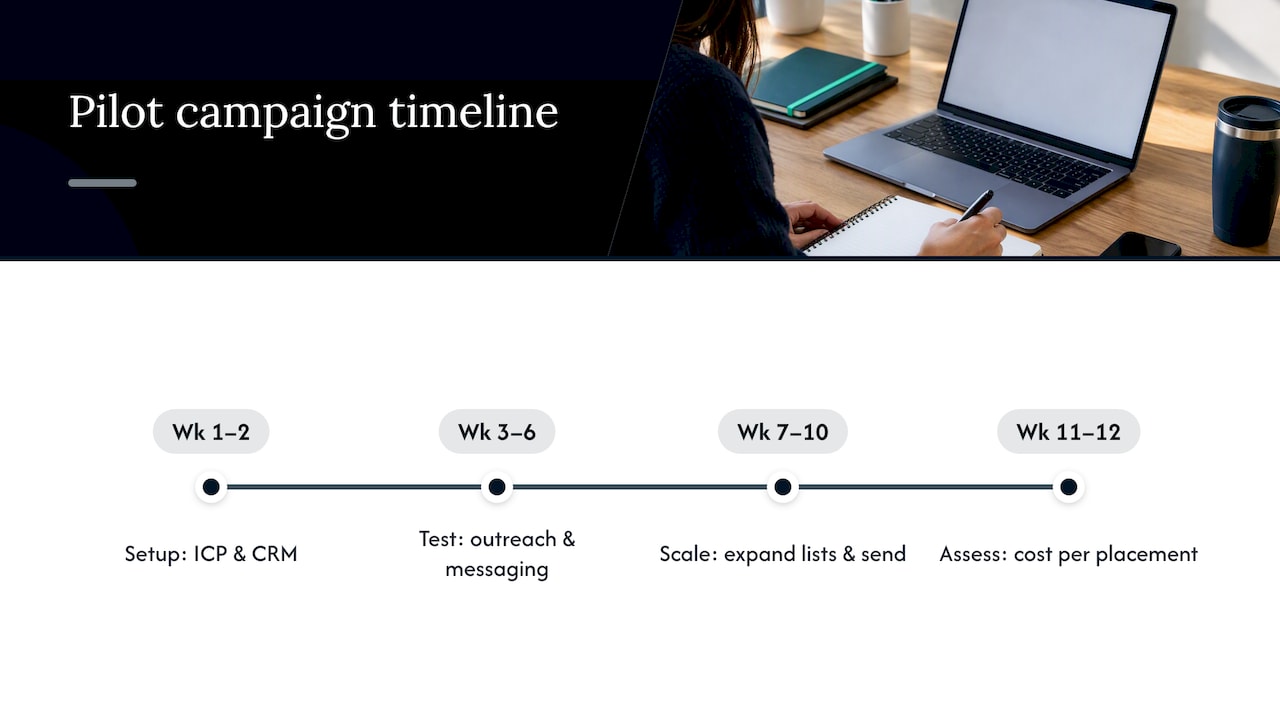
Weeks one and two cover setup: defining the ideal client profile, cleaning the CRM, and configuring saved searches or list filters. This is also when a team decides which two or three channels to launch first, since trying everything at once usually dilutes effort rather than multiplying results.
Weeks three through six are the testing phase. Initial outreach sequences go live on a small segment, messaging gets refined based on reply rates, and referral asks start going out to recently placed clients. Hyper-targeted, focused campaigns can produce qualified leads within a matter of months rather than requiring a full year to show signal.
Weeks seven through ten focus on scaling what works: expanding the LinkedIn saved search list, increasing email sending volume within deliverability limits, and formalizing the referral program with clearer incentives.
By weeks eleven and twelve, most agencies have enough data to calculate early cost per placement and decide which channel deserves more budget. This 90-day window matches a standard pilot cycle and gives enough volume to judge a channel honestly, rather than reacting to the first week’s results.
Cost Breakdown: Subscription Tiers, Fees, and Total Investment
Budgeting for lead generation involves more than the sticker price of a single tool. Outbound email platforms, LinkedIn Sales Navigator seats, data enrichment subscriptions, and a CRM or ATS to manage it all each carry separate costs, and hidden fees often show up in per-seat pricing, data export limits, or charges for verified contact credits beyond a monthly allowance.
For the operational backbone connecting sales and recruiting, our own pricing illustrates the range agencies should expect from a consolidated platform. Our HR Team plan runs 69 EUR per month per user, while our Recruitment Agencies plan runs 79 EUR per month per user; our Enterprise tier is priced on request based on team size and modules needed.
Beyond the core platform, agencies typically budget separately for LinkedIn Sales Navigator seats, an email deliverability tool, and any third-party data enrichment service, each billed on its own subscription cycle. When comparing vendors, ask whether contact credits roll over unused, whether data exports carry an extra fee, and whether the contract locks you into an annual term before you have evidence the channel works. A 60 to 90 day pilot budget should account for every one of these line items, not just the headline subscription price, to avoid a total cost that surprises finance midway through the quarter.
Recruitify Team: Recommended Sequencing and Quick Wins
We recommend prioritizing referrals and hiring-signal outbound first, since both convert faster with less setup. Layer in LinkedIn and email once messaging is proven, and let automation scale volume only after integration and measurement are solid. Compliance and CRM integration stay constant priorities throughout, never an afterthought once spend increases.
- Recruitify Team
How Recruitify Helps Staffing Agencies Generate and Convert Leads
Running referrals, LinkedIn, and outbound email as separate efforts means separate spreadsheets, separate follow-up reminders, and separate reporting that never quite lines up. We built Recruitify to put the entire sales and recruiting pipeline into one workspace, so a referral, a LinkedIn reply, and an email response all land in the same system instead of three.
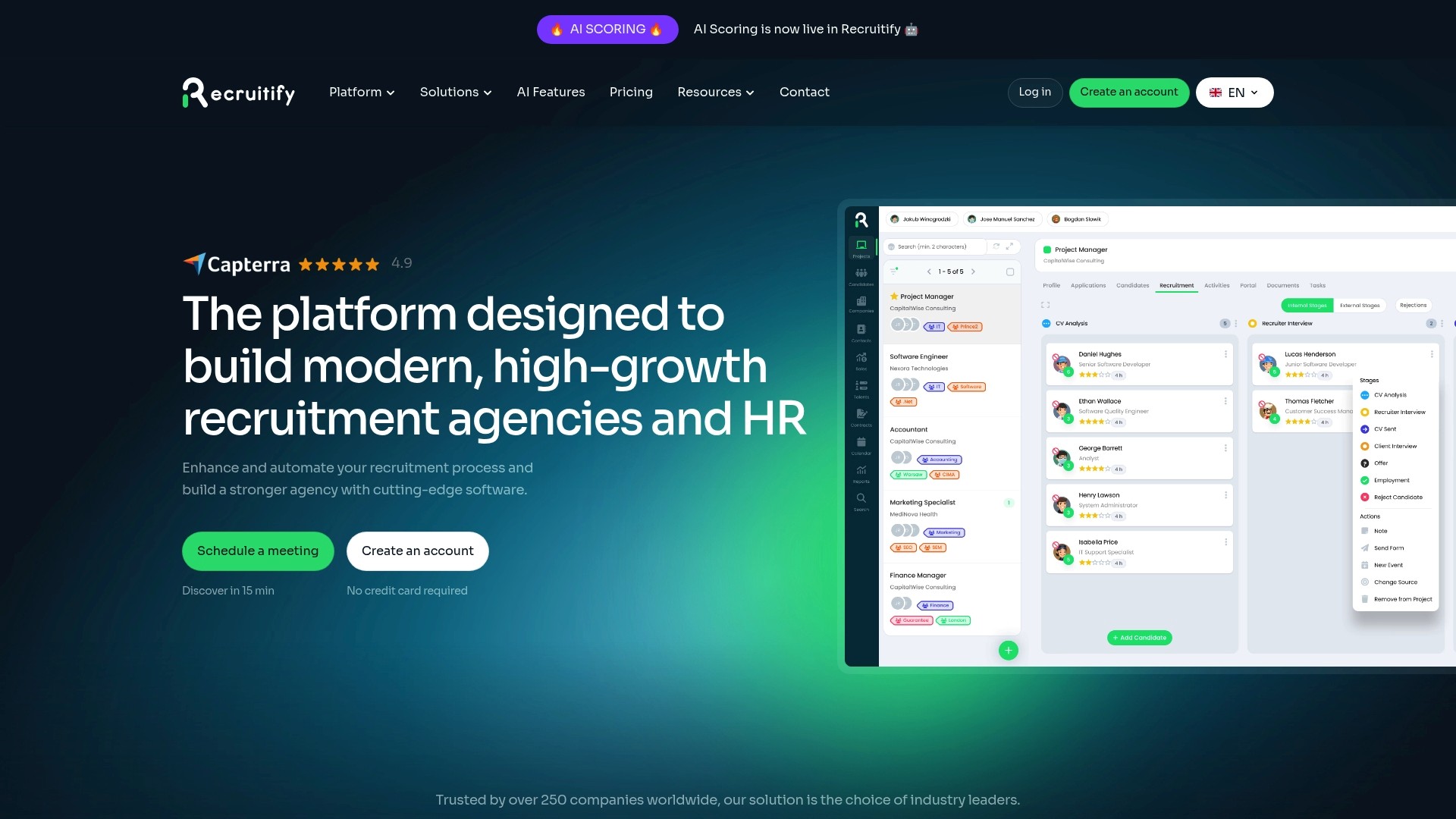
Our ATS, CRM, and contracting modules share one record to prevent leads from being lost between sales and delivery.
Our workflow automation can cut administrative tasks significantly, from intake to contract.
Our AI CV parser and contextual matching engine turn raw applications into ranked shortlists quickly.
An integrated GDPR consent module keeps a full audit trail for contact records.
If the channel mix in this guide sounds like more than your current spreadsheet can handle, our Recruitment Agencies plan is built for exactly that shift. Check pricing and see which plan fits your team size before your next pilot starts.
FAQ
How Much Should You Pay for Lead Generation?
Costs vary widely by channel and vendor, so there is no single market rate to quote. A useful approach is to budget a pilot of 60 to 90 days and calculate cost per qualified conversation and cost per placement before committing to a larger annual spend.
Which Company Is the Best for Lead Generation?
There is no single best provider for every agency, since the right fit depends on your niche, your existing CRM setup, and which channels your clients respond to. Evaluate any vendor on verification methodology, data refresh cadence, and integration with your existing tools rather than on brand recognition alone.
How Much Is the Salary of a Lead Generation Specialist?
Salary figures for this role vary significantly by region, seniority, and whether the position sits inside an agency or a vendor, and no verified figure is publicly available to state as a standard. Agencies hiring for this role typically benchmark against local recruiting and sales development salary data for their own market.
What Are the Top 10 Lead Generation Companies?
There is no verified, agreed-upon ranking of the top ten lead generation companies, and claims of a definitive list should be treated with caution. A more reliable approach is to evaluate vendors directly against your own criteria: verification methodology, refresh cadence, integration options, and contract terms.
Sources
Staffing Hub - The 1 challenge staffing firms face in 2025 and how to solve it
Windmill Strategy - B2B LinkedIn ads brand awareness strategy
Reports and Primary Sources Used for This Guide
Staffing Hub - The 1 challenge staffing firms face in 2025 and how to solve it
Windmill Strategy - B2B LinkedIn ads brand awareness strategy
Recommended


News & Updates
Stay up-to-date with the latest innovations, features, and tips about Recruitify!
By providing your email address within the newsletter sign-up form, you confirm its processing to send marketing information regarding the Administrator’s products and services. The Administrator of your personal data processed for the abovementioned purposes is Recruitify Spółka z o.o., based in Warsaw, Poland (KRS 0000709889). For more information on the principles of personal data processing and the rights of data subjects, please check the Privacy Policy.

Last updated:
60 - 90 Day Pilot to Turn Hiring Signals Into Staffing Lead Generation
Innovations
The Recruitify Team
The most reliable approach combines targeted LinkedIn outreach, personalized outbound email, and referral programs, all prioritized by fresh hiring-signal data and run through integrated automation. Agencies that layer these channels report faster qualified conversations and stronger placement conversion than those relying on a single tactic, particularly when verified contact data feeds directly into CRM and ATS workflows rather than sitting in a static spreadsheet.
Start with referrals and hiring signal outreach, then add LinkedIn and email after testing messaging; assess reply and conversation rates during the first 30 days.
Because 92% of B2B buyers already prefer a vendor before formal evaluation, publish niche hiring insights and personalize connection requests around company specific details.
Segment email by hiring signal, personalize the opening, follow up twice over 10 to 12 days, and call prospects who open multiple messages.
Refresh priority contact lists monthly, verify vendor records, and track consent; sample 50 records quarterly to check for bounced emails or changed roles.
Run a 60 to 90 day pilot, tag every lead source, and compare cost per placement across channels before expanding spend or signing annual contracts.
RecruitifyBring Hiring Signals Into One WorkflowRecruitify combines sales CRM, recruitment pipelines, and sourcing tools to help IT recruitment agencies manage leads and candidates in one platform.Explore Recruitify
Table of Contents
Quick-Action Overview: High-Impact Channels and Where to Start
LinkedIn Playbook for Staffing Agencies
High-Converting Outbound Email and Phone Outreach
Referral Programs and Partnerships
Job Boards, Hiring Signals, and Data Freshness
AI and Automation That Scale Staffing Lead Generation
Data Hygiene: Verification, Duplicate Removal, and Consent
How to Measure Success: Metrics and a Simple ROI Checklist
Implementation Checklist: Vendor Questions and a 60-90 Day Pilot Plan
Why Integrated Technology Matters: Recruitify Proof Points
Timeline: Campaign Setup and Ramp-Up Phases
Cost Breakdown: Subscription Tiers, Fees, and Total Investment
Recruitify Team: Recommended Sequencing and Quick Wins
How Recruitify Helps Staffing Agencies Generate and Convert Leads
FAQ
Sources
Reports and Primary Sources Used for This Guide
Quick-Action Overview: High-Impact Channels and Where to Start
Staffing firms rarely win with one channel alone. Outbound teams use multiple methods on average at once, and combining channels consistently outperforms single-channel programs. The rule of thumb: pick two or three channels that match your audience, run them in parallel, and let early results tell you where to add budget.
LinkedIn: builds credibility with hiring managers and reaches multiple stakeholders in a buying group at once.
Outbound email: gives you direct, scalable access to decision-makers without waiting for inbound interest.
Referrals: typically convert at the highest rate of any channel and cost the least to maintain.
Hiring signals: new job posts, funding rounds, and leadership changes tell you which accounts to prioritize right now.
Start with referrals and signal-based outbound, since both require less setup and tend to produce early wins. Layer in LinkedIn and email once you have a working message and a clear sense of who responds. Watch reply rate and contact-to-conversation rate in the first 30 days before judging anything else.
LinkedIn Playbook for Staffing Agencies
LinkedIn works best when it is treated as a targeted account channel, not a broadcast tool. Begin by defining your ideal client profile: industry, company size, and the specific titles involved in a hiring decision, then build saved searches in Sales Navigator around those filters.
Build saved searches around your ICP and refresh them monthly as roles and companies change.
Publish short, data-backed posts about hiring trends in your niche to build recognition before you reach out.
Send a connection request with a one-line reason tied to something specific about the prospect’s company.
Follow up three to five days later with a message referencing a hiring signal, not a generic pitch.
Buyer research shows 92% of B2B buyers already have a preferred vendor before formal evaluation begins, which is why awareness content matters as much as the outreach message itself. Track profile views, post engagement, and which contacts open a second message, since those signals tell you who is warming up before they ever reply.
Pro Tip: Comment thoughtfully on a prospect’s own posts before sending a connection request. It warms the relationship without costing you a message.
High-Converting Outbound Email and Phone Outreach
Segmentation decides whether outbound email feels relevant or feels like spam. Group prospects by the hiring signal that triggered the list (new role posted, headcount growth, leadership change) and by the size of the buying committee you are likely facing, since larger deals often involve more than three decision-makers.
Open with a specific, verifiable detail about the company, not a flattering generality.
Tie your offer directly to the signal that put them on the list.
Close with a low-friction ask, such as a 15-minute call rather than a meeting.
Follow up twice over 10 to 12 days before pausing the sequence.
Personalize at least the first line and the signal reference; everything else can be templated. Escalate to a phone call once a prospect opens multiple emails or replies with interest but goes quiet, and hand off to a senior recruiter or account manager the moment the conversation turns to specific roles or rates.
Referral Programs and Partnerships
Referrals often outperform every paid channel on placement rate, and fast-growth staffing agencies are more likely to run a formal referral program (https://staffinghub.com/wp-content/uploads/_pda/2025/04/Staffing-Hub-2025-State-of-Staffing-Report-Full-Temp.pdf) than firms with flat or declining growth. A referral arrives pre-qualified by trust, which shortens the sales cycle considerably.
Offer a clear, modest incentive tied to a closed placement, not just an introduction.
Make the referral capture a one-field form or a direct message, never a multi-step process.
Track every referral source inside your CRM so you can see which clients and candidates send the most business.
Thank and update referrers after each stage, since visibility keeps the pipeline active.
Pro Tip: Ask for a referral right after a successful placement, when the client’s satisfaction is highest and the ask feels natural.
Job Boards, Hiring Signals, and Data Freshness
Job boards still produce a large share of placements for most agencies, but the signals around a posting matter more than the posting itself. Prioritize accounts showing real movement.
New job postings, especially multiple roles opened in a short window.
Funding announcements or expansion news, which often precede hiring sprints.
Leadership or org changes, since new managers frequently restaff their teams.
Headcount growth visible on LinkedIn or in public filings.
Static lists decay quickly as people change roles and companies shift priorities, so ask any data vendor how often records are refreshed and how contact details are verified before you buy a list.
AI and Automation That Scale Staffing Lead Generation
Automation earns its place when it removes repetitive work, not when it replaces judgment. Lead enrichment, CV parsing, contextual matching, and sequenced outreach all reduce the hours spent on manual data entry and let recruiters spend more time on conversations that actually move a deal forward.
Enrichment tools append verified contact and company data to raw leads before outreach begins.
CV parsing extracts structured candidate data from resumes in seconds, cutting manual entry.
Contextual matching scores candidates against open roles using more than keyword overlap.
Sequencing tools automate follow-up timing so no lead goes cold from simple neglect.
One agency platform claim holds that full workflow automation can cut administrative tasks by 70%, freeing recruiters to focus on relationship-building rather than data entry. AI should flag, score, and draft, while a person still makes the final call on tone and timing, and any platform handling candidate data should maintain a clear audit trail for compliance.
Data Hygiene: Verification, Duplicate Removal, and Consent
Clean data is the difference between a productive outreach day and wasted effort. A few habits keep a database usable.
Refresh high-priority lists at least monthly and deduplicate on name, company, and email together, not any single field.
Ask vendors how leads are verified and how recently each record was checked.
Confirm consent records exist for every contact, with a traceable history of when and how consent was captured.
Estimate decay by sampling 50 records quarterly and checking how many bounce or have changed roles.
A database that decays unnoticed quietly inflates your cost per qualified conversation, even when the channel mix looks right on paper.
How to Measure Success: Metrics and a Simple ROI Checklist
Staffing leaders need a small set of KPIs that tie lead sources back to actual placements, not just activity volume.
Placements from source: which channel actually closed the role, tracked at the CRM record level.
Quality of hire: measured by client feedback or early turnover after placement.
Cost per hire: total channel spend divided by placements closed from that channel.
Time to fill: days from first contact to signed placement, compared across channels.
Contact-to-conversation rate: how many outreach attempts turn into a real reply.
Set up a minimal attribution model by tagging every lead source at intake and reviewing results monthly rather than waiting for quarter-end. For a pilot, a simple checklist works: total spend, number of qualified conversations generated, placements closed, and cost per placement, compared channel by channel after 60 days.
Implementation Checklist: Vendor Questions and a 60-90 Day Pilot Plan
Before signing with any lead-generation vendor or tool, a short readiness check saves months of wasted spend.
Ask vendors how leads are verified, how often data refreshes, and whether they offer an audit trail for consent.
Confirm integration options with your existing ATS and CRM before committing to a contract.
Assign a single internal owner accountable for the pilot’s results.
Clean your CRM and set a baseline report before the pilot starts, so comparisons mean something.
Run the pilot for 60 to 90 days, then decide to scale, adjust, or stop based on cost per placement.
Why Integrated Technology Matters: Recruitify Proof Points
Agencies juggling separate ATS, CRM, and spreadsheet systems lose time to re-entry and lost context between sales and recruiting. Our platform, Recruitify, consolidates these functions into one workspace built specifically for IT staffing and headhunting teams.
Our recruitment and sales modules operate inside a single ecosystem, so a lead and a candidate pipeline never live in separate tools.
Full workflow automation can reduce administrative tasks significantly, from first contact to contract generation.
Our AI CV parser extracts structured candidate data from various document types quickly.
Our contextual matching engine scores candidates against role requirements beyond simple keyword search.
An integrated GDPR consent management module maintains a full audit trail for records processed.
Timeline: Campaign Setup and Ramp-Up Phases
A realistic lead generation program for a staffing agency unfolds in recognizable phases rather than producing results overnight.
Weeks one and two cover setup: defining the ideal client profile, cleaning the CRM, and configuring saved searches or list filters. This is also when a team decides which two or three channels to launch first, since trying everything at once usually dilutes effort rather than multiplying results.
Weeks three through six are the testing phase. Initial outreach sequences go live on a small segment, messaging gets refined based on reply rates, and referral asks start going out to recently placed clients. Hyper-targeted, focused campaigns can produce qualified leads within a matter of months rather than requiring a full year to show signal.
Weeks seven through ten focus on scaling what works: expanding the LinkedIn saved search list, increasing email sending volume within deliverability limits, and formalizing the referral program with clearer incentives.
By weeks eleven and twelve, most agencies have enough data to calculate early cost per placement and decide which channel deserves more budget. This 90-day window matches a standard pilot cycle and gives enough volume to judge a channel honestly, rather than reacting to the first week’s results.
Cost Breakdown: Subscription Tiers, Fees, and Total Investment
Budgeting for lead generation involves more than the sticker price of a single tool. Outbound email platforms, LinkedIn Sales Navigator seats, data enrichment subscriptions, and a CRM or ATS to manage it all each carry separate costs, and hidden fees often show up in per-seat pricing, data export limits, or charges for verified contact credits beyond a monthly allowance.
For the operational backbone connecting sales and recruiting, our own pricing illustrates the range agencies should expect from a consolidated platform. Our HR Team plan runs 69 EUR per month per user, while our Recruitment Agencies plan runs 79 EUR per month per user; our Enterprise tier is priced on request based on team size and modules needed.
Beyond the core platform, agencies typically budget separately for LinkedIn Sales Navigator seats, an email deliverability tool, and any third-party data enrichment service, each billed on its own subscription cycle. When comparing vendors, ask whether contact credits roll over unused, whether data exports carry an extra fee, and whether the contract locks you into an annual term before you have evidence the channel works. A 60 to 90 day pilot budget should account for every one of these line items, not just the headline subscription price, to avoid a total cost that surprises finance midway through the quarter.
Recruitify Team: Recommended Sequencing and Quick Wins
We recommend prioritizing referrals and hiring-signal outbound first, since both convert faster with less setup. Layer in LinkedIn and email once messaging is proven, and let automation scale volume only after integration and measurement are solid. Compliance and CRM integration stay constant priorities throughout, never an afterthought once spend increases.
- Recruitify Team
How Recruitify Helps Staffing Agencies Generate and Convert Leads
Running referrals, LinkedIn, and outbound email as separate efforts means separate spreadsheets, separate follow-up reminders, and separate reporting that never quite lines up. We built Recruitify to put the entire sales and recruiting pipeline into one workspace, so a referral, a LinkedIn reply, and an email response all land in the same system instead of three.
Our ATS, CRM, and contracting modules share one record to prevent leads from being lost between sales and delivery.
Our workflow automation can cut administrative tasks significantly, from intake to contract.
Our AI CV parser and contextual matching engine turn raw applications into ranked shortlists quickly.
An integrated GDPR consent module keeps a full audit trail for contact records.
If the channel mix in this guide sounds like more than your current spreadsheet can handle, our Recruitment Agencies plan is built for exactly that shift. Check pricing and see which plan fits your team size before your next pilot starts.
FAQ
How Much Should You Pay for Lead Generation?
Costs vary widely by channel and vendor, so there is no single market rate to quote. A useful approach is to budget a pilot of 60 to 90 days and calculate cost per qualified conversation and cost per placement before committing to a larger annual spend.
Which Company Is the Best for Lead Generation?
There is no single best provider for every agency, since the right fit depends on your niche, your existing CRM setup, and which channels your clients respond to. Evaluate any vendor on verification methodology, data refresh cadence, and integration with your existing tools rather than on brand recognition alone.
How Much Is the Salary of a Lead Generation Specialist?
Salary figures for this role vary significantly by region, seniority, and whether the position sits inside an agency or a vendor, and no verified figure is publicly available to state as a standard. Agencies hiring for this role typically benchmark against local recruiting and sales development salary data for their own market.
What Are the Top 10 Lead Generation Companies?
There is no verified, agreed-upon ranking of the top ten lead generation companies, and claims of a definitive list should be treated with caution. A more reliable approach is to evaluate vendors directly against your own criteria: verification methodology, refresh cadence, integration options, and contract terms.
Sources
Staffing Hub - The 1 challenge staffing firms face in 2025 and how to solve it
Windmill Strategy - B2B LinkedIn ads brand awareness strategy
Reports and Primary Sources Used for This Guide
Staffing Hub - The 1 challenge staffing firms face in 2025 and how to solve it
Windmill Strategy - B2B LinkedIn ads brand awareness strategy
Recommended
News & Updates
Stay up-to-date with the latest innovations, features, and tips about Recruitify!
By providing your email address within the newsletter sign-up form, you confirm its processing to send marketing information regarding the Administrator’s products and services. The Administrator of your personal data processed for the abovementioned purposes is Recruitify Spółka z o.o., based in Warsaw, Poland (KRS 0000709889). For more information on the principles of personal data processing and the rights of data subjects, please check the Privacy Policy.
Last updated:
60 - 90 Day Pilot to Turn Hiring Signals Into Staffing Lead Generation
Innovations
The Recruitify Team
The most reliable approach combines targeted LinkedIn outreach, personalized outbound email, and referral programs, all prioritized by fresh hiring-signal data and run through integrated automation. Agencies that layer these channels report faster qualified conversations and stronger placement conversion than those relying on a single tactic, particularly when verified contact data feeds directly into CRM and ATS workflows rather than sitting in a static spreadsheet.
Start with referrals and hiring signal outreach, then add LinkedIn and email after testing messaging; assess reply and conversation rates during the first 30 days.
Because 92% of B2B buyers already prefer a vendor before formal evaluation, publish niche hiring insights and personalize connection requests around company specific details.
Segment email by hiring signal, personalize the opening, follow up twice over 10 to 12 days, and call prospects who open multiple messages.
Refresh priority contact lists monthly, verify vendor records, and track consent; sample 50 records quarterly to check for bounced emails or changed roles.
Run a 60 to 90 day pilot, tag every lead source, and compare cost per placement across channels before expanding spend or signing annual contracts.
RecruitifyBring Hiring Signals Into One WorkflowRecruitify combines sales CRM, recruitment pipelines, and sourcing tools to help IT recruitment agencies manage leads and candidates in one platform.Explore Recruitify
Table of Contents
Quick-Action Overview: High-Impact Channels and Where to Start
LinkedIn Playbook for Staffing Agencies
High-Converting Outbound Email and Phone Outreach
Referral Programs and Partnerships
Job Boards, Hiring Signals, and Data Freshness
AI and Automation That Scale Staffing Lead Generation
Data Hygiene: Verification, Duplicate Removal, and Consent
How to Measure Success: Metrics and a Simple ROI Checklist
Implementation Checklist: Vendor Questions and a 60-90 Day Pilot Plan
Why Integrated Technology Matters: Recruitify Proof Points
Timeline: Campaign Setup and Ramp-Up Phases
Cost Breakdown: Subscription Tiers, Fees, and Total Investment
Recruitify Team: Recommended Sequencing and Quick Wins
How Recruitify Helps Staffing Agencies Generate and Convert Leads
FAQ
Sources
Reports and Primary Sources Used for This Guide
Quick-Action Overview: High-Impact Channels and Where to Start
Staffing firms rarely win with one channel alone. Outbound teams use multiple methods on average at once, and combining channels consistently outperforms single-channel programs. The rule of thumb: pick two or three channels that match your audience, run them in parallel, and let early results tell you where to add budget.
LinkedIn: builds credibility with hiring managers and reaches multiple stakeholders in a buying group at once.
Outbound email: gives you direct, scalable access to decision-makers without waiting for inbound interest.
Referrals: typically convert at the highest rate of any channel and cost the least to maintain.
Hiring signals: new job posts, funding rounds, and leadership changes tell you which accounts to prioritize right now.
Start with referrals and signal-based outbound, since both require less setup and tend to produce early wins. Layer in LinkedIn and email once you have a working message and a clear sense of who responds. Watch reply rate and contact-to-conversation rate in the first 30 days before judging anything else.
LinkedIn Playbook for Staffing Agencies
LinkedIn works best when it is treated as a targeted account channel, not a broadcast tool. Begin by defining your ideal client profile: industry, company size, and the specific titles involved in a hiring decision, then build saved searches in Sales Navigator around those filters.
Build saved searches around your ICP and refresh them monthly as roles and companies change.
Publish short, data-backed posts about hiring trends in your niche to build recognition before you reach out.
Send a connection request with a one-line reason tied to something specific about the prospect’s company.
Follow up three to five days later with a message referencing a hiring signal, not a generic pitch.
Buyer research shows 92% of B2B buyers already have a preferred vendor before formal evaluation begins, which is why awareness content matters as much as the outreach message itself. Track profile views, post engagement, and which contacts open a second message, since those signals tell you who is warming up before they ever reply.
Pro Tip: Comment thoughtfully on a prospect’s own posts before sending a connection request. It warms the relationship without costing you a message.
High-Converting Outbound Email and Phone Outreach
Segmentation decides whether outbound email feels relevant or feels like spam. Group prospects by the hiring signal that triggered the list (new role posted, headcount growth, leadership change) and by the size of the buying committee you are likely facing, since larger deals often involve more than three decision-makers.
Open with a specific, verifiable detail about the company, not a flattering generality.
Tie your offer directly to the signal that put them on the list.
Close with a low-friction ask, such as a 15-minute call rather than a meeting.
Follow up twice over 10 to 12 days before pausing the sequence.
Personalize at least the first line and the signal reference; everything else can be templated. Escalate to a phone call once a prospect opens multiple emails or replies with interest but goes quiet, and hand off to a senior recruiter or account manager the moment the conversation turns to specific roles or rates.
Referral Programs and Partnerships
Referrals often outperform every paid channel on placement rate, and fast-growth staffing agencies are more likely to run a formal referral program (https://staffinghub.com/wp-content/uploads/_pda/2025/04/Staffing-Hub-2025-State-of-Staffing-Report-Full-Temp.pdf) than firms with flat or declining growth. A referral arrives pre-qualified by trust, which shortens the sales cycle considerably.
Offer a clear, modest incentive tied to a closed placement, not just an introduction.
Make the referral capture a one-field form or a direct message, never a multi-step process.
Track every referral source inside your CRM so you can see which clients and candidates send the most business.
Thank and update referrers after each stage, since visibility keeps the pipeline active.
Pro Tip: Ask for a referral right after a successful placement, when the client’s satisfaction is highest and the ask feels natural.
Job Boards, Hiring Signals, and Data Freshness
Job boards still produce a large share of placements for most agencies, but the signals around a posting matter more than the posting itself. Prioritize accounts showing real movement.
New job postings, especially multiple roles opened in a short window.
Funding announcements or expansion news, which often precede hiring sprints.
Leadership or org changes, since new managers frequently restaff their teams.
Headcount growth visible on LinkedIn or in public filings.
Static lists decay quickly as people change roles and companies shift priorities, so ask any data vendor how often records are refreshed and how contact details are verified before you buy a list.
AI and Automation That Scale Staffing Lead Generation
Automation earns its place when it removes repetitive work, not when it replaces judgment. Lead enrichment, CV parsing, contextual matching, and sequenced outreach all reduce the hours spent on manual data entry and let recruiters spend more time on conversations that actually move a deal forward.
Enrichment tools append verified contact and company data to raw leads before outreach begins.
CV parsing extracts structured candidate data from resumes in seconds, cutting manual entry.
Contextual matching scores candidates against open roles using more than keyword overlap.
Sequencing tools automate follow-up timing so no lead goes cold from simple neglect.
One agency platform claim holds that full workflow automation can cut administrative tasks by 70%, freeing recruiters to focus on relationship-building rather than data entry. AI should flag, score, and draft, while a person still makes the final call on tone and timing, and any platform handling candidate data should maintain a clear audit trail for compliance.
Data Hygiene: Verification, Duplicate Removal, and Consent
Clean data is the difference between a productive outreach day and wasted effort. A few habits keep a database usable.
Refresh high-priority lists at least monthly and deduplicate on name, company, and email together, not any single field.
Ask vendors how leads are verified and how recently each record was checked.
Confirm consent records exist for every contact, with a traceable history of when and how consent was captured.
Estimate decay by sampling 50 records quarterly and checking how many bounce or have changed roles.
A database that decays unnoticed quietly inflates your cost per qualified conversation, even when the channel mix looks right on paper.
How to Measure Success: Metrics and a Simple ROI Checklist
Staffing leaders need a small set of KPIs that tie lead sources back to actual placements, not just activity volume.
Placements from source: which channel actually closed the role, tracked at the CRM record level.
Quality of hire: measured by client feedback or early turnover after placement.
Cost per hire: total channel spend divided by placements closed from that channel.
Time to fill: days from first contact to signed placement, compared across channels.
Contact-to-conversation rate: how many outreach attempts turn into a real reply.
Set up a minimal attribution model by tagging every lead source at intake and reviewing results monthly rather than waiting for quarter-end. For a pilot, a simple checklist works: total spend, number of qualified conversations generated, placements closed, and cost per placement, compared channel by channel after 60 days.
Implementation Checklist: Vendor Questions and a 60-90 Day Pilot Plan
Before signing with any lead-generation vendor or tool, a short readiness check saves months of wasted spend.
Ask vendors how leads are verified, how often data refreshes, and whether they offer an audit trail for consent.
Confirm integration options with your existing ATS and CRM before committing to a contract.
Assign a single internal owner accountable for the pilot’s results.
Clean your CRM and set a baseline report before the pilot starts, so comparisons mean something.
Run the pilot for 60 to 90 days, then decide to scale, adjust, or stop based on cost per placement.
Why Integrated Technology Matters: Recruitify Proof Points
Agencies juggling separate ATS, CRM, and spreadsheet systems lose time to re-entry and lost context between sales and recruiting. Our platform, Recruitify, consolidates these functions into one workspace built specifically for IT staffing and headhunting teams.
Our recruitment and sales modules operate inside a single ecosystem, so a lead and a candidate pipeline never live in separate tools.
Full workflow automation can reduce administrative tasks significantly, from first contact to contract generation.
Our AI CV parser extracts structured candidate data from various document types quickly.
Our contextual matching engine scores candidates against role requirements beyond simple keyword search.
An integrated GDPR consent management module maintains a full audit trail for records processed.
Timeline: Campaign Setup and Ramp-Up Phases
A realistic lead generation program for a staffing agency unfolds in recognizable phases rather than producing results overnight.
Weeks one and two cover setup: defining the ideal client profile, cleaning the CRM, and configuring saved searches or list filters. This is also when a team decides which two or three channels to launch first, since trying everything at once usually dilutes effort rather than multiplying results.
Weeks three through six are the testing phase. Initial outreach sequences go live on a small segment, messaging gets refined based on reply rates, and referral asks start going out to recently placed clients. Hyper-targeted, focused campaigns can produce qualified leads within a matter of months rather than requiring a full year to show signal.
Weeks seven through ten focus on scaling what works: expanding the LinkedIn saved search list, increasing email sending volume within deliverability limits, and formalizing the referral program with clearer incentives.
By weeks eleven and twelve, most agencies have enough data to calculate early cost per placement and decide which channel deserves more budget. This 90-day window matches a standard pilot cycle and gives enough volume to judge a channel honestly, rather than reacting to the first week’s results.
Cost Breakdown: Subscription Tiers, Fees, and Total Investment
Budgeting for lead generation involves more than the sticker price of a single tool. Outbound email platforms, LinkedIn Sales Navigator seats, data enrichment subscriptions, and a CRM or ATS to manage it all each carry separate costs, and hidden fees often show up in per-seat pricing, data export limits, or charges for verified contact credits beyond a monthly allowance.
For the operational backbone connecting sales and recruiting, our own pricing illustrates the range agencies should expect from a consolidated platform. Our HR Team plan runs 69 EUR per month per user, while our Recruitment Agencies plan runs 79 EUR per month per user; our Enterprise tier is priced on request based on team size and modules needed.
Beyond the core platform, agencies typically budget separately for LinkedIn Sales Navigator seats, an email deliverability tool, and any third-party data enrichment service, each billed on its own subscription cycle. When comparing vendors, ask whether contact credits roll over unused, whether data exports carry an extra fee, and whether the contract locks you into an annual term before you have evidence the channel works. A 60 to 90 day pilot budget should account for every one of these line items, not just the headline subscription price, to avoid a total cost that surprises finance midway through the quarter.
Recruitify Team: Recommended Sequencing and Quick Wins
We recommend prioritizing referrals and hiring-signal outbound first, since both convert faster with less setup. Layer in LinkedIn and email once messaging is proven, and let automation scale volume only after integration and measurement are solid. Compliance and CRM integration stay constant priorities throughout, never an afterthought once spend increases.
- Recruitify Team
How Recruitify Helps Staffing Agencies Generate and Convert Leads
Running referrals, LinkedIn, and outbound email as separate efforts means separate spreadsheets, separate follow-up reminders, and separate reporting that never quite lines up. We built Recruitify to put the entire sales and recruiting pipeline into one workspace, so a referral, a LinkedIn reply, and an email response all land in the same system instead of three.
Our ATS, CRM, and contracting modules share one record to prevent leads from being lost between sales and delivery.
Our workflow automation can cut administrative tasks significantly, from intake to contract.
Our AI CV parser and contextual matching engine turn raw applications into ranked shortlists quickly.
An integrated GDPR consent module keeps a full audit trail for contact records.
If the channel mix in this guide sounds like more than your current spreadsheet can handle, our Recruitment Agencies plan is built for exactly that shift. Check pricing and see which plan fits your team size before your next pilot starts.
FAQ
How Much Should You Pay for Lead Generation?
Costs vary widely by channel and vendor, so there is no single market rate to quote. A useful approach is to budget a pilot of 60 to 90 days and calculate cost per qualified conversation and cost per placement before committing to a larger annual spend.
Which Company Is the Best for Lead Generation?
There is no single best provider for every agency, since the right fit depends on your niche, your existing CRM setup, and which channels your clients respond to. Evaluate any vendor on verification methodology, data refresh cadence, and integration with your existing tools rather than on brand recognition alone.
How Much Is the Salary of a Lead Generation Specialist?
Salary figures for this role vary significantly by region, seniority, and whether the position sits inside an agency or a vendor, and no verified figure is publicly available to state as a standard. Agencies hiring for this role typically benchmark against local recruiting and sales development salary data for their own market.
What Are the Top 10 Lead Generation Companies?
There is no verified, agreed-upon ranking of the top ten lead generation companies, and claims of a definitive list should be treated with caution. A more reliable approach is to evaluate vendors directly against your own criteria: verification methodology, refresh cadence, integration options, and contract terms.
Sources
Staffing Hub - The 1 challenge staffing firms face in 2025 and how to solve it
Windmill Strategy - B2B LinkedIn ads brand awareness strategy
Reports and Primary Sources Used for This Guide
Staffing Hub - The 1 challenge staffing firms face in 2025 and how to solve it
Windmill Strategy - B2B LinkedIn ads brand awareness strategy
Recommended
News & Updates
Stay up-to-date with the latest innovations, features, and tips about Recruitify!
By providing your email address within the newsletter sign-up form, you confirm its processing to send marketing information regarding the Administrator’s products and services. The Administrator of your personal data processed for the abovementioned purposes is Recruitify Spółka z o.o., based in Warsaw, Poland (KRS 0000709889). For more information on the principles of personal data processing and the rights of data subjects, please check the Privacy Policy.

Discover More

Recruitment Process
Pipeline Forecasting for Recruiting: 8 Steps to Trust the Numbers
Recruiting pipeline forecasting predicts fill dates and hiring odds from pipeline data. See the inputs, limits, and eight steps for a reliable forecast.
10 Oct 2026
Discover More

Recruitment Process
HR Teams: 3 Priorities and an RFP Checklist for Branded Career Portals
Three research backed priorities and an RFP checklist HR teams can use to build a branded career portal that converts candidates, meets WCAG 2.1 AA, and...
8 Oct 2026
Discover More

Recruitment Process
Stop Syncing Files: ATS and HRIS Integration for HR Teams & Agencies
Implementation steps to sync ATS and HRIS at offer acceptance. Learn field mapping, governance, a 5 phase rollout, and Recruitify's practitioner perspective.
7 Oct 2026
Discover More
Recruitment Process
Pipeline Forecasting for Recruiting: 8 Steps to Trust the Numbers
Recruiting pipeline forecasting predicts fill dates and hiring odds from pipeline data. See the inputs, limits, and eight steps for a reliable forecast.
10 Oct 2026
Discover More
Recruitment Process
HR Teams: 3 Priorities and an RFP Checklist for Branded Career Portals
Three research backed priorities and an RFP checklist HR teams can use to build a branded career portal that converts candidates, meets WCAG 2.1 AA, and...
8 Oct 2026
Discover More