
Last updated:
Stop Syncing Files: ATS and HRIS Integration for HR Teams & Agencies

Recruitment Process

The Recruitify Team
Yes, integrate your ATS and HRIS, and do it with API-based transfers that push only the required hire fields at offer acceptance, not entire candidate files. Done this way, the integration cuts duplicate data entry and onboarding delays while limiting the single biggest risk: field-mapping errors. The moment a candidate becomes a hire is the design boundary that determines what data moves and when.
TL;DR:
Integration should transmit only essential hire data such as legal name, start date, job title, and compensation, to avoid retention risks and ensure accuracy.
Real-time API-based integrations with OAuth 2.0 and detailed field mapping significantly reduce errors, delays, and duplicate records compared to file transfer methods.
Building a robust error queue and conducting regular reconciliation reports are key to identifying silent data drift and preventing recurring failure modes.
Native connectors work best for critical hire-to-onboard flows, but unified APIs support multi-vendor environments, prioritizing reliability over feature parity.
Support for REST APIs and clear documentation should be verified before choosing ATS systems, as these ensure smoother, near-real-time data transfer and easier upkeep.
RecruitifyConnect Your Recruitment WorkflowRecruitify.ai brings ATS, Sales CRM, and IT contracting into one operational ecosystem for modern IT recruitment agencies.Visit Recruitify.ai
Table of Contents
What ATS HRIS integration actually does: data flows and the hire boundary
Integration architectures: native connectors, middleware, and unified APIs
Technical checklist for authentication, mapping, and monitoring
Data governance: single source of truth and AI oversight
Implementation roadmap: from discovery to hypercare
Common failure modes and how to prevent them
When to extend your HRIS versus keep best-of-breed ATS workflows
Why reliability should outrank feature parity
How Recruitify fits into a connected hiring stack
FAQ
Sources
What ATS HRIS integration actually does: data flows and the hire boundary
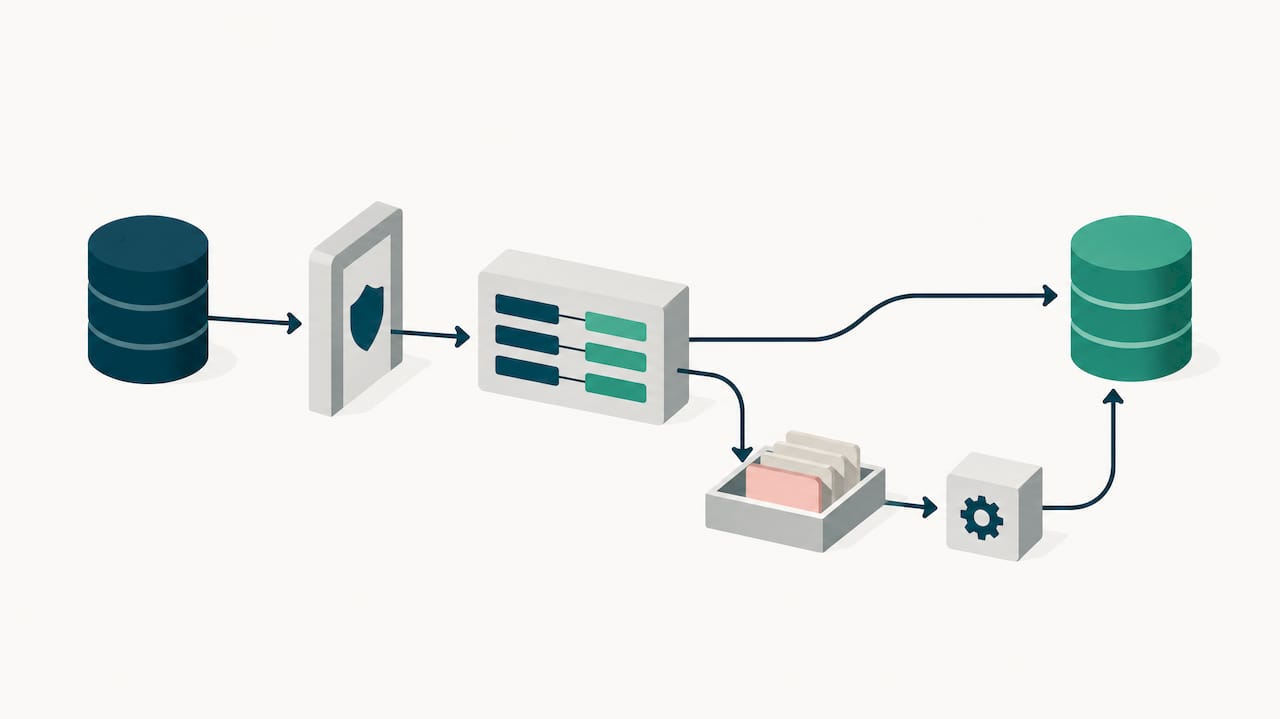
An ATS) manages applicants from sourcing through offer. An HRIS manages employees from hire through departure. The integration boundary sits precisely at offer acceptance, the authoritative moment when a candidate record should convert into an employee record. Not all applicant data belongs in the HRIS. According to Treegarden’s integration guide, the transfer should include only fields required to build an accurate employee profile and trigger onboarding, not the full candidate file.
Fields that typically move at hire:
Legal name, contact details, and start date
Job title, department, and reporting manager
Compensation and employment type
Work eligibility and tax or banking details where collected
Fields that should stay in the ATS include interview notes, rejected-candidate history, and sourcing channel data. Moving them into the HRIS creates retention risk, since employee records are often kept far longer than recruiting records should be under most data protection frameworks.
Integration architectures: native connectors, middleware, and unified APIs
Four patterns dominate ATS-HRIS integration, and each carries different maintenance costs.
Native connectors: built and maintained by the vendor, these are reliable for high-volume flows like hire-to-onboard but only exist for popular ATS-HRIS pairs.
Middleware or orchestration platforms: tools like Boomi, Workato, or MuleSoft sit between systems, handling retries and transformation logic, though they add another platform to license and monitor, as CIPD’s guidance on large-organization HR systems notes for complex, multi-system environments.
Unified API platforms: a single codebase connects to dozens of ATS and HRIS vendors through one normalized schema, which is efficient when an organization must support many downstream systems rather than one fixed pair.
Legacy file transfers: SFTP or CSV batch jobs still work, but only when no API exists.
Modern integrations generally favor REST-based APIs over older file transfer methods because they support real-time or near-real-time sync and hold up better against vendor UI changes, according to Integrate. Unified API documentation from unified.to confirms that aggregated APIs let a single integration layer support many ATS and HRIS systems at once, which matters for agencies or enterprises juggling several vendors rather than one fixed pairing.
Technical checklist for authentication, mapping, and monitoring
A working integration depends on a small set of technical disciplines applied consistently.
Secure authentication: use OAuth 2.0 with token rotation and encrypt all data in transit.
Comprehensive field map: document source field, destination field, data type, transformation rule, and mandatory flag for every data point that moves.
Idempotent operations: design writes so that retried requests never create duplicate employee records.
Conflict and retry rules: define which system wins when both are updated and how many retry attempts occur before a failure is logged.
Monitoring and error queues: route failed records to a visible queue rather than letting them disappear silently.
Treegarden’s integration strategy guide identifies field-mapping mismatches as the leading cause of integration failure, and recommends a field map that lists source and destination types, transformation rules, allowed values, and example records, then validates every sandbox record automatically before go-live.
Pro Tip: Build your error queue before your happy-path logic. You will need it on day one, not after the first incident.
Data governance: single source of truth and AI oversight
Once data starts moving between systems, governance decides who owns what and who can touch it.
The HRIS should function as the single source of truth for employee data once a hire is confirmed, with the ATS deferring to it for any post-hire updates.
Candidate data retention and employee data retention need separate rules, since recruiting records are often legally required to be purged sooner than employment records.
Access permissions should distinguish recruiters, HR administrators, and payroll staff, each seeing only what their role requires.
AI features inside recruiting tools, such as resume scoring or candidate matching, raise governance questions that go beyond IT configuration. CIPD guidance on how people professionals should develop, deploy and use AI recommends treating these system changes as organizational change programs, bringing HR, legal, and IT into the decision early rather than after an AI tool is already live. That same early involvement reduces rework when an integration touches both recruiting and employment data.
Implementation roadmap: from discovery to hypercare
A realistic rollout follows distinct phases rather than a single big-bang launch.
Discovery: align HR, IT, legal, and recruiting stakeholders on which fields must sync and why, documenting requirements in a shared workshop.
Sandbox mapping: build the field map and run end-to-end test cases using sample candidate records that mirror real-world edge cases.
Pilot hires: route a small batch of real hires through the integration, checking that each record lands correctly in the HRIS before expanding.
Broad rollout: open the integration to all hiring managers and departments once pilot results are clean.
Hypercare: monitor error rates closely for several weeks, keep a documented rollback plan ready, and run audit checks to confirm no silent data loss occurred.
Many agencies compress discovery and pilot into a short window; a 4-to-8-week pilot structure is a common pattern for smaller teams looking for early wins before a full rollout.
Common failure modes and how to prevent them
Most integration failures trace back to a handful of recurring mistakes, each with a known fix.
Field-mapping mismatches: enforce controlled vocabularies and validation rules so a free-text department name cannot silently break a dropdown field on the other side.
Partial or delayed syncs: design near-real-time sync where possible, or a reconciled batch cadence with alerts when a batch fails to complete.
Bidirectional overwrite conflicts: set explicit ownership rules, so the HRIS always wins on post-hire employee data and the ATS never overwrites it after hire.
Untested edge cases: run automated validation scripts and periodic reconciliation reports comparing record counts between systems.
Pro Tip: Run a weekly reconciliation report even after go-live. Silent drift between systems is easier to catch in a count mismatch than in a support ticket.
When to extend your HRIS versus keep best-of-breed ATS workflows
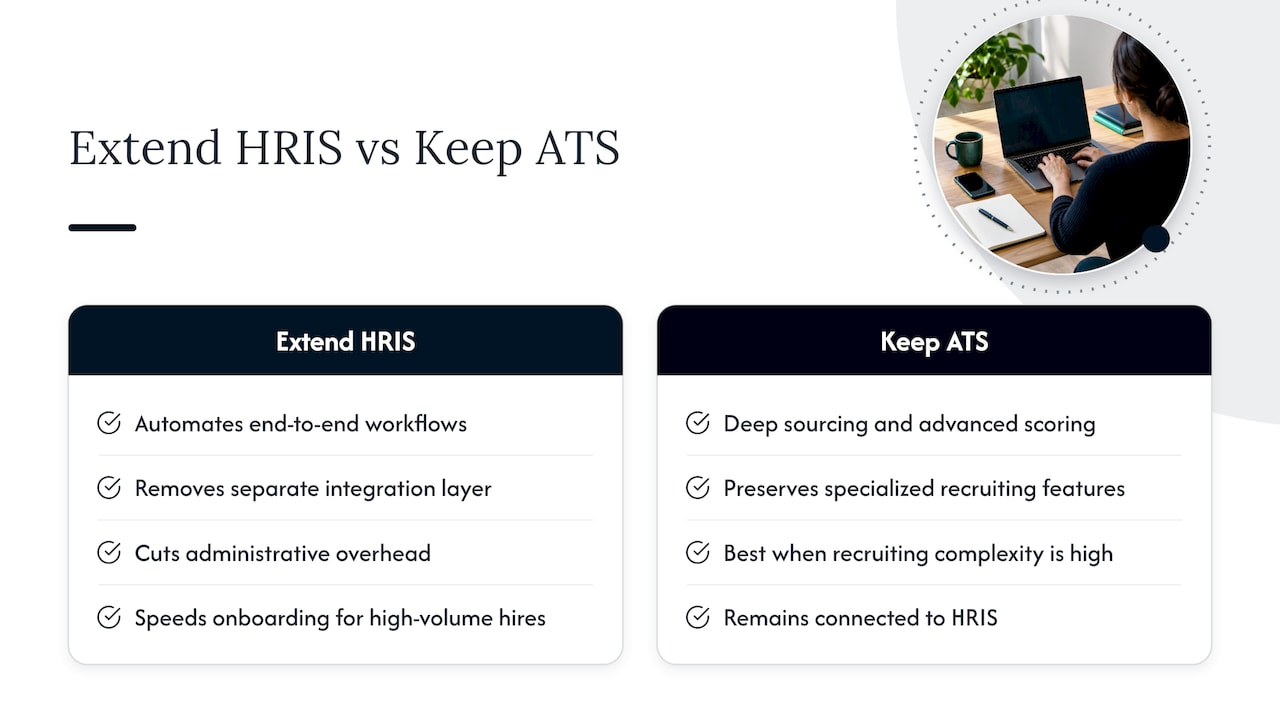
Consolidated platforms that combine applicant tracking and CRM functions can automate workflows from first candidate contact through contract generation, cutting administrative overhead and removing the need for a separate integration layer entirely. That approach speeds onboarding for agencies managing high hire volume. Specialized ATS features, such as deep sourcing and advanced scoring, remain valuable when recruiting complexity outweighs the benefit of a single system, and some organizations will reasonably keep a best-of-breed ATS connected to their HRIS through the architectures described above.
Why reliability should outrank feature parity
We would rather see a team choose native connectors for the critical hire-to-onboard flow and layer unified APIs on top for scale, instead of chasing every feature a vendor advertises. Integration success is best measured in onboarding time and payroll error rate, not in connector count. Bringing HR, legal, and IT into the conversation early avoids the expensive rework that follows a governance gap discovered after go-live.
- Recruitify Team
How Recruitify fits into a connected hiring stack
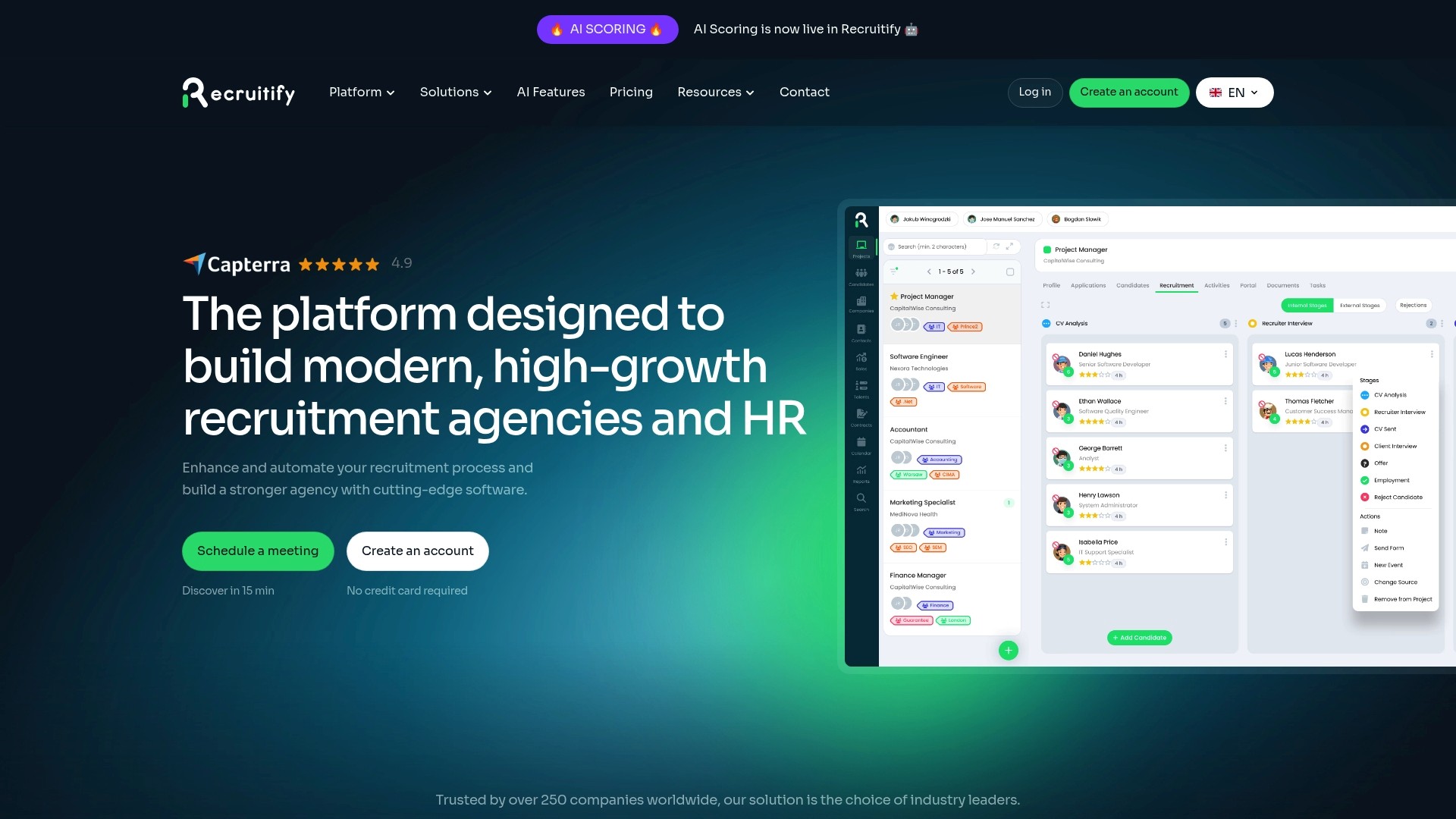
We built our platform to remove the integration burden rather than add to it, combining ATS, CRM, and contracting workflows with automated candidate-to-contract generation, advanced CV parsing, and contextual matching inside one system with data protection compliance.
For agencies and HR teams weighing a consolidated approach against stitching together separate systems, our pricing page outlines the HR Team and Recruitment Agencies plans, each priced per user per month, so you can compare the cost of consolidation against your current integration overhead.
FAQ
What is the difference between an ATS and an HRIS?
An ATS manages the recruiting process, from sourcing candidates through making an offer, while an HRIS manages the employee lifecycle after hire, including payroll, benefits, and personnel records. The two systems need to exchange data at the hire event so a candidate converts cleanly into an employee record.
What does ATS integration actually connect?
ATS integration links the recruiting system to other platforms, most commonly an HRIS, so that hire data flows automatically instead of being re-entered by hand. The connection typically triggers at offer acceptance and moves fields like name, start date, job title, and compensation into the employee record.
Which ATS systems work best for HRIS integration?
The best fit depends on whether your organization needs native connectors, middleware, or a unified API layer to support multiple HRIS vendors. Platforms like Recruitify combine ATS and CRM functions in one system, which removes the need for a separate HRIS integration for agencies managing their own hiring and contracting workflows.
What should HR teams check before choosing ATS software for integration?
HR teams should confirm the ATS supports REST-based APIs rather than only file transfers, since API-based sync tends to be more reliable and closer to real-time. It also helps to confirm the vendor provides clear field-mapping documentation and audit logging before committing to a long-term contract.
Sources
Recommended


News & Updates
Stay up-to-date with the latest innovations, features, and tips about Recruitify!
By providing your email address within the newsletter sign-up form, you confirm its processing to send marketing information regarding the Administrator’s products and services. The Administrator of your personal data processed for the abovementioned purposes is Recruitify Spółka z o.o., based in Warsaw, Poland (KRS 0000709889). For more information on the principles of personal data processing and the rights of data subjects, please check the Privacy Policy.

Last updated:
Stop Syncing Files: ATS and HRIS Integration for HR Teams & Agencies
Recruitment Process
The Recruitify Team
Yes, integrate your ATS and HRIS, and do it with API-based transfers that push only the required hire fields at offer acceptance, not entire candidate files. Done this way, the integration cuts duplicate data entry and onboarding delays while limiting the single biggest risk: field-mapping errors. The moment a candidate becomes a hire is the design boundary that determines what data moves and when.
TL;DR:
Integration should transmit only essential hire data such as legal name, start date, job title, and compensation, to avoid retention risks and ensure accuracy.
Real-time API-based integrations with OAuth 2.0 and detailed field mapping significantly reduce errors, delays, and duplicate records compared to file transfer methods.
Building a robust error queue and conducting regular reconciliation reports are key to identifying silent data drift and preventing recurring failure modes.
Native connectors work best for critical hire-to-onboard flows, but unified APIs support multi-vendor environments, prioritizing reliability over feature parity.
Support for REST APIs and clear documentation should be verified before choosing ATS systems, as these ensure smoother, near-real-time data transfer and easier upkeep.
RecruitifyConnect Your Recruitment WorkflowRecruitify.ai brings ATS, Sales CRM, and IT contracting into one operational ecosystem for modern IT recruitment agencies.Visit Recruitify.ai
Table of Contents
What ATS HRIS integration actually does: data flows and the hire boundary
Integration architectures: native connectors, middleware, and unified APIs
Technical checklist for authentication, mapping, and monitoring
Data governance: single source of truth and AI oversight
Implementation roadmap: from discovery to hypercare
Common failure modes and how to prevent them
When to extend your HRIS versus keep best-of-breed ATS workflows
Why reliability should outrank feature parity
How Recruitify fits into a connected hiring stack
FAQ
Sources
What ATS HRIS integration actually does: data flows and the hire boundary
An ATS) manages applicants from sourcing through offer. An HRIS manages employees from hire through departure. The integration boundary sits precisely at offer acceptance, the authoritative moment when a candidate record should convert into an employee record. Not all applicant data belongs in the HRIS. According to Treegarden’s integration guide, the transfer should include only fields required to build an accurate employee profile and trigger onboarding, not the full candidate file.
Fields that typically move at hire:
Legal name, contact details, and start date
Job title, department, and reporting manager
Compensation and employment type
Work eligibility and tax or banking details where collected
Fields that should stay in the ATS include interview notes, rejected-candidate history, and sourcing channel data. Moving them into the HRIS creates retention risk, since employee records are often kept far longer than recruiting records should be under most data protection frameworks.
Integration architectures: native connectors, middleware, and unified APIs
Four patterns dominate ATS-HRIS integration, and each carries different maintenance costs.
Native connectors: built and maintained by the vendor, these are reliable for high-volume flows like hire-to-onboard but only exist for popular ATS-HRIS pairs.
Middleware or orchestration platforms: tools like Boomi, Workato, or MuleSoft sit between systems, handling retries and transformation logic, though they add another platform to license and monitor, as CIPD’s guidance on large-organization HR systems notes for complex, multi-system environments.
Unified API platforms: a single codebase connects to dozens of ATS and HRIS vendors through one normalized schema, which is efficient when an organization must support many downstream systems rather than one fixed pair.
Legacy file transfers: SFTP or CSV batch jobs still work, but only when no API exists.
Modern integrations generally favor REST-based APIs over older file transfer methods because they support real-time or near-real-time sync and hold up better against vendor UI changes, according to Integrate. Unified API documentation from unified.to confirms that aggregated APIs let a single integration layer support many ATS and HRIS systems at once, which matters for agencies or enterprises juggling several vendors rather than one fixed pairing.
Technical checklist for authentication, mapping, and monitoring
A working integration depends on a small set of technical disciplines applied consistently.
Secure authentication: use OAuth 2.0 with token rotation and encrypt all data in transit.
Comprehensive field map: document source field, destination field, data type, transformation rule, and mandatory flag for every data point that moves.
Idempotent operations: design writes so that retried requests never create duplicate employee records.
Conflict and retry rules: define which system wins when both are updated and how many retry attempts occur before a failure is logged.
Monitoring and error queues: route failed records to a visible queue rather than letting them disappear silently.
Treegarden’s integration strategy guide identifies field-mapping mismatches as the leading cause of integration failure, and recommends a field map that lists source and destination types, transformation rules, allowed values, and example records, then validates every sandbox record automatically before go-live.
Pro Tip: Build your error queue before your happy-path logic. You will need it on day one, not after the first incident.
Data governance: single source of truth and AI oversight
Once data starts moving between systems, governance decides who owns what and who can touch it.
The HRIS should function as the single source of truth for employee data once a hire is confirmed, with the ATS deferring to it for any post-hire updates.
Candidate data retention and employee data retention need separate rules, since recruiting records are often legally required to be purged sooner than employment records.
Access permissions should distinguish recruiters, HR administrators, and payroll staff, each seeing only what their role requires.
AI features inside recruiting tools, such as resume scoring or candidate matching, raise governance questions that go beyond IT configuration. CIPD guidance on how people professionals should develop, deploy and use AI recommends treating these system changes as organizational change programs, bringing HR, legal, and IT into the decision early rather than after an AI tool is already live. That same early involvement reduces rework when an integration touches both recruiting and employment data.
Implementation roadmap: from discovery to hypercare
A realistic rollout follows distinct phases rather than a single big-bang launch.
Discovery: align HR, IT, legal, and recruiting stakeholders on which fields must sync and why, documenting requirements in a shared workshop.
Sandbox mapping: build the field map and run end-to-end test cases using sample candidate records that mirror real-world edge cases.
Pilot hires: route a small batch of real hires through the integration, checking that each record lands correctly in the HRIS before expanding.
Broad rollout: open the integration to all hiring managers and departments once pilot results are clean.
Hypercare: monitor error rates closely for several weeks, keep a documented rollback plan ready, and run audit checks to confirm no silent data loss occurred.
Many agencies compress discovery and pilot into a short window; a 4-to-8-week pilot structure is a common pattern for smaller teams looking for early wins before a full rollout.
Common failure modes and how to prevent them
Most integration failures trace back to a handful of recurring mistakes, each with a known fix.
Field-mapping mismatches: enforce controlled vocabularies and validation rules so a free-text department name cannot silently break a dropdown field on the other side.
Partial or delayed syncs: design near-real-time sync where possible, or a reconciled batch cadence with alerts when a batch fails to complete.
Bidirectional overwrite conflicts: set explicit ownership rules, so the HRIS always wins on post-hire employee data and the ATS never overwrites it after hire.
Untested edge cases: run automated validation scripts and periodic reconciliation reports comparing record counts between systems.
Pro Tip: Run a weekly reconciliation report even after go-live. Silent drift between systems is easier to catch in a count mismatch than in a support ticket.
When to extend your HRIS versus keep best-of-breed ATS workflows
Consolidated platforms that combine applicant tracking and CRM functions can automate workflows from first candidate contact through contract generation, cutting administrative overhead and removing the need for a separate integration layer entirely. That approach speeds onboarding for agencies managing high hire volume. Specialized ATS features, such as deep sourcing and advanced scoring, remain valuable when recruiting complexity outweighs the benefit of a single system, and some organizations will reasonably keep a best-of-breed ATS connected to their HRIS through the architectures described above.
Why reliability should outrank feature parity
We would rather see a team choose native connectors for the critical hire-to-onboard flow and layer unified APIs on top for scale, instead of chasing every feature a vendor advertises. Integration success is best measured in onboarding time and payroll error rate, not in connector count. Bringing HR, legal, and IT into the conversation early avoids the expensive rework that follows a governance gap discovered after go-live.
- Recruitify Team
How Recruitify fits into a connected hiring stack
We built our platform to remove the integration burden rather than add to it, combining ATS, CRM, and contracting workflows with automated candidate-to-contract generation, advanced CV parsing, and contextual matching inside one system with data protection compliance.
For agencies and HR teams weighing a consolidated approach against stitching together separate systems, our pricing page outlines the HR Team and Recruitment Agencies plans, each priced per user per month, so you can compare the cost of consolidation against your current integration overhead.
FAQ
What is the difference between an ATS and an HRIS?
An ATS manages the recruiting process, from sourcing candidates through making an offer, while an HRIS manages the employee lifecycle after hire, including payroll, benefits, and personnel records. The two systems need to exchange data at the hire event so a candidate converts cleanly into an employee record.
What does ATS integration actually connect?
ATS integration links the recruiting system to other platforms, most commonly an HRIS, so that hire data flows automatically instead of being re-entered by hand. The connection typically triggers at offer acceptance and moves fields like name, start date, job title, and compensation into the employee record.
Which ATS systems work best for HRIS integration?
The best fit depends on whether your organization needs native connectors, middleware, or a unified API layer to support multiple HRIS vendors. Platforms like Recruitify combine ATS and CRM functions in one system, which removes the need for a separate HRIS integration for agencies managing their own hiring and contracting workflows.
What should HR teams check before choosing ATS software for integration?
HR teams should confirm the ATS supports REST-based APIs rather than only file transfers, since API-based sync tends to be more reliable and closer to real-time. It also helps to confirm the vendor provides clear field-mapping documentation and audit logging before committing to a long-term contract.
Sources
Recommended
News & Updates
Stay up-to-date with the latest innovations, features, and tips about Recruitify!
By providing your email address within the newsletter sign-up form, you confirm its processing to send marketing information regarding the Administrator’s products and services. The Administrator of your personal data processed for the abovementioned purposes is Recruitify Spółka z o.o., based in Warsaw, Poland (KRS 0000709889). For more information on the principles of personal data processing and the rights of data subjects, please check the Privacy Policy.
Last updated:
Stop Syncing Files: ATS and HRIS Integration for HR Teams & Agencies
Recruitment Process
The Recruitify Team
Yes, integrate your ATS and HRIS, and do it with API-based transfers that push only the required hire fields at offer acceptance, not entire candidate files. Done this way, the integration cuts duplicate data entry and onboarding delays while limiting the single biggest risk: field-mapping errors. The moment a candidate becomes a hire is the design boundary that determines what data moves and when.
TL;DR:
Integration should transmit only essential hire data such as legal name, start date, job title, and compensation, to avoid retention risks and ensure accuracy.
Real-time API-based integrations with OAuth 2.0 and detailed field mapping significantly reduce errors, delays, and duplicate records compared to file transfer methods.
Building a robust error queue and conducting regular reconciliation reports are key to identifying silent data drift and preventing recurring failure modes.
Native connectors work best for critical hire-to-onboard flows, but unified APIs support multi-vendor environments, prioritizing reliability over feature parity.
Support for REST APIs and clear documentation should be verified before choosing ATS systems, as these ensure smoother, near-real-time data transfer and easier upkeep.
RecruitifyConnect Your Recruitment WorkflowRecruitify.ai brings ATS, Sales CRM, and IT contracting into one operational ecosystem for modern IT recruitment agencies.Visit Recruitify.ai
Table of Contents
What ATS HRIS integration actually does: data flows and the hire boundary
Integration architectures: native connectors, middleware, and unified APIs
Technical checklist for authentication, mapping, and monitoring
Data governance: single source of truth and AI oversight
Implementation roadmap: from discovery to hypercare
Common failure modes and how to prevent them
When to extend your HRIS versus keep best-of-breed ATS workflows
Why reliability should outrank feature parity
How Recruitify fits into a connected hiring stack
FAQ
Sources
What ATS HRIS integration actually does: data flows and the hire boundary
An ATS) manages applicants from sourcing through offer. An HRIS manages employees from hire through departure. The integration boundary sits precisely at offer acceptance, the authoritative moment when a candidate record should convert into an employee record. Not all applicant data belongs in the HRIS. According to Treegarden’s integration guide, the transfer should include only fields required to build an accurate employee profile and trigger onboarding, not the full candidate file.
Fields that typically move at hire:
Legal name, contact details, and start date
Job title, department, and reporting manager
Compensation and employment type
Work eligibility and tax or banking details where collected
Fields that should stay in the ATS include interview notes, rejected-candidate history, and sourcing channel data. Moving them into the HRIS creates retention risk, since employee records are often kept far longer than recruiting records should be under most data protection frameworks.
Integration architectures: native connectors, middleware, and unified APIs
Four patterns dominate ATS-HRIS integration, and each carries different maintenance costs.
Native connectors: built and maintained by the vendor, these are reliable for high-volume flows like hire-to-onboard but only exist for popular ATS-HRIS pairs.
Middleware or orchestration platforms: tools like Boomi, Workato, or MuleSoft sit between systems, handling retries and transformation logic, though they add another platform to license and monitor, as CIPD’s guidance on large-organization HR systems notes for complex, multi-system environments.
Unified API platforms: a single codebase connects to dozens of ATS and HRIS vendors through one normalized schema, which is efficient when an organization must support many downstream systems rather than one fixed pair.
Legacy file transfers: SFTP or CSV batch jobs still work, but only when no API exists.
Modern integrations generally favor REST-based APIs over older file transfer methods because they support real-time or near-real-time sync and hold up better against vendor UI changes, according to Integrate. Unified API documentation from unified.to confirms that aggregated APIs let a single integration layer support many ATS and HRIS systems at once, which matters for agencies or enterprises juggling several vendors rather than one fixed pairing.
Technical checklist for authentication, mapping, and monitoring
A working integration depends on a small set of technical disciplines applied consistently.
Secure authentication: use OAuth 2.0 with token rotation and encrypt all data in transit.
Comprehensive field map: document source field, destination field, data type, transformation rule, and mandatory flag for every data point that moves.
Idempotent operations: design writes so that retried requests never create duplicate employee records.
Conflict and retry rules: define which system wins when both are updated and how many retry attempts occur before a failure is logged.
Monitoring and error queues: route failed records to a visible queue rather than letting them disappear silently.
Treegarden’s integration strategy guide identifies field-mapping mismatches as the leading cause of integration failure, and recommends a field map that lists source and destination types, transformation rules, allowed values, and example records, then validates every sandbox record automatically before go-live.
Pro Tip: Build your error queue before your happy-path logic. You will need it on day one, not after the first incident.
Data governance: single source of truth and AI oversight
Once data starts moving between systems, governance decides who owns what and who can touch it.
The HRIS should function as the single source of truth for employee data once a hire is confirmed, with the ATS deferring to it for any post-hire updates.
Candidate data retention and employee data retention need separate rules, since recruiting records are often legally required to be purged sooner than employment records.
Access permissions should distinguish recruiters, HR administrators, and payroll staff, each seeing only what their role requires.
AI features inside recruiting tools, such as resume scoring or candidate matching, raise governance questions that go beyond IT configuration. CIPD guidance on how people professionals should develop, deploy and use AI recommends treating these system changes as organizational change programs, bringing HR, legal, and IT into the decision early rather than after an AI tool is already live. That same early involvement reduces rework when an integration touches both recruiting and employment data.
Implementation roadmap: from discovery to hypercare
A realistic rollout follows distinct phases rather than a single big-bang launch.
Discovery: align HR, IT, legal, and recruiting stakeholders on which fields must sync and why, documenting requirements in a shared workshop.
Sandbox mapping: build the field map and run end-to-end test cases using sample candidate records that mirror real-world edge cases.
Pilot hires: route a small batch of real hires through the integration, checking that each record lands correctly in the HRIS before expanding.
Broad rollout: open the integration to all hiring managers and departments once pilot results are clean.
Hypercare: monitor error rates closely for several weeks, keep a documented rollback plan ready, and run audit checks to confirm no silent data loss occurred.
Many agencies compress discovery and pilot into a short window; a 4-to-8-week pilot structure is a common pattern for smaller teams looking for early wins before a full rollout.
Common failure modes and how to prevent them
Most integration failures trace back to a handful of recurring mistakes, each with a known fix.
Field-mapping mismatches: enforce controlled vocabularies and validation rules so a free-text department name cannot silently break a dropdown field on the other side.
Partial or delayed syncs: design near-real-time sync where possible, or a reconciled batch cadence with alerts when a batch fails to complete.
Bidirectional overwrite conflicts: set explicit ownership rules, so the HRIS always wins on post-hire employee data and the ATS never overwrites it after hire.
Untested edge cases: run automated validation scripts and periodic reconciliation reports comparing record counts between systems.
Pro Tip: Run a weekly reconciliation report even after go-live. Silent drift between systems is easier to catch in a count mismatch than in a support ticket.
When to extend your HRIS versus keep best-of-breed ATS workflows
Consolidated platforms that combine applicant tracking and CRM functions can automate workflows from first candidate contact through contract generation, cutting administrative overhead and removing the need for a separate integration layer entirely. That approach speeds onboarding for agencies managing high hire volume. Specialized ATS features, such as deep sourcing and advanced scoring, remain valuable when recruiting complexity outweighs the benefit of a single system, and some organizations will reasonably keep a best-of-breed ATS connected to their HRIS through the architectures described above.
Why reliability should outrank feature parity
We would rather see a team choose native connectors for the critical hire-to-onboard flow and layer unified APIs on top for scale, instead of chasing every feature a vendor advertises. Integration success is best measured in onboarding time and payroll error rate, not in connector count. Bringing HR, legal, and IT into the conversation early avoids the expensive rework that follows a governance gap discovered after go-live.
- Recruitify Team
How Recruitify fits into a connected hiring stack
We built our platform to remove the integration burden rather than add to it, combining ATS, CRM, and contracting workflows with automated candidate-to-contract generation, advanced CV parsing, and contextual matching inside one system with data protection compliance.
For agencies and HR teams weighing a consolidated approach against stitching together separate systems, our pricing page outlines the HR Team and Recruitment Agencies plans, each priced per user per month, so you can compare the cost of consolidation against your current integration overhead.
FAQ
What is the difference between an ATS and an HRIS?
An ATS manages the recruiting process, from sourcing candidates through making an offer, while an HRIS manages the employee lifecycle after hire, including payroll, benefits, and personnel records. The two systems need to exchange data at the hire event so a candidate converts cleanly into an employee record.
What does ATS integration actually connect?
ATS integration links the recruiting system to other platforms, most commonly an HRIS, so that hire data flows automatically instead of being re-entered by hand. The connection typically triggers at offer acceptance and moves fields like name, start date, job title, and compensation into the employee record.
Which ATS systems work best for HRIS integration?
The best fit depends on whether your organization needs native connectors, middleware, or a unified API layer to support multiple HRIS vendors. Platforms like Recruitify combine ATS and CRM functions in one system, which removes the need for a separate HRIS integration for agencies managing their own hiring and contracting workflows.
What should HR teams check before choosing ATS software for integration?
HR teams should confirm the ATS supports REST-based APIs rather than only file transfers, since API-based sync tends to be more reliable and closer to real-time. It also helps to confirm the vendor provides clear field-mapping documentation and audit logging before committing to a long-term contract.
Sources
Recommended
News & Updates
Stay up-to-date with the latest innovations, features, and tips about Recruitify!
By providing your email address within the newsletter sign-up form, you confirm its processing to send marketing information regarding the Administrator’s products and services. The Administrator of your personal data processed for the abovementioned purposes is Recruitify Spółka z o.o., based in Warsaw, Poland (KRS 0000709889). For more information on the principles of personal data processing and the rights of data subjects, please check the Privacy Policy.

Discover More

Recruitment Process
Pipeline Forecasting for Recruiting: 8 Steps to Trust the Numbers
Recruiting pipeline forecasting predicts fill dates and hiring odds from pipeline data. See the inputs, limits, and eight steps for a reliable forecast.
10 Oct 2026
Discover More

Innovations
60 - 90 Day Pilot to Turn Hiring Signals Into Staffing Lead Generation
Run a 60 - 90 day pilot to convert hiring signals into qualified conversations. Use LinkedIn, targeted outbound, and ATS/CRM automation to measure cost per...
9 Oct 2026
Discover More

Recruitment Process
HR Teams: 3 Priorities and an RFP Checklist for Branded Career Portals
Three research backed priorities and an RFP checklist HR teams can use to build a branded career portal that converts candidates, meets WCAG 2.1 AA, and...
8 Oct 2026
Discover More
Recruitment Process
Pipeline Forecasting for Recruiting: 8 Steps to Trust the Numbers
Recruiting pipeline forecasting predicts fill dates and hiring odds from pipeline data. See the inputs, limits, and eight steps for a reliable forecast.
10 Oct 2026
Discover More
Innovations
60 - 90 Day Pilot to Turn Hiring Signals Into Staffing Lead Generation
Run a 60 - 90 day pilot to convert hiring signals into qualified conversations. Use LinkedIn, targeted outbound, and ATS/CRM automation to measure cost per...
9 Oct 2026
Discover More