
Last updated:
CRM in a Recruitment Agency: Because Your Client is a Critical Part of the Hiring Process

Innovations

Iwo Paliszewski
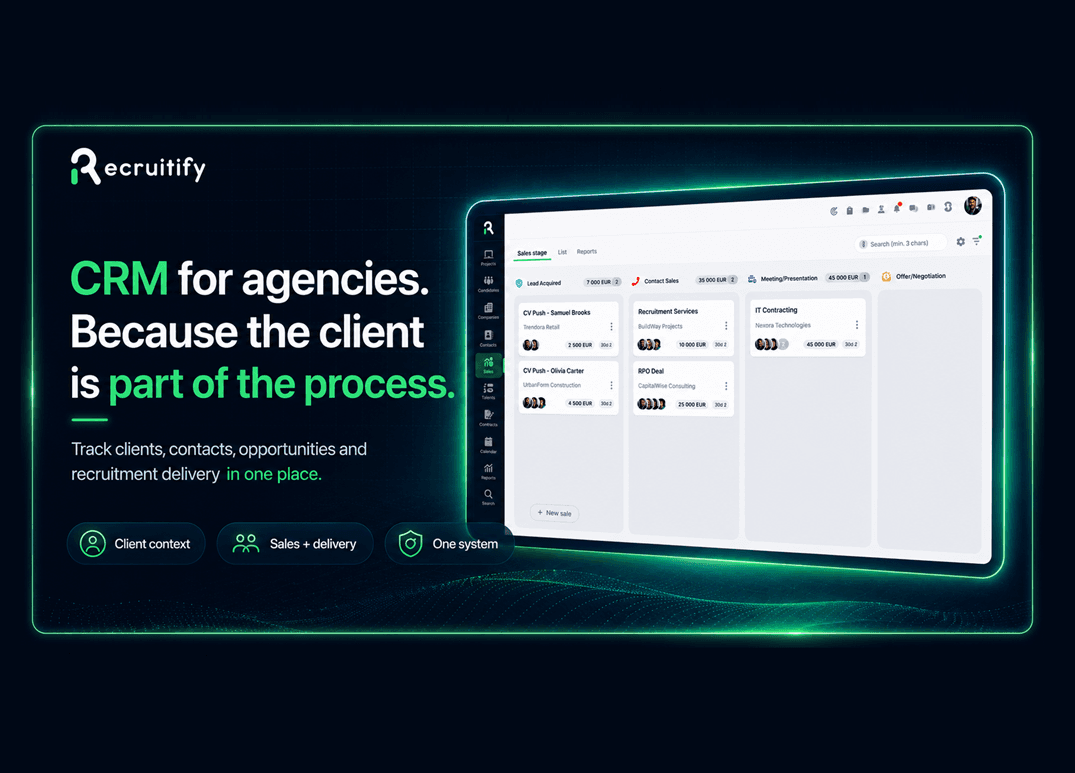
CRM in a Recruitment Agency: Because the client is also part of the hiring process
Recruitment agencies rarely work exclusively with candidates.
Of course, candidates are at the very heart of campaign delivery. Recruiters source, screen, evaluate, present them, and strive to maintain strong relationships with them. Most recruitment platforms were originally built around exactly this foundation: around candidates, applications, CVs, pipeline stages, status updates, and final placements.
But in an agency, recruitment is never a candidate-only process. It is equally a client-focused process.
Behind every vacancy, there is a specific company. A hiring manager. Sometimes a Talent Acquisition specialist, a business owner, a procurement professional, or several stakeholders from different departments at once. There are briefings, negotiations, intake meetings, feedback loops, commercial terms, and opportunities for future business.
If this entire client context lives outside of your recruitment platform – your workflow is simply incomplete.
Recruitment agencies don't just fill vacancies. They manage relationships
For an in-house HR team, the recruitment process usually starts with opening a vacancy and ends with onboarding. Commercial relationships do not come into play here.
For an agency, every recruitment project is part of a much broader business relationship.
A client might have one active role today, open another next month, have a long-term hiring plan, changing expectations, internal decision-makers, past feedback on candidates, and a history of collaboration spanning years.
A recruiter working on an active vacancy needs more than just a job description. They need to know exactly what was promised, what the client truly prioritises when choosing between two strong profiles, which candidates were rejected previously and why, how quickly the client provides feedback, and who ultimately makes the final decision.
When this information is scattered across emails, spreadsheets, private notes, and individual memories, the agency loses control over the account. The recruitment process might struggle on – but the commercial context surrounding it becomes incredibly fragile.
An ATS without client context is only half the picture
Many agencies use an ATS to manage candidates and jobs, and a separate CRM to manage client relationships. Economically, this might seem to make sense. The ATS handles delivery, while the CRM handles sales.
In practice, this boundary is far from clear-cut.
Consider a typical scenario: a recruiter has been sourcing for three weeks. The client has rejected two strong candidates, but the feedback was vague – "not quite the right fit". The recruiter doesn't know if the issue was technical depth, lack of domain experience, salary expectations, or something that was never properly defined in the brief.
Without access to the history of previous submissions, recurring rejection patterns, and consolidated feedback in one place, the recruiter has to guess. They adjust their search based on gut instinct rather than hard data. Consequently, they will likely present a similar profile again – only to receive another vague rejection.
When client context is readily available, this pattern becomes clear. The recruiter can recalibrate their search, have an honest consultation with the client, and protect both the hiring process and the candidate experience from frustration.
Delivery and client relationship management constantly overlap. A consultant who spots a new hiring need during a routine client update shouldn't have to rely on a sticky note or an email that gets lost in a crowded inbox. A manager who wants to identify which clients generate the most profitable placements versus the most administration shouldn't have to reconstruct this from memory.
In an agency, delivery drives sales opportunities, and sales context shapes delivery. If these two worlds are siloed, your team loses a massive competitive advantage.
The client is part of the Candidate Experience
Candidate Experience is usually discussed as something that lies solely in the hands of the recruiter. And yes – to a large extent, it does. But the client also plays a massive role in this.
If a client provides feedback quickly, the candidate feels the process moving. If the client delays, the candidate is left waiting – and starts looking elsewhere. If requirements change mid-process, candidates are assessed against one set of expectations and rejected based on another, often without understanding why.
From the candidate’s perspective, the agency and the client are part of the exact same journey. There is no clear distinction.
This means client behaviour directly impacts your recruitment metrics. Slow feedback increases time-to-hire. Unclear briefs drive up rejection rates. Frequent scope changes burn through candidate goodwill and engagement that took weeks to build.
A powerful CRM integrated with your daily recruitment workflow helps agencies clearly identify these patterns – not just on the current job, but across the entire client history. It equips recruiters to manage the client-side dynamics effectively, protecting the quality of the process for everyone involved.
Client feedback should not vanish into email threads
One of the most valuable assets in recruitment is client feedback.
Why was a candidate rejected? Was the technical level too low? Were salary expectations too high? Did the client prefer someone else despite this candidate being excellent? Did the hiring manager change their mind after seeing the market map?
This feedback is not just useful for the current vacancy. It shapes future shortlists, search calibration, and sourcing strategies for that client.
Too often, however, this intelligence is trapped in email threads or informal phone calls. One recruiter knows because they spoke with the client. Another might have no idea. A business developer only hears fragments. After six months, this vital context vanishes entirely.
When client feedback is permanently linked to their profile, job history, and submitted candidates – it becomes useful, searchable business intelligence. Your agency learns from every single project, rather than just closing the file and starting from scratch on the next.
Sales opportunities are often born during delivery
For many agencies, the sales pipeline and the delivery pipeline are not two separate realities. They constantly feed into each other.
Business development doesn't only happen before a project begins. Quite often, the best opportunities emerge during delivery.
A recruiter learns that a client is opening a new department. A hiring manager mentions in passing that another team is struggling to recruit. A client asks if the agency can support them on a completely different business unit. Project delivery reveals a need for B2B contractors, executive search, or long-term workforce planning.
These are not just casual remarks. They are high-value commercial signals.
But if your recruitment platform doesn't foster CRM thinking, these signals are incredibly easy to lose. They remain as side-notes in an email or a call log, never evolving into a qualified opportunity.
An integrated CRM helps convert relationship signals into closed deals. It doesn't force recruiters to become pushy salespeople; it simply ensures your agency captures the commercial intelligence needed to drive account growth.
Agencies need full visibility – clients, contacts, jobs, and candidates
A recruitment agency is a complex web of connections.
Candidates connect to campaigns. Campaigns to clients. Clients to specific key contacts. Contacts lead to future business. Past feedback shapes future strategy. Successful placements drive account growth.
If these connections are not visible within a unified system, your agency becomes a hostage to human memory – and individual memory doesn't scale, can't be successfully handed over, and doesn't survive staff turnover.
What happens when a recruiter leaves? When an Account Manager is on extended leave? When a client returns after six months, but the person who held their context in their head has moved on? Without a built-in CRM, the answers to these questions usually drown in operational chaos.
With a robust platform in place, your agency enjoys 360-degree visibility at all times: active clients, open roles, communication history, past placements, feedback patterns, upcoming pipeline, and the next steps required to close.
This is not just about better reporting. It is about the operational continuity and valuation of your business.
CRM is not just a tool for sales reps
A common mistake agencies make is treating a CRM solely as a pipeline tool for sales – something the BD team updates once a week.
In reality, a recruitment CRM should empower anyone who impacts the client touchpoint.
Recruiters need commercial context to deliver better shortlists. Salespeople need delivery insights to manage client expectations and secure renewals. Managers need visibility to identify risk and forecast revenue. Account owners need an accurate history of what was promised, what has been delivered, and what was agreed.
The relationship with a single client can involve sourcing, screening, profile submissions, feedback loops, fee negotiations, and long-term account growth. You cannot silo this into a single department's task list.
That is why a recruitment CRM should not be a separate software database that consultants update only when prompted. It must be woven into the daily workflow – visible and valuable to those doing the sourcing and delivery, not just those managing the sales pipeline.
The client is not an onlooker. Your software should reflect this
When client context is connected and fully visible, recruiters work smarter.
They understand requirements faster. They qualify vacancies better. They spot bottlenecks much earlier – before slow client feedback ruins a candidate relationship, and before an inaccurate brief wastes weeks of valuable sourcing time. They can leverage insights gained from previous projects, rather than starting from absolute zero with every new intake call.
A great CRM does not replace the human touch in recruitment. It protects it.
It ensures relationships do not live exclusively in someone’s inbox, notebook, or head. It guarantees that when something critical happens – a key piece of feedback, a new hiring requirement, a shift in market rates – it is documented where the entire team can see it and act instantly.
Because in an executive search firm or recruitment agency, the client is not just the background to the process. The client is an active participant in it.
And since the client is part of the process, client intelligence must be an integral part of your system.
That is why at Recruitify, we built CRM functionality into the very core of our platform. We believe recruitment agencies need far more than just status tracking in an ATS. They need a system designed for how agency recruitment works in the real world – uniting candidates and clients, delivery and relationships, placements and pipeline in one powerful software.


News & Updates
Stay up-to-date with the latest innovations, features, and tips about Recruitify!
By providing your email address within the newsletter sign-up form, you confirm its processing to send marketing information regarding the Administrator’s products and services. The Administrator of your personal data processed for the abovementioned purposes is Recruitify Spółka z o.o., based in Warsaw, Poland (KRS 0000709889). For more information on the principles of personal data processing and the rights of data subjects, please check the Privacy Policy.

Last updated:
CRM in a Recruitment Agency: Because Your Client is a Critical Part of the Hiring Process
Innovations
Iwo Paliszewski
CRM in a Recruitment Agency: Because the client is also part of the hiring process
Recruitment agencies rarely work exclusively with candidates.
Of course, candidates are at the very heart of campaign delivery. Recruiters source, screen, evaluate, present them, and strive to maintain strong relationships with them. Most recruitment platforms were originally built around exactly this foundation: around candidates, applications, CVs, pipeline stages, status updates, and final placements.
But in an agency, recruitment is never a candidate-only process. It is equally a client-focused process.
Behind every vacancy, there is a specific company. A hiring manager. Sometimes a Talent Acquisition specialist, a business owner, a procurement professional, or several stakeholders from different departments at once. There are briefings, negotiations, intake meetings, feedback loops, commercial terms, and opportunities for future business.
If this entire client context lives outside of your recruitment platform – your workflow is simply incomplete.
Recruitment agencies don't just fill vacancies. They manage relationships
For an in-house HR team, the recruitment process usually starts with opening a vacancy and ends with onboarding. Commercial relationships do not come into play here.
For an agency, every recruitment project is part of a much broader business relationship.
A client might have one active role today, open another next month, have a long-term hiring plan, changing expectations, internal decision-makers, past feedback on candidates, and a history of collaboration spanning years.
A recruiter working on an active vacancy needs more than just a job description. They need to know exactly what was promised, what the client truly prioritises when choosing between two strong profiles, which candidates were rejected previously and why, how quickly the client provides feedback, and who ultimately makes the final decision.
When this information is scattered across emails, spreadsheets, private notes, and individual memories, the agency loses control over the account. The recruitment process might struggle on – but the commercial context surrounding it becomes incredibly fragile.
An ATS without client context is only half the picture
Many agencies use an ATS to manage candidates and jobs, and a separate CRM to manage client relationships. Economically, this might seem to make sense. The ATS handles delivery, while the CRM handles sales.
In practice, this boundary is far from clear-cut.
Consider a typical scenario: a recruiter has been sourcing for three weeks. The client has rejected two strong candidates, but the feedback was vague – "not quite the right fit". The recruiter doesn't know if the issue was technical depth, lack of domain experience, salary expectations, or something that was never properly defined in the brief.
Without access to the history of previous submissions, recurring rejection patterns, and consolidated feedback in one place, the recruiter has to guess. They adjust their search based on gut instinct rather than hard data. Consequently, they will likely present a similar profile again – only to receive another vague rejection.
When client context is readily available, this pattern becomes clear. The recruiter can recalibrate their search, have an honest consultation with the client, and protect both the hiring process and the candidate experience from frustration.
Delivery and client relationship management constantly overlap. A consultant who spots a new hiring need during a routine client update shouldn't have to rely on a sticky note or an email that gets lost in a crowded inbox. A manager who wants to identify which clients generate the most profitable placements versus the most administration shouldn't have to reconstruct this from memory.
In an agency, delivery drives sales opportunities, and sales context shapes delivery. If these two worlds are siloed, your team loses a massive competitive advantage.
The client is part of the Candidate Experience
Candidate Experience is usually discussed as something that lies solely in the hands of the recruiter. And yes – to a large extent, it does. But the client also plays a massive role in this.
If a client provides feedback quickly, the candidate feels the process moving. If the client delays, the candidate is left waiting – and starts looking elsewhere. If requirements change mid-process, candidates are assessed against one set of expectations and rejected based on another, often without understanding why.
From the candidate’s perspective, the agency and the client are part of the exact same journey. There is no clear distinction.
This means client behaviour directly impacts your recruitment metrics. Slow feedback increases time-to-hire. Unclear briefs drive up rejection rates. Frequent scope changes burn through candidate goodwill and engagement that took weeks to build.
A powerful CRM integrated with your daily recruitment workflow helps agencies clearly identify these patterns – not just on the current job, but across the entire client history. It equips recruiters to manage the client-side dynamics effectively, protecting the quality of the process for everyone involved.
Client feedback should not vanish into email threads
One of the most valuable assets in recruitment is client feedback.
Why was a candidate rejected? Was the technical level too low? Were salary expectations too high? Did the client prefer someone else despite this candidate being excellent? Did the hiring manager change their mind after seeing the market map?
This feedback is not just useful for the current vacancy. It shapes future shortlists, search calibration, and sourcing strategies for that client.
Too often, however, this intelligence is trapped in email threads or informal phone calls. One recruiter knows because they spoke with the client. Another might have no idea. A business developer only hears fragments. After six months, this vital context vanishes entirely.
When client feedback is permanently linked to their profile, job history, and submitted candidates – it becomes useful, searchable business intelligence. Your agency learns from every single project, rather than just closing the file and starting from scratch on the next.
Sales opportunities are often born during delivery
For many agencies, the sales pipeline and the delivery pipeline are not two separate realities. They constantly feed into each other.
Business development doesn't only happen before a project begins. Quite often, the best opportunities emerge during delivery.
A recruiter learns that a client is opening a new department. A hiring manager mentions in passing that another team is struggling to recruit. A client asks if the agency can support them on a completely different business unit. Project delivery reveals a need for B2B contractors, executive search, or long-term workforce planning.
These are not just casual remarks. They are high-value commercial signals.
But if your recruitment platform doesn't foster CRM thinking, these signals are incredibly easy to lose. They remain as side-notes in an email or a call log, never evolving into a qualified opportunity.
An integrated CRM helps convert relationship signals into closed deals. It doesn't force recruiters to become pushy salespeople; it simply ensures your agency captures the commercial intelligence needed to drive account growth.
Agencies need full visibility – clients, contacts, jobs, and candidates
A recruitment agency is a complex web of connections.
Candidates connect to campaigns. Campaigns to clients. Clients to specific key contacts. Contacts lead to future business. Past feedback shapes future strategy. Successful placements drive account growth.
If these connections are not visible within a unified system, your agency becomes a hostage to human memory – and individual memory doesn't scale, can't be successfully handed over, and doesn't survive staff turnover.
What happens when a recruiter leaves? When an Account Manager is on extended leave? When a client returns after six months, but the person who held their context in their head has moved on? Without a built-in CRM, the answers to these questions usually drown in operational chaos.
With a robust platform in place, your agency enjoys 360-degree visibility at all times: active clients, open roles, communication history, past placements, feedback patterns, upcoming pipeline, and the next steps required to close.
This is not just about better reporting. It is about the operational continuity and valuation of your business.
CRM is not just a tool for sales reps
A common mistake agencies make is treating a CRM solely as a pipeline tool for sales – something the BD team updates once a week.
In reality, a recruitment CRM should empower anyone who impacts the client touchpoint.
Recruiters need commercial context to deliver better shortlists. Salespeople need delivery insights to manage client expectations and secure renewals. Managers need visibility to identify risk and forecast revenue. Account owners need an accurate history of what was promised, what has been delivered, and what was agreed.
The relationship with a single client can involve sourcing, screening, profile submissions, feedback loops, fee negotiations, and long-term account growth. You cannot silo this into a single department's task list.
That is why a recruitment CRM should not be a separate software database that consultants update only when prompted. It must be woven into the daily workflow – visible and valuable to those doing the sourcing and delivery, not just those managing the sales pipeline.
The client is not an onlooker. Your software should reflect this
When client context is connected and fully visible, recruiters work smarter.
They understand requirements faster. They qualify vacancies better. They spot bottlenecks much earlier – before slow client feedback ruins a candidate relationship, and before an inaccurate brief wastes weeks of valuable sourcing time. They can leverage insights gained from previous projects, rather than starting from absolute zero with every new intake call.
A great CRM does not replace the human touch in recruitment. It protects it.
It ensures relationships do not live exclusively in someone’s inbox, notebook, or head. It guarantees that when something critical happens – a key piece of feedback, a new hiring requirement, a shift in market rates – it is documented where the entire team can see it and act instantly.
Because in an executive search firm or recruitment agency, the client is not just the background to the process. The client is an active participant in it.
And since the client is part of the process, client intelligence must be an integral part of your system.
That is why at Recruitify, we built CRM functionality into the very core of our platform. We believe recruitment agencies need far more than just status tracking in an ATS. They need a system designed for how agency recruitment works in the real world – uniting candidates and clients, delivery and relationships, placements and pipeline in one powerful software.
News & Updates
Stay up-to-date with the latest innovations, features, and tips about Recruitify!
By providing your email address within the newsletter sign-up form, you confirm its processing to send marketing information regarding the Administrator’s products and services. The Administrator of your personal data processed for the abovementioned purposes is Recruitify Spółka z o.o., based in Warsaw, Poland (KRS 0000709889). For more information on the principles of personal data processing and the rights of data subjects, please check the Privacy Policy.
Last updated:
CRM in a Recruitment Agency: Because Your Client is a Critical Part of the Hiring Process
Innovations
Iwo Paliszewski
CRM in a Recruitment Agency: Because the client is also part of the hiring process
Recruitment agencies rarely work exclusively with candidates.
Of course, candidates are at the very heart of campaign delivery. Recruiters source, screen, evaluate, present them, and strive to maintain strong relationships with them. Most recruitment platforms were originally built around exactly this foundation: around candidates, applications, CVs, pipeline stages, status updates, and final placements.
But in an agency, recruitment is never a candidate-only process. It is equally a client-focused process.
Behind every vacancy, there is a specific company. A hiring manager. Sometimes a Talent Acquisition specialist, a business owner, a procurement professional, or several stakeholders from different departments at once. There are briefings, negotiations, intake meetings, feedback loops, commercial terms, and opportunities for future business.
If this entire client context lives outside of your recruitment platform – your workflow is simply incomplete.
Recruitment agencies don't just fill vacancies. They manage relationships
For an in-house HR team, the recruitment process usually starts with opening a vacancy and ends with onboarding. Commercial relationships do not come into play here.
For an agency, every recruitment project is part of a much broader business relationship.
A client might have one active role today, open another next month, have a long-term hiring plan, changing expectations, internal decision-makers, past feedback on candidates, and a history of collaboration spanning years.
A recruiter working on an active vacancy needs more than just a job description. They need to know exactly what was promised, what the client truly prioritises when choosing between two strong profiles, which candidates were rejected previously and why, how quickly the client provides feedback, and who ultimately makes the final decision.
When this information is scattered across emails, spreadsheets, private notes, and individual memories, the agency loses control over the account. The recruitment process might struggle on – but the commercial context surrounding it becomes incredibly fragile.
An ATS without client context is only half the picture
Many agencies use an ATS to manage candidates and jobs, and a separate CRM to manage client relationships. Economically, this might seem to make sense. The ATS handles delivery, while the CRM handles sales.
In practice, this boundary is far from clear-cut.
Consider a typical scenario: a recruiter has been sourcing for three weeks. The client has rejected two strong candidates, but the feedback was vague – "not quite the right fit". The recruiter doesn't know if the issue was technical depth, lack of domain experience, salary expectations, or something that was never properly defined in the brief.
Without access to the history of previous submissions, recurring rejection patterns, and consolidated feedback in one place, the recruiter has to guess. They adjust their search based on gut instinct rather than hard data. Consequently, they will likely present a similar profile again – only to receive another vague rejection.
When client context is readily available, this pattern becomes clear. The recruiter can recalibrate their search, have an honest consultation with the client, and protect both the hiring process and the candidate experience from frustration.
Delivery and client relationship management constantly overlap. A consultant who spots a new hiring need during a routine client update shouldn't have to rely on a sticky note or an email that gets lost in a crowded inbox. A manager who wants to identify which clients generate the most profitable placements versus the most administration shouldn't have to reconstruct this from memory.
In an agency, delivery drives sales opportunities, and sales context shapes delivery. If these two worlds are siloed, your team loses a massive competitive advantage.
The client is part of the Candidate Experience
Candidate Experience is usually discussed as something that lies solely in the hands of the recruiter. And yes – to a large extent, it does. But the client also plays a massive role in this.
If a client provides feedback quickly, the candidate feels the process moving. If the client delays, the candidate is left waiting – and starts looking elsewhere. If requirements change mid-process, candidates are assessed against one set of expectations and rejected based on another, often without understanding why.
From the candidate’s perspective, the agency and the client are part of the exact same journey. There is no clear distinction.
This means client behaviour directly impacts your recruitment metrics. Slow feedback increases time-to-hire. Unclear briefs drive up rejection rates. Frequent scope changes burn through candidate goodwill and engagement that took weeks to build.
A powerful CRM integrated with your daily recruitment workflow helps agencies clearly identify these patterns – not just on the current job, but across the entire client history. It equips recruiters to manage the client-side dynamics effectively, protecting the quality of the process for everyone involved.
Client feedback should not vanish into email threads
One of the most valuable assets in recruitment is client feedback.
Why was a candidate rejected? Was the technical level too low? Were salary expectations too high? Did the client prefer someone else despite this candidate being excellent? Did the hiring manager change their mind after seeing the market map?
This feedback is not just useful for the current vacancy. It shapes future shortlists, search calibration, and sourcing strategies for that client.
Too often, however, this intelligence is trapped in email threads or informal phone calls. One recruiter knows because they spoke with the client. Another might have no idea. A business developer only hears fragments. After six months, this vital context vanishes entirely.
When client feedback is permanently linked to their profile, job history, and submitted candidates – it becomes useful, searchable business intelligence. Your agency learns from every single project, rather than just closing the file and starting from scratch on the next.
Sales opportunities are often born during delivery
For many agencies, the sales pipeline and the delivery pipeline are not two separate realities. They constantly feed into each other.
Business development doesn't only happen before a project begins. Quite often, the best opportunities emerge during delivery.
A recruiter learns that a client is opening a new department. A hiring manager mentions in passing that another team is struggling to recruit. A client asks if the agency can support them on a completely different business unit. Project delivery reveals a need for B2B contractors, executive search, or long-term workforce planning.
These are not just casual remarks. They are high-value commercial signals.
But if your recruitment platform doesn't foster CRM thinking, these signals are incredibly easy to lose. They remain as side-notes in an email or a call log, never evolving into a qualified opportunity.
An integrated CRM helps convert relationship signals into closed deals. It doesn't force recruiters to become pushy salespeople; it simply ensures your agency captures the commercial intelligence needed to drive account growth.
Agencies need full visibility – clients, contacts, jobs, and candidates
A recruitment agency is a complex web of connections.
Candidates connect to campaigns. Campaigns to clients. Clients to specific key contacts. Contacts lead to future business. Past feedback shapes future strategy. Successful placements drive account growth.
If these connections are not visible within a unified system, your agency becomes a hostage to human memory – and individual memory doesn't scale, can't be successfully handed over, and doesn't survive staff turnover.
What happens when a recruiter leaves? When an Account Manager is on extended leave? When a client returns after six months, but the person who held their context in their head has moved on? Without a built-in CRM, the answers to these questions usually drown in operational chaos.
With a robust platform in place, your agency enjoys 360-degree visibility at all times: active clients, open roles, communication history, past placements, feedback patterns, upcoming pipeline, and the next steps required to close.
This is not just about better reporting. It is about the operational continuity and valuation of your business.
CRM is not just a tool for sales reps
A common mistake agencies make is treating a CRM solely as a pipeline tool for sales – something the BD team updates once a week.
In reality, a recruitment CRM should empower anyone who impacts the client touchpoint.
Recruiters need commercial context to deliver better shortlists. Salespeople need delivery insights to manage client expectations and secure renewals. Managers need visibility to identify risk and forecast revenue. Account owners need an accurate history of what was promised, what has been delivered, and what was agreed.
The relationship with a single client can involve sourcing, screening, profile submissions, feedback loops, fee negotiations, and long-term account growth. You cannot silo this into a single department's task list.
That is why a recruitment CRM should not be a separate software database that consultants update only when prompted. It must be woven into the daily workflow – visible and valuable to those doing the sourcing and delivery, not just those managing the sales pipeline.
The client is not an onlooker. Your software should reflect this
When client context is connected and fully visible, recruiters work smarter.
They understand requirements faster. They qualify vacancies better. They spot bottlenecks much earlier – before slow client feedback ruins a candidate relationship, and before an inaccurate brief wastes weeks of valuable sourcing time. They can leverage insights gained from previous projects, rather than starting from absolute zero with every new intake call.
A great CRM does not replace the human touch in recruitment. It protects it.
It ensures relationships do not live exclusively in someone’s inbox, notebook, or head. It guarantees that when something critical happens – a key piece of feedback, a new hiring requirement, a shift in market rates – it is documented where the entire team can see it and act instantly.
Because in an executive search firm or recruitment agency, the client is not just the background to the process. The client is an active participant in it.
And since the client is part of the process, client intelligence must be an integral part of your system.
That is why at Recruitify, we built CRM functionality into the very core of our platform. We believe recruitment agencies need far more than just status tracking in an ATS. They need a system designed for how agency recruitment works in the real world – uniting candidates and clients, delivery and relationships, placements and pipeline in one powerful software.
News & Updates
Stay up-to-date with the latest innovations, features, and tips about Recruitify!
By providing your email address within the newsletter sign-up form, you confirm its processing to send marketing information regarding the Administrator’s products and services. The Administrator of your personal data processed for the abovementioned purposes is Recruitify Spółka z o.o., based in Warsaw, Poland (KRS 0000709889). For more information on the principles of personal data processing and the rights of data subjects, please check the Privacy Policy.

Discover More

Applicant Tracking System
Copy These Interview Feedback Forms Recruiters Can Use in Their ATS
Copyable, stage-specific interview feedback forms Recruiters can paste into Google Forms or an ATS. Pilot a template, then review results after five...
21 Sept 2026
Discover More

HR Analytics
3 Guardrails for Recruiters Using Automated Rejection Emails
Stop ghosting and protect your employer brand with stage-based templates, research-backed timing SLAs, and a rollout plan recruiters can implement fast.
20 Sept 2026
Discover More

Recruitment Process
Recruiters: Job Posting Automation, Safe Pilot and No Duplicate Posts
Guide for recruiters and agencies to implement job posting automation, get 60–90 day payback, prevent duplicate posts, and run a safe pilot.
19 Sept 2026
Discover More
Applicant Tracking System
Copy These Interview Feedback Forms Recruiters Can Use in Their ATS
Copyable, stage-specific interview feedback forms Recruiters can paste into Google Forms or an ATS. Pilot a template, then review results after five...
21 Sept 2026
Discover More
HR Analytics
3 Guardrails for Recruiters Using Automated Rejection Emails
Stop ghosting and protect your employer brand with stage-based templates, research-backed timing SLAs, and a rollout plan recruiters can implement fast.
20 Sept 2026
Discover More