
Last updated:
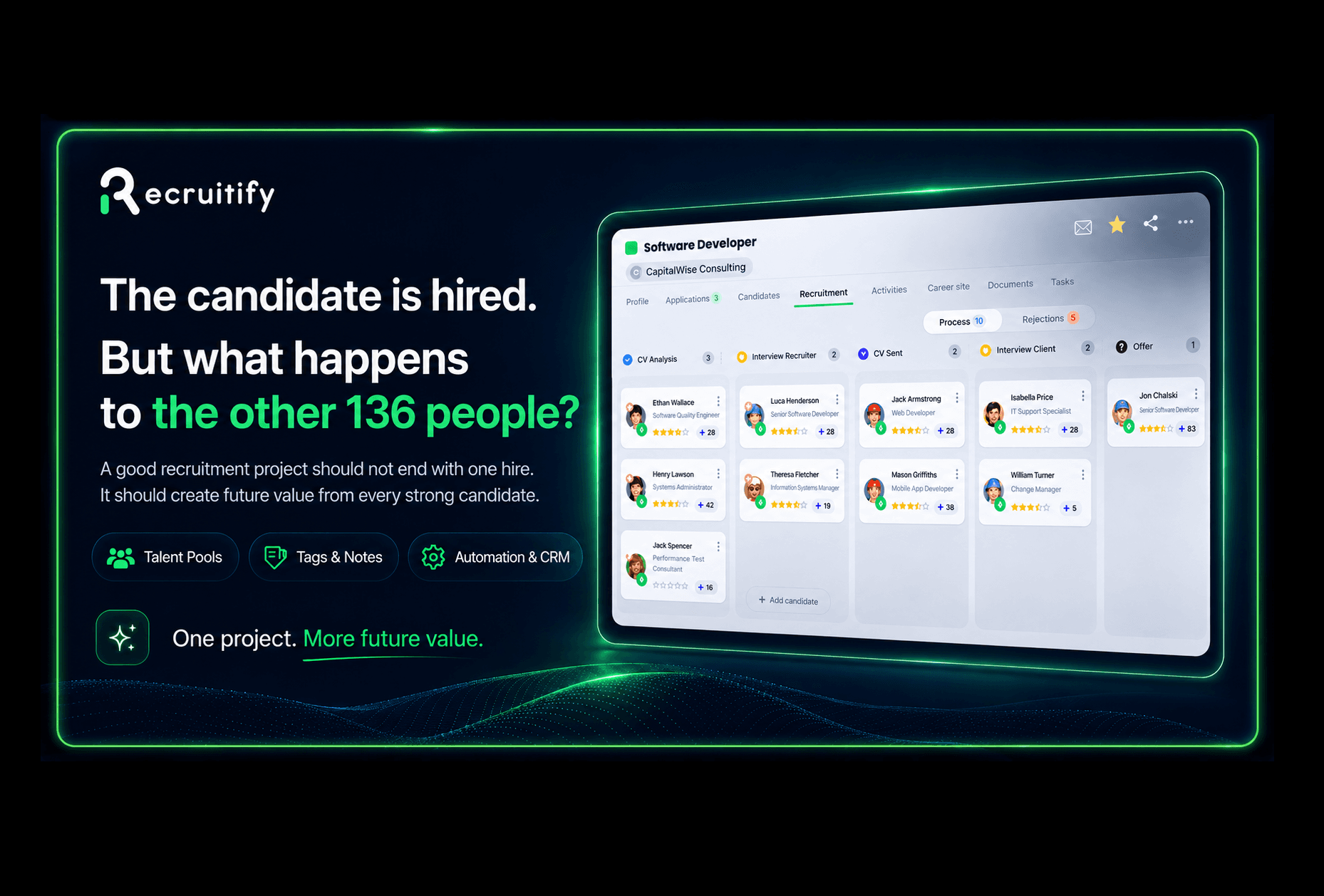
The Project Is Closed. The Candidate Is Hired. But What Happens to the Other 136 People?

Innovations

Iwo Paliszewski
A recruiter closes a project.
The client is happy. The hiring manager chose the right person. The offer was accepted. The start date is confirmed.
From the outside, this looks like a clean success: one vacancy, one hire, one finished process.
But inside the recruitment system, the story is more complicated.
There were 137 candidates in that project. One person got the job. That leaves 136 others - and among them, not everyone was a poor fit. Maybe 12 were genuinely strong. Maybe five reached the final stage. Maybe three had exactly the kind of background that would be valuable for another client in three months. Maybe someone was too expensive for this role, but perfect for the next one.
The project is closed. But the value created during that project should not disappear with it.
In many recruitment teams, that is exactly what happens.
Every recruitment project creates knowledge. Most of it is never reused.
Recruitment is typically measured by one outcome: was the role filled?
That makes sense. But if we only look at the person who was hired, we miss something important.
Every project generates real intelligence: which profiles actually make it through, what salary expectations look like in this market right now, why strong candidates dropped out, what the client truly values when they have to choose between two good people.
This knowledge is valuable - but only if it is captured.
The 136 other candidates are not just "unsuccessful applicants." They represent sourcing effort that has already happened, conversations that have already started, evaluations that have already been done. If none of that context is preserved, the team will have to recreate it from scratch next time.
That is one of the most common and most invisible forms of waste in recruitment.
The database has their CVs. That is not the same as knowing who they are.
Most candidates do not literally disappear. Their profiles remain in the ATS. Their CVs are still there.
But storage is not the same as usability.
A candidate can be in the database and still be practically lost.
Their rejection reason might say "not selected" - which tells the next recruiter almost nothing. Was the candidate too junior, or too senior? Was the salary too high, or just slightly above budget? Did the client prefer someone else, even though this person was genuinely strong? Was the candidate unavailable in October but potentially open again in spring?
These differences matter enormously. A candidate who reached the final round and lost to someone with slightly more niche experience should be treated very differently from someone who lacked the basic requirements. If all of them share the same "rejected" status, the database loses its intelligence.
One real example: a recruiter places a strong candidate for a CFO role. The client goes with someone who had more M&A experience. Six months later, the same agency gets a CFO search for a different client - one where M&A experience is not the priority. If that earlier finalist was properly tagged and noted, they are the first call. If not, the recruiter starts LinkedIn from scratch.
Silver medalists are the most underused sourcing channel in recruitment.
Every recruiter knows the concept - the candidate who was strong, went through several rounds, and did not get the job.
These candidates are unusually valuable. They have already been engaged. They understand the type of role. They have been assessed and discussed. There is already context and trust built.
And yet, silver medalists are systematically underused.
They end up buried in old projects, old notes, old shortlists. A recruiter may remember them for a few weeks. But as new projects arrive, the memory fades. When a similar role opens up, the team often starts from scratch instead of returning to people they already know well.
This is not because recruiters do not care. It is because recruitment moves fast, and without the right system habits, even valuable people become hard to retrieve.
What should happen when a project closes?
The end of a recruitment project should be a knowledge-capture moment - not just an administrative one.
Before the project disappears from daily attention, a few questions are worth asking:
Who was strong but not selected, and why exactly?
Who should be added to a talent pool for future roles?
Which candidates are worth a follow-up message in three to six months?
Which rejection reasons carry enough detail to be useful in a future search?
This does not need to be a heavy process. In fact, if it requires too much manual effort, it will simply not happen - recruiters already have another role to fill, another client to update, another shortlist to prepare.
That is why this kind of knowledge capture needs to be built into the system itself, not added on top of it.
This is where dynamic talent pools can become useful. Not as passive folders, but as living segments of the database that can collect strong candidates from shortlists, applications, hires, or key project stages - and make them easier to reuse when a similar opportunity appears.
Tags, notes, and rejection reasons are not admin. They are future search intelligence.
A well-written note can explain why a candidate stood out - not just what they did, but why they impressed the team. A precise rejection reason can tell the next recruiter whether the issue was skill fit, salary expectations, availability, motivation, or simply client preference on a day when two strong candidates had to be separated.
A tag showing that someone is open to relocation, available from Q3, or has led teams through a specific kind of transformation can directly change which candidates surface in the next search.
This information may not change the outcome of the current project. But it can change the outcome of the next one - sometimes significantly.
Data quality in recruitment is not a technical problem. It is an operational habit.
Communication should not end with "we chose someone else."
There is also a human side to this.
When someone reaches the final stages of a recruitment process, a generic rejection email is a missed opportunity. From the candidate's perspective, they invested time, energy, and sometimes real hope. How the team communicates at the end of that process determines whether they stay open to future opportunities - or quietly decide this agency is not worth engaging with again.
Staying in touch with strong candidates does not require a live vacancy. A short message acknowledging the situation, keeping the relationship warm, and flagging that you would like to reconnect when the right role appears - that kind of communication builds something most sourcing tools cannot buy: genuine goodwill.
The real question is whether your database gets smarter after every project.
Every completed recruitment project should make the database more useful. Not just larger.
If the system knows more after each project - which profiles were strong, which were rejected and why, which candidates are worth revisiting, which people should be grouped together for future opportunities - then past work keeps generating value.
If it does not, then the team keeps starting from zero. The database grows in size, but not in intelligence. And the sourcing effort from the last project does not reduce the effort required for the next one.
The best recruitment teams understand this. They do not only fill roles. They build memory.
Every closed project is an opportunity to make the next one faster, cheaper, and better.
The question is whether the system - and the habits around it - make that easy enough to actually happen.
At Recruitify, this is one of the problems we care deeply about: helping recruitment teams turn completed projects into reusable knowledge, not forgotten history.
That is why we build features such as Dynamic Talent Pools, structured candidate data, automation, tagging, candidate communication, and project history - not to create more admin, but to help recruiters preserve context and reuse the value they have already created.
Because a recruitment system should not only help you close one role. It should make the next one easier.


News & Updates
Stay up-to-date with the latest innovations, features, and tips about Recruitify!
By providing your email address within the newsletter sign-up form, you confirm its processing to send marketing information regarding the Administrator’s products and services. The Administrator of your personal data processed for the abovementioned purposes is Recruitify Spółka z o.o., based in Warsaw, Poland (KRS 0000709889). For more information on the principles of personal data processing and the rights of data subjects, please check the Privacy Policy.

Last updated:
The Project Is Closed. The Candidate Is Hired. But What Happens to the Other 136 People?
Innovations
Iwo Paliszewski
A recruiter closes a project.
The client is happy. The hiring manager chose the right person. The offer was accepted. The start date is confirmed.
From the outside, this looks like a clean success: one vacancy, one hire, one finished process.
But inside the recruitment system, the story is more complicated.
There were 137 candidates in that project. One person got the job. That leaves 136 others - and among them, not everyone was a poor fit. Maybe 12 were genuinely strong. Maybe five reached the final stage. Maybe three had exactly the kind of background that would be valuable for another client in three months. Maybe someone was too expensive for this role, but perfect for the next one.
The project is closed. But the value created during that project should not disappear with it.
In many recruitment teams, that is exactly what happens.
Every recruitment project creates knowledge. Most of it is never reused.
Recruitment is typically measured by one outcome: was the role filled?
That makes sense. But if we only look at the person who was hired, we miss something important.
Every project generates real intelligence: which profiles actually make it through, what salary expectations look like in this market right now, why strong candidates dropped out, what the client truly values when they have to choose between two good people.
This knowledge is valuable - but only if it is captured.
The 136 other candidates are not just "unsuccessful applicants." They represent sourcing effort that has already happened, conversations that have already started, evaluations that have already been done. If none of that context is preserved, the team will have to recreate it from scratch next time.
That is one of the most common and most invisible forms of waste in recruitment.
The database has their CVs. That is not the same as knowing who they are.
Most candidates do not literally disappear. Their profiles remain in the ATS. Their CVs are still there.
But storage is not the same as usability.
A candidate can be in the database and still be practically lost.
Their rejection reason might say "not selected" - which tells the next recruiter almost nothing. Was the candidate too junior, or too senior? Was the salary too high, or just slightly above budget? Did the client prefer someone else, even though this person was genuinely strong? Was the candidate unavailable in October but potentially open again in spring?
These differences matter enormously. A candidate who reached the final round and lost to someone with slightly more niche experience should be treated very differently from someone who lacked the basic requirements. If all of them share the same "rejected" status, the database loses its intelligence.
One real example: a recruiter places a strong candidate for a CFO role. The client goes with someone who had more M&A experience. Six months later, the same agency gets a CFO search for a different client - one where M&A experience is not the priority. If that earlier finalist was properly tagged and noted, they are the first call. If not, the recruiter starts LinkedIn from scratch.
Silver medalists are the most underused sourcing channel in recruitment.
Every recruiter knows the concept - the candidate who was strong, went through several rounds, and did not get the job.
These candidates are unusually valuable. They have already been engaged. They understand the type of role. They have been assessed and discussed. There is already context and trust built.
And yet, silver medalists are systematically underused.
They end up buried in old projects, old notes, old shortlists. A recruiter may remember them for a few weeks. But as new projects arrive, the memory fades. When a similar role opens up, the team often starts from scratch instead of returning to people they already know well.
This is not because recruiters do not care. It is because recruitment moves fast, and without the right system habits, even valuable people become hard to retrieve.
What should happen when a project closes?
The end of a recruitment project should be a knowledge-capture moment - not just an administrative one.
Before the project disappears from daily attention, a few questions are worth asking:
Who was strong but not selected, and why exactly?
Who should be added to a talent pool for future roles?
Which candidates are worth a follow-up message in three to six months?
Which rejection reasons carry enough detail to be useful in a future search?
This does not need to be a heavy process. In fact, if it requires too much manual effort, it will simply not happen - recruiters already have another role to fill, another client to update, another shortlist to prepare.
That is why this kind of knowledge capture needs to be built into the system itself, not added on top of it.
This is where dynamic talent pools can become useful. Not as passive folders, but as living segments of the database that can collect strong candidates from shortlists, applications, hires, or key project stages - and make them easier to reuse when a similar opportunity appears.
Tags, notes, and rejection reasons are not admin. They are future search intelligence.
A well-written note can explain why a candidate stood out - not just what they did, but why they impressed the team. A precise rejection reason can tell the next recruiter whether the issue was skill fit, salary expectations, availability, motivation, or simply client preference on a day when two strong candidates had to be separated.
A tag showing that someone is open to relocation, available from Q3, or has led teams through a specific kind of transformation can directly change which candidates surface in the next search.
This information may not change the outcome of the current project. But it can change the outcome of the next one - sometimes significantly.
Data quality in recruitment is not a technical problem. It is an operational habit.
Communication should not end with "we chose someone else."
There is also a human side to this.
When someone reaches the final stages of a recruitment process, a generic rejection email is a missed opportunity. From the candidate's perspective, they invested time, energy, and sometimes real hope. How the team communicates at the end of that process determines whether they stay open to future opportunities - or quietly decide this agency is not worth engaging with again.
Staying in touch with strong candidates does not require a live vacancy. A short message acknowledging the situation, keeping the relationship warm, and flagging that you would like to reconnect when the right role appears - that kind of communication builds something most sourcing tools cannot buy: genuine goodwill.
The real question is whether your database gets smarter after every project.
Every completed recruitment project should make the database more useful. Not just larger.
If the system knows more after each project - which profiles were strong, which were rejected and why, which candidates are worth revisiting, which people should be grouped together for future opportunities - then past work keeps generating value.
If it does not, then the team keeps starting from zero. The database grows in size, but not in intelligence. And the sourcing effort from the last project does not reduce the effort required for the next one.
The best recruitment teams understand this. They do not only fill roles. They build memory.
Every closed project is an opportunity to make the next one faster, cheaper, and better.
The question is whether the system - and the habits around it - make that easy enough to actually happen.
At Recruitify, this is one of the problems we care deeply about: helping recruitment teams turn completed projects into reusable knowledge, not forgotten history.
That is why we build features such as Dynamic Talent Pools, structured candidate data, automation, tagging, candidate communication, and project history - not to create more admin, but to help recruiters preserve context and reuse the value they have already created.
Because a recruitment system should not only help you close one role. It should make the next one easier.
News & Updates
Stay up-to-date with the latest innovations, features, and tips about Recruitify!
By providing your email address within the newsletter sign-up form, you confirm its processing to send marketing information regarding the Administrator’s products and services. The Administrator of your personal data processed for the abovementioned purposes is Recruitify Spółka z o.o., based in Warsaw, Poland (KRS 0000709889). For more information on the principles of personal data processing and the rights of data subjects, please check the Privacy Policy.
Last updated:
The Project Is Closed. The Candidate Is Hired. But What Happens to the Other 136 People?
Innovations
Iwo Paliszewski
A recruiter closes a project.
The client is happy. The hiring manager chose the right person. The offer was accepted. The start date is confirmed.
From the outside, this looks like a clean success: one vacancy, one hire, one finished process.
But inside the recruitment system, the story is more complicated.
There were 137 candidates in that project. One person got the job. That leaves 136 others - and among them, not everyone was a poor fit. Maybe 12 were genuinely strong. Maybe five reached the final stage. Maybe three had exactly the kind of background that would be valuable for another client in three months. Maybe someone was too expensive for this role, but perfect for the next one.
The project is closed. But the value created during that project should not disappear with it.
In many recruitment teams, that is exactly what happens.
Every recruitment project creates knowledge. Most of it is never reused.
Recruitment is typically measured by one outcome: was the role filled?
That makes sense. But if we only look at the person who was hired, we miss something important.
Every project generates real intelligence: which profiles actually make it through, what salary expectations look like in this market right now, why strong candidates dropped out, what the client truly values when they have to choose between two good people.
This knowledge is valuable - but only if it is captured.
The 136 other candidates are not just "unsuccessful applicants." They represent sourcing effort that has already happened, conversations that have already started, evaluations that have already been done. If none of that context is preserved, the team will have to recreate it from scratch next time.
That is one of the most common and most invisible forms of waste in recruitment.
The database has their CVs. That is not the same as knowing who they are.
Most candidates do not literally disappear. Their profiles remain in the ATS. Their CVs are still there.
But storage is not the same as usability.
A candidate can be in the database and still be practically lost.
Their rejection reason might say "not selected" - which tells the next recruiter almost nothing. Was the candidate too junior, or too senior? Was the salary too high, or just slightly above budget? Did the client prefer someone else, even though this person was genuinely strong? Was the candidate unavailable in October but potentially open again in spring?
These differences matter enormously. A candidate who reached the final round and lost to someone with slightly more niche experience should be treated very differently from someone who lacked the basic requirements. If all of them share the same "rejected" status, the database loses its intelligence.
One real example: a recruiter places a strong candidate for a CFO role. The client goes with someone who had more M&A experience. Six months later, the same agency gets a CFO search for a different client - one where M&A experience is not the priority. If that earlier finalist was properly tagged and noted, they are the first call. If not, the recruiter starts LinkedIn from scratch.
Silver medalists are the most underused sourcing channel in recruitment.
Every recruiter knows the concept - the candidate who was strong, went through several rounds, and did not get the job.
These candidates are unusually valuable. They have already been engaged. They understand the type of role. They have been assessed and discussed. There is already context and trust built.
And yet, silver medalists are systematically underused.
They end up buried in old projects, old notes, old shortlists. A recruiter may remember them for a few weeks. But as new projects arrive, the memory fades. When a similar role opens up, the team often starts from scratch instead of returning to people they already know well.
This is not because recruiters do not care. It is because recruitment moves fast, and without the right system habits, even valuable people become hard to retrieve.
What should happen when a project closes?
The end of a recruitment project should be a knowledge-capture moment - not just an administrative one.
Before the project disappears from daily attention, a few questions are worth asking:
Who was strong but not selected, and why exactly?
Who should be added to a talent pool for future roles?
Which candidates are worth a follow-up message in three to six months?
Which rejection reasons carry enough detail to be useful in a future search?
This does not need to be a heavy process. In fact, if it requires too much manual effort, it will simply not happen - recruiters already have another role to fill, another client to update, another shortlist to prepare.
That is why this kind of knowledge capture needs to be built into the system itself, not added on top of it.
This is where dynamic talent pools can become useful. Not as passive folders, but as living segments of the database that can collect strong candidates from shortlists, applications, hires, or key project stages - and make them easier to reuse when a similar opportunity appears.
Tags, notes, and rejection reasons are not admin. They are future search intelligence.
A well-written note can explain why a candidate stood out - not just what they did, but why they impressed the team. A precise rejection reason can tell the next recruiter whether the issue was skill fit, salary expectations, availability, motivation, or simply client preference on a day when two strong candidates had to be separated.
A tag showing that someone is open to relocation, available from Q3, or has led teams through a specific kind of transformation can directly change which candidates surface in the next search.
This information may not change the outcome of the current project. But it can change the outcome of the next one - sometimes significantly.
Data quality in recruitment is not a technical problem. It is an operational habit.
Communication should not end with "we chose someone else."
There is also a human side to this.
When someone reaches the final stages of a recruitment process, a generic rejection email is a missed opportunity. From the candidate's perspective, they invested time, energy, and sometimes real hope. How the team communicates at the end of that process determines whether they stay open to future opportunities - or quietly decide this agency is not worth engaging with again.
Staying in touch with strong candidates does not require a live vacancy. A short message acknowledging the situation, keeping the relationship warm, and flagging that you would like to reconnect when the right role appears - that kind of communication builds something most sourcing tools cannot buy: genuine goodwill.
The real question is whether your database gets smarter after every project.
Every completed recruitment project should make the database more useful. Not just larger.
If the system knows more after each project - which profiles were strong, which were rejected and why, which candidates are worth revisiting, which people should be grouped together for future opportunities - then past work keeps generating value.
If it does not, then the team keeps starting from zero. The database grows in size, but not in intelligence. And the sourcing effort from the last project does not reduce the effort required for the next one.
The best recruitment teams understand this. They do not only fill roles. They build memory.
Every closed project is an opportunity to make the next one faster, cheaper, and better.
The question is whether the system - and the habits around it - make that easy enough to actually happen.
At Recruitify, this is one of the problems we care deeply about: helping recruitment teams turn completed projects into reusable knowledge, not forgotten history.
That is why we build features such as Dynamic Talent Pools, structured candidate data, automation, tagging, candidate communication, and project history - not to create more admin, but to help recruiters preserve context and reuse the value they have already created.
Because a recruitment system should not only help you close one role. It should make the next one easier.
News & Updates
Stay up-to-date with the latest innovations, features, and tips about Recruitify!
By providing your email address within the newsletter sign-up form, you confirm its processing to send marketing information regarding the Administrator’s products and services. The Administrator of your personal data processed for the abovementioned purposes is Recruitify Spółka z o.o., based in Warsaw, Poland (KRS 0000709889). For more information on the principles of personal data processing and the rights of data subjects, please check the Privacy Policy.

Discover More

Applicant Tracking System
Copy These Interview Feedback Forms Recruiters Can Use in Their ATS
Copyable, stage-specific interview feedback forms Recruiters can paste into Google Forms or an ATS. Pilot a template, then review results after five...
21 Sept 2026
Discover More

HR Analytics
3 Guardrails for Recruiters Using Automated Rejection Emails
Stop ghosting and protect your employer brand with stage-based templates, research-backed timing SLAs, and a rollout plan recruiters can implement fast.
20 Sept 2026
Discover More

Recruitment Process
Recruiters: Job Posting Automation, Safe Pilot and No Duplicate Posts
Guide for recruiters and agencies to implement job posting automation, get 60–90 day payback, prevent duplicate posts, and run a safe pilot.
19 Sept 2026
Discover More
Applicant Tracking System
Copy These Interview Feedback Forms Recruiters Can Use in Their ATS
Copyable, stage-specific interview feedback forms Recruiters can paste into Google Forms or an ATS. Pilot a template, then review results after five...
21 Sept 2026
Discover More
HR Analytics
3 Guardrails for Recruiters Using Automated Rejection Emails
Stop ghosting and protect your employer brand with stage-based templates, research-backed timing SLAs, and a rollout plan recruiters can implement fast.
20 Sept 2026
Discover More