
Last updated:
From A to Z: Architecting Talent Acquisition, Distinguishing HRM from Recruitment Software, and Selecting High-Performance Systems.

Innovations

Iwo Paliszewski
ATS and Recruitment Systems - The Ultimate A to Z Guide
What are they, how do they work, how do they differ from HRM, and how do you choose the ultimate recruitment software?
Recruitment in 2026 looks radically different from a decade ago. Candidate sourcing channels have shifted, application volumes have surged, business expectations of HR departments have risen, and above all, data has become king. Driven by these shifts, ATS and broader recruitment platforms have fundamentally evolved.
Today, it is virtually impossible to imagine a professional HR department, recruitment agency, or contracting firm operating without dedicated candidate tracking software. At the same time, massive misconceptions still surround the concept of an ATS. Some businesses treat it as little more than a digital inbox. Others see it solely as a reporting tool or a standard CRM.
But the reality is far more powerful.
This comprehensive guide demystifies the entire landscape: from the history of ATS, through the core differences between an ATS, a recruitment platform, and HRM systems, right down to contracting, AI, and the critical challenges of data migration.
The History of ATS - From Digital Filing Cabinet to the Recruitment Operating System
To truly appreciate the value of a modern ATS, it helps to look back at where it all began.
In the 90s, when the internet revolutionised job postings, companies suddenly faced an unprecedented influx of applications. Previously, CVs arrived via post or hand delivery. Overnight, the process became mass-scale.
With the launch of job boards like Monster and later LinkedIn, applying became instant and effortless. A single click could flood a recruiter’s inbox with dozens of CVs.
The first ATS solutions emerged to solve this absolute chaos. Their purpose was simple:
store CVs in one place and make them searchable.
Essentially, they were basic databases with keyword filtering. There was no automation, no strategic analytics, and zero CRM integration. It was just a digital candidate catalogue.
The second generation of ATS introduced recruitment project management—bringing in pipeline stages, candidate statuses, and recruiter assignments.
The third generation, which we experience today, is a fully integrated ecosystem combining:
Candidate management,
Client Relationship Management (CRM),
Automated communication,
Business intelligence and reporting,
Advanced AI elements,
Seamless integrations with the wider HR tech stack.
The ATS is no longer just an archive. It is the powerhouse of your recruitment operations.
What is an ATS vs. a Recruitment System?
This is where we must clarify a crucial distinction in terminology.
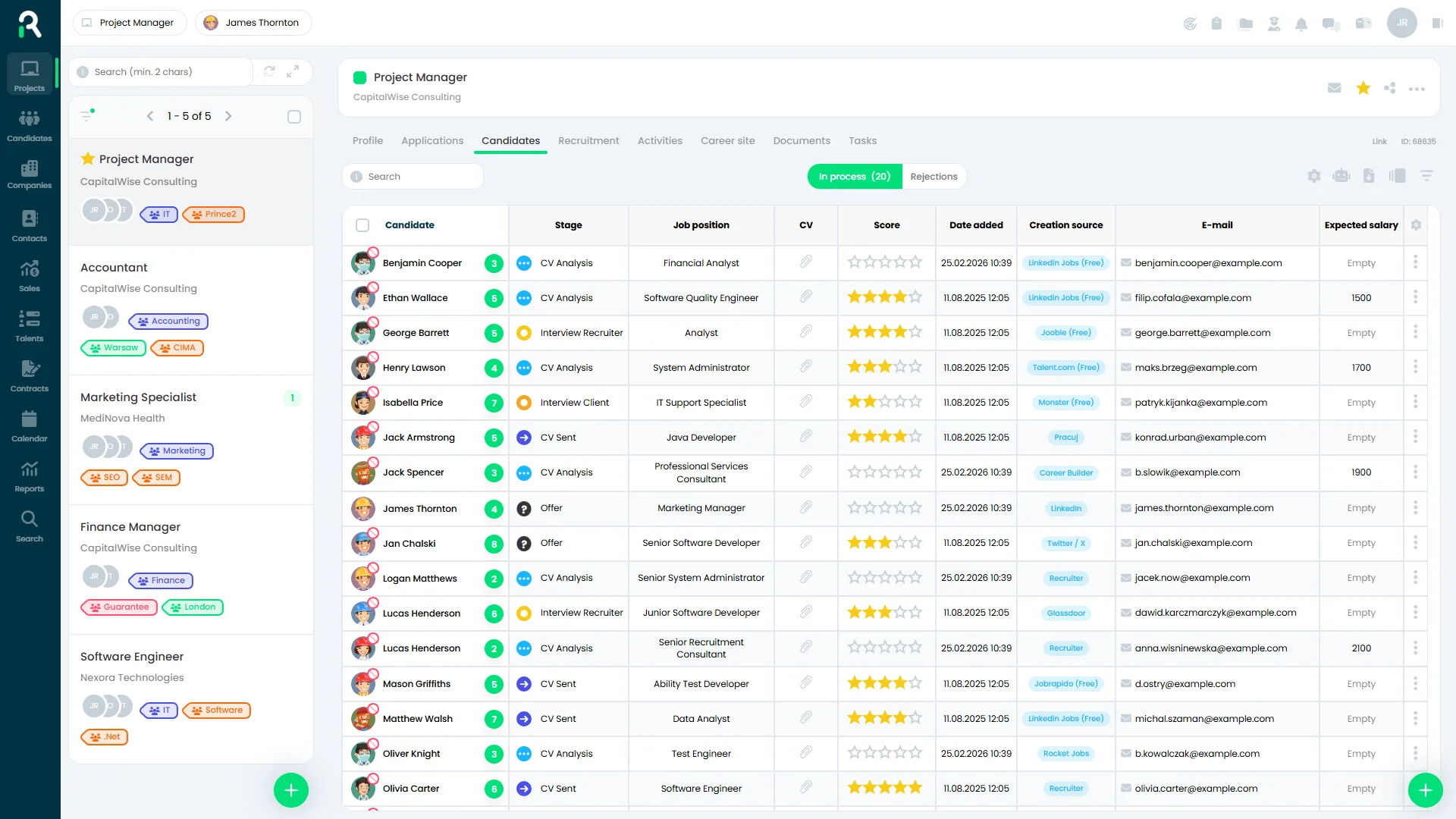
An ATS (Applicant Tracking System) is, by definition, a system designed to track applications. Its primary goal is to collect and organise incoming candidate submissions. An ATS focuses on:
Applications,
CVs,
Candidate stages,
The screening and selection process.
This is the essential foundation.
However, a modern recruitment system is a much broader concept. It encompasses the ATS but elevates its functionality with highly commercially driven modules, such as:
Talent pool nurturing,
Multi-channel candidate engagement,
Process automation,
Strategic business analytics,
Client Relationship Management (crucial for agencies),
Sales and financial management (for contracting and body leasing models).
Put simply:
An ATS answers the question:
"What is happening with the candidate's application?"
A recruitment system answers the question:
"How do we manage the entire talent acquisition pipeline as a business-critical, revenue-generating engine?"
This is a fundamental shift in perspective.
ATS vs. HRM - Two Entirely Different Stages of the Employee Lifecycle
An ATS is often confused with an HRM (Human Resource Management) system. In practice, they serve two completely different business functions.
An ATS operates pre-hire. It drives sourcing, screening, candidate engagement, and the final hiring decision.
Meanwhile, HRM kicks in post-hire. It is designed to handle:
Onboarding,
Time and attendance tracking,
Training and enablement,
Performance management,
Employee reviews,
Payroll and compensation management.
Trying to force an HRM system to act as an ATS usually results in recruiters working outside the system entirely—simply because HRM platforms are not engineered to handle hundreds of active applicants and dynamic candidate pipelines.
In a modern HR tech stack, both systems must integrate seamlessly—but they can never replace one another.
ATS for In-House HR, Recruitment Agencies, and Contracting - Three Distinct Models
There is no "one-size-fits-all" ATS. Requirements differ drastically based on your business model.
1. In-House HR Departments
For internal HR teams, the key priorities are:
Exceptional candidate experience,
Seamless hiring manager collaboration,
Executive-level reporting,
Strict GDPR compliance,
Process transparency.
Here, the ATS acts as a key internal business enabler to secure top talent.
2. Recruitment Agencies
For agencies, recruitment is the product. A consultant’s time translates directly into revenue and placement fees.
Therefore, the platform must seamlessly merge:
The candidate database,
The client CRM,
Interaction history,
The sales and placement pipeline,
Consultant productivity and billing reports.
Without a robust, agency-specific CRM module, a recruitment system is incomplete.
3. Contracting and Body Leasing
In contract recruitment, the agency hires a specialist and leases them to the end client, billing on an hourly or daily rate. Body leasing is a highly similar, fast-paced model especially popular in the IT sector.
In this fast-moving model, the recruitment process is just the starting point.
The system must manage:
Contract and compliance management,
Rates and margins,
Automated invoicing,
Timesheet submission and tracking,
Real-time project profitability metrics.
Standard ATS platforms fall incredibly short here. You need a dedicated, operatively focused recruitment and billing platform.
The Business Advantages of Deploying a Powerful ATS
Implementing a state-of-the-art recruitment platform transforms your business across multiple dimensions.
Firstly, it delivers complete centralisation. All candidate data and history sit in one secure workspace, eliminating communication silos and security risks.
Secondly, it drives supreme operational efficiency. Automating repetitive tasks dramatically slashes your time-to-hire, allowing your fee-earners and recruiters to focus on closing deals rather than admin.
Thirdly, it builds invaluable data capital. Every candidate touchpoint, source, and interaction becomes part of a rich analytical engine to guide business strategy.
Fourthly, it offers infinite scalability. Your agency can scale its job volume and client base without a proportional increase in administrative overhead.
How to Choose Your ATS - The Vital Question You Should Be Asking
The biggest mistake agencies make when choosing an ATS is comparing features and prices before truly mapping their own recruitment workflow. It is like buying a high-performance vehicle based on the dashboard buttons rather than deciding if you need to navigate narrow city streets, haul heavy cargo, or dominate the motorway. Your ATS must elevate your specific way of working, not force your team to bend to rigid software. This is why your very first question should never be: "which ATS is the best?" but rather: "what does successful recruitment look like for us, and where are we currently losing time or quality?"
In practice, you should start with a straightforward audit: how does a candidate realistically flow from the moment a new client brief is taken to the signed contract? Who makes the decisions, who is the bottleneck, where do delays occur, and where does communication slip through the cracks? More often than not, the issue isn't the lack of an ATS, but the lack of a cohesive process—which a new software will only expose. A great recruitment system won't magically fix a broken process, but it will make your workflow measurable, repeatable, and beautifully predictable. That is a game-changer when your agency is scaling and you can no longer manage placements on Slack and WhatsApp.
The next step is matching the platform to your specific business model.
An internal HR team making 30 hires a year will need a completely different solution focused on employee brand, whereas a fast-growing recruitment agency running 40 split-desk pipelines simultaneously relies on candidate flow, client SLAs, and high-tempo consultant activity. Similarly, a contracting or temp agency needs an end-to-end operational powerhouse where the hire is just step one, followed immediately by contractor compliance, timesheets, margins, and automated billing. Choosing an ATS without keeping these business models in mind leads to the classic trap: after a few months, your team abandons the platform back for Excel "because it's faster," and your expensive software becomes a glorifed, overpriced archive.
You must also consider all stakeholders. A modern ATS isn't just a workspace for recruiters; it impacts hiring managers, HRBPs, legal teams (compliance/GDPR), IT (integrations), and in agency models, your sales and account management teams. If the platform is friction-free for only one group while others actively bypass it, your business loses its greatest asset: a single source of truth. When demoing, ask yourself: who needs access, why, and how often? A hiring manager checking in once a week for quick feedback needs an ultra-simple, intuitive portal, whilst a recruiter spending 6 hours a day in the system requires robust, keyboard-shortcut-driven efficiency.
Only when you have mapped these needs should you dive into features—but do so by asking, "how does this feature solve our specific pain point?" rather than checking generic boxes. For instance, "automation" is often a buzzword, but true recruitment automation can range from a simple status-change email to sophisticated workflows, such as automatic manager reminders after 48 hours of silence, auto-tagging profiles, or custom nurture tracks based on job disciplines. The same applies to "AI in recruitment": in one system, it is just a basic text generator; in another, it is intelligent candidate matching and predictive analytics based on historical data. Without defining your commercial goal, the term "AI" has no value.
To make an informed decision, list your requirements under "must-have" and "nice-to-have," but define them in terms of business outcomes. Instead of asking for "reports," ask: "we must track the velocity of each pipeline stage to instantly see where deals stall." Instead of "email integration," specify: "we need a unified client and candidate communication history so deals are never dropped when a senior consultant is out." This is the difference between a generic software checklist and a real business-enablement strategy.
Ultimately, choosing an ATS is not just a software purchase; it is choosing how your recruitment agency will operate for the next 2 to 5 years. This is why any product demo must be run using your real-world scenarios: your sectors, your pipeline stages, and your typical workarounds (such as headhunting, high-volume roles, or client submissions). Competitors frequently talk about "supporting every stage" and smooth data migration—and while this is vital, ensure their onboarding matches your daily operations, rather than a polished "slideshow ideal."
If you want to sum it up: a truly great ATS doesn't just boast the longest feature list. It is the one that successfully eliminates chaos from your daily operations, makes your pipeline highly predictable, and enables you to scale revenue and headcount effortlessly—without dropping the ball on candidate or client experience.
The Tangible ROI of Deploying a Modern ATS and Recruitment Platform
While it is easy to justify an ATS with standard slogans like "time-saving," the real business benefits run far deeper. They truly shine after a few months when your platform becomes rich with actionable data. The first and most immediate win is the eradication of information chaos. When candidates sit in outlook folders, feedback is buried in private chats, and statuses live in disjointed spreadsheets, your business has no single source of truth. A robust ATS centralises everything into a single, high-performing workspace. This makes your agency completely resilient—no longer dependent on a single consultant who might be off sick or who "remembers chatting to that premium candidate a few months ago."
The second major benefit is sheer speed—not just clicking faster, but drastically reducing decision-making latency. Recruitment processes frequently drag out not from a lack of talent, but due to internal delays, missed feedback, and a lack of transparency. A dedicated recruitment system shines a spotlight on exactly where a placement is stalled: is it at recruiter screening, with the client's hiring manager, or at the offer stage? This translates directly into fewer internal status meetings and endless follow-up pings, because the real-time status of every fee-earner's pipeline is visible at a glance.
The third benefit is elevated communication and candidate/client experience. Professionals do not expect miracles; they expect predictability—a swift acknowledgement of their application, updates on where they stand, and professional, consistent touchpoints. Industry studies show that a modern ATS organises your outreach, allowing recruiters to manage multiple pipelines effectively without ever letting a hot lead go cold. In the agency world, this is a premium brand differentiator; a candidate might forget the exact job description, but they will never forget that your agency treated them with absolute professionalism.
The fourth benefit is the creation of a proprietary talent asset and long-term candidate nurturing. For any serious recruitment agency, the highest cost is getting a qualified candidate's attention. If that data is left to rot in inbox folders after a role is closed, your business is paying that acquisition cost over and over again. An ATS builds a dynamic, structured database where you can nurture talent pools, tag niche skill sets, and instantly recall warm candidates for new briefs. This is your ultimate competitive edge: when a client demands talent "yesterday," you don't start from scratch; you mine your goldmine of existing talent.
Fifthly, it introduces metrics-driven business management. Top-performing agencies scale on KPIs like time-to-hire, source effectiveness, consultant billing ratios, and placement margins. These aren't just HR metrics; this is the commercial language of business growth. Without a powerful ATS, recruitment operations are driven by gut feeling; with it, they become a highly predictable and measurable sales engine. This allows you to forecast revenue with confidence, optimise job board spend, and invest in channels that actually deliver placements.
Sixthly, it ensures seamless security and effortless compliance. This is a topic many agency owners ignore until they are faced with a data audit, a data breach, or a formal candidate request to be removed from the database under GDPR. A top-tier ATS automates consent collection, manages data retention periods, tracks processing history, and controls access permissions. On a day-to-day basis, this might run silently in the background, but in a critical compliance audit, it represents the difference between business-as-usual and catastrophic brand damage.
For staffing and contracting agencies, there is a further layer of profitability: seamless team scalability without operational friction. If you have 10 consultants operating on individual spreadsheets, scaling to 20 won't double your revenue—it will simply double the administrative mess. A unified ATS + CRM + Billing platform turns your recruitment into a repeatable, optimized process. It enables you to onboard new recruiters faster, enforce compliance standards seamlessly, and manage massive client accounts effortlessly. This is how you shift from a "hero-dependent" business to a highly valuable, process-driven organization.
ATS and AI - What Artificial Intelligence Really Changes in Recruitment Software
In today's software market, "AI" is thrown around as a ultimate marketing buzzword; "our ATS uses AI," "AI speeds up screening," "AI matches candidates instantly." The reality is that artificial intelligence in recruitment consists of several highly distinct technologies—and each brings very different business values (and different compliance risks). Instead of asking a vendor "does your system have AI?" a savvy agency owner should ask: "where does AI actually take the administrative burden off my consultants, and where is it just marketing fluff?" Understading this is critical, as candidates now use AI tools to generate CVs and applications, flooding systems with polished, keyword-optimised profiles. Consequently, the value of how an ATS parses this data and how your recruiters interpret it has never been higher.
The first practical layer of AI is structured data processing: CV parsing, data extraction, and the normalisation of job titles, companies, technologies, and skills. This isn't "magical decision-making"—it's high-speed administrative assistance that converts unstructured PDFs into clean, searchable, and filterable candidate profiles. The second layer is smart matching: algorithms that recommend the best profiles for a job brief based on skills, career trajectory, and historical placement data. While this can feel like the holy grail of sourcing, the quality of matching is heavily dependent on the quality of your database structure and job definitions.
The third layer is proactive workflow automation, or "next best action." Rather than just displaying data, the system actively prompts the recruiter: who needs a follow-up, which hiring manager is stalling on feedback, which sourcing channel has the highest conversion for this role, and where you're at risk of breaching client SLAs. This is where an ATS transitions from a static database to an active co-pilot. The fourth layer is content generation: drafting compelling job adverts, personalised outreach sequences, and interview summaries. While a massive time-saver, it requires strong brand standards to ensure your candidate engagement doesn't become robotically generic.
Finally, the fifth and most business-critical layer is predictive analytics. Here, AI doesn't evaluate a person; it analyzes your operational pipeline. It predicts which roles will be hard to fill, flags potential bottlenecks in your active processes, estimates time-to-hire based on current market dynamics, and evaluates how job board spend translates into placement fees. This is the sophisticated analytical capability that modern recruitment leaders rely on to drive performance, control costs, and scale operations. Ultimately, the true value of AI isn't to replace the human element of recruitment, but to empower your consultants with actionable intelligence so they can make faster, smarter placements.
We must also be realistic about the limits of technology. No AI can replace a skilled consultant's candidate interview, assess true motivation, or evaluate cultural fit—such as work style, drive, and soft skills. AI is excellent at sorting through data at scale, but commercial and strategic decisions remain firmly a human responsibility. A mature, professional agency treats AI as a powerful operational accelerant, not a decision-making oracle.
ATS in 2026 - Where is Recruitment Tech Heading?
If we are to talk honestly about the future of recruitment software in 2026, we have to look past the PR slogans and focus on the real market forces: intense pressure on time-to-hire, high demands for talent quality, and the sheer volume of "noise" in candidate data. Recruitment is simultaneously more high-volume and more high-touch than ever before. High-volume, because applying has become effortless, leading to candidates sending CVs globally in seconds. High-touch, because candidates and clients expect rapid, highly personalised, and data-driven communication. In this landscape, a modern ATS is no longer just back-office software; it is a high-velocity "deal pipeline"—functioning much like a CRM does for enterprise sales teams.
The first major evolutionary trend is intelligent process automation. We have moved far beyond sending basic automatic email templates. Today's systems actively manage process integrity: chasing hiring managers for feedback, flagging SLA breaches, prioritizing recruiter tasks, and automating compliance lifecycles. Leading platforms are engineered to be entirely "process-driven," meaning the system doesn't just record outcomes—it actively guides your consultants to close placements as fast as possible.
The second trend is the transformation of the ATS into a sophisticated "data-hub" for recruitment intelligence. Discussions have shifted away from basic features like Kanban boards, focused instead on advanced data metrics: mapping conversion rates across pipeline stages, analyzing cost-per-hire, and calculating the exact ROI of sourcing channels. Modern agency owners manage recruitment like a high-performance sales funnel, making deep analytics and Business Intelligence (BI) integrations standard requirements.
The third trend is AI driving quality screening rather than simple selection. With candidates utilizing AI to optimize their CVs, raw text documents have become highly inflated. The modern ATS must excel at signal detection: verifying career consistency, extracting quantifiable achievements, and highlighting verified skills. Concurrently, systems are integrating data from external assessments, video interviews, and task samples, allowing the ATS to act as a unified hub for comprehensive candidate evaluation.
Fourthly, open APIs and deep integrations are now a mandatory baseline, not a premium extra. A system that cannot seamlessly sync with your Outlook/Gmail, calendar, main job boards, and other key business platforms forces your team into slow, manual data entry—the most expensive waste of a recruiter's time. The modern recruitment agency operates on a unified, high-performance tech stack: integrating ATS, CRM, back-office payroll, sourcing tools, and video interviewing platforms into one seamless workflow.
Fifthly, data compliance and security have taken centrestage. Candidate databases represent major legal and reputational risk if mismanaged. Modern ATS platforms must seamlessly handle automated consent workflows, data retention policies, direct search compliance, and absolute audit trails. Although compliance might not be the most glamorous topic, it is a non-negotiable requirement for protecting your agency's brand value and securing enterprise-level clients.
Finally, the sixth major shift is that the ATS has expanded from a transactional tracking tool to a long-term talent relationship manager. Sourcing databases, internal candidate redeployment, automated talent pool campaigns, and continuous nurturing are where agencies are winning. By building and owning their candidate communities, the most profitable agencies are reducing their reliance on expensive job boards and cold outreach. In 2026, market dominance belongs to agencies that possess clean, organized, and active databases paired with razor-sharp workflows.
ATS Migration and Implementation - How to Switch Systems with On-Time Delivery and Zero Data Loss
Upgrading or changing your recruitment software is a major strategic decision. While often delayed due to fears of operational downtime or data loss, a successful migration is actually the ultimate catalyst for business growth. Candidate databases are not just flat text files; they contain years of candidate interactions, recruiter notes, client communication, GDPR consent histories, and vital financial parameters (especially in contract and temp models). Migration must therefore be treated like a critical, highly structured business project.
A successful implementation begins with a thorough data audit. Most agencies discover during migration that their legacy database contains duplicate profiles, outdated records, missing consents, or inconsistent candidate tracking. Migrating is the perfect opportunity to clean your database, standardise pipeline stages, and establish clear, high-performing operational standards for your recruitment team.
Key elements of a fast, secure, and stress-free data migration include:
Comprehensive data auditing and deduplication,
Precise mapping between legacy databases and the new platform,
Migrating a representative sample first to run rigorous tests,
Comprehensive team training prior to the system going live,
Structured, phased go-live with expert post-launch engineering support.
An excellently executed ATS migration does far more than just improve your team's day-to-day workflow; it dramatically accelerates your recruitment velocity, lowers your business risk, and delivers ultra-clean data analytics to scale your agency.
Integrations, APIs, and the Modern HR Tech Ecosystem
A modern recruitment system does not run in isolation. It serves as the core engine within a wider business tech stack that includes HRM systems, payroll software, calendar platforms, video conferencing tools, job boards, and advanced business intelligence analytics. A lack of deep integration results in slow, manual data entry, which is the single biggest drain on recruitment productivity and fee generation.
When choosing your next platform, focus on these critical integration capabilities:
Two-way email and calendar synchronisation,
One-click multi-posting across premium job portals,
Seamless candidate data flow to payroll or HRMs upon placement,
A fully documented, open API for tailored customisations,
Effortless data export to external BI tools.
Forward-thinking agency owners treat their ATS as an extensible platform that scales and adapts with their business growth. An open API and a flexible, cloud-native architecture are no longer "nice-to-haves"—they are essential for maintaining your competitive edge.
The Real Cost of an ATS - Evaluating the Total Cost of Ownership (TCO)
The subscription price of an ATS is only one component of its true cost of ownership. Many recruitment agencies make the mistake of looking only at the monthly per-user licensing fees, completely overlooking the implementation, data migration, consultant training, and long-term platform maintenance costs. To calculate the real ROI, you must evaluate the complete Total Cost of Ownership (TCO) over a multi-year period.
The total cost of ownership consists of:
- Core licensing or monthly subscription fees,
- Implementation, setup, and custom configuration costs,
- Staff training and system onboarding,
- Third-party software integrations,
- Internal team hours allocated to system launch.
Crucially, this commercial investment must be measured against the financial returns: a massive reduction in time-to-hire, increased placement capacity per recruiter, highly accurate billing tracking, and scaling your agency without administrative headcount growth.
Common Pitfalls to Avoid When Choosing Recruitment Software
Many recruitment business owners and HR leaders repeatedly fall into the same traps when choosing software. A common error is selecting a system based simply on the lowest price tag or generic brand popularity, rather than its alignment with their actual business model. Another mistake is ignoring the inputs of the actual recruiters who will use the software every day, which leads to low user adoption and a highly expensive platform that sits unused.
To guarantee a successful software purchase, avoid these classic mistakes:
Failing to map your internal workflows before starting software demos,
Underestimating the effort and importance of data migration,
Ignoring the capacity for custom integrations,
Skipping a structured training and enablement plan,
Treating the system rollout as an IT project rather than a strategic business initiative.
By systematically avoiding these pitfalls, you ensure your new recruitment system becomes an absolute powerhouse for your team, driving business growth and placement volumes for years to come.


News & Updates
Stay up-to-date with the latest innovations, features, and tips about Recruitify!
By providing your email address within the newsletter sign-up form, you confirm its processing to send marketing information regarding the Administrator’s products and services. The Administrator of your personal data processed for the abovementioned purposes is Recruitify Spółka z o.o., based in Warsaw, Poland (KRS 0000709889). For more information on the principles of personal data processing and the rights of data subjects, please check the Privacy Policy.

Last updated:
From A to Z: Architecting Talent Acquisition, Distinguishing HRM from Recruitment Software, and Selecting High-Performance Systems.
Innovations
Iwo Paliszewski
ATS and Recruitment Systems - The Ultimate A to Z Guide
What are they, how do they work, how do they differ from HRM, and how do you choose the ultimate recruitment software?
Recruitment in 2026 looks radically different from a decade ago. Candidate sourcing channels have shifted, application volumes have surged, business expectations of HR departments have risen, and above all, data has become king. Driven by these shifts, ATS and broader recruitment platforms have fundamentally evolved.
Today, it is virtually impossible to imagine a professional HR department, recruitment agency, or contracting firm operating without dedicated candidate tracking software. At the same time, massive misconceptions still surround the concept of an ATS. Some businesses treat it as little more than a digital inbox. Others see it solely as a reporting tool or a standard CRM.
But the reality is far more powerful.
This comprehensive guide demystifies the entire landscape: from the history of ATS, through the core differences between an ATS, a recruitment platform, and HRM systems, right down to contracting, AI, and the critical challenges of data migration.
The History of ATS - From Digital Filing Cabinet to the Recruitment Operating System
To truly appreciate the value of a modern ATS, it helps to look back at where it all began.
In the 90s, when the internet revolutionised job postings, companies suddenly faced an unprecedented influx of applications. Previously, CVs arrived via post or hand delivery. Overnight, the process became mass-scale.
With the launch of job boards like Monster and later LinkedIn, applying became instant and effortless. A single click could flood a recruiter’s inbox with dozens of CVs.
The first ATS solutions emerged to solve this absolute chaos. Their purpose was simple:
store CVs in one place and make them searchable.
Essentially, they were basic databases with keyword filtering. There was no automation, no strategic analytics, and zero CRM integration. It was just a digital candidate catalogue.
The second generation of ATS introduced recruitment project management—bringing in pipeline stages, candidate statuses, and recruiter assignments.
The third generation, which we experience today, is a fully integrated ecosystem combining:
Candidate management,
Client Relationship Management (CRM),
Automated communication,
Business intelligence and reporting,
Advanced AI elements,
Seamless integrations with the wider HR tech stack.
The ATS is no longer just an archive. It is the powerhouse of your recruitment operations.
What is an ATS vs. a Recruitment System?
This is where we must clarify a crucial distinction in terminology.
An ATS (Applicant Tracking System) is, by definition, a system designed to track applications. Its primary goal is to collect and organise incoming candidate submissions. An ATS focuses on:
Applications,
CVs,
Candidate stages,
The screening and selection process.
This is the essential foundation.
However, a modern recruitment system is a much broader concept. It encompasses the ATS but elevates its functionality with highly commercially driven modules, such as:
Talent pool nurturing,
Multi-channel candidate engagement,
Process automation,
Strategic business analytics,
Client Relationship Management (crucial for agencies),
Sales and financial management (for contracting and body leasing models).
Put simply:
An ATS answers the question:
"What is happening with the candidate's application?"
A recruitment system answers the question:
"How do we manage the entire talent acquisition pipeline as a business-critical, revenue-generating engine?"
This is a fundamental shift in perspective.
ATS vs. HRM - Two Entirely Different Stages of the Employee Lifecycle
An ATS is often confused with an HRM (Human Resource Management) system. In practice, they serve two completely different business functions.
An ATS operates pre-hire. It drives sourcing, screening, candidate engagement, and the final hiring decision.
Meanwhile, HRM kicks in post-hire. It is designed to handle:
Onboarding,
Time and attendance tracking,
Training and enablement,
Performance management,
Employee reviews,
Payroll and compensation management.
Trying to force an HRM system to act as an ATS usually results in recruiters working outside the system entirely—simply because HRM platforms are not engineered to handle hundreds of active applicants and dynamic candidate pipelines.
In a modern HR tech stack, both systems must integrate seamlessly—but they can never replace one another.
ATS for In-House HR, Recruitment Agencies, and Contracting - Three Distinct Models
There is no "one-size-fits-all" ATS. Requirements differ drastically based on your business model.
1. In-House HR Departments
For internal HR teams, the key priorities are:
Exceptional candidate experience,
Seamless hiring manager collaboration,
Executive-level reporting,
Strict GDPR compliance,
Process transparency.
Here, the ATS acts as a key internal business enabler to secure top talent.
2. Recruitment Agencies
For agencies, recruitment is the product. A consultant’s time translates directly into revenue and placement fees.
Therefore, the platform must seamlessly merge:
The candidate database,
The client CRM,
Interaction history,
The sales and placement pipeline,
Consultant productivity and billing reports.
Without a robust, agency-specific CRM module, a recruitment system is incomplete.
3. Contracting and Body Leasing
In contract recruitment, the agency hires a specialist and leases them to the end client, billing on an hourly or daily rate. Body leasing is a highly similar, fast-paced model especially popular in the IT sector.
In this fast-moving model, the recruitment process is just the starting point.
The system must manage:
Contract and compliance management,
Rates and margins,
Automated invoicing,
Timesheet submission and tracking,
Real-time project profitability metrics.
Standard ATS platforms fall incredibly short here. You need a dedicated, operatively focused recruitment and billing platform.
The Business Advantages of Deploying a Powerful ATS
Implementing a state-of-the-art recruitment platform transforms your business across multiple dimensions.
Firstly, it delivers complete centralisation. All candidate data and history sit in one secure workspace, eliminating communication silos and security risks.
Secondly, it drives supreme operational efficiency. Automating repetitive tasks dramatically slashes your time-to-hire, allowing your fee-earners and recruiters to focus on closing deals rather than admin.
Thirdly, it builds invaluable data capital. Every candidate touchpoint, source, and interaction becomes part of a rich analytical engine to guide business strategy.
Fourthly, it offers infinite scalability. Your agency can scale its job volume and client base without a proportional increase in administrative overhead.
How to Choose Your ATS - The Vital Question You Should Be Asking
The biggest mistake agencies make when choosing an ATS is comparing features and prices before truly mapping their own recruitment workflow. It is like buying a high-performance vehicle based on the dashboard buttons rather than deciding if you need to navigate narrow city streets, haul heavy cargo, or dominate the motorway. Your ATS must elevate your specific way of working, not force your team to bend to rigid software. This is why your very first question should never be: "which ATS is the best?" but rather: "what does successful recruitment look like for us, and where are we currently losing time or quality?"
In practice, you should start with a straightforward audit: how does a candidate realistically flow from the moment a new client brief is taken to the signed contract? Who makes the decisions, who is the bottleneck, where do delays occur, and where does communication slip through the cracks? More often than not, the issue isn't the lack of an ATS, but the lack of a cohesive process—which a new software will only expose. A great recruitment system won't magically fix a broken process, but it will make your workflow measurable, repeatable, and beautifully predictable. That is a game-changer when your agency is scaling and you can no longer manage placements on Slack and WhatsApp.
The next step is matching the platform to your specific business model.
An internal HR team making 30 hires a year will need a completely different solution focused on employee brand, whereas a fast-growing recruitment agency running 40 split-desk pipelines simultaneously relies on candidate flow, client SLAs, and high-tempo consultant activity. Similarly, a contracting or temp agency needs an end-to-end operational powerhouse where the hire is just step one, followed immediately by contractor compliance, timesheets, margins, and automated billing. Choosing an ATS without keeping these business models in mind leads to the classic trap: after a few months, your team abandons the platform back for Excel "because it's faster," and your expensive software becomes a glorifed, overpriced archive.
You must also consider all stakeholders. A modern ATS isn't just a workspace for recruiters; it impacts hiring managers, HRBPs, legal teams (compliance/GDPR), IT (integrations), and in agency models, your sales and account management teams. If the platform is friction-free for only one group while others actively bypass it, your business loses its greatest asset: a single source of truth. When demoing, ask yourself: who needs access, why, and how often? A hiring manager checking in once a week for quick feedback needs an ultra-simple, intuitive portal, whilst a recruiter spending 6 hours a day in the system requires robust, keyboard-shortcut-driven efficiency.
Only when you have mapped these needs should you dive into features—but do so by asking, "how does this feature solve our specific pain point?" rather than checking generic boxes. For instance, "automation" is often a buzzword, but true recruitment automation can range from a simple status-change email to sophisticated workflows, such as automatic manager reminders after 48 hours of silence, auto-tagging profiles, or custom nurture tracks based on job disciplines. The same applies to "AI in recruitment": in one system, it is just a basic text generator; in another, it is intelligent candidate matching and predictive analytics based on historical data. Without defining your commercial goal, the term "AI" has no value.
To make an informed decision, list your requirements under "must-have" and "nice-to-have," but define them in terms of business outcomes. Instead of asking for "reports," ask: "we must track the velocity of each pipeline stage to instantly see where deals stall." Instead of "email integration," specify: "we need a unified client and candidate communication history so deals are never dropped when a senior consultant is out." This is the difference between a generic software checklist and a real business-enablement strategy.
Ultimately, choosing an ATS is not just a software purchase; it is choosing how your recruitment agency will operate for the next 2 to 5 years. This is why any product demo must be run using your real-world scenarios: your sectors, your pipeline stages, and your typical workarounds (such as headhunting, high-volume roles, or client submissions). Competitors frequently talk about "supporting every stage" and smooth data migration—and while this is vital, ensure their onboarding matches your daily operations, rather than a polished "slideshow ideal."
If you want to sum it up: a truly great ATS doesn't just boast the longest feature list. It is the one that successfully eliminates chaos from your daily operations, makes your pipeline highly predictable, and enables you to scale revenue and headcount effortlessly—without dropping the ball on candidate or client experience.
The Tangible ROI of Deploying a Modern ATS and Recruitment Platform
While it is easy to justify an ATS with standard slogans like "time-saving," the real business benefits run far deeper. They truly shine after a few months when your platform becomes rich with actionable data. The first and most immediate win is the eradication of information chaos. When candidates sit in outlook folders, feedback is buried in private chats, and statuses live in disjointed spreadsheets, your business has no single source of truth. A robust ATS centralises everything into a single, high-performing workspace. This makes your agency completely resilient—no longer dependent on a single consultant who might be off sick or who "remembers chatting to that premium candidate a few months ago."
The second major benefit is sheer speed—not just clicking faster, but drastically reducing decision-making latency. Recruitment processes frequently drag out not from a lack of talent, but due to internal delays, missed feedback, and a lack of transparency. A dedicated recruitment system shines a spotlight on exactly where a placement is stalled: is it at recruiter screening, with the client's hiring manager, or at the offer stage? This translates directly into fewer internal status meetings and endless follow-up pings, because the real-time status of every fee-earner's pipeline is visible at a glance.
The third benefit is elevated communication and candidate/client experience. Professionals do not expect miracles; they expect predictability—a swift acknowledgement of their application, updates on where they stand, and professional, consistent touchpoints. Industry studies show that a modern ATS organises your outreach, allowing recruiters to manage multiple pipelines effectively without ever letting a hot lead go cold. In the agency world, this is a premium brand differentiator; a candidate might forget the exact job description, but they will never forget that your agency treated them with absolute professionalism.
The fourth benefit is the creation of a proprietary talent asset and long-term candidate nurturing. For any serious recruitment agency, the highest cost is getting a qualified candidate's attention. If that data is left to rot in inbox folders after a role is closed, your business is paying that acquisition cost over and over again. An ATS builds a dynamic, structured database where you can nurture talent pools, tag niche skill sets, and instantly recall warm candidates for new briefs. This is your ultimate competitive edge: when a client demands talent "yesterday," you don't start from scratch; you mine your goldmine of existing talent.
Fifthly, it introduces metrics-driven business management. Top-performing agencies scale on KPIs like time-to-hire, source effectiveness, consultant billing ratios, and placement margins. These aren't just HR metrics; this is the commercial language of business growth. Without a powerful ATS, recruitment operations are driven by gut feeling; with it, they become a highly predictable and measurable sales engine. This allows you to forecast revenue with confidence, optimise job board spend, and invest in channels that actually deliver placements.
Sixthly, it ensures seamless security and effortless compliance. This is a topic many agency owners ignore until they are faced with a data audit, a data breach, or a formal candidate request to be removed from the database under GDPR. A top-tier ATS automates consent collection, manages data retention periods, tracks processing history, and controls access permissions. On a day-to-day basis, this might run silently in the background, but in a critical compliance audit, it represents the difference between business-as-usual and catastrophic brand damage.
For staffing and contracting agencies, there is a further layer of profitability: seamless team scalability without operational friction. If you have 10 consultants operating on individual spreadsheets, scaling to 20 won't double your revenue—it will simply double the administrative mess. A unified ATS + CRM + Billing platform turns your recruitment into a repeatable, optimized process. It enables you to onboard new recruiters faster, enforce compliance standards seamlessly, and manage massive client accounts effortlessly. This is how you shift from a "hero-dependent" business to a highly valuable, process-driven organization.
ATS and AI - What Artificial Intelligence Really Changes in Recruitment Software
In today's software market, "AI" is thrown around as a ultimate marketing buzzword; "our ATS uses AI," "AI speeds up screening," "AI matches candidates instantly." The reality is that artificial intelligence in recruitment consists of several highly distinct technologies—and each brings very different business values (and different compliance risks). Instead of asking a vendor "does your system have AI?" a savvy agency owner should ask: "where does AI actually take the administrative burden off my consultants, and where is it just marketing fluff?" Understading this is critical, as candidates now use AI tools to generate CVs and applications, flooding systems with polished, keyword-optimised profiles. Consequently, the value of how an ATS parses this data and how your recruiters interpret it has never been higher.
The first practical layer of AI is structured data processing: CV parsing, data extraction, and the normalisation of job titles, companies, technologies, and skills. This isn't "magical decision-making"—it's high-speed administrative assistance that converts unstructured PDFs into clean, searchable, and filterable candidate profiles. The second layer is smart matching: algorithms that recommend the best profiles for a job brief based on skills, career trajectory, and historical placement data. While this can feel like the holy grail of sourcing, the quality of matching is heavily dependent on the quality of your database structure and job definitions.
The third layer is proactive workflow automation, or "next best action." Rather than just displaying data, the system actively prompts the recruiter: who needs a follow-up, which hiring manager is stalling on feedback, which sourcing channel has the highest conversion for this role, and where you're at risk of breaching client SLAs. This is where an ATS transitions from a static database to an active co-pilot. The fourth layer is content generation: drafting compelling job adverts, personalised outreach sequences, and interview summaries. While a massive time-saver, it requires strong brand standards to ensure your candidate engagement doesn't become robotically generic.
Finally, the fifth and most business-critical layer is predictive analytics. Here, AI doesn't evaluate a person; it analyzes your operational pipeline. It predicts which roles will be hard to fill, flags potential bottlenecks in your active processes, estimates time-to-hire based on current market dynamics, and evaluates how job board spend translates into placement fees. This is the sophisticated analytical capability that modern recruitment leaders rely on to drive performance, control costs, and scale operations. Ultimately, the true value of AI isn't to replace the human element of recruitment, but to empower your consultants with actionable intelligence so they can make faster, smarter placements.
We must also be realistic about the limits of technology. No AI can replace a skilled consultant's candidate interview, assess true motivation, or evaluate cultural fit—such as work style, drive, and soft skills. AI is excellent at sorting through data at scale, but commercial and strategic decisions remain firmly a human responsibility. A mature, professional agency treats AI as a powerful operational accelerant, not a decision-making oracle.
ATS in 2026 - Where is Recruitment Tech Heading?
If we are to talk honestly about the future of recruitment software in 2026, we have to look past the PR slogans and focus on the real market forces: intense pressure on time-to-hire, high demands for talent quality, and the sheer volume of "noise" in candidate data. Recruitment is simultaneously more high-volume and more high-touch than ever before. High-volume, because applying has become effortless, leading to candidates sending CVs globally in seconds. High-touch, because candidates and clients expect rapid, highly personalised, and data-driven communication. In this landscape, a modern ATS is no longer just back-office software; it is a high-velocity "deal pipeline"—functioning much like a CRM does for enterprise sales teams.
The first major evolutionary trend is intelligent process automation. We have moved far beyond sending basic automatic email templates. Today's systems actively manage process integrity: chasing hiring managers for feedback, flagging SLA breaches, prioritizing recruiter tasks, and automating compliance lifecycles. Leading platforms are engineered to be entirely "process-driven," meaning the system doesn't just record outcomes—it actively guides your consultants to close placements as fast as possible.
The second trend is the transformation of the ATS into a sophisticated "data-hub" for recruitment intelligence. Discussions have shifted away from basic features like Kanban boards, focused instead on advanced data metrics: mapping conversion rates across pipeline stages, analyzing cost-per-hire, and calculating the exact ROI of sourcing channels. Modern agency owners manage recruitment like a high-performance sales funnel, making deep analytics and Business Intelligence (BI) integrations standard requirements.
The third trend is AI driving quality screening rather than simple selection. With candidates utilizing AI to optimize their CVs, raw text documents have become highly inflated. The modern ATS must excel at signal detection: verifying career consistency, extracting quantifiable achievements, and highlighting verified skills. Concurrently, systems are integrating data from external assessments, video interviews, and task samples, allowing the ATS to act as a unified hub for comprehensive candidate evaluation.
Fourthly, open APIs and deep integrations are now a mandatory baseline, not a premium extra. A system that cannot seamlessly sync with your Outlook/Gmail, calendar, main job boards, and other key business platforms forces your team into slow, manual data entry—the most expensive waste of a recruiter's time. The modern recruitment agency operates on a unified, high-performance tech stack: integrating ATS, CRM, back-office payroll, sourcing tools, and video interviewing platforms into one seamless workflow.
Fifthly, data compliance and security have taken centrestage. Candidate databases represent major legal and reputational risk if mismanaged. Modern ATS platforms must seamlessly handle automated consent workflows, data retention policies, direct search compliance, and absolute audit trails. Although compliance might not be the most glamorous topic, it is a non-negotiable requirement for protecting your agency's brand value and securing enterprise-level clients.
Finally, the sixth major shift is that the ATS has expanded from a transactional tracking tool to a long-term talent relationship manager. Sourcing databases, internal candidate redeployment, automated talent pool campaigns, and continuous nurturing are where agencies are winning. By building and owning their candidate communities, the most profitable agencies are reducing their reliance on expensive job boards and cold outreach. In 2026, market dominance belongs to agencies that possess clean, organized, and active databases paired with razor-sharp workflows.
ATS Migration and Implementation - How to Switch Systems with On-Time Delivery and Zero Data Loss
Upgrading or changing your recruitment software is a major strategic decision. While often delayed due to fears of operational downtime or data loss, a successful migration is actually the ultimate catalyst for business growth. Candidate databases are not just flat text files; they contain years of candidate interactions, recruiter notes, client communication, GDPR consent histories, and vital financial parameters (especially in contract and temp models). Migration must therefore be treated like a critical, highly structured business project.
A successful implementation begins with a thorough data audit. Most agencies discover during migration that their legacy database contains duplicate profiles, outdated records, missing consents, or inconsistent candidate tracking. Migrating is the perfect opportunity to clean your database, standardise pipeline stages, and establish clear, high-performing operational standards for your recruitment team.
Key elements of a fast, secure, and stress-free data migration include:
Comprehensive data auditing and deduplication,
Precise mapping between legacy databases and the new platform,
Migrating a representative sample first to run rigorous tests,
Comprehensive team training prior to the system going live,
Structured, phased go-live with expert post-launch engineering support.
An excellently executed ATS migration does far more than just improve your team's day-to-day workflow; it dramatically accelerates your recruitment velocity, lowers your business risk, and delivers ultra-clean data analytics to scale your agency.
Integrations, APIs, and the Modern HR Tech Ecosystem
A modern recruitment system does not run in isolation. It serves as the core engine within a wider business tech stack that includes HRM systems, payroll software, calendar platforms, video conferencing tools, job boards, and advanced business intelligence analytics. A lack of deep integration results in slow, manual data entry, which is the single biggest drain on recruitment productivity and fee generation.
When choosing your next platform, focus on these critical integration capabilities:
Two-way email and calendar synchronisation,
One-click multi-posting across premium job portals,
Seamless candidate data flow to payroll or HRMs upon placement,
A fully documented, open API for tailored customisations,
Effortless data export to external BI tools.
Forward-thinking agency owners treat their ATS as an extensible platform that scales and adapts with their business growth. An open API and a flexible, cloud-native architecture are no longer "nice-to-haves"—they are essential for maintaining your competitive edge.
The Real Cost of an ATS - Evaluating the Total Cost of Ownership (TCO)
The subscription price of an ATS is only one component of its true cost of ownership. Many recruitment agencies make the mistake of looking only at the monthly per-user licensing fees, completely overlooking the implementation, data migration, consultant training, and long-term platform maintenance costs. To calculate the real ROI, you must evaluate the complete Total Cost of Ownership (TCO) over a multi-year period.
The total cost of ownership consists of:
- Core licensing or monthly subscription fees,
- Implementation, setup, and custom configuration costs,
- Staff training and system onboarding,
- Third-party software integrations,
- Internal team hours allocated to system launch.
Crucially, this commercial investment must be measured against the financial returns: a massive reduction in time-to-hire, increased placement capacity per recruiter, highly accurate billing tracking, and scaling your agency without administrative headcount growth.
Common Pitfalls to Avoid When Choosing Recruitment Software
Many recruitment business owners and HR leaders repeatedly fall into the same traps when choosing software. A common error is selecting a system based simply on the lowest price tag or generic brand popularity, rather than its alignment with their actual business model. Another mistake is ignoring the inputs of the actual recruiters who will use the software every day, which leads to low user adoption and a highly expensive platform that sits unused.
To guarantee a successful software purchase, avoid these classic mistakes:
Failing to map your internal workflows before starting software demos,
Underestimating the effort and importance of data migration,
Ignoring the capacity for custom integrations,
Skipping a structured training and enablement plan,
Treating the system rollout as an IT project rather than a strategic business initiative.
By systematically avoiding these pitfalls, you ensure your new recruitment system becomes an absolute powerhouse for your team, driving business growth and placement volumes for years to come.
News & Updates
Stay up-to-date with the latest innovations, features, and tips about Recruitify!
By providing your email address within the newsletter sign-up form, you confirm its processing to send marketing information regarding the Administrator’s products and services. The Administrator of your personal data processed for the abovementioned purposes is Recruitify Spółka z o.o., based in Warsaw, Poland (KRS 0000709889). For more information on the principles of personal data processing and the rights of data subjects, please check the Privacy Policy.
Last updated:
From A to Z: Architecting Talent Acquisition, Distinguishing HRM from Recruitment Software, and Selecting High-Performance Systems.
Innovations
Iwo Paliszewski
ATS and Recruitment Systems - The Ultimate A to Z Guide
What are they, how do they work, how do they differ from HRM, and how do you choose the ultimate recruitment software?
Recruitment in 2026 looks radically different from a decade ago. Candidate sourcing channels have shifted, application volumes have surged, business expectations of HR departments have risen, and above all, data has become king. Driven by these shifts, ATS and broader recruitment platforms have fundamentally evolved.
Today, it is virtually impossible to imagine a professional HR department, recruitment agency, or contracting firm operating without dedicated candidate tracking software. At the same time, massive misconceptions still surround the concept of an ATS. Some businesses treat it as little more than a digital inbox. Others see it solely as a reporting tool or a standard CRM.
But the reality is far more powerful.
This comprehensive guide demystifies the entire landscape: from the history of ATS, through the core differences between an ATS, a recruitment platform, and HRM systems, right down to contracting, AI, and the critical challenges of data migration.
The History of ATS - From Digital Filing Cabinet to the Recruitment Operating System
To truly appreciate the value of a modern ATS, it helps to look back at where it all began.
In the 90s, when the internet revolutionised job postings, companies suddenly faced an unprecedented influx of applications. Previously, CVs arrived via post or hand delivery. Overnight, the process became mass-scale.
With the launch of job boards like Monster and later LinkedIn, applying became instant and effortless. A single click could flood a recruiter’s inbox with dozens of CVs.
The first ATS solutions emerged to solve this absolute chaos. Their purpose was simple:
store CVs in one place and make them searchable.
Essentially, they were basic databases with keyword filtering. There was no automation, no strategic analytics, and zero CRM integration. It was just a digital candidate catalogue.
The second generation of ATS introduced recruitment project management—bringing in pipeline stages, candidate statuses, and recruiter assignments.
The third generation, which we experience today, is a fully integrated ecosystem combining:
Candidate management,
Client Relationship Management (CRM),
Automated communication,
Business intelligence and reporting,
Advanced AI elements,
Seamless integrations with the wider HR tech stack.
The ATS is no longer just an archive. It is the powerhouse of your recruitment operations.
What is an ATS vs. a Recruitment System?
This is where we must clarify a crucial distinction in terminology.
An ATS (Applicant Tracking System) is, by definition, a system designed to track applications. Its primary goal is to collect and organise incoming candidate submissions. An ATS focuses on:
Applications,
CVs,
Candidate stages,
The screening and selection process.
This is the essential foundation.
However, a modern recruitment system is a much broader concept. It encompasses the ATS but elevates its functionality with highly commercially driven modules, such as:
Talent pool nurturing,
Multi-channel candidate engagement,
Process automation,
Strategic business analytics,
Client Relationship Management (crucial for agencies),
Sales and financial management (for contracting and body leasing models).
Put simply:
An ATS answers the question:
"What is happening with the candidate's application?"
A recruitment system answers the question:
"How do we manage the entire talent acquisition pipeline as a business-critical, revenue-generating engine?"
This is a fundamental shift in perspective.
ATS vs. HRM - Two Entirely Different Stages of the Employee Lifecycle
An ATS is often confused with an HRM (Human Resource Management) system. In practice, they serve two completely different business functions.
An ATS operates pre-hire. It drives sourcing, screening, candidate engagement, and the final hiring decision.
Meanwhile, HRM kicks in post-hire. It is designed to handle:
Onboarding,
Time and attendance tracking,
Training and enablement,
Performance management,
Employee reviews,
Payroll and compensation management.
Trying to force an HRM system to act as an ATS usually results in recruiters working outside the system entirely—simply because HRM platforms are not engineered to handle hundreds of active applicants and dynamic candidate pipelines.
In a modern HR tech stack, both systems must integrate seamlessly—but they can never replace one another.
ATS for In-House HR, Recruitment Agencies, and Contracting - Three Distinct Models
There is no "one-size-fits-all" ATS. Requirements differ drastically based on your business model.
1. In-House HR Departments
For internal HR teams, the key priorities are:
Exceptional candidate experience,
Seamless hiring manager collaboration,
Executive-level reporting,
Strict GDPR compliance,
Process transparency.
Here, the ATS acts as a key internal business enabler to secure top talent.
2. Recruitment Agencies
For agencies, recruitment is the product. A consultant’s time translates directly into revenue and placement fees.
Therefore, the platform must seamlessly merge:
The candidate database,
The client CRM,
Interaction history,
The sales and placement pipeline,
Consultant productivity and billing reports.
Without a robust, agency-specific CRM module, a recruitment system is incomplete.
3. Contracting and Body Leasing
In contract recruitment, the agency hires a specialist and leases them to the end client, billing on an hourly or daily rate. Body leasing is a highly similar, fast-paced model especially popular in the IT sector.
In this fast-moving model, the recruitment process is just the starting point.
The system must manage:
Contract and compliance management,
Rates and margins,
Automated invoicing,
Timesheet submission and tracking,
Real-time project profitability metrics.
Standard ATS platforms fall incredibly short here. You need a dedicated, operatively focused recruitment and billing platform.
The Business Advantages of Deploying a Powerful ATS
Implementing a state-of-the-art recruitment platform transforms your business across multiple dimensions.
Firstly, it delivers complete centralisation. All candidate data and history sit in one secure workspace, eliminating communication silos and security risks.
Secondly, it drives supreme operational efficiency. Automating repetitive tasks dramatically slashes your time-to-hire, allowing your fee-earners and recruiters to focus on closing deals rather than admin.
Thirdly, it builds invaluable data capital. Every candidate touchpoint, source, and interaction becomes part of a rich analytical engine to guide business strategy.
Fourthly, it offers infinite scalability. Your agency can scale its job volume and client base without a proportional increase in administrative overhead.
How to Choose Your ATS - The Vital Question You Should Be Asking
The biggest mistake agencies make when choosing an ATS is comparing features and prices before truly mapping their own recruitment workflow. It is like buying a high-performance vehicle based on the dashboard buttons rather than deciding if you need to navigate narrow city streets, haul heavy cargo, or dominate the motorway. Your ATS must elevate your specific way of working, not force your team to bend to rigid software. This is why your very first question should never be: "which ATS is the best?" but rather: "what does successful recruitment look like for us, and where are we currently losing time or quality?"
In practice, you should start with a straightforward audit: how does a candidate realistically flow from the moment a new client brief is taken to the signed contract? Who makes the decisions, who is the bottleneck, where do delays occur, and where does communication slip through the cracks? More often than not, the issue isn't the lack of an ATS, but the lack of a cohesive process—which a new software will only expose. A great recruitment system won't magically fix a broken process, but it will make your workflow measurable, repeatable, and beautifully predictable. That is a game-changer when your agency is scaling and you can no longer manage placements on Slack and WhatsApp.
The next step is matching the platform to your specific business model.
An internal HR team making 30 hires a year will need a completely different solution focused on employee brand, whereas a fast-growing recruitment agency running 40 split-desk pipelines simultaneously relies on candidate flow, client SLAs, and high-tempo consultant activity. Similarly, a contracting or temp agency needs an end-to-end operational powerhouse where the hire is just step one, followed immediately by contractor compliance, timesheets, margins, and automated billing. Choosing an ATS without keeping these business models in mind leads to the classic trap: after a few months, your team abandons the platform back for Excel "because it's faster," and your expensive software becomes a glorifed, overpriced archive.
You must also consider all stakeholders. A modern ATS isn't just a workspace for recruiters; it impacts hiring managers, HRBPs, legal teams (compliance/GDPR), IT (integrations), and in agency models, your sales and account management teams. If the platform is friction-free for only one group while others actively bypass it, your business loses its greatest asset: a single source of truth. When demoing, ask yourself: who needs access, why, and how often? A hiring manager checking in once a week for quick feedback needs an ultra-simple, intuitive portal, whilst a recruiter spending 6 hours a day in the system requires robust, keyboard-shortcut-driven efficiency.
Only when you have mapped these needs should you dive into features—but do so by asking, "how does this feature solve our specific pain point?" rather than checking generic boxes. For instance, "automation" is often a buzzword, but true recruitment automation can range from a simple status-change email to sophisticated workflows, such as automatic manager reminders after 48 hours of silence, auto-tagging profiles, or custom nurture tracks based on job disciplines. The same applies to "AI in recruitment": in one system, it is just a basic text generator; in another, it is intelligent candidate matching and predictive analytics based on historical data. Without defining your commercial goal, the term "AI" has no value.
To make an informed decision, list your requirements under "must-have" and "nice-to-have," but define them in terms of business outcomes. Instead of asking for "reports," ask: "we must track the velocity of each pipeline stage to instantly see where deals stall." Instead of "email integration," specify: "we need a unified client and candidate communication history so deals are never dropped when a senior consultant is out." This is the difference between a generic software checklist and a real business-enablement strategy.
Ultimately, choosing an ATS is not just a software purchase; it is choosing how your recruitment agency will operate for the next 2 to 5 years. This is why any product demo must be run using your real-world scenarios: your sectors, your pipeline stages, and your typical workarounds (such as headhunting, high-volume roles, or client submissions). Competitors frequently talk about "supporting every stage" and smooth data migration—and while this is vital, ensure their onboarding matches your daily operations, rather than a polished "slideshow ideal."
If you want to sum it up: a truly great ATS doesn't just boast the longest feature list. It is the one that successfully eliminates chaos from your daily operations, makes your pipeline highly predictable, and enables you to scale revenue and headcount effortlessly—without dropping the ball on candidate or client experience.
The Tangible ROI of Deploying a Modern ATS and Recruitment Platform
While it is easy to justify an ATS with standard slogans like "time-saving," the real business benefits run far deeper. They truly shine after a few months when your platform becomes rich with actionable data. The first and most immediate win is the eradication of information chaos. When candidates sit in outlook folders, feedback is buried in private chats, and statuses live in disjointed spreadsheets, your business has no single source of truth. A robust ATS centralises everything into a single, high-performing workspace. This makes your agency completely resilient—no longer dependent on a single consultant who might be off sick or who "remembers chatting to that premium candidate a few months ago."
The second major benefit is sheer speed—not just clicking faster, but drastically reducing decision-making latency. Recruitment processes frequently drag out not from a lack of talent, but due to internal delays, missed feedback, and a lack of transparency. A dedicated recruitment system shines a spotlight on exactly where a placement is stalled: is it at recruiter screening, with the client's hiring manager, or at the offer stage? This translates directly into fewer internal status meetings and endless follow-up pings, because the real-time status of every fee-earner's pipeline is visible at a glance.
The third benefit is elevated communication and candidate/client experience. Professionals do not expect miracles; they expect predictability—a swift acknowledgement of their application, updates on where they stand, and professional, consistent touchpoints. Industry studies show that a modern ATS organises your outreach, allowing recruiters to manage multiple pipelines effectively without ever letting a hot lead go cold. In the agency world, this is a premium brand differentiator; a candidate might forget the exact job description, but they will never forget that your agency treated them with absolute professionalism.
The fourth benefit is the creation of a proprietary talent asset and long-term candidate nurturing. For any serious recruitment agency, the highest cost is getting a qualified candidate's attention. If that data is left to rot in inbox folders after a role is closed, your business is paying that acquisition cost over and over again. An ATS builds a dynamic, structured database where you can nurture talent pools, tag niche skill sets, and instantly recall warm candidates for new briefs. This is your ultimate competitive edge: when a client demands talent "yesterday," you don't start from scratch; you mine your goldmine of existing talent.
Fifthly, it introduces metrics-driven business management. Top-performing agencies scale on KPIs like time-to-hire, source effectiveness, consultant billing ratios, and placement margins. These aren't just HR metrics; this is the commercial language of business growth. Without a powerful ATS, recruitment operations are driven by gut feeling; with it, they become a highly predictable and measurable sales engine. This allows you to forecast revenue with confidence, optimise job board spend, and invest in channels that actually deliver placements.
Sixthly, it ensures seamless security and effortless compliance. This is a topic many agency owners ignore until they are faced with a data audit, a data breach, or a formal candidate request to be removed from the database under GDPR. A top-tier ATS automates consent collection, manages data retention periods, tracks processing history, and controls access permissions. On a day-to-day basis, this might run silently in the background, but in a critical compliance audit, it represents the difference between business-as-usual and catastrophic brand damage.
For staffing and contracting agencies, there is a further layer of profitability: seamless team scalability without operational friction. If you have 10 consultants operating on individual spreadsheets, scaling to 20 won't double your revenue—it will simply double the administrative mess. A unified ATS + CRM + Billing platform turns your recruitment into a repeatable, optimized process. It enables you to onboard new recruiters faster, enforce compliance standards seamlessly, and manage massive client accounts effortlessly. This is how you shift from a "hero-dependent" business to a highly valuable, process-driven organization.
ATS and AI - What Artificial Intelligence Really Changes in Recruitment Software
In today's software market, "AI" is thrown around as a ultimate marketing buzzword; "our ATS uses AI," "AI speeds up screening," "AI matches candidates instantly." The reality is that artificial intelligence in recruitment consists of several highly distinct technologies—and each brings very different business values (and different compliance risks). Instead of asking a vendor "does your system have AI?" a savvy agency owner should ask: "where does AI actually take the administrative burden off my consultants, and where is it just marketing fluff?" Understading this is critical, as candidates now use AI tools to generate CVs and applications, flooding systems with polished, keyword-optimised profiles. Consequently, the value of how an ATS parses this data and how your recruiters interpret it has never been higher.
The first practical layer of AI is structured data processing: CV parsing, data extraction, and the normalisation of job titles, companies, technologies, and skills. This isn't "magical decision-making"—it's high-speed administrative assistance that converts unstructured PDFs into clean, searchable, and filterable candidate profiles. The second layer is smart matching: algorithms that recommend the best profiles for a job brief based on skills, career trajectory, and historical placement data. While this can feel like the holy grail of sourcing, the quality of matching is heavily dependent on the quality of your database structure and job definitions.
The third layer is proactive workflow automation, or "next best action." Rather than just displaying data, the system actively prompts the recruiter: who needs a follow-up, which hiring manager is stalling on feedback, which sourcing channel has the highest conversion for this role, and where you're at risk of breaching client SLAs. This is where an ATS transitions from a static database to an active co-pilot. The fourth layer is content generation: drafting compelling job adverts, personalised outreach sequences, and interview summaries. While a massive time-saver, it requires strong brand standards to ensure your candidate engagement doesn't become robotically generic.
Finally, the fifth and most business-critical layer is predictive analytics. Here, AI doesn't evaluate a person; it analyzes your operational pipeline. It predicts which roles will be hard to fill, flags potential bottlenecks in your active processes, estimates time-to-hire based on current market dynamics, and evaluates how job board spend translates into placement fees. This is the sophisticated analytical capability that modern recruitment leaders rely on to drive performance, control costs, and scale operations. Ultimately, the true value of AI isn't to replace the human element of recruitment, but to empower your consultants with actionable intelligence so they can make faster, smarter placements.
We must also be realistic about the limits of technology. No AI can replace a skilled consultant's candidate interview, assess true motivation, or evaluate cultural fit—such as work style, drive, and soft skills. AI is excellent at sorting through data at scale, but commercial and strategic decisions remain firmly a human responsibility. A mature, professional agency treats AI as a powerful operational accelerant, not a decision-making oracle.
ATS in 2026 - Where is Recruitment Tech Heading?
If we are to talk honestly about the future of recruitment software in 2026, we have to look past the PR slogans and focus on the real market forces: intense pressure on time-to-hire, high demands for talent quality, and the sheer volume of "noise" in candidate data. Recruitment is simultaneously more high-volume and more high-touch than ever before. High-volume, because applying has become effortless, leading to candidates sending CVs globally in seconds. High-touch, because candidates and clients expect rapid, highly personalised, and data-driven communication. In this landscape, a modern ATS is no longer just back-office software; it is a high-velocity "deal pipeline"—functioning much like a CRM does for enterprise sales teams.
The first major evolutionary trend is intelligent process automation. We have moved far beyond sending basic automatic email templates. Today's systems actively manage process integrity: chasing hiring managers for feedback, flagging SLA breaches, prioritizing recruiter tasks, and automating compliance lifecycles. Leading platforms are engineered to be entirely "process-driven," meaning the system doesn't just record outcomes—it actively guides your consultants to close placements as fast as possible.
The second trend is the transformation of the ATS into a sophisticated "data-hub" for recruitment intelligence. Discussions have shifted away from basic features like Kanban boards, focused instead on advanced data metrics: mapping conversion rates across pipeline stages, analyzing cost-per-hire, and calculating the exact ROI of sourcing channels. Modern agency owners manage recruitment like a high-performance sales funnel, making deep analytics and Business Intelligence (BI) integrations standard requirements.
The third trend is AI driving quality screening rather than simple selection. With candidates utilizing AI to optimize their CVs, raw text documents have become highly inflated. The modern ATS must excel at signal detection: verifying career consistency, extracting quantifiable achievements, and highlighting verified skills. Concurrently, systems are integrating data from external assessments, video interviews, and task samples, allowing the ATS to act as a unified hub for comprehensive candidate evaluation.
Fourthly, open APIs and deep integrations are now a mandatory baseline, not a premium extra. A system that cannot seamlessly sync with your Outlook/Gmail, calendar, main job boards, and other key business platforms forces your team into slow, manual data entry—the most expensive waste of a recruiter's time. The modern recruitment agency operates on a unified, high-performance tech stack: integrating ATS, CRM, back-office payroll, sourcing tools, and video interviewing platforms into one seamless workflow.
Fifthly, data compliance and security have taken centrestage. Candidate databases represent major legal and reputational risk if mismanaged. Modern ATS platforms must seamlessly handle automated consent workflows, data retention policies, direct search compliance, and absolute audit trails. Although compliance might not be the most glamorous topic, it is a non-negotiable requirement for protecting your agency's brand value and securing enterprise-level clients.
Finally, the sixth major shift is that the ATS has expanded from a transactional tracking tool to a long-term talent relationship manager. Sourcing databases, internal candidate redeployment, automated talent pool campaigns, and continuous nurturing are where agencies are winning. By building and owning their candidate communities, the most profitable agencies are reducing their reliance on expensive job boards and cold outreach. In 2026, market dominance belongs to agencies that possess clean, organized, and active databases paired with razor-sharp workflows.
ATS Migration and Implementation - How to Switch Systems with On-Time Delivery and Zero Data Loss
Upgrading or changing your recruitment software is a major strategic decision. While often delayed due to fears of operational downtime or data loss, a successful migration is actually the ultimate catalyst for business growth. Candidate databases are not just flat text files; they contain years of candidate interactions, recruiter notes, client communication, GDPR consent histories, and vital financial parameters (especially in contract and temp models). Migration must therefore be treated like a critical, highly structured business project.
A successful implementation begins with a thorough data audit. Most agencies discover during migration that their legacy database contains duplicate profiles, outdated records, missing consents, or inconsistent candidate tracking. Migrating is the perfect opportunity to clean your database, standardise pipeline stages, and establish clear, high-performing operational standards for your recruitment team.
Key elements of a fast, secure, and stress-free data migration include:
Comprehensive data auditing and deduplication,
Precise mapping between legacy databases and the new platform,
Migrating a representative sample first to run rigorous tests,
Comprehensive team training prior to the system going live,
Structured, phased go-live with expert post-launch engineering support.
An excellently executed ATS migration does far more than just improve your team's day-to-day workflow; it dramatically accelerates your recruitment velocity, lowers your business risk, and delivers ultra-clean data analytics to scale your agency.
Integrations, APIs, and the Modern HR Tech Ecosystem
A modern recruitment system does not run in isolation. It serves as the core engine within a wider business tech stack that includes HRM systems, payroll software, calendar platforms, video conferencing tools, job boards, and advanced business intelligence analytics. A lack of deep integration results in slow, manual data entry, which is the single biggest drain on recruitment productivity and fee generation.
When choosing your next platform, focus on these critical integration capabilities:
Two-way email and calendar synchronisation,
One-click multi-posting across premium job portals,
Seamless candidate data flow to payroll or HRMs upon placement,
A fully documented, open API for tailored customisations,
Effortless data export to external BI tools.
Forward-thinking agency owners treat their ATS as an extensible platform that scales and adapts with their business growth. An open API and a flexible, cloud-native architecture are no longer "nice-to-haves"—they are essential for maintaining your competitive edge.
The Real Cost of an ATS - Evaluating the Total Cost of Ownership (TCO)
The subscription price of an ATS is only one component of its true cost of ownership. Many recruitment agencies make the mistake of looking only at the monthly per-user licensing fees, completely overlooking the implementation, data migration, consultant training, and long-term platform maintenance costs. To calculate the real ROI, you must evaluate the complete Total Cost of Ownership (TCO) over a multi-year period.
The total cost of ownership consists of:
- Core licensing or monthly subscription fees,
- Implementation, setup, and custom configuration costs,
- Staff training and system onboarding,
- Third-party software integrations,
- Internal team hours allocated to system launch.
Crucially, this commercial investment must be measured against the financial returns: a massive reduction in time-to-hire, increased placement capacity per recruiter, highly accurate billing tracking, and scaling your agency without administrative headcount growth.
Common Pitfalls to Avoid When Choosing Recruitment Software
Many recruitment business owners and HR leaders repeatedly fall into the same traps when choosing software. A common error is selecting a system based simply on the lowest price tag or generic brand popularity, rather than its alignment with their actual business model. Another mistake is ignoring the inputs of the actual recruiters who will use the software every day, which leads to low user adoption and a highly expensive platform that sits unused.
To guarantee a successful software purchase, avoid these classic mistakes:
Failing to map your internal workflows before starting software demos,
Underestimating the effort and importance of data migration,
Ignoring the capacity for custom integrations,
Skipping a structured training and enablement plan,
Treating the system rollout as an IT project rather than a strategic business initiative.
By systematically avoiding these pitfalls, you ensure your new recruitment system becomes an absolute powerhouse for your team, driving business growth and placement volumes for years to come.
News & Updates
Stay up-to-date with the latest innovations, features, and tips about Recruitify!
By providing your email address within the newsletter sign-up form, you confirm its processing to send marketing information regarding the Administrator’s products and services. The Administrator of your personal data processed for the abovementioned purposes is Recruitify Spółka z o.o., based in Warsaw, Poland (KRS 0000709889). For more information on the principles of personal data processing and the rights of data subjects, please check the Privacy Policy.

Discover More

Recruitment Process
Stack Overflow Sourcing: 3 Steps Recruiters Use to Qualify Developers
Assess developer skills through Stack Overflow tags, answers, and GitHub activity, then follow three steps to qualify candidates and scale outreach.
12 Oct 2026
Discover More

Recruitment Process
Candidate Reactivation for Agencies: Compliant Templates That Scale
Candidate reactivation helps agencies reach past candidates through triggers, templates, CRM and ATS automation, and a compliance checklist.
11 Oct 2026
Discover More

Recruitment Process
Pipeline Forecasting for Recruiting: 8 Steps to Trust the Numbers
Recruiting pipeline forecasting predicts fill dates and hiring odds from pipeline data. See the inputs, limits, and eight steps for a reliable forecast.
10 Oct 2026
Discover More
Recruitment Process
Stack Overflow Sourcing: 3 Steps Recruiters Use to Qualify Developers
Assess developer skills through Stack Overflow tags, answers, and GitHub activity, then follow three steps to qualify candidates and scale outreach.
12 Oct 2026
Discover More
Recruitment Process
Candidate Reactivation for Agencies: Compliant Templates That Scale
Candidate reactivation helps agencies reach past candidates through triggers, templates, CRM and ATS automation, and a compliance checklist.
11 Oct 2026
Discover More