Last updated:
Recruiters: Compliant Automated Candidate Outreach in 3–4 Touches

Recruitment Process

The Recruitify Team
Automated candidate outreach is the use of software and AI to send, sequence, and manage contact with candidates across email, LinkedIn, SMS, and phone at a scale no individual recruiter could sustain manually. It works best as augmentation, not replacement: the technology should absorb repetitive sourcing, follow-ups, and scheduling, while recruiters retain judgment over screening calls, offer negotiations, and any decision that shapes a candidate’s experience of your agency.
TL;DR:
Automated outreach is most effective for volume tasks like initial contact, follow-up reminders, and scheduling, while human judgment is essential for negotiations and candidate assessments.
Sequence design should prioritize personalization with relevant details and escalate immediately when candidates show strong interest or hesitation to avoid robotic responses.
Data hygiene practices such as deduplication, standardized titles, and profile enrichment significantly improve message relevance and response rates.
Compliance requires maintaining detailed consent records and respecting revocation, with rules varying by jurisdiction and communication channel.
Tracking key metrics like reply, qualified response, and interview rates over time offers better insights than volume alone, with continuous testing improving outreach effectiveness.
Recruitifyrecruitify.aiAutomate Outreach With Better OversightRecruitify.ai connects recruitment workflows, candidate data, and GDPR consent management in one operational ecosystem for modern IT agencies.Explore Recruitify.ai
Table of Contents
What automated candidate outreach covers: channels, core features, and workflow fit
What to automate versus what to keep human
Multi-channel outreach sequences and sample templates
Personalization at scale: data hygiene and message tailoring
Compliance and consent: a practical checklist for outreach regulations
How to measure outreach effectiveness: KPIs, benchmarks, and testing
Implementation checklist: a step-by-step rollout plan
How an integrated platform supports outreach, consent, and auditability
Why automation should augment recruiters, not replace them
Getting integrated, compliant outreach automation up and running
FAQ
Sources
What automated candidate outreach covers: channels, core features, and workflow fit
Before adopting or building an outreach system, it helps to understand what the category actually includes. Most platforms combine several distinct functions into a single workflow, and recognizing each one clarifies where automation adds value and where it introduces risk.
Sourcing: pulling candidate profiles from databases, job boards, or the open web based on role criteria.
Contact discovery: finding verified email addresses, phone numbers, or social profiles for identified candidates.
Sequence builder: scheduling a series of touches across channels with defined timing and branching logic.
Reply handling: routing responses to recruiters, flagging interest signals, and pausing sequences automatically.
Interview booking: syncing calendars so candidates can self-schedule without back-and-forth emails.
ATS/CRM sync: logging every touchpoint against the candidate record so nothing lives in a separate spreadsheet.
Each channel carries tradeoffs. Email scales easily and is simple to track, but open rates vary widely and inboxes are crowded. LinkedIn and InMail messages tend to feel more personal and land in a professional context, though volume limits and platform restrictions cap how far they scale. SMS and WhatsApp get read quickly, often within minutes, but they demand stricter consent handling and a lower tolerance for generic copy. Phone calls remain the highest-conversion channel for serious candidates, yet they do not scale at all and should stay largely human-led.
The workflow fit matters as much as the channel mix. Outreach that is not connected to your applicant tracking system creates duplicate records, missed follow-ups, and compliance gaps, since nobody has a single view of who was contacted, when, and with what consent basis. Integrating outreach directly into the sourcing and ATS pipeline means every message becomes part of the candidate’s permanent record rather than a disconnected marketing action.
What to automate versus what to keep human
The clearest failures in candidate outreach happen when agencies automate the wrong layer: they let software handle judgment calls instead of volume, and candidates notice immediately. A useful rule of thumb is to automate anything repetitive and time-bound, and keep anything relational or evaluative in human hands.
Automate: initial contact for passive sourcing, follow-up reminders, interview scheduling links, and status update notifications.
Keep human: screening conversations, salary negotiation, feedback after interviews, and any message responding to a candidate’s personal circumstances.
Escalate automatically when a candidate replies with a question, expresses hesitation, or requests a call. A human-in-the-loop trigger should pull the conversation out of the sequence the moment a reply shows genuine engagement.
Failure modes tend to follow a predictable pattern. A candidate who replies to a templated message often gets another templated message back, because the sequence kept running instead of pausing. Another common pattern is tone mismatch: a highly personalized subject line followed by a generic body that reveals the “personalization” was just a merged field. According to SHRM’s research on AI in recruitment, the strongest outcomes come when automation handles scale tasks while recruiters preserve the relationship-building work that candidates actually remember.
Pro Tip: Set a hard rule that any reply containing a question mark exits the automated sequence and routes to a recruiter within one business day.
Multi-channel outreach sequences and sample templates
A well-built sequence balances persistence with respect for the candidate’s time. The templates below are skeletons to adapt, not scripts to copy verbatim, since tone should match your agency’s voice and the role’s seniority.
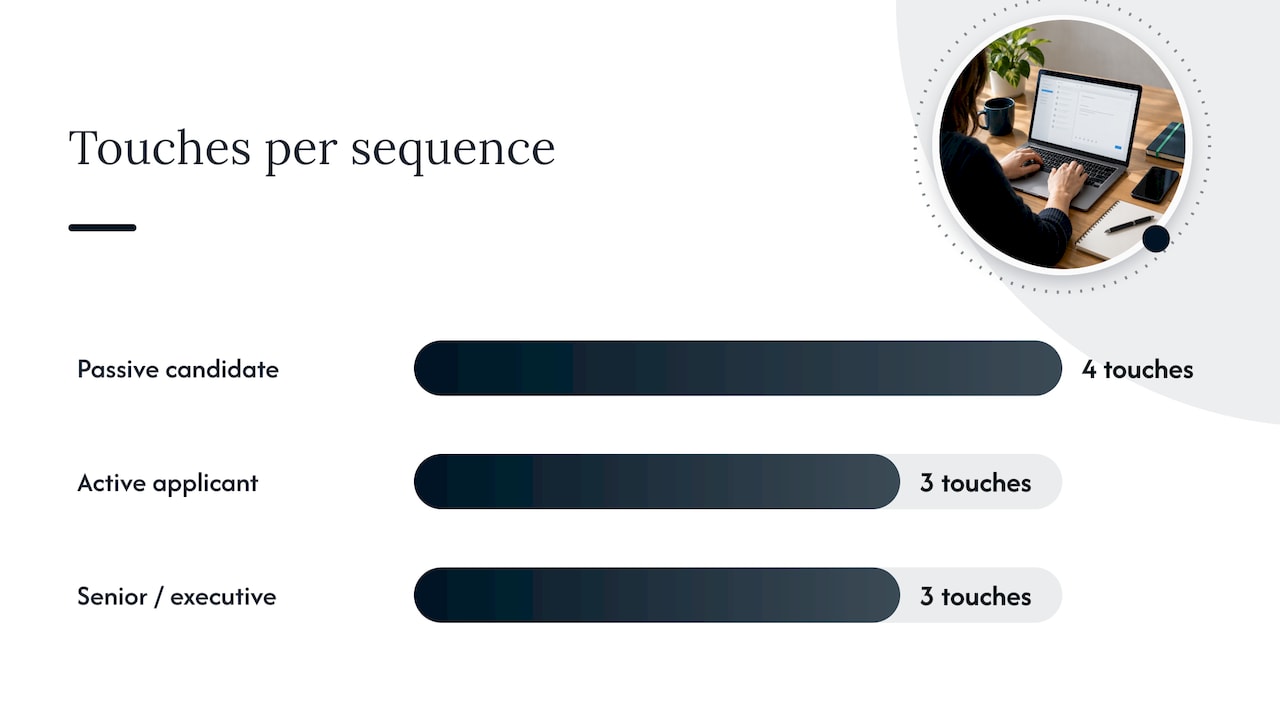
Passive candidate, mid-level technical role: Day 1 email introducing the opportunity with one specific detail about their background. Day 3 LinkedIn message if no email reply, referencing the same project detail. Day 7 short follow-up email with a direct question (“Worth a 15-minute call this week?”). Day 12 final email closing the loop, leaving the door open for future roles.
Active candidate who applied directly: Same-day automated confirmation. Day 2 human-reviewed screening question sent by email or SMS. Day 4 interview scheduling link if the screening response is positive. No further automated touches after the first human reply, since the candidate has already shown intent.
Senior or executive-level search: Day 1 personalized email referencing a specific achievement, never a template field alone. Day 5 phone call attempt, logged manually. Day 9 LinkedIn message only if email and phone both failed to connect. Automation here should handle logging and reminders, not the outreach copy itself.
The decision to escalate to human outreach should not wait for a fixed day in the sequence. Any signal of strong interest, hesitation, or a question about compensation should trigger an immediate human handoff regardless of where the candidate sits in the cadence. Sequences should also have a defined stop point: three to four touches across 10 to 14 days is a reasonable ceiling before moving the candidate to a longer-term nurture list rather than continuing to message weekly.
Personalization triggers matter more than message volume. A reference to a specific repository, certification, or previous employer tends to outperform a generic “I saw your profile” opener, and follow-up messages should build on the previous touch rather than repeating it. If a candidate has not engaged after the full sequence, the system should automatically tag them for review rather than looping them back into a fresh sequence with no record of prior contact. An automated sourcing agent can flag strong matches early, but the message itself should carry enough specific detail that it reads as intentional rather than mass-produced, a distinction covered in more depth in how automated sourcing agents identify candidates.
Personalization at scale: data hygiene and message tailoring
Personalization only works when the underlying data is clean. A merge field pulling the wrong job title or an outdated company name undermines trust faster than a generic message ever could, since it signals the sender did not actually check.
Deduplication: merge duplicate candidate records before launching any sequence, since the same person receiving two different messages from the same agency damages credibility immediately.
Canonicalization of titles: normalize job titles across sources (for example, “Sr. Software Eng.” and “Senior Software Engineer” should resolve to one standard label) so matching logic and personalization tokens stay accurate.
Enrichment: supplement sparse profiles with verified data from the candidate’s own public activity rather than guessing at skills or seniority.
Token selection: names, specific project or technology references, and shared connections tend to increase reply rates, while overused tokens like “I noticed your impressive background” read as filler and often lower response quality.
Privacy safeguards: strip or mask sensitive fields such as age, nationality, or health-related data from any automated message generation step, keeping that information available only where a legitimate business need exists.
Good personalization is less about the number of tokens and more about whether the message would feel odd if the candidate knew it was partly generated. A system that surfaces real detail, a specific repository contribution, a recent certification, a shared former employer, tends to perform better than one that simply inserts a name into a static template.
Compliance and consent: a practical checklist for outreach regulations
Compliance failures in candidate outreach are rarely intentional. They happen because consent and consent records live in different systems, or because nobody checked which rules apply to which channel. The requirements differ by jurisdiction and by channel, so a single blanket policy will not cover every case.
Email: the FTC’s CAN-SPAM compliance guide requires accurate header information, a truthful subject line, and a working unsubscribe mechanism on every marketing email sent to candidates in the United States.
SMS and voice: the FCC’s rules on consent revocation clarify how candidates can revoke consent for automated calls and texts, and outreach systems must honor revocation immediately once received.
UK and EU electronic marketing: ICO guidance on PECR explains that unsolicited electronic marketing generally requires valid consent, with an easy, visible opt-out on every message.
Consent logging: record the timestamp, source, and channel-specific flag for every consent captured, since a verbal or implied consent with no record is difficult to defend in an audit.
Vendor due diligence: when working through a third-party platform, your agency typically remains the “instigator” of the marketing under PECR unless a contract explicitly reassigns that responsibility.
Recruiters who build auditable consent trails reduce their exposure to regulatory complaints, according to the ICO’s guidance on electronic marketing, which stresses recordkeeping as a core part of lawful outreach. Consent and legitimate interest are not interchangeable: legitimate interest may justify some processing of professional contact data, but most proactive electronic marketing still requires a documented consent basis, and the two should never be conflated in your internal policy.
How to measure outreach effectiveness: KPIs, benchmarks, and testing
Measuring outreach only by volume sent misses the point. The metrics that matter track how many of those messages led somewhere real.
Reply rate: the share of candidates who respond at all, a basic signal of whether the message landed and read as relevant.
Qualified-response rate: replies that indicate genuine interest or fit, which matters more than raw reply volume since a high reply rate full of “not interested” responses is not success.
Interview rate: the share of contacted candidates who convert to a scheduled interview, the metric most tied to actual hiring outcomes.
Time-to-hire: tracked alongside the above to confirm automation is accelerating the funnel rather than just adding more touches without speeding anything up.
Benchmarks vary widely by role seniority and market, so treat any fixed number with caution and focus on trend over time within your own data rather than chasing an external figure. When running A/B tests on subject lines or sequence timing, test one variable at a time and wait for a large enough sample before declaring a winner, since small candidate pools make false positives common. SHRM’s research notes that automation tends to produce measurable efficiency gains when it is applied to well-defined, repetitive tasks rather than judged on reply rate alone.
Implementation checklist: a step-by-step rollout plan
Rolling out automated outreach works best as a staged process rather than a single switch, since both your data and your team need time to adjust.
Audit consent and data quality first: confirm what consent basis exists for your current candidate database before sending a single automated message.
Pilot with one role type: choose a single job category and a small candidate segment to test sequence design before expanding.
Build human-in-the-loop checkpoints: define exactly which reply types route to a recruiter and confirm the escalation works before scaling volume.
Connect outreach to your ATS: ensure every automated touch logs against the candidate record automatically rather than relying on manual entry.
Set governance rules: document who can edit sequence copy, how often templates get reviewed, and who owns compliance sign-off.
Monitor and adjust: review reply and qualified-response rates weekly during the pilot, then monthly once the system stabilizes.
Treat the pilot phase as a genuine test, not a formality. A sequence that performs well on 50 candidates can behave very differently at 500, particularly once reply volume exceeds what a recruiter can review same-day. Integrating outreach into existing recruitment project workflows during the pilot, rather than running it as a side process, makes the eventual scale-up far less disruptive.
Pro Tip: Run your pilot for at least one full sequence cycle, typically two to three weeks, before changing any template, so you measure the sequence rather than a moving target.
How an integrated platform supports outreach, consent, and auditability
Agencies managing outreach, ATS records, and client contracts across separate tools often lose track of where consent lives or which version of a candidate’s profile is current. Some platforms address this by consolidating ATS, CRM, and contracting modules into one operational system, so outreach activity, consent status, and candidate records sit in the same place rather than across disconnected spreadsheets and inboxes.
Contextual Matching AI and Scoring: evaluates applications against project requirements and returns shortlists with a percentage match score, reducing manual screening before outreach even begins.
AI CV Parser with OCR: builds a structured candidate profile from PDFs, scans, or photos in seconds and flags duplicates automatically, addressing the data hygiene issues that undermine personalization.
Blind CV AI: generates anonymized candidate profiles for client presentation, useful when sharing shortlists while protecting candidate identity.
X-RAY Search and Boolean Engine: scans the open web and internal databases, generating Boolean strings automatically to speed up sourcing ahead of outreach.
GDPR consent management module: maintains a full audit trail with digital proof for every record, supporting the consent logging practices outlined earlier in this guide.
Such consolidation aims to deliver a substantial reduction in administrative tasks by automating workflows from initial lead contact through final contract generation, as claimed by some companies about their platforms.
Why automation should augment recruiters, not replace them
The temptation with any outreach automation tool is to measure success purely by volume: more messages sent, more sequences running, more candidates in the pipeline. That metric is seductive, but largely meaningless. Candidates can tell within one message whether a recruiter engaged with their background or whether a system matched a keyword, and the agencies that treat automation as a volume lever rather than a time-saving one tend to see reply rates decline even as send counts climb.
The more useful framing is that automation exists to buy recruiters time, not to buy them scale for its own sake. The agencies getting this right use the hours saved on repetitive sourcing and scheduling to have more substantive conversations with fewer candidates, not to blast more candidates with the same thin message. Efficiency and candidate experience are not opposing goals, but only when automation stays confined to the tasks that do not require a human’s judgment.
- Recruitify Team
Getting integrated, compliant outreach automation up and running
Agencies that have tried stitching together separate sourcing tools, email platforms, and spreadsheets know the real cost is not the outreach itself but the hours spent reconciling records across systems that do not talk to each other. Recruitify was built to close that gap by combining ATS, CRM, and automation workflows into a single system where every outreach touch, consent record, and candidate update lives in one place.
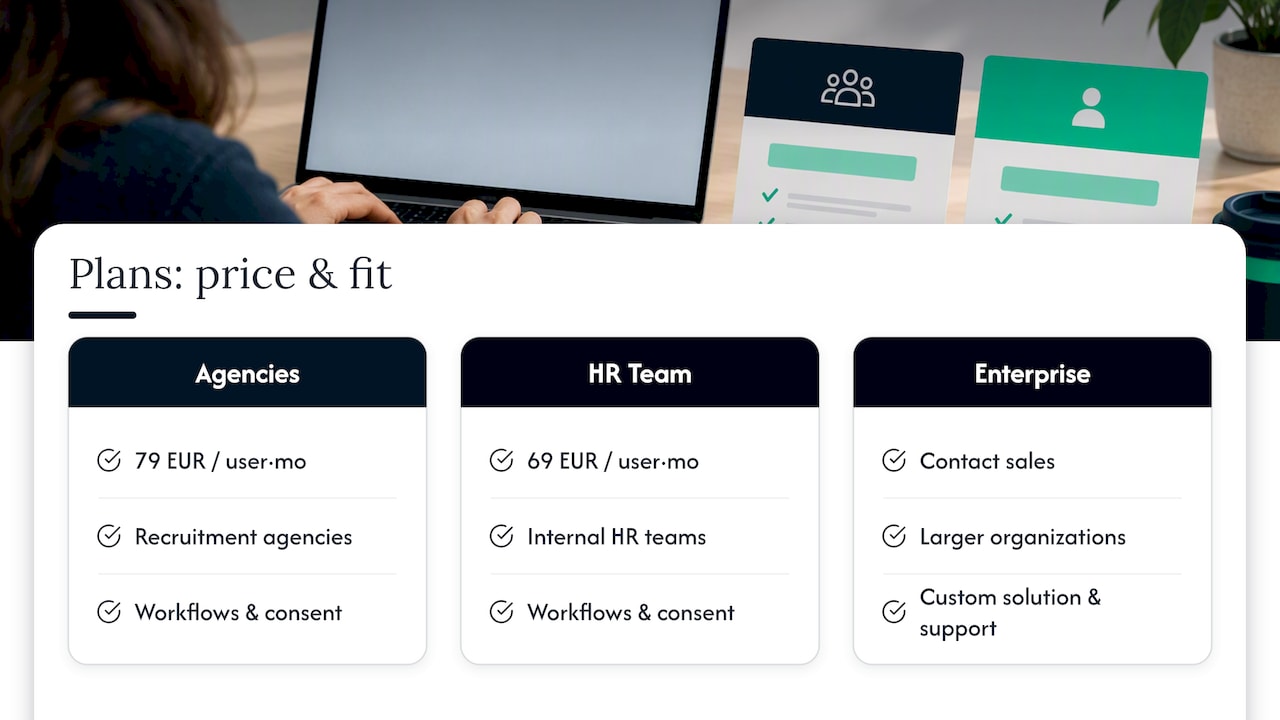
For agencies, the Recruitment Agencies plan runs 79 EUR per month per user and includes the automated workflows, consent tracking, and matching tools described throughout this guide. Internal HR teams can access the same core automation through the HR Team plan at 69 EUR per month per user, while larger organizations with more complex structures can inquire about Enterprise pricing directly. If your outreach currently runs across separate tools with no shared audit trail, the automation module is the clearest starting point to see how an integrated workflow handles consent, sequencing, and ATS sync together. Check current plan details on the pricing page and see whether a demo fits your agency’s next hiring cycle.
This article is general information, not a substitute for advice from a qualified lawyer. Consult a qualified legal professional about your own circumstances before acting on anything here.
FAQ
What is candidate outreach?
Candidate outreach is the process of initiating and managing contact with potential job candidates, whether they applied directly or were sourced proactively. It spans email, LinkedIn, SMS, and phone, and increasingly relies on automation to handle the repetitive parts of that contact at scale.
What are the top 5 ATS systems?
There is no single authoritative ranking of ATS platforms, since the right choice depends on agency size, workflow complexity, and whether outreach and CRM functions need to live in the same system. Recruiters should evaluate options based on integration depth, automation capability, and compliance features such as consent tracking rather than relying on generic “top 5” lists.
What is the 80/20 rule in recruiting?
Definitions vary, but common recruiting heuristics emphasize that a large share of successful placements often come from a small portion of sourcing channels or candidate relationships. In practice, this is used as a prioritization guideline rather than a precise statistic, encouraging recruiters to focus effort on the highest-yield activities.
What are the 5 C’s of recruitment?
The “5 C’s” framework varies by source, but common versions include clarity, candidate experience, communication, consistency, and culture fit as the pillars of an effective recruiting process. Because the exact list differs across sources, it is best treated as a general organizing concept rather than a fixed standard.
How does automation affect candidate response rates?
Automation tends to improve response rates when messages stay personalized and relevant, since consistent, well-timed follow-up alone increases the chance a candidate replies. According to SHRM’s research on AI in recruitment, the strongest results come from using automation for scale and consistency while keeping message content specific enough to feel genuinely tailored.
Sources
Recommended


News & Updates
Stay up-to-date with the latest innovations, features, and tips about Recruitify!
By providing your email address within the newsletter sign-up form, you confirm its processing to send marketing information regarding the Administrator’s products and services. The Administrator of your personal data processed for the abovementioned purposes is Recruitify Spółka z o.o., based in Warsaw, Poland (KRS 0000709889). For more information on the principles of personal data processing and the rights of data subjects, please check the Privacy Policy.

Last updated:
Recruiters: Compliant Automated Candidate Outreach in 3–4 Touches
Recruitment Process
The Recruitify Team
Automated candidate outreach is the use of software and AI to send, sequence, and manage contact with candidates across email, LinkedIn, SMS, and phone at a scale no individual recruiter could sustain manually. It works best as augmentation, not replacement: the technology should absorb repetitive sourcing, follow-ups, and scheduling, while recruiters retain judgment over screening calls, offer negotiations, and any decision that shapes a candidate’s experience of your agency.
TL;DR:
Automated outreach is most effective for volume tasks like initial contact, follow-up reminders, and scheduling, while human judgment is essential for negotiations and candidate assessments.
Sequence design should prioritize personalization with relevant details and escalate immediately when candidates show strong interest or hesitation to avoid robotic responses.
Data hygiene practices such as deduplication, standardized titles, and profile enrichment significantly improve message relevance and response rates.
Compliance requires maintaining detailed consent records and respecting revocation, with rules varying by jurisdiction and communication channel.
Tracking key metrics like reply, qualified response, and interview rates over time offers better insights than volume alone, with continuous testing improving outreach effectiveness.
Recruitifyrecruitify.aiAutomate Outreach With Better OversightRecruitify.ai connects recruitment workflows, candidate data, and GDPR consent management in one operational ecosystem for modern IT agencies.Explore Recruitify.ai
Table of Contents
What automated candidate outreach covers: channels, core features, and workflow fit
What to automate versus what to keep human
Multi-channel outreach sequences and sample templates
Personalization at scale: data hygiene and message tailoring
Compliance and consent: a practical checklist for outreach regulations
How to measure outreach effectiveness: KPIs, benchmarks, and testing
Implementation checklist: a step-by-step rollout plan
How an integrated platform supports outreach, consent, and auditability
Why automation should augment recruiters, not replace them
Getting integrated, compliant outreach automation up and running
FAQ
Sources
What automated candidate outreach covers: channels, core features, and workflow fit
Before adopting or building an outreach system, it helps to understand what the category actually includes. Most platforms combine several distinct functions into a single workflow, and recognizing each one clarifies where automation adds value and where it introduces risk.
Sourcing: pulling candidate profiles from databases, job boards, or the open web based on role criteria.
Contact discovery: finding verified email addresses, phone numbers, or social profiles for identified candidates.
Sequence builder: scheduling a series of touches across channels with defined timing and branching logic.
Reply handling: routing responses to recruiters, flagging interest signals, and pausing sequences automatically.
Interview booking: syncing calendars so candidates can self-schedule without back-and-forth emails.
ATS/CRM sync: logging every touchpoint against the candidate record so nothing lives in a separate spreadsheet.
Each channel carries tradeoffs. Email scales easily and is simple to track, but open rates vary widely and inboxes are crowded. LinkedIn and InMail messages tend to feel more personal and land in a professional context, though volume limits and platform restrictions cap how far they scale. SMS and WhatsApp get read quickly, often within minutes, but they demand stricter consent handling and a lower tolerance for generic copy. Phone calls remain the highest-conversion channel for serious candidates, yet they do not scale at all and should stay largely human-led.
The workflow fit matters as much as the channel mix. Outreach that is not connected to your applicant tracking system creates duplicate records, missed follow-ups, and compliance gaps, since nobody has a single view of who was contacted, when, and with what consent basis. Integrating outreach directly into the sourcing and ATS pipeline means every message becomes part of the candidate’s permanent record rather than a disconnected marketing action.
What to automate versus what to keep human
The clearest failures in candidate outreach happen when agencies automate the wrong layer: they let software handle judgment calls instead of volume, and candidates notice immediately. A useful rule of thumb is to automate anything repetitive and time-bound, and keep anything relational or evaluative in human hands.
Automate: initial contact for passive sourcing, follow-up reminders, interview scheduling links, and status update notifications.
Keep human: screening conversations, salary negotiation, feedback after interviews, and any message responding to a candidate’s personal circumstances.
Escalate automatically when a candidate replies with a question, expresses hesitation, or requests a call. A human-in-the-loop trigger should pull the conversation out of the sequence the moment a reply shows genuine engagement.
Failure modes tend to follow a predictable pattern. A candidate who replies to a templated message often gets another templated message back, because the sequence kept running instead of pausing. Another common pattern is tone mismatch: a highly personalized subject line followed by a generic body that reveals the “personalization” was just a merged field. According to SHRM’s research on AI in recruitment, the strongest outcomes come when automation handles scale tasks while recruiters preserve the relationship-building work that candidates actually remember.
Pro Tip: Set a hard rule that any reply containing a question mark exits the automated sequence and routes to a recruiter within one business day.
Multi-channel outreach sequences and sample templates
A well-built sequence balances persistence with respect for the candidate’s time. The templates below are skeletons to adapt, not scripts to copy verbatim, since tone should match your agency’s voice and the role’s seniority.
Passive candidate, mid-level technical role: Day 1 email introducing the opportunity with one specific detail about their background. Day 3 LinkedIn message if no email reply, referencing the same project detail. Day 7 short follow-up email with a direct question (“Worth a 15-minute call this week?”). Day 12 final email closing the loop, leaving the door open for future roles.
Active candidate who applied directly: Same-day automated confirmation. Day 2 human-reviewed screening question sent by email or SMS. Day 4 interview scheduling link if the screening response is positive. No further automated touches after the first human reply, since the candidate has already shown intent.
Senior or executive-level search: Day 1 personalized email referencing a specific achievement, never a template field alone. Day 5 phone call attempt, logged manually. Day 9 LinkedIn message only if email and phone both failed to connect. Automation here should handle logging and reminders, not the outreach copy itself.
The decision to escalate to human outreach should not wait for a fixed day in the sequence. Any signal of strong interest, hesitation, or a question about compensation should trigger an immediate human handoff regardless of where the candidate sits in the cadence. Sequences should also have a defined stop point: three to four touches across 10 to 14 days is a reasonable ceiling before moving the candidate to a longer-term nurture list rather than continuing to message weekly.
Personalization triggers matter more than message volume. A reference to a specific repository, certification, or previous employer tends to outperform a generic “I saw your profile” opener, and follow-up messages should build on the previous touch rather than repeating it. If a candidate has not engaged after the full sequence, the system should automatically tag them for review rather than looping them back into a fresh sequence with no record of prior contact. An automated sourcing agent can flag strong matches early, but the message itself should carry enough specific detail that it reads as intentional rather than mass-produced, a distinction covered in more depth in how automated sourcing agents identify candidates.
Personalization at scale: data hygiene and message tailoring
Personalization only works when the underlying data is clean. A merge field pulling the wrong job title or an outdated company name undermines trust faster than a generic message ever could, since it signals the sender did not actually check.
Deduplication: merge duplicate candidate records before launching any sequence, since the same person receiving two different messages from the same agency damages credibility immediately.
Canonicalization of titles: normalize job titles across sources (for example, “Sr. Software Eng.” and “Senior Software Engineer” should resolve to one standard label) so matching logic and personalization tokens stay accurate.
Enrichment: supplement sparse profiles with verified data from the candidate’s own public activity rather than guessing at skills or seniority.
Token selection: names, specific project or technology references, and shared connections tend to increase reply rates, while overused tokens like “I noticed your impressive background” read as filler and often lower response quality.
Privacy safeguards: strip or mask sensitive fields such as age, nationality, or health-related data from any automated message generation step, keeping that information available only where a legitimate business need exists.
Good personalization is less about the number of tokens and more about whether the message would feel odd if the candidate knew it was partly generated. A system that surfaces real detail, a specific repository contribution, a recent certification, a shared former employer, tends to perform better than one that simply inserts a name into a static template.
Compliance and consent: a practical checklist for outreach regulations
Compliance failures in candidate outreach are rarely intentional. They happen because consent and consent records live in different systems, or because nobody checked which rules apply to which channel. The requirements differ by jurisdiction and by channel, so a single blanket policy will not cover every case.
Email: the FTC’s CAN-SPAM compliance guide requires accurate header information, a truthful subject line, and a working unsubscribe mechanism on every marketing email sent to candidates in the United States.
SMS and voice: the FCC’s rules on consent revocation clarify how candidates can revoke consent for automated calls and texts, and outreach systems must honor revocation immediately once received.
UK and EU electronic marketing: ICO guidance on PECR explains that unsolicited electronic marketing generally requires valid consent, with an easy, visible opt-out on every message.
Consent logging: record the timestamp, source, and channel-specific flag for every consent captured, since a verbal or implied consent with no record is difficult to defend in an audit.
Vendor due diligence: when working through a third-party platform, your agency typically remains the “instigator” of the marketing under PECR unless a contract explicitly reassigns that responsibility.
Recruiters who build auditable consent trails reduce their exposure to regulatory complaints, according to the ICO’s guidance on electronic marketing, which stresses recordkeeping as a core part of lawful outreach. Consent and legitimate interest are not interchangeable: legitimate interest may justify some processing of professional contact data, but most proactive electronic marketing still requires a documented consent basis, and the two should never be conflated in your internal policy.
How to measure outreach effectiveness: KPIs, benchmarks, and testing
Measuring outreach only by volume sent misses the point. The metrics that matter track how many of those messages led somewhere real.
Reply rate: the share of candidates who respond at all, a basic signal of whether the message landed and read as relevant.
Qualified-response rate: replies that indicate genuine interest or fit, which matters more than raw reply volume since a high reply rate full of “not interested” responses is not success.
Interview rate: the share of contacted candidates who convert to a scheduled interview, the metric most tied to actual hiring outcomes.
Time-to-hire: tracked alongside the above to confirm automation is accelerating the funnel rather than just adding more touches without speeding anything up.
Benchmarks vary widely by role seniority and market, so treat any fixed number with caution and focus on trend over time within your own data rather than chasing an external figure. When running A/B tests on subject lines or sequence timing, test one variable at a time and wait for a large enough sample before declaring a winner, since small candidate pools make false positives common. SHRM’s research notes that automation tends to produce measurable efficiency gains when it is applied to well-defined, repetitive tasks rather than judged on reply rate alone.
Implementation checklist: a step-by-step rollout plan
Rolling out automated outreach works best as a staged process rather than a single switch, since both your data and your team need time to adjust.
Audit consent and data quality first: confirm what consent basis exists for your current candidate database before sending a single automated message.
Pilot with one role type: choose a single job category and a small candidate segment to test sequence design before expanding.
Build human-in-the-loop checkpoints: define exactly which reply types route to a recruiter and confirm the escalation works before scaling volume.
Connect outreach to your ATS: ensure every automated touch logs against the candidate record automatically rather than relying on manual entry.
Set governance rules: document who can edit sequence copy, how often templates get reviewed, and who owns compliance sign-off.
Monitor and adjust: review reply and qualified-response rates weekly during the pilot, then monthly once the system stabilizes.
Treat the pilot phase as a genuine test, not a formality. A sequence that performs well on 50 candidates can behave very differently at 500, particularly once reply volume exceeds what a recruiter can review same-day. Integrating outreach into existing recruitment project workflows during the pilot, rather than running it as a side process, makes the eventual scale-up far less disruptive.
Pro Tip: Run your pilot for at least one full sequence cycle, typically two to three weeks, before changing any template, so you measure the sequence rather than a moving target.
How an integrated platform supports outreach, consent, and auditability
Agencies managing outreach, ATS records, and client contracts across separate tools often lose track of where consent lives or which version of a candidate’s profile is current. Some platforms address this by consolidating ATS, CRM, and contracting modules into one operational system, so outreach activity, consent status, and candidate records sit in the same place rather than across disconnected spreadsheets and inboxes.
Contextual Matching AI and Scoring: evaluates applications against project requirements and returns shortlists with a percentage match score, reducing manual screening before outreach even begins.
AI CV Parser with OCR: builds a structured candidate profile from PDFs, scans, or photos in seconds and flags duplicates automatically, addressing the data hygiene issues that undermine personalization.
Blind CV AI: generates anonymized candidate profiles for client presentation, useful when sharing shortlists while protecting candidate identity.
X-RAY Search and Boolean Engine: scans the open web and internal databases, generating Boolean strings automatically to speed up sourcing ahead of outreach.
GDPR consent management module: maintains a full audit trail with digital proof for every record, supporting the consent logging practices outlined earlier in this guide.
Such consolidation aims to deliver a substantial reduction in administrative tasks by automating workflows from initial lead contact through final contract generation, as claimed by some companies about their platforms.
Why automation should augment recruiters, not replace them
The temptation with any outreach automation tool is to measure success purely by volume: more messages sent, more sequences running, more candidates in the pipeline. That metric is seductive, but largely meaningless. Candidates can tell within one message whether a recruiter engaged with their background or whether a system matched a keyword, and the agencies that treat automation as a volume lever rather than a time-saving one tend to see reply rates decline even as send counts climb.
The more useful framing is that automation exists to buy recruiters time, not to buy them scale for its own sake. The agencies getting this right use the hours saved on repetitive sourcing and scheduling to have more substantive conversations with fewer candidates, not to blast more candidates with the same thin message. Efficiency and candidate experience are not opposing goals, but only when automation stays confined to the tasks that do not require a human’s judgment.
- Recruitify Team
Getting integrated, compliant outreach automation up and running
Agencies that have tried stitching together separate sourcing tools, email platforms, and spreadsheets know the real cost is not the outreach itself but the hours spent reconciling records across systems that do not talk to each other. Recruitify was built to close that gap by combining ATS, CRM, and automation workflows into a single system where every outreach touch, consent record, and candidate update lives in one place.
For agencies, the Recruitment Agencies plan runs 79 EUR per month per user and includes the automated workflows, consent tracking, and matching tools described throughout this guide. Internal HR teams can access the same core automation through the HR Team plan at 69 EUR per month per user, while larger organizations with more complex structures can inquire about Enterprise pricing directly. If your outreach currently runs across separate tools with no shared audit trail, the automation module is the clearest starting point to see how an integrated workflow handles consent, sequencing, and ATS sync together. Check current plan details on the pricing page and see whether a demo fits your agency’s next hiring cycle.
This article is general information, not a substitute for advice from a qualified lawyer. Consult a qualified legal professional about your own circumstances before acting on anything here.
FAQ
What is candidate outreach?
Candidate outreach is the process of initiating and managing contact with potential job candidates, whether they applied directly or were sourced proactively. It spans email, LinkedIn, SMS, and phone, and increasingly relies on automation to handle the repetitive parts of that contact at scale.
What are the top 5 ATS systems?
There is no single authoritative ranking of ATS platforms, since the right choice depends on agency size, workflow complexity, and whether outreach and CRM functions need to live in the same system. Recruiters should evaluate options based on integration depth, automation capability, and compliance features such as consent tracking rather than relying on generic “top 5” lists.
What is the 80/20 rule in recruiting?
Definitions vary, but common recruiting heuristics emphasize that a large share of successful placements often come from a small portion of sourcing channels or candidate relationships. In practice, this is used as a prioritization guideline rather than a precise statistic, encouraging recruiters to focus effort on the highest-yield activities.
What are the 5 C’s of recruitment?
The “5 C’s” framework varies by source, but common versions include clarity, candidate experience, communication, consistency, and culture fit as the pillars of an effective recruiting process. Because the exact list differs across sources, it is best treated as a general organizing concept rather than a fixed standard.
How does automation affect candidate response rates?
Automation tends to improve response rates when messages stay personalized and relevant, since consistent, well-timed follow-up alone increases the chance a candidate replies. According to SHRM’s research on AI in recruitment, the strongest results come from using automation for scale and consistency while keeping message content specific enough to feel genuinely tailored.
Sources
Recommended
News & Updates
Stay up-to-date with the latest innovations, features, and tips about Recruitify!
By providing your email address within the newsletter sign-up form, you confirm its processing to send marketing information regarding the Administrator’s products and services. The Administrator of your personal data processed for the abovementioned purposes is Recruitify Spółka z o.o., based in Warsaw, Poland (KRS 0000709889). For more information on the principles of personal data processing and the rights of data subjects, please check the Privacy Policy.
Last updated:
Recruiters: Compliant Automated Candidate Outreach in 3–4 Touches
Recruitment Process
The Recruitify Team
Automated candidate outreach is the use of software and AI to send, sequence, and manage contact with candidates across email, LinkedIn, SMS, and phone at a scale no individual recruiter could sustain manually. It works best as augmentation, not replacement: the technology should absorb repetitive sourcing, follow-ups, and scheduling, while recruiters retain judgment over screening calls, offer negotiations, and any decision that shapes a candidate’s experience of your agency.
TL;DR:
Automated outreach is most effective for volume tasks like initial contact, follow-up reminders, and scheduling, while human judgment is essential for negotiations and candidate assessments.
Sequence design should prioritize personalization with relevant details and escalate immediately when candidates show strong interest or hesitation to avoid robotic responses.
Data hygiene practices such as deduplication, standardized titles, and profile enrichment significantly improve message relevance and response rates.
Compliance requires maintaining detailed consent records and respecting revocation, with rules varying by jurisdiction and communication channel.
Tracking key metrics like reply, qualified response, and interview rates over time offers better insights than volume alone, with continuous testing improving outreach effectiveness.
Recruitifyrecruitify.aiAutomate Outreach With Better OversightRecruitify.ai connects recruitment workflows, candidate data, and GDPR consent management in one operational ecosystem for modern IT agencies.Explore Recruitify.ai
Table of Contents
What automated candidate outreach covers: channels, core features, and workflow fit
What to automate versus what to keep human
Multi-channel outreach sequences and sample templates
Personalization at scale: data hygiene and message tailoring
Compliance and consent: a practical checklist for outreach regulations
How to measure outreach effectiveness: KPIs, benchmarks, and testing
Implementation checklist: a step-by-step rollout plan
How an integrated platform supports outreach, consent, and auditability
Why automation should augment recruiters, not replace them
Getting integrated, compliant outreach automation up and running
FAQ
Sources
What automated candidate outreach covers: channels, core features, and workflow fit
Before adopting or building an outreach system, it helps to understand what the category actually includes. Most platforms combine several distinct functions into a single workflow, and recognizing each one clarifies where automation adds value and where it introduces risk.
Sourcing: pulling candidate profiles from databases, job boards, or the open web based on role criteria.
Contact discovery: finding verified email addresses, phone numbers, or social profiles for identified candidates.
Sequence builder: scheduling a series of touches across channels with defined timing and branching logic.
Reply handling: routing responses to recruiters, flagging interest signals, and pausing sequences automatically.
Interview booking: syncing calendars so candidates can self-schedule without back-and-forth emails.
ATS/CRM sync: logging every touchpoint against the candidate record so nothing lives in a separate spreadsheet.
Each channel carries tradeoffs. Email scales easily and is simple to track, but open rates vary widely and inboxes are crowded. LinkedIn and InMail messages tend to feel more personal and land in a professional context, though volume limits and platform restrictions cap how far they scale. SMS and WhatsApp get read quickly, often within minutes, but they demand stricter consent handling and a lower tolerance for generic copy. Phone calls remain the highest-conversion channel for serious candidates, yet they do not scale at all and should stay largely human-led.
The workflow fit matters as much as the channel mix. Outreach that is not connected to your applicant tracking system creates duplicate records, missed follow-ups, and compliance gaps, since nobody has a single view of who was contacted, when, and with what consent basis. Integrating outreach directly into the sourcing and ATS pipeline means every message becomes part of the candidate’s permanent record rather than a disconnected marketing action.
What to automate versus what to keep human
The clearest failures in candidate outreach happen when agencies automate the wrong layer: they let software handle judgment calls instead of volume, and candidates notice immediately. A useful rule of thumb is to automate anything repetitive and time-bound, and keep anything relational or evaluative in human hands.
Automate: initial contact for passive sourcing, follow-up reminders, interview scheduling links, and status update notifications.
Keep human: screening conversations, salary negotiation, feedback after interviews, and any message responding to a candidate’s personal circumstances.
Escalate automatically when a candidate replies with a question, expresses hesitation, or requests a call. A human-in-the-loop trigger should pull the conversation out of the sequence the moment a reply shows genuine engagement.
Failure modes tend to follow a predictable pattern. A candidate who replies to a templated message often gets another templated message back, because the sequence kept running instead of pausing. Another common pattern is tone mismatch: a highly personalized subject line followed by a generic body that reveals the “personalization” was just a merged field. According to SHRM’s research on AI in recruitment, the strongest outcomes come when automation handles scale tasks while recruiters preserve the relationship-building work that candidates actually remember.
Pro Tip: Set a hard rule that any reply containing a question mark exits the automated sequence and routes to a recruiter within one business day.
Multi-channel outreach sequences and sample templates
A well-built sequence balances persistence with respect for the candidate’s time. The templates below are skeletons to adapt, not scripts to copy verbatim, since tone should match your agency’s voice and the role’s seniority.
Passive candidate, mid-level technical role: Day 1 email introducing the opportunity with one specific detail about their background. Day 3 LinkedIn message if no email reply, referencing the same project detail. Day 7 short follow-up email with a direct question (“Worth a 15-minute call this week?”). Day 12 final email closing the loop, leaving the door open for future roles.
Active candidate who applied directly: Same-day automated confirmation. Day 2 human-reviewed screening question sent by email or SMS. Day 4 interview scheduling link if the screening response is positive. No further automated touches after the first human reply, since the candidate has already shown intent.
Senior or executive-level search: Day 1 personalized email referencing a specific achievement, never a template field alone. Day 5 phone call attempt, logged manually. Day 9 LinkedIn message only if email and phone both failed to connect. Automation here should handle logging and reminders, not the outreach copy itself.
The decision to escalate to human outreach should not wait for a fixed day in the sequence. Any signal of strong interest, hesitation, or a question about compensation should trigger an immediate human handoff regardless of where the candidate sits in the cadence. Sequences should also have a defined stop point: three to four touches across 10 to 14 days is a reasonable ceiling before moving the candidate to a longer-term nurture list rather than continuing to message weekly.
Personalization triggers matter more than message volume. A reference to a specific repository, certification, or previous employer tends to outperform a generic “I saw your profile” opener, and follow-up messages should build on the previous touch rather than repeating it. If a candidate has not engaged after the full sequence, the system should automatically tag them for review rather than looping them back into a fresh sequence with no record of prior contact. An automated sourcing agent can flag strong matches early, but the message itself should carry enough specific detail that it reads as intentional rather than mass-produced, a distinction covered in more depth in how automated sourcing agents identify candidates.
Personalization at scale: data hygiene and message tailoring
Personalization only works when the underlying data is clean. A merge field pulling the wrong job title or an outdated company name undermines trust faster than a generic message ever could, since it signals the sender did not actually check.
Deduplication: merge duplicate candidate records before launching any sequence, since the same person receiving two different messages from the same agency damages credibility immediately.
Canonicalization of titles: normalize job titles across sources (for example, “Sr. Software Eng.” and “Senior Software Engineer” should resolve to one standard label) so matching logic and personalization tokens stay accurate.
Enrichment: supplement sparse profiles with verified data from the candidate’s own public activity rather than guessing at skills or seniority.
Token selection: names, specific project or technology references, and shared connections tend to increase reply rates, while overused tokens like “I noticed your impressive background” read as filler and often lower response quality.
Privacy safeguards: strip or mask sensitive fields such as age, nationality, or health-related data from any automated message generation step, keeping that information available only where a legitimate business need exists.
Good personalization is less about the number of tokens and more about whether the message would feel odd if the candidate knew it was partly generated. A system that surfaces real detail, a specific repository contribution, a recent certification, a shared former employer, tends to perform better than one that simply inserts a name into a static template.
Compliance and consent: a practical checklist for outreach regulations
Compliance failures in candidate outreach are rarely intentional. They happen because consent and consent records live in different systems, or because nobody checked which rules apply to which channel. The requirements differ by jurisdiction and by channel, so a single blanket policy will not cover every case.
Email: the FTC’s CAN-SPAM compliance guide requires accurate header information, a truthful subject line, and a working unsubscribe mechanism on every marketing email sent to candidates in the United States.
SMS and voice: the FCC’s rules on consent revocation clarify how candidates can revoke consent for automated calls and texts, and outreach systems must honor revocation immediately once received.
UK and EU electronic marketing: ICO guidance on PECR explains that unsolicited electronic marketing generally requires valid consent, with an easy, visible opt-out on every message.
Consent logging: record the timestamp, source, and channel-specific flag for every consent captured, since a verbal or implied consent with no record is difficult to defend in an audit.
Vendor due diligence: when working through a third-party platform, your agency typically remains the “instigator” of the marketing under PECR unless a contract explicitly reassigns that responsibility.
Recruiters who build auditable consent trails reduce their exposure to regulatory complaints, according to the ICO’s guidance on electronic marketing, which stresses recordkeeping as a core part of lawful outreach. Consent and legitimate interest are not interchangeable: legitimate interest may justify some processing of professional contact data, but most proactive electronic marketing still requires a documented consent basis, and the two should never be conflated in your internal policy.
How to measure outreach effectiveness: KPIs, benchmarks, and testing
Measuring outreach only by volume sent misses the point. The metrics that matter track how many of those messages led somewhere real.
Reply rate: the share of candidates who respond at all, a basic signal of whether the message landed and read as relevant.
Qualified-response rate: replies that indicate genuine interest or fit, which matters more than raw reply volume since a high reply rate full of “not interested” responses is not success.
Interview rate: the share of contacted candidates who convert to a scheduled interview, the metric most tied to actual hiring outcomes.
Time-to-hire: tracked alongside the above to confirm automation is accelerating the funnel rather than just adding more touches without speeding anything up.
Benchmarks vary widely by role seniority and market, so treat any fixed number with caution and focus on trend over time within your own data rather than chasing an external figure. When running A/B tests on subject lines or sequence timing, test one variable at a time and wait for a large enough sample before declaring a winner, since small candidate pools make false positives common. SHRM’s research notes that automation tends to produce measurable efficiency gains when it is applied to well-defined, repetitive tasks rather than judged on reply rate alone.
Implementation checklist: a step-by-step rollout plan
Rolling out automated outreach works best as a staged process rather than a single switch, since both your data and your team need time to adjust.
Audit consent and data quality first: confirm what consent basis exists for your current candidate database before sending a single automated message.
Pilot with one role type: choose a single job category and a small candidate segment to test sequence design before expanding.
Build human-in-the-loop checkpoints: define exactly which reply types route to a recruiter and confirm the escalation works before scaling volume.
Connect outreach to your ATS: ensure every automated touch logs against the candidate record automatically rather than relying on manual entry.
Set governance rules: document who can edit sequence copy, how often templates get reviewed, and who owns compliance sign-off.
Monitor and adjust: review reply and qualified-response rates weekly during the pilot, then monthly once the system stabilizes.
Treat the pilot phase as a genuine test, not a formality. A sequence that performs well on 50 candidates can behave very differently at 500, particularly once reply volume exceeds what a recruiter can review same-day. Integrating outreach into existing recruitment project workflows during the pilot, rather than running it as a side process, makes the eventual scale-up far less disruptive.
Pro Tip: Run your pilot for at least one full sequence cycle, typically two to three weeks, before changing any template, so you measure the sequence rather than a moving target.
How an integrated platform supports outreach, consent, and auditability
Agencies managing outreach, ATS records, and client contracts across separate tools often lose track of where consent lives or which version of a candidate’s profile is current. Some platforms address this by consolidating ATS, CRM, and contracting modules into one operational system, so outreach activity, consent status, and candidate records sit in the same place rather than across disconnected spreadsheets and inboxes.
Contextual Matching AI and Scoring: evaluates applications against project requirements and returns shortlists with a percentage match score, reducing manual screening before outreach even begins.
AI CV Parser with OCR: builds a structured candidate profile from PDFs, scans, or photos in seconds and flags duplicates automatically, addressing the data hygiene issues that undermine personalization.
Blind CV AI: generates anonymized candidate profiles for client presentation, useful when sharing shortlists while protecting candidate identity.
X-RAY Search and Boolean Engine: scans the open web and internal databases, generating Boolean strings automatically to speed up sourcing ahead of outreach.
GDPR consent management module: maintains a full audit trail with digital proof for every record, supporting the consent logging practices outlined earlier in this guide.
Such consolidation aims to deliver a substantial reduction in administrative tasks by automating workflows from initial lead contact through final contract generation, as claimed by some companies about their platforms.
Why automation should augment recruiters, not replace them
The temptation with any outreach automation tool is to measure success purely by volume: more messages sent, more sequences running, more candidates in the pipeline. That metric is seductive, but largely meaningless. Candidates can tell within one message whether a recruiter engaged with their background or whether a system matched a keyword, and the agencies that treat automation as a volume lever rather than a time-saving one tend to see reply rates decline even as send counts climb.
The more useful framing is that automation exists to buy recruiters time, not to buy them scale for its own sake. The agencies getting this right use the hours saved on repetitive sourcing and scheduling to have more substantive conversations with fewer candidates, not to blast more candidates with the same thin message. Efficiency and candidate experience are not opposing goals, but only when automation stays confined to the tasks that do not require a human’s judgment.
- Recruitify Team
Getting integrated, compliant outreach automation up and running
Agencies that have tried stitching together separate sourcing tools, email platforms, and spreadsheets know the real cost is not the outreach itself but the hours spent reconciling records across systems that do not talk to each other. Recruitify was built to close that gap by combining ATS, CRM, and automation workflows into a single system where every outreach touch, consent record, and candidate update lives in one place.
For agencies, the Recruitment Agencies plan runs 79 EUR per month per user and includes the automated workflows, consent tracking, and matching tools described throughout this guide. Internal HR teams can access the same core automation through the HR Team plan at 69 EUR per month per user, while larger organizations with more complex structures can inquire about Enterprise pricing directly. If your outreach currently runs across separate tools with no shared audit trail, the automation module is the clearest starting point to see how an integrated workflow handles consent, sequencing, and ATS sync together. Check current plan details on the pricing page and see whether a demo fits your agency’s next hiring cycle.
This article is general information, not a substitute for advice from a qualified lawyer. Consult a qualified legal professional about your own circumstances before acting on anything here.
FAQ
What is candidate outreach?
Candidate outreach is the process of initiating and managing contact with potential job candidates, whether they applied directly or were sourced proactively. It spans email, LinkedIn, SMS, and phone, and increasingly relies on automation to handle the repetitive parts of that contact at scale.
What are the top 5 ATS systems?
There is no single authoritative ranking of ATS platforms, since the right choice depends on agency size, workflow complexity, and whether outreach and CRM functions need to live in the same system. Recruiters should evaluate options based on integration depth, automation capability, and compliance features such as consent tracking rather than relying on generic “top 5” lists.
What is the 80/20 rule in recruiting?
Definitions vary, but common recruiting heuristics emphasize that a large share of successful placements often come from a small portion of sourcing channels or candidate relationships. In practice, this is used as a prioritization guideline rather than a precise statistic, encouraging recruiters to focus effort on the highest-yield activities.
What are the 5 C’s of recruitment?
The “5 C’s” framework varies by source, but common versions include clarity, candidate experience, communication, consistency, and culture fit as the pillars of an effective recruiting process. Because the exact list differs across sources, it is best treated as a general organizing concept rather than a fixed standard.
How does automation affect candidate response rates?
Automation tends to improve response rates when messages stay personalized and relevant, since consistent, well-timed follow-up alone increases the chance a candidate replies. According to SHRM’s research on AI in recruitment, the strongest results come from using automation for scale and consistency while keeping message content specific enough to feel genuinely tailored.
Sources
Recommended
News & Updates
Stay up-to-date with the latest innovations, features, and tips about Recruitify!
By providing your email address within the newsletter sign-up form, you confirm its processing to send marketing information regarding the Administrator’s products and services. The Administrator of your personal data processed for the abovementioned purposes is Recruitify Spółka z o.o., based in Warsaw, Poland (KRS 0000709889). For more information on the principles of personal data processing and the rights of data subjects, please check the Privacy Policy.

Discover More

Acquiring Talent
Plan Integrations First: 3 Recruiting Tech Stack Architectures
Plan integrations before you buy. A practical guide to three integration architectures, a five step rollout, and evaluating Recruitify.
5 Oct 2026
Discover More

Recruitment Process
Recruiters: AI Ready, GDPR Safe Candidate Communication Automation
Hands on playbook for recruiters to deploy candidate communication automation with AI personalization and GDPR guardrails. 30–90 day checklist
3 Oct 2026
Discover More

Innovations
3.4M Applicants Show AI Recruiting Bias: HR Per Job Audit Plan
Practitioner-first playbook for HR to reduce AI bias in recruiting. Run per job audits, measure selection rates per role, and keep human review before...
2 Oct 2026
Discover More
Acquiring Talent
Plan Integrations First: 3 Recruiting Tech Stack Architectures
Plan integrations before you buy. A practical guide to three integration architectures, a five step rollout, and evaluating Recruitify.
5 Oct 2026
Discover More
Recruitment Process
Recruiters: AI Ready, GDPR Safe Candidate Communication Automation
Hands on playbook for recruiters to deploy candidate communication automation with AI personalization and GDPR guardrails. 30–90 day checklist
3 Oct 2026
Discover More