Last updated:
Submittal to Interview Ratio: Formula, Benchmarks, Fixes

Recruitment Process

The Recruitify Team
The submittal to interview ratio tells you how many candidates you send to a client for each one who gets an interview. Divide candidates submitted by candidates interviewed: 40 submittals and 12 interviews give 3.3 to 1. Flip it (interviews ÷ submittals × 100) and you get a 30% interview rate. Most published benchmarks put a healthy range at roughly 3:1 to 5:1, and lower is better. Below you will find the exact counting rules, benchmarks by role type, the factors that move the number and a practical plan to improve it.
Key Takeaways
The ratio is candidates submitted ÷ candidates interviewed. Its mirror image, the interview rate, is interviews ÷ submittals × 100.
Published benchmarks cluster around 3:1 to 5:1, with specialized technical roles often tighter and high-volume roles looser.
The metric mostly reflects how well a recruiter understood the role and how clearly the client defined it, so fix intake before you fix sourcing.
Count each candidate-opening pair once and use one definition of “submitted” across the team, otherwise the number is not comparable.
Segment by recruiter, client, job type and period. An agency-wide average hides the real problem.
Table of Contents
What the submittal to interview ratio measures
A submittal is a candidate formally presented to a client or hiring manager, usually with a profile or write-up. The ratio compares those presentations with the interviews that follow. iReformat describes it as a measure of how many candidate submissions to clients result in interviews, with higher interview rates pointing to better candidate-job matching and stronger client relationships.
That is the difference from an applicant-to-interview rate. The applicant-to-interview rate sits at the top of the funnel and mostly describes your job ad, your screening and the market. The submittal-to-interview ratio sits after your screening. Every submittal is a claim to the client that this person fits, and the client’s decision to interview or pass is the first external verdict on that claim. This is why agencies, headhunters and IT contracting firms watch it closely: it is the earliest signal of whether your shortlist matches what the client actually wants.
You may also see it called the submit-to-interview ratio. It is the same metric.

How to calculate it
There are two ways to express the same data, and teams often mix them up.
Expression | Formula | Example (40 submittals, 12 interviews) |
|---|---|---|
Submittals per interview | Candidates submitted ÷ candidates interviewed | 40 ÷ 12 = 3.3 to 1 |
Interview rate (%) | Interviews ÷ submittals × 100 | 12 ÷ 40 × 100 = 30% |
Both versions appear in the WorkInSiders calculator and formula guide, which uses the same 40 and 12 example. Other sources write the formula as interviews ÷ submittals, which gives a decimal or percentage. Both are valid. Pick one for your reports and label it clearly, because “3.3” and “0.30” describe the same performance but read in opposite directions: for the first, lower is better, for the second, higher is better.
A worked example by recruiter
Imagine a four-person IT contracting team over one quarter.
Recruiter | Submittals | Interviews | Submittals per interview | Interview rate |
|---|---|---|---|---|
A | 24 | 10 | 2.4 | 42% |
B | 30 | 9 | 3.3 | 30% |
C | 36 | 8 | 4.5 | 22% |
D | 20 | 3 | 6.7 | 15% |
The team total is 110 submittals and 30 interviews, or 3.7 to 1. That looks acceptable. Yet recruiter D sends more than six profiles for each interview, and the average hides it. This is why segmentation matters, as covered below. The figures here are illustrative, not data from a real agency.
What counts as a submission and an interview
The ratio is only as honest as its definitions. Three rules keep it clean.
Define “submitted” once. A submittal is a candidate formally presented to the client with a profile or write-up. A name mentioned on a call, or a CV forwarded informally, is not the same event. WorkInSiders notes that inconsistent definitions of “submitted” can distort the ratio.
Count candidate-opening pairs once. Staffingleads defines the conversion as interviewed candidate-opening pairs divided by submitted candidate-opening pairs. A candidate who goes through three interview rounds for one job is one interview for this metric, not three. Counting rounds inflates conversion.
Count first interviews, and allow for lag. Count the candidates from this period’s submittals who were invited to a first interview, even if it happens in the next period. A client who takes a week to respond will make a Friday submittal look like a miss in a weekly report.
Keep numerator and denominator on the same population. If your submittal count includes every client but your interview count only includes clients that report back, the ratio will look better than reality. Where a client interviews without telling you, log it as soon as you learn of it.
Benchmarks: what is a good ratio?
Published figures vary, and they come from staffing-industry blogs rather than audited studies, so treat them as orientation, not a target handed down by the market.
The most common range is 3:1 to 5:1, meaning three to five submittals per interview.
One source calls one interview per two to three submittals a strong result.
The same iReformat guide gives context-specific ranges: technical or specialized roles often 2:1 to 3:1, general professional roles 3:1 to 5:1, and high-volume or commodity roles 5:1 to 8:1. New client relationships tend to start worse and improve over time.
Role type | Typical range | Why |
|---|---|---|
Technical / specialized | 2:1 to 3:1 | Few candidates qualify, so agencies send fewer, better-matched profiles |
General professional | 3:1 to 5:1 | More candidates qualify, clients compare more options |
High-volume / commodity | 5:1 to 8:1 | Many similar profiles, speed matters more than selectivity |
A very low ratio is not automatically a triumph. If nearly every submittal gets an interview, you may be submitting too few candidates, and a client with no alternatives to compare against can drag out a decision or fill the role elsewhere. Recruiting practitioners who share their own targets often aim for a ratio that leaves room for some passes. Use your own history by client and role type as the primary benchmark, and use industry ranges as a sanity check.
What moves the ratio
The ratio has three drivers: the candidate, the recruiter and the client. EZ Staffing Factoring says the metric reveals candidate quality, how effectively recruiters qualify, and how clear the client is about the job order requirements.
Recruiter-side factors
An incomplete intake: the recruiter did not learn what is truly mandatory versus nice to have.
Keyword-level screening that misses stack relationships, for example treating two frameworks as interchangeable when the client does not.
Weak packaging: a raw CV sent without a write-up that ties the candidate to the client’s requirements. A recruiting practitioner’s funnel guide lists not understanding the position and not packaging submittals effectively among the causes of a low selection rate.
Submitting to fill volume targets rather than to match the role.
Client-side factors
Hiring managers who are very selective or still undecided about what they need.
Slow feedback, which delays interviews and muddies the data.
A new relationship in which the client has not yet learned how you screen.
Candidate-side factors
Compensation, location or availability that was never confirmed before submission.
Duplicate submissions of a candidate already presented by another source.
Most of these are fixable on your side, which is the encouraging part. The same practitioner source also notes that clients sometimes pass on candidates who were genuinely strong, so a single miss is not a verdict. Watch the pattern over a period, not a single requisition.
How to track it across recruiters, clients and periods
An aggregate number answers “how are we doing?” but not “where do we act?”. iReformat recommends tracking the ratio by individual recruiter, client, job type and time period so that segmented data points to specific improvement opportunities.
A workable routine:
Log every submittal with the candidate, the opening, the client, the recruiter and the date.
Log the first-interview invitation against the same record, with its date.
Review monthly by recruiter and by client, and quarterly by job type.
Use a lag window, for example comparing a month’s submittals with interviews booked over the following two to three weeks.
Record pass reasons whenever the client gives them. A pattern such as “wants more cloud experience” is worth more than the ratio itself.
Spreadsheets can do this, but they break the moment two people record the same submittal differently. A recruiting system that ties the submittal to the job record and the client record removes that problem. Our own guides on recruiter productivity metrics and recruitment KPIs show how this metric fits next to the others, and application conversion rate covers the stage before submission.
How to improve the ratio without lowering quality
Improving the ratio does not mean submitting fewer people for the sake of the number. It means each submittal is better aimed. These steps work in order.
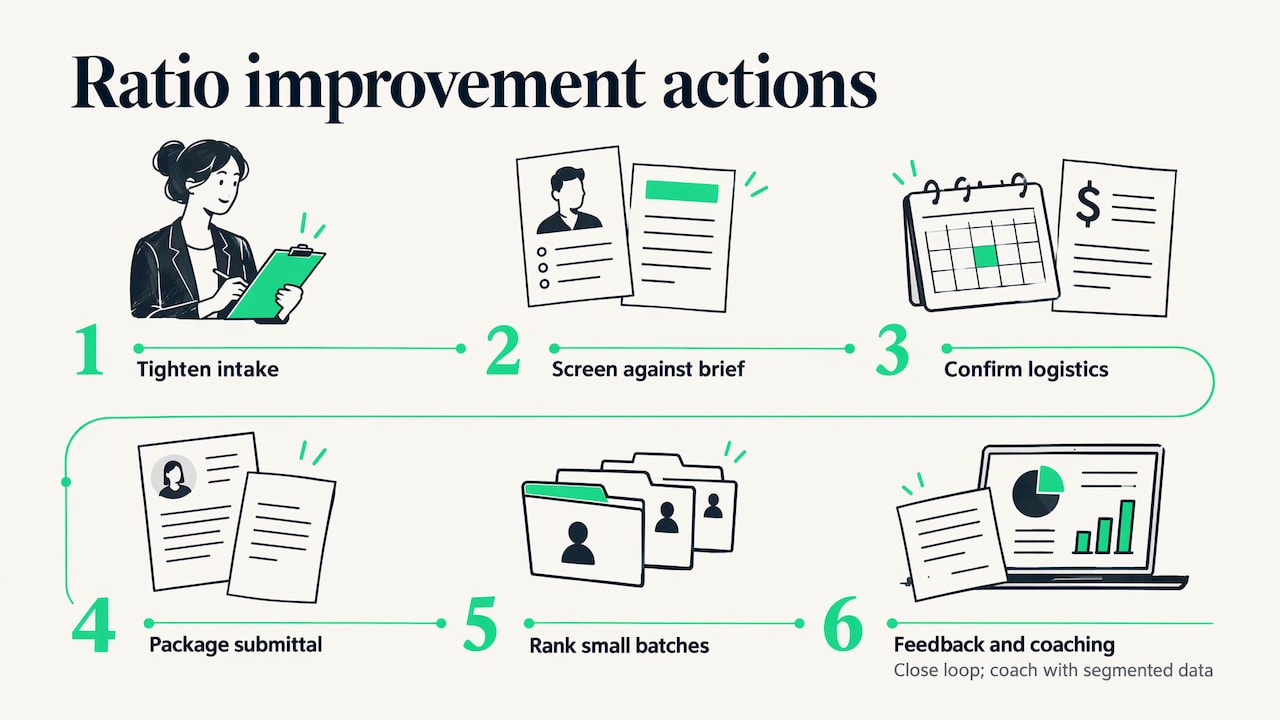
1. Tighten the intake
Before sourcing, agree with the client on three to five must-haves, the real deal-breakers, the compensation range and the interview process. Write them into the job record so every recruiter works from the same brief. Ask for a sample profile of someone the client would have interviewed. If a client cannot say what they want, share two contrasting profiles early and let their reaction define the brief.
2. Screen against the brief, not keywords
A keyword match tells you a term appears on a CV. It does not tell you whether the candidate used that technology in a comparable environment. Score each candidate against the must-haves and keep a written reason for every inclusion. Contextual scoring in an applicant tracking system can do the first pass and give you a percentage match, leaving the recruiter to judge the borderline cases.
3. Confirm the logistics before submitting
Check availability, notice period, rate or salary expectation, location and work authorization with the candidate first. Many wasted submittals fail on a fact the candidate could have confirmed in two minutes.
4. Package the submittal
Send a short write-up that maps the candidate to the client’s requirements in the client’s language, flags any gap honestly and says why the candidate is still worth meeting. Consistent, anonymized formatting also helps clients compare quickly.
5. Submit in small, ranked batches
Three strong profiles with a clear recommendation usually outperform ten unranked ones. Send the best first and the rest only if the client asks.
6. Close the feedback loop
When a client passes, ask one question: what was missing? Log the answer. After a few rounds you will know that client’s real filter, and your ratio with that client tends to improve over time, as new relationships generally do.
7. Coach with segmented data
Use the recruiter-level view to find who needs help with intake, who needs help with packaging and who is submitting too early. Compare each recruiter’s ratio to their own history and role mix, not to the team average alone.
Perspective: why the ratio is a data problem as much as a skill problem
We see the submittal to interview ratio as a symptom of how well information travels between the client, the recruiter and the candidate. When requirements live in an email thread, CVs live in folders and submittals live in a spreadsheet, nobody can say which part of the chain failed.
That is why we built Recruitify to keep the sales pipeline and the recruitment pipeline in one place. The client record, the job requirements, the candidate profile and the submittal sit together, so the question “why did this client pass?” has an answer you can find.
Our contextual matching AI is designed to look at relationships within a candidate’s tech stack and deliver a shortlist with a percentage match score, and our CV parser is designed to build a structured profile in about 3 seconds and flag duplicates. Both aim at the same outcome: fewer weak submittals and more of the strong ones reaching the client.
Our aim is for agencies to close more placements without growing the team, and a better submittal to interview ratio is one of the clearest early signs that this is happening.
Recruitify Team
Tracking the ratio inside your recruiting system
If you run an agency, an IT contracting firm or an internal team, the ratio is easiest to maintain when submittals are a native step rather than a manual note. Recruitify combines an ATS, a sales CRM and a contracting module, with recruitment projects that tie candidates to openings and custom reports for slicing results by recruiter, client and period. Teams placing developers can also look at our ATS for software houses.
Plans are €61 per user per month for HR Team and €67 per user per month for Agency, and Enterprise is priced on request. See the full plan comparison to choose the right tier.
To see how the pieces fit together, explore the all-in-one ATS and CRM and book a demo from the page.
FAQ
What is a good submittal to interview ratio?
Most published guidance puts it between 3:1 and 5:1, and some sources treat 2:1 to 3:1 as strong. Specialized technical roles usually run tighter, while high-volume roles run looser. Your own history with each client is the more useful benchmark.
Is a lower submittal to interview ratio always better?
Lower means fewer submittals per interview, which generally signals good matching. A ratio close to 1:1, however, can mean you are sending too few options for the client to compare. Aim for consistently strong matches with room for the client to choose.
How do I convert the ratio into a percentage?
Divide interviews by submittals and multiply by 100. With 12 interviews from 40 submittals, that is 30%, which is the same performance as 3.3 submittals per interview.
How long should I wait before measuring the ratio?
Use a lag window, because clients rarely respond on the day of submission. Many teams compare each month’s submittals with interviews booked over the following few weeks, and count first interviews only.
How is it different from an application-to-interview rate?
The application-to-interview rate measures your funnel from raw applicants, so it reflects job ads and market conditions. The submittal ratio starts after your screening and measures how well your shortlist matched what the client wanted.
Sources
WorkInSiders: Submittal to Interview Ratio Calculator and Formula
Staffingleads: How to calculate fill rate, time-to-fill and submission ratios
EZ Staffing Factoring: Key Recruiting Metrics for Staffing Firms to Monitor
Boolean Black Belt: Sourcing and Recruiting Candidate Funnel Output Calculators
Recommended
Track 5 Recruitment Funnel Metrics That Predict Hires for TA Teams
Shortlisting Criteria in Recruiting: How to Build a Fair Shortlist
Cut 70% Admin Time With AI Interview Scheduling for Enterprise HR


News & Updates
Stay up-to-date with the latest innovations, features, and tips about Recruitify!
By providing your email address within the newsletter sign-up form, you confirm its processing to send marketing information regarding the Administrator’s products and services. The Administrator of your personal data processed for the abovementioned purposes is Recruitify Spółka z o.o., based in Warsaw, Poland (KRS 0000709889). For more information on the principles of personal data processing and the rights of data subjects, please check the Privacy Policy.

Last updated:
Submittal to Interview Ratio: Formula, Benchmarks, Fixes
Recruitment Process
The Recruitify Team
The submittal to interview ratio tells you how many candidates you send to a client for each one who gets an interview. Divide candidates submitted by candidates interviewed: 40 submittals and 12 interviews give 3.3 to 1. Flip it (interviews ÷ submittals × 100) and you get a 30% interview rate. Most published benchmarks put a healthy range at roughly 3:1 to 5:1, and lower is better. Below you will find the exact counting rules, benchmarks by role type, the factors that move the number and a practical plan to improve it.
Key Takeaways
The ratio is candidates submitted ÷ candidates interviewed. Its mirror image, the interview rate, is interviews ÷ submittals × 100.
Published benchmarks cluster around 3:1 to 5:1, with specialized technical roles often tighter and high-volume roles looser.
The metric mostly reflects how well a recruiter understood the role and how clearly the client defined it, so fix intake before you fix sourcing.
Count each candidate-opening pair once and use one definition of “submitted” across the team, otherwise the number is not comparable.
Segment by recruiter, client, job type and period. An agency-wide average hides the real problem.
Table of Contents
What the submittal to interview ratio measures
A submittal is a candidate formally presented to a client or hiring manager, usually with a profile or write-up. The ratio compares those presentations with the interviews that follow. iReformat describes it as a measure of how many candidate submissions to clients result in interviews, with higher interview rates pointing to better candidate-job matching and stronger client relationships.
That is the difference from an applicant-to-interview rate. The applicant-to-interview rate sits at the top of the funnel and mostly describes your job ad, your screening and the market. The submittal-to-interview ratio sits after your screening. Every submittal is a claim to the client that this person fits, and the client’s decision to interview or pass is the first external verdict on that claim. This is why agencies, headhunters and IT contracting firms watch it closely: it is the earliest signal of whether your shortlist matches what the client actually wants.
You may also see it called the submit-to-interview ratio. It is the same metric.
How to calculate it
There are two ways to express the same data, and teams often mix them up.
Expression | Formula | Example (40 submittals, 12 interviews) |
|---|---|---|
Submittals per interview | Candidates submitted ÷ candidates interviewed | 40 ÷ 12 = 3.3 to 1 |
Interview rate (%) | Interviews ÷ submittals × 100 | 12 ÷ 40 × 100 = 30% |
Both versions appear in the WorkInSiders calculator and formula guide, which uses the same 40 and 12 example. Other sources write the formula as interviews ÷ submittals, which gives a decimal or percentage. Both are valid. Pick one for your reports and label it clearly, because “3.3” and “0.30” describe the same performance but read in opposite directions: for the first, lower is better, for the second, higher is better.
A worked example by recruiter
Imagine a four-person IT contracting team over one quarter.
Recruiter | Submittals | Interviews | Submittals per interview | Interview rate |
|---|---|---|---|---|
A | 24 | 10 | 2.4 | 42% |
B | 30 | 9 | 3.3 | 30% |
C | 36 | 8 | 4.5 | 22% |
D | 20 | 3 | 6.7 | 15% |
The team total is 110 submittals and 30 interviews, or 3.7 to 1. That looks acceptable. Yet recruiter D sends more than six profiles for each interview, and the average hides it. This is why segmentation matters, as covered below. The figures here are illustrative, not data from a real agency.
What counts as a submission and an interview
The ratio is only as honest as its definitions. Three rules keep it clean.
Define “submitted” once. A submittal is a candidate formally presented to the client with a profile or write-up. A name mentioned on a call, or a CV forwarded informally, is not the same event. WorkInSiders notes that inconsistent definitions of “submitted” can distort the ratio.
Count candidate-opening pairs once. Staffingleads defines the conversion as interviewed candidate-opening pairs divided by submitted candidate-opening pairs. A candidate who goes through three interview rounds for one job is one interview for this metric, not three. Counting rounds inflates conversion.
Count first interviews, and allow for lag. Count the candidates from this period’s submittals who were invited to a first interview, even if it happens in the next period. A client who takes a week to respond will make a Friday submittal look like a miss in a weekly report.
Keep numerator and denominator on the same population. If your submittal count includes every client but your interview count only includes clients that report back, the ratio will look better than reality. Where a client interviews without telling you, log it as soon as you learn of it.
Benchmarks: what is a good ratio?
Published figures vary, and they come from staffing-industry blogs rather than audited studies, so treat them as orientation, not a target handed down by the market.
The most common range is 3:1 to 5:1, meaning three to five submittals per interview.
One source calls one interview per two to three submittals a strong result.
The same iReformat guide gives context-specific ranges: technical or specialized roles often 2:1 to 3:1, general professional roles 3:1 to 5:1, and high-volume or commodity roles 5:1 to 8:1. New client relationships tend to start worse and improve over time.
Role type | Typical range | Why |
|---|---|---|
Technical / specialized | 2:1 to 3:1 | Few candidates qualify, so agencies send fewer, better-matched profiles |
General professional | 3:1 to 5:1 | More candidates qualify, clients compare more options |
High-volume / commodity | 5:1 to 8:1 | Many similar profiles, speed matters more than selectivity |
A very low ratio is not automatically a triumph. If nearly every submittal gets an interview, you may be submitting too few candidates, and a client with no alternatives to compare against can drag out a decision or fill the role elsewhere. Recruiting practitioners who share their own targets often aim for a ratio that leaves room for some passes. Use your own history by client and role type as the primary benchmark, and use industry ranges as a sanity check.
What moves the ratio
The ratio has three drivers: the candidate, the recruiter and the client. EZ Staffing Factoring says the metric reveals candidate quality, how effectively recruiters qualify, and how clear the client is about the job order requirements.
Recruiter-side factors
An incomplete intake: the recruiter did not learn what is truly mandatory versus nice to have.
Keyword-level screening that misses stack relationships, for example treating two frameworks as interchangeable when the client does not.
Weak packaging: a raw CV sent without a write-up that ties the candidate to the client’s requirements. A recruiting practitioner’s funnel guide lists not understanding the position and not packaging submittals effectively among the causes of a low selection rate.
Submitting to fill volume targets rather than to match the role.
Client-side factors
Hiring managers who are very selective or still undecided about what they need.
Slow feedback, which delays interviews and muddies the data.
A new relationship in which the client has not yet learned how you screen.
Candidate-side factors
Compensation, location or availability that was never confirmed before submission.
Duplicate submissions of a candidate already presented by another source.
Most of these are fixable on your side, which is the encouraging part. The same practitioner source also notes that clients sometimes pass on candidates who were genuinely strong, so a single miss is not a verdict. Watch the pattern over a period, not a single requisition.
How to track it across recruiters, clients and periods
An aggregate number answers “how are we doing?” but not “where do we act?”. iReformat recommends tracking the ratio by individual recruiter, client, job type and time period so that segmented data points to specific improvement opportunities.
A workable routine:
Log every submittal with the candidate, the opening, the client, the recruiter and the date.
Log the first-interview invitation against the same record, with its date.
Review monthly by recruiter and by client, and quarterly by job type.
Use a lag window, for example comparing a month’s submittals with interviews booked over the following two to three weeks.
Record pass reasons whenever the client gives them. A pattern such as “wants more cloud experience” is worth more than the ratio itself.
Spreadsheets can do this, but they break the moment two people record the same submittal differently. A recruiting system that ties the submittal to the job record and the client record removes that problem. Our own guides on recruiter productivity metrics and recruitment KPIs show how this metric fits next to the others, and application conversion rate covers the stage before submission.
How to improve the ratio without lowering quality
Improving the ratio does not mean submitting fewer people for the sake of the number. It means each submittal is better aimed. These steps work in order.
1. Tighten the intake
Before sourcing, agree with the client on three to five must-haves, the real deal-breakers, the compensation range and the interview process. Write them into the job record so every recruiter works from the same brief. Ask for a sample profile of someone the client would have interviewed. If a client cannot say what they want, share two contrasting profiles early and let their reaction define the brief.
2. Screen against the brief, not keywords
A keyword match tells you a term appears on a CV. It does not tell you whether the candidate used that technology in a comparable environment. Score each candidate against the must-haves and keep a written reason for every inclusion. Contextual scoring in an applicant tracking system can do the first pass and give you a percentage match, leaving the recruiter to judge the borderline cases.
3. Confirm the logistics before submitting
Check availability, notice period, rate or salary expectation, location and work authorization with the candidate first. Many wasted submittals fail on a fact the candidate could have confirmed in two minutes.
4. Package the submittal
Send a short write-up that maps the candidate to the client’s requirements in the client’s language, flags any gap honestly and says why the candidate is still worth meeting. Consistent, anonymized formatting also helps clients compare quickly.
5. Submit in small, ranked batches
Three strong profiles with a clear recommendation usually outperform ten unranked ones. Send the best first and the rest only if the client asks.
6. Close the feedback loop
When a client passes, ask one question: what was missing? Log the answer. After a few rounds you will know that client’s real filter, and your ratio with that client tends to improve over time, as new relationships generally do.
7. Coach with segmented data
Use the recruiter-level view to find who needs help with intake, who needs help with packaging and who is submitting too early. Compare each recruiter’s ratio to their own history and role mix, not to the team average alone.
Perspective: why the ratio is a data problem as much as a skill problem
We see the submittal to interview ratio as a symptom of how well information travels between the client, the recruiter and the candidate. When requirements live in an email thread, CVs live in folders and submittals live in a spreadsheet, nobody can say which part of the chain failed.
That is why we built Recruitify to keep the sales pipeline and the recruitment pipeline in one place. The client record, the job requirements, the candidate profile and the submittal sit together, so the question “why did this client pass?” has an answer you can find.
Our contextual matching AI is designed to look at relationships within a candidate’s tech stack and deliver a shortlist with a percentage match score, and our CV parser is designed to build a structured profile in about 3 seconds and flag duplicates. Both aim at the same outcome: fewer weak submittals and more of the strong ones reaching the client.
Our aim is for agencies to close more placements without growing the team, and a better submittal to interview ratio is one of the clearest early signs that this is happening.
Recruitify Team
Tracking the ratio inside your recruiting system
If you run an agency, an IT contracting firm or an internal team, the ratio is easiest to maintain when submittals are a native step rather than a manual note. Recruitify combines an ATS, a sales CRM and a contracting module, with recruitment projects that tie candidates to openings and custom reports for slicing results by recruiter, client and period. Teams placing developers can also look at our ATS for software houses.
Plans are €61 per user per month for HR Team and €67 per user per month for Agency, and Enterprise is priced on request. See the full plan comparison to choose the right tier.
To see how the pieces fit together, explore the all-in-one ATS and CRM and book a demo from the page.
FAQ
What is a good submittal to interview ratio?
Most published guidance puts it between 3:1 and 5:1, and some sources treat 2:1 to 3:1 as strong. Specialized technical roles usually run tighter, while high-volume roles run looser. Your own history with each client is the more useful benchmark.
Is a lower submittal to interview ratio always better?
Lower means fewer submittals per interview, which generally signals good matching. A ratio close to 1:1, however, can mean you are sending too few options for the client to compare. Aim for consistently strong matches with room for the client to choose.
How do I convert the ratio into a percentage?
Divide interviews by submittals and multiply by 100. With 12 interviews from 40 submittals, that is 30%, which is the same performance as 3.3 submittals per interview.
How long should I wait before measuring the ratio?
Use a lag window, because clients rarely respond on the day of submission. Many teams compare each month’s submittals with interviews booked over the following few weeks, and count first interviews only.
How is it different from an application-to-interview rate?
The application-to-interview rate measures your funnel from raw applicants, so it reflects job ads and market conditions. The submittal ratio starts after your screening and measures how well your shortlist matched what the client wanted.
Sources
WorkInSiders: Submittal to Interview Ratio Calculator and Formula
Staffingleads: How to calculate fill rate, time-to-fill and submission ratios
EZ Staffing Factoring: Key Recruiting Metrics for Staffing Firms to Monitor
Boolean Black Belt: Sourcing and Recruiting Candidate Funnel Output Calculators
Recommended
Track 5 Recruitment Funnel Metrics That Predict Hires for TA Teams
Shortlisting Criteria in Recruiting: How to Build a Fair Shortlist
Cut 70% Admin Time With AI Interview Scheduling for Enterprise HR
News & Updates
Stay up-to-date with the latest innovations, features, and tips about Recruitify!
By providing your email address within the newsletter sign-up form, you confirm its processing to send marketing information regarding the Administrator’s products and services. The Administrator of your personal data processed for the abovementioned purposes is Recruitify Spółka z o.o., based in Warsaw, Poland (KRS 0000709889). For more information on the principles of personal data processing and the rights of data subjects, please check the Privacy Policy.

Discover More

Applicant Tracking System
Staffing Sales Pipeline: Stages, Metrics and Automation
Build a staffing sales pipeline that turns target accounts into active job orders: stages, entry rules, metrics and how ATS and CRM automation keep it moving.
8 Nov 2026
Discover More

Recruitment Process
Recruitment Kanban: Build a Pipeline Board That Keeps Candidates Moving
How to build a recruitment Kanban board: pipeline stages, WIP limits, ownership, pipeline velocity and health metrics, plus how automation keeps the data reliable.
7 Nov 2026
Discover More

Innovations
Audit Trail in Recruiting: What to Log, Keep and Prove
A recruiting audit trail records who did what to which candidate record, and when. See what to log, how long to keep it, and what GDPR and US rules expect.
6 Nov 2026
Discover More
Applicant Tracking System
Staffing Sales Pipeline: Stages, Metrics and Automation
Build a staffing sales pipeline that turns target accounts into active job orders: stages, entry rules, metrics and how ATS and CRM automation keep it moving.
8 Nov 2026
Discover More
Recruitment Process
Recruitment Kanban: Build a Pipeline Board That Keeps Candidates Moving
How to build a recruitment Kanban board: pipeline stages, WIP limits, ownership, pipeline velocity and health metrics, plus how automation keeps the data reliable.
7 Nov 2026
Discover More