
Last updated:
Recruiters: AI Ready, GDPR Safe Candidate Communication Automation

Recruitment Process

The Recruitify Team
Candidate communication automation scales personalized outreach, speeds up interview scheduling, and removes the repetitive messaging that eats a recruiter’s day. Teams that deploy it well see measurable gains: fewer hours spent on manual follow-up, higher reply and show rates, and fewer candidates lost to silence between stages. The question is not whether to automate, but which touchpoints to automate first. The next section breaks that down.
TL;DR:
Automating initial communication tasks can significantly reduce manual follow-up time and improve candidate response rates, especially when paired with AI-driven shortlisting.
Priority automation channels include email for detailed communication, SMS for quick reminders, and chatbots for repetitive FAQs, while sensitive conversations should remain manual.
Implementing automation successfully requires mapping the candidate journey, starting with high-volume roles, and piloting before expanding to other positions, with proper compliance measures in place.
Over-automating and neglecting consent are the most common pitfalls; starting small and measuring effectiveness helps ensure the process remains compliant and impactful.
Recruitify offers integrated tools for parsing, matching, and compliance, enabling a smoother rollout of automation with transparent pricing and support for both internal teams and agencies.
RecruitifyBring Recruitment Automation TogetherRecruitify combines ATS, Sales CRM, AI matching, and GDPR consent management in one operational ecosystem for recruitment teams.Explore Recruitify
Table of Contents
What candidate communication automation actually covers
The measurable benefits recruiters report
Which channels and features actually move the needle
Building the rollout: a step-by-step roadmap
Keeping outreach compliant and candidate trust intact
The metrics that tell you whether it is working
How Recruitify’s platform applies these principles
A 30 to 90 day checklist to start now
What most teams get wrong about automation
A faster way to put this playbook into practice
Sources
FAQ
What candidate communication automation actually covers
Candidate communication automation refers to software that sends, schedules, and manages candidate-facing messages using predefined templates, triggers, and logic rather than manual typing for every touchpoint. It includes tools like scheduling links, two-way SMS or chat, template email sequences, and conditional triggers that fire based on a candidate’s stage in the pipeline. The goal is not to replace recruiter judgment, but to remove the mechanical parts of staying in touch.
Most agencies and HR teams apply it across a handful of recurring moments in the hiring flow:
Application acknowledgment, sent the moment a candidate applies.
Screening status updates, including rejections handled with care.
Interview invitations, confirmations, and reminders.
Offer-stage communications and scheduling for final steps.
Onboarding handoffs once an offer is accepted.
It is worth separating communication automation from full hiring automation. Screening engines and decision automation (deciding who advances) are a different category, with different risk profiles. Communication automation handles the logistics and touchpoints; it does not decide who gets hired. Keeping that line clear matters both operationally and legally, since automated decision-making carries its own compliance obligations that automated messaging does not.
The measurable benefits recruiters report
The most immediate benefit is time. Recruiters spend a large share of a typical week on scheduling, status updates, and reminder messages that follow the same pattern every time. Automating those sequences frees that time for sourcing, interviewing, and client or hiring-manager conversations, and the effect compounds as requisition volume grows: a team hiring for five roles saves modestly, a team hiring for fifty saves substantially more per recruiter hour.
Engagement metrics tend to move in a predictable direction once automated reminders and scheduling links replace manual back-and-forth. Candidates respond faster when a scheduling link arrives within minutes of an application instead of days later, and interview show rates generally improve when automated reminders land 24 and 2 hours before a scheduled call. Those gains multiply when communication automation is paired with AI-driven shortlisting, since recruiters spend less time coordinating and more time with the candidates most likely to be a fit.
Candidate experience benefits follow closely behind. Phenom’s 2025 State of Candidate Experience report found that many Fortune 500 career sites still fail to apply AI and automation for personalized candidate journeys, even as younger candidates increasingly expect the kind of tailored, responsive experience they get from consumer apps.
Many Fortune 500 companies still fall short in applying AI and automation to personalize the candidate experience, according to Phenom’s 2025 benchmark, which means teams that get this right early have room to stand out.
Automation is not the right tool everywhere. Sensitive conversations, like counteroffers, final negotiations, or delivering a layoff-related rejection, still call for a human voice and should stay manual.
Which channels and features actually move the needle
Not every channel deserves the same investment. Email remains the backbone for longer, detailed messages such as interview prep guides or offer letters, and it scales cheaply. SMS gets opened far faster than email in most cases, which makes it ideal for reminders and time-sensitive scheduling, but it is more consent-sensitive and needs explicit opt-in. Chatbots handle repetitive questions (application status, job details, basic FAQs) around the clock without tying up a recruiter. Phone still matters for high-touch moments: final interviews, offer calls, and anything emotionally charged.
Before building out workflows, prioritize features that deliver value quickly:
Templates with personalization tokens (name, role, recruiter, next step).
Conditional triggers that route different messages based on candidate stage or source.
Calendar links with two-way scheduling, so candidates pick a slot without a phone tag.
Analytics on open rates, reply rates, and drop-off points by stage.
On the AI side, three capabilities are worth evaluating closely: contextual matching that scores candidates against a role’s actual requirements rather than keyword overlap, resume parsing that builds a structured profile in seconds instead of manual data entry, and auto-screening responses that flag obvious mismatches early so recruiters do not spend time scheduling interviews that will not go anywhere. These features work best layered on top of solid communication workflows, not as a replacement for them.
Building the rollout: a step-by-step roadmap
A successful rollout starts narrow and expands once the fundamentals work. Trying to automate every touchpoint across every role in week one tends to produce brittle workflows and confused candidates.
Map the full candidate journey and identify the two or three highest-value touchpoints to automate first, typically application acknowledgment and interview scheduling.
Segment candidate types (entry-level, specialized technical roles, executive search) and write persona-driven templates for each, since a generic message reads as generic.
Define the trigger logic: who receives which message, at what stage, and after how long. A candidate who has not responded in 48 hours needs a different message than one who just applied.
Integrate the automation with your ATS, calendar, and sourcing tools so candidate data flows in one direction without duplicate records or missed updates.
Pilot the workflow with a single role or team for two to four weeks, track the core metrics, and adjust templates and triggers based on what the data shows.
Expand to additional roles and teams once the pilot numbers hold up, keeping the same measurement discipline at each stage.
Build in rollout controls from the start: a human override on any message before it sends in sensitive situations, throttles that cap how many automated messages a candidate receives in a short window, and a clear escalation path when a candidate replies with a question the automation cannot answer.
Pro Tip: Start your pilot with the role that has the highest application volume and the most repetitive messaging, not your hardest-to-fill role. The volume gives you faster, more reliable data.
Keeping outreach compliant and candidate trust intact
Automated outreach touches personal data, which means privacy rules apply from the first message. Under GDPR, recruiters need a documented lawful basis for contacting candidates, whether that is consent or legitimate interest, and legitimate interest specifically requires a documented balancing test rather than an assumption that reaching out is fine by default. GDPR enforcement data shows that organizations face real financial and operational risk when they cannot show a lawful basis or maintain a clear audit trail for how candidate data was collected and used.

GDPR fines for mishandling personal data, including candidate records, have reached levels that make compliance a board-level concern, not just an HR task, per DataGuard’s enforcement guidance.
In the United States, SMS outreach often falls under TCPA-style rules that require express written consent before a candidate can be texted, along with an immediate opt-out mechanism such as a “Reply STOP” instruction. A few operational habits keep most teams on solid ground:
Capture explicit opt-in before adding any candidate to an SMS workflow.
Provide a working, immediate opt-out on every automated text.
Log the source and date of every candidate record, not just the content of the message.
Set a data retention policy so old candidate records do not sit indefinitely without a documented reason.
None of this requires a legal department to execute day to day, but it does require building these checks into the workflow rather than treating them as an afterthought.
The metrics that tell you whether it is working
A short list of meaningful metrics beats a dashboard full of vanity numbers. SHRM’s research on candidate experience points toward measuring outcomes recruiters can actually act on, rather than tracking everything that happens to be easy to count.
At the candidate level, watch open rate, reply rate, time-to-first-response, and interview show rate, since these tell you whether messages are landing and candidates are engaging. At the process level, track time saved per requisition, interviews scheduled per recruiter, and overall time-to-hire, which show whether the automation is actually reducing workload rather than just shifting it.
Quality signals worth tracking include offer acceptance rate and candidate satisfaction feedback, since fast responses mean little if the experience feels impersonal.
Run A/B tests on templates and channels (subject lines, SMS versus email for reminders) rather than guessing which version performs better.
Set a baseline before the pilot starts so improvement is measurable, not assumed.
How Recruitify’s platform applies these principles
Recruitify was built around the same priorities this guide outlines: fast data capture, smart matching, and compliance baked into the workflow rather than bolted on afterward. The platform’s AI CV Parser extracts structured candidate data from PDFs, scans, or photos in about three seconds and automatically flags duplicates, which removes one of the slowest manual steps in the candidate journey. Its Contextual Matching AI scores applications against actual role requirements and produces ready-made shortlists with a percentage match, so recruiters spend less time filtering and more time communicating with the right candidates.
Workflow automation covers the full path from first contact to contract generation, cutting repetitive admin significantly.
The GDPR consent management module maintains a full audit trail, with digital proof for every candidate record.
Database monetization tools help agencies re-engage candidates already in their system rather than sourcing from scratch.
A unified recruitment CRM keeps sales and recruiting pipelines in one view, which supports consistent, timely candidate follow-up across both sides of the business.
These modules are designed to support the exact roadmap described above: faster parsing feeds better segmentation, matching scores inform trigger logic, and the audit trail keeps outreach defensible.
A 30 to 90 day checklist to start now
A phased rollout keeps risk low while building internal confidence in the system.
Days 1 to 7: map the candidate journey for one pilot role and draft three to five message templates covering acknowledgment, screening, and interview invitations.
Weeks 2 to 4: connect the ATS and calendar integrations, capture consent properly, and run a two-week pilot with real candidates.
Months 2 to 3: review the KPIs from the pilot, refine templates based on reply and show rates, then expand to additional roles and add SMS or chat if consent requirements are met.
Success looks like measurable time savings and steady or improving reply rates. If a template underperforms after two cycles, rewrite it rather than waiting for it to improve on its own.
What most teams get wrong about automation
The biggest mistake is not under-automating, it is over-automating too quickly, stacking generic templates onto every stage without checking whether candidates actually respond to them. A close second is treating consent as paperwork rather than infrastructure, which creates legal exposure later. The teams that succeed start with one or two touchpoints, measure honestly, and only add automation where the data shows it helps rather than where it is simply possible.
- Recruitify Team
A faster way to put this playbook into practice
Recruitify brings the matching, parsing, and compliance tools this guide recommends into one system, so agencies and HR teams can automate candidate communication without stitching together separate tools.
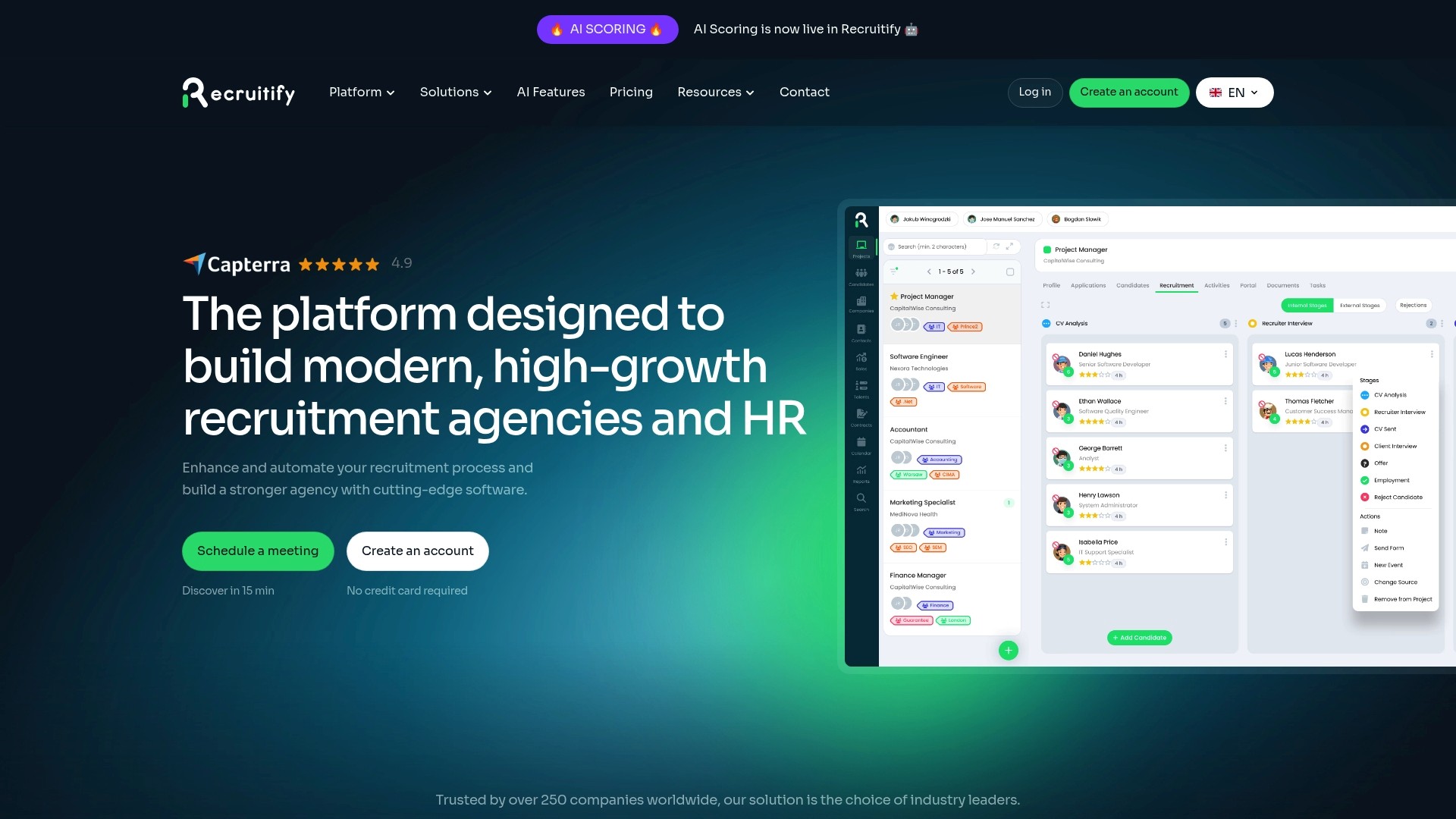
The HR Team plan runs 69 EUR per month per user, built for internal hiring teams.
The Recruitment Agencies plan runs 79 EUR per month per user, built for agencies managing multiple client pipelines.
Enterprise pricing is available on request for larger deployments.
Check Recruitify’s pricing page to compare plans and start a pilot with your own candidate data.
Sources
FAQ
What are the top ATS systems recruiters use?
There is no single official ranking of top ATS systems, and the right choice depends on team size, budget, and whether recruiters need built-in CRM or contracting features alongside core applicant tracking. Agencies evaluating options typically compare platforms on automation depth, integration support, and compliance tools rather than brand recognition alone.
What is the 70/30 rule in hiring?
Definitions of informal rules about time allocation vary across recruiting teams, and these are not standardized industry terms with fixed meanings. Some teams use such informal guidelines to describe splitting time between sourcing and administrative tasks, which is part of why communication automation appeals to teams trying to shift that balance.
What is candidate communication automation?
It is software that sends, schedules, and manages candidate-facing messages, such as application acknowledgments, interview invitations, and reminders, using templates and triggers instead of manual typing. It covers email, SMS, chatbots, and scheduling tools, and it typically integrates with an ATS or recruitment CRM to keep candidate data current.
What is the 80/20 rule in recruiting?
Like other informal rules, some recruiting teams refer to heuristics that suggest a small share of effort or candidates drives most hiring outcomes. These are used inconsistently rather than as fixed standards, and are not benchmarks with single documented sources, so treat them as rules of thumb rather than precise metrics to report on.
Is automated candidate messaging compliant with GDPR?
It can be, provided the organization documents a lawful basis for contacting candidates, maintains an audit trail of consent and data sources, and allows candidates to be forgotten or removed on request. GDPR enforcement guidance shows that missing documentation, not automation itself, is what creates legal risk.
Recommended


News & Updates
Stay up-to-date with the latest innovations, features, and tips about Recruitify!
By providing your email address within the newsletter sign-up form, you confirm its processing to send marketing information regarding the Administrator’s products and services. The Administrator of your personal data processed for the abovementioned purposes is Recruitify Spółka z o.o., based in Warsaw, Poland (KRS 0000709889). For more information on the principles of personal data processing and the rights of data subjects, please check the Privacy Policy.

Last updated:
Recruiters: AI Ready, GDPR Safe Candidate Communication Automation
Recruitment Process
The Recruitify Team
Candidate communication automation scales personalized outreach, speeds up interview scheduling, and removes the repetitive messaging that eats a recruiter’s day. Teams that deploy it well see measurable gains: fewer hours spent on manual follow-up, higher reply and show rates, and fewer candidates lost to silence between stages. The question is not whether to automate, but which touchpoints to automate first. The next section breaks that down.
TL;DR:
Automating initial communication tasks can significantly reduce manual follow-up time and improve candidate response rates, especially when paired with AI-driven shortlisting.
Priority automation channels include email for detailed communication, SMS for quick reminders, and chatbots for repetitive FAQs, while sensitive conversations should remain manual.
Implementing automation successfully requires mapping the candidate journey, starting with high-volume roles, and piloting before expanding to other positions, with proper compliance measures in place.
Over-automating and neglecting consent are the most common pitfalls; starting small and measuring effectiveness helps ensure the process remains compliant and impactful.
Recruitify offers integrated tools for parsing, matching, and compliance, enabling a smoother rollout of automation with transparent pricing and support for both internal teams and agencies.
RecruitifyBring Recruitment Automation TogetherRecruitify combines ATS, Sales CRM, AI matching, and GDPR consent management in one operational ecosystem for recruitment teams.Explore Recruitify
Table of Contents
What candidate communication automation actually covers
The measurable benefits recruiters report
Which channels and features actually move the needle
Building the rollout: a step-by-step roadmap
Keeping outreach compliant and candidate trust intact
The metrics that tell you whether it is working
How Recruitify’s platform applies these principles
A 30 to 90 day checklist to start now
What most teams get wrong about automation
A faster way to put this playbook into practice
Sources
FAQ
What candidate communication automation actually covers
Candidate communication automation refers to software that sends, schedules, and manages candidate-facing messages using predefined templates, triggers, and logic rather than manual typing for every touchpoint. It includes tools like scheduling links, two-way SMS or chat, template email sequences, and conditional triggers that fire based on a candidate’s stage in the pipeline. The goal is not to replace recruiter judgment, but to remove the mechanical parts of staying in touch.
Most agencies and HR teams apply it across a handful of recurring moments in the hiring flow:
Application acknowledgment, sent the moment a candidate applies.
Screening status updates, including rejections handled with care.
Interview invitations, confirmations, and reminders.
Offer-stage communications and scheduling for final steps.
Onboarding handoffs once an offer is accepted.
It is worth separating communication automation from full hiring automation. Screening engines and decision automation (deciding who advances) are a different category, with different risk profiles. Communication automation handles the logistics and touchpoints; it does not decide who gets hired. Keeping that line clear matters both operationally and legally, since automated decision-making carries its own compliance obligations that automated messaging does not.
The measurable benefits recruiters report
The most immediate benefit is time. Recruiters spend a large share of a typical week on scheduling, status updates, and reminder messages that follow the same pattern every time. Automating those sequences frees that time for sourcing, interviewing, and client or hiring-manager conversations, and the effect compounds as requisition volume grows: a team hiring for five roles saves modestly, a team hiring for fifty saves substantially more per recruiter hour.
Engagement metrics tend to move in a predictable direction once automated reminders and scheduling links replace manual back-and-forth. Candidates respond faster when a scheduling link arrives within minutes of an application instead of days later, and interview show rates generally improve when automated reminders land 24 and 2 hours before a scheduled call. Those gains multiply when communication automation is paired with AI-driven shortlisting, since recruiters spend less time coordinating and more time with the candidates most likely to be a fit.
Candidate experience benefits follow closely behind. Phenom’s 2025 State of Candidate Experience report found that many Fortune 500 career sites still fail to apply AI and automation for personalized candidate journeys, even as younger candidates increasingly expect the kind of tailored, responsive experience they get from consumer apps.
Many Fortune 500 companies still fall short in applying AI and automation to personalize the candidate experience, according to Phenom’s 2025 benchmark, which means teams that get this right early have room to stand out.
Automation is not the right tool everywhere. Sensitive conversations, like counteroffers, final negotiations, or delivering a layoff-related rejection, still call for a human voice and should stay manual.
Which channels and features actually move the needle
Not every channel deserves the same investment. Email remains the backbone for longer, detailed messages such as interview prep guides or offer letters, and it scales cheaply. SMS gets opened far faster than email in most cases, which makes it ideal for reminders and time-sensitive scheduling, but it is more consent-sensitive and needs explicit opt-in. Chatbots handle repetitive questions (application status, job details, basic FAQs) around the clock without tying up a recruiter. Phone still matters for high-touch moments: final interviews, offer calls, and anything emotionally charged.
Before building out workflows, prioritize features that deliver value quickly:
Templates with personalization tokens (name, role, recruiter, next step).
Conditional triggers that route different messages based on candidate stage or source.
Calendar links with two-way scheduling, so candidates pick a slot without a phone tag.
Analytics on open rates, reply rates, and drop-off points by stage.
On the AI side, three capabilities are worth evaluating closely: contextual matching that scores candidates against a role’s actual requirements rather than keyword overlap, resume parsing that builds a structured profile in seconds instead of manual data entry, and auto-screening responses that flag obvious mismatches early so recruiters do not spend time scheduling interviews that will not go anywhere. These features work best layered on top of solid communication workflows, not as a replacement for them.
Building the rollout: a step-by-step roadmap
A successful rollout starts narrow and expands once the fundamentals work. Trying to automate every touchpoint across every role in week one tends to produce brittle workflows and confused candidates.
Map the full candidate journey and identify the two or three highest-value touchpoints to automate first, typically application acknowledgment and interview scheduling.
Segment candidate types (entry-level, specialized technical roles, executive search) and write persona-driven templates for each, since a generic message reads as generic.
Define the trigger logic: who receives which message, at what stage, and after how long. A candidate who has not responded in 48 hours needs a different message than one who just applied.
Integrate the automation with your ATS, calendar, and sourcing tools so candidate data flows in one direction without duplicate records or missed updates.
Pilot the workflow with a single role or team for two to four weeks, track the core metrics, and adjust templates and triggers based on what the data shows.
Expand to additional roles and teams once the pilot numbers hold up, keeping the same measurement discipline at each stage.
Build in rollout controls from the start: a human override on any message before it sends in sensitive situations, throttles that cap how many automated messages a candidate receives in a short window, and a clear escalation path when a candidate replies with a question the automation cannot answer.
Pro Tip: Start your pilot with the role that has the highest application volume and the most repetitive messaging, not your hardest-to-fill role. The volume gives you faster, more reliable data.
Keeping outreach compliant and candidate trust intact
Automated outreach touches personal data, which means privacy rules apply from the first message. Under GDPR, recruiters need a documented lawful basis for contacting candidates, whether that is consent or legitimate interest, and legitimate interest specifically requires a documented balancing test rather than an assumption that reaching out is fine by default. GDPR enforcement data shows that organizations face real financial and operational risk when they cannot show a lawful basis or maintain a clear audit trail for how candidate data was collected and used.
GDPR fines for mishandling personal data, including candidate records, have reached levels that make compliance a board-level concern, not just an HR task, per DataGuard’s enforcement guidance.
In the United States, SMS outreach often falls under TCPA-style rules that require express written consent before a candidate can be texted, along with an immediate opt-out mechanism such as a “Reply STOP” instruction. A few operational habits keep most teams on solid ground:
Capture explicit opt-in before adding any candidate to an SMS workflow.
Provide a working, immediate opt-out on every automated text.
Log the source and date of every candidate record, not just the content of the message.
Set a data retention policy so old candidate records do not sit indefinitely without a documented reason.
None of this requires a legal department to execute day to day, but it does require building these checks into the workflow rather than treating them as an afterthought.
The metrics that tell you whether it is working
A short list of meaningful metrics beats a dashboard full of vanity numbers. SHRM’s research on candidate experience points toward measuring outcomes recruiters can actually act on, rather than tracking everything that happens to be easy to count.
At the candidate level, watch open rate, reply rate, time-to-first-response, and interview show rate, since these tell you whether messages are landing and candidates are engaging. At the process level, track time saved per requisition, interviews scheduled per recruiter, and overall time-to-hire, which show whether the automation is actually reducing workload rather than just shifting it.
Quality signals worth tracking include offer acceptance rate and candidate satisfaction feedback, since fast responses mean little if the experience feels impersonal.
Run A/B tests on templates and channels (subject lines, SMS versus email for reminders) rather than guessing which version performs better.
Set a baseline before the pilot starts so improvement is measurable, not assumed.
How Recruitify’s platform applies these principles
Recruitify was built around the same priorities this guide outlines: fast data capture, smart matching, and compliance baked into the workflow rather than bolted on afterward. The platform’s AI CV Parser extracts structured candidate data from PDFs, scans, or photos in about three seconds and automatically flags duplicates, which removes one of the slowest manual steps in the candidate journey. Its Contextual Matching AI scores applications against actual role requirements and produces ready-made shortlists with a percentage match, so recruiters spend less time filtering and more time communicating with the right candidates.
Workflow automation covers the full path from first contact to contract generation, cutting repetitive admin significantly.
The GDPR consent management module maintains a full audit trail, with digital proof for every candidate record.
Database monetization tools help agencies re-engage candidates already in their system rather than sourcing from scratch.
A unified recruitment CRM keeps sales and recruiting pipelines in one view, which supports consistent, timely candidate follow-up across both sides of the business.
These modules are designed to support the exact roadmap described above: faster parsing feeds better segmentation, matching scores inform trigger logic, and the audit trail keeps outreach defensible.
A 30 to 90 day checklist to start now
A phased rollout keeps risk low while building internal confidence in the system.
Days 1 to 7: map the candidate journey for one pilot role and draft three to five message templates covering acknowledgment, screening, and interview invitations.
Weeks 2 to 4: connect the ATS and calendar integrations, capture consent properly, and run a two-week pilot with real candidates.
Months 2 to 3: review the KPIs from the pilot, refine templates based on reply and show rates, then expand to additional roles and add SMS or chat if consent requirements are met.
Success looks like measurable time savings and steady or improving reply rates. If a template underperforms after two cycles, rewrite it rather than waiting for it to improve on its own.
What most teams get wrong about automation
The biggest mistake is not under-automating, it is over-automating too quickly, stacking generic templates onto every stage without checking whether candidates actually respond to them. A close second is treating consent as paperwork rather than infrastructure, which creates legal exposure later. The teams that succeed start with one or two touchpoints, measure honestly, and only add automation where the data shows it helps rather than where it is simply possible.
- Recruitify Team
A faster way to put this playbook into practice
Recruitify brings the matching, parsing, and compliance tools this guide recommends into one system, so agencies and HR teams can automate candidate communication without stitching together separate tools.
The HR Team plan runs 69 EUR per month per user, built for internal hiring teams.
The Recruitment Agencies plan runs 79 EUR per month per user, built for agencies managing multiple client pipelines.
Enterprise pricing is available on request for larger deployments.
Check Recruitify’s pricing page to compare plans and start a pilot with your own candidate data.
Sources
FAQ
What are the top ATS systems recruiters use?
There is no single official ranking of top ATS systems, and the right choice depends on team size, budget, and whether recruiters need built-in CRM or contracting features alongside core applicant tracking. Agencies evaluating options typically compare platforms on automation depth, integration support, and compliance tools rather than brand recognition alone.
What is the 70/30 rule in hiring?
Definitions of informal rules about time allocation vary across recruiting teams, and these are not standardized industry terms with fixed meanings. Some teams use such informal guidelines to describe splitting time between sourcing and administrative tasks, which is part of why communication automation appeals to teams trying to shift that balance.
What is candidate communication automation?
It is software that sends, schedules, and manages candidate-facing messages, such as application acknowledgments, interview invitations, and reminders, using templates and triggers instead of manual typing. It covers email, SMS, chatbots, and scheduling tools, and it typically integrates with an ATS or recruitment CRM to keep candidate data current.
What is the 80/20 rule in recruiting?
Like other informal rules, some recruiting teams refer to heuristics that suggest a small share of effort or candidates drives most hiring outcomes. These are used inconsistently rather than as fixed standards, and are not benchmarks with single documented sources, so treat them as rules of thumb rather than precise metrics to report on.
Is automated candidate messaging compliant with GDPR?
It can be, provided the organization documents a lawful basis for contacting candidates, maintains an audit trail of consent and data sources, and allows candidates to be forgotten or removed on request. GDPR enforcement guidance shows that missing documentation, not automation itself, is what creates legal risk.
Recommended
News & Updates
Stay up-to-date with the latest innovations, features, and tips about Recruitify!
By providing your email address within the newsletter sign-up form, you confirm its processing to send marketing information regarding the Administrator’s products and services. The Administrator of your personal data processed for the abovementioned purposes is Recruitify Spółka z o.o., based in Warsaw, Poland (KRS 0000709889). For more information on the principles of personal data processing and the rights of data subjects, please check the Privacy Policy.
Last updated:
Recruiters: AI Ready, GDPR Safe Candidate Communication Automation
Recruitment Process
The Recruitify Team
Candidate communication automation scales personalized outreach, speeds up interview scheduling, and removes the repetitive messaging that eats a recruiter’s day. Teams that deploy it well see measurable gains: fewer hours spent on manual follow-up, higher reply and show rates, and fewer candidates lost to silence between stages. The question is not whether to automate, but which touchpoints to automate first. The next section breaks that down.
TL;DR:
Automating initial communication tasks can significantly reduce manual follow-up time and improve candidate response rates, especially when paired with AI-driven shortlisting.
Priority automation channels include email for detailed communication, SMS for quick reminders, and chatbots for repetitive FAQs, while sensitive conversations should remain manual.
Implementing automation successfully requires mapping the candidate journey, starting with high-volume roles, and piloting before expanding to other positions, with proper compliance measures in place.
Over-automating and neglecting consent are the most common pitfalls; starting small and measuring effectiveness helps ensure the process remains compliant and impactful.
Recruitify offers integrated tools for parsing, matching, and compliance, enabling a smoother rollout of automation with transparent pricing and support for both internal teams and agencies.
RecruitifyBring Recruitment Automation TogetherRecruitify combines ATS, Sales CRM, AI matching, and GDPR consent management in one operational ecosystem for recruitment teams.Explore Recruitify
Table of Contents
What candidate communication automation actually covers
The measurable benefits recruiters report
Which channels and features actually move the needle
Building the rollout: a step-by-step roadmap
Keeping outreach compliant and candidate trust intact
The metrics that tell you whether it is working
How Recruitify’s platform applies these principles
A 30 to 90 day checklist to start now
What most teams get wrong about automation
A faster way to put this playbook into practice
Sources
FAQ
What candidate communication automation actually covers
Candidate communication automation refers to software that sends, schedules, and manages candidate-facing messages using predefined templates, triggers, and logic rather than manual typing for every touchpoint. It includes tools like scheduling links, two-way SMS or chat, template email sequences, and conditional triggers that fire based on a candidate’s stage in the pipeline. The goal is not to replace recruiter judgment, but to remove the mechanical parts of staying in touch.
Most agencies and HR teams apply it across a handful of recurring moments in the hiring flow:
Application acknowledgment, sent the moment a candidate applies.
Screening status updates, including rejections handled with care.
Interview invitations, confirmations, and reminders.
Offer-stage communications and scheduling for final steps.
Onboarding handoffs once an offer is accepted.
It is worth separating communication automation from full hiring automation. Screening engines and decision automation (deciding who advances) are a different category, with different risk profiles. Communication automation handles the logistics and touchpoints; it does not decide who gets hired. Keeping that line clear matters both operationally and legally, since automated decision-making carries its own compliance obligations that automated messaging does not.
The measurable benefits recruiters report
The most immediate benefit is time. Recruiters spend a large share of a typical week on scheduling, status updates, and reminder messages that follow the same pattern every time. Automating those sequences frees that time for sourcing, interviewing, and client or hiring-manager conversations, and the effect compounds as requisition volume grows: a team hiring for five roles saves modestly, a team hiring for fifty saves substantially more per recruiter hour.
Engagement metrics tend to move in a predictable direction once automated reminders and scheduling links replace manual back-and-forth. Candidates respond faster when a scheduling link arrives within minutes of an application instead of days later, and interview show rates generally improve when automated reminders land 24 and 2 hours before a scheduled call. Those gains multiply when communication automation is paired with AI-driven shortlisting, since recruiters spend less time coordinating and more time with the candidates most likely to be a fit.
Candidate experience benefits follow closely behind. Phenom’s 2025 State of Candidate Experience report found that many Fortune 500 career sites still fail to apply AI and automation for personalized candidate journeys, even as younger candidates increasingly expect the kind of tailored, responsive experience they get from consumer apps.
Many Fortune 500 companies still fall short in applying AI and automation to personalize the candidate experience, according to Phenom’s 2025 benchmark, which means teams that get this right early have room to stand out.
Automation is not the right tool everywhere. Sensitive conversations, like counteroffers, final negotiations, or delivering a layoff-related rejection, still call for a human voice and should stay manual.
Which channels and features actually move the needle
Not every channel deserves the same investment. Email remains the backbone for longer, detailed messages such as interview prep guides or offer letters, and it scales cheaply. SMS gets opened far faster than email in most cases, which makes it ideal for reminders and time-sensitive scheduling, but it is more consent-sensitive and needs explicit opt-in. Chatbots handle repetitive questions (application status, job details, basic FAQs) around the clock without tying up a recruiter. Phone still matters for high-touch moments: final interviews, offer calls, and anything emotionally charged.
Before building out workflows, prioritize features that deliver value quickly:
Templates with personalization tokens (name, role, recruiter, next step).
Conditional triggers that route different messages based on candidate stage or source.
Calendar links with two-way scheduling, so candidates pick a slot without a phone tag.
Analytics on open rates, reply rates, and drop-off points by stage.
On the AI side, three capabilities are worth evaluating closely: contextual matching that scores candidates against a role’s actual requirements rather than keyword overlap, resume parsing that builds a structured profile in seconds instead of manual data entry, and auto-screening responses that flag obvious mismatches early so recruiters do not spend time scheduling interviews that will not go anywhere. These features work best layered on top of solid communication workflows, not as a replacement for them.
Building the rollout: a step-by-step roadmap
A successful rollout starts narrow and expands once the fundamentals work. Trying to automate every touchpoint across every role in week one tends to produce brittle workflows and confused candidates.
Map the full candidate journey and identify the two or three highest-value touchpoints to automate first, typically application acknowledgment and interview scheduling.
Segment candidate types (entry-level, specialized technical roles, executive search) and write persona-driven templates for each, since a generic message reads as generic.
Define the trigger logic: who receives which message, at what stage, and after how long. A candidate who has not responded in 48 hours needs a different message than one who just applied.
Integrate the automation with your ATS, calendar, and sourcing tools so candidate data flows in one direction without duplicate records or missed updates.
Pilot the workflow with a single role or team for two to four weeks, track the core metrics, and adjust templates and triggers based on what the data shows.
Expand to additional roles and teams once the pilot numbers hold up, keeping the same measurement discipline at each stage.
Build in rollout controls from the start: a human override on any message before it sends in sensitive situations, throttles that cap how many automated messages a candidate receives in a short window, and a clear escalation path when a candidate replies with a question the automation cannot answer.
Pro Tip: Start your pilot with the role that has the highest application volume and the most repetitive messaging, not your hardest-to-fill role. The volume gives you faster, more reliable data.
Keeping outreach compliant and candidate trust intact
Automated outreach touches personal data, which means privacy rules apply from the first message. Under GDPR, recruiters need a documented lawful basis for contacting candidates, whether that is consent or legitimate interest, and legitimate interest specifically requires a documented balancing test rather than an assumption that reaching out is fine by default. GDPR enforcement data shows that organizations face real financial and operational risk when they cannot show a lawful basis or maintain a clear audit trail for how candidate data was collected and used.
GDPR fines for mishandling personal data, including candidate records, have reached levels that make compliance a board-level concern, not just an HR task, per DataGuard’s enforcement guidance.
In the United States, SMS outreach often falls under TCPA-style rules that require express written consent before a candidate can be texted, along with an immediate opt-out mechanism such as a “Reply STOP” instruction. A few operational habits keep most teams on solid ground:
Capture explicit opt-in before adding any candidate to an SMS workflow.
Provide a working, immediate opt-out on every automated text.
Log the source and date of every candidate record, not just the content of the message.
Set a data retention policy so old candidate records do not sit indefinitely without a documented reason.
None of this requires a legal department to execute day to day, but it does require building these checks into the workflow rather than treating them as an afterthought.
The metrics that tell you whether it is working
A short list of meaningful metrics beats a dashboard full of vanity numbers. SHRM’s research on candidate experience points toward measuring outcomes recruiters can actually act on, rather than tracking everything that happens to be easy to count.
At the candidate level, watch open rate, reply rate, time-to-first-response, and interview show rate, since these tell you whether messages are landing and candidates are engaging. At the process level, track time saved per requisition, interviews scheduled per recruiter, and overall time-to-hire, which show whether the automation is actually reducing workload rather than just shifting it.
Quality signals worth tracking include offer acceptance rate and candidate satisfaction feedback, since fast responses mean little if the experience feels impersonal.
Run A/B tests on templates and channels (subject lines, SMS versus email for reminders) rather than guessing which version performs better.
Set a baseline before the pilot starts so improvement is measurable, not assumed.
How Recruitify’s platform applies these principles
Recruitify was built around the same priorities this guide outlines: fast data capture, smart matching, and compliance baked into the workflow rather than bolted on afterward. The platform’s AI CV Parser extracts structured candidate data from PDFs, scans, or photos in about three seconds and automatically flags duplicates, which removes one of the slowest manual steps in the candidate journey. Its Contextual Matching AI scores applications against actual role requirements and produces ready-made shortlists with a percentage match, so recruiters spend less time filtering and more time communicating with the right candidates.
Workflow automation covers the full path from first contact to contract generation, cutting repetitive admin significantly.
The GDPR consent management module maintains a full audit trail, with digital proof for every candidate record.
Database monetization tools help agencies re-engage candidates already in their system rather than sourcing from scratch.
A unified recruitment CRM keeps sales and recruiting pipelines in one view, which supports consistent, timely candidate follow-up across both sides of the business.
These modules are designed to support the exact roadmap described above: faster parsing feeds better segmentation, matching scores inform trigger logic, and the audit trail keeps outreach defensible.
A 30 to 90 day checklist to start now
A phased rollout keeps risk low while building internal confidence in the system.
Days 1 to 7: map the candidate journey for one pilot role and draft three to five message templates covering acknowledgment, screening, and interview invitations.
Weeks 2 to 4: connect the ATS and calendar integrations, capture consent properly, and run a two-week pilot with real candidates.
Months 2 to 3: review the KPIs from the pilot, refine templates based on reply and show rates, then expand to additional roles and add SMS or chat if consent requirements are met.
Success looks like measurable time savings and steady or improving reply rates. If a template underperforms after two cycles, rewrite it rather than waiting for it to improve on its own.
What most teams get wrong about automation
The biggest mistake is not under-automating, it is over-automating too quickly, stacking generic templates onto every stage without checking whether candidates actually respond to them. A close second is treating consent as paperwork rather than infrastructure, which creates legal exposure later. The teams that succeed start with one or two touchpoints, measure honestly, and only add automation where the data shows it helps rather than where it is simply possible.
- Recruitify Team
A faster way to put this playbook into practice
Recruitify brings the matching, parsing, and compliance tools this guide recommends into one system, so agencies and HR teams can automate candidate communication without stitching together separate tools.
The HR Team plan runs 69 EUR per month per user, built for internal hiring teams.
The Recruitment Agencies plan runs 79 EUR per month per user, built for agencies managing multiple client pipelines.
Enterprise pricing is available on request for larger deployments.
Check Recruitify’s pricing page to compare plans and start a pilot with your own candidate data.
Sources
FAQ
What are the top ATS systems recruiters use?
There is no single official ranking of top ATS systems, and the right choice depends on team size, budget, and whether recruiters need built-in CRM or contracting features alongside core applicant tracking. Agencies evaluating options typically compare platforms on automation depth, integration support, and compliance tools rather than brand recognition alone.
What is the 70/30 rule in hiring?
Definitions of informal rules about time allocation vary across recruiting teams, and these are not standardized industry terms with fixed meanings. Some teams use such informal guidelines to describe splitting time between sourcing and administrative tasks, which is part of why communication automation appeals to teams trying to shift that balance.
What is candidate communication automation?
It is software that sends, schedules, and manages candidate-facing messages, such as application acknowledgments, interview invitations, and reminders, using templates and triggers instead of manual typing. It covers email, SMS, chatbots, and scheduling tools, and it typically integrates with an ATS or recruitment CRM to keep candidate data current.
What is the 80/20 rule in recruiting?
Like other informal rules, some recruiting teams refer to heuristics that suggest a small share of effort or candidates drives most hiring outcomes. These are used inconsistently rather than as fixed standards, and are not benchmarks with single documented sources, so treat them as rules of thumb rather than precise metrics to report on.
Is automated candidate messaging compliant with GDPR?
It can be, provided the organization documents a lawful basis for contacting candidates, maintains an audit trail of consent and data sources, and allows candidates to be forgotten or removed on request. GDPR enforcement guidance shows that missing documentation, not automation itself, is what creates legal risk.
Recommended
News & Updates
Stay up-to-date with the latest innovations, features, and tips about Recruitify!
By providing your email address within the newsletter sign-up form, you confirm its processing to send marketing information regarding the Administrator’s products and services. The Administrator of your personal data processed for the abovementioned purposes is Recruitify Spółka z o.o., based in Warsaw, Poland (KRS 0000709889). For more information on the principles of personal data processing and the rights of data subjects, please check the Privacy Policy.

Discover More

Acquiring Talent
Plan Integrations First: 3 Recruiting Tech Stack Architectures
Plan integrations before you buy. A practical guide to three integration architectures, a five step rollout, and evaluating Recruitify.
5 Oct 2026
Discover More

Recruitment Process
Recruiters: Compliant Automated Candidate Outreach in 3–4 Touches
A compliance-first playbook for recruiters: build auditable automated outreach with 3–4-touch sequences, personalization rules, consent logging, KPIs, and...
4 Oct 2026
Discover More

Innovations
3.4M Applicants Show AI Recruiting Bias: HR Per Job Audit Plan
Practitioner-first playbook for HR to reduce AI bias in recruiting. Run per job audits, measure selection rates per role, and keep human review before...
2 Oct 2026
Discover More
Acquiring Talent
Plan Integrations First: 3 Recruiting Tech Stack Architectures
Plan integrations before you buy. A practical guide to three integration architectures, a five step rollout, and evaluating Recruitify.
5 Oct 2026
Discover More
Recruitment Process
Recruiters: Compliant Automated Candidate Outreach in 3–4 Touches
A compliance-first playbook for recruiters: build auditable automated outreach with 3–4-touch sequences, personalization rules, consent logging, KPIs, and...
4 Oct 2026
Discover More