

Last updated:
From minutes to seconds: Candidate profiles for recruiters, PKK and ready-to-use templates

Recruitment Process

The Recruitify Team
From Minutes to Seconds: Candidate Profiles for Recruiters, PKK, and a Ready-to-Use Template
A candidate profile is a set of formal requirements, competencies, and traits that describe the perfect fit for a specific role. In driver recruitment, a distinct document of the same name operates under the Polish acronym: PKK, i.e., Driver Candidate Profile. This is an official 11-digit number generated in the Central Register of Drivers, which is essential to begin driving lessons and sit the driving test.
In short:
A candidate profile is an internal tool designed to precisely define the requirements, competencies, and traits of your ideal candidate—it is not a job advertisement.
A well-constructed profile covers formal requirements, experience, hard and soft skills, and logistical preferences, making it easy to screen CVs and conduct interviews.
Building a profile step-by-step involves analyzing the position, separating critical must-haves from nice-to-haves, and testing criteria on real CVs so you don't narrow down your candidate pool too much.
The PKK number in the CEPEK system is required to start driver training and sit the driving test, and the application can be submitted in person or online, requiring specific documents.
Automating your recruitment process, including using a CV parser and AI tools, significantly slashes profile creation times and boosts selection quality—allowing you to scale your candidate volume and streamline your team's workflow.
Table of Contents
Definition and Scope: What a Candidate Profile Is in Recruitment
Key Components of a Candidate Profile (What to Include)
How to Write a Candidate Profile Step-by-Step
Driver Candidate Profile (PKK): What It Is and How to Obtain It
How Candidate Profiles Work in an ATS and How Automation Empowers Recruiters
Practical Candidate Profile Template to Copy
Author's Perspective: Practical Tips and Pitfalls in Profile Creation
How Recruitify Streamlines Candidate Profile Building
Sources
Definition and Scope: What a Candidate Profile Is in Recruitment
A candidate profile is a screening tool, not a job posting. A recruiter creates it after analyzing the role to serve as a concrete benchmark for screening CVs, conducting interviews, and deciding on next-round invitations.
The difference between a candidate profile and a job description (JD) is crucial, though often blurred. A job description is a public document addressed to candidates, outlining duties and offer conditions. A candidate profile works the opposite way. It is an internal document for the recruiter that defines exactly who you are looking for, what experience, competencies, and traits they must possess, long before the job ad is written. HR guides emphasize that a well-crafted profile covers formal requirements, experience, hard and soft skills, and personality traits, and its creation begins with a deep dive analysis of the role.
Investing time in building a profile pays off handsomely, especially for high-volume, repeatable roles (e.g., sales representatives, drivers, developers) and business-critical positions where a bad hire costs the most. To fast-track this, it is worth leveraging our experts – trainers, coaches, and HR consultants from HR Together Consulting to help with training and validating profiles with hiring managers. For one-off, straightforward roles, a simplified profile version is more than enough.

Key Components of a Candidate Profile (What to Include)
A great candidate profile answers five key questions: who can apply, what can they achieve, how do they work, who will they collaborate with, and under what conditions. In practice, this breaks down into five data fields:
Formal Requirements and Licenses – education, certifications, licenses, industry permits (e.g., Category C driving license, professional electrical permits).
Experience and Achievements – years in a similar role, quantifiable results (e.g., "increased sales by 20% in 12 months").
Hard Skills – specific tools and technologies: Excel, SQL, CRM systems, fleet software, programming languages.
Soft Skills – communication, teamwork, stress tolerance, defined by observable behaviors during interviews.
Logistical Preferences and Constraints – location, availability/shift work, willingness to travel, salary expectations.
Pro Tip: Avoid describing soft skills with generic adjectives like "communicative" or "engaged". Instead, define what that behavior looks like in action, e.g., "leads client negotiations independently without management support". This is much easier to verify during an interview.
How to Write a Candidate Profile Step-by-Step
Building a candidate profile is a logical, repeatable process that you can apply to any new vacancy. These steps deliver results regardless of the industry:
Extract requirements from the job description. Review daily and project-based duties, then map a specific competence to each task.
Apply the must-have vs. nice-to-have method. Separate critical requirements from those that are just a bonus. Piling too many demands into the first category artificially shrinks your candidate pool.
Test your criteria on real CVs. Run a quick check on a few random CVs in your database to see if your criteria filter out the right talent, or if they are accidentally disqualifying great candidates due to rigid phrasing.
Refine your job ad phrasing based on the profile. Using terms like "minimum 5 years of experience" instead of "experienced specialist" attracts highly targeted talent.
Perform a final pre-launch check. Ensure every field in your candidate profile is reflected in the job ad copy and nothing got lost in translation.
Pro Tip: A profile packed with too many "must-have" requirements can severely choke your candidate pipeline. Keep your must-haves to a tight three or four key points.
Driver Candidate Profile (PKK): What It Is and How to Obtain It
In Poland, the PKK is an 11-digit identification number generated in the Central Register of Drivers system. Without it, no driving school can register a student, and the regional exam centre will not allow them to take the driving test.

This number is always required when starting a course for a new driving license category, whether it is a first attempt at Category B or upgrading to C or D. Without the PKK, the process simply cannot begin.
Applications are submitted in person at the local communication department corresponding to the applicant's registered address, or increasingly online via a trusted profile. Local offices publish their own lists of required documents, so it is highly recommended to check their specific guidelines beforehand. Typically, you will need:
a completed PKK application form,
a medical certificate confirming no health counterindications for driving,
a current passport-style photo (35×45 mm),
a valid ID document for verification.
Ready-to-use PKK application templates make it much easier to complete the form correctly for any category, from AM to E. Processing times vary by office, so checking the application status directly with the local department or online portal is best. Driver registration regulations are subject to updates, as seen in the changes published in the Journal of Laws, so it is always wise to double-check the current legal status before applying.
How Candidate Profiles Work in an ATS and How Automation Empowers Recruiters

In a modern ATS, a candidate profile stops being a static document and becomes a dynamic set of fields that structure your entire recruitment pipeline. Application statuses, skill tags, and interview notes allow you to instantly filter your candidate database without digging through endless Excel spreadsheets—which ATS documentation highlights as the key to retaining long-term application context.
Automation completely revolutionizes how these profiles are built. A CV parser automatically reads candidate documents and populates profile fields in seconds, while AI-powered screening tools generate instant matching scores and tailored interview questions.
Automated CV parsing slashes candidate profile creation from 15 minutes down to mere seconds.
Automated summaries make sharing comprehensive shortlists with hiring managers effortless, without writing lengthy emails.
A centralized database eliminates duplicates and lets you easily rediscover silver-medalist candidates from previous campaigns.
Recruitify speeds up your entire recruitment cycle up to five times by combining CV parsing, applicant tracking, and CRM into one powerful platform, as proven by this recruitment agency implementation case study. For more practical insights on automated hiring, read our guide on saving time through recruitment automation.
Practical Candidate Profile Template to Copy
You can copy this framework directly into your spreadsheet or ATS and customize it for any role you are hiring for.
Header and Summary: job title, department, one-sentence profile summary (e.g., "experienced B2B sales specialist from the IT sector").
Experience: list each position using the formula role → achievement → timeframe, e.g., "sales representative → grew client portfolio by 15 accounts → 18 months". This format makes comparing candidates incredibly fast.
Competencies with Levels: tools or skills graded by proficiency (basic, intermediate, expert), e.g., "SQL, Intermediate".
Logistical Fields: location, employment type, salary range, notice period/availability.
Saving your candidate profile summary in markdown format makes it easy to process this data further, such as generating tailored interview questions in AI-powered tools.
Author's Perspective: Practical Tips and Pitfalls in Profile Creation
The most common mistake in building candidate profiles is confusing a wish list with actual job requirements. Recruitment teams that load profiles with ten "must-have" requirements usually end up with a dry candidate pipeline after three weeks. A candidate profile is not set in stone. It should be constantly iterated based on real-world market data—who is actually applying and who gets hired. Before rolling out a new profile on a massive scale, test it on a single pilot campaign to see if it attracts candidates who are a true fit for your business.
— Recruitify Team
How Recruitify Streamlines Candidate Profile Building
Manually typing CV details into spreadsheets is a massive waste of recruiter time that could be spent building relationships. Recruitify does the heavy lifting for you: our CV parser automatically populates candidate profile fields, while our centralized database keeps all your talent data in one place, instantly accessible to your whole team.
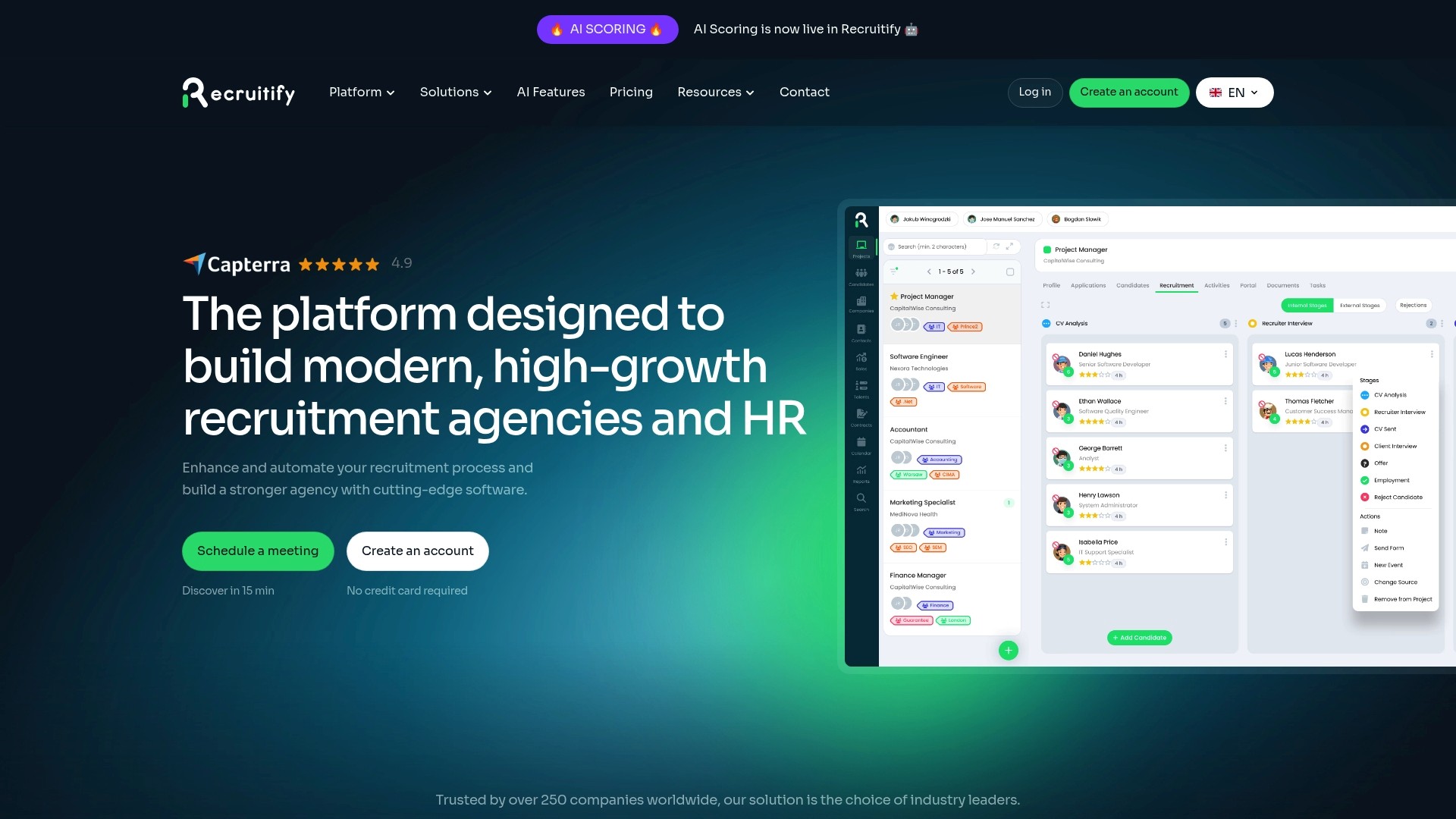
Instead of building a profile from scratch for every vacancy, you can leverage ready-to-use templates and auto-generated summaries that are ready to be shared with hiring managers. Thanks to this approach, one recruitment agency boosted their candidate presentation rate by 40%—without adding a single head to their team. If you want to see how this works in practice for your HR department or recruitment agency, explore the Recruitify platform and book a demo of our CV parsing and candidate profile management features today.
Sources
Verify PKK requirements in Poland via CEK on gov.pl and on your local communication department's website, where you can access official application templates.
Recommended Reading


News & Updates
Stay up-to-date with the latest innovations, features, and tips about Recruitify!
By providing your email address within the newsletter sign-up form, you confirm its processing to send marketing information regarding the Administrator’s products and services. The Administrator of your personal data processed for the abovementioned purposes is Recruitify Spółka z o.o., based in Warsaw, Poland (KRS 0000709889). For more information on the principles of personal data processing and the rights of data subjects, please check the Privacy Policy.

Last updated:
From minutes to seconds: Candidate profiles for recruiters, PKK and ready-to-use templates
Recruitment Process
The Recruitify Team
From Minutes to Seconds: Candidate Profiles for Recruiters, PKK, and a Ready-to-Use Template
A candidate profile is a set of formal requirements, competencies, and traits that describe the perfect fit for a specific role. In driver recruitment, a distinct document of the same name operates under the Polish acronym: PKK, i.e., Driver Candidate Profile. This is an official 11-digit number generated in the Central Register of Drivers, which is essential to begin driving lessons and sit the driving test.
In short:
A candidate profile is an internal tool designed to precisely define the requirements, competencies, and traits of your ideal candidate—it is not a job advertisement.
A well-constructed profile covers formal requirements, experience, hard and soft skills, and logistical preferences, making it easy to screen CVs and conduct interviews.
Building a profile step-by-step involves analyzing the position, separating critical must-haves from nice-to-haves, and testing criteria on real CVs so you don't narrow down your candidate pool too much.
The PKK number in the CEPEK system is required to start driver training and sit the driving test, and the application can be submitted in person or online, requiring specific documents.
Automating your recruitment process, including using a CV parser and AI tools, significantly slashes profile creation times and boosts selection quality—allowing you to scale your candidate volume and streamline your team's workflow.
Table of Contents
Definition and Scope: What a Candidate Profile Is in Recruitment
Key Components of a Candidate Profile (What to Include)
How to Write a Candidate Profile Step-by-Step
Driver Candidate Profile (PKK): What It Is and How to Obtain It
How Candidate Profiles Work in an ATS and How Automation Empowers Recruiters
Practical Candidate Profile Template to Copy
Author's Perspective: Practical Tips and Pitfalls in Profile Creation
How Recruitify Streamlines Candidate Profile Building
Sources
Definition and Scope: What a Candidate Profile Is in Recruitment
A candidate profile is a screening tool, not a job posting. A recruiter creates it after analyzing the role to serve as a concrete benchmark for screening CVs, conducting interviews, and deciding on next-round invitations.
The difference between a candidate profile and a job description (JD) is crucial, though often blurred. A job description is a public document addressed to candidates, outlining duties and offer conditions. A candidate profile works the opposite way. It is an internal document for the recruiter that defines exactly who you are looking for, what experience, competencies, and traits they must possess, long before the job ad is written. HR guides emphasize that a well-crafted profile covers formal requirements, experience, hard and soft skills, and personality traits, and its creation begins with a deep dive analysis of the role.
Investing time in building a profile pays off handsomely, especially for high-volume, repeatable roles (e.g., sales representatives, drivers, developers) and business-critical positions where a bad hire costs the most. To fast-track this, it is worth leveraging our experts – trainers, coaches, and HR consultants from HR Together Consulting to help with training and validating profiles with hiring managers. For one-off, straightforward roles, a simplified profile version is more than enough.
Key Components of a Candidate Profile (What to Include)
A great candidate profile answers five key questions: who can apply, what can they achieve, how do they work, who will they collaborate with, and under what conditions. In practice, this breaks down into five data fields:
Formal Requirements and Licenses – education, certifications, licenses, industry permits (e.g., Category C driving license, professional electrical permits).
Experience and Achievements – years in a similar role, quantifiable results (e.g., "increased sales by 20% in 12 months").
Hard Skills – specific tools and technologies: Excel, SQL, CRM systems, fleet software, programming languages.
Soft Skills – communication, teamwork, stress tolerance, defined by observable behaviors during interviews.
Logistical Preferences and Constraints – location, availability/shift work, willingness to travel, salary expectations.
Pro Tip: Avoid describing soft skills with generic adjectives like "communicative" or "engaged". Instead, define what that behavior looks like in action, e.g., "leads client negotiations independently without management support". This is much easier to verify during an interview.
How to Write a Candidate Profile Step-by-Step
Building a candidate profile is a logical, repeatable process that you can apply to any new vacancy. These steps deliver results regardless of the industry:
Extract requirements from the job description. Review daily and project-based duties, then map a specific competence to each task.
Apply the must-have vs. nice-to-have method. Separate critical requirements from those that are just a bonus. Piling too many demands into the first category artificially shrinks your candidate pool.
Test your criteria on real CVs. Run a quick check on a few random CVs in your database to see if your criteria filter out the right talent, or if they are accidentally disqualifying great candidates due to rigid phrasing.
Refine your job ad phrasing based on the profile. Using terms like "minimum 5 years of experience" instead of "experienced specialist" attracts highly targeted talent.
Perform a final pre-launch check. Ensure every field in your candidate profile is reflected in the job ad copy and nothing got lost in translation.
Pro Tip: A profile packed with too many "must-have" requirements can severely choke your candidate pipeline. Keep your must-haves to a tight three or four key points.
Driver Candidate Profile (PKK): What It Is and How to Obtain It
In Poland, the PKK is an 11-digit identification number generated in the Central Register of Drivers system. Without it, no driving school can register a student, and the regional exam centre will not allow them to take the driving test.
This number is always required when starting a course for a new driving license category, whether it is a first attempt at Category B or upgrading to C or D. Without the PKK, the process simply cannot begin.
Applications are submitted in person at the local communication department corresponding to the applicant's registered address, or increasingly online via a trusted profile. Local offices publish their own lists of required documents, so it is highly recommended to check their specific guidelines beforehand. Typically, you will need:
a completed PKK application form,
a medical certificate confirming no health counterindications for driving,
a current passport-style photo (35×45 mm),
a valid ID document for verification.
Ready-to-use PKK application templates make it much easier to complete the form correctly for any category, from AM to E. Processing times vary by office, so checking the application status directly with the local department or online portal is best. Driver registration regulations are subject to updates, as seen in the changes published in the Journal of Laws, so it is always wise to double-check the current legal status before applying.
How Candidate Profiles Work in an ATS and How Automation Empowers Recruiters
In a modern ATS, a candidate profile stops being a static document and becomes a dynamic set of fields that structure your entire recruitment pipeline. Application statuses, skill tags, and interview notes allow you to instantly filter your candidate database without digging through endless Excel spreadsheets—which ATS documentation highlights as the key to retaining long-term application context.
Automation completely revolutionizes how these profiles are built. A CV parser automatically reads candidate documents and populates profile fields in seconds, while AI-powered screening tools generate instant matching scores and tailored interview questions.
Automated CV parsing slashes candidate profile creation from 15 minutes down to mere seconds.
Automated summaries make sharing comprehensive shortlists with hiring managers effortless, without writing lengthy emails.
A centralized database eliminates duplicates and lets you easily rediscover silver-medalist candidates from previous campaigns.
Recruitify speeds up your entire recruitment cycle up to five times by combining CV parsing, applicant tracking, and CRM into one powerful platform, as proven by this recruitment agency implementation case study. For more practical insights on automated hiring, read our guide on saving time through recruitment automation.
Practical Candidate Profile Template to Copy
You can copy this framework directly into your spreadsheet or ATS and customize it for any role you are hiring for.
Header and Summary: job title, department, one-sentence profile summary (e.g., "experienced B2B sales specialist from the IT sector").
Experience: list each position using the formula role → achievement → timeframe, e.g., "sales representative → grew client portfolio by 15 accounts → 18 months". This format makes comparing candidates incredibly fast.
Competencies with Levels: tools or skills graded by proficiency (basic, intermediate, expert), e.g., "SQL, Intermediate".
Logistical Fields: location, employment type, salary range, notice period/availability.
Saving your candidate profile summary in markdown format makes it easy to process this data further, such as generating tailored interview questions in AI-powered tools.
Author's Perspective: Practical Tips and Pitfalls in Profile Creation
The most common mistake in building candidate profiles is confusing a wish list with actual job requirements. Recruitment teams that load profiles with ten "must-have" requirements usually end up with a dry candidate pipeline after three weeks. A candidate profile is not set in stone. It should be constantly iterated based on real-world market data—who is actually applying and who gets hired. Before rolling out a new profile on a massive scale, test it on a single pilot campaign to see if it attracts candidates who are a true fit for your business.
— Recruitify Team
How Recruitify Streamlines Candidate Profile Building
Manually typing CV details into spreadsheets is a massive waste of recruiter time that could be spent building relationships. Recruitify does the heavy lifting for you: our CV parser automatically populates candidate profile fields, while our centralized database keeps all your talent data in one place, instantly accessible to your whole team.
Instead of building a profile from scratch for every vacancy, you can leverage ready-to-use templates and auto-generated summaries that are ready to be shared with hiring managers. Thanks to this approach, one recruitment agency boosted their candidate presentation rate by 40%—without adding a single head to their team. If you want to see how this works in practice for your HR department or recruitment agency, explore the Recruitify platform and book a demo of our CV parsing and candidate profile management features today.
Sources
Verify PKK requirements in Poland via CEK on gov.pl and on your local communication department's website, where you can access official application templates.
Recommended Reading
News & Updates
Stay up-to-date with the latest innovations, features, and tips about Recruitify!
By providing your email address within the newsletter sign-up form, you confirm its processing to send marketing information regarding the Administrator’s products and services. The Administrator of your personal data processed for the abovementioned purposes is Recruitify Spółka z o.o., based in Warsaw, Poland (KRS 0000709889). For more information on the principles of personal data processing and the rights of data subjects, please check the Privacy Policy.
Last updated:
From minutes to seconds: Candidate profiles for recruiters, PKK and ready-to-use templates
Recruitment Process
The Recruitify Team
From Minutes to Seconds: Candidate Profiles for Recruiters, PKK, and a Ready-to-Use Template
A candidate profile is a set of formal requirements, competencies, and traits that describe the perfect fit for a specific role. In driver recruitment, a distinct document of the same name operates under the Polish acronym: PKK, i.e., Driver Candidate Profile. This is an official 11-digit number generated in the Central Register of Drivers, which is essential to begin driving lessons and sit the driving test.
In short:
A candidate profile is an internal tool designed to precisely define the requirements, competencies, and traits of your ideal candidate—it is not a job advertisement.
A well-constructed profile covers formal requirements, experience, hard and soft skills, and logistical preferences, making it easy to screen CVs and conduct interviews.
Building a profile step-by-step involves analyzing the position, separating critical must-haves from nice-to-haves, and testing criteria on real CVs so you don't narrow down your candidate pool too much.
The PKK number in the CEPEK system is required to start driver training and sit the driving test, and the application can be submitted in person or online, requiring specific documents.
Automating your recruitment process, including using a CV parser and AI tools, significantly slashes profile creation times and boosts selection quality—allowing you to scale your candidate volume and streamline your team's workflow.
Table of Contents
Definition and Scope: What a Candidate Profile Is in Recruitment
Key Components of a Candidate Profile (What to Include)
How to Write a Candidate Profile Step-by-Step
Driver Candidate Profile (PKK): What It Is and How to Obtain It
How Candidate Profiles Work in an ATS and How Automation Empowers Recruiters
Practical Candidate Profile Template to Copy
Author's Perspective: Practical Tips and Pitfalls in Profile Creation
How Recruitify Streamlines Candidate Profile Building
Sources
Definition and Scope: What a Candidate Profile Is in Recruitment
A candidate profile is a screening tool, not a job posting. A recruiter creates it after analyzing the role to serve as a concrete benchmark for screening CVs, conducting interviews, and deciding on next-round invitations.
The difference between a candidate profile and a job description (JD) is crucial, though often blurred. A job description is a public document addressed to candidates, outlining duties and offer conditions. A candidate profile works the opposite way. It is an internal document for the recruiter that defines exactly who you are looking for, what experience, competencies, and traits they must possess, long before the job ad is written. HR guides emphasize that a well-crafted profile covers formal requirements, experience, hard and soft skills, and personality traits, and its creation begins with a deep dive analysis of the role.
Investing time in building a profile pays off handsomely, especially for high-volume, repeatable roles (e.g., sales representatives, drivers, developers) and business-critical positions where a bad hire costs the most. To fast-track this, it is worth leveraging our experts – trainers, coaches, and HR consultants from HR Together Consulting to help with training and validating profiles with hiring managers. For one-off, straightforward roles, a simplified profile version is more than enough.
Key Components of a Candidate Profile (What to Include)
A great candidate profile answers five key questions: who can apply, what can they achieve, how do they work, who will they collaborate with, and under what conditions. In practice, this breaks down into five data fields:
Formal Requirements and Licenses – education, certifications, licenses, industry permits (e.g., Category C driving license, professional electrical permits).
Experience and Achievements – years in a similar role, quantifiable results (e.g., "increased sales by 20% in 12 months").
Hard Skills – specific tools and technologies: Excel, SQL, CRM systems, fleet software, programming languages.
Soft Skills – communication, teamwork, stress tolerance, defined by observable behaviors during interviews.
Logistical Preferences and Constraints – location, availability/shift work, willingness to travel, salary expectations.
Pro Tip: Avoid describing soft skills with generic adjectives like "communicative" or "engaged". Instead, define what that behavior looks like in action, e.g., "leads client negotiations independently without management support". This is much easier to verify during an interview.
How to Write a Candidate Profile Step-by-Step
Building a candidate profile is a logical, repeatable process that you can apply to any new vacancy. These steps deliver results regardless of the industry:
Extract requirements from the job description. Review daily and project-based duties, then map a specific competence to each task.
Apply the must-have vs. nice-to-have method. Separate critical requirements from those that are just a bonus. Piling too many demands into the first category artificially shrinks your candidate pool.
Test your criteria on real CVs. Run a quick check on a few random CVs in your database to see if your criteria filter out the right talent, or if they are accidentally disqualifying great candidates due to rigid phrasing.
Refine your job ad phrasing based on the profile. Using terms like "minimum 5 years of experience" instead of "experienced specialist" attracts highly targeted talent.
Perform a final pre-launch check. Ensure every field in your candidate profile is reflected in the job ad copy and nothing got lost in translation.
Pro Tip: A profile packed with too many "must-have" requirements can severely choke your candidate pipeline. Keep your must-haves to a tight three or four key points.
Driver Candidate Profile (PKK): What It Is and How to Obtain It
In Poland, the PKK is an 11-digit identification number generated in the Central Register of Drivers system. Without it, no driving school can register a student, and the regional exam centre will not allow them to take the driving test.
This number is always required when starting a course for a new driving license category, whether it is a first attempt at Category B or upgrading to C or D. Without the PKK, the process simply cannot begin.
Applications are submitted in person at the local communication department corresponding to the applicant's registered address, or increasingly online via a trusted profile. Local offices publish their own lists of required documents, so it is highly recommended to check their specific guidelines beforehand. Typically, you will need:
a completed PKK application form,
a medical certificate confirming no health counterindications for driving,
a current passport-style photo (35×45 mm),
a valid ID document for verification.
Ready-to-use PKK application templates make it much easier to complete the form correctly for any category, from AM to E. Processing times vary by office, so checking the application status directly with the local department or online portal is best. Driver registration regulations are subject to updates, as seen in the changes published in the Journal of Laws, so it is always wise to double-check the current legal status before applying.
How Candidate Profiles Work in an ATS and How Automation Empowers Recruiters
In a modern ATS, a candidate profile stops being a static document and becomes a dynamic set of fields that structure your entire recruitment pipeline. Application statuses, skill tags, and interview notes allow you to instantly filter your candidate database without digging through endless Excel spreadsheets—which ATS documentation highlights as the key to retaining long-term application context.
Automation completely revolutionizes how these profiles are built. A CV parser automatically reads candidate documents and populates profile fields in seconds, while AI-powered screening tools generate instant matching scores and tailored interview questions.
Automated CV parsing slashes candidate profile creation from 15 minutes down to mere seconds.
Automated summaries make sharing comprehensive shortlists with hiring managers effortless, without writing lengthy emails.
A centralized database eliminates duplicates and lets you easily rediscover silver-medalist candidates from previous campaigns.
Recruitify speeds up your entire recruitment cycle up to five times by combining CV parsing, applicant tracking, and CRM into one powerful platform, as proven by this recruitment agency implementation case study. For more practical insights on automated hiring, read our guide on saving time through recruitment automation.
Practical Candidate Profile Template to Copy
You can copy this framework directly into your spreadsheet or ATS and customize it for any role you are hiring for.
Header and Summary: job title, department, one-sentence profile summary (e.g., "experienced B2B sales specialist from the IT sector").
Experience: list each position using the formula role → achievement → timeframe, e.g., "sales representative → grew client portfolio by 15 accounts → 18 months". This format makes comparing candidates incredibly fast.
Competencies with Levels: tools or skills graded by proficiency (basic, intermediate, expert), e.g., "SQL, Intermediate".
Logistical Fields: location, employment type, salary range, notice period/availability.
Saving your candidate profile summary in markdown format makes it easy to process this data further, such as generating tailored interview questions in AI-powered tools.
Author's Perspective: Practical Tips and Pitfalls in Profile Creation
The most common mistake in building candidate profiles is confusing a wish list with actual job requirements. Recruitment teams that load profiles with ten "must-have" requirements usually end up with a dry candidate pipeline after three weeks. A candidate profile is not set in stone. It should be constantly iterated based on real-world market data—who is actually applying and who gets hired. Before rolling out a new profile on a massive scale, test it on a single pilot campaign to see if it attracts candidates who are a true fit for your business.
— Recruitify Team
How Recruitify Streamlines Candidate Profile Building
Manually typing CV details into spreadsheets is a massive waste of recruiter time that could be spent building relationships. Recruitify does the heavy lifting for you: our CV parser automatically populates candidate profile fields, while our centralized database keeps all your talent data in one place, instantly accessible to your whole team.
Instead of building a profile from scratch for every vacancy, you can leverage ready-to-use templates and auto-generated summaries that are ready to be shared with hiring managers. Thanks to this approach, one recruitment agency boosted their candidate presentation rate by 40%—without adding a single head to their team. If you want to see how this works in practice for your HR department or recruitment agency, explore the Recruitify platform and book a demo of our CV parsing and candidate profile management features today.
Sources
Verify PKK requirements in Poland via CEK on gov.pl and on your local communication department's website, where you can access official application templates.
Recommended Reading
News & Updates
Stay up-to-date with the latest innovations, features, and tips about Recruitify!
By providing your email address within the newsletter sign-up form, you confirm its processing to send marketing information regarding the Administrator’s products and services. The Administrator of your personal data processed for the abovementioned purposes is Recruitify Spółka z o.o., based in Warsaw, Poland (KRS 0000709889). For more information on the principles of personal data processing and the rights of data subjects, please check the Privacy Policy.

Discover More

Recruitment Process
Recruiters: Job Posting Automation, Safe Pilot and No Duplicate Posts
Guide for recruiters and agencies to implement job posting automation, get 60–90 day payback, prevent duplicate posts, and run a safe pilot.
19 Sept 2026
Discover More

Recruitment Process
Win Renewals With 7–10 KPIs: Client Reporting for Agencies
Automate client reporting for agencies around a focused 7 to 10 KPI set, white labeled dashboards, and a vendor agnostic checklist that proves ROI and...
18 Sept 2026
Discover More

Recruitment Process
For Agencies: Orchestrate Stages with Recruitment Workflow Automation
Orchestrate recruitment workflow automation with scorecards and human gates. Pilot safely; agencies report 70% fewer admin tasks.
17 Sept 2026
Discover More
Recruitment Process
Recruiters: Job Posting Automation, Safe Pilot and No Duplicate Posts
Guide for recruiters and agencies to implement job posting automation, get 60–90 day payback, prevent duplicate posts, and run a safe pilot.
19 Sept 2026
Discover More
Recruitment Process
Win Renewals With 7–10 KPIs: Client Reporting for Agencies
Automate client reporting for agencies around a focused 7 to 10 KPI set, white labeled dashboards, and a vendor agnostic checklist that proves ROI and...
18 Sept 2026
Discover More