
Last updated:
Hire smarter: automate your KPIs and launch a pilot in just 3 months

Innovations

The Recruitify Team
Quality of Hire for Recruitment Agencies: Automated KPIs and a 3-Month Pilot Plan
Quality of hire is the measurable value a new employee brings to an organisation. It is expressed as a normalised score combining pre-hire and post-hire data, such as assessment results, performance reviews, retention rates, and hiring manager satisfaction. Measuring it answers one critical question: is your recruitment process selecting the right talent? In the following sections, we outline specific KPIs, the exact formula to calculate this metric, and a three-month pilot plan to get you started.
In short:
Measuring Quality of Hire combines both pre-hire and post-hire data to evaluate if your recruitment funnel is successfully delivering top-tier candidates.
Key KPIs include 90-day performance reviews, first-year retention, hiring manager satisfaction, and candidate quality by source, though we recommend focusing on no more than four when starting out.
A successful Quality of Hire programme should be built around a weighted scorecard, established before the hiring process begins and analysed regularly.
Automating your ATS with powerful analytics modules streamlines the collection and organisation of data, making your Quality of Hire analysis seamless whilst eliminating manual errors and bias.
To truly drive up the quality of your placements, you must optimise the recruitment process itself — utilising skills assessments, clear role descriptions, and structured onboarding, rather than just tracking the metrics.
Table of Contents
Where Quality of Hire Ends: Scope and Common Misconceptions
Which KPIs Measure Quality of Hire?
How to Calculate Quality of Hire: The Scorecard and Formula
Which Tools Support Quality of Hire Measurement?
How to Improve Quality of Hire in Practice
How to Implement QoH Measurement: Checklist and Schedule
Case Study: Quality of Hire Measurement in a Recruitment Agency Setting
What's Next for Quality of Hire Measurement?
Measure Quality of Hire Without Manual Data Entry Across Five Spreadsheets
Sources
Where Quality of Hire Ends: Scope and Common Misconceptions
Quality of Hire spans two distinct phases in the recruitment cycle. Pre-hire data consists of signals gathered before a contract is signed: test scores, structured interview evaluations, and candidate source quality. Post-hire data surfaces after the start date: performance reviews, retention, hiring manager satisfaction, and 360-degree feedback. This metric does not replace efficiency metrics like time-to-hire or cost-per-hire. Whilst those tell you how quickly and cost-effectively you fill a role, Quality of Hire tells you if the placement was worth making in the first place.
However, the definition of QoH has its limitations. The scorecard for a software engineer and a production operator will rely on completely different components, as the role's context changes the weight of each factor. Industry reports on measuring work quality demonstrate that Quality of Hire is multidimensional and cannot be reduced to a single number without losing valuable context.
The three most common misconceptions surrounding QoH:
Treating retention as the sole indicator of quality, without factoring in actual performance.
Comparing results across completely different roles without normalizing the data.
Measuring QoH only once a year, rather than in a continuous cycle tied directly to your active recruitment.
Which KPIs Measure Quality of Hire?
An effective KPI framework combines data from both stages of the hiring journey. From the post-hire phase, agencies typically track 90-day performance reviews, first-year retention rates, hiring manager satisfaction scores, and feedback from 360-degree evaluations. From the pre-hire phase, the most valuable metrics are skills assessment results, candidate quality by source, and profile alignment with the role description.
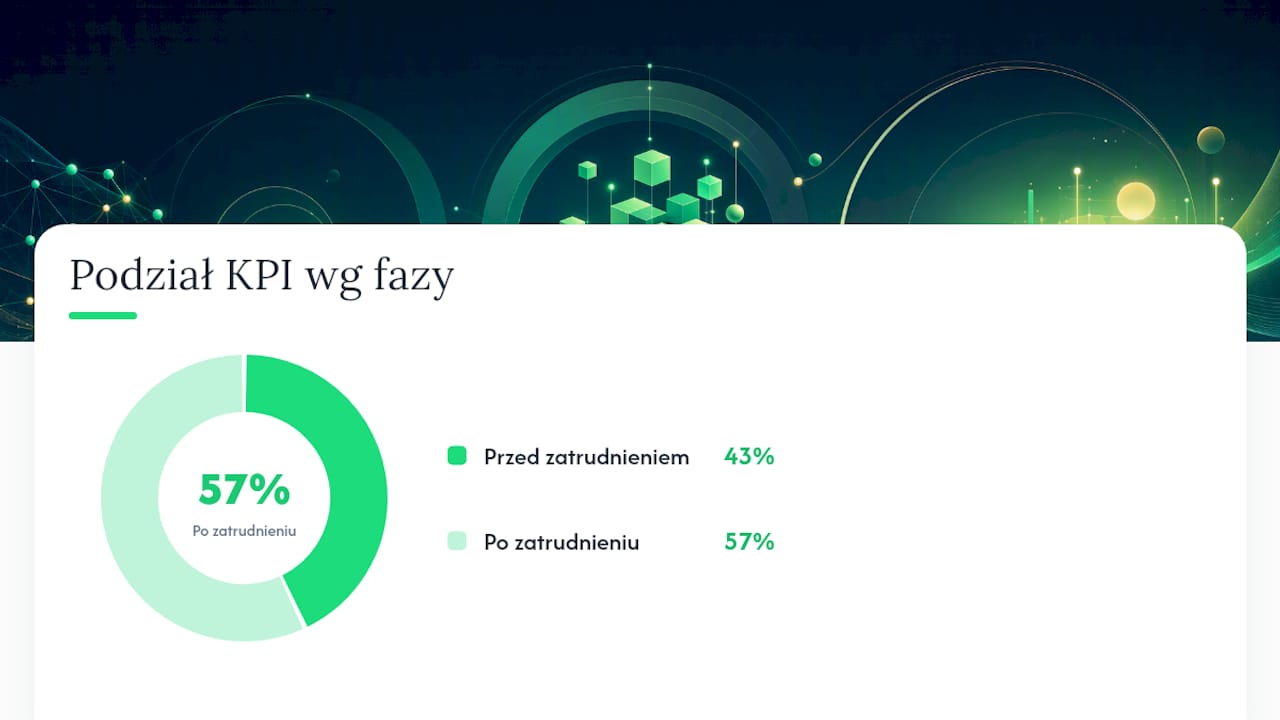
Each of these metrics has its limitations. First-year retention tells you nothing about the productivity of an employee who stays but underperforms. Hiring manager ratings can be subjective and depend heavily on the manager's own assessment skills. Industry experts strongly recommend combining multiple metrics, as a holistic score balances out these individual weaknesses.
Directory of Core KPIs:
Performance reviews at 90 days and 1 year,
Retention rates at 6 and 12 months,
Hiring manager satisfaction (on a scale of 1–5),
360-degree feedback results,
Candidate quality by source,
Pre-employment test scores.
Pro Tip: Don't track more than 4 KPIs at the start. More metrics won't give you a better overview — they will only clutter your dashboard and lead to a report that no one regularly reviews.
Experts at SHRM recommend measuring QoH both pre- and post-hire, and then scaling the result as a weighted index rather than viewing them as disconnected numbers.
How to Calculate Quality of Hire: The Scorecard and Formula
A scorecard is simply a weighted table of your chosen KPIs, tailored to a specific role. These weights should be agreed upon by your recruitment team and the hiring manager before the search begins — not after the placement has already been made.
Here is a practical formula to use:
Select 3–4 core KPIs for the role,
Assign a percentage weight to each, totalling 100%,
Convert each KPI result into a standard 0–100 scale,
Multiply each score by its weight and sum the totals,
Use this final index to compare hiring success across similar roles.
Example for a Sales Specialist role:
A score of 84 out of 100 represents a strong, solid placement. Scores consistently falling below 60 signal an issue with your selection process for that specific role, rather than just the individual hire. Tracking this index consistently across placements allows you to identify over time which candidate sources and interview stages are the strongest predictors of top performance.
Which Tools Support Quality of Hire Measurement?
An ATS with built-in analytics centralises pre-hire and post-hire data in one place, completely eliminating the need to manually copy scores from spreadsheets to HR systems. Automating hiring manager satisfaction surveys and scheduled 360-degree feedback loops works best when triggered automatically at key milestones, such as 30, 90, and 365 days post-placement.

In 2025 and 2026, forward-thinking recruitment agencies are increasingly leveraging ATS automation to remove subjective bias from candidate evaluations and accelerate KPI tracking, leaving behind gut-feeling decisions.
Key features to look for in a recruitment platform:
Integration of performance review data,
Automated post-hire survey triggers,
Candidate source tracking across the entire recruitment funnel,
Seamless data export to KPI dashboards.
Pro Tip: Before trusting automated candidate scoring, audit your historical data. Algorithms trained on past human recruitment decisions can easily replicate previous hiring biases if that data isn't properly cleansed first. Learn more about managing this risk in our analysis of AI in recruitment.
How to Improve Quality of Hire in Practice
Tracking the metric won't drive results unless you optimise the recruitment process that powers it. These three operational shifts yield the most immediate, high-impact improvements:
Replace generic interviews with structured skills assessments or work samples. Methods such as psychometric testing, assessment centres, and practical tasks predict job performance far more accurately than multiple rounds of unstructured conversations, as highlighted in WUP Warszawa's guide to recruitment and selection.
Build a role-based scorecard before advertising. Agreeing on a precise job description and KPI weights upfront eliminates alignment issues regarding what 'success' actually looks like.
Strengthen your onboarding and feedback loops. Transparent communication from the initial job posting through the first few months of employment dramatically improves retention and candidate satisfaction, as supported by practical insights into candidate experience.
Robust employer branding ties this loop together: candidates who enter your client's organisation with realistic expectations are far less likely to leave within their first year.
How to Implement QoH Measurement: Checklist and Schedule
Successful implementation starts with a business objective, not just a metric. Before choosing your KPIs, define what a "successful placement" looks like for that specific role.
Weeks 1–2: Define the business goal for your pilot program and select one specific team or client account to test it on.
Week 3: Select 3–4 baseline KPIs and assign a data owner to track each one.
Week 4: Configure automated data collection within your ATS platform.
Months 2–3: Gather data from every new hire made within the pilot group.
End of Month 3: Review the results, compare the QoH index across different candidate sources, and decide on scaling the process to other departments.
Pro Tip: Don't delay your pilot waiting for the "perfect" set of metrics. Quality of Hire initiatives are most successful when agencies start with a lean set of KPIs, test them for three months in one business unit, and then scale based on real-world results, in line with SHRM recommendations.
Case Study: Quality of Hire Measurement in a Recruitment Agency Setting
Recruitify combines ATS, CRM, and recruitment automation into a single, unified system, allowing agencies and corporate HR teams to track pre-hire and post-hire metrics without juggling multiple tools. A recent client case study highlights how automation and intelligent talent pools enabled an agency to increase candidate presentations by 40% whilst significantly reducing time-to-hire.
These key takeaways can be applied to any scaling agency:
Automating candidate matching from active talent pools slashes initial response times.
Standardising candidate profiles reduces evaluation inconsistencies across recruiters.
An elevated candidate experience directly correlates with richer, higher-quality responses during assessments.
What's Next for Quality of Hire Measurement?
Whilst automation and predictive screening tools will continue to accelerate how rapidly recruitment teams compile QoH metrics, technology cannot replace regular data audits to ensure algorithms aren't reinforcing historical human bias. The most successful agency leaders we work with don't wait for perfect systems. They run a pilot using four key metrics with one team, refine their scorecard after three months, and scale from there. This structured approach — rather than just another software feature — is what transforms Quality of Hire into a powerful commercial tool rather than a forgotten report.
Measure Quality of Hire Without Manual Data Entry Across Five Spreadsheets
Recruitify seamlessly integrates ATS, CRM, and recruitment automation, freeing you from manually matching assessment scores, hiring manager feedback, and retention statistics across disconnected systems. The platform automatically tracks candidate touchpoints from first contact, accelerating your overall hiring cycles up to five times and building a robust database to calculate QoH without the administrative headache.
Ready to see it in action? Discover how our client increased candidate submissions by 40% using automation, or download our ebook on overcoming HR and recruitment challenges to prepare for your first pilot. Book your personalised demo on the Recruitify homepage today and see how easy it is to configure custom KPI dashboards for your team.
Sources
Recommended Reading


News & Updates
Stay up-to-date with the latest innovations, features, and tips about Recruitify!
By providing your email address within the newsletter sign-up form, you confirm its processing to send marketing information regarding the Administrator’s products and services. The Administrator of your personal data processed for the abovementioned purposes is Recruitify Spółka z o.o., based in Warsaw, Poland (KRS 0000709889). For more information on the principles of personal data processing and the rights of data subjects, please check the Privacy Policy.

Last updated:
Hire smarter: automate your KPIs and launch a pilot in just 3 months
Innovations
The Recruitify Team
Quality of Hire for Recruitment Agencies: Automated KPIs and a 3-Month Pilot Plan
Quality of hire is the measurable value a new employee brings to an organisation. It is expressed as a normalised score combining pre-hire and post-hire data, such as assessment results, performance reviews, retention rates, and hiring manager satisfaction. Measuring it answers one critical question: is your recruitment process selecting the right talent? In the following sections, we outline specific KPIs, the exact formula to calculate this metric, and a three-month pilot plan to get you started.
In short:
Measuring Quality of Hire combines both pre-hire and post-hire data to evaluate if your recruitment funnel is successfully delivering top-tier candidates.
Key KPIs include 90-day performance reviews, first-year retention, hiring manager satisfaction, and candidate quality by source, though we recommend focusing on no more than four when starting out.
A successful Quality of Hire programme should be built around a weighted scorecard, established before the hiring process begins and analysed regularly.
Automating your ATS with powerful analytics modules streamlines the collection and organisation of data, making your Quality of Hire analysis seamless whilst eliminating manual errors and bias.
To truly drive up the quality of your placements, you must optimise the recruitment process itself — utilising skills assessments, clear role descriptions, and structured onboarding, rather than just tracking the metrics.
Table of Contents
Where Quality of Hire Ends: Scope and Common Misconceptions
Which KPIs Measure Quality of Hire?
How to Calculate Quality of Hire: The Scorecard and Formula
Which Tools Support Quality of Hire Measurement?
How to Improve Quality of Hire in Practice
How to Implement QoH Measurement: Checklist and Schedule
Case Study: Quality of Hire Measurement in a Recruitment Agency Setting
What's Next for Quality of Hire Measurement?
Measure Quality of Hire Without Manual Data Entry Across Five Spreadsheets
Sources
Where Quality of Hire Ends: Scope and Common Misconceptions
Quality of Hire spans two distinct phases in the recruitment cycle. Pre-hire data consists of signals gathered before a contract is signed: test scores, structured interview evaluations, and candidate source quality. Post-hire data surfaces after the start date: performance reviews, retention, hiring manager satisfaction, and 360-degree feedback. This metric does not replace efficiency metrics like time-to-hire or cost-per-hire. Whilst those tell you how quickly and cost-effectively you fill a role, Quality of Hire tells you if the placement was worth making in the first place.
However, the definition of QoH has its limitations. The scorecard for a software engineer and a production operator will rely on completely different components, as the role's context changes the weight of each factor. Industry reports on measuring work quality demonstrate that Quality of Hire is multidimensional and cannot be reduced to a single number without losing valuable context.
The three most common misconceptions surrounding QoH:
Treating retention as the sole indicator of quality, without factoring in actual performance.
Comparing results across completely different roles without normalizing the data.
Measuring QoH only once a year, rather than in a continuous cycle tied directly to your active recruitment.
Which KPIs Measure Quality of Hire?
An effective KPI framework combines data from both stages of the hiring journey. From the post-hire phase, agencies typically track 90-day performance reviews, first-year retention rates, hiring manager satisfaction scores, and feedback from 360-degree evaluations. From the pre-hire phase, the most valuable metrics are skills assessment results, candidate quality by source, and profile alignment with the role description.
Each of these metrics has its limitations. First-year retention tells you nothing about the productivity of an employee who stays but underperforms. Hiring manager ratings can be subjective and depend heavily on the manager's own assessment skills. Industry experts strongly recommend combining multiple metrics, as a holistic score balances out these individual weaknesses.
Directory of Core KPIs:
Performance reviews at 90 days and 1 year,
Retention rates at 6 and 12 months,
Hiring manager satisfaction (on a scale of 1–5),
360-degree feedback results,
Candidate quality by source,
Pre-employment test scores.
Pro Tip: Don't track more than 4 KPIs at the start. More metrics won't give you a better overview — they will only clutter your dashboard and lead to a report that no one regularly reviews.
Experts at SHRM recommend measuring QoH both pre- and post-hire, and then scaling the result as a weighted index rather than viewing them as disconnected numbers.
How to Calculate Quality of Hire: The Scorecard and Formula
A scorecard is simply a weighted table of your chosen KPIs, tailored to a specific role. These weights should be agreed upon by your recruitment team and the hiring manager before the search begins — not after the placement has already been made.
Here is a practical formula to use:
Select 3–4 core KPIs for the role,
Assign a percentage weight to each, totalling 100%,
Convert each KPI result into a standard 0–100 scale,
Multiply each score by its weight and sum the totals,
Use this final index to compare hiring success across similar roles.
Example for a Sales Specialist role:
A score of 84 out of 100 represents a strong, solid placement. Scores consistently falling below 60 signal an issue with your selection process for that specific role, rather than just the individual hire. Tracking this index consistently across placements allows you to identify over time which candidate sources and interview stages are the strongest predictors of top performance.
Which Tools Support Quality of Hire Measurement?
An ATS with built-in analytics centralises pre-hire and post-hire data in one place, completely eliminating the need to manually copy scores from spreadsheets to HR systems. Automating hiring manager satisfaction surveys and scheduled 360-degree feedback loops works best when triggered automatically at key milestones, such as 30, 90, and 365 days post-placement.
In 2025 and 2026, forward-thinking recruitment agencies are increasingly leveraging ATS automation to remove subjective bias from candidate evaluations and accelerate KPI tracking, leaving behind gut-feeling decisions.
Key features to look for in a recruitment platform:
Integration of performance review data,
Automated post-hire survey triggers,
Candidate source tracking across the entire recruitment funnel,
Seamless data export to KPI dashboards.
Pro Tip: Before trusting automated candidate scoring, audit your historical data. Algorithms trained on past human recruitment decisions can easily replicate previous hiring biases if that data isn't properly cleansed first. Learn more about managing this risk in our analysis of AI in recruitment.
How to Improve Quality of Hire in Practice
Tracking the metric won't drive results unless you optimise the recruitment process that powers it. These three operational shifts yield the most immediate, high-impact improvements:
Replace generic interviews with structured skills assessments or work samples. Methods such as psychometric testing, assessment centres, and practical tasks predict job performance far more accurately than multiple rounds of unstructured conversations, as highlighted in WUP Warszawa's guide to recruitment and selection.
Build a role-based scorecard before advertising. Agreeing on a precise job description and KPI weights upfront eliminates alignment issues regarding what 'success' actually looks like.
Strengthen your onboarding and feedback loops. Transparent communication from the initial job posting through the first few months of employment dramatically improves retention and candidate satisfaction, as supported by practical insights into candidate experience.
Robust employer branding ties this loop together: candidates who enter your client's organisation with realistic expectations are far less likely to leave within their first year.
How to Implement QoH Measurement: Checklist and Schedule
Successful implementation starts with a business objective, not just a metric. Before choosing your KPIs, define what a "successful placement" looks like for that specific role.
Weeks 1–2: Define the business goal for your pilot program and select one specific team or client account to test it on.
Week 3: Select 3–4 baseline KPIs and assign a data owner to track each one.
Week 4: Configure automated data collection within your ATS platform.
Months 2–3: Gather data from every new hire made within the pilot group.
End of Month 3: Review the results, compare the QoH index across different candidate sources, and decide on scaling the process to other departments.
Pro Tip: Don't delay your pilot waiting for the "perfect" set of metrics. Quality of Hire initiatives are most successful when agencies start with a lean set of KPIs, test them for three months in one business unit, and then scale based on real-world results, in line with SHRM recommendations.
Case Study: Quality of Hire Measurement in a Recruitment Agency Setting
Recruitify combines ATS, CRM, and recruitment automation into a single, unified system, allowing agencies and corporate HR teams to track pre-hire and post-hire metrics without juggling multiple tools. A recent client case study highlights how automation and intelligent talent pools enabled an agency to increase candidate presentations by 40% whilst significantly reducing time-to-hire.
These key takeaways can be applied to any scaling agency:
Automating candidate matching from active talent pools slashes initial response times.
Standardising candidate profiles reduces evaluation inconsistencies across recruiters.
An elevated candidate experience directly correlates with richer, higher-quality responses during assessments.
What's Next for Quality of Hire Measurement?
Whilst automation and predictive screening tools will continue to accelerate how rapidly recruitment teams compile QoH metrics, technology cannot replace regular data audits to ensure algorithms aren't reinforcing historical human bias. The most successful agency leaders we work with don't wait for perfect systems. They run a pilot using four key metrics with one team, refine their scorecard after three months, and scale from there. This structured approach — rather than just another software feature — is what transforms Quality of Hire into a powerful commercial tool rather than a forgotten report.
Measure Quality of Hire Without Manual Data Entry Across Five Spreadsheets
Recruitify seamlessly integrates ATS, CRM, and recruitment automation, freeing you from manually matching assessment scores, hiring manager feedback, and retention statistics across disconnected systems. The platform automatically tracks candidate touchpoints from first contact, accelerating your overall hiring cycles up to five times and building a robust database to calculate QoH without the administrative headache.
Ready to see it in action? Discover how our client increased candidate submissions by 40% using automation, or download our ebook on overcoming HR and recruitment challenges to prepare for your first pilot. Book your personalised demo on the Recruitify homepage today and see how easy it is to configure custom KPI dashboards for your team.
Sources
Recommended Reading
News & Updates
Stay up-to-date with the latest innovations, features, and tips about Recruitify!
By providing your email address within the newsletter sign-up form, you confirm its processing to send marketing information regarding the Administrator’s products and services. The Administrator of your personal data processed for the abovementioned purposes is Recruitify Spółka z o.o., based in Warsaw, Poland (KRS 0000709889). For more information on the principles of personal data processing and the rights of data subjects, please check the Privacy Policy.
Last updated:
Hire smarter: automate your KPIs and launch a pilot in just 3 months
Innovations
The Recruitify Team
Quality of Hire for Recruitment Agencies: Automated KPIs and a 3-Month Pilot Plan
Quality of hire is the measurable value a new employee brings to an organisation. It is expressed as a normalised score combining pre-hire and post-hire data, such as assessment results, performance reviews, retention rates, and hiring manager satisfaction. Measuring it answers one critical question: is your recruitment process selecting the right talent? In the following sections, we outline specific KPIs, the exact formula to calculate this metric, and a three-month pilot plan to get you started.
In short:
Measuring Quality of Hire combines both pre-hire and post-hire data to evaluate if your recruitment funnel is successfully delivering top-tier candidates.
Key KPIs include 90-day performance reviews, first-year retention, hiring manager satisfaction, and candidate quality by source, though we recommend focusing on no more than four when starting out.
A successful Quality of Hire programme should be built around a weighted scorecard, established before the hiring process begins and analysed regularly.
Automating your ATS with powerful analytics modules streamlines the collection and organisation of data, making your Quality of Hire analysis seamless whilst eliminating manual errors and bias.
To truly drive up the quality of your placements, you must optimise the recruitment process itself — utilising skills assessments, clear role descriptions, and structured onboarding, rather than just tracking the metrics.
Table of Contents
Where Quality of Hire Ends: Scope and Common Misconceptions
Which KPIs Measure Quality of Hire?
How to Calculate Quality of Hire: The Scorecard and Formula
Which Tools Support Quality of Hire Measurement?
How to Improve Quality of Hire in Practice
How to Implement QoH Measurement: Checklist and Schedule
Case Study: Quality of Hire Measurement in a Recruitment Agency Setting
What's Next for Quality of Hire Measurement?
Measure Quality of Hire Without Manual Data Entry Across Five Spreadsheets
Sources
Where Quality of Hire Ends: Scope and Common Misconceptions
Quality of Hire spans two distinct phases in the recruitment cycle. Pre-hire data consists of signals gathered before a contract is signed: test scores, structured interview evaluations, and candidate source quality. Post-hire data surfaces after the start date: performance reviews, retention, hiring manager satisfaction, and 360-degree feedback. This metric does not replace efficiency metrics like time-to-hire or cost-per-hire. Whilst those tell you how quickly and cost-effectively you fill a role, Quality of Hire tells you if the placement was worth making in the first place.
However, the definition of QoH has its limitations. The scorecard for a software engineer and a production operator will rely on completely different components, as the role's context changes the weight of each factor. Industry reports on measuring work quality demonstrate that Quality of Hire is multidimensional and cannot be reduced to a single number without losing valuable context.
The three most common misconceptions surrounding QoH:
Treating retention as the sole indicator of quality, without factoring in actual performance.
Comparing results across completely different roles without normalizing the data.
Measuring QoH only once a year, rather than in a continuous cycle tied directly to your active recruitment.
Which KPIs Measure Quality of Hire?
An effective KPI framework combines data from both stages of the hiring journey. From the post-hire phase, agencies typically track 90-day performance reviews, first-year retention rates, hiring manager satisfaction scores, and feedback from 360-degree evaluations. From the pre-hire phase, the most valuable metrics are skills assessment results, candidate quality by source, and profile alignment with the role description.
Each of these metrics has its limitations. First-year retention tells you nothing about the productivity of an employee who stays but underperforms. Hiring manager ratings can be subjective and depend heavily on the manager's own assessment skills. Industry experts strongly recommend combining multiple metrics, as a holistic score balances out these individual weaknesses.
Directory of Core KPIs:
Performance reviews at 90 days and 1 year,
Retention rates at 6 and 12 months,
Hiring manager satisfaction (on a scale of 1–5),
360-degree feedback results,
Candidate quality by source,
Pre-employment test scores.
Pro Tip: Don't track more than 4 KPIs at the start. More metrics won't give you a better overview — they will only clutter your dashboard and lead to a report that no one regularly reviews.
Experts at SHRM recommend measuring QoH both pre- and post-hire, and then scaling the result as a weighted index rather than viewing them as disconnected numbers.
How to Calculate Quality of Hire: The Scorecard and Formula
A scorecard is simply a weighted table of your chosen KPIs, tailored to a specific role. These weights should be agreed upon by your recruitment team and the hiring manager before the search begins — not after the placement has already been made.
Here is a practical formula to use:
Select 3–4 core KPIs for the role,
Assign a percentage weight to each, totalling 100%,
Convert each KPI result into a standard 0–100 scale,
Multiply each score by its weight and sum the totals,
Use this final index to compare hiring success across similar roles.
Example for a Sales Specialist role:
A score of 84 out of 100 represents a strong, solid placement. Scores consistently falling below 60 signal an issue with your selection process for that specific role, rather than just the individual hire. Tracking this index consistently across placements allows you to identify over time which candidate sources and interview stages are the strongest predictors of top performance.
Which Tools Support Quality of Hire Measurement?
An ATS with built-in analytics centralises pre-hire and post-hire data in one place, completely eliminating the need to manually copy scores from spreadsheets to HR systems. Automating hiring manager satisfaction surveys and scheduled 360-degree feedback loops works best when triggered automatically at key milestones, such as 30, 90, and 365 days post-placement.
In 2025 and 2026, forward-thinking recruitment agencies are increasingly leveraging ATS automation to remove subjective bias from candidate evaluations and accelerate KPI tracking, leaving behind gut-feeling decisions.
Key features to look for in a recruitment platform:
Integration of performance review data,
Automated post-hire survey triggers,
Candidate source tracking across the entire recruitment funnel,
Seamless data export to KPI dashboards.
Pro Tip: Before trusting automated candidate scoring, audit your historical data. Algorithms trained on past human recruitment decisions can easily replicate previous hiring biases if that data isn't properly cleansed first. Learn more about managing this risk in our analysis of AI in recruitment.
How to Improve Quality of Hire in Practice
Tracking the metric won't drive results unless you optimise the recruitment process that powers it. These three operational shifts yield the most immediate, high-impact improvements:
Replace generic interviews with structured skills assessments or work samples. Methods such as psychometric testing, assessment centres, and practical tasks predict job performance far more accurately than multiple rounds of unstructured conversations, as highlighted in WUP Warszawa's guide to recruitment and selection.
Build a role-based scorecard before advertising. Agreeing on a precise job description and KPI weights upfront eliminates alignment issues regarding what 'success' actually looks like.
Strengthen your onboarding and feedback loops. Transparent communication from the initial job posting through the first few months of employment dramatically improves retention and candidate satisfaction, as supported by practical insights into candidate experience.
Robust employer branding ties this loop together: candidates who enter your client's organisation with realistic expectations are far less likely to leave within their first year.
How to Implement QoH Measurement: Checklist and Schedule
Successful implementation starts with a business objective, not just a metric. Before choosing your KPIs, define what a "successful placement" looks like for that specific role.
Weeks 1–2: Define the business goal for your pilot program and select one specific team or client account to test it on.
Week 3: Select 3–4 baseline KPIs and assign a data owner to track each one.
Week 4: Configure automated data collection within your ATS platform.
Months 2–3: Gather data from every new hire made within the pilot group.
End of Month 3: Review the results, compare the QoH index across different candidate sources, and decide on scaling the process to other departments.
Pro Tip: Don't delay your pilot waiting for the "perfect" set of metrics. Quality of Hire initiatives are most successful when agencies start with a lean set of KPIs, test them for three months in one business unit, and then scale based on real-world results, in line with SHRM recommendations.
Case Study: Quality of Hire Measurement in a Recruitment Agency Setting
Recruitify combines ATS, CRM, and recruitment automation into a single, unified system, allowing agencies and corporate HR teams to track pre-hire and post-hire metrics without juggling multiple tools. A recent client case study highlights how automation and intelligent talent pools enabled an agency to increase candidate presentations by 40% whilst significantly reducing time-to-hire.
These key takeaways can be applied to any scaling agency:
Automating candidate matching from active talent pools slashes initial response times.
Standardising candidate profiles reduces evaluation inconsistencies across recruiters.
An elevated candidate experience directly correlates with richer, higher-quality responses during assessments.
What's Next for Quality of Hire Measurement?
Whilst automation and predictive screening tools will continue to accelerate how rapidly recruitment teams compile QoH metrics, technology cannot replace regular data audits to ensure algorithms aren't reinforcing historical human bias. The most successful agency leaders we work with don't wait for perfect systems. They run a pilot using four key metrics with one team, refine their scorecard after three months, and scale from there. This structured approach — rather than just another software feature — is what transforms Quality of Hire into a powerful commercial tool rather than a forgotten report.
Measure Quality of Hire Without Manual Data Entry Across Five Spreadsheets
Recruitify seamlessly integrates ATS, CRM, and recruitment automation, freeing you from manually matching assessment scores, hiring manager feedback, and retention statistics across disconnected systems. The platform automatically tracks candidate touchpoints from first contact, accelerating your overall hiring cycles up to five times and building a robust database to calculate QoH without the administrative headache.
Ready to see it in action? Discover how our client increased candidate submissions by 40% using automation, or download our ebook on overcoming HR and recruitment challenges to prepare for your first pilot. Book your personalised demo on the Recruitify homepage today and see how easy it is to configure custom KPI dashboards for your team.
Sources
Recommended Reading
News & Updates
Stay up-to-date with the latest innovations, features, and tips about Recruitify!
By providing your email address within the newsletter sign-up form, you confirm its processing to send marketing information regarding the Administrator’s products and services. The Administrator of your personal data processed for the abovementioned purposes is Recruitify Spółka z o.o., based in Warsaw, Poland (KRS 0000709889). For more information on the principles of personal data processing and the rights of data subjects, please check the Privacy Policy.

Discover More

Recruitment Process
Pipeline Forecasting for Recruiting: 8 Steps to Trust the Numbers
Recruiting pipeline forecasting predicts fill dates and hiring odds from pipeline data. See the inputs, limits, and eight steps for a reliable forecast.
10 Oct 2026
Discover More

Innovations
60 - 90 Day Pilot to Turn Hiring Signals Into Staffing Lead Generation
Run a 60 - 90 day pilot to convert hiring signals into qualified conversations. Use LinkedIn, targeted outbound, and ATS/CRM automation to measure cost per...
9 Oct 2026
Discover More

Recruitment Process
HR Teams: 3 Priorities and an RFP Checklist for Branded Career Portals
Three research backed priorities and an RFP checklist HR teams can use to build a branded career portal that converts candidates, meets WCAG 2.1 AA, and...
8 Oct 2026
Discover More
Recruitment Process
Pipeline Forecasting for Recruiting: 8 Steps to Trust the Numbers
Recruiting pipeline forecasting predicts fill dates and hiring odds from pipeline data. See the inputs, limits, and eight steps for a reliable forecast.
10 Oct 2026
Discover More
Innovations
60 - 90 Day Pilot to Turn Hiring Signals Into Staffing Lead Generation
Run a 60 - 90 day pilot to convert hiring signals into qualified conversations. Use LinkedIn, targeted outbound, and ATS/CRM automation to measure cost per...
9 Oct 2026
Discover More