Last updated:
HR Leaders: Predictive Recruitment Forecasts That Turn Plans Into Hires

Applicant Tracking System

The Recruitify Team
Recruitment forecasting is the process of predicting future hiring needs using historical workforce data, business growth drivers, and attrition patterns rather than gut instinct. The recommended approach is driver-based forecasting tied directly to business strategy and core HR metrics, not a static annual headcount number. Get the drivers right, and everything downstream, from sourcing to budget, gets easier to plan.
TL;DR:
Using driver-based forecasting aligns recruitment plans with business strategies, enabling proactive talent sourcing ahead of project needs.
Combining trend extrapolation, driver models, and predictive analytics offers the most effective approach for different business volatility levels.
Regularly stress-testing key levers like revenue growth, attrition, and hiring speed improves forecast robustness and provides clear decision options.
Turning forecasts into actionable plans requires ownership, sign-off, and mapping specific hiring, reskilling, or contracting steps to projected gaps.
Integrated data platforms reduce reconciliation delays, improve forecast accuracy, and support frequent updates vital for dynamic workforce planning.
RecruitifyTurn Hiring Forecasts Into ActionRecruitify connects sales, recruitment, and contracting data, helping IT recruitment agencies act on projected workforce needs from one operational ecosystem.Explore Recruitify
Table of Contents
Why Recruitment Forecasting Matters for Business Strategy
What Forecasting Methods Should HR Teams Use?
How Do You Build Scenario and Sensitivity Plans?
From Forecast to Workforce Plan: An Operational Checklist
Which Tools and Integrations Actually Support Forecasting?
How Recruitify Approaches Forecasting Data in Practice
Common Forecasting Mistakes and the One Fix Worth Trying
Put Your Forecast Into Action With Recruitify
Sources
FAQ
Why Recruitment Forecasting Matters for Business Strategy
Most companies confuse two different exercises. Annual headcount budgeting asks, “How many people can finance approve for next year?” Strategic workforce planning asks a harder question: “What capabilities does the business need three to six years from now, and what does that require today?” Bain & Company recommends a six-year strategic horizon with a three-year checkpoint, arguing that the real value of the exercise is not numerical precision. It’s getting executives to agree on which capabilities matter most.
That distinction changes how HR teams should operate. A forecast built only around this year’s budget cycle reacts to vacancies after they open. A forecast built around business drivers, revenue targets, product launches, geographic expansion, anticipates them months in advance.
The CIPD’s framework for workforce planning separates the “hard” side of planning (headcount numbers, budgets, ratios) from the “soft” side (skills, capabilities, succession depth). Skipping the soft side is the single most common forecasting mistake. A team can hit its headcount target and still lack the skills the business actually needs.
Done well, recruitment forecasting delivers three concrete benefits:
Fewer emergency requisitions, because talent needs surface in planning conversations, not in a panicked hiring manager’s inbox.
A direct line between recruiting spend and business outcomes, which makes budget conversations with finance far less adversarial.
Better quality of hire, since sourcing teams get lead time instead of scrambling to fill a role in two weeks.
Cadence matters as much as method. Run a light operational forecast monthly, tied to open requisitions and near-term attrition. Run a full strategic forecast twice a year, owned jointly by HR leadership and finance, refreshed whenever a major business event (an acquisition, a new product line, a market exit) changes the underlying assumptions.
What Forecasting Methods Should HR Teams Use?
The right method depends on your time horizon and how volatile your business is, not on which model sounds the most sophisticated. Three approaches cover almost every situation an HR team will face.
Trend extrapolation and moving averages work for near-term, stable operational hiring. If a call center has added 8 to 10 agents per quarter for two years and the business hasn’t changed direction, a simple moving average predicts next quarter reasonably well. It fails the moment growth accelerates, a new market opens, or a product line gets cut.
Driver-based demand models link headcount directly to business KPIs, revenue per employee, units shipped per production worker, accounts managed per customer success rep. This is the workhorse method for most mid-size and enterprise teams because it forces a conversation about what actually drives the need for people, rather than treating headcount as its own independent variable.
Predictive analytics and machine learning models add real value for specialist, hard-to-fill roles where subtle patterns (skill adjacency, market scarcity signals, internal mobility patterns) matter more than a simple ratio. Forecasting algorithms can model talent shortages and reduce bias in evaluation, but they need volume and clean historical data to work. For high-volume, low-complexity roles, a predictive model usually adds cost without adding accuracy.
Here’s how the three stack up in practice:
Trend extrapolation: fast to build, needs minimal data, breaks down when the business changes direction.
Driver-based models: moderate effort, ties directly to strategy, requires clean finance and ops data to calibrate.
Predictive analytics: high setup cost, strongest for scarce or specialist roles, weak ROI without sufficient data volume.
For most organizations, the practical answer is a hybrid: driver-based models as the backbone, layered with scenario planning, and predictive analytics reserved specifically for the small number of roles that are genuinely hard to source.
How Do You Build Scenario and Sensitivity Plans?
Pick two or three levers, never more, and stress-test them against your base forecast. Trying to model every possible variable at once produces a plan nobody can act on.
The levers worth testing are almost always the same three: revenue growth rate, attrition rate, and hiring velocity (how fast the recruiting engine can actually fill approved roles). Everything else is usually a second-order effect of one of those three.
Build the base case first. This is your most-likely forecast using current trend data and approved business plans.
Flex each lever up and down independently. What happens to headcount need if attrition rises from 12% to 18%? What if revenue growth misses target by a third?
Read the gaps, not just the totals. A 15% swing in one department might be absorbable through cross-training; the same swing in a specialized engineering team might require six months of lead time you don’t have.
Attach a contingency to each scenario. Best case might mean pre-approving contractor budget. Worst case might mean a hiring pause with reskilling as the release valve.
Pro Tip: When presenting scenarios to leadership, never lead with the model’s mechanics. Lead with the decision it forces: “If growth comes in at the low end, we free up budget for reskilling. If it comes in high, we need approval to start sourcing for three specialist roles now, not in Q3.” Executives respond to decisions, not spreadsheets.
Contractors and body-leasing arrangements are worth building into every scenario as a release valve, since they let a team absorb a demand spike without a permanent headcount commitment that’s expensive to unwind if the spike doesn’t hold.

From Forecast to Workforce Plan: An Operational Checklist
A forecast that never turns into a staffing action is just a slide deck. The OPM workforce planning guide frames this as a direct link between supply-demand gaps and specific workforce actions, hire, reskill, redeploy, or contract out, rather than defaulting to hiring for every gap.
Start with ownership. Every forecast needs a named owner (usually a TA leader or HR business partner) and a sign-off gate with finance before it becomes an approved plan. Without that gate, forecasts drift into wish lists.
Once a gap is confirmed, sort it into one of five buckets:
Hire externally when the skill doesn’t exist internally and time allows a normal search.
Reskill or redeploy when the skill gap is close enough that internal mobility beats an external search.
Automate when the underlying task, not the role, is what’s actually driving the demand.
Contract or lease talent when the need is real but temporary or uncertain.
Delay when the gap is speculative and tied to a scenario that hasn’t materialized yet.
Map every approved action back to budget before it moves forward. Recruiting capacity (how many open roles one recruiter can realistically run at once) should factor into the plan the same way headcount does; overloading a lean recruiting team quietly extends time-to-fill across every open role, not just the new ones.
Forecast Element | What to Track | Review Cadence |
|---|---|---|
Forecast accuracy | Predicted vs. actual headcount by department | Quarterly |
Time-to-fill by role | Actual days vs. forecasted lead time | Monthly |
Budget-to-plan variance | Approved spend vs. forecasted spend | Quarterly |
Action-type mix | Share of gaps filled via hire, reskill, contract, automate | Semiannual |
Dashboards should sit in one place, visible to both HR and finance, so forecast accuracy becomes a shared metric instead of an HR-only scorecard nobody outside the department ever sees.
Which Tools and Integrations Actually Support Forecasting?
A forecast is only as reliable as the data pipeline behind it, and most of the failures HR teams run into trace back to fragmented systems rather than bad math.
Four capabilities matter more than any specific vendor:
A single source of truth for headcount, attrition, and requisition data, so finance and HR aren’t reconciling two different spreadsheets before every planning meeting.
Automated data extraction (ETL) from the ATS and CRM, so forecast inputs update without a manual export-import cycle every month.
Dashboards that surface funnel leakage, where candidates drop out of the pipeline, and source conversion rates, not just headcount totals.
A scenario-planning module that lets you flex assumptions without rebuilding the model from scratch each time.
HR dashboards that centralize ATS and payroll data are the foundation most forecasting processes are missing, according to workforce planning guidance from Indeed. Pull source-of-hire, pipeline conversion by stage, and offer acceptance rate directly from your applicant tracking system rather than reconstructing them by hand each quarter.
The buy-versus-build decision usually comes down to three factors: data maturity (do you already have clean historical records?), scale (is this worth a custom build, or does an off-the-shelf platform cover it?), and cost of delay (how much is a slow forecast actually costing you in emergency hires?). When evaluating any platform, look for real data connectors into your existing systems, a documented audit trail for compliance, and built-in scenario support, not just reporting after the fact.
How Recruitify Approaches Forecasting Data in Practice
Forecasting breaks down fastest when sales pipeline data, recruiting pipeline data, and contracting data live in three disconnected systems. Recruitify consolidates the ATS, CRM, and IT contracting workflow into one operational base, which removes the reconciliation work that usually eats up a forecasting cycle before the analysis even starts.
That consolidation matters practically, not just conceptually:
Automating a significant portion of administrative workflow tasks frees recruiting capacity that would otherwise go to data entry, capacity that can instead go toward sourcing the roles a forecast flags as priority.
Contextual Matching AI & Scoring evaluates candidates against project requirements automatically, which helps flag which open roles are genuinely hard to fill before a recruiter has spent weeks discovering that manually.
A single tab spanning sales opportunities and recruitment projects means demand signals from the sales pipeline feed directly into hiring forecasts instead of arriving as a surprise handoff between departments.
Agencies running pilots on this kind of integrated setup can track specific before-and-after numbers: manual hours reclaimed, forecast refresh frequency, and time-to-fill on the roles flagged as priority.
Common Forecasting Mistakes and the One Fix Worth Trying
The biggest mistake in recruitment forecasting isn’t a bad model. It’s treating the forecast as a single static number produced once a year and left alone until the next budget cycle. Business conditions shift monthly; a forecast that doesn’t shift with them is wrong the moment it’s finished.
Governance beats complexity here. A simple driver-based check run monthly, tied to actual attrition and pipeline data, outperforms an elaborate annual model nobody revisits. If you want one experiment for the next 90 days, pick your three highest-cost roles, build a driver-based forecast for just those, and compare it against actual outcomes every four weeks. That single habit tends to teach a team more about forecast accuracy than a full annual overhaul.
- Recruitify Team
Put Your Forecast Into Action With Recruitify
Building an accurate forecast is only half the job. Turning it into filled roles without drowning your team in spreadsheets and status meetings is where most plans stall. Recruitify closes that gap by connecting the forecast to the actual recruiting workflow: recruitment projects, candidate scoring, and contracting all inside one operational platform, so the gap between “we need three DevOps engineers by Q3” and an active sourcing project isn’t a separate step.
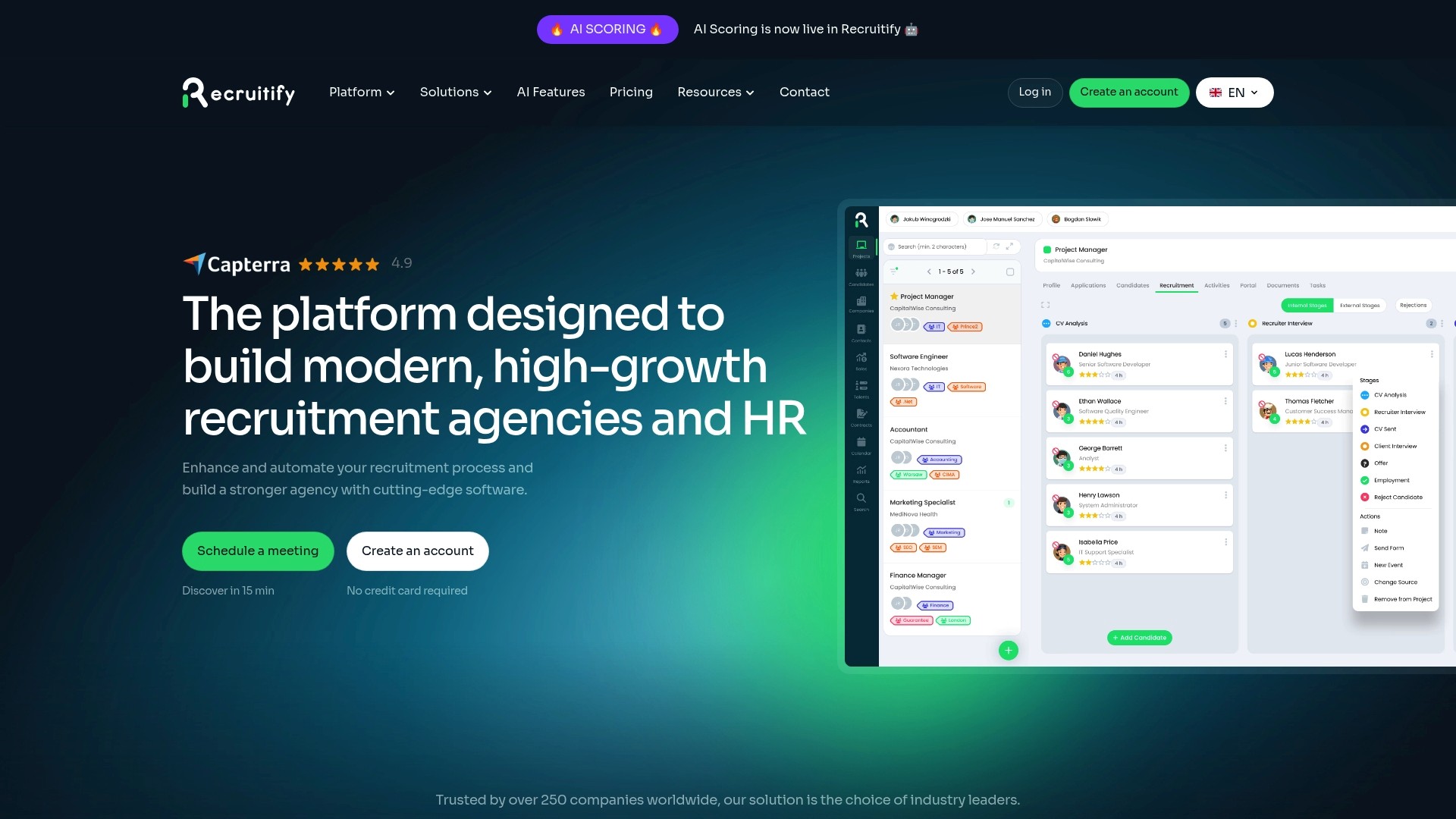
If you’re running a pilot, three metrics are worth tracking from day one: reduction in manual administrative hours, how often your forecast actually gets refreshed once the friction of updating it disappears, and time-to-fill on the specific roles your forecast flagged as priority. Contextual Matching AI & Scoring helps prioritize sourcing on exactly those hard-to-fill roles, while automation handles the administrative load that usually keeps forecasts from getting revisited often enough. Start a trial and run your next quarter’s forecast through a system built to act on it, not just report it.
Sources
A forecast is only as good as what feeds it. Recruitment forecasting draws on two distinct data streams, and skipping either one produces a lopsided model.
Internal data should include:
External data should include labor market supply signals, salary benchmarks for hard-to-fill roles, and broader skills trends. The World Economic Forum’s Future of Jobs Report tracks how demographics, automation, and policy shifts reshape talent supply, and those macro trends belong in any forecast that looks further out than a single quarter.
Pro Tip: Turn raw metrics into forecast drivers with a simple formula: projected headcount need = (current headcount × expected attrition rate) + (net new roles tied to revenue or product targets). Run that calculation by department, not company-wide, and the output becomes something a hiring manager can actually act on.
Practitioners who prioritize metrics executives already track, quality of hire, pipeline conversion, source ROI, and offer acceptance, get more traction with finance than teams reporting vanity numbers like total applications received. Refresh your internal data monthly at minimum, and audit data governance quarterly. Duplicate records and stale attrition figures quietly wreck forecast accuracy long before anyone notices.
FAQ
What Are the Four Types of Forecasting?
HR forecasting generally splits into trend-based (moving averages), driver-based (tied to business KPIs), predictive/statistical (machine learning models), and judgmental forecasting (expert or manager estimates used when data is thin).
What Are the Seven Steps of Workforce Forecasting?
A typical process runs: define business objectives, gather internal and external data, analyze current supply, project future demand, identify gaps, plan actions (hire, reskill, contract, automate), and monitor forecast accuracy against actual results.
What Are Common HR Forecasting Techniques?
The most-used techniques are trend extrapolation, driver-based demand modeling, and predictive analytics, often combined with scenario and sensitivity planning to stress-test assumptions like attrition and growth rate.
What Is the “Golden Rule” of Forecasting?
There’s no single universally agreed golden rule, but the closest consensus among practitioners is that forecasts should tie directly to business strategy and get revisited on a set cadence rather than treated as a fixed annual figure.
Can Software Like Recruitify Improve Forecast Accuracy?
Platforms that consolidate ATS, CRM, and contracting data into one system remove the manual reconciliation that typically delays forecast updates, which lets teams refresh projections more often and catch gaps sooner.
Recommended


News & Updates
Stay up-to-date with the latest innovations, features, and tips about Recruitify!
By providing your email address within the newsletter sign-up form, you confirm its processing to send marketing information regarding the Administrator’s products and services. The Administrator of your personal data processed for the abovementioned purposes is Recruitify Spółka z o.o., based in Warsaw, Poland (KRS 0000709889). For more information on the principles of personal data processing and the rights of data subjects, please check the Privacy Policy.

Last updated:
HR Leaders: Predictive Recruitment Forecasts That Turn Plans Into Hires
Applicant Tracking System
The Recruitify Team
Recruitment forecasting is the process of predicting future hiring needs using historical workforce data, business growth drivers, and attrition patterns rather than gut instinct. The recommended approach is driver-based forecasting tied directly to business strategy and core HR metrics, not a static annual headcount number. Get the drivers right, and everything downstream, from sourcing to budget, gets easier to plan.
TL;DR:
Using driver-based forecasting aligns recruitment plans with business strategies, enabling proactive talent sourcing ahead of project needs.
Combining trend extrapolation, driver models, and predictive analytics offers the most effective approach for different business volatility levels.
Regularly stress-testing key levers like revenue growth, attrition, and hiring speed improves forecast robustness and provides clear decision options.
Turning forecasts into actionable plans requires ownership, sign-off, and mapping specific hiring, reskilling, or contracting steps to projected gaps.
Integrated data platforms reduce reconciliation delays, improve forecast accuracy, and support frequent updates vital for dynamic workforce planning.
RecruitifyTurn Hiring Forecasts Into ActionRecruitify connects sales, recruitment, and contracting data, helping IT recruitment agencies act on projected workforce needs from one operational ecosystem.Explore Recruitify
Table of Contents
Why Recruitment Forecasting Matters for Business Strategy
What Forecasting Methods Should HR Teams Use?
How Do You Build Scenario and Sensitivity Plans?
From Forecast to Workforce Plan: An Operational Checklist
Which Tools and Integrations Actually Support Forecasting?
How Recruitify Approaches Forecasting Data in Practice
Common Forecasting Mistakes and the One Fix Worth Trying
Put Your Forecast Into Action With Recruitify
Sources
FAQ
Why Recruitment Forecasting Matters for Business Strategy
Most companies confuse two different exercises. Annual headcount budgeting asks, “How many people can finance approve for next year?” Strategic workforce planning asks a harder question: “What capabilities does the business need three to six years from now, and what does that require today?” Bain & Company recommends a six-year strategic horizon with a three-year checkpoint, arguing that the real value of the exercise is not numerical precision. It’s getting executives to agree on which capabilities matter most.
That distinction changes how HR teams should operate. A forecast built only around this year’s budget cycle reacts to vacancies after they open. A forecast built around business drivers, revenue targets, product launches, geographic expansion, anticipates them months in advance.
The CIPD’s framework for workforce planning separates the “hard” side of planning (headcount numbers, budgets, ratios) from the “soft” side (skills, capabilities, succession depth). Skipping the soft side is the single most common forecasting mistake. A team can hit its headcount target and still lack the skills the business actually needs.
Done well, recruitment forecasting delivers three concrete benefits:
Fewer emergency requisitions, because talent needs surface in planning conversations, not in a panicked hiring manager’s inbox.
A direct line between recruiting spend and business outcomes, which makes budget conversations with finance far less adversarial.
Better quality of hire, since sourcing teams get lead time instead of scrambling to fill a role in two weeks.
Cadence matters as much as method. Run a light operational forecast monthly, tied to open requisitions and near-term attrition. Run a full strategic forecast twice a year, owned jointly by HR leadership and finance, refreshed whenever a major business event (an acquisition, a new product line, a market exit) changes the underlying assumptions.
What Forecasting Methods Should HR Teams Use?
The right method depends on your time horizon and how volatile your business is, not on which model sounds the most sophisticated. Three approaches cover almost every situation an HR team will face.
Trend extrapolation and moving averages work for near-term, stable operational hiring. If a call center has added 8 to 10 agents per quarter for two years and the business hasn’t changed direction, a simple moving average predicts next quarter reasonably well. It fails the moment growth accelerates, a new market opens, or a product line gets cut.
Driver-based demand models link headcount directly to business KPIs, revenue per employee, units shipped per production worker, accounts managed per customer success rep. This is the workhorse method for most mid-size and enterprise teams because it forces a conversation about what actually drives the need for people, rather than treating headcount as its own independent variable.
Predictive analytics and machine learning models add real value for specialist, hard-to-fill roles where subtle patterns (skill adjacency, market scarcity signals, internal mobility patterns) matter more than a simple ratio. Forecasting algorithms can model talent shortages and reduce bias in evaluation, but they need volume and clean historical data to work. For high-volume, low-complexity roles, a predictive model usually adds cost without adding accuracy.
Here’s how the three stack up in practice:
Trend extrapolation: fast to build, needs minimal data, breaks down when the business changes direction.
Driver-based models: moderate effort, ties directly to strategy, requires clean finance and ops data to calibrate.
Predictive analytics: high setup cost, strongest for scarce or specialist roles, weak ROI without sufficient data volume.
For most organizations, the practical answer is a hybrid: driver-based models as the backbone, layered with scenario planning, and predictive analytics reserved specifically for the small number of roles that are genuinely hard to source.
How Do You Build Scenario and Sensitivity Plans?
Pick two or three levers, never more, and stress-test them against your base forecast. Trying to model every possible variable at once produces a plan nobody can act on.
The levers worth testing are almost always the same three: revenue growth rate, attrition rate, and hiring velocity (how fast the recruiting engine can actually fill approved roles). Everything else is usually a second-order effect of one of those three.
Build the base case first. This is your most-likely forecast using current trend data and approved business plans.
Flex each lever up and down independently. What happens to headcount need if attrition rises from 12% to 18%? What if revenue growth misses target by a third?
Read the gaps, not just the totals. A 15% swing in one department might be absorbable through cross-training; the same swing in a specialized engineering team might require six months of lead time you don’t have.
Attach a contingency to each scenario. Best case might mean pre-approving contractor budget. Worst case might mean a hiring pause with reskilling as the release valve.
Pro Tip: When presenting scenarios to leadership, never lead with the model’s mechanics. Lead with the decision it forces: “If growth comes in at the low end, we free up budget for reskilling. If it comes in high, we need approval to start sourcing for three specialist roles now, not in Q3.” Executives respond to decisions, not spreadsheets.
Contractors and body-leasing arrangements are worth building into every scenario as a release valve, since they let a team absorb a demand spike without a permanent headcount commitment that’s expensive to unwind if the spike doesn’t hold.
From Forecast to Workforce Plan: An Operational Checklist
A forecast that never turns into a staffing action is just a slide deck. The OPM workforce planning guide frames this as a direct link between supply-demand gaps and specific workforce actions, hire, reskill, redeploy, or contract out, rather than defaulting to hiring for every gap.
Start with ownership. Every forecast needs a named owner (usually a TA leader or HR business partner) and a sign-off gate with finance before it becomes an approved plan. Without that gate, forecasts drift into wish lists.
Once a gap is confirmed, sort it into one of five buckets:
Hire externally when the skill doesn’t exist internally and time allows a normal search.
Reskill or redeploy when the skill gap is close enough that internal mobility beats an external search.
Automate when the underlying task, not the role, is what’s actually driving the demand.
Contract or lease talent when the need is real but temporary or uncertain.
Delay when the gap is speculative and tied to a scenario that hasn’t materialized yet.
Map every approved action back to budget before it moves forward. Recruiting capacity (how many open roles one recruiter can realistically run at once) should factor into the plan the same way headcount does; overloading a lean recruiting team quietly extends time-to-fill across every open role, not just the new ones.
Forecast Element | What to Track | Review Cadence |
|---|---|---|
Forecast accuracy | Predicted vs. actual headcount by department | Quarterly |
Time-to-fill by role | Actual days vs. forecasted lead time | Monthly |
Budget-to-plan variance | Approved spend vs. forecasted spend | Quarterly |
Action-type mix | Share of gaps filled via hire, reskill, contract, automate | Semiannual |
Dashboards should sit in one place, visible to both HR and finance, so forecast accuracy becomes a shared metric instead of an HR-only scorecard nobody outside the department ever sees.
Which Tools and Integrations Actually Support Forecasting?
A forecast is only as reliable as the data pipeline behind it, and most of the failures HR teams run into trace back to fragmented systems rather than bad math.
Four capabilities matter more than any specific vendor:
A single source of truth for headcount, attrition, and requisition data, so finance and HR aren’t reconciling two different spreadsheets before every planning meeting.
Automated data extraction (ETL) from the ATS and CRM, so forecast inputs update without a manual export-import cycle every month.
Dashboards that surface funnel leakage, where candidates drop out of the pipeline, and source conversion rates, not just headcount totals.
A scenario-planning module that lets you flex assumptions without rebuilding the model from scratch each time.
HR dashboards that centralize ATS and payroll data are the foundation most forecasting processes are missing, according to workforce planning guidance from Indeed. Pull source-of-hire, pipeline conversion by stage, and offer acceptance rate directly from your applicant tracking system rather than reconstructing them by hand each quarter.
The buy-versus-build decision usually comes down to three factors: data maturity (do you already have clean historical records?), scale (is this worth a custom build, or does an off-the-shelf platform cover it?), and cost of delay (how much is a slow forecast actually costing you in emergency hires?). When evaluating any platform, look for real data connectors into your existing systems, a documented audit trail for compliance, and built-in scenario support, not just reporting after the fact.
How Recruitify Approaches Forecasting Data in Practice
Forecasting breaks down fastest when sales pipeline data, recruiting pipeline data, and contracting data live in three disconnected systems. Recruitify consolidates the ATS, CRM, and IT contracting workflow into one operational base, which removes the reconciliation work that usually eats up a forecasting cycle before the analysis even starts.
That consolidation matters practically, not just conceptually:
Automating a significant portion of administrative workflow tasks frees recruiting capacity that would otherwise go to data entry, capacity that can instead go toward sourcing the roles a forecast flags as priority.
Contextual Matching AI & Scoring evaluates candidates against project requirements automatically, which helps flag which open roles are genuinely hard to fill before a recruiter has spent weeks discovering that manually.
A single tab spanning sales opportunities and recruitment projects means demand signals from the sales pipeline feed directly into hiring forecasts instead of arriving as a surprise handoff between departments.
Agencies running pilots on this kind of integrated setup can track specific before-and-after numbers: manual hours reclaimed, forecast refresh frequency, and time-to-fill on the roles flagged as priority.
Common Forecasting Mistakes and the One Fix Worth Trying
The biggest mistake in recruitment forecasting isn’t a bad model. It’s treating the forecast as a single static number produced once a year and left alone until the next budget cycle. Business conditions shift monthly; a forecast that doesn’t shift with them is wrong the moment it’s finished.
Governance beats complexity here. A simple driver-based check run monthly, tied to actual attrition and pipeline data, outperforms an elaborate annual model nobody revisits. If you want one experiment for the next 90 days, pick your three highest-cost roles, build a driver-based forecast for just those, and compare it against actual outcomes every four weeks. That single habit tends to teach a team more about forecast accuracy than a full annual overhaul.
- Recruitify Team
Put Your Forecast Into Action With Recruitify
Building an accurate forecast is only half the job. Turning it into filled roles without drowning your team in spreadsheets and status meetings is where most plans stall. Recruitify closes that gap by connecting the forecast to the actual recruiting workflow: recruitment projects, candidate scoring, and contracting all inside one operational platform, so the gap between “we need three DevOps engineers by Q3” and an active sourcing project isn’t a separate step.
If you’re running a pilot, three metrics are worth tracking from day one: reduction in manual administrative hours, how often your forecast actually gets refreshed once the friction of updating it disappears, and time-to-fill on the specific roles your forecast flagged as priority. Contextual Matching AI & Scoring helps prioritize sourcing on exactly those hard-to-fill roles, while automation handles the administrative load that usually keeps forecasts from getting revisited often enough. Start a trial and run your next quarter’s forecast through a system built to act on it, not just report it.
Sources
A forecast is only as good as what feeds it. Recruitment forecasting draws on two distinct data streams, and skipping either one produces a lopsided model.
Internal data should include:
External data should include labor market supply signals, salary benchmarks for hard-to-fill roles, and broader skills trends. The World Economic Forum’s Future of Jobs Report tracks how demographics, automation, and policy shifts reshape talent supply, and those macro trends belong in any forecast that looks further out than a single quarter.
Pro Tip: Turn raw metrics into forecast drivers with a simple formula: projected headcount need = (current headcount × expected attrition rate) + (net new roles tied to revenue or product targets). Run that calculation by department, not company-wide, and the output becomes something a hiring manager can actually act on.
Practitioners who prioritize metrics executives already track, quality of hire, pipeline conversion, source ROI, and offer acceptance, get more traction with finance than teams reporting vanity numbers like total applications received. Refresh your internal data monthly at minimum, and audit data governance quarterly. Duplicate records and stale attrition figures quietly wreck forecast accuracy long before anyone notices.
FAQ
What Are the Four Types of Forecasting?
HR forecasting generally splits into trend-based (moving averages), driver-based (tied to business KPIs), predictive/statistical (machine learning models), and judgmental forecasting (expert or manager estimates used when data is thin).
What Are the Seven Steps of Workforce Forecasting?
A typical process runs: define business objectives, gather internal and external data, analyze current supply, project future demand, identify gaps, plan actions (hire, reskill, contract, automate), and monitor forecast accuracy against actual results.
What Are Common HR Forecasting Techniques?
The most-used techniques are trend extrapolation, driver-based demand modeling, and predictive analytics, often combined with scenario and sensitivity planning to stress-test assumptions like attrition and growth rate.
What Is the “Golden Rule” of Forecasting?
There’s no single universally agreed golden rule, but the closest consensus among practitioners is that forecasts should tie directly to business strategy and get revisited on a set cadence rather than treated as a fixed annual figure.
Can Software Like Recruitify Improve Forecast Accuracy?
Platforms that consolidate ATS, CRM, and contracting data into one system remove the manual reconciliation that typically delays forecast updates, which lets teams refresh projections more often and catch gaps sooner.
Recommended
News & Updates
Stay up-to-date with the latest innovations, features, and tips about Recruitify!
By providing your email address within the newsletter sign-up form, you confirm its processing to send marketing information regarding the Administrator’s products and services. The Administrator of your personal data processed for the abovementioned purposes is Recruitify Spółka z o.o., based in Warsaw, Poland (KRS 0000709889). For more information on the principles of personal data processing and the rights of data subjects, please check the Privacy Policy.
Last updated:
HR Leaders: Predictive Recruitment Forecasts That Turn Plans Into Hires
Applicant Tracking System
The Recruitify Team
Recruitment forecasting is the process of predicting future hiring needs using historical workforce data, business growth drivers, and attrition patterns rather than gut instinct. The recommended approach is driver-based forecasting tied directly to business strategy and core HR metrics, not a static annual headcount number. Get the drivers right, and everything downstream, from sourcing to budget, gets easier to plan.
TL;DR:
Using driver-based forecasting aligns recruitment plans with business strategies, enabling proactive talent sourcing ahead of project needs.
Combining trend extrapolation, driver models, and predictive analytics offers the most effective approach for different business volatility levels.
Regularly stress-testing key levers like revenue growth, attrition, and hiring speed improves forecast robustness and provides clear decision options.
Turning forecasts into actionable plans requires ownership, sign-off, and mapping specific hiring, reskilling, or contracting steps to projected gaps.
Integrated data platforms reduce reconciliation delays, improve forecast accuracy, and support frequent updates vital for dynamic workforce planning.
RecruitifyTurn Hiring Forecasts Into ActionRecruitify connects sales, recruitment, and contracting data, helping IT recruitment agencies act on projected workforce needs from one operational ecosystem.Explore Recruitify
Table of Contents
Why Recruitment Forecasting Matters for Business Strategy
What Forecasting Methods Should HR Teams Use?
How Do You Build Scenario and Sensitivity Plans?
From Forecast to Workforce Plan: An Operational Checklist
Which Tools and Integrations Actually Support Forecasting?
How Recruitify Approaches Forecasting Data in Practice
Common Forecasting Mistakes and the One Fix Worth Trying
Put Your Forecast Into Action With Recruitify
Sources
FAQ
Why Recruitment Forecasting Matters for Business Strategy
Most companies confuse two different exercises. Annual headcount budgeting asks, “How many people can finance approve for next year?” Strategic workforce planning asks a harder question: “What capabilities does the business need three to six years from now, and what does that require today?” Bain & Company recommends a six-year strategic horizon with a three-year checkpoint, arguing that the real value of the exercise is not numerical precision. It’s getting executives to agree on which capabilities matter most.
That distinction changes how HR teams should operate. A forecast built only around this year’s budget cycle reacts to vacancies after they open. A forecast built around business drivers, revenue targets, product launches, geographic expansion, anticipates them months in advance.
The CIPD’s framework for workforce planning separates the “hard” side of planning (headcount numbers, budgets, ratios) from the “soft” side (skills, capabilities, succession depth). Skipping the soft side is the single most common forecasting mistake. A team can hit its headcount target and still lack the skills the business actually needs.
Done well, recruitment forecasting delivers three concrete benefits:
Fewer emergency requisitions, because talent needs surface in planning conversations, not in a panicked hiring manager’s inbox.
A direct line between recruiting spend and business outcomes, which makes budget conversations with finance far less adversarial.
Better quality of hire, since sourcing teams get lead time instead of scrambling to fill a role in two weeks.
Cadence matters as much as method. Run a light operational forecast monthly, tied to open requisitions and near-term attrition. Run a full strategic forecast twice a year, owned jointly by HR leadership and finance, refreshed whenever a major business event (an acquisition, a new product line, a market exit) changes the underlying assumptions.
What Forecasting Methods Should HR Teams Use?
The right method depends on your time horizon and how volatile your business is, not on which model sounds the most sophisticated. Three approaches cover almost every situation an HR team will face.
Trend extrapolation and moving averages work for near-term, stable operational hiring. If a call center has added 8 to 10 agents per quarter for two years and the business hasn’t changed direction, a simple moving average predicts next quarter reasonably well. It fails the moment growth accelerates, a new market opens, or a product line gets cut.
Driver-based demand models link headcount directly to business KPIs, revenue per employee, units shipped per production worker, accounts managed per customer success rep. This is the workhorse method for most mid-size and enterprise teams because it forces a conversation about what actually drives the need for people, rather than treating headcount as its own independent variable.
Predictive analytics and machine learning models add real value for specialist, hard-to-fill roles where subtle patterns (skill adjacency, market scarcity signals, internal mobility patterns) matter more than a simple ratio. Forecasting algorithms can model talent shortages and reduce bias in evaluation, but they need volume and clean historical data to work. For high-volume, low-complexity roles, a predictive model usually adds cost without adding accuracy.
Here’s how the three stack up in practice:
Trend extrapolation: fast to build, needs minimal data, breaks down when the business changes direction.
Driver-based models: moderate effort, ties directly to strategy, requires clean finance and ops data to calibrate.
Predictive analytics: high setup cost, strongest for scarce or specialist roles, weak ROI without sufficient data volume.
For most organizations, the practical answer is a hybrid: driver-based models as the backbone, layered with scenario planning, and predictive analytics reserved specifically for the small number of roles that are genuinely hard to source.
How Do You Build Scenario and Sensitivity Plans?
Pick two or three levers, never more, and stress-test them against your base forecast. Trying to model every possible variable at once produces a plan nobody can act on.
The levers worth testing are almost always the same three: revenue growth rate, attrition rate, and hiring velocity (how fast the recruiting engine can actually fill approved roles). Everything else is usually a second-order effect of one of those three.
Build the base case first. This is your most-likely forecast using current trend data and approved business plans.
Flex each lever up and down independently. What happens to headcount need if attrition rises from 12% to 18%? What if revenue growth misses target by a third?
Read the gaps, not just the totals. A 15% swing in one department might be absorbable through cross-training; the same swing in a specialized engineering team might require six months of lead time you don’t have.
Attach a contingency to each scenario. Best case might mean pre-approving contractor budget. Worst case might mean a hiring pause with reskilling as the release valve.
Pro Tip: When presenting scenarios to leadership, never lead with the model’s mechanics. Lead with the decision it forces: “If growth comes in at the low end, we free up budget for reskilling. If it comes in high, we need approval to start sourcing for three specialist roles now, not in Q3.” Executives respond to decisions, not spreadsheets.
Contractors and body-leasing arrangements are worth building into every scenario as a release valve, since they let a team absorb a demand spike without a permanent headcount commitment that’s expensive to unwind if the spike doesn’t hold.
From Forecast to Workforce Plan: An Operational Checklist
A forecast that never turns into a staffing action is just a slide deck. The OPM workforce planning guide frames this as a direct link between supply-demand gaps and specific workforce actions, hire, reskill, redeploy, or contract out, rather than defaulting to hiring for every gap.
Start with ownership. Every forecast needs a named owner (usually a TA leader or HR business partner) and a sign-off gate with finance before it becomes an approved plan. Without that gate, forecasts drift into wish lists.
Once a gap is confirmed, sort it into one of five buckets:
Hire externally when the skill doesn’t exist internally and time allows a normal search.
Reskill or redeploy when the skill gap is close enough that internal mobility beats an external search.
Automate when the underlying task, not the role, is what’s actually driving the demand.
Contract or lease talent when the need is real but temporary or uncertain.
Delay when the gap is speculative and tied to a scenario that hasn’t materialized yet.
Map every approved action back to budget before it moves forward. Recruiting capacity (how many open roles one recruiter can realistically run at once) should factor into the plan the same way headcount does; overloading a lean recruiting team quietly extends time-to-fill across every open role, not just the new ones.
Forecast Element | What to Track | Review Cadence |
|---|---|---|
Forecast accuracy | Predicted vs. actual headcount by department | Quarterly |
Time-to-fill by role | Actual days vs. forecasted lead time | Monthly |
Budget-to-plan variance | Approved spend vs. forecasted spend | Quarterly |
Action-type mix | Share of gaps filled via hire, reskill, contract, automate | Semiannual |
Dashboards should sit in one place, visible to both HR and finance, so forecast accuracy becomes a shared metric instead of an HR-only scorecard nobody outside the department ever sees.
Which Tools and Integrations Actually Support Forecasting?
A forecast is only as reliable as the data pipeline behind it, and most of the failures HR teams run into trace back to fragmented systems rather than bad math.
Four capabilities matter more than any specific vendor:
A single source of truth for headcount, attrition, and requisition data, so finance and HR aren’t reconciling two different spreadsheets before every planning meeting.
Automated data extraction (ETL) from the ATS and CRM, so forecast inputs update without a manual export-import cycle every month.
Dashboards that surface funnel leakage, where candidates drop out of the pipeline, and source conversion rates, not just headcount totals.
A scenario-planning module that lets you flex assumptions without rebuilding the model from scratch each time.
HR dashboards that centralize ATS and payroll data are the foundation most forecasting processes are missing, according to workforce planning guidance from Indeed. Pull source-of-hire, pipeline conversion by stage, and offer acceptance rate directly from your applicant tracking system rather than reconstructing them by hand each quarter.
The buy-versus-build decision usually comes down to three factors: data maturity (do you already have clean historical records?), scale (is this worth a custom build, or does an off-the-shelf platform cover it?), and cost of delay (how much is a slow forecast actually costing you in emergency hires?). When evaluating any platform, look for real data connectors into your existing systems, a documented audit trail for compliance, and built-in scenario support, not just reporting after the fact.
How Recruitify Approaches Forecasting Data in Practice
Forecasting breaks down fastest when sales pipeline data, recruiting pipeline data, and contracting data live in three disconnected systems. Recruitify consolidates the ATS, CRM, and IT contracting workflow into one operational base, which removes the reconciliation work that usually eats up a forecasting cycle before the analysis even starts.
That consolidation matters practically, not just conceptually:
Automating a significant portion of administrative workflow tasks frees recruiting capacity that would otherwise go to data entry, capacity that can instead go toward sourcing the roles a forecast flags as priority.
Contextual Matching AI & Scoring evaluates candidates against project requirements automatically, which helps flag which open roles are genuinely hard to fill before a recruiter has spent weeks discovering that manually.
A single tab spanning sales opportunities and recruitment projects means demand signals from the sales pipeline feed directly into hiring forecasts instead of arriving as a surprise handoff between departments.
Agencies running pilots on this kind of integrated setup can track specific before-and-after numbers: manual hours reclaimed, forecast refresh frequency, and time-to-fill on the roles flagged as priority.
Common Forecasting Mistakes and the One Fix Worth Trying
The biggest mistake in recruitment forecasting isn’t a bad model. It’s treating the forecast as a single static number produced once a year and left alone until the next budget cycle. Business conditions shift monthly; a forecast that doesn’t shift with them is wrong the moment it’s finished.
Governance beats complexity here. A simple driver-based check run monthly, tied to actual attrition and pipeline data, outperforms an elaborate annual model nobody revisits. If you want one experiment for the next 90 days, pick your three highest-cost roles, build a driver-based forecast for just those, and compare it against actual outcomes every four weeks. That single habit tends to teach a team more about forecast accuracy than a full annual overhaul.
- Recruitify Team
Put Your Forecast Into Action With Recruitify
Building an accurate forecast is only half the job. Turning it into filled roles without drowning your team in spreadsheets and status meetings is where most plans stall. Recruitify closes that gap by connecting the forecast to the actual recruiting workflow: recruitment projects, candidate scoring, and contracting all inside one operational platform, so the gap between “we need three DevOps engineers by Q3” and an active sourcing project isn’t a separate step.
If you’re running a pilot, three metrics are worth tracking from day one: reduction in manual administrative hours, how often your forecast actually gets refreshed once the friction of updating it disappears, and time-to-fill on the specific roles your forecast flagged as priority. Contextual Matching AI & Scoring helps prioritize sourcing on exactly those hard-to-fill roles, while automation handles the administrative load that usually keeps forecasts from getting revisited often enough. Start a trial and run your next quarter’s forecast through a system built to act on it, not just report it.
Sources
A forecast is only as good as what feeds it. Recruitment forecasting draws on two distinct data streams, and skipping either one produces a lopsided model.
Internal data should include:
External data should include labor market supply signals, salary benchmarks for hard-to-fill roles, and broader skills trends. The World Economic Forum’s Future of Jobs Report tracks how demographics, automation, and policy shifts reshape talent supply, and those macro trends belong in any forecast that looks further out than a single quarter.
Pro Tip: Turn raw metrics into forecast drivers with a simple formula: projected headcount need = (current headcount × expected attrition rate) + (net new roles tied to revenue or product targets). Run that calculation by department, not company-wide, and the output becomes something a hiring manager can actually act on.
Practitioners who prioritize metrics executives already track, quality of hire, pipeline conversion, source ROI, and offer acceptance, get more traction with finance than teams reporting vanity numbers like total applications received. Refresh your internal data monthly at minimum, and audit data governance quarterly. Duplicate records and stale attrition figures quietly wreck forecast accuracy long before anyone notices.
FAQ
What Are the Four Types of Forecasting?
HR forecasting generally splits into trend-based (moving averages), driver-based (tied to business KPIs), predictive/statistical (machine learning models), and judgmental forecasting (expert or manager estimates used when data is thin).
What Are the Seven Steps of Workforce Forecasting?
A typical process runs: define business objectives, gather internal and external data, analyze current supply, project future demand, identify gaps, plan actions (hire, reskill, contract, automate), and monitor forecast accuracy against actual results.
What Are Common HR Forecasting Techniques?
The most-used techniques are trend extrapolation, driver-based demand modeling, and predictive analytics, often combined with scenario and sensitivity planning to stress-test assumptions like attrition and growth rate.
What Is the “Golden Rule” of Forecasting?
There’s no single universally agreed golden rule, but the closest consensus among practitioners is that forecasts should tie directly to business strategy and get revisited on a set cadence rather than treated as a fixed annual figure.
Can Software Like Recruitify Improve Forecast Accuracy?
Platforms that consolidate ATS, CRM, and contracting data into one system remove the manual reconciliation that typically delays forecast updates, which lets teams refresh projections more often and catch gaps sooner.
Recommended
News & Updates
Stay up-to-date with the latest innovations, features, and tips about Recruitify!
By providing your email address within the newsletter sign-up form, you confirm its processing to send marketing information regarding the Administrator’s products and services. The Administrator of your personal data processed for the abovementioned purposes is Recruitify Spółka z o.o., based in Warsaw, Poland (KRS 0000709889). For more information on the principles of personal data processing and the rights of data subjects, please check the Privacy Policy.

Discover More

Applicant Tracking System
Skills Based Hiring: Launch a 3–5 Competency Pilot for HR Teams
Practical roadmap for HR: pilot skills based hiring, pick 3–5 competencies, use 30–90 minute work samples, run a measured pilot, and track core KPIs.
14 Sept 2026
Discover More

Recruitment Process
Cut 70% Admin Time With AI Interview Scheduling for Enterprise HR
Cut administrative work by 70% with AI interview scheduling. A practical, enterprise-focused checklist to evaluate vendors, pilot rollout, and reduce...
13 Sept 2026
Discover More

Recruitment Process
Start With 3 Recruitment KPIs That Actually Drive Agency Growth
Focus on three starter KPIs—time to fill, fill rate, gross margin. Use a stage aware cadence and unified reporting to close handoffs and boost accuracy.
12 Sept 2026
Discover More
Applicant Tracking System
Skills Based Hiring: Launch a 3–5 Competency Pilot for HR Teams
Practical roadmap for HR: pilot skills based hiring, pick 3–5 competencies, use 30–90 minute work samples, run a measured pilot, and track core KPIs.
14 Sept 2026
Discover More
Recruitment Process
Cut 70% Admin Time With AI Interview Scheduling for Enterprise HR
Cut administrative work by 70% with AI interview scheduling. A practical, enterprise-focused checklist to evaluate vendors, pilot rollout, and reduce...
13 Sept 2026
Discover More