Last updated:
Skills Based Hiring: Launch a 3–5 Competency Pilot for HR Teams

Applicant Tracking System

Iwo Paliszewski
Skills-based hiring means evaluating candidates on demonstrated abilities, such as coding tests, work samples, and structured interviews, rather than relying on degree requirements or years of experience as proxies for capability. The immediate payoff for employers is a wider, more accurate applicant pool and a better match between what a candidate can actually do and what the role requires. The practical next step is simple: pick one role, build a competency dictionary with three to five skills, and run a measured pilot before rolling it out further.
Skills-based hiring reduces reliance on degrees or experience by focusing on demonstrated abilities, leading to faster and more cost-effective recruitment.
Building a competency dictionary with three to five core skills per role and calibrating scorers ensures consistent and fair assessment outcomes.
Effective assessments are standardized, take 30 to 90 minutes, and align with real job tasks, with rubrics written before candidate responses are reviewed.
Pilot programs should start with one or two roles, measure success against clear KPIs, and avoid covering too many competencies or assessment stages at once.
Recruitment platforms equipped with AI scoring, CV parsing, and automation streamline the process, support documentation, and help maintain fairness and compliance.
RecruitifyMake Skills-Based Hiring OperationalRecruitify combines AI matching, scoring, CV parsing, and workflow automation to help recruitment teams manage skills-focused hiring in one system.Explore Recruitify
Table of Contents
What Is Skills-Based Hiring and Why Does It Matter Now?
How Do You Build a Skills-Based Hiring Program Step by Step?
How Do You Design Fair, Valid Skills Assessments?
How Do You Write Job Postings That Attract Skills-First Applicants?
What KPIs Prove Skills-Based Hiring Is Working?
What Are the Common Pitfalls in Skills-Based Hiring?
How Does Recruitment Technology Operationalize Skills-Based Hiring?
When Should HR Teams Act, and When Should They Wait?
How Recruitify Supports a Skills-Based Hiring Pilot
Sources
FAQ
What Is Skills-Based Hiring and Why Does It Matter Now?
Skills-based hiring is gaining traction because the old proxies are failing employers more often than they succeed. A four-year degree tells you a candidate finished school. It tells you almost nothing about whether they can debug a production issue, write a persuasive proposal, or manage a client escalation under pressure.
The data backs up the shift. In a SHRM survey of 1,688 members, 56% of employers already use pre-employment assessments, and 79% of those employers say the assessments matter as much as, or more than, traditional criteria like degrees and years of experience. That is not a fringe practice anymore. It is closer to the median approach among employers who screen seriously.
Statistic Callout: Among employers using pre-employment skills assessments, 79% rate them as equally or more important than education and experience requirements, according to SHRM.
The Skills-First Hiring Starter Kit published through Apprenticeship.gov compiles employer-reported results that make the business case concrete:
Many adopters reported reduced time-to-hire.
Many adopters reported reduced hiring costs.
Many adopters reported improved retention.
Those numbers matter, but the Burning Glass Institute found a gap between public commitment and daily practice. Plenty of employers announce they have dropped degree requirements, yet postings, screening criteria, and hiring manager habits often stay unchanged. The payoff shows up only when the shift is actually implemented, measured, and enforced, not just declared in a press release.
How Do You Build a Skills-Based Hiring Program Step by Step?
A pilot beats a full rollout every time. Here is the sequence that gets HR teams from concept to a working, measurable program.
Pick one or two pilot roles. Choose roles with high hiring volume or a known gap between resume-based screening and actual job performance. Set measurable success criteria upfront, such as reducing time-to-hire by a set number of days or improving 90-day performance ratings.
Profile the role using the 3-5 competency rule. Interview the hiring manager and two or three top performers currently in the role. Distill what you learn into three to five core competencies, never more. Practitioner guidance consistently points to this range because scoring consistency collapses once interviewers have to juggle a longer list.
Build a competency dictionary. For each competency, write a clear definition plus three observable behavioral levels (basic, proficient, expert). This becomes the shared language your interviewers and assessment rubrics use, echoing the competency-based recruitment approach of reducing subjective judgment through structured, observable criteria.
Choose your assessment mix. Match the method to the competency. Technical skills often suit a timed work sample. Collaboration or judgment often suits a structured behavioral interview. Consider pairing technical tests with a learning-agility measure, since skills decay and the ability to pick up new ones fast is often as predictive as current proficiency.
Design pilot logistics before you launch. Decide where the assessment sits in your funnel, how long candidates get, who scores it, and how ties get resolved. Write this down. You will need it later for both consistency and compliance defense.
Calibrate your scorers. Run at least one calibration session where two evaluators independently score the same set of sample responses, then compare and reconcile differences. Skipping this step is the single most common reason skills-based pilots produce inconsistent, hard-to-defend results.
Train hiring managers before go-live. A rubric is only as good as the person applying it. Walk hiring managers through the competency dictionary, show them scored examples at each level, and have them practice on a handful of past candidates before they touch live applicants.
Launch, track, and review at a fixed interval. Set a review point at 30 or 60 days to check whether the pilot is hitting its success criteria, then decide whether to expand, adjust, or shelve it.
Pro Tip: Run your first calibration session with anonymized past candidate responses, not live applicants. It removes any pressure to “get the right answer” and lets scorers focus purely on how consistently they interpret the rubric.
Centralizing the pilot roles, competency dictionaries, and scoring data in one place rather than scattered spreadsheets makes the calibration and review steps far less painful. A dedicated recruitment project workspace keeps every pilot’s criteria and outcomes attached to the role itself, which matters once you are running two or three pilots at once and need to compare results.

How Do You Design Fair, Valid Skills Assessments?
Good work samples share three traits: they mirror a real task from the job, they are standardized so every candidate faces the same challenge, and they respect the candidate’s time. Design guidance from structured skills-assessment research recommends keeping most work samples between 30 and 90 minutes, scored against a rubric written before a single candidate takes the test.
Rubric construction follows a simple pattern:
Write the rubric before you see any candidate responses, not after.
Anchor each score level to a real example, not just an abstract description.
Limit scoring dimensions to the same three to five competencies from your dictionary, so the rubric and the job profile stay in sync.
Run a calibration pass with two scorers on identical sample answers before the assessment goes live, reconciling any gaps in interpretation.
Placement in the funnel matters as much as the assessment itself. Run skills assessments after an initial resume or portfolio triage, not before it. Assessing your entire applicant pool wastes grading effort on candidates who were never going to clear a basic qualifications bar, and it slows down the strong candidates you actually want to move quickly.
A common mistake is stacking too many assessment stages, one technical test plus a case study plus a panel interview, all measuring roughly the same competencies. That fatigues candidates and rarely adds predictive value beyond the first well-designed measure. Combining one work sample with one structured interview tends to balance predictive validity against candidate time, adjusting the mix based on how critical the role is. Document every rubric, scoring decision, and calibration session. That paper trail is what supports your process if a hiring decision is ever challenged on fairness grounds.
How Do You Write Job Postings That Attract Skills-First Applicants?
Traditional job postings filter out capable people before they ever apply. A posting that lists “bachelor’s degree required” and “5+ years experience” as hard requirements will screen out a self-taught developer or a career-changer who has the actual skill but not the credential trail. Rewriting postings around skills fixes that at the source.
Practical wording changes:
Replace “Bachelor’s degree in Computer Science required” with “Demonstrated proficiency in [specific skill], shown through projects, certifications, or work experience.”
State outcomes instead of requirements: “You will be able to debug production issues within an SLA” instead of “3+ years of experience required.”
Explicitly invite non-traditional paths, mirroring guidance from NACE’s research on skills-based candidate expectations: “We welcome applicants who gained this skill through bootcamps, self-study, military training, or on-the-job experience.”
Keep the application form short. Ask for a resume and, where relevant, an optional portfolio or work sample link, not a five-page application.
State the assessment timeline upfront. Candidates who know they will hear back within two weeks and take one 45-minute assessment are far more likely to finish the process.
Pro Tip: Add one sentence to every posting stating exactly how skills will be evaluated. Candidates who know a work sample is coming, rather than being surprised by it mid-process, complete assessments at noticeably higher rates.
What KPIs Prove Skills-Based Hiring Is Working?
Four numbers tell you whether the pilot is paying off: time-to-hire, time-to-productivity, quality-of-hire at the 3, 6, and 12-month marks, and early attrition within the first 90 days. Track them against a baseline from your prior hiring process for the same role, not against an industry average that may not reflect your context.
Time-to-hire: days from posting to offer acceptance, tracked before and after the pilot.
Time-to-productivity: how long until a new hire reaches expected output, based on manager check-ins at 30 and 60 days.
Quality-of-hire: manager performance ratings at 3, 6, and 12 months, compared against hires made through your old process.
Early attrition: percentage of hires who leave or are let go within 90 days.
Statistic Callout: Employers running skills-first programs reported 81% reduced time-to-hire and 91% improved retention, according to the Skills-First Hiring Starter Kit. Use those figures as a benchmark, not a guarantee, when setting your own pilot targets.
Review a simple dashboard monthly during the pilot, then quarterly once the program stabilizes. Feed the same competency scores into learning and development planning. A candidate who scores “proficient” but not “expert” on a given competency is a clear signal for a targeted onboarding plan, and the same data supports internal mobility decisions later.
What Are the Common Pitfalls in Skills-Based Hiring?
Most failed pilots share the same handful of mistakes, and nearly all of them are avoidable with a bit of discipline upfront.
Assessment bloat. Piling on more than five competencies, or stacking multiple redundant assessment stages, produces inconsistent scoring and candidate drop-off.
Skipping calibration. Without a reconciliation session between scorers, the same answer can earn wildly different scores from different interviewers.
Unpaid production work. Asking candidates to complete a real, deliverable-grade project for free is both an ethical problem and a fairness risk. Keep work samples time-boxed and clearly scoped as an evaluation exercise, not free labor.
Thin documentation. Under EEOC job-relatedness standards, you need a written record connecting each assessment to a documented job requirement. Retroactively justifying an assessment after a challenge is far harder than documenting it before launch.
Pay discounting. Some employers quietly offer lower salaries to non-degree hires who cleared the same skills bar as degree holders. That undermines the entire premise of the program and creates real legal exposure. If the skill is equivalent, the pay should be too.
How Does Recruitment Technology Operationalize Skills-Based Hiring?
Running a skills-based program by spreadsheet works for one pilot role. It falls apart once you are managing competency dictionaries, rubrics, and scores across a dozen open roles at once. This is where automation earns its place in the process rather than just adding convenience.
AI candidate scoring compares applications against a role’s competency profile automatically, cutting the manual screening time that would otherwise go into reading every resume by hand.
CV parsing with OCR extracts structured data from resumes and builds a candidate profile in seconds, populating the same fields your competency dashboard needs without manual re-entry.
Workflow automation keeps assessment stages, scoring, and reviewer sign-off moving in sequence, while preserving a timestamped audit trail for every decision, which matters directly for the documentation that EEOC defensibility requires.
Consolidated reporting ties assessment scores back to time-to-hire and quality-of-hire metrics automatically, instead of requiring someone to reconcile numbers from three different systems.
A platform like contextual matching AI can turn a role’s competency dictionary into a live scoring model, so shortlists reflect skill match rather than keyword overlap alone.
When Should HR Teams Act, and When Should They Wait?
The instinct to roll out skills-based hiring company-wide in one move is understandable, but it is the wrong instinct. Pilot first, on one or two roles, and give yourself a real measurement window before touching anything else. Programs that skip straight to scale almost always run into the same wall the Burning Glass Institute documented: a public commitment with no operational follow-through, because nobody built the calibration and measurement infrastructure first.
The teams that succeed treat this as a governance project, not just a recruiting tactic. Align hiring managers, L&D, and compensation before expanding beyond the pilot, because a competency model that only recruiting understands will not survive contact with a hiring manager who was never trained on it. Calibration and documentation are not bureaucratic overhead. They are what makes the difference between a program you can defend and one you cannot.
- Recruitify Team
How Recruitify Supports a Skills-Based Hiring Pilot
The platform gives HR teams a way to run the calibration, scoring, and documentation work this article describes without adding headcount to manage it. Instead of tracking competency scores in one spreadsheet and candidate status in another, the platform’s contextual matching AI scores applications against your role’s competency profile directly, and its CV parser builds structured candidate data in seconds.
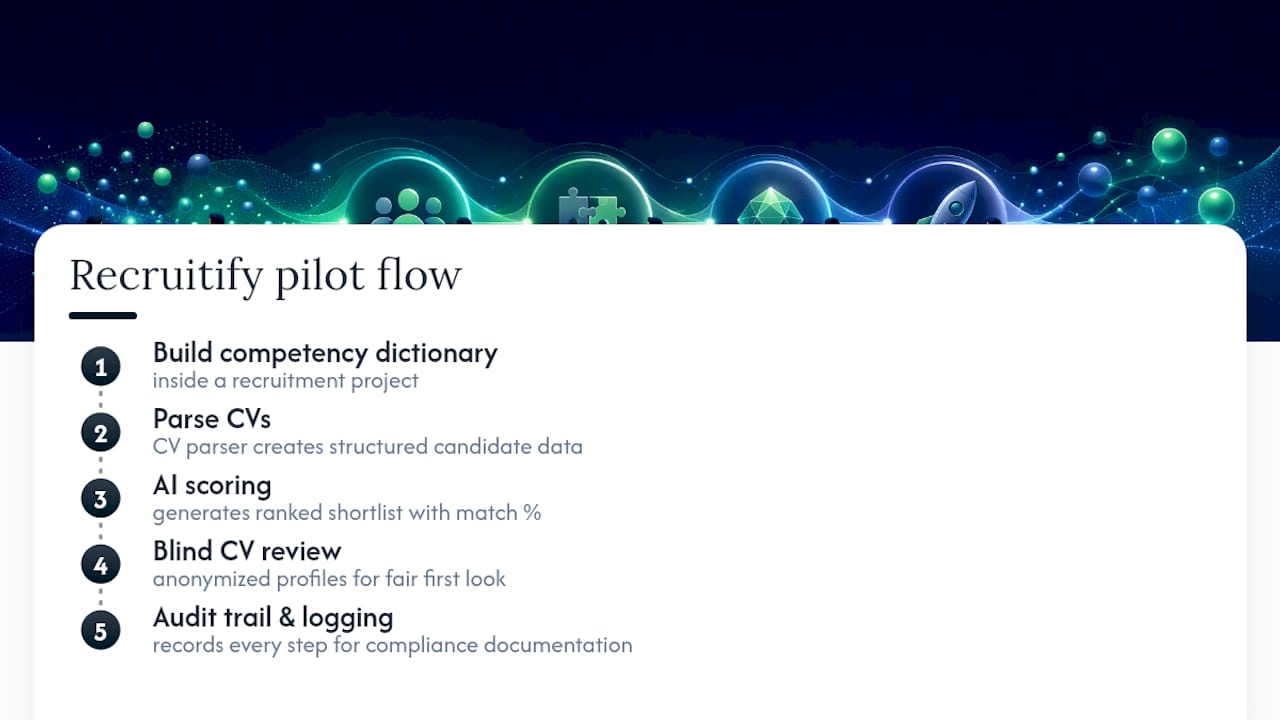
A typical flow looks like this: build your competency dictionary inside a recruitment project, let AI scoring generate a ranked shortlist with match percentages, then hand hiring managers an anonymized profile through the Blind CV module for a fairer first look. Every step, from initial screen to final scoring, can be logged in an audit trail that supports the documentation your compliance file needs.
Automation tools built into the platform handle the repetitive parts of assessment orchestration, so your recruiters spend their time on calibration and candidate conversations instead of chasing spreadsheet updates. If your pilot is ready to move past manual tracking, request a walkthrough of the platform to see how a role profile can become a scored shortlist in minutes rather than days.
Sources
The SHRM survey on skills assessments provides the adoption statistics cited throughout this guide. The Apprenticeship.gov Skills-First Hiring Starter Kit offers a practical government-issued framework with employer-reported outcomes. The Burning Glass Institute’s research documents the gap between skills-based announcements and actual implementation. SHL’s Global Skills Assessment illustrates how vendor-built competency taxonomies support consistent measurement.
Using Skills Assessments Over Education, Experience Requirements - SHRM
Skills-Based Hiring: The Long Road from Pronouncements to Practice - Burning Glass Institute
How to Structure a Skills Assessment for Remote Hires - Get Claude library
FAQ
What Is the Difference Between Skills-Based and Traditional Hiring?
Traditional hiring screens primarily on degree and years of experience as proxies for ability, while skills-based hiring evaluates the actual skill directly through assessments, work samples, or structured interviews.
How Many Competencies Should a Skills-Based Role Profile Have?
Practitioner guidance recommends limiting each role profile to three to five core competencies, since longer lists tend to produce inconsistent scoring across interviewers.
How Long Should a Skills Assessment Take?
Most effective work-sample assessments run between 30 and 90 minutes and are standardized and rubric-scored, according to structured assessment design guidance.
Does Skills-Based Hiring Really Reduce Time-to-Hire?
Employers adopting skills-first programs reported an 81% reduction in time-to-hire and a 78% reduction in hiring costs, per the Skills-First Hiring Starter Kit.
Can Recruitment Software Support a Skills-Based Hiring Pilot?
Yes. Platforms like Recruitify combine AI scoring, CV parsing, and workflow automation to build structured competency profiles and maintain the audit trail needed for consistent, defensible skills-based screening.
Recommended


News & Updates
Stay up-to-date with the latest innovations, features, and tips about Recruitify!
By providing your email address within the newsletter sign-up form, you confirm its processing to send marketing information regarding the Administrator’s products and services. The Administrator of your personal data processed for the abovementioned purposes is Recruitify Spółka z o.o., based in Warsaw, Poland (KRS 0000709889). For more information on the principles of personal data processing and the rights of data subjects, please check the Privacy Policy.

Last updated:
Skills Based Hiring: Launch a 3–5 Competency Pilot for HR Teams
Applicant Tracking System
Iwo Paliszewski
Skills-based hiring means evaluating candidates on demonstrated abilities, such as coding tests, work samples, and structured interviews, rather than relying on degree requirements or years of experience as proxies for capability. The immediate payoff for employers is a wider, more accurate applicant pool and a better match between what a candidate can actually do and what the role requires. The practical next step is simple: pick one role, build a competency dictionary with three to five skills, and run a measured pilot before rolling it out further.
Skills-based hiring reduces reliance on degrees or experience by focusing on demonstrated abilities, leading to faster and more cost-effective recruitment.
Building a competency dictionary with three to five core skills per role and calibrating scorers ensures consistent and fair assessment outcomes.
Effective assessments are standardized, take 30 to 90 minutes, and align with real job tasks, with rubrics written before candidate responses are reviewed.
Pilot programs should start with one or two roles, measure success against clear KPIs, and avoid covering too many competencies or assessment stages at once.
Recruitment platforms equipped with AI scoring, CV parsing, and automation streamline the process, support documentation, and help maintain fairness and compliance.
RecruitifyMake Skills-Based Hiring OperationalRecruitify combines AI matching, scoring, CV parsing, and workflow automation to help recruitment teams manage skills-focused hiring in one system.Explore Recruitify
Table of Contents
What Is Skills-Based Hiring and Why Does It Matter Now?
How Do You Build a Skills-Based Hiring Program Step by Step?
How Do You Design Fair, Valid Skills Assessments?
How Do You Write Job Postings That Attract Skills-First Applicants?
What KPIs Prove Skills-Based Hiring Is Working?
What Are the Common Pitfalls in Skills-Based Hiring?
How Does Recruitment Technology Operationalize Skills-Based Hiring?
When Should HR Teams Act, and When Should They Wait?
How Recruitify Supports a Skills-Based Hiring Pilot
Sources
FAQ
What Is Skills-Based Hiring and Why Does It Matter Now?
Skills-based hiring is gaining traction because the old proxies are failing employers more often than they succeed. A four-year degree tells you a candidate finished school. It tells you almost nothing about whether they can debug a production issue, write a persuasive proposal, or manage a client escalation under pressure.
The data backs up the shift. In a SHRM survey of 1,688 members, 56% of employers already use pre-employment assessments, and 79% of those employers say the assessments matter as much as, or more than, traditional criteria like degrees and years of experience. That is not a fringe practice anymore. It is closer to the median approach among employers who screen seriously.
Statistic Callout: Among employers using pre-employment skills assessments, 79% rate them as equally or more important than education and experience requirements, according to SHRM.
The Skills-First Hiring Starter Kit published through Apprenticeship.gov compiles employer-reported results that make the business case concrete:
Many adopters reported reduced time-to-hire.
Many adopters reported reduced hiring costs.
Many adopters reported improved retention.
Those numbers matter, but the Burning Glass Institute found a gap between public commitment and daily practice. Plenty of employers announce they have dropped degree requirements, yet postings, screening criteria, and hiring manager habits often stay unchanged. The payoff shows up only when the shift is actually implemented, measured, and enforced, not just declared in a press release.
How Do You Build a Skills-Based Hiring Program Step by Step?
A pilot beats a full rollout every time. Here is the sequence that gets HR teams from concept to a working, measurable program.
Pick one or two pilot roles. Choose roles with high hiring volume or a known gap between resume-based screening and actual job performance. Set measurable success criteria upfront, such as reducing time-to-hire by a set number of days or improving 90-day performance ratings.
Profile the role using the 3-5 competency rule. Interview the hiring manager and two or three top performers currently in the role. Distill what you learn into three to five core competencies, never more. Practitioner guidance consistently points to this range because scoring consistency collapses once interviewers have to juggle a longer list.
Build a competency dictionary. For each competency, write a clear definition plus three observable behavioral levels (basic, proficient, expert). This becomes the shared language your interviewers and assessment rubrics use, echoing the competency-based recruitment approach of reducing subjective judgment through structured, observable criteria.
Choose your assessment mix. Match the method to the competency. Technical skills often suit a timed work sample. Collaboration or judgment often suits a structured behavioral interview. Consider pairing technical tests with a learning-agility measure, since skills decay and the ability to pick up new ones fast is often as predictive as current proficiency.
Design pilot logistics before you launch. Decide where the assessment sits in your funnel, how long candidates get, who scores it, and how ties get resolved. Write this down. You will need it later for both consistency and compliance defense.
Calibrate your scorers. Run at least one calibration session where two evaluators independently score the same set of sample responses, then compare and reconcile differences. Skipping this step is the single most common reason skills-based pilots produce inconsistent, hard-to-defend results.
Train hiring managers before go-live. A rubric is only as good as the person applying it. Walk hiring managers through the competency dictionary, show them scored examples at each level, and have them practice on a handful of past candidates before they touch live applicants.
Launch, track, and review at a fixed interval. Set a review point at 30 or 60 days to check whether the pilot is hitting its success criteria, then decide whether to expand, adjust, or shelve it.
Pro Tip: Run your first calibration session with anonymized past candidate responses, not live applicants. It removes any pressure to “get the right answer” and lets scorers focus purely on how consistently they interpret the rubric.
Centralizing the pilot roles, competency dictionaries, and scoring data in one place rather than scattered spreadsheets makes the calibration and review steps far less painful. A dedicated recruitment project workspace keeps every pilot’s criteria and outcomes attached to the role itself, which matters once you are running two or three pilots at once and need to compare results.
How Do You Design Fair, Valid Skills Assessments?
Good work samples share three traits: they mirror a real task from the job, they are standardized so every candidate faces the same challenge, and they respect the candidate’s time. Design guidance from structured skills-assessment research recommends keeping most work samples between 30 and 90 minutes, scored against a rubric written before a single candidate takes the test.
Rubric construction follows a simple pattern:
Write the rubric before you see any candidate responses, not after.
Anchor each score level to a real example, not just an abstract description.
Limit scoring dimensions to the same three to five competencies from your dictionary, so the rubric and the job profile stay in sync.
Run a calibration pass with two scorers on identical sample answers before the assessment goes live, reconciling any gaps in interpretation.
Placement in the funnel matters as much as the assessment itself. Run skills assessments after an initial resume or portfolio triage, not before it. Assessing your entire applicant pool wastes grading effort on candidates who were never going to clear a basic qualifications bar, and it slows down the strong candidates you actually want to move quickly.
A common mistake is stacking too many assessment stages, one technical test plus a case study plus a panel interview, all measuring roughly the same competencies. That fatigues candidates and rarely adds predictive value beyond the first well-designed measure. Combining one work sample with one structured interview tends to balance predictive validity against candidate time, adjusting the mix based on how critical the role is. Document every rubric, scoring decision, and calibration session. That paper trail is what supports your process if a hiring decision is ever challenged on fairness grounds.
How Do You Write Job Postings That Attract Skills-First Applicants?
Traditional job postings filter out capable people before they ever apply. A posting that lists “bachelor’s degree required” and “5+ years experience” as hard requirements will screen out a self-taught developer or a career-changer who has the actual skill but not the credential trail. Rewriting postings around skills fixes that at the source.
Practical wording changes:
Replace “Bachelor’s degree in Computer Science required” with “Demonstrated proficiency in [specific skill], shown through projects, certifications, or work experience.”
State outcomes instead of requirements: “You will be able to debug production issues within an SLA” instead of “3+ years of experience required.”
Explicitly invite non-traditional paths, mirroring guidance from NACE’s research on skills-based candidate expectations: “We welcome applicants who gained this skill through bootcamps, self-study, military training, or on-the-job experience.”
Keep the application form short. Ask for a resume and, where relevant, an optional portfolio or work sample link, not a five-page application.
State the assessment timeline upfront. Candidates who know they will hear back within two weeks and take one 45-minute assessment are far more likely to finish the process.
Pro Tip: Add one sentence to every posting stating exactly how skills will be evaluated. Candidates who know a work sample is coming, rather than being surprised by it mid-process, complete assessments at noticeably higher rates.
What KPIs Prove Skills-Based Hiring Is Working?
Four numbers tell you whether the pilot is paying off: time-to-hire, time-to-productivity, quality-of-hire at the 3, 6, and 12-month marks, and early attrition within the first 90 days. Track them against a baseline from your prior hiring process for the same role, not against an industry average that may not reflect your context.
Time-to-hire: days from posting to offer acceptance, tracked before and after the pilot.
Time-to-productivity: how long until a new hire reaches expected output, based on manager check-ins at 30 and 60 days.
Quality-of-hire: manager performance ratings at 3, 6, and 12 months, compared against hires made through your old process.
Early attrition: percentage of hires who leave or are let go within 90 days.
Statistic Callout: Employers running skills-first programs reported 81% reduced time-to-hire and 91% improved retention, according to the Skills-First Hiring Starter Kit. Use those figures as a benchmark, not a guarantee, when setting your own pilot targets.
Review a simple dashboard monthly during the pilot, then quarterly once the program stabilizes. Feed the same competency scores into learning and development planning. A candidate who scores “proficient” but not “expert” on a given competency is a clear signal for a targeted onboarding plan, and the same data supports internal mobility decisions later.
What Are the Common Pitfalls in Skills-Based Hiring?
Most failed pilots share the same handful of mistakes, and nearly all of them are avoidable with a bit of discipline upfront.
Assessment bloat. Piling on more than five competencies, or stacking multiple redundant assessment stages, produces inconsistent scoring and candidate drop-off.
Skipping calibration. Without a reconciliation session between scorers, the same answer can earn wildly different scores from different interviewers.
Unpaid production work. Asking candidates to complete a real, deliverable-grade project for free is both an ethical problem and a fairness risk. Keep work samples time-boxed and clearly scoped as an evaluation exercise, not free labor.
Thin documentation. Under EEOC job-relatedness standards, you need a written record connecting each assessment to a documented job requirement. Retroactively justifying an assessment after a challenge is far harder than documenting it before launch.
Pay discounting. Some employers quietly offer lower salaries to non-degree hires who cleared the same skills bar as degree holders. That undermines the entire premise of the program and creates real legal exposure. If the skill is equivalent, the pay should be too.
How Does Recruitment Technology Operationalize Skills-Based Hiring?
Running a skills-based program by spreadsheet works for one pilot role. It falls apart once you are managing competency dictionaries, rubrics, and scores across a dozen open roles at once. This is where automation earns its place in the process rather than just adding convenience.
AI candidate scoring compares applications against a role’s competency profile automatically, cutting the manual screening time that would otherwise go into reading every resume by hand.
CV parsing with OCR extracts structured data from resumes and builds a candidate profile in seconds, populating the same fields your competency dashboard needs without manual re-entry.
Workflow automation keeps assessment stages, scoring, and reviewer sign-off moving in sequence, while preserving a timestamped audit trail for every decision, which matters directly for the documentation that EEOC defensibility requires.
Consolidated reporting ties assessment scores back to time-to-hire and quality-of-hire metrics automatically, instead of requiring someone to reconcile numbers from three different systems.
A platform like contextual matching AI can turn a role’s competency dictionary into a live scoring model, so shortlists reflect skill match rather than keyword overlap alone.
When Should HR Teams Act, and When Should They Wait?
The instinct to roll out skills-based hiring company-wide in one move is understandable, but it is the wrong instinct. Pilot first, on one or two roles, and give yourself a real measurement window before touching anything else. Programs that skip straight to scale almost always run into the same wall the Burning Glass Institute documented: a public commitment with no operational follow-through, because nobody built the calibration and measurement infrastructure first.
The teams that succeed treat this as a governance project, not just a recruiting tactic. Align hiring managers, L&D, and compensation before expanding beyond the pilot, because a competency model that only recruiting understands will not survive contact with a hiring manager who was never trained on it. Calibration and documentation are not bureaucratic overhead. They are what makes the difference between a program you can defend and one you cannot.
- Recruitify Team
How Recruitify Supports a Skills-Based Hiring Pilot
The platform gives HR teams a way to run the calibration, scoring, and documentation work this article describes without adding headcount to manage it. Instead of tracking competency scores in one spreadsheet and candidate status in another, the platform’s contextual matching AI scores applications against your role’s competency profile directly, and its CV parser builds structured candidate data in seconds.
A typical flow looks like this: build your competency dictionary inside a recruitment project, let AI scoring generate a ranked shortlist with match percentages, then hand hiring managers an anonymized profile through the Blind CV module for a fairer first look. Every step, from initial screen to final scoring, can be logged in an audit trail that supports the documentation your compliance file needs.
Automation tools built into the platform handle the repetitive parts of assessment orchestration, so your recruiters spend their time on calibration and candidate conversations instead of chasing spreadsheet updates. If your pilot is ready to move past manual tracking, request a walkthrough of the platform to see how a role profile can become a scored shortlist in minutes rather than days.
Sources
The SHRM survey on skills assessments provides the adoption statistics cited throughout this guide. The Apprenticeship.gov Skills-First Hiring Starter Kit offers a practical government-issued framework with employer-reported outcomes. The Burning Glass Institute’s research documents the gap between skills-based announcements and actual implementation. SHL’s Global Skills Assessment illustrates how vendor-built competency taxonomies support consistent measurement.
Using Skills Assessments Over Education, Experience Requirements - SHRM
Skills-Based Hiring: The Long Road from Pronouncements to Practice - Burning Glass Institute
How to Structure a Skills Assessment for Remote Hires - Get Claude library
FAQ
What Is the Difference Between Skills-Based and Traditional Hiring?
Traditional hiring screens primarily on degree and years of experience as proxies for ability, while skills-based hiring evaluates the actual skill directly through assessments, work samples, or structured interviews.
How Many Competencies Should a Skills-Based Role Profile Have?
Practitioner guidance recommends limiting each role profile to three to five core competencies, since longer lists tend to produce inconsistent scoring across interviewers.
How Long Should a Skills Assessment Take?
Most effective work-sample assessments run between 30 and 90 minutes and are standardized and rubric-scored, according to structured assessment design guidance.
Does Skills-Based Hiring Really Reduce Time-to-Hire?
Employers adopting skills-first programs reported an 81% reduction in time-to-hire and a 78% reduction in hiring costs, per the Skills-First Hiring Starter Kit.
Can Recruitment Software Support a Skills-Based Hiring Pilot?
Yes. Platforms like Recruitify combine AI scoring, CV parsing, and workflow automation to build structured competency profiles and maintain the audit trail needed for consistent, defensible skills-based screening.
Recommended
News & Updates
Stay up-to-date with the latest innovations, features, and tips about Recruitify!
By providing your email address within the newsletter sign-up form, you confirm its processing to send marketing information regarding the Administrator’s products and services. The Administrator of your personal data processed for the abovementioned purposes is Recruitify Spółka z o.o., based in Warsaw, Poland (KRS 0000709889). For more information on the principles of personal data processing and the rights of data subjects, please check the Privacy Policy.
Last updated:
Skills Based Hiring: Launch a 3–5 Competency Pilot for HR Teams
Applicant Tracking System
Iwo Paliszewski
Skills-based hiring means evaluating candidates on demonstrated abilities, such as coding tests, work samples, and structured interviews, rather than relying on degree requirements or years of experience as proxies for capability. The immediate payoff for employers is a wider, more accurate applicant pool and a better match between what a candidate can actually do and what the role requires. The practical next step is simple: pick one role, build a competency dictionary with three to five skills, and run a measured pilot before rolling it out further.
Skills-based hiring reduces reliance on degrees or experience by focusing on demonstrated abilities, leading to faster and more cost-effective recruitment.
Building a competency dictionary with three to five core skills per role and calibrating scorers ensures consistent and fair assessment outcomes.
Effective assessments are standardized, take 30 to 90 minutes, and align with real job tasks, with rubrics written before candidate responses are reviewed.
Pilot programs should start with one or two roles, measure success against clear KPIs, and avoid covering too many competencies or assessment stages at once.
Recruitment platforms equipped with AI scoring, CV parsing, and automation streamline the process, support documentation, and help maintain fairness and compliance.
RecruitifyMake Skills-Based Hiring OperationalRecruitify combines AI matching, scoring, CV parsing, and workflow automation to help recruitment teams manage skills-focused hiring in one system.Explore Recruitify
Table of Contents
What Is Skills-Based Hiring and Why Does It Matter Now?
How Do You Build a Skills-Based Hiring Program Step by Step?
How Do You Design Fair, Valid Skills Assessments?
How Do You Write Job Postings That Attract Skills-First Applicants?
What KPIs Prove Skills-Based Hiring Is Working?
What Are the Common Pitfalls in Skills-Based Hiring?
How Does Recruitment Technology Operationalize Skills-Based Hiring?
When Should HR Teams Act, and When Should They Wait?
How Recruitify Supports a Skills-Based Hiring Pilot
Sources
FAQ
What Is Skills-Based Hiring and Why Does It Matter Now?
Skills-based hiring is gaining traction because the old proxies are failing employers more often than they succeed. A four-year degree tells you a candidate finished school. It tells you almost nothing about whether they can debug a production issue, write a persuasive proposal, or manage a client escalation under pressure.
The data backs up the shift. In a SHRM survey of 1,688 members, 56% of employers already use pre-employment assessments, and 79% of those employers say the assessments matter as much as, or more than, traditional criteria like degrees and years of experience. That is not a fringe practice anymore. It is closer to the median approach among employers who screen seriously.
Statistic Callout: Among employers using pre-employment skills assessments, 79% rate them as equally or more important than education and experience requirements, according to SHRM.
The Skills-First Hiring Starter Kit published through Apprenticeship.gov compiles employer-reported results that make the business case concrete:
Many adopters reported reduced time-to-hire.
Many adopters reported reduced hiring costs.
Many adopters reported improved retention.
Those numbers matter, but the Burning Glass Institute found a gap between public commitment and daily practice. Plenty of employers announce they have dropped degree requirements, yet postings, screening criteria, and hiring manager habits often stay unchanged. The payoff shows up only when the shift is actually implemented, measured, and enforced, not just declared in a press release.
How Do You Build a Skills-Based Hiring Program Step by Step?
A pilot beats a full rollout every time. Here is the sequence that gets HR teams from concept to a working, measurable program.
Pick one or two pilot roles. Choose roles with high hiring volume or a known gap between resume-based screening and actual job performance. Set measurable success criteria upfront, such as reducing time-to-hire by a set number of days or improving 90-day performance ratings.
Profile the role using the 3-5 competency rule. Interview the hiring manager and two or three top performers currently in the role. Distill what you learn into three to five core competencies, never more. Practitioner guidance consistently points to this range because scoring consistency collapses once interviewers have to juggle a longer list.
Build a competency dictionary. For each competency, write a clear definition plus three observable behavioral levels (basic, proficient, expert). This becomes the shared language your interviewers and assessment rubrics use, echoing the competency-based recruitment approach of reducing subjective judgment through structured, observable criteria.
Choose your assessment mix. Match the method to the competency. Technical skills often suit a timed work sample. Collaboration or judgment often suits a structured behavioral interview. Consider pairing technical tests with a learning-agility measure, since skills decay and the ability to pick up new ones fast is often as predictive as current proficiency.
Design pilot logistics before you launch. Decide where the assessment sits in your funnel, how long candidates get, who scores it, and how ties get resolved. Write this down. You will need it later for both consistency and compliance defense.
Calibrate your scorers. Run at least one calibration session where two evaluators independently score the same set of sample responses, then compare and reconcile differences. Skipping this step is the single most common reason skills-based pilots produce inconsistent, hard-to-defend results.
Train hiring managers before go-live. A rubric is only as good as the person applying it. Walk hiring managers through the competency dictionary, show them scored examples at each level, and have them practice on a handful of past candidates before they touch live applicants.
Launch, track, and review at a fixed interval. Set a review point at 30 or 60 days to check whether the pilot is hitting its success criteria, then decide whether to expand, adjust, or shelve it.
Pro Tip: Run your first calibration session with anonymized past candidate responses, not live applicants. It removes any pressure to “get the right answer” and lets scorers focus purely on how consistently they interpret the rubric.
Centralizing the pilot roles, competency dictionaries, and scoring data in one place rather than scattered spreadsheets makes the calibration and review steps far less painful. A dedicated recruitment project workspace keeps every pilot’s criteria and outcomes attached to the role itself, which matters once you are running two or three pilots at once and need to compare results.
How Do You Design Fair, Valid Skills Assessments?
Good work samples share three traits: they mirror a real task from the job, they are standardized so every candidate faces the same challenge, and they respect the candidate’s time. Design guidance from structured skills-assessment research recommends keeping most work samples between 30 and 90 minutes, scored against a rubric written before a single candidate takes the test.
Rubric construction follows a simple pattern:
Write the rubric before you see any candidate responses, not after.
Anchor each score level to a real example, not just an abstract description.
Limit scoring dimensions to the same three to five competencies from your dictionary, so the rubric and the job profile stay in sync.
Run a calibration pass with two scorers on identical sample answers before the assessment goes live, reconciling any gaps in interpretation.
Placement in the funnel matters as much as the assessment itself. Run skills assessments after an initial resume or portfolio triage, not before it. Assessing your entire applicant pool wastes grading effort on candidates who were never going to clear a basic qualifications bar, and it slows down the strong candidates you actually want to move quickly.
A common mistake is stacking too many assessment stages, one technical test plus a case study plus a panel interview, all measuring roughly the same competencies. That fatigues candidates and rarely adds predictive value beyond the first well-designed measure. Combining one work sample with one structured interview tends to balance predictive validity against candidate time, adjusting the mix based on how critical the role is. Document every rubric, scoring decision, and calibration session. That paper trail is what supports your process if a hiring decision is ever challenged on fairness grounds.
How Do You Write Job Postings That Attract Skills-First Applicants?
Traditional job postings filter out capable people before they ever apply. A posting that lists “bachelor’s degree required” and “5+ years experience” as hard requirements will screen out a self-taught developer or a career-changer who has the actual skill but not the credential trail. Rewriting postings around skills fixes that at the source.
Practical wording changes:
Replace “Bachelor’s degree in Computer Science required” with “Demonstrated proficiency in [specific skill], shown through projects, certifications, or work experience.”
State outcomes instead of requirements: “You will be able to debug production issues within an SLA” instead of “3+ years of experience required.”
Explicitly invite non-traditional paths, mirroring guidance from NACE’s research on skills-based candidate expectations: “We welcome applicants who gained this skill through bootcamps, self-study, military training, or on-the-job experience.”
Keep the application form short. Ask for a resume and, where relevant, an optional portfolio or work sample link, not a five-page application.
State the assessment timeline upfront. Candidates who know they will hear back within two weeks and take one 45-minute assessment are far more likely to finish the process.
Pro Tip: Add one sentence to every posting stating exactly how skills will be evaluated. Candidates who know a work sample is coming, rather than being surprised by it mid-process, complete assessments at noticeably higher rates.
What KPIs Prove Skills-Based Hiring Is Working?
Four numbers tell you whether the pilot is paying off: time-to-hire, time-to-productivity, quality-of-hire at the 3, 6, and 12-month marks, and early attrition within the first 90 days. Track them against a baseline from your prior hiring process for the same role, not against an industry average that may not reflect your context.
Time-to-hire: days from posting to offer acceptance, tracked before and after the pilot.
Time-to-productivity: how long until a new hire reaches expected output, based on manager check-ins at 30 and 60 days.
Quality-of-hire: manager performance ratings at 3, 6, and 12 months, compared against hires made through your old process.
Early attrition: percentage of hires who leave or are let go within 90 days.
Statistic Callout: Employers running skills-first programs reported 81% reduced time-to-hire and 91% improved retention, according to the Skills-First Hiring Starter Kit. Use those figures as a benchmark, not a guarantee, when setting your own pilot targets.
Review a simple dashboard monthly during the pilot, then quarterly once the program stabilizes. Feed the same competency scores into learning and development planning. A candidate who scores “proficient” but not “expert” on a given competency is a clear signal for a targeted onboarding plan, and the same data supports internal mobility decisions later.
What Are the Common Pitfalls in Skills-Based Hiring?
Most failed pilots share the same handful of mistakes, and nearly all of them are avoidable with a bit of discipline upfront.
Assessment bloat. Piling on more than five competencies, or stacking multiple redundant assessment stages, produces inconsistent scoring and candidate drop-off.
Skipping calibration. Without a reconciliation session between scorers, the same answer can earn wildly different scores from different interviewers.
Unpaid production work. Asking candidates to complete a real, deliverable-grade project for free is both an ethical problem and a fairness risk. Keep work samples time-boxed and clearly scoped as an evaluation exercise, not free labor.
Thin documentation. Under EEOC job-relatedness standards, you need a written record connecting each assessment to a documented job requirement. Retroactively justifying an assessment after a challenge is far harder than documenting it before launch.
Pay discounting. Some employers quietly offer lower salaries to non-degree hires who cleared the same skills bar as degree holders. That undermines the entire premise of the program and creates real legal exposure. If the skill is equivalent, the pay should be too.
How Does Recruitment Technology Operationalize Skills-Based Hiring?
Running a skills-based program by spreadsheet works for one pilot role. It falls apart once you are managing competency dictionaries, rubrics, and scores across a dozen open roles at once. This is where automation earns its place in the process rather than just adding convenience.
AI candidate scoring compares applications against a role’s competency profile automatically, cutting the manual screening time that would otherwise go into reading every resume by hand.
CV parsing with OCR extracts structured data from resumes and builds a candidate profile in seconds, populating the same fields your competency dashboard needs without manual re-entry.
Workflow automation keeps assessment stages, scoring, and reviewer sign-off moving in sequence, while preserving a timestamped audit trail for every decision, which matters directly for the documentation that EEOC defensibility requires.
Consolidated reporting ties assessment scores back to time-to-hire and quality-of-hire metrics automatically, instead of requiring someone to reconcile numbers from three different systems.
A platform like contextual matching AI can turn a role’s competency dictionary into a live scoring model, so shortlists reflect skill match rather than keyword overlap alone.
When Should HR Teams Act, and When Should They Wait?
The instinct to roll out skills-based hiring company-wide in one move is understandable, but it is the wrong instinct. Pilot first, on one or two roles, and give yourself a real measurement window before touching anything else. Programs that skip straight to scale almost always run into the same wall the Burning Glass Institute documented: a public commitment with no operational follow-through, because nobody built the calibration and measurement infrastructure first.
The teams that succeed treat this as a governance project, not just a recruiting tactic. Align hiring managers, L&D, and compensation before expanding beyond the pilot, because a competency model that only recruiting understands will not survive contact with a hiring manager who was never trained on it. Calibration and documentation are not bureaucratic overhead. They are what makes the difference between a program you can defend and one you cannot.
- Recruitify Team
How Recruitify Supports a Skills-Based Hiring Pilot
The platform gives HR teams a way to run the calibration, scoring, and documentation work this article describes without adding headcount to manage it. Instead of tracking competency scores in one spreadsheet and candidate status in another, the platform’s contextual matching AI scores applications against your role’s competency profile directly, and its CV parser builds structured candidate data in seconds.
A typical flow looks like this: build your competency dictionary inside a recruitment project, let AI scoring generate a ranked shortlist with match percentages, then hand hiring managers an anonymized profile through the Blind CV module for a fairer first look. Every step, from initial screen to final scoring, can be logged in an audit trail that supports the documentation your compliance file needs.
Automation tools built into the platform handle the repetitive parts of assessment orchestration, so your recruiters spend their time on calibration and candidate conversations instead of chasing spreadsheet updates. If your pilot is ready to move past manual tracking, request a walkthrough of the platform to see how a role profile can become a scored shortlist in minutes rather than days.
Sources
The SHRM survey on skills assessments provides the adoption statistics cited throughout this guide. The Apprenticeship.gov Skills-First Hiring Starter Kit offers a practical government-issued framework with employer-reported outcomes. The Burning Glass Institute’s research documents the gap between skills-based announcements and actual implementation. SHL’s Global Skills Assessment illustrates how vendor-built competency taxonomies support consistent measurement.
Using Skills Assessments Over Education, Experience Requirements - SHRM
Skills-Based Hiring: The Long Road from Pronouncements to Practice - Burning Glass Institute
How to Structure a Skills Assessment for Remote Hires - Get Claude library
FAQ
What Is the Difference Between Skills-Based and Traditional Hiring?
Traditional hiring screens primarily on degree and years of experience as proxies for ability, while skills-based hiring evaluates the actual skill directly through assessments, work samples, or structured interviews.
How Many Competencies Should a Skills-Based Role Profile Have?
Practitioner guidance recommends limiting each role profile to three to five core competencies, since longer lists tend to produce inconsistent scoring across interviewers.
How Long Should a Skills Assessment Take?
Most effective work-sample assessments run between 30 and 90 minutes and are standardized and rubric-scored, according to structured assessment design guidance.
Does Skills-Based Hiring Really Reduce Time-to-Hire?
Employers adopting skills-first programs reported an 81% reduction in time-to-hire and a 78% reduction in hiring costs, per the Skills-First Hiring Starter Kit.
Can Recruitment Software Support a Skills-Based Hiring Pilot?
Yes. Platforms like Recruitify combine AI scoring, CV parsing, and workflow automation to build structured competency profiles and maintain the audit trail needed for consistent, defensible skills-based screening.
Recommended
News & Updates
Stay up-to-date with the latest innovations, features, and tips about Recruitify!
By providing your email address within the newsletter sign-up form, you confirm its processing to send marketing information regarding the Administrator’s products and services. The Administrator of your personal data processed for the abovementioned purposes is Recruitify Spółka z o.o., based in Warsaw, Poland (KRS 0000709889). For more information on the principles of personal data processing and the rights of data subjects, please check the Privacy Policy.

Discover More

Recruitment Process
Cut 70% Admin Time With AI Interview Scheduling for Enterprise HR
Cut administrative work by 70% with AI interview scheduling. A practical, enterprise-focused checklist to evaluate vendors, pilot rollout, and reduce...
13 Sept 2026
Discover More

Recruitment Process
Start With 3 Recruitment KPIs That Actually Drive Agency Growth
Focus on three starter KPIs—time to fill, fill rate, gross margin. Use a stage aware cadence and unified reporting to close handoffs and boost accuracy.
12 Sept 2026
Discover More

Recruitment Process
90 Day Recruitment Marketing Strategy With Funnel Math for Recruiters
For recruiters: build always on pipelines with role level funnel math, a 3–5 KPI scorecard, and automation to cut admin.
11 Sept 2026
Discover More
Recruitment Process
Cut 70% Admin Time With AI Interview Scheduling for Enterprise HR
Cut administrative work by 70% with AI interview scheduling. A practical, enterprise-focused checklist to evaluate vendors, pilot rollout, and reduce...
13 Sept 2026
Discover More
Recruitment Process
Start With 3 Recruitment KPIs That Actually Drive Agency Growth
Focus on three starter KPIs—time to fill, fill rate, gross margin. Use a stage aware cadence and unified reporting to close handoffs and boost accuracy.
12 Sept 2026
Discover More