
Last updated:
7 Tactics to Optimize the Recruitment Process for TA Leaders

HR Analytics

The Recruitify Team
Recruitment process optimization means shortening time-to-decision and raising shortlist quality by fixing three things: role clarity through scorecards, structured evaluation, and selective automation. Get those right and time-to-fill drops, drop-off falls, and offers land on candidates who actually fit the role. This guide breaks down the tactics, the metrics that catch bottlenecks early, and where AI genuinely helps versus where it just adds risk.
TL;DR:
Prioritize early-stage metrics like time-to-shortlist and decision bottlenecks over overall time-to-hire to identify specific process issues quickly.
Use a staged funnel map with clear owners and strict timeboxes to ensure consistent progress at each recruitment stage.
Deploy AI to assist with CV parsing, matching, and scheduling, but keep final offers and rejections human-controlled to mitigate risks and bias.
Pilot process changes on a single requisition type, establish baseline metrics, and regularly audit AI decisions to ensure quality and prevent false rejects.
Focusing on structured evaluation and disciplined process management can improve quality and speed without relying solely on automation or tool proliferation.
RecruitifyOptimize Recruitment From One PlatformRecruitify.ai brings ATS, Sales CRM, and IT contracting together, with AI matching and CV parsing for more efficient recruitment operations.Explore Recruitify.ai
Table of Contents
What Does Recruitment Process Optimization Actually Involve?
Priority Tactics To Optimize Your Recruiting Process
What Metrics and KPIs Should You Track First?
Building a Funnel Map: Stages, Owners, and Timeboxes
Where AI Actually Helps, and Where It Adds Risk
How To Pilot and Govern Process Changes
Why the Speed and Quality Trade-Off Is Overstated
How Recruitify Operationalizes This Playbook
Sources
FAQ
What Does Recruitment Process Optimization Actually Involve?
Recruitment process optimization is the discipline of removing friction and guesswork from every stage between a job requisition and a signed offer. It is not the same as simply hiring faster. A team that fills roles in 20 days but loses 40% of new hires within six months has not optimized anything.
The practice rests on three levers, and they work in sequence, not parallel.
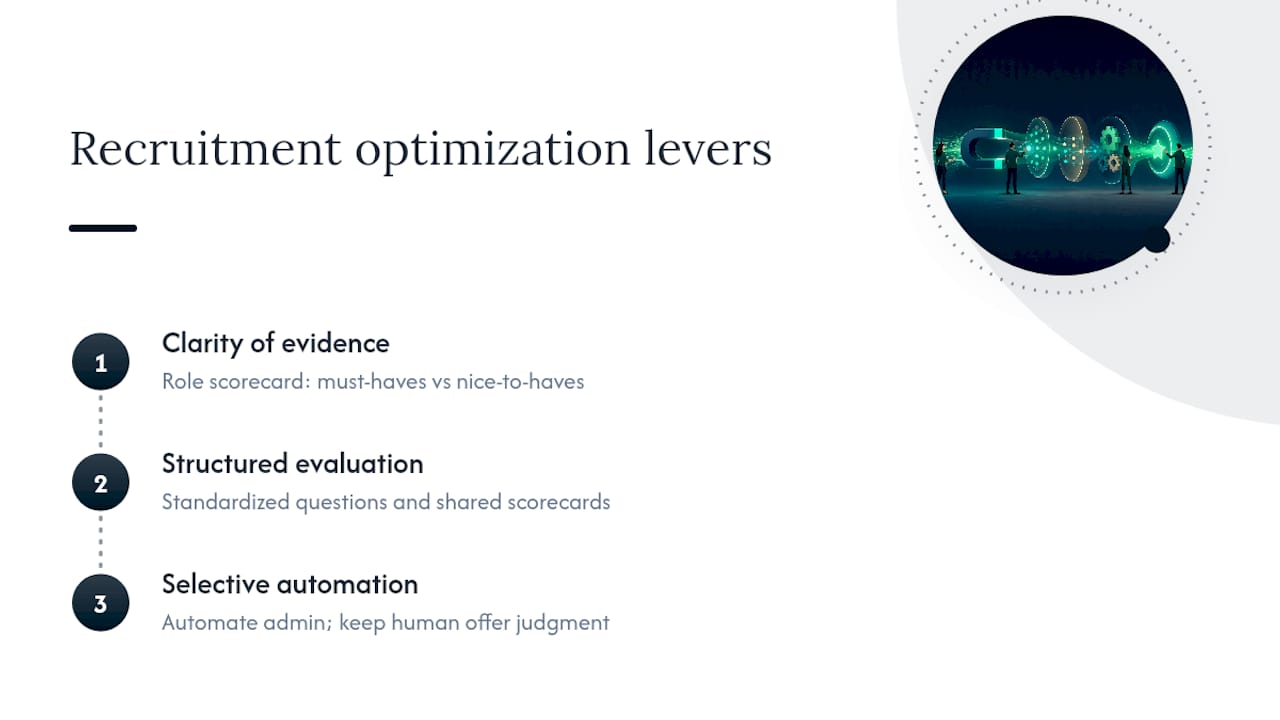
Clarity of evidence first. Before you touch a sourcing channel, you need a role scorecard that separates must-haves from nice-to-haves. Vague, inflated requirements are one of the most common sources of wasted recruiter effort, according to IBM Consulting’s hiring efficiency research, which frames the fix as making better judgments with clearer evidence rather than adding more steps.
Structured evaluation second. Standardized interview questions and shared scorecards reduce the variance that comes from five interviewers grading five different things.
Selective automation third. AI and workflow tools should remove administrative drag, not replace human judgment on offers and rejections.
Skip the order and you get what most stalled hiring processes look like: heavy automation bolted onto an unclear role definition, which just produces faster noise instead of faster signal.
Priority Tactics To Optimize Your Recruiting Process
Most teams try to fix hiring speed by adding tools. The better fix is sequencing the basics correctly, then automating around them. Here is the order that actually moves time-to-decision.
Lock intake before you source. Get the hiring manager and the recruiter to sign off on a scorecard in the kickoff meeting, not after the first ten resumes arrive. This single step prevents the most common cause of restarted searches: a hiring manager who “knows it when they see it” three weeks in.
Rewrite job descriptions around must-haves. Cut the wish-list language. A JD with twelve requirements filters out qualified candidates who assume they need all twelve.
Spend sourcing budget where signal is highest. Referral programs and a strong employer brand tend to produce candidates who convert at higher rates than cold outbound, and Greenhouse’s research on modern hiring systems points to prioritizing signal early over raising volume.
Set shortlist rules before screening starts. Decide upfront how resume parsing and early-stage assessments feed into a shortlist, so screening doesn’t turn into ad hoc gut checks.
Standardize interviews and debriefs. Give every interviewer the same core questions and a shared scorecard. Debrief within 24 hours, while impressions are still sharp and comparable.
Keep a runner-up pool alive. Strong candidates who lost out on one role are often the fastest fill for the next one. A quarterly re-engagement email costs almost nothing and shortens time-to-fill on future reqs.
Set communication SLAs. Commit to responding to candidates within 48 hours at every stage and publish the interview schedule upfront. Practitioner guidance from Indeed’s recruitment process research consistently flags slow or inconsistent candidate communication as a top driver of drop-off.
Pro Tip: Run your scorecard sign-off as a 15-minute recorded call, not an email thread. Hiring managers who talk through the must-haves out loud catch contradictions in their own requirements far faster than they do reading a document.
What Metrics and KPIs Should You Track First?
Time-to-fill gets quoted most often, but it hides where the actual delay lives. Track the funnel in stages, not just start-to-finish.
Time-to-shortlist: days from requisition open to a finalized shortlist. Slow here usually means the JD or sourcing channel is wrong, not the interview process.
Time-to-decision: days from final interview to an offer decision. This is often the biggest hidden bottleneck, and SHRM’s recruiting guide treats it as more diagnostic than raw time-to-fill because it isolates internal indecision from external sourcing delay.
Time-to-hire: days from candidate application to accepted offer, useful for comparing candidate experience across roles.
Funnel conversion by stage: what percentage moves from applied to screened, screened to interviewed, interviewed to offered. A steep drop at one stage tells you exactly where to look.
Drop-off reasons, categorized: “compensation,” “timeline,” “took another offer,” “process too slow.” Without categorization, drop-off is just a number with no diagnosis.
Quality-of-hire proxies: 90-day manager satisfaction scores, ramp time, and voluntary attrition in the first six months. Periodically sample rejected candidates to check for false rejects.
Smaller teams with low volume should prioritize time-to-decision and drop-off reasons since they surface problems fast with minimal data. High-volume teams need funnel conversion rates broken out by source, because at scale a 5% conversion gap at one stage represents real cost.
Building a Funnel Map: Stages, Owners, and Timeboxes
A Funnel Map assigns a default timebox and a named owner to every stage of the hiring process, so nothing drifts because “someone will get to it.” The structure below, adapted from i10X’s AI recruiting workflow framework, gives every recruiting team a starting template.
Intake: recruiter and hiring manager, scorecard signed off within 2 business days of req opening.
Source: recruiter owns channel selection, target 5 to 10 qualified applicants before moving on.
Screen: recruiter with AI-assisted parsing, 48-hour turnaround on new applicants.
Outreach: recruiter, response SLA of 48 hours to any candidate reply.
Interview: hiring team, debrief scorecards submitted within 24 hours of the final interview.
Offer: hiring manager and recruiter jointly, decision made within 3 business days of the last debrief.
Onboard handoff: recruiter to HR, documentation transferred before start date confirmation.
Reporting: TA lead, funnel metrics reviewed weekly.
The rule that matters most: AI and automation can assist at intake, screen, and outreach, but the offer and reject gates stay human. Any auto-screening step needs a weekly sample audit, a practice detailed further in the AI governance section below.
Where AI Actually Helps, and Where It Adds Risk
AI earns its place in recruiting when it handles volume and drafts, not final decisions. The highest-value uses are CV parsing, contextual matching against job requirements, interview scheduling, draft outreach messages, and decision-support reports that summarize interview signal for a human reviewer.
The evidence on AI interview reports is genuinely mixed, and worth taking seriously before you deploy one. Field experiments published on arXiv found that structured AI interview reports raised pass rates for shortlisted finalists by 17.5 to 20 percentage points when recruiters saw the reports before deciding. That is a meaningful lift in decision quality. But the same research found that when a 30 to 40 minute AI interview was required as part of the application, only about a quarter of candidates completed it. The tool that improves decisions can also quietly filter out strong candidates who simply won’t sit through it.
AI’s real impact is uneven. Multi-sector analysis from F1000Research found AI adoption correlates strongly with efficiency gains and modest candidate-experience improvements, but has only a modest effect on bias mitigation and little effect on candidate trust unless paired with explainability and human oversight.
Guardrails that should be non-negotiable in any AI-assisted process:
No auto-reject without a human audit pass.
A human gate on every offer and every rejection decision.
Weekly sampling of low AI scores to hunt for false rejects.
Logged, versioned prompts and models so a vendor change doesn’t silently shift outcomes.
Pro Tip: Target AI interviewing at junior roles first, where resumes carry the least signal. That’s where the pass-rate lift is largest and the attrition trade-off is easiest to justify.
How To Pilot and Govern Process Changes
Pick one requisition type for your pilot, ideally one with steady volume, and record baseline metrics for at least a month before changing anything.
Set a baseline. Capture time-to-shortlist, time-to-decision, and drop-off reasons for the current process before any change.
Define audit rules. Sample rejected candidates weekly for false rejects and survey hiring managers on decision confidence.
Assign governance owners. Someone on TA leadership reviews pilot metrics and revalidates the model or process monthly.
Scale in stages. Move from single pilot to limited expansion once metrics hold for two full cycles, then to full adoption with documented training for every recruiter involved.
Why the Speed and Quality Trade-Off Is Overstated
Most teams treat speed and quality as opposing forces, but the data suggests otherwise. The real trade-off is between structure and drift. AI interview reports lift pass-rate accuracy by up to 20 points, but only when someone still reads them before deciding. System-driven hiring with a human gate at every consequential decision is the model that holds up. Process discipline is the multiplier, not the shortcut.
- Recruitify Team
How Recruitify Operationalizes This Playbook
The platform was built to support the playbook this guide describes, integrating necessary functions into a single system. Scorecard sign-off occurs within the same workspace as sourcing to streamline intake. The AI CV parser extracts structured candidate data from PDFs, scans, and photos in seconds, and the contextual matching engine scores applicants against your role requirements instead of just keyword-matching resumes.
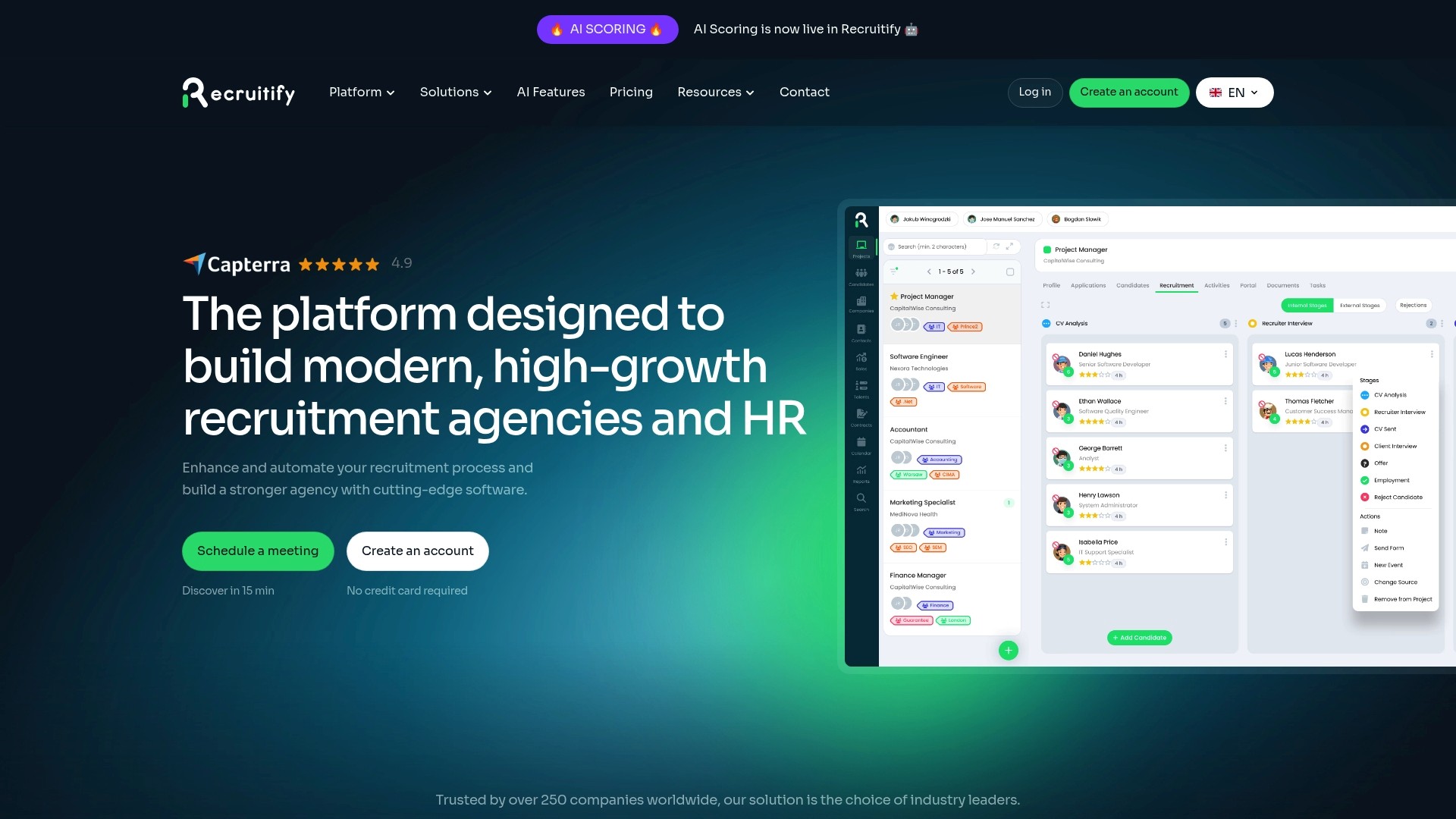
Pipeline management runs through one connected view that links your sales CRM to recruiting workflows, so agencies aren’t juggling spreadsheets between client development and candidate sourcing. A GDPR consent management module maintains a full audit trail on candidate records, supporting compliance and audit requirements. Workflow automation across the platform is built to cut administrative overhead, reducing repetitive task time by roughly 70% in practical deployments, freeing recruiters for the judgment calls that actually need a human.
If your funnel map has gaps at intake, screening, or reporting, a demo of the platform can illustrate where automation can help close them. Book a pilot walkthrough and see your own requisition data mapped against this workflow.
Sources
FAQ
What Is Recruitment Process Optimization?
Recruitment process optimization is the practice of improving hiring speed, decision quality, and predictability by clarifying role requirements, standardizing evaluation, and applying automation selectively rather than across every stage.
What Are the Three P’s of Recruitment?
Definitions vary across sources, but the concept commonly points to People, Process, and Performance, the idea that hiring outcomes depend on who evaluates candidates, the structure they follow, and how results get measured afterward.
Which Metric Should You Track First If You’re Short on Time?
Start with time-to-decision and categorized drop-off reasons. Both surface bottlenecks fast with minimal data collection, and SHRM’s recruiting guidance treats them as more diagnostic than raw time-to-fill.
Does AI Interviewing Actually Improve Hiring Decisions?
Structured AI interview reports raised finalist pass rates by 17.5 to 20 percentage points in controlled field experiments, but requiring the interview upfront reduced completion to about one quarter, so placement in the funnel matters as much as the tool itself.
Recommended


News & Updates
Stay up-to-date with the latest innovations, features, and tips about Recruitify!
By providing your email address within the newsletter sign-up form, you confirm its processing to send marketing information regarding the Administrator’s products and services. The Administrator of your personal data processed for the abovementioned purposes is Recruitify Spółka z o.o., based in Warsaw, Poland (KRS 0000709889). For more information on the principles of personal data processing and the rights of data subjects, please check the Privacy Policy.

Last updated:
7 Tactics to Optimize the Recruitment Process for TA Leaders
HR Analytics
The Recruitify Team
Recruitment process optimization means shortening time-to-decision and raising shortlist quality by fixing three things: role clarity through scorecards, structured evaluation, and selective automation. Get those right and time-to-fill drops, drop-off falls, and offers land on candidates who actually fit the role. This guide breaks down the tactics, the metrics that catch bottlenecks early, and where AI genuinely helps versus where it just adds risk.
TL;DR:
Prioritize early-stage metrics like time-to-shortlist and decision bottlenecks over overall time-to-hire to identify specific process issues quickly.
Use a staged funnel map with clear owners and strict timeboxes to ensure consistent progress at each recruitment stage.
Deploy AI to assist with CV parsing, matching, and scheduling, but keep final offers and rejections human-controlled to mitigate risks and bias.
Pilot process changes on a single requisition type, establish baseline metrics, and regularly audit AI decisions to ensure quality and prevent false rejects.
Focusing on structured evaluation and disciplined process management can improve quality and speed without relying solely on automation or tool proliferation.
RecruitifyOptimize Recruitment From One PlatformRecruitify.ai brings ATS, Sales CRM, and IT contracting together, with AI matching and CV parsing for more efficient recruitment operations.Explore Recruitify.ai
Table of Contents
What Does Recruitment Process Optimization Actually Involve?
Priority Tactics To Optimize Your Recruiting Process
What Metrics and KPIs Should You Track First?
Building a Funnel Map: Stages, Owners, and Timeboxes
Where AI Actually Helps, and Where It Adds Risk
How To Pilot and Govern Process Changes
Why the Speed and Quality Trade-Off Is Overstated
How Recruitify Operationalizes This Playbook
Sources
FAQ
What Does Recruitment Process Optimization Actually Involve?
Recruitment process optimization is the discipline of removing friction and guesswork from every stage between a job requisition and a signed offer. It is not the same as simply hiring faster. A team that fills roles in 20 days but loses 40% of new hires within six months has not optimized anything.
The practice rests on three levers, and they work in sequence, not parallel.
Clarity of evidence first. Before you touch a sourcing channel, you need a role scorecard that separates must-haves from nice-to-haves. Vague, inflated requirements are one of the most common sources of wasted recruiter effort, according to IBM Consulting’s hiring efficiency research, which frames the fix as making better judgments with clearer evidence rather than adding more steps.
Structured evaluation second. Standardized interview questions and shared scorecards reduce the variance that comes from five interviewers grading five different things.
Selective automation third. AI and workflow tools should remove administrative drag, not replace human judgment on offers and rejections.
Skip the order and you get what most stalled hiring processes look like: heavy automation bolted onto an unclear role definition, which just produces faster noise instead of faster signal.
Priority Tactics To Optimize Your Recruiting Process
Most teams try to fix hiring speed by adding tools. The better fix is sequencing the basics correctly, then automating around them. Here is the order that actually moves time-to-decision.
Lock intake before you source. Get the hiring manager and the recruiter to sign off on a scorecard in the kickoff meeting, not after the first ten resumes arrive. This single step prevents the most common cause of restarted searches: a hiring manager who “knows it when they see it” three weeks in.
Rewrite job descriptions around must-haves. Cut the wish-list language. A JD with twelve requirements filters out qualified candidates who assume they need all twelve.
Spend sourcing budget where signal is highest. Referral programs and a strong employer brand tend to produce candidates who convert at higher rates than cold outbound, and Greenhouse’s research on modern hiring systems points to prioritizing signal early over raising volume.
Set shortlist rules before screening starts. Decide upfront how resume parsing and early-stage assessments feed into a shortlist, so screening doesn’t turn into ad hoc gut checks.
Standardize interviews and debriefs. Give every interviewer the same core questions and a shared scorecard. Debrief within 24 hours, while impressions are still sharp and comparable.
Keep a runner-up pool alive. Strong candidates who lost out on one role are often the fastest fill for the next one. A quarterly re-engagement email costs almost nothing and shortens time-to-fill on future reqs.
Set communication SLAs. Commit to responding to candidates within 48 hours at every stage and publish the interview schedule upfront. Practitioner guidance from Indeed’s recruitment process research consistently flags slow or inconsistent candidate communication as a top driver of drop-off.
Pro Tip: Run your scorecard sign-off as a 15-minute recorded call, not an email thread. Hiring managers who talk through the must-haves out loud catch contradictions in their own requirements far faster than they do reading a document.
What Metrics and KPIs Should You Track First?
Time-to-fill gets quoted most often, but it hides where the actual delay lives. Track the funnel in stages, not just start-to-finish.
Time-to-shortlist: days from requisition open to a finalized shortlist. Slow here usually means the JD or sourcing channel is wrong, not the interview process.
Time-to-decision: days from final interview to an offer decision. This is often the biggest hidden bottleneck, and SHRM’s recruiting guide treats it as more diagnostic than raw time-to-fill because it isolates internal indecision from external sourcing delay.
Time-to-hire: days from candidate application to accepted offer, useful for comparing candidate experience across roles.
Funnel conversion by stage: what percentage moves from applied to screened, screened to interviewed, interviewed to offered. A steep drop at one stage tells you exactly where to look.
Drop-off reasons, categorized: “compensation,” “timeline,” “took another offer,” “process too slow.” Without categorization, drop-off is just a number with no diagnosis.
Quality-of-hire proxies: 90-day manager satisfaction scores, ramp time, and voluntary attrition in the first six months. Periodically sample rejected candidates to check for false rejects.
Smaller teams with low volume should prioritize time-to-decision and drop-off reasons since they surface problems fast with minimal data. High-volume teams need funnel conversion rates broken out by source, because at scale a 5% conversion gap at one stage represents real cost.
Building a Funnel Map: Stages, Owners, and Timeboxes
A Funnel Map assigns a default timebox and a named owner to every stage of the hiring process, so nothing drifts because “someone will get to it.” The structure below, adapted from i10X’s AI recruiting workflow framework, gives every recruiting team a starting template.
Intake: recruiter and hiring manager, scorecard signed off within 2 business days of req opening.
Source: recruiter owns channel selection, target 5 to 10 qualified applicants before moving on.
Screen: recruiter with AI-assisted parsing, 48-hour turnaround on new applicants.
Outreach: recruiter, response SLA of 48 hours to any candidate reply.
Interview: hiring team, debrief scorecards submitted within 24 hours of the final interview.
Offer: hiring manager and recruiter jointly, decision made within 3 business days of the last debrief.
Onboard handoff: recruiter to HR, documentation transferred before start date confirmation.
Reporting: TA lead, funnel metrics reviewed weekly.
The rule that matters most: AI and automation can assist at intake, screen, and outreach, but the offer and reject gates stay human. Any auto-screening step needs a weekly sample audit, a practice detailed further in the AI governance section below.
Where AI Actually Helps, and Where It Adds Risk
AI earns its place in recruiting when it handles volume and drafts, not final decisions. The highest-value uses are CV parsing, contextual matching against job requirements, interview scheduling, draft outreach messages, and decision-support reports that summarize interview signal for a human reviewer.
The evidence on AI interview reports is genuinely mixed, and worth taking seriously before you deploy one. Field experiments published on arXiv found that structured AI interview reports raised pass rates for shortlisted finalists by 17.5 to 20 percentage points when recruiters saw the reports before deciding. That is a meaningful lift in decision quality. But the same research found that when a 30 to 40 minute AI interview was required as part of the application, only about a quarter of candidates completed it. The tool that improves decisions can also quietly filter out strong candidates who simply won’t sit through it.
AI’s real impact is uneven. Multi-sector analysis from F1000Research found AI adoption correlates strongly with efficiency gains and modest candidate-experience improvements, but has only a modest effect on bias mitigation and little effect on candidate trust unless paired with explainability and human oversight.
Guardrails that should be non-negotiable in any AI-assisted process:
No auto-reject without a human audit pass.
A human gate on every offer and every rejection decision.
Weekly sampling of low AI scores to hunt for false rejects.
Logged, versioned prompts and models so a vendor change doesn’t silently shift outcomes.
Pro Tip: Target AI interviewing at junior roles first, where resumes carry the least signal. That’s where the pass-rate lift is largest and the attrition trade-off is easiest to justify.
How To Pilot and Govern Process Changes
Pick one requisition type for your pilot, ideally one with steady volume, and record baseline metrics for at least a month before changing anything.
Set a baseline. Capture time-to-shortlist, time-to-decision, and drop-off reasons for the current process before any change.
Define audit rules. Sample rejected candidates weekly for false rejects and survey hiring managers on decision confidence.
Assign governance owners. Someone on TA leadership reviews pilot metrics and revalidates the model or process monthly.
Scale in stages. Move from single pilot to limited expansion once metrics hold for two full cycles, then to full adoption with documented training for every recruiter involved.
Why the Speed and Quality Trade-Off Is Overstated
Most teams treat speed and quality as opposing forces, but the data suggests otherwise. The real trade-off is between structure and drift. AI interview reports lift pass-rate accuracy by up to 20 points, but only when someone still reads them before deciding. System-driven hiring with a human gate at every consequential decision is the model that holds up. Process discipline is the multiplier, not the shortcut.
- Recruitify Team
How Recruitify Operationalizes This Playbook
The platform was built to support the playbook this guide describes, integrating necessary functions into a single system. Scorecard sign-off occurs within the same workspace as sourcing to streamline intake. The AI CV parser extracts structured candidate data from PDFs, scans, and photos in seconds, and the contextual matching engine scores applicants against your role requirements instead of just keyword-matching resumes.
Pipeline management runs through one connected view that links your sales CRM to recruiting workflows, so agencies aren’t juggling spreadsheets between client development and candidate sourcing. A GDPR consent management module maintains a full audit trail on candidate records, supporting compliance and audit requirements. Workflow automation across the platform is built to cut administrative overhead, reducing repetitive task time by roughly 70% in practical deployments, freeing recruiters for the judgment calls that actually need a human.
If your funnel map has gaps at intake, screening, or reporting, a demo of the platform can illustrate where automation can help close them. Book a pilot walkthrough and see your own requisition data mapped against this workflow.
Sources
FAQ
What Is Recruitment Process Optimization?
Recruitment process optimization is the practice of improving hiring speed, decision quality, and predictability by clarifying role requirements, standardizing evaluation, and applying automation selectively rather than across every stage.
What Are the Three P’s of Recruitment?
Definitions vary across sources, but the concept commonly points to People, Process, and Performance, the idea that hiring outcomes depend on who evaluates candidates, the structure they follow, and how results get measured afterward.
Which Metric Should You Track First If You’re Short on Time?
Start with time-to-decision and categorized drop-off reasons. Both surface bottlenecks fast with minimal data collection, and SHRM’s recruiting guidance treats them as more diagnostic than raw time-to-fill.
Does AI Interviewing Actually Improve Hiring Decisions?
Structured AI interview reports raised finalist pass rates by 17.5 to 20 percentage points in controlled field experiments, but requiring the interview upfront reduced completion to about one quarter, so placement in the funnel matters as much as the tool itself.
Recommended
News & Updates
Stay up-to-date with the latest innovations, features, and tips about Recruitify!
By providing your email address within the newsletter sign-up form, you confirm its processing to send marketing information regarding the Administrator’s products and services. The Administrator of your personal data processed for the abovementioned purposes is Recruitify Spółka z o.o., based in Warsaw, Poland (KRS 0000709889). For more information on the principles of personal data processing and the rights of data subjects, please check the Privacy Policy.
Last updated:
7 Tactics to Optimize the Recruitment Process for TA Leaders
HR Analytics
The Recruitify Team
Recruitment process optimization means shortening time-to-decision and raising shortlist quality by fixing three things: role clarity through scorecards, structured evaluation, and selective automation. Get those right and time-to-fill drops, drop-off falls, and offers land on candidates who actually fit the role. This guide breaks down the tactics, the metrics that catch bottlenecks early, and where AI genuinely helps versus where it just adds risk.
TL;DR:
Prioritize early-stage metrics like time-to-shortlist and decision bottlenecks over overall time-to-hire to identify specific process issues quickly.
Use a staged funnel map with clear owners and strict timeboxes to ensure consistent progress at each recruitment stage.
Deploy AI to assist with CV parsing, matching, and scheduling, but keep final offers and rejections human-controlled to mitigate risks and bias.
Pilot process changes on a single requisition type, establish baseline metrics, and regularly audit AI decisions to ensure quality and prevent false rejects.
Focusing on structured evaluation and disciplined process management can improve quality and speed without relying solely on automation or tool proliferation.
RecruitifyOptimize Recruitment From One PlatformRecruitify.ai brings ATS, Sales CRM, and IT contracting together, with AI matching and CV parsing for more efficient recruitment operations.Explore Recruitify.ai
Table of Contents
What Does Recruitment Process Optimization Actually Involve?
Priority Tactics To Optimize Your Recruiting Process
What Metrics and KPIs Should You Track First?
Building a Funnel Map: Stages, Owners, and Timeboxes
Where AI Actually Helps, and Where It Adds Risk
How To Pilot and Govern Process Changes
Why the Speed and Quality Trade-Off Is Overstated
How Recruitify Operationalizes This Playbook
Sources
FAQ
What Does Recruitment Process Optimization Actually Involve?
Recruitment process optimization is the discipline of removing friction and guesswork from every stage between a job requisition and a signed offer. It is not the same as simply hiring faster. A team that fills roles in 20 days but loses 40% of new hires within six months has not optimized anything.
The practice rests on three levers, and they work in sequence, not parallel.
Clarity of evidence first. Before you touch a sourcing channel, you need a role scorecard that separates must-haves from nice-to-haves. Vague, inflated requirements are one of the most common sources of wasted recruiter effort, according to IBM Consulting’s hiring efficiency research, which frames the fix as making better judgments with clearer evidence rather than adding more steps.
Structured evaluation second. Standardized interview questions and shared scorecards reduce the variance that comes from five interviewers grading five different things.
Selective automation third. AI and workflow tools should remove administrative drag, not replace human judgment on offers and rejections.
Skip the order and you get what most stalled hiring processes look like: heavy automation bolted onto an unclear role definition, which just produces faster noise instead of faster signal.
Priority Tactics To Optimize Your Recruiting Process
Most teams try to fix hiring speed by adding tools. The better fix is sequencing the basics correctly, then automating around them. Here is the order that actually moves time-to-decision.
Lock intake before you source. Get the hiring manager and the recruiter to sign off on a scorecard in the kickoff meeting, not after the first ten resumes arrive. This single step prevents the most common cause of restarted searches: a hiring manager who “knows it when they see it” three weeks in.
Rewrite job descriptions around must-haves. Cut the wish-list language. A JD with twelve requirements filters out qualified candidates who assume they need all twelve.
Spend sourcing budget where signal is highest. Referral programs and a strong employer brand tend to produce candidates who convert at higher rates than cold outbound, and Greenhouse’s research on modern hiring systems points to prioritizing signal early over raising volume.
Set shortlist rules before screening starts. Decide upfront how resume parsing and early-stage assessments feed into a shortlist, so screening doesn’t turn into ad hoc gut checks.
Standardize interviews and debriefs. Give every interviewer the same core questions and a shared scorecard. Debrief within 24 hours, while impressions are still sharp and comparable.
Keep a runner-up pool alive. Strong candidates who lost out on one role are often the fastest fill for the next one. A quarterly re-engagement email costs almost nothing and shortens time-to-fill on future reqs.
Set communication SLAs. Commit to responding to candidates within 48 hours at every stage and publish the interview schedule upfront. Practitioner guidance from Indeed’s recruitment process research consistently flags slow or inconsistent candidate communication as a top driver of drop-off.
Pro Tip: Run your scorecard sign-off as a 15-minute recorded call, not an email thread. Hiring managers who talk through the must-haves out loud catch contradictions in their own requirements far faster than they do reading a document.
What Metrics and KPIs Should You Track First?
Time-to-fill gets quoted most often, but it hides where the actual delay lives. Track the funnel in stages, not just start-to-finish.
Time-to-shortlist: days from requisition open to a finalized shortlist. Slow here usually means the JD or sourcing channel is wrong, not the interview process.
Time-to-decision: days from final interview to an offer decision. This is often the biggest hidden bottleneck, and SHRM’s recruiting guide treats it as more diagnostic than raw time-to-fill because it isolates internal indecision from external sourcing delay.
Time-to-hire: days from candidate application to accepted offer, useful for comparing candidate experience across roles.
Funnel conversion by stage: what percentage moves from applied to screened, screened to interviewed, interviewed to offered. A steep drop at one stage tells you exactly where to look.
Drop-off reasons, categorized: “compensation,” “timeline,” “took another offer,” “process too slow.” Without categorization, drop-off is just a number with no diagnosis.
Quality-of-hire proxies: 90-day manager satisfaction scores, ramp time, and voluntary attrition in the first six months. Periodically sample rejected candidates to check for false rejects.
Smaller teams with low volume should prioritize time-to-decision and drop-off reasons since they surface problems fast with minimal data. High-volume teams need funnel conversion rates broken out by source, because at scale a 5% conversion gap at one stage represents real cost.
Building a Funnel Map: Stages, Owners, and Timeboxes
A Funnel Map assigns a default timebox and a named owner to every stage of the hiring process, so nothing drifts because “someone will get to it.” The structure below, adapted from i10X’s AI recruiting workflow framework, gives every recruiting team a starting template.
Intake: recruiter and hiring manager, scorecard signed off within 2 business days of req opening.
Source: recruiter owns channel selection, target 5 to 10 qualified applicants before moving on.
Screen: recruiter with AI-assisted parsing, 48-hour turnaround on new applicants.
Outreach: recruiter, response SLA of 48 hours to any candidate reply.
Interview: hiring team, debrief scorecards submitted within 24 hours of the final interview.
Offer: hiring manager and recruiter jointly, decision made within 3 business days of the last debrief.
Onboard handoff: recruiter to HR, documentation transferred before start date confirmation.
Reporting: TA lead, funnel metrics reviewed weekly.
The rule that matters most: AI and automation can assist at intake, screen, and outreach, but the offer and reject gates stay human. Any auto-screening step needs a weekly sample audit, a practice detailed further in the AI governance section below.
Where AI Actually Helps, and Where It Adds Risk
AI earns its place in recruiting when it handles volume and drafts, not final decisions. The highest-value uses are CV parsing, contextual matching against job requirements, interview scheduling, draft outreach messages, and decision-support reports that summarize interview signal for a human reviewer.
The evidence on AI interview reports is genuinely mixed, and worth taking seriously before you deploy one. Field experiments published on arXiv found that structured AI interview reports raised pass rates for shortlisted finalists by 17.5 to 20 percentage points when recruiters saw the reports before deciding. That is a meaningful lift in decision quality. But the same research found that when a 30 to 40 minute AI interview was required as part of the application, only about a quarter of candidates completed it. The tool that improves decisions can also quietly filter out strong candidates who simply won’t sit through it.
AI’s real impact is uneven. Multi-sector analysis from F1000Research found AI adoption correlates strongly with efficiency gains and modest candidate-experience improvements, but has only a modest effect on bias mitigation and little effect on candidate trust unless paired with explainability and human oversight.
Guardrails that should be non-negotiable in any AI-assisted process:
No auto-reject without a human audit pass.
A human gate on every offer and every rejection decision.
Weekly sampling of low AI scores to hunt for false rejects.
Logged, versioned prompts and models so a vendor change doesn’t silently shift outcomes.
Pro Tip: Target AI interviewing at junior roles first, where resumes carry the least signal. That’s where the pass-rate lift is largest and the attrition trade-off is easiest to justify.
How To Pilot and Govern Process Changes
Pick one requisition type for your pilot, ideally one with steady volume, and record baseline metrics for at least a month before changing anything.
Set a baseline. Capture time-to-shortlist, time-to-decision, and drop-off reasons for the current process before any change.
Define audit rules. Sample rejected candidates weekly for false rejects and survey hiring managers on decision confidence.
Assign governance owners. Someone on TA leadership reviews pilot metrics and revalidates the model or process monthly.
Scale in stages. Move from single pilot to limited expansion once metrics hold for two full cycles, then to full adoption with documented training for every recruiter involved.
Why the Speed and Quality Trade-Off Is Overstated
Most teams treat speed and quality as opposing forces, but the data suggests otherwise. The real trade-off is between structure and drift. AI interview reports lift pass-rate accuracy by up to 20 points, but only when someone still reads them before deciding. System-driven hiring with a human gate at every consequential decision is the model that holds up. Process discipline is the multiplier, not the shortcut.
- Recruitify Team
How Recruitify Operationalizes This Playbook
The platform was built to support the playbook this guide describes, integrating necessary functions into a single system. Scorecard sign-off occurs within the same workspace as sourcing to streamline intake. The AI CV parser extracts structured candidate data from PDFs, scans, and photos in seconds, and the contextual matching engine scores applicants against your role requirements instead of just keyword-matching resumes.
Pipeline management runs through one connected view that links your sales CRM to recruiting workflows, so agencies aren’t juggling spreadsheets between client development and candidate sourcing. A GDPR consent management module maintains a full audit trail on candidate records, supporting compliance and audit requirements. Workflow automation across the platform is built to cut administrative overhead, reducing repetitive task time by roughly 70% in practical deployments, freeing recruiters for the judgment calls that actually need a human.
If your funnel map has gaps at intake, screening, or reporting, a demo of the platform can illustrate where automation can help close them. Book a pilot walkthrough and see your own requisition data mapped against this workflow.
Sources
FAQ
What Is Recruitment Process Optimization?
Recruitment process optimization is the practice of improving hiring speed, decision quality, and predictability by clarifying role requirements, standardizing evaluation, and applying automation selectively rather than across every stage.
What Are the Three P’s of Recruitment?
Definitions vary across sources, but the concept commonly points to People, Process, and Performance, the idea that hiring outcomes depend on who evaluates candidates, the structure they follow, and how results get measured afterward.
Which Metric Should You Track First If You’re Short on Time?
Start with time-to-decision and categorized drop-off reasons. Both surface bottlenecks fast with minimal data collection, and SHRM’s recruiting guidance treats them as more diagnostic than raw time-to-fill.
Does AI Interviewing Actually Improve Hiring Decisions?
Structured AI interview reports raised finalist pass rates by 17.5 to 20 percentage points in controlled field experiments, but requiring the interview upfront reduced completion to about one quarter, so placement in the funnel matters as much as the tool itself.
Recommended
News & Updates
Stay up-to-date with the latest innovations, features, and tips about Recruitify!
By providing your email address within the newsletter sign-up form, you confirm its processing to send marketing information regarding the Administrator’s products and services. The Administrator of your personal data processed for the abovementioned purposes is Recruitify Spółka z o.o., based in Warsaw, Poland (KRS 0000709889). For more information on the principles of personal data processing and the rights of data subjects, please check the Privacy Policy.

Discover More

Applicant Tracking System
HR Leaders: Predictive Recruitment Forecasts That Turn Plans Into Hires
Practical steps for HR leaders to build predictive, data-driven recruitment forecasts, link them to finance and ops, and convert projections into hires...
15 Sept 2026
Discover More

Applicant Tracking System
Skills Based Hiring: Launch a 3–5 Competency Pilot for HR Teams
Practical roadmap for HR: pilot skills based hiring, pick 3–5 competencies, use 30–90 minute work samples, run a measured pilot, and track core KPIs.
14 Sept 2026
Discover More

Recruitment Process
Cut 70% Admin Time With AI Interview Scheduling for Enterprise HR
Cut administrative work by 70% with AI interview scheduling. A practical, enterprise-focused checklist to evaluate vendors, pilot rollout, and reduce...
13 Sept 2026
Discover More
Applicant Tracking System
HR Leaders: Predictive Recruitment Forecasts That Turn Plans Into Hires
Practical steps for HR leaders to build predictive, data-driven recruitment forecasts, link them to finance and ops, and convert projections into hires...
15 Sept 2026
Discover More
Applicant Tracking System
Skills Based Hiring: Launch a 3–5 Competency Pilot for HR Teams
Practical roadmap for HR: pilot skills based hiring, pick 3–5 competencies, use 30–90 minute work samples, run a measured pilot, and track core KPIs.
14 Sept 2026
Discover More