Last updated:
Cut Screening Time 70%: Six Phase Remote Hiring Process for HR Teams

Applicant Tracking System

The Recruitify Team
A remote hiring process is the sequence of screening, evaluating, and onboarding steps a company runs when candidates and interviewers never meet in person. The single rule that separates a process that works from one that stalls is async-first design: default to structured, written, and recorded evaluation, and reserve live synchronous time for the two or three decisions that actually need a real-time conversation. Done right, this produces faster offers, fairer comparisons across candidates, and hires who ramp up without the informal mentoring an office provides automatically.
TL;DR:
Remote hiring requires an async-first process design to reduce time-to-offer and minimize drop-offs caused by prolonged loops and timezone issues.
Using structured intake questions, work samples, and recorded responses effectively filters candidates and reduces reliance on synchronous interviews.
AI-powered screening and multiposting cut manual review time by about 70% and improve applicant quality by targeting remote-specific channels.
Clear communication protocols and early compliance checks prevent delays, ghosting, and misclassification risks throughout the process.
Building an inclusive, respectful candidate experience with explicit timelines, flexible assessments, and data privacy safeguards improves diversity and candidate retention.
RecruitifyScreen Candidates With Less AdminRecruitify brings AI matching, CV parsing, sourcing, and recruitment workflows together for faster screening without expanding your team.Explore Recruitify
Table of Contents
Why the Remote Hiring Process Needs a Different Design
The Remote Hiring Process, Step by Step
Async-First Assessments That Scale Without Losing Signal
Sourcing and Screening at Scale Without Losing Quality
Interview Design and Scheduling Across Time Zones
Remote Onboarding: The 30-60-90 Plan That Actually Sticks
Compliance, Classification, and Payroll Before You Post the Role
Tools and Automation That Address the Real Bottlenecks
Metrics That Tell You Whether the Process Is Working
Communication Protocols That Keep Candidates and Teams Aligned
Diversity, Equity, and Inclusion in a Remote Hiring Process
Candidate Experience and Engagement in a Remote Process
Security and Data Privacy in Remote Hiring
Cost Analysis and Budgeting for Remote Hiring
Recruitify Team Perspective: Three Moves to Make This Week
How Recruitify Can Help You Fix the Bottleneck
Sources
FAQ
Why the Remote Hiring Process Needs a Different Design
Posting a role as remote does not just widen your applicant pool. It changes the entire mechanics of evaluation, and most of the remote hiring challenges teams run into trace back to reusing an in-office process on a distributed one.
Remote job postings draw 3 to 7 times more applicants than local roles, which overwhelms recruiters who screen resumes one at a time. That volume alone forces a choice: build filtering into the process or drown in it.
The bigger loss is subtler. In an office, you pick up signal from how someone handles a hallway question, whether they show up early, how they collaborate off the record. None of that exists remotely, so the process has to manufacture equivalent signal through written tasks, recorded answers, and async collaboration exercises. Skip that step and you are hiring on interview charisma alone.
Timezone friction adds another layer, stretching interview loops from days into weeks and giving candidates time to accept a competing offer. Left unaddressed, these gaps produce the same three failure modes repeatedly:
Higher ghosting rates as loops drag past the two-week mark
Misclassification risk when contractor and employee status gets decided too late
Onboarding slowdowns because ramp plans assume proximity that never existed
Industry data on remote hiring obstacles points to the same conclusion: teams that shorten loops and shift to async-first evaluation see measurably better drop-off and time-to-hire numbers than teams that don’t.
The Remote Hiring Process, Step by Step
A remote hiring process breaks into six phases, and each one produces a specific artifact you can point to when someone asks “where are we on this role?”
Define the role before you post it. Write down overlap hours (the window your hire must be online with the team), async norms (how fast a Slack message needs a reply), and two or three measurable outcomes for the first 90 days. A role description without these three elements guarantees mismatched expectations by week three.
Attract candidates with transparent, benchmarked pay. Post to remote-specific channels and multipost across boards that reach distributed talent rather than relying on a single local job board. Include a real pay range, not a placeholder. Candidates researching remote recruitment strategies consistently rank transparent compensation above brand name when deciding whether to apply.
Screen with structured intake, not resume skimming. Build an intake form that asks every candidate the same qualifying questions and includes one short, role-specific written task. A single paragraph response to a real scenario tells you more about async communication skill than three pages of resume bullet points.
Evaluate through work samples and recorded responses. This is where the remote job application process should diverge hardest from the in-office version. Ask for a small, timeboxed work sample tied directly to the job, and use a recorded video response for one or two open-ended questions instead of burning a live slot on them.
Decide and make the offer fast. Speed matters more remotely because a slow decision reads as low interest, and strong candidates already have other conversations running. Present total compensation clearly, including any location-based adjustments, and run compliance checks (background, right-to-work, classification) as conditional steps that don’t hold up the offer conversation itself.
Pre-board before day one, then onboard with milestones. Ship equipment, provision accounts, and assign a buddy before the start date. Set 30, 60, and 90-day markers with specific, measurable outcomes rather than vague “get up to speed” language.
Each phase needs an owner and a maximum elapsed time. Without that constraint, the process expands to fill whatever time is available, and that is how a three-week hiring plan turns into a seven-week one.
Async-First Assessments That Scale Without Losing Signal
Three async patterns cover almost every evaluation need in remote recruitment strategies: structured intake questions, take-home work samples, and recorded video responses. Each replaces a synchronous step that would otherwise require calendar coordination across time zones.
Structured intake works best early, filtering on must-have criteria and communication clarity before anyone invests interview time. Take-home work samples fit mid-funnel, when you need to see actual output, not a description of past output. Recorded responses work well for behavioral or motivational questions that don’t require back-and-forth.
Design each async task with three fixed elements:
A clear prompt scoped to a real task the role performs, not an abstract puzzle
A stated time limit, generally 30 to 90 minutes depending on seniority
A scoring rubric shared across every reviewer, so two people scoring the same submission land within a point of each other
Escalate to a synchronous conversation only when the decision genuinely needs real-time interaction: culture fit discussions, negotiation, or clarifying a work sample that raised questions. Everything else can stay async.
Teams that adopt this pattern see shorter elapsed time-to-offer and better candidate experience for applicants spread across multiple time zones, since nobody is waiting on a calendar match to move forward.
Pro Tip: Run a validity check on every async assessment: confirm it’s job-related, keep conditions consistent for every candidate, and manually review a sample of both passes and fails each quarter to catch scoring drift before it becomes a pattern.
Sourcing and Screening at Scale Without Losing Quality
High application volume is the defining challenge of remote talent acquisition, and the fix is layered filtering rather than one giant funnel.
Start by multiposting to channels that already attract remote-specific talent instead of generic boards that skew local. That alone changes the quality mix of who applies. Layer a structured intake form on top, asking for the same qualifying answers from every applicant so you’re comparing consistent data rather than free-form resumes.
From there, contextual AI screening earns its place. Rather than keyword matching, a scoring engine that understands relationships within a candidate’s skill set can surface a focused shortlist automatically, cutting the manual review pile down to a workable size. AI-assisted screening has been shown to cut initial screening time by roughly 70% when applied to high-volume remote postings, freeing recruiters to spend their time on candidates worth a real conversation.
That efficiency needs guardrails, though:
Always have a human review edge cases the algorithm flags as borderline, not just the clear rejects
Audit a sample of the shortlist against the full applicant pool periodically to check for bias creep
Document the criteria the screening tool weighs, so you can explain a decision if a candidate asks
The EEOC’s guidance on AI in employment is explicit here: automated selection tools must be job-related, validated, and paired with reasonable accommodations for applicants with disabilities. Automation speeds up screening. It does not remove your responsibility for what the screening decides.
Interview Design and Scheduling Across Time Zones
Synchronous interviews are the most expensive part of a remote hiring process, in calendar time and in candidate patience, so use them sparingly and deliberately.
Cap the loop at two to three rounds. Map each round to one specific dimension: technical depth, collaboration style, role-specific judgment. Anything beyond three rounds usually duplicates a signal you already have.
Structure virtual onsites in blocks, not marathons. A short orientation at the start, focused evaluation segments, and built-in breaks of 10 to 15 minutes between sessions keep both the candidate and the interview panel sharp instead of fatigued by hour four.
Schedule in the candidate’s local time, always. Display times in the candidate’s own zone, not the interviewer’s, and avoid booking slots outside roughly 7 AM to 9 PM local time even when it’s convenient on your end.
Use a scorecard per interviewer. Each person evaluates a distinct competency and records it independently before the debrief. This is the structured-scorecard approach CIPD recommends for keeping selection decisions fair and defensible, and it stops the debrief from turning into a popularity vote.
Remote Onboarding: The 30-60-90 Plan That Actually Sticks
Effective remote onboarding starts before day one, not on it. Ship equipment early, provision every account the new hire needs, confirm their first-week schedule, and assign a buddy who isn’t their manager, someone they can ask small questions without feeling like they’re bothering anyone important.
Day one should include recorded walkthroughs of core systems and processes, so the new hire can revisit material instead of relying on a single live session they half-absorbed. Integration happens the fastest through small, low-risk collaborative projects paired with scheduled, informal social time, since remote hires don’t get the accidental hallway conversations that build relationships in an office.
The 30-60-90 structure gives ramp time actual shape:
Day 30: Core systems mastered, first small deliverable shipped, initial manager check-in completed
Day 60: Independent ownership of at least one recurring task, cross-team relationships established
Day 90: Full productivity benchmark met, first performance conversation scheduled
Assumptions built for in-office ramp routinely fail remote hires, and deliberate, async-first onboarding plans shorten time-to-productivity while reducing the early attrition that quietly erases the savings from a fast hiring process.
Compliance, Classification, and Payroll Before You Post the Role
Decide whether a role is filled as an employee, an independent contractor, or through an Employer of Record before you source a single candidate. Sorting this out after an offer is verbally accepted is how offers collapse or get delayed by weeks.

An Employer of Record makes sense when you want to hire in a country where you have no legal entity, since it handles local payroll and statutory compliance on your behalf. Contractor arrangements work for defined, project-based work but carry real misclassification risk if the person functions like a full employee in practice, set hours, ongoing supervision, integration into your core team.
Some jurisdictions also require specific contract language or timing (a written contract issued within a set number of days of the start date, for instance), and missing that window can invalidate the agreement.
Build compliance triggers directly into your offer workflow:
Confirm classification and jurisdiction requirements before the offer letter goes out, not after
Flag any location-specific contract or notice requirements at the offer stage
Route EOR or global payroll setup to run in parallel with background checks, not after them
CIPD guidance recommends documenting the full recruitment process and testing any recruitment technology for validity before adoption, a standard that applies just as much to classification workflows as it does to interview design.
Tools and Automation That Address the Real Bottlenecks
The bottlenecks in remote hiring are predictable: too many applications, too much manual data entry, and too little visibility once a candidate moves past screening. Four tool classes address these directly: an ATS with AI screening, multiposting software, assessment platforms, and scheduling automation.
Contextual matching AI reduces manual screening by understanding relationships within a candidate’s skill set rather than matching isolated keywords, which is what makes a 70% reduction in screening time achievable in practice. Pairing that with OCR-based CV parsing means a resume in any format, PDF, scan, or photo, becomes a structured profile in seconds rather than a manual data-entry task.
A workable mini-workflow looks like this:
Intake form captures qualifying answers and the async writing sample automatically
AI scoring produces a ranked shortlist with a match percentage against the role
A recruiter reviews the shortlist and edge cases before anyone moves to interviews
Offer triggers fire automatically once compliance checks clear
Recruitify’s automation tools are built around this exact pattern, consolidating the ATS and contextual scoring so recruiters aren’t rebuilding the same shortlist logic in a spreadsheet every time a role opens.
Pro Tip: Log every automated screening decision and keep a documented accommodation path for candidates who need an alternative to a timed or video-based assessment. That log is what makes the process defensible later.
Metrics That Tell You Whether the Process Is Working
Five numbers matter more than the rest: time-to-offer, time-to-hire, candidate drop-off rate, quality-of-hire, and onboarding ramp time. Track all five together, because optimizing one in isolation (speed, usually) tends to quietly damage another.
A compressed loop where the role allows it, paired with lower offer-to-start drop-off, is the combination worth targeting. Longer time-to-hire and elevated drop-off are the two most common symptoms of a remote process that hasn’t been redesigned from its in-office original.
Run small experiments rather than overhauling everything at once:
Test async screening against synchronous phone screens for one role family and compare drop-off
Try disclosing compensation range earlier in the funnel and measure application quality
Compare two assessment formats (work sample vs. recorded response) for predictive accuracy against 90-day performance
Feed every retro back into the process document. A metric that never changes anything is just a number on a dashboard.
Communication Protocols That Keep Candidates and Teams Aligned
A remote hiring process lives or dies on how well information moves between candidates and the hiring team, since there’s no shared office to fill in the gaps informally.
Set a response-time standard and hold to it: acknowledge every application within a defined window, even if it’s an automated confirmation, and commit to updating candidates at each stage transition rather than leaving them to guess. Silence is the single biggest driver of candidate frustration in remote hiring, since candidates have no visual cues (a recruiter walking past their desk, a hallway comment) to reassure them the process is still moving.
Internally, the hiring team needs its own protocol. Define who owns candidate communication at each stage, where interview notes get logged, and how feedback gets shared before the next round is scheduled. A shared, structured scorecard prevents the common failure where two interviewers form contradictory impressions and nobody resolves the disagreement before the offer decision.
For the candidate side, a few practices consistently improve how the process feels:
State the number of rounds and expected total timeline in the very first outreach message
Confirm timezone and format for every scheduled call, in writing, not just verbally
Send a short, specific rejection rather than silence, even a two-line note preserves goodwill for future roles
These protocols cost almost nothing to implement and they solve the exact problem that makes ghosting feel mutual: candidates disappear when companies disappear first.
Diversity, Equity, and Inclusion in a Remote Hiring Process
Remote hiring widens the applicant pool geographically, but that alone doesn’t guarantee a fairer outcome. The process design determines whether that wider pool translates into more inclusive hiring or simply more applicants funneled through the same biased shortcuts.
Structured, validated assessments are the single strongest lever here. CIPD’s guidance on inclusive recruitment points to structured interviews and validated tests over unstructured conversations, which tend to reward familiarity and confidence rather than job-relevant skill. Async work samples help too, since they let candidates demonstrate ability without the pressure of live performance, which benefits candidates who communicate better at writing or need extra processing time.
Reasonable adjustments need to be built into the process, not offered as an afterthought when someone asks. That means giving every candidate the option to request an alternative assessment format before the assessment stage, not after a complaint. The EEOC’s guidance on AI-based selection tools makes this explicit for any automated screening or video-based evaluation: accommodations are a requirement, not a courtesy.
Timezone accessibility is its own inclusion issue. Scheduling every interview in your own business hours quietly excludes strong candidates in distant time zones, and that exclusion often correlates with geography in ways that narrow diversity without anyone intending it. Building interview windows that stretch across time zones, and defaulting to async where possible, keeps the wider applicant pool from actually working in your favor according to Forbes’s data.
Candidate Experience and Engagement in a Remote Process
Candidate experience in a remote hiring process has to be built deliberately, because none of the incidental warmth of an in-person visit, a handshake, a tour of the office, exists to compensate for a clunky process.
Engagement starts at the application itself. A long, repetitive form that asks for the same information the resume already contains signals a process that hasn’t been designed with the candidate’s time in mind. A short, well-designed intake form that includes one meaningful task instead of ten redundant fields respects that time and produces better signal simultaneously.
Throughout the funnel, momentum matters more remotely than in-office, because a candidate waiting a week for a callback has nothing to anchor their patience beyond a calendar. Set expectations explicitly: tell candidates how long each stage will take and stick to that timeline. When a stage runs long, a short update beats silence every time.
The interview experience itself should feel considered rather than improvised. Send a clear agenda before any video call: who they’ll meet, what to expect, how long it runs. A candidate walking into a virtual interview blind, unsure whether it’s a technical deep dive or a casual chat, starts the conversation defensively instead of openly.
Close the loop regardless of outcome. A specific, respectful rejection costs a recruiter two minutes and often turns a rejected candidate into a future referral source or a returning applicant for a better-fit role later.
Security and Data Privacy in Remote Hiring
Remote hiring processes handle more personal data across more systems than in-office hiring typically did, resumes, video recordings, background check results, and often data flowing across multiple countries with different privacy rules.
Video-based assessments and recorded responses raise the stakes: that footage is personal data, and it needs a defined retention period and a clear policy on who can access it and when it gets deleted. Storing recordings indefinitely “just in case” creates unnecessary exposure without any hiring benefit.
Any AI scoring or screening tool touching candidate data needs a documented basis for what it collects, how it’s used, and how long it’s retained, alongside a straightforward way for candidates to ask what data a company holds on them. This is where a consent management structure with a genuine audit trail matters, since it lets a company demonstrate, not just assert, that it handled candidate data properly if ever asked to prove it.
Practical safeguards worth building into the process from day one:
Restrict access to candidate records by role, not by default team-wide visibility
Set an automatic deletion or anonymization schedule for rejected candidates’ data
Keep an audit trail of who accessed or modified a candidate record and when
Data privacy discipline in hiring isn’t separate from candidate experience. A candidate who feels their information was handled carelessly rarely applies again, no matter how good the role sounded.
Cost Analysis and Budgeting for Remote Hiring
Budgeting for a remote hiring process means accounting for costs that don’t show up in an in-office budget line item, alongside the familiar ones that shrink.
Job board and multiposting fees often rise, since reaching a distributed pool typically means posting across more channels than a single local board would require. Assessment platform subscriptions, video interview tools, and background check services that cover multiple countries add recurring costs that scale with hiring volume rather than headcount.
Against that, remote hiring cuts real costs too: no relocation packages, no office tour logistics, and often a wider, more price-competitive talent pool than a single metro area offers. The net effect depends heavily on how much manual screening time the process demands, since recruiter hours spent sorting through the 3 to 7 times higher applicant volume that remote postings attract represent a real, if often uncounted, cost.
Automation shifts that math directly. A tool that cuts screening time by roughly 70% converts recruiter hours that were going into resume triage into hours spent on interviews and offer negotiation, the parts of the process that actually close roles. Budgeting for that kind of platform cost against the recruiter hours it displaces usually shows a clear return, particularly for teams hiring more than a handful of roles per quarter.
Recruitify Team Perspective: Three Moves to Make This Week
The teams that fix remote hiring fastest don’t overhaul everything at once. They document one role template with clear async expectations, add a single structured async assessment to their highest-volume role, and start tracking time-to-offer and drop-off rate immediately, before touching anything else.
Pilot automation on your worst bottleneck first, usually initial screening, rather than hiring more recruiting capacity to absorb volume manually. More hands rarely fixes a broken process; it just adds more people repeating the same inefficiency.
- Recruitify Team
How Recruitify Can Help You Fix the Bottleneck
Recruitify is the tool that turns the exact bottlenecks this guide covers, high application volume, slow manual screening, scattered compliance records, into a single operational workflow instead of five disconnected tools.
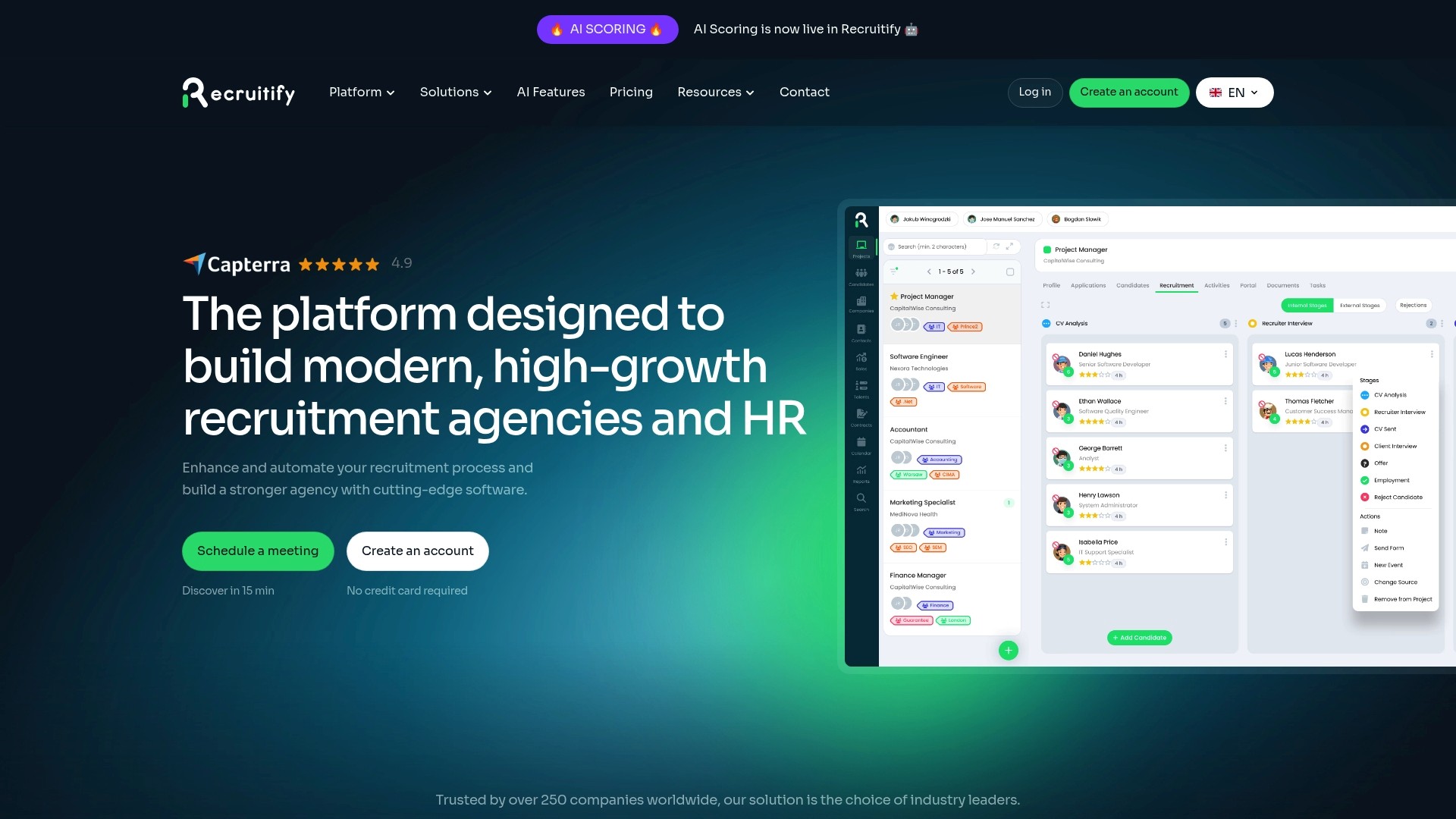
Recruitify’s contextual matching AI reads relationships within a candidate’s skill set rather than matching keywords, delivering ranked shortlists with a match score so recruiters spend their time on conversations, not resume triage. The AI CV parser builds a structured profile from any resume format in seconds and flags duplicates automatically, while multiposting pushes a single job out across channels without manual reposting for every board. Recruitify’s own positioning claims a 70% reduction in administrative workload across the full pipeline, and its GDPR consent module maintains a full audit trail for every candidate record, which matters when a candidate asks what data you hold on them.
If you’re evaluating whether to build this in-house or adopt a platform, start with the Recruitment Agencies plan at €79 per month per user or the HR Team plan at €69 per month per user, and request a demo to see the contextual matching engine run against your own open roles before committing.
Sources
FAQ
Is It Hard to Get Hired for a Remote Job?
It’s competitive rather than inherently hard, since remote postings draw 3 to 7 times more applicants than local roles, which raises the bar on standing out early. Candidates who complete structured intake tasks thoroughly and demonstrate clear async communication skill tend to clear screening faster than those relying on a resume alone.
What Is the 70/30 Rule in Hiring?
There’s no single standardized “70/30 rule” recognized across hiring practice, and definitions vary depending on the source. Some teams use it informally to describe splitting evaluation weight between hard skills and cultural or communication fit, but treat any specific ratio as a team-level guideline rather than an industry standard.
Is Remote Work Going Away?
No, remote and hybrid arrangements remain a fixture of hiring strategy, not a temporary phase. A Gartner survey found 82% of company leaders plan to allow remote work at least part of the time, and that structural shift continues to shape how companies build their hiring processes.
What Is the Easiest Remote Job to Get Hired For?
Roles with clearly measurable, portfolio-based output, like writing, design, customer support, and entry-level technical support, tend to move fastest through remote hiring processes because they’re easy to evaluate through a work sample rather than a lengthy interview loop. Candidates who can demonstrate results quickly through an async task typically clear screening with less friction than roles requiring extensive live evaluation.
How Does Recruitify Support a Remote Hiring Process?
Recruitify consolidates AI-driven candidate scoring, CV parsing, and multiposting into one platform, addressing the volume and manual-screening bottlenecks that slow remote hiring down. Pricing starts with the HR Team plan at €69 per month per user, with a Recruitment Agencies plan available at €79 per month per user for agency teams handling higher applicant volume.
Recommended


News & Updates
Stay up-to-date with the latest innovations, features, and tips about Recruitify!
By providing your email address within the newsletter sign-up form, you confirm its processing to send marketing information regarding the Administrator’s products and services. The Administrator of your personal data processed for the abovementioned purposes is Recruitify Spółka z o.o., based in Warsaw, Poland (KRS 0000709889). For more information on the principles of personal data processing and the rights of data subjects, please check the Privacy Policy.

Last updated:
Cut Screening Time 70%: Six Phase Remote Hiring Process for HR Teams
Applicant Tracking System
The Recruitify Team
A remote hiring process is the sequence of screening, evaluating, and onboarding steps a company runs when candidates and interviewers never meet in person. The single rule that separates a process that works from one that stalls is async-first design: default to structured, written, and recorded evaluation, and reserve live synchronous time for the two or three decisions that actually need a real-time conversation. Done right, this produces faster offers, fairer comparisons across candidates, and hires who ramp up without the informal mentoring an office provides automatically.
TL;DR:
Remote hiring requires an async-first process design to reduce time-to-offer and minimize drop-offs caused by prolonged loops and timezone issues.
Using structured intake questions, work samples, and recorded responses effectively filters candidates and reduces reliance on synchronous interviews.
AI-powered screening and multiposting cut manual review time by about 70% and improve applicant quality by targeting remote-specific channels.
Clear communication protocols and early compliance checks prevent delays, ghosting, and misclassification risks throughout the process.
Building an inclusive, respectful candidate experience with explicit timelines, flexible assessments, and data privacy safeguards improves diversity and candidate retention.
RecruitifyScreen Candidates With Less AdminRecruitify brings AI matching, CV parsing, sourcing, and recruitment workflows together for faster screening without expanding your team.Explore Recruitify
Table of Contents
Why the Remote Hiring Process Needs a Different Design
The Remote Hiring Process, Step by Step
Async-First Assessments That Scale Without Losing Signal
Sourcing and Screening at Scale Without Losing Quality
Interview Design and Scheduling Across Time Zones
Remote Onboarding: The 30-60-90 Plan That Actually Sticks
Compliance, Classification, and Payroll Before You Post the Role
Tools and Automation That Address the Real Bottlenecks
Metrics That Tell You Whether the Process Is Working
Communication Protocols That Keep Candidates and Teams Aligned
Diversity, Equity, and Inclusion in a Remote Hiring Process
Candidate Experience and Engagement in a Remote Process
Security and Data Privacy in Remote Hiring
Cost Analysis and Budgeting for Remote Hiring
Recruitify Team Perspective: Three Moves to Make This Week
How Recruitify Can Help You Fix the Bottleneck
Sources
FAQ
Why the Remote Hiring Process Needs a Different Design
Posting a role as remote does not just widen your applicant pool. It changes the entire mechanics of evaluation, and most of the remote hiring challenges teams run into trace back to reusing an in-office process on a distributed one.
Remote job postings draw 3 to 7 times more applicants than local roles, which overwhelms recruiters who screen resumes one at a time. That volume alone forces a choice: build filtering into the process or drown in it.
The bigger loss is subtler. In an office, you pick up signal from how someone handles a hallway question, whether they show up early, how they collaborate off the record. None of that exists remotely, so the process has to manufacture equivalent signal through written tasks, recorded answers, and async collaboration exercises. Skip that step and you are hiring on interview charisma alone.
Timezone friction adds another layer, stretching interview loops from days into weeks and giving candidates time to accept a competing offer. Left unaddressed, these gaps produce the same three failure modes repeatedly:
Higher ghosting rates as loops drag past the two-week mark
Misclassification risk when contractor and employee status gets decided too late
Onboarding slowdowns because ramp plans assume proximity that never existed
Industry data on remote hiring obstacles points to the same conclusion: teams that shorten loops and shift to async-first evaluation see measurably better drop-off and time-to-hire numbers than teams that don’t.
The Remote Hiring Process, Step by Step
A remote hiring process breaks into six phases, and each one produces a specific artifact you can point to when someone asks “where are we on this role?”
Define the role before you post it. Write down overlap hours (the window your hire must be online with the team), async norms (how fast a Slack message needs a reply), and two or three measurable outcomes for the first 90 days. A role description without these three elements guarantees mismatched expectations by week three.
Attract candidates with transparent, benchmarked pay. Post to remote-specific channels and multipost across boards that reach distributed talent rather than relying on a single local job board. Include a real pay range, not a placeholder. Candidates researching remote recruitment strategies consistently rank transparent compensation above brand name when deciding whether to apply.
Screen with structured intake, not resume skimming. Build an intake form that asks every candidate the same qualifying questions and includes one short, role-specific written task. A single paragraph response to a real scenario tells you more about async communication skill than three pages of resume bullet points.
Evaluate through work samples and recorded responses. This is where the remote job application process should diverge hardest from the in-office version. Ask for a small, timeboxed work sample tied directly to the job, and use a recorded video response for one or two open-ended questions instead of burning a live slot on them.
Decide and make the offer fast. Speed matters more remotely because a slow decision reads as low interest, and strong candidates already have other conversations running. Present total compensation clearly, including any location-based adjustments, and run compliance checks (background, right-to-work, classification) as conditional steps that don’t hold up the offer conversation itself.
Pre-board before day one, then onboard with milestones. Ship equipment, provision accounts, and assign a buddy before the start date. Set 30, 60, and 90-day markers with specific, measurable outcomes rather than vague “get up to speed” language.
Each phase needs an owner and a maximum elapsed time. Without that constraint, the process expands to fill whatever time is available, and that is how a three-week hiring plan turns into a seven-week one.
Async-First Assessments That Scale Without Losing Signal
Three async patterns cover almost every evaluation need in remote recruitment strategies: structured intake questions, take-home work samples, and recorded video responses. Each replaces a synchronous step that would otherwise require calendar coordination across time zones.
Structured intake works best early, filtering on must-have criteria and communication clarity before anyone invests interview time. Take-home work samples fit mid-funnel, when you need to see actual output, not a description of past output. Recorded responses work well for behavioral or motivational questions that don’t require back-and-forth.
Design each async task with three fixed elements:
A clear prompt scoped to a real task the role performs, not an abstract puzzle
A stated time limit, generally 30 to 90 minutes depending on seniority
A scoring rubric shared across every reviewer, so two people scoring the same submission land within a point of each other
Escalate to a synchronous conversation only when the decision genuinely needs real-time interaction: culture fit discussions, negotiation, or clarifying a work sample that raised questions. Everything else can stay async.
Teams that adopt this pattern see shorter elapsed time-to-offer and better candidate experience for applicants spread across multiple time zones, since nobody is waiting on a calendar match to move forward.
Pro Tip: Run a validity check on every async assessment: confirm it’s job-related, keep conditions consistent for every candidate, and manually review a sample of both passes and fails each quarter to catch scoring drift before it becomes a pattern.
Sourcing and Screening at Scale Without Losing Quality
High application volume is the defining challenge of remote talent acquisition, and the fix is layered filtering rather than one giant funnel.
Start by multiposting to channels that already attract remote-specific talent instead of generic boards that skew local. That alone changes the quality mix of who applies. Layer a structured intake form on top, asking for the same qualifying answers from every applicant so you’re comparing consistent data rather than free-form resumes.
From there, contextual AI screening earns its place. Rather than keyword matching, a scoring engine that understands relationships within a candidate’s skill set can surface a focused shortlist automatically, cutting the manual review pile down to a workable size. AI-assisted screening has been shown to cut initial screening time by roughly 70% when applied to high-volume remote postings, freeing recruiters to spend their time on candidates worth a real conversation.
That efficiency needs guardrails, though:
Always have a human review edge cases the algorithm flags as borderline, not just the clear rejects
Audit a sample of the shortlist against the full applicant pool periodically to check for bias creep
Document the criteria the screening tool weighs, so you can explain a decision if a candidate asks
The EEOC’s guidance on AI in employment is explicit here: automated selection tools must be job-related, validated, and paired with reasonable accommodations for applicants with disabilities. Automation speeds up screening. It does not remove your responsibility for what the screening decides.
Interview Design and Scheduling Across Time Zones
Synchronous interviews are the most expensive part of a remote hiring process, in calendar time and in candidate patience, so use them sparingly and deliberately.
Cap the loop at two to three rounds. Map each round to one specific dimension: technical depth, collaboration style, role-specific judgment. Anything beyond three rounds usually duplicates a signal you already have.
Structure virtual onsites in blocks, not marathons. A short orientation at the start, focused evaluation segments, and built-in breaks of 10 to 15 minutes between sessions keep both the candidate and the interview panel sharp instead of fatigued by hour four.
Schedule in the candidate’s local time, always. Display times in the candidate’s own zone, not the interviewer’s, and avoid booking slots outside roughly 7 AM to 9 PM local time even when it’s convenient on your end.
Use a scorecard per interviewer. Each person evaluates a distinct competency and records it independently before the debrief. This is the structured-scorecard approach CIPD recommends for keeping selection decisions fair and defensible, and it stops the debrief from turning into a popularity vote.
Remote Onboarding: The 30-60-90 Plan That Actually Sticks
Effective remote onboarding starts before day one, not on it. Ship equipment early, provision every account the new hire needs, confirm their first-week schedule, and assign a buddy who isn’t their manager, someone they can ask small questions without feeling like they’re bothering anyone important.
Day one should include recorded walkthroughs of core systems and processes, so the new hire can revisit material instead of relying on a single live session they half-absorbed. Integration happens the fastest through small, low-risk collaborative projects paired with scheduled, informal social time, since remote hires don’t get the accidental hallway conversations that build relationships in an office.
The 30-60-90 structure gives ramp time actual shape:
Day 30: Core systems mastered, first small deliverable shipped, initial manager check-in completed
Day 60: Independent ownership of at least one recurring task, cross-team relationships established
Day 90: Full productivity benchmark met, first performance conversation scheduled
Assumptions built for in-office ramp routinely fail remote hires, and deliberate, async-first onboarding plans shorten time-to-productivity while reducing the early attrition that quietly erases the savings from a fast hiring process.
Compliance, Classification, and Payroll Before You Post the Role
Decide whether a role is filled as an employee, an independent contractor, or through an Employer of Record before you source a single candidate. Sorting this out after an offer is verbally accepted is how offers collapse or get delayed by weeks.
An Employer of Record makes sense when you want to hire in a country where you have no legal entity, since it handles local payroll and statutory compliance on your behalf. Contractor arrangements work for defined, project-based work but carry real misclassification risk if the person functions like a full employee in practice, set hours, ongoing supervision, integration into your core team.
Some jurisdictions also require specific contract language or timing (a written contract issued within a set number of days of the start date, for instance), and missing that window can invalidate the agreement.
Build compliance triggers directly into your offer workflow:
Confirm classification and jurisdiction requirements before the offer letter goes out, not after
Flag any location-specific contract or notice requirements at the offer stage
Route EOR or global payroll setup to run in parallel with background checks, not after them
CIPD guidance recommends documenting the full recruitment process and testing any recruitment technology for validity before adoption, a standard that applies just as much to classification workflows as it does to interview design.
Tools and Automation That Address the Real Bottlenecks
The bottlenecks in remote hiring are predictable: too many applications, too much manual data entry, and too little visibility once a candidate moves past screening. Four tool classes address these directly: an ATS with AI screening, multiposting software, assessment platforms, and scheduling automation.
Contextual matching AI reduces manual screening by understanding relationships within a candidate’s skill set rather than matching isolated keywords, which is what makes a 70% reduction in screening time achievable in practice. Pairing that with OCR-based CV parsing means a resume in any format, PDF, scan, or photo, becomes a structured profile in seconds rather than a manual data-entry task.
A workable mini-workflow looks like this:
Intake form captures qualifying answers and the async writing sample automatically
AI scoring produces a ranked shortlist with a match percentage against the role
A recruiter reviews the shortlist and edge cases before anyone moves to interviews
Offer triggers fire automatically once compliance checks clear
Recruitify’s automation tools are built around this exact pattern, consolidating the ATS and contextual scoring so recruiters aren’t rebuilding the same shortlist logic in a spreadsheet every time a role opens.
Pro Tip: Log every automated screening decision and keep a documented accommodation path for candidates who need an alternative to a timed or video-based assessment. That log is what makes the process defensible later.
Metrics That Tell You Whether the Process Is Working
Five numbers matter more than the rest: time-to-offer, time-to-hire, candidate drop-off rate, quality-of-hire, and onboarding ramp time. Track all five together, because optimizing one in isolation (speed, usually) tends to quietly damage another.
A compressed loop where the role allows it, paired with lower offer-to-start drop-off, is the combination worth targeting. Longer time-to-hire and elevated drop-off are the two most common symptoms of a remote process that hasn’t been redesigned from its in-office original.
Run small experiments rather than overhauling everything at once:
Test async screening against synchronous phone screens for one role family and compare drop-off
Try disclosing compensation range earlier in the funnel and measure application quality
Compare two assessment formats (work sample vs. recorded response) for predictive accuracy against 90-day performance
Feed every retro back into the process document. A metric that never changes anything is just a number on a dashboard.
Communication Protocols That Keep Candidates and Teams Aligned
A remote hiring process lives or dies on how well information moves between candidates and the hiring team, since there’s no shared office to fill in the gaps informally.
Set a response-time standard and hold to it: acknowledge every application within a defined window, even if it’s an automated confirmation, and commit to updating candidates at each stage transition rather than leaving them to guess. Silence is the single biggest driver of candidate frustration in remote hiring, since candidates have no visual cues (a recruiter walking past their desk, a hallway comment) to reassure them the process is still moving.
Internally, the hiring team needs its own protocol. Define who owns candidate communication at each stage, where interview notes get logged, and how feedback gets shared before the next round is scheduled. A shared, structured scorecard prevents the common failure where two interviewers form contradictory impressions and nobody resolves the disagreement before the offer decision.
For the candidate side, a few practices consistently improve how the process feels:
State the number of rounds and expected total timeline in the very first outreach message
Confirm timezone and format for every scheduled call, in writing, not just verbally
Send a short, specific rejection rather than silence, even a two-line note preserves goodwill for future roles
These protocols cost almost nothing to implement and they solve the exact problem that makes ghosting feel mutual: candidates disappear when companies disappear first.
Diversity, Equity, and Inclusion in a Remote Hiring Process
Remote hiring widens the applicant pool geographically, but that alone doesn’t guarantee a fairer outcome. The process design determines whether that wider pool translates into more inclusive hiring or simply more applicants funneled through the same biased shortcuts.
Structured, validated assessments are the single strongest lever here. CIPD’s guidance on inclusive recruitment points to structured interviews and validated tests over unstructured conversations, which tend to reward familiarity and confidence rather than job-relevant skill. Async work samples help too, since they let candidates demonstrate ability without the pressure of live performance, which benefits candidates who communicate better at writing or need extra processing time.
Reasonable adjustments need to be built into the process, not offered as an afterthought when someone asks. That means giving every candidate the option to request an alternative assessment format before the assessment stage, not after a complaint. The EEOC’s guidance on AI-based selection tools makes this explicit for any automated screening or video-based evaluation: accommodations are a requirement, not a courtesy.
Timezone accessibility is its own inclusion issue. Scheduling every interview in your own business hours quietly excludes strong candidates in distant time zones, and that exclusion often correlates with geography in ways that narrow diversity without anyone intending it. Building interview windows that stretch across time zones, and defaulting to async where possible, keeps the wider applicant pool from actually working in your favor according to Forbes’s data.
Candidate Experience and Engagement in a Remote Process
Candidate experience in a remote hiring process has to be built deliberately, because none of the incidental warmth of an in-person visit, a handshake, a tour of the office, exists to compensate for a clunky process.
Engagement starts at the application itself. A long, repetitive form that asks for the same information the resume already contains signals a process that hasn’t been designed with the candidate’s time in mind. A short, well-designed intake form that includes one meaningful task instead of ten redundant fields respects that time and produces better signal simultaneously.
Throughout the funnel, momentum matters more remotely than in-office, because a candidate waiting a week for a callback has nothing to anchor their patience beyond a calendar. Set expectations explicitly: tell candidates how long each stage will take and stick to that timeline. When a stage runs long, a short update beats silence every time.
The interview experience itself should feel considered rather than improvised. Send a clear agenda before any video call: who they’ll meet, what to expect, how long it runs. A candidate walking into a virtual interview blind, unsure whether it’s a technical deep dive or a casual chat, starts the conversation defensively instead of openly.
Close the loop regardless of outcome. A specific, respectful rejection costs a recruiter two minutes and often turns a rejected candidate into a future referral source or a returning applicant for a better-fit role later.
Security and Data Privacy in Remote Hiring
Remote hiring processes handle more personal data across more systems than in-office hiring typically did, resumes, video recordings, background check results, and often data flowing across multiple countries with different privacy rules.
Video-based assessments and recorded responses raise the stakes: that footage is personal data, and it needs a defined retention period and a clear policy on who can access it and when it gets deleted. Storing recordings indefinitely “just in case” creates unnecessary exposure without any hiring benefit.
Any AI scoring or screening tool touching candidate data needs a documented basis for what it collects, how it’s used, and how long it’s retained, alongside a straightforward way for candidates to ask what data a company holds on them. This is where a consent management structure with a genuine audit trail matters, since it lets a company demonstrate, not just assert, that it handled candidate data properly if ever asked to prove it.
Practical safeguards worth building into the process from day one:
Restrict access to candidate records by role, not by default team-wide visibility
Set an automatic deletion or anonymization schedule for rejected candidates’ data
Keep an audit trail of who accessed or modified a candidate record and when
Data privacy discipline in hiring isn’t separate from candidate experience. A candidate who feels their information was handled carelessly rarely applies again, no matter how good the role sounded.
Cost Analysis and Budgeting for Remote Hiring
Budgeting for a remote hiring process means accounting for costs that don’t show up in an in-office budget line item, alongside the familiar ones that shrink.
Job board and multiposting fees often rise, since reaching a distributed pool typically means posting across more channels than a single local board would require. Assessment platform subscriptions, video interview tools, and background check services that cover multiple countries add recurring costs that scale with hiring volume rather than headcount.
Against that, remote hiring cuts real costs too: no relocation packages, no office tour logistics, and often a wider, more price-competitive talent pool than a single metro area offers. The net effect depends heavily on how much manual screening time the process demands, since recruiter hours spent sorting through the 3 to 7 times higher applicant volume that remote postings attract represent a real, if often uncounted, cost.
Automation shifts that math directly. A tool that cuts screening time by roughly 70% converts recruiter hours that were going into resume triage into hours spent on interviews and offer negotiation, the parts of the process that actually close roles. Budgeting for that kind of platform cost against the recruiter hours it displaces usually shows a clear return, particularly for teams hiring more than a handful of roles per quarter.
Recruitify Team Perspective: Three Moves to Make This Week
The teams that fix remote hiring fastest don’t overhaul everything at once. They document one role template with clear async expectations, add a single structured async assessment to their highest-volume role, and start tracking time-to-offer and drop-off rate immediately, before touching anything else.
Pilot automation on your worst bottleneck first, usually initial screening, rather than hiring more recruiting capacity to absorb volume manually. More hands rarely fixes a broken process; it just adds more people repeating the same inefficiency.
- Recruitify Team
How Recruitify Can Help You Fix the Bottleneck
Recruitify is the tool that turns the exact bottlenecks this guide covers, high application volume, slow manual screening, scattered compliance records, into a single operational workflow instead of five disconnected tools.
Recruitify’s contextual matching AI reads relationships within a candidate’s skill set rather than matching keywords, delivering ranked shortlists with a match score so recruiters spend their time on conversations, not resume triage. The AI CV parser builds a structured profile from any resume format in seconds and flags duplicates automatically, while multiposting pushes a single job out across channels without manual reposting for every board. Recruitify’s own positioning claims a 70% reduction in administrative workload across the full pipeline, and its GDPR consent module maintains a full audit trail for every candidate record, which matters when a candidate asks what data you hold on them.
If you’re evaluating whether to build this in-house or adopt a platform, start with the Recruitment Agencies plan at €79 per month per user or the HR Team plan at €69 per month per user, and request a demo to see the contextual matching engine run against your own open roles before committing.
Sources
FAQ
Is It Hard to Get Hired for a Remote Job?
It’s competitive rather than inherently hard, since remote postings draw 3 to 7 times more applicants than local roles, which raises the bar on standing out early. Candidates who complete structured intake tasks thoroughly and demonstrate clear async communication skill tend to clear screening faster than those relying on a resume alone.
What Is the 70/30 Rule in Hiring?
There’s no single standardized “70/30 rule” recognized across hiring practice, and definitions vary depending on the source. Some teams use it informally to describe splitting evaluation weight between hard skills and cultural or communication fit, but treat any specific ratio as a team-level guideline rather than an industry standard.
Is Remote Work Going Away?
No, remote and hybrid arrangements remain a fixture of hiring strategy, not a temporary phase. A Gartner survey found 82% of company leaders plan to allow remote work at least part of the time, and that structural shift continues to shape how companies build their hiring processes.
What Is the Easiest Remote Job to Get Hired For?
Roles with clearly measurable, portfolio-based output, like writing, design, customer support, and entry-level technical support, tend to move fastest through remote hiring processes because they’re easy to evaluate through a work sample rather than a lengthy interview loop. Candidates who can demonstrate results quickly through an async task typically clear screening with less friction than roles requiring extensive live evaluation.
How Does Recruitify Support a Remote Hiring Process?
Recruitify consolidates AI-driven candidate scoring, CV parsing, and multiposting into one platform, addressing the volume and manual-screening bottlenecks that slow remote hiring down. Pricing starts with the HR Team plan at €69 per month per user, with a Recruitment Agencies plan available at €79 per month per user for agency teams handling higher applicant volume.
Recommended
News & Updates
Stay up-to-date with the latest innovations, features, and tips about Recruitify!
By providing your email address within the newsletter sign-up form, you confirm its processing to send marketing information regarding the Administrator’s products and services. The Administrator of your personal data processed for the abovementioned purposes is Recruitify Spółka z o.o., based in Warsaw, Poland (KRS 0000709889). For more information on the principles of personal data processing and the rights of data subjects, please check the Privacy Policy.
Last updated:
Cut Screening Time 70%: Six Phase Remote Hiring Process for HR Teams
Applicant Tracking System
The Recruitify Team
A remote hiring process is the sequence of screening, evaluating, and onboarding steps a company runs when candidates and interviewers never meet in person. The single rule that separates a process that works from one that stalls is async-first design: default to structured, written, and recorded evaluation, and reserve live synchronous time for the two or three decisions that actually need a real-time conversation. Done right, this produces faster offers, fairer comparisons across candidates, and hires who ramp up without the informal mentoring an office provides automatically.
TL;DR:
Remote hiring requires an async-first process design to reduce time-to-offer and minimize drop-offs caused by prolonged loops and timezone issues.
Using structured intake questions, work samples, and recorded responses effectively filters candidates and reduces reliance on synchronous interviews.
AI-powered screening and multiposting cut manual review time by about 70% and improve applicant quality by targeting remote-specific channels.
Clear communication protocols and early compliance checks prevent delays, ghosting, and misclassification risks throughout the process.
Building an inclusive, respectful candidate experience with explicit timelines, flexible assessments, and data privacy safeguards improves diversity and candidate retention.
RecruitifyScreen Candidates With Less AdminRecruitify brings AI matching, CV parsing, sourcing, and recruitment workflows together for faster screening without expanding your team.Explore Recruitify
Table of Contents
Why the Remote Hiring Process Needs a Different Design
The Remote Hiring Process, Step by Step
Async-First Assessments That Scale Without Losing Signal
Sourcing and Screening at Scale Without Losing Quality
Interview Design and Scheduling Across Time Zones
Remote Onboarding: The 30-60-90 Plan That Actually Sticks
Compliance, Classification, and Payroll Before You Post the Role
Tools and Automation That Address the Real Bottlenecks
Metrics That Tell You Whether the Process Is Working
Communication Protocols That Keep Candidates and Teams Aligned
Diversity, Equity, and Inclusion in a Remote Hiring Process
Candidate Experience and Engagement in a Remote Process
Security and Data Privacy in Remote Hiring
Cost Analysis and Budgeting for Remote Hiring
Recruitify Team Perspective: Three Moves to Make This Week
How Recruitify Can Help You Fix the Bottleneck
Sources
FAQ
Why the Remote Hiring Process Needs a Different Design
Posting a role as remote does not just widen your applicant pool. It changes the entire mechanics of evaluation, and most of the remote hiring challenges teams run into trace back to reusing an in-office process on a distributed one.
Remote job postings draw 3 to 7 times more applicants than local roles, which overwhelms recruiters who screen resumes one at a time. That volume alone forces a choice: build filtering into the process or drown in it.
The bigger loss is subtler. In an office, you pick up signal from how someone handles a hallway question, whether they show up early, how they collaborate off the record. None of that exists remotely, so the process has to manufacture equivalent signal through written tasks, recorded answers, and async collaboration exercises. Skip that step and you are hiring on interview charisma alone.
Timezone friction adds another layer, stretching interview loops from days into weeks and giving candidates time to accept a competing offer. Left unaddressed, these gaps produce the same three failure modes repeatedly:
Higher ghosting rates as loops drag past the two-week mark
Misclassification risk when contractor and employee status gets decided too late
Onboarding slowdowns because ramp plans assume proximity that never existed
Industry data on remote hiring obstacles points to the same conclusion: teams that shorten loops and shift to async-first evaluation see measurably better drop-off and time-to-hire numbers than teams that don’t.
The Remote Hiring Process, Step by Step
A remote hiring process breaks into six phases, and each one produces a specific artifact you can point to when someone asks “where are we on this role?”
Define the role before you post it. Write down overlap hours (the window your hire must be online with the team), async norms (how fast a Slack message needs a reply), and two or three measurable outcomes for the first 90 days. A role description without these three elements guarantees mismatched expectations by week three.
Attract candidates with transparent, benchmarked pay. Post to remote-specific channels and multipost across boards that reach distributed talent rather than relying on a single local job board. Include a real pay range, not a placeholder. Candidates researching remote recruitment strategies consistently rank transparent compensation above brand name when deciding whether to apply.
Screen with structured intake, not resume skimming. Build an intake form that asks every candidate the same qualifying questions and includes one short, role-specific written task. A single paragraph response to a real scenario tells you more about async communication skill than three pages of resume bullet points.
Evaluate through work samples and recorded responses. This is where the remote job application process should diverge hardest from the in-office version. Ask for a small, timeboxed work sample tied directly to the job, and use a recorded video response for one or two open-ended questions instead of burning a live slot on them.
Decide and make the offer fast. Speed matters more remotely because a slow decision reads as low interest, and strong candidates already have other conversations running. Present total compensation clearly, including any location-based adjustments, and run compliance checks (background, right-to-work, classification) as conditional steps that don’t hold up the offer conversation itself.
Pre-board before day one, then onboard with milestones. Ship equipment, provision accounts, and assign a buddy before the start date. Set 30, 60, and 90-day markers with specific, measurable outcomes rather than vague “get up to speed” language.
Each phase needs an owner and a maximum elapsed time. Without that constraint, the process expands to fill whatever time is available, and that is how a three-week hiring plan turns into a seven-week one.
Async-First Assessments That Scale Without Losing Signal
Three async patterns cover almost every evaluation need in remote recruitment strategies: structured intake questions, take-home work samples, and recorded video responses. Each replaces a synchronous step that would otherwise require calendar coordination across time zones.
Structured intake works best early, filtering on must-have criteria and communication clarity before anyone invests interview time. Take-home work samples fit mid-funnel, when you need to see actual output, not a description of past output. Recorded responses work well for behavioral or motivational questions that don’t require back-and-forth.
Design each async task with three fixed elements:
A clear prompt scoped to a real task the role performs, not an abstract puzzle
A stated time limit, generally 30 to 90 minutes depending on seniority
A scoring rubric shared across every reviewer, so two people scoring the same submission land within a point of each other
Escalate to a synchronous conversation only when the decision genuinely needs real-time interaction: culture fit discussions, negotiation, or clarifying a work sample that raised questions. Everything else can stay async.
Teams that adopt this pattern see shorter elapsed time-to-offer and better candidate experience for applicants spread across multiple time zones, since nobody is waiting on a calendar match to move forward.
Pro Tip: Run a validity check on every async assessment: confirm it’s job-related, keep conditions consistent for every candidate, and manually review a sample of both passes and fails each quarter to catch scoring drift before it becomes a pattern.
Sourcing and Screening at Scale Without Losing Quality
High application volume is the defining challenge of remote talent acquisition, and the fix is layered filtering rather than one giant funnel.
Start by multiposting to channels that already attract remote-specific talent instead of generic boards that skew local. That alone changes the quality mix of who applies. Layer a structured intake form on top, asking for the same qualifying answers from every applicant so you’re comparing consistent data rather than free-form resumes.
From there, contextual AI screening earns its place. Rather than keyword matching, a scoring engine that understands relationships within a candidate’s skill set can surface a focused shortlist automatically, cutting the manual review pile down to a workable size. AI-assisted screening has been shown to cut initial screening time by roughly 70% when applied to high-volume remote postings, freeing recruiters to spend their time on candidates worth a real conversation.
That efficiency needs guardrails, though:
Always have a human review edge cases the algorithm flags as borderline, not just the clear rejects
Audit a sample of the shortlist against the full applicant pool periodically to check for bias creep
Document the criteria the screening tool weighs, so you can explain a decision if a candidate asks
The EEOC’s guidance on AI in employment is explicit here: automated selection tools must be job-related, validated, and paired with reasonable accommodations for applicants with disabilities. Automation speeds up screening. It does not remove your responsibility for what the screening decides.
Interview Design and Scheduling Across Time Zones
Synchronous interviews are the most expensive part of a remote hiring process, in calendar time and in candidate patience, so use them sparingly and deliberately.
Cap the loop at two to three rounds. Map each round to one specific dimension: technical depth, collaboration style, role-specific judgment. Anything beyond three rounds usually duplicates a signal you already have.
Structure virtual onsites in blocks, not marathons. A short orientation at the start, focused evaluation segments, and built-in breaks of 10 to 15 minutes between sessions keep both the candidate and the interview panel sharp instead of fatigued by hour four.
Schedule in the candidate’s local time, always. Display times in the candidate’s own zone, not the interviewer’s, and avoid booking slots outside roughly 7 AM to 9 PM local time even when it’s convenient on your end.
Use a scorecard per interviewer. Each person evaluates a distinct competency and records it independently before the debrief. This is the structured-scorecard approach CIPD recommends for keeping selection decisions fair and defensible, and it stops the debrief from turning into a popularity vote.
Remote Onboarding: The 30-60-90 Plan That Actually Sticks
Effective remote onboarding starts before day one, not on it. Ship equipment early, provision every account the new hire needs, confirm their first-week schedule, and assign a buddy who isn’t their manager, someone they can ask small questions without feeling like they’re bothering anyone important.
Day one should include recorded walkthroughs of core systems and processes, so the new hire can revisit material instead of relying on a single live session they half-absorbed. Integration happens the fastest through small, low-risk collaborative projects paired with scheduled, informal social time, since remote hires don’t get the accidental hallway conversations that build relationships in an office.
The 30-60-90 structure gives ramp time actual shape:
Day 30: Core systems mastered, first small deliverable shipped, initial manager check-in completed
Day 60: Independent ownership of at least one recurring task, cross-team relationships established
Day 90: Full productivity benchmark met, first performance conversation scheduled
Assumptions built for in-office ramp routinely fail remote hires, and deliberate, async-first onboarding plans shorten time-to-productivity while reducing the early attrition that quietly erases the savings from a fast hiring process.
Compliance, Classification, and Payroll Before You Post the Role
Decide whether a role is filled as an employee, an independent contractor, or through an Employer of Record before you source a single candidate. Sorting this out after an offer is verbally accepted is how offers collapse or get delayed by weeks.
An Employer of Record makes sense when you want to hire in a country where you have no legal entity, since it handles local payroll and statutory compliance on your behalf. Contractor arrangements work for defined, project-based work but carry real misclassification risk if the person functions like a full employee in practice, set hours, ongoing supervision, integration into your core team.
Some jurisdictions also require specific contract language or timing (a written contract issued within a set number of days of the start date, for instance), and missing that window can invalidate the agreement.
Build compliance triggers directly into your offer workflow:
Confirm classification and jurisdiction requirements before the offer letter goes out, not after
Flag any location-specific contract or notice requirements at the offer stage
Route EOR or global payroll setup to run in parallel with background checks, not after them
CIPD guidance recommends documenting the full recruitment process and testing any recruitment technology for validity before adoption, a standard that applies just as much to classification workflows as it does to interview design.
Tools and Automation That Address the Real Bottlenecks
The bottlenecks in remote hiring are predictable: too many applications, too much manual data entry, and too little visibility once a candidate moves past screening. Four tool classes address these directly: an ATS with AI screening, multiposting software, assessment platforms, and scheduling automation.
Contextual matching AI reduces manual screening by understanding relationships within a candidate’s skill set rather than matching isolated keywords, which is what makes a 70% reduction in screening time achievable in practice. Pairing that with OCR-based CV parsing means a resume in any format, PDF, scan, or photo, becomes a structured profile in seconds rather than a manual data-entry task.
A workable mini-workflow looks like this:
Intake form captures qualifying answers and the async writing sample automatically
AI scoring produces a ranked shortlist with a match percentage against the role
A recruiter reviews the shortlist and edge cases before anyone moves to interviews
Offer triggers fire automatically once compliance checks clear
Recruitify’s automation tools are built around this exact pattern, consolidating the ATS and contextual scoring so recruiters aren’t rebuilding the same shortlist logic in a spreadsheet every time a role opens.
Pro Tip: Log every automated screening decision and keep a documented accommodation path for candidates who need an alternative to a timed or video-based assessment. That log is what makes the process defensible later.
Metrics That Tell You Whether the Process Is Working
Five numbers matter more than the rest: time-to-offer, time-to-hire, candidate drop-off rate, quality-of-hire, and onboarding ramp time. Track all five together, because optimizing one in isolation (speed, usually) tends to quietly damage another.
A compressed loop where the role allows it, paired with lower offer-to-start drop-off, is the combination worth targeting. Longer time-to-hire and elevated drop-off are the two most common symptoms of a remote process that hasn’t been redesigned from its in-office original.
Run small experiments rather than overhauling everything at once:
Test async screening against synchronous phone screens for one role family and compare drop-off
Try disclosing compensation range earlier in the funnel and measure application quality
Compare two assessment formats (work sample vs. recorded response) for predictive accuracy against 90-day performance
Feed every retro back into the process document. A metric that never changes anything is just a number on a dashboard.
Communication Protocols That Keep Candidates and Teams Aligned
A remote hiring process lives or dies on how well information moves between candidates and the hiring team, since there’s no shared office to fill in the gaps informally.
Set a response-time standard and hold to it: acknowledge every application within a defined window, even if it’s an automated confirmation, and commit to updating candidates at each stage transition rather than leaving them to guess. Silence is the single biggest driver of candidate frustration in remote hiring, since candidates have no visual cues (a recruiter walking past their desk, a hallway comment) to reassure them the process is still moving.
Internally, the hiring team needs its own protocol. Define who owns candidate communication at each stage, where interview notes get logged, and how feedback gets shared before the next round is scheduled. A shared, structured scorecard prevents the common failure where two interviewers form contradictory impressions and nobody resolves the disagreement before the offer decision.
For the candidate side, a few practices consistently improve how the process feels:
State the number of rounds and expected total timeline in the very first outreach message
Confirm timezone and format for every scheduled call, in writing, not just verbally
Send a short, specific rejection rather than silence, even a two-line note preserves goodwill for future roles
These protocols cost almost nothing to implement and they solve the exact problem that makes ghosting feel mutual: candidates disappear when companies disappear first.
Diversity, Equity, and Inclusion in a Remote Hiring Process
Remote hiring widens the applicant pool geographically, but that alone doesn’t guarantee a fairer outcome. The process design determines whether that wider pool translates into more inclusive hiring or simply more applicants funneled through the same biased shortcuts.
Structured, validated assessments are the single strongest lever here. CIPD’s guidance on inclusive recruitment points to structured interviews and validated tests over unstructured conversations, which tend to reward familiarity and confidence rather than job-relevant skill. Async work samples help too, since they let candidates demonstrate ability without the pressure of live performance, which benefits candidates who communicate better at writing or need extra processing time.
Reasonable adjustments need to be built into the process, not offered as an afterthought when someone asks. That means giving every candidate the option to request an alternative assessment format before the assessment stage, not after a complaint. The EEOC’s guidance on AI-based selection tools makes this explicit for any automated screening or video-based evaluation: accommodations are a requirement, not a courtesy.
Timezone accessibility is its own inclusion issue. Scheduling every interview in your own business hours quietly excludes strong candidates in distant time zones, and that exclusion often correlates with geography in ways that narrow diversity without anyone intending it. Building interview windows that stretch across time zones, and defaulting to async where possible, keeps the wider applicant pool from actually working in your favor according to Forbes’s data.
Candidate Experience and Engagement in a Remote Process
Candidate experience in a remote hiring process has to be built deliberately, because none of the incidental warmth of an in-person visit, a handshake, a tour of the office, exists to compensate for a clunky process.
Engagement starts at the application itself. A long, repetitive form that asks for the same information the resume already contains signals a process that hasn’t been designed with the candidate’s time in mind. A short, well-designed intake form that includes one meaningful task instead of ten redundant fields respects that time and produces better signal simultaneously.
Throughout the funnel, momentum matters more remotely than in-office, because a candidate waiting a week for a callback has nothing to anchor their patience beyond a calendar. Set expectations explicitly: tell candidates how long each stage will take and stick to that timeline. When a stage runs long, a short update beats silence every time.
The interview experience itself should feel considered rather than improvised. Send a clear agenda before any video call: who they’ll meet, what to expect, how long it runs. A candidate walking into a virtual interview blind, unsure whether it’s a technical deep dive or a casual chat, starts the conversation defensively instead of openly.
Close the loop regardless of outcome. A specific, respectful rejection costs a recruiter two minutes and often turns a rejected candidate into a future referral source or a returning applicant for a better-fit role later.
Security and Data Privacy in Remote Hiring
Remote hiring processes handle more personal data across more systems than in-office hiring typically did, resumes, video recordings, background check results, and often data flowing across multiple countries with different privacy rules.
Video-based assessments and recorded responses raise the stakes: that footage is personal data, and it needs a defined retention period and a clear policy on who can access it and when it gets deleted. Storing recordings indefinitely “just in case” creates unnecessary exposure without any hiring benefit.
Any AI scoring or screening tool touching candidate data needs a documented basis for what it collects, how it’s used, and how long it’s retained, alongside a straightforward way for candidates to ask what data a company holds on them. This is where a consent management structure with a genuine audit trail matters, since it lets a company demonstrate, not just assert, that it handled candidate data properly if ever asked to prove it.
Practical safeguards worth building into the process from day one:
Restrict access to candidate records by role, not by default team-wide visibility
Set an automatic deletion or anonymization schedule for rejected candidates’ data
Keep an audit trail of who accessed or modified a candidate record and when
Data privacy discipline in hiring isn’t separate from candidate experience. A candidate who feels their information was handled carelessly rarely applies again, no matter how good the role sounded.
Cost Analysis and Budgeting for Remote Hiring
Budgeting for a remote hiring process means accounting for costs that don’t show up in an in-office budget line item, alongside the familiar ones that shrink.
Job board and multiposting fees often rise, since reaching a distributed pool typically means posting across more channels than a single local board would require. Assessment platform subscriptions, video interview tools, and background check services that cover multiple countries add recurring costs that scale with hiring volume rather than headcount.
Against that, remote hiring cuts real costs too: no relocation packages, no office tour logistics, and often a wider, more price-competitive talent pool than a single metro area offers. The net effect depends heavily on how much manual screening time the process demands, since recruiter hours spent sorting through the 3 to 7 times higher applicant volume that remote postings attract represent a real, if often uncounted, cost.
Automation shifts that math directly. A tool that cuts screening time by roughly 70% converts recruiter hours that were going into resume triage into hours spent on interviews and offer negotiation, the parts of the process that actually close roles. Budgeting for that kind of platform cost against the recruiter hours it displaces usually shows a clear return, particularly for teams hiring more than a handful of roles per quarter.
Recruitify Team Perspective: Three Moves to Make This Week
The teams that fix remote hiring fastest don’t overhaul everything at once. They document one role template with clear async expectations, add a single structured async assessment to their highest-volume role, and start tracking time-to-offer and drop-off rate immediately, before touching anything else.
Pilot automation on your worst bottleneck first, usually initial screening, rather than hiring more recruiting capacity to absorb volume manually. More hands rarely fixes a broken process; it just adds more people repeating the same inefficiency.
- Recruitify Team
How Recruitify Can Help You Fix the Bottleneck
Recruitify is the tool that turns the exact bottlenecks this guide covers, high application volume, slow manual screening, scattered compliance records, into a single operational workflow instead of five disconnected tools.
Recruitify’s contextual matching AI reads relationships within a candidate’s skill set rather than matching keywords, delivering ranked shortlists with a match score so recruiters spend their time on conversations, not resume triage. The AI CV parser builds a structured profile from any resume format in seconds and flags duplicates automatically, while multiposting pushes a single job out across channels without manual reposting for every board. Recruitify’s own positioning claims a 70% reduction in administrative workload across the full pipeline, and its GDPR consent module maintains a full audit trail for every candidate record, which matters when a candidate asks what data you hold on them.
If you’re evaluating whether to build this in-house or adopt a platform, start with the Recruitment Agencies plan at €79 per month per user or the HR Team plan at €69 per month per user, and request a demo to see the contextual matching engine run against your own open roles before committing.
Sources
FAQ
Is It Hard to Get Hired for a Remote Job?
It’s competitive rather than inherently hard, since remote postings draw 3 to 7 times more applicants than local roles, which raises the bar on standing out early. Candidates who complete structured intake tasks thoroughly and demonstrate clear async communication skill tend to clear screening faster than those relying on a resume alone.
What Is the 70/30 Rule in Hiring?
There’s no single standardized “70/30 rule” recognized across hiring practice, and definitions vary depending on the source. Some teams use it informally to describe splitting evaluation weight between hard skills and cultural or communication fit, but treat any specific ratio as a team-level guideline rather than an industry standard.
Is Remote Work Going Away?
No, remote and hybrid arrangements remain a fixture of hiring strategy, not a temporary phase. A Gartner survey found 82% of company leaders plan to allow remote work at least part of the time, and that structural shift continues to shape how companies build their hiring processes.
What Is the Easiest Remote Job to Get Hired For?
Roles with clearly measurable, portfolio-based output, like writing, design, customer support, and entry-level technical support, tend to move fastest through remote hiring processes because they’re easy to evaluate through a work sample rather than a lengthy interview loop. Candidates who can demonstrate results quickly through an async task typically clear screening with less friction than roles requiring extensive live evaluation.
How Does Recruitify Support a Remote Hiring Process?
Recruitify consolidates AI-driven candidate scoring, CV parsing, and multiposting into one platform, addressing the volume and manual-screening bottlenecks that slow remote hiring down. Pricing starts with the HR Team plan at €69 per month per user, with a Recruitment Agencies plan available at €79 per month per user for agency teams handling higher applicant volume.
Recommended
News & Updates
Stay up-to-date with the latest innovations, features, and tips about Recruitify!
By providing your email address within the newsletter sign-up form, you confirm its processing to send marketing information regarding the Administrator’s products and services. The Administrator of your personal data processed for the abovementioned purposes is Recruitify Spółka z o.o., based in Warsaw, Poland (KRS 0000709889). For more information on the principles of personal data processing and the rights of data subjects, please check the Privacy Policy.

Discover More

Recruitment Process
Cut Apply Time to 90 Seconds: Mobile Recruiting Strategy for TA Teams
Mobile recruiting strategy for TA teams: cut apply time under 90 seconds, track device level metrics, and fix your funnel in three sprints.
25 Sept 2026
Discover More

Recruitment Process
Shortlists in Days With Signal Driven Talent Pools for Recruiters
A signal first playbook for recruiters to build GDPR compliant talent pools that deliver shortlists in days. Includes five practical steps, tagging, and...
24 Sept 2026
Discover More

Recruitment Process
Recruiters: Build a Talent Pool That Fills Roles in 90 Days
Build a skills first talent pool in 90 days: assign an owner, set searchable fields, track consent, and nurture candidates from one ATS+CRM.
22 Sept 2026
Discover More
Recruitment Process
Cut Apply Time to 90 Seconds: Mobile Recruiting Strategy for TA Teams
Mobile recruiting strategy for TA teams: cut apply time under 90 seconds, track device level metrics, and fix your funnel in three sprints.
25 Sept 2026
Discover More
Recruitment Process
Shortlists in Days With Signal Driven Talent Pools for Recruiters
A signal first playbook for recruiters to build GDPR compliant talent pools that deliver shortlists in days. Includes five practical steps, tagging, and...
24 Sept 2026
Discover More