Last updated:
Prove Channel ROI in 90 Days, Recruiters Using Source of Hire Tracking

Applicant Tracking System

The Recruitify Team
Source of hire is the recruitment channel that ultimately produced a hired candidate, not just wherever they submitted an application. The single most valuable move a recruiting team can make right now is enforcing tagging at the point of entry for every candidate, then pairing that source data with outcome metrics like cost per hire and 12-month retention. Done well, this tells recruiters and TA leaders exactly which channels to fund, which to cut, and which look busy but produce nothing worth keeping.
Standardize all recruitment channel tags to ensure accurate reporting of source of hire percentages and avoid fragmented data.
Pair source of hire data with outcome metrics such as cost per hire, source-to-close time, and 12-month retention for actionable insights.
Use a combination of ATS mandatory fields, surveys, UTM tracking, and recruiter logs to accurately attribute candidate sources.
Enforce consistent attribution rules, lock source tags at first contact, and assign a data steward to maintain data integrity and governance.
Implement a regular review cadence, including weekly checks for tagging gaps and quarterly assessments for budget and channel effectiveness.
RecruitifyTurn Recruitment Data Into DecisionsRecruitify brings your sales pipeline, recruitment workflow, candidate data, and reporting into one operational ecosystem for IT recruitment teams.Explore Recruitify
Table of Contents
What source of hire means and which channels to standardize
Why source-of-hire tracking matters for ROI, quality, and retention
Outcome metrics to report alongside source of hire
How to measure source of hire: ATS tagging, surveys, analytics, and recruiter logs
Attribution rules and data governance that make the reports usable
Building a source-of-hire dashboard: fields, widgets, and cadence
How to analyze results and turn them into hiring decisions
Common pitfalls and a quick data-quality checklist
How Recruitify supports the practices this guide recommends
What the data keeps telling us
Put source-of-hire tracking on autopilot with Recruitify
Sources
FAQ
What source of hire means and which channels to standardize
Source of hire is the specific channel through which a candidate entered your pipeline and was ultimately hired, expressed as a percentage of total hires per channel. The formula is simple: source share equals hires from a given channel divided by total hires in the period, multiplied by 100.
That number gets confused constantly with source of application, which counts where candidates first showed up regardless of whether they were hired. A job board might generate hundreds of applications and zero hires, while an employee referral program brings in five applications and three hires. Tracking applications alone would rank the job board as your top channel. Tracking hires by source tells the real story.
Before you build any report, standardize the channel taxonomy everyone tags against. A workable starting list includes:
Employee referrals
Job boards (naming each one individually, not lumped together)
Career site / direct applications
Recruiter sourcing (LinkedIn, Boolean search, outbound outreach)
Recruitment agencies and staffing partners
Social media and employer branding campaigns
Internal mobility and rehires
Campus and university partnerships
Every recruiter on the team needs to use the exact same labels. A field called “LinkedIn” in one recruiter’s notes and “LI Sourced” in another’s will fracture your reporting before it starts.
Why source-of-hire tracking matters for ROI, quality, and retention
Volume-only reporting rewards the channel that produces the most applications, not the one that produces the best hires. That distinction changes budget decisions. A paid job board that fills a requisition fast but produces candidates who leave within six months looks cheap on a cost-per-application basis and expensive once you factor in replacement cost and lost productivity.
Leading recruiting teams have moved past counting hires and now track outcome metrics such as source-to-close time, offer acceptance rate by source, and 12-month retention to judge whether a channel actually works.
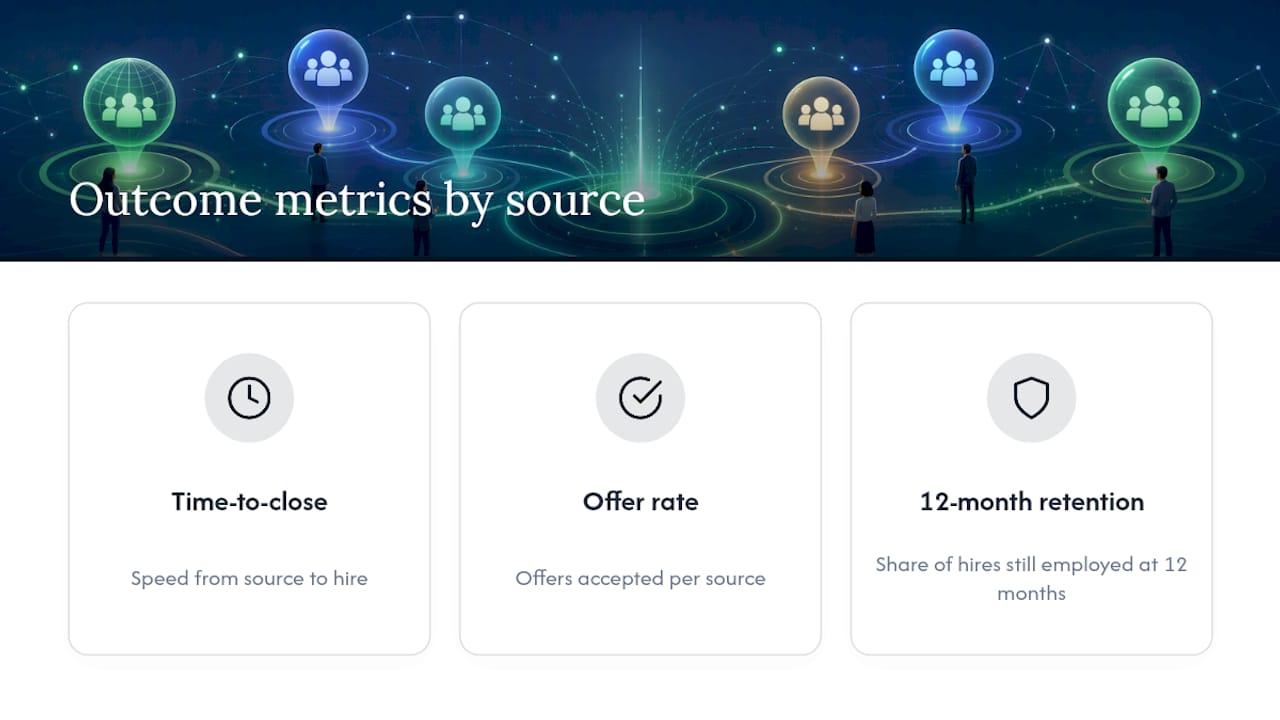
A referral program that costs more per hire in bonuses can still win on total cost once you account for faster time-to-fill and stronger retention, a pattern that shows up often enough that referral programs tend to post the strongest combined cost and retention outcomes, though every organization should verify this against its own numbers rather than assume it.
Finance cares about cost per hire. Hiring managers care about time-to-fill and quality of the final candidate. Retention and people analytics teams care about whether a hire is still there and performing a year later. Source-of-hire data, paired with outcomes, is the one report that speaks to all three audiences at once.
Outcome metrics to report alongside source of hire
Source share on its own is a vanity number. Pair it with these four categories to make it decision-grade:
Cost per hire by source. Include direct advertising spend, agency fees, and a reasonable allocation of recruiter time for each channel.
Source-to-close time. How long it takes a candidate from that channel to move from first contact to signed offer, and how that compares to your overall time-to-hire.
Offer acceptance and conversion rates by source. A channel that generates strong candidates who consistently decline offers has a different problem than one with weak candidate quality.
6- and 12-month retention and early performance proxies. Manager satisfaction scores, ramp-to-productivity time, or performance review outcomes segmented by original source.
None of these numbers mean much read in isolation. A channel with a low cost per hire but poor 12-month retention is quietly expensive. A channel with a higher upfront cost but strong retention and fast source-to-close time is often the better long-term investment, even though it never looks that way on a simple spreadsheet of ad spend.
How to measure source of hire: ATS tagging, surveys, analytics, and recruiter logs
No single method captures source of hire perfectly. The strongest reports come from combining four approaches, with one designated as the system of record.
Configure a mandatory source field in your ATS. Set it so a candidate record cannot advance past initial screening without a source tag. Automate the tag wherever possible (job board integrations, career page forms, referral portals) so it isn’t left to memory.
Use a short candidate-source survey as a fallback. A single question, “How did you first hear about this role?” with a dropdown of your standardized channel list, catches candidates who slip through automated tagging, like a friend who forwarded a job posting link.
Apply UTM parameters and referral tracking on career pages. This captures the digital trail for candidates who click through from social posts, newsletters, or partner sites before they ever fill out a form.
Require recruiter-entered source logging for outbound-sourced candidates. When a recruiter finds someone through Boolean search or a passive-candidate database, that source needs to be logged manually at first contact, not reconstructed later from memory.
Pick one method as your primary source of truth, typically the ATS field, and treat the others as verification and gap-filling tools. Recruitify’s recruitment project structure is built around exactly this idea: attribution gets captured as candidates move through the funnel rather than reconstructed afterward.
Pro Tip: *Run a quarterly spot-check comparing your ATS source field against candidate survey responses for a random sample of 20 hires.
Attribution rules and data governance that make the reports usable
A candidate who saw your job on LinkedIn, applied through the career page, and was later referred by a current employee touches three channels before they’re hired. Without a governance rule, three different recruiters could tag that hire three different ways, and your quarterly report becomes unusable.
Decide upfront whether you use first-touch attribution (crediting the channel that introduced the candidate) or last-touch attribution (crediting the channel that triggered the actual application or hire). Most practitioners settle this before a sourcing campaign launches, not after data starts coming in, because retrofitting a rule onto existing records creates inconsistent history.
Governance rules worth writing down and enforcing:
Pick one attribution rule (first-touch or last-touch) and apply it uniformly across every requisition.
Store the full multi-touch history as metadata in the candidate record, even though your reports pull from the single chosen rule — this preserves detail for later analysis without breaking daily reporting.
Lock source tags at the point of first contact. Retrospective tagging, someone updating a source field weeks after the fact based on a guess, is one of the fastest ways to corrupt a dataset.
Assign a data steward, usually a TA operations lead, who owns the taxonomy and approves any new channel labels.
Pro Tip: Treat your source taxonomy like a controlled vocabulary. Every time someone wants to add a new tag (“LinkedIn Outreach Q3 Campaign”), ask whether it’s a genuinely new channel or a variant of one you already track. Taxonomy sprawl kills reporting faster than missing data.
Building a source-of-hire dashboard: fields, widgets, and cadence
A usable dashboard starts with a minimum dataset. Without these fields, no visualization will save the report. A workable minimum includes candidate ID, role ID, source field, date first seen, full touch history as metadata, hire decision, hire date, recruiter ID, and the cost components tied to that channel: direct sourcing cost, advertising spend, and any agency fees.
Build the dashboard around a small number of widgets rather than trying to visualize everything:
Source share by channel (percentage of total hires)
Cost per hire by channel, trended quarter over quarter
Source-to-close time by channel
Offer acceptance rate by channel
6- and 12-month retention by channel
Add filters for role family, seniority level, and individual recruiter. A channel that performs brilliantly for senior engineering roles may perform poorly for entry-level sales hires, and averaging the two together hides both signals. Centralized dashboards remove the need to manually reconcile separate spreadsheets from finance, the ATS, and recruiter notes every reporting cycle.
Cadence | Who reviews it | What it’s for |
|---|---|---|
Weekly | Recruiters, TA ops | Catch tagging gaps, missing source fields, funnel stalls |
Monthly | TA leadership, hiring managers | Spot trends in conversion and cost by channel |
Quarterly | TA leadership, finance | Budget reallocation and channel investment decisions |
How to analyze results and turn them into hiring decisions
Raw source share tells you where hires came from. It doesn’t tell you where to invest next. That requires a deliberate analytical sequence.
Rank channels by conversion and retention, not volume. A channel producing fewer hires but higher offer acceptance and stronger 12-month retention should outrank a high-volume channel with weak follow-through.
Run controlled pilots before shifting significant budget. Move a modest percentage of spend to a promising channel for one hiring cycle and compare results against your baseline before committing further.
Apply causal methods only at sufficient scale. For larger organizations with rich historical data, techniques like propensity score matching combined with predictive analytics can separate a channel’s true effect on hiring rate and retention from confounding differences in candidate pools, something descriptive averages can’t do on their own.
Translate findings into recruiter playbooks. If referrals consistently outperform on retention, build a referral-bonus structure and a recruiter incentive around it rather than leaving the insight in a slide deck.
Smaller teams without the data volume for causal modeling still gain real value from steps one and two. Save the advanced statistical work for once your dataset has enough hires per channel to support it.
Common pitfalls and a quick data-quality checklist
Most source-of-hire reports fail quietly, producing numbers that look clean but mislead every decision built on them. The usual culprits:
Inconsistent taxonomy. Different recruiters, different labels, same channel, fragmented data.
Retrospective tagging. Filling in a source field weeks after hire, based on guesswork rather than a timestamped record.
Duplicate candidate records. A candidate who applies twice through different channels can get counted, and credited, twice.
Reporting volume only. Celebrating a channel for hire count while ignoring cost per hire and retention.
Missing cost or retention fields. A source report with no cost data can rank channels but can’t tell you whether they’re worth funding.
Run this validation checklist monthly: confirm every hired candidate has a non-blank source field, spot-check a sample against candidate survey responses, scan for duplicate candidate IDs, and verify at least one cost element exists for every recorded hire. Ad-hoc adoption of recruiting technology is still common, which is exactly why a short, repeatable checklist matters more than a sophisticated tool nobody audits.
How Recruitify supports the practices this guide recommends
Every recommendation above (tag at entry, enforce one taxonomy, pair source with cost and retention) depends on infrastructure that doesn’t rely on recruiter memory. That’s the operational gap Recruitify is built to close.
Mandatory tagging at point of entry through automated workflows that capture source data the moment a candidate enters the pipeline, rather than relying on someone updating a field later.
AI CV Parser with OCR that builds a structured candidate profile in seconds and automatically flags duplicates, addressing one of the most common data-quality pitfalls directly.
A GDPR consent management module with a full audit trail, giving every source record digital proof and timestamp discipline built into the automated workflow, not bolted on afterward.
A unified ATS and CRM pipeline that eliminates the spreadsheet reconciliation problem, since sourcing, recruiting, and outcome data live in one system instead of three.
Some recruitment platforms offer significant reductions in administrative tasks for teams that automate workflows, freeing recruiters to focus on candidate conversations instead of manual data entry.
What the data keeps telling us
Recruitify Team’s honest read on this: most teams already collect source data. Almost none of them pair it with outcomes, which is why the reporting exists but never changes a budget decision. Cost and retention by channel are what turn a spreadsheet into a lever.
Start small. Pick one taxonomy, turn on a mandatory ATS field, and run a 90-day pilot on two or three channels before overhauling your entire reporting stack. Keep the audit trail intact from day one. Retrofitting governance onto messy historical data is far harder than building it in from the start.
- Recruitify Team
Put source-of-hire tracking on autopilot with Recruitify
Manually reconciling job board exports, referral spreadsheets, and recruiter notes to figure out where your best hires actually came from eats hours every week that could go toward closing requisitions. Recruitify consolidates your ATS, CRM, and reporting into one pipeline, so source tagging happens automatically at the point of entry instead of getting patched together after the fact.
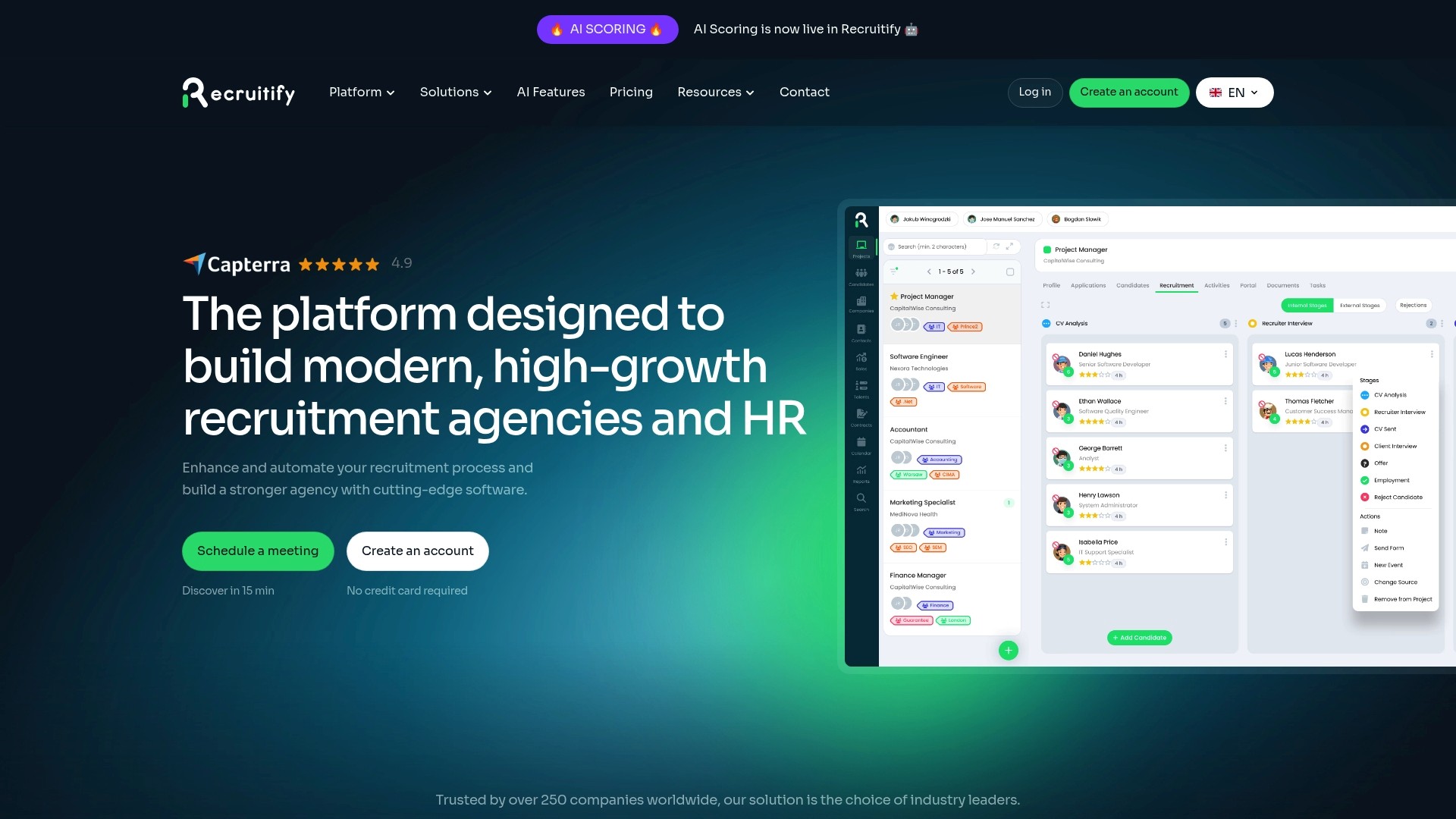
The platform’s AI CV Parser and contextual matching engine mean every candidate record carries structured source and outcome data from day one, with a GDPR audit trail built in rather than added as an afterthought. Pricing runs $69 per user per month for HR teams and $79 per user per month for recruitment agencies, with Enterprise pricing available on request. If your team is ready to replace scattered spreadsheets with a single source-of-hire report that actually holds up, explore Recruitify’s recruitment project workflows and book a demo to see your own pipeline data in action.
Sources
FAQ
What is source of hire?
Source of hire is the recruitment channel that ultimately produced a hired candidate, measured as a percentage of total hires per channel. It differs from source of application, which counts where candidates first showed up regardless of whether they were ever hired.
Is source-of-hire tracking software legit?
Yes, when it’s built into an ATS with mandatory tagging and an audit trail rather than left to manual spreadsheets. Platforms like Recruitify enforce tagging at the point of entry and pair source data with cost and retention metrics, which is the approach that leading recruiting teams have shifted toward to validate real channel effectiveness.
What are the top applicant tracking systems for source tracking?
The strongest options are ATS platforms with mandatory source fields, automated tagging at candidate entry, and integrated reporting rather than manual exports. Recruitify combines these with CV parsing and CRM integration in a single pipeline, which reduces the reconciliation work that fragments source data across separate systems.
What are red flags in a source-of-hire report?
Watch for inconsistent channel labels across recruiters, source fields filled in retrospectively rather than at first contact, duplicate candidate records, and reports that show hire volume without cost or retention data attached. Any of these signals the underlying data can’t be trusted for budget decisions.
How often should we review source-of-hire data?
Check tagging completeness weekly to catch gaps early, review conversion and cost trends monthly with TA leadership, and reserve quarterly reviews for budget reallocation decisions with finance. This cadence matches how dashboards are typically used to catch problems before they distort a full reporting cycle.
Recommended


News & Updates
Stay up-to-date with the latest innovations, features, and tips about Recruitify!
By providing your email address within the newsletter sign-up form, you confirm its processing to send marketing information regarding the Administrator’s products and services. The Administrator of your personal data processed for the abovementioned purposes is Recruitify Spółka z o.o., based in Warsaw, Poland (KRS 0000709889). For more information on the principles of personal data processing and the rights of data subjects, please check the Privacy Policy.

Last updated:
Prove Channel ROI in 90 Days, Recruiters Using Source of Hire Tracking
Applicant Tracking System
The Recruitify Team
Source of hire is the recruitment channel that ultimately produced a hired candidate, not just wherever they submitted an application. The single most valuable move a recruiting team can make right now is enforcing tagging at the point of entry for every candidate, then pairing that source data with outcome metrics like cost per hire and 12-month retention. Done well, this tells recruiters and TA leaders exactly which channels to fund, which to cut, and which look busy but produce nothing worth keeping.
Standardize all recruitment channel tags to ensure accurate reporting of source of hire percentages and avoid fragmented data.
Pair source of hire data with outcome metrics such as cost per hire, source-to-close time, and 12-month retention for actionable insights.
Use a combination of ATS mandatory fields, surveys, UTM tracking, and recruiter logs to accurately attribute candidate sources.
Enforce consistent attribution rules, lock source tags at first contact, and assign a data steward to maintain data integrity and governance.
Implement a regular review cadence, including weekly checks for tagging gaps and quarterly assessments for budget and channel effectiveness.
RecruitifyTurn Recruitment Data Into DecisionsRecruitify brings your sales pipeline, recruitment workflow, candidate data, and reporting into one operational ecosystem for IT recruitment teams.Explore Recruitify
Table of Contents
What source of hire means and which channels to standardize
Why source-of-hire tracking matters for ROI, quality, and retention
Outcome metrics to report alongside source of hire
How to measure source of hire: ATS tagging, surveys, analytics, and recruiter logs
Attribution rules and data governance that make the reports usable
Building a source-of-hire dashboard: fields, widgets, and cadence
How to analyze results and turn them into hiring decisions
Common pitfalls and a quick data-quality checklist
How Recruitify supports the practices this guide recommends
What the data keeps telling us
Put source-of-hire tracking on autopilot with Recruitify
Sources
FAQ
What source of hire means and which channels to standardize
Source of hire is the specific channel through which a candidate entered your pipeline and was ultimately hired, expressed as a percentage of total hires per channel. The formula is simple: source share equals hires from a given channel divided by total hires in the period, multiplied by 100.
That number gets confused constantly with source of application, which counts where candidates first showed up regardless of whether they were hired. A job board might generate hundreds of applications and zero hires, while an employee referral program brings in five applications and three hires. Tracking applications alone would rank the job board as your top channel. Tracking hires by source tells the real story.
Before you build any report, standardize the channel taxonomy everyone tags against. A workable starting list includes:
Employee referrals
Job boards (naming each one individually, not lumped together)
Career site / direct applications
Recruiter sourcing (LinkedIn, Boolean search, outbound outreach)
Recruitment agencies and staffing partners
Social media and employer branding campaigns
Internal mobility and rehires
Campus and university partnerships
Every recruiter on the team needs to use the exact same labels. A field called “LinkedIn” in one recruiter’s notes and “LI Sourced” in another’s will fracture your reporting before it starts.
Why source-of-hire tracking matters for ROI, quality, and retention
Volume-only reporting rewards the channel that produces the most applications, not the one that produces the best hires. That distinction changes budget decisions. A paid job board that fills a requisition fast but produces candidates who leave within six months looks cheap on a cost-per-application basis and expensive once you factor in replacement cost and lost productivity.
Leading recruiting teams have moved past counting hires and now track outcome metrics such as source-to-close time, offer acceptance rate by source, and 12-month retention to judge whether a channel actually works.
A referral program that costs more per hire in bonuses can still win on total cost once you account for faster time-to-fill and stronger retention, a pattern that shows up often enough that referral programs tend to post the strongest combined cost and retention outcomes, though every organization should verify this against its own numbers rather than assume it.
Finance cares about cost per hire. Hiring managers care about time-to-fill and quality of the final candidate. Retention and people analytics teams care about whether a hire is still there and performing a year later. Source-of-hire data, paired with outcomes, is the one report that speaks to all three audiences at once.
Outcome metrics to report alongside source of hire
Source share on its own is a vanity number. Pair it with these four categories to make it decision-grade:
Cost per hire by source. Include direct advertising spend, agency fees, and a reasonable allocation of recruiter time for each channel.
Source-to-close time. How long it takes a candidate from that channel to move from first contact to signed offer, and how that compares to your overall time-to-hire.
Offer acceptance and conversion rates by source. A channel that generates strong candidates who consistently decline offers has a different problem than one with weak candidate quality.
6- and 12-month retention and early performance proxies. Manager satisfaction scores, ramp-to-productivity time, or performance review outcomes segmented by original source.
None of these numbers mean much read in isolation. A channel with a low cost per hire but poor 12-month retention is quietly expensive. A channel with a higher upfront cost but strong retention and fast source-to-close time is often the better long-term investment, even though it never looks that way on a simple spreadsheet of ad spend.
How to measure source of hire: ATS tagging, surveys, analytics, and recruiter logs
No single method captures source of hire perfectly. The strongest reports come from combining four approaches, with one designated as the system of record.
Configure a mandatory source field in your ATS. Set it so a candidate record cannot advance past initial screening without a source tag. Automate the tag wherever possible (job board integrations, career page forms, referral portals) so it isn’t left to memory.
Use a short candidate-source survey as a fallback. A single question, “How did you first hear about this role?” with a dropdown of your standardized channel list, catches candidates who slip through automated tagging, like a friend who forwarded a job posting link.
Apply UTM parameters and referral tracking on career pages. This captures the digital trail for candidates who click through from social posts, newsletters, or partner sites before they ever fill out a form.
Require recruiter-entered source logging for outbound-sourced candidates. When a recruiter finds someone through Boolean search or a passive-candidate database, that source needs to be logged manually at first contact, not reconstructed later from memory.
Pick one method as your primary source of truth, typically the ATS field, and treat the others as verification and gap-filling tools. Recruitify’s recruitment project structure is built around exactly this idea: attribution gets captured as candidates move through the funnel rather than reconstructed afterward.
Pro Tip: *Run a quarterly spot-check comparing your ATS source field against candidate survey responses for a random sample of 20 hires.
Attribution rules and data governance that make the reports usable
A candidate who saw your job on LinkedIn, applied through the career page, and was later referred by a current employee touches three channels before they’re hired. Without a governance rule, three different recruiters could tag that hire three different ways, and your quarterly report becomes unusable.
Decide upfront whether you use first-touch attribution (crediting the channel that introduced the candidate) or last-touch attribution (crediting the channel that triggered the actual application or hire). Most practitioners settle this before a sourcing campaign launches, not after data starts coming in, because retrofitting a rule onto existing records creates inconsistent history.
Governance rules worth writing down and enforcing:
Pick one attribution rule (first-touch or last-touch) and apply it uniformly across every requisition.
Store the full multi-touch history as metadata in the candidate record, even though your reports pull from the single chosen rule — this preserves detail for later analysis without breaking daily reporting.
Lock source tags at the point of first contact. Retrospective tagging, someone updating a source field weeks after the fact based on a guess, is one of the fastest ways to corrupt a dataset.
Assign a data steward, usually a TA operations lead, who owns the taxonomy and approves any new channel labels.
Pro Tip: Treat your source taxonomy like a controlled vocabulary. Every time someone wants to add a new tag (“LinkedIn Outreach Q3 Campaign”), ask whether it’s a genuinely new channel or a variant of one you already track. Taxonomy sprawl kills reporting faster than missing data.
Building a source-of-hire dashboard: fields, widgets, and cadence
A usable dashboard starts with a minimum dataset. Without these fields, no visualization will save the report. A workable minimum includes candidate ID, role ID, source field, date first seen, full touch history as metadata, hire decision, hire date, recruiter ID, and the cost components tied to that channel: direct sourcing cost, advertising spend, and any agency fees.
Build the dashboard around a small number of widgets rather than trying to visualize everything:
Source share by channel (percentage of total hires)
Cost per hire by channel, trended quarter over quarter
Source-to-close time by channel
Offer acceptance rate by channel
6- and 12-month retention by channel
Add filters for role family, seniority level, and individual recruiter. A channel that performs brilliantly for senior engineering roles may perform poorly for entry-level sales hires, and averaging the two together hides both signals. Centralized dashboards remove the need to manually reconcile separate spreadsheets from finance, the ATS, and recruiter notes every reporting cycle.
Cadence | Who reviews it | What it’s for |
|---|---|---|
Weekly | Recruiters, TA ops | Catch tagging gaps, missing source fields, funnel stalls |
Monthly | TA leadership, hiring managers | Spot trends in conversion and cost by channel |
Quarterly | TA leadership, finance | Budget reallocation and channel investment decisions |
How to analyze results and turn them into hiring decisions
Raw source share tells you where hires came from. It doesn’t tell you where to invest next. That requires a deliberate analytical sequence.
Rank channels by conversion and retention, not volume. A channel producing fewer hires but higher offer acceptance and stronger 12-month retention should outrank a high-volume channel with weak follow-through.
Run controlled pilots before shifting significant budget. Move a modest percentage of spend to a promising channel for one hiring cycle and compare results against your baseline before committing further.
Apply causal methods only at sufficient scale. For larger organizations with rich historical data, techniques like propensity score matching combined with predictive analytics can separate a channel’s true effect on hiring rate and retention from confounding differences in candidate pools, something descriptive averages can’t do on their own.
Translate findings into recruiter playbooks. If referrals consistently outperform on retention, build a referral-bonus structure and a recruiter incentive around it rather than leaving the insight in a slide deck.
Smaller teams without the data volume for causal modeling still gain real value from steps one and two. Save the advanced statistical work for once your dataset has enough hires per channel to support it.
Common pitfalls and a quick data-quality checklist
Most source-of-hire reports fail quietly, producing numbers that look clean but mislead every decision built on them. The usual culprits:
Inconsistent taxonomy. Different recruiters, different labels, same channel, fragmented data.
Retrospective tagging. Filling in a source field weeks after hire, based on guesswork rather than a timestamped record.
Duplicate candidate records. A candidate who applies twice through different channels can get counted, and credited, twice.
Reporting volume only. Celebrating a channel for hire count while ignoring cost per hire and retention.
Missing cost or retention fields. A source report with no cost data can rank channels but can’t tell you whether they’re worth funding.
Run this validation checklist monthly: confirm every hired candidate has a non-blank source field, spot-check a sample against candidate survey responses, scan for duplicate candidate IDs, and verify at least one cost element exists for every recorded hire. Ad-hoc adoption of recruiting technology is still common, which is exactly why a short, repeatable checklist matters more than a sophisticated tool nobody audits.
How Recruitify supports the practices this guide recommends
Every recommendation above (tag at entry, enforce one taxonomy, pair source with cost and retention) depends on infrastructure that doesn’t rely on recruiter memory. That’s the operational gap Recruitify is built to close.
Mandatory tagging at point of entry through automated workflows that capture source data the moment a candidate enters the pipeline, rather than relying on someone updating a field later.
AI CV Parser with OCR that builds a structured candidate profile in seconds and automatically flags duplicates, addressing one of the most common data-quality pitfalls directly.
A GDPR consent management module with a full audit trail, giving every source record digital proof and timestamp discipline built into the automated workflow, not bolted on afterward.
A unified ATS and CRM pipeline that eliminates the spreadsheet reconciliation problem, since sourcing, recruiting, and outcome data live in one system instead of three.
Some recruitment platforms offer significant reductions in administrative tasks for teams that automate workflows, freeing recruiters to focus on candidate conversations instead of manual data entry.
What the data keeps telling us
Recruitify Team’s honest read on this: most teams already collect source data. Almost none of them pair it with outcomes, which is why the reporting exists but never changes a budget decision. Cost and retention by channel are what turn a spreadsheet into a lever.
Start small. Pick one taxonomy, turn on a mandatory ATS field, and run a 90-day pilot on two or three channels before overhauling your entire reporting stack. Keep the audit trail intact from day one. Retrofitting governance onto messy historical data is far harder than building it in from the start.
- Recruitify Team
Put source-of-hire tracking on autopilot with Recruitify
Manually reconciling job board exports, referral spreadsheets, and recruiter notes to figure out where your best hires actually came from eats hours every week that could go toward closing requisitions. Recruitify consolidates your ATS, CRM, and reporting into one pipeline, so source tagging happens automatically at the point of entry instead of getting patched together after the fact.
The platform’s AI CV Parser and contextual matching engine mean every candidate record carries structured source and outcome data from day one, with a GDPR audit trail built in rather than added as an afterthought. Pricing runs $69 per user per month for HR teams and $79 per user per month for recruitment agencies, with Enterprise pricing available on request. If your team is ready to replace scattered spreadsheets with a single source-of-hire report that actually holds up, explore Recruitify’s recruitment project workflows and book a demo to see your own pipeline data in action.
Sources
FAQ
What is source of hire?
Source of hire is the recruitment channel that ultimately produced a hired candidate, measured as a percentage of total hires per channel. It differs from source of application, which counts where candidates first showed up regardless of whether they were ever hired.
Is source-of-hire tracking software legit?
Yes, when it’s built into an ATS with mandatory tagging and an audit trail rather than left to manual spreadsheets. Platforms like Recruitify enforce tagging at the point of entry and pair source data with cost and retention metrics, which is the approach that leading recruiting teams have shifted toward to validate real channel effectiveness.
What are the top applicant tracking systems for source tracking?
The strongest options are ATS platforms with mandatory source fields, automated tagging at candidate entry, and integrated reporting rather than manual exports. Recruitify combines these with CV parsing and CRM integration in a single pipeline, which reduces the reconciliation work that fragments source data across separate systems.
What are red flags in a source-of-hire report?
Watch for inconsistent channel labels across recruiters, source fields filled in retrospectively rather than at first contact, duplicate candidate records, and reports that show hire volume without cost or retention data attached. Any of these signals the underlying data can’t be trusted for budget decisions.
How often should we review source-of-hire data?
Check tagging completeness weekly to catch gaps early, review conversion and cost trends monthly with TA leadership, and reserve quarterly reviews for budget reallocation decisions with finance. This cadence matches how dashboards are typically used to catch problems before they distort a full reporting cycle.
Recommended
News & Updates
Stay up-to-date with the latest innovations, features, and tips about Recruitify!
By providing your email address within the newsletter sign-up form, you confirm its processing to send marketing information regarding the Administrator’s products and services. The Administrator of your personal data processed for the abovementioned purposes is Recruitify Spółka z o.o., based in Warsaw, Poland (KRS 0000709889). For more information on the principles of personal data processing and the rights of data subjects, please check the Privacy Policy.
Last updated:
Prove Channel ROI in 90 Days, Recruiters Using Source of Hire Tracking
Applicant Tracking System
The Recruitify Team
Source of hire is the recruitment channel that ultimately produced a hired candidate, not just wherever they submitted an application. The single most valuable move a recruiting team can make right now is enforcing tagging at the point of entry for every candidate, then pairing that source data with outcome metrics like cost per hire and 12-month retention. Done well, this tells recruiters and TA leaders exactly which channels to fund, which to cut, and which look busy but produce nothing worth keeping.
Standardize all recruitment channel tags to ensure accurate reporting of source of hire percentages and avoid fragmented data.
Pair source of hire data with outcome metrics such as cost per hire, source-to-close time, and 12-month retention for actionable insights.
Use a combination of ATS mandatory fields, surveys, UTM tracking, and recruiter logs to accurately attribute candidate sources.
Enforce consistent attribution rules, lock source tags at first contact, and assign a data steward to maintain data integrity and governance.
Implement a regular review cadence, including weekly checks for tagging gaps and quarterly assessments for budget and channel effectiveness.
RecruitifyTurn Recruitment Data Into DecisionsRecruitify brings your sales pipeline, recruitment workflow, candidate data, and reporting into one operational ecosystem for IT recruitment teams.Explore Recruitify
Table of Contents
What source of hire means and which channels to standardize
Why source-of-hire tracking matters for ROI, quality, and retention
Outcome metrics to report alongside source of hire
How to measure source of hire: ATS tagging, surveys, analytics, and recruiter logs
Attribution rules and data governance that make the reports usable
Building a source-of-hire dashboard: fields, widgets, and cadence
How to analyze results and turn them into hiring decisions
Common pitfalls and a quick data-quality checklist
How Recruitify supports the practices this guide recommends
What the data keeps telling us
Put source-of-hire tracking on autopilot with Recruitify
Sources
FAQ
What source of hire means and which channels to standardize
Source of hire is the specific channel through which a candidate entered your pipeline and was ultimately hired, expressed as a percentage of total hires per channel. The formula is simple: source share equals hires from a given channel divided by total hires in the period, multiplied by 100.
That number gets confused constantly with source of application, which counts where candidates first showed up regardless of whether they were hired. A job board might generate hundreds of applications and zero hires, while an employee referral program brings in five applications and three hires. Tracking applications alone would rank the job board as your top channel. Tracking hires by source tells the real story.
Before you build any report, standardize the channel taxonomy everyone tags against. A workable starting list includes:
Employee referrals
Job boards (naming each one individually, not lumped together)
Career site / direct applications
Recruiter sourcing (LinkedIn, Boolean search, outbound outreach)
Recruitment agencies and staffing partners
Social media and employer branding campaigns
Internal mobility and rehires
Campus and university partnerships
Every recruiter on the team needs to use the exact same labels. A field called “LinkedIn” in one recruiter’s notes and “LI Sourced” in another’s will fracture your reporting before it starts.
Why source-of-hire tracking matters for ROI, quality, and retention
Volume-only reporting rewards the channel that produces the most applications, not the one that produces the best hires. That distinction changes budget decisions. A paid job board that fills a requisition fast but produces candidates who leave within six months looks cheap on a cost-per-application basis and expensive once you factor in replacement cost and lost productivity.
Leading recruiting teams have moved past counting hires and now track outcome metrics such as source-to-close time, offer acceptance rate by source, and 12-month retention to judge whether a channel actually works.
A referral program that costs more per hire in bonuses can still win on total cost once you account for faster time-to-fill and stronger retention, a pattern that shows up often enough that referral programs tend to post the strongest combined cost and retention outcomes, though every organization should verify this against its own numbers rather than assume it.
Finance cares about cost per hire. Hiring managers care about time-to-fill and quality of the final candidate. Retention and people analytics teams care about whether a hire is still there and performing a year later. Source-of-hire data, paired with outcomes, is the one report that speaks to all three audiences at once.
Outcome metrics to report alongside source of hire
Source share on its own is a vanity number. Pair it with these four categories to make it decision-grade:
Cost per hire by source. Include direct advertising spend, agency fees, and a reasonable allocation of recruiter time for each channel.
Source-to-close time. How long it takes a candidate from that channel to move from first contact to signed offer, and how that compares to your overall time-to-hire.
Offer acceptance and conversion rates by source. A channel that generates strong candidates who consistently decline offers has a different problem than one with weak candidate quality.
6- and 12-month retention and early performance proxies. Manager satisfaction scores, ramp-to-productivity time, or performance review outcomes segmented by original source.
None of these numbers mean much read in isolation. A channel with a low cost per hire but poor 12-month retention is quietly expensive. A channel with a higher upfront cost but strong retention and fast source-to-close time is often the better long-term investment, even though it never looks that way on a simple spreadsheet of ad spend.
How to measure source of hire: ATS tagging, surveys, analytics, and recruiter logs
No single method captures source of hire perfectly. The strongest reports come from combining four approaches, with one designated as the system of record.
Configure a mandatory source field in your ATS. Set it so a candidate record cannot advance past initial screening without a source tag. Automate the tag wherever possible (job board integrations, career page forms, referral portals) so it isn’t left to memory.
Use a short candidate-source survey as a fallback. A single question, “How did you first hear about this role?” with a dropdown of your standardized channel list, catches candidates who slip through automated tagging, like a friend who forwarded a job posting link.
Apply UTM parameters and referral tracking on career pages. This captures the digital trail for candidates who click through from social posts, newsletters, or partner sites before they ever fill out a form.
Require recruiter-entered source logging for outbound-sourced candidates. When a recruiter finds someone through Boolean search or a passive-candidate database, that source needs to be logged manually at first contact, not reconstructed later from memory.
Pick one method as your primary source of truth, typically the ATS field, and treat the others as verification and gap-filling tools. Recruitify’s recruitment project structure is built around exactly this idea: attribution gets captured as candidates move through the funnel rather than reconstructed afterward.
Pro Tip: *Run a quarterly spot-check comparing your ATS source field against candidate survey responses for a random sample of 20 hires.
Attribution rules and data governance that make the reports usable
A candidate who saw your job on LinkedIn, applied through the career page, and was later referred by a current employee touches three channels before they’re hired. Without a governance rule, three different recruiters could tag that hire three different ways, and your quarterly report becomes unusable.
Decide upfront whether you use first-touch attribution (crediting the channel that introduced the candidate) or last-touch attribution (crediting the channel that triggered the actual application or hire). Most practitioners settle this before a sourcing campaign launches, not after data starts coming in, because retrofitting a rule onto existing records creates inconsistent history.
Governance rules worth writing down and enforcing:
Pick one attribution rule (first-touch or last-touch) and apply it uniformly across every requisition.
Store the full multi-touch history as metadata in the candidate record, even though your reports pull from the single chosen rule — this preserves detail for later analysis without breaking daily reporting.
Lock source tags at the point of first contact. Retrospective tagging, someone updating a source field weeks after the fact based on a guess, is one of the fastest ways to corrupt a dataset.
Assign a data steward, usually a TA operations lead, who owns the taxonomy and approves any new channel labels.
Pro Tip: Treat your source taxonomy like a controlled vocabulary. Every time someone wants to add a new tag (“LinkedIn Outreach Q3 Campaign”), ask whether it’s a genuinely new channel or a variant of one you already track. Taxonomy sprawl kills reporting faster than missing data.
Building a source-of-hire dashboard: fields, widgets, and cadence
A usable dashboard starts with a minimum dataset. Without these fields, no visualization will save the report. A workable minimum includes candidate ID, role ID, source field, date first seen, full touch history as metadata, hire decision, hire date, recruiter ID, and the cost components tied to that channel: direct sourcing cost, advertising spend, and any agency fees.
Build the dashboard around a small number of widgets rather than trying to visualize everything:
Source share by channel (percentage of total hires)
Cost per hire by channel, trended quarter over quarter
Source-to-close time by channel
Offer acceptance rate by channel
6- and 12-month retention by channel
Add filters for role family, seniority level, and individual recruiter. A channel that performs brilliantly for senior engineering roles may perform poorly for entry-level sales hires, and averaging the two together hides both signals. Centralized dashboards remove the need to manually reconcile separate spreadsheets from finance, the ATS, and recruiter notes every reporting cycle.
Cadence | Who reviews it | What it’s for |
|---|---|---|
Weekly | Recruiters, TA ops | Catch tagging gaps, missing source fields, funnel stalls |
Monthly | TA leadership, hiring managers | Spot trends in conversion and cost by channel |
Quarterly | TA leadership, finance | Budget reallocation and channel investment decisions |
How to analyze results and turn them into hiring decisions
Raw source share tells you where hires came from. It doesn’t tell you where to invest next. That requires a deliberate analytical sequence.
Rank channels by conversion and retention, not volume. A channel producing fewer hires but higher offer acceptance and stronger 12-month retention should outrank a high-volume channel with weak follow-through.
Run controlled pilots before shifting significant budget. Move a modest percentage of spend to a promising channel for one hiring cycle and compare results against your baseline before committing further.
Apply causal methods only at sufficient scale. For larger organizations with rich historical data, techniques like propensity score matching combined with predictive analytics can separate a channel’s true effect on hiring rate and retention from confounding differences in candidate pools, something descriptive averages can’t do on their own.
Translate findings into recruiter playbooks. If referrals consistently outperform on retention, build a referral-bonus structure and a recruiter incentive around it rather than leaving the insight in a slide deck.
Smaller teams without the data volume for causal modeling still gain real value from steps one and two. Save the advanced statistical work for once your dataset has enough hires per channel to support it.
Common pitfalls and a quick data-quality checklist
Most source-of-hire reports fail quietly, producing numbers that look clean but mislead every decision built on them. The usual culprits:
Inconsistent taxonomy. Different recruiters, different labels, same channel, fragmented data.
Retrospective tagging. Filling in a source field weeks after hire, based on guesswork rather than a timestamped record.
Duplicate candidate records. A candidate who applies twice through different channels can get counted, and credited, twice.
Reporting volume only. Celebrating a channel for hire count while ignoring cost per hire and retention.
Missing cost or retention fields. A source report with no cost data can rank channels but can’t tell you whether they’re worth funding.
Run this validation checklist monthly: confirm every hired candidate has a non-blank source field, spot-check a sample against candidate survey responses, scan for duplicate candidate IDs, and verify at least one cost element exists for every recorded hire. Ad-hoc adoption of recruiting technology is still common, which is exactly why a short, repeatable checklist matters more than a sophisticated tool nobody audits.
How Recruitify supports the practices this guide recommends
Every recommendation above (tag at entry, enforce one taxonomy, pair source with cost and retention) depends on infrastructure that doesn’t rely on recruiter memory. That’s the operational gap Recruitify is built to close.
Mandatory tagging at point of entry through automated workflows that capture source data the moment a candidate enters the pipeline, rather than relying on someone updating a field later.
AI CV Parser with OCR that builds a structured candidate profile in seconds and automatically flags duplicates, addressing one of the most common data-quality pitfalls directly.
A GDPR consent management module with a full audit trail, giving every source record digital proof and timestamp discipline built into the automated workflow, not bolted on afterward.
A unified ATS and CRM pipeline that eliminates the spreadsheet reconciliation problem, since sourcing, recruiting, and outcome data live in one system instead of three.
Some recruitment platforms offer significant reductions in administrative tasks for teams that automate workflows, freeing recruiters to focus on candidate conversations instead of manual data entry.
What the data keeps telling us
Recruitify Team’s honest read on this: most teams already collect source data. Almost none of them pair it with outcomes, which is why the reporting exists but never changes a budget decision. Cost and retention by channel are what turn a spreadsheet into a lever.
Start small. Pick one taxonomy, turn on a mandatory ATS field, and run a 90-day pilot on two or three channels before overhauling your entire reporting stack. Keep the audit trail intact from day one. Retrofitting governance onto messy historical data is far harder than building it in from the start.
- Recruitify Team
Put source-of-hire tracking on autopilot with Recruitify
Manually reconciling job board exports, referral spreadsheets, and recruiter notes to figure out where your best hires actually came from eats hours every week that could go toward closing requisitions. Recruitify consolidates your ATS, CRM, and reporting into one pipeline, so source tagging happens automatically at the point of entry instead of getting patched together after the fact.
The platform’s AI CV Parser and contextual matching engine mean every candidate record carries structured source and outcome data from day one, with a GDPR audit trail built in rather than added as an afterthought. Pricing runs $69 per user per month for HR teams and $79 per user per month for recruitment agencies, with Enterprise pricing available on request. If your team is ready to replace scattered spreadsheets with a single source-of-hire report that actually holds up, explore Recruitify’s recruitment project workflows and book a demo to see your own pipeline data in action.
Sources
FAQ
What is source of hire?
Source of hire is the recruitment channel that ultimately produced a hired candidate, measured as a percentage of total hires per channel. It differs from source of application, which counts where candidates first showed up regardless of whether they were ever hired.
Is source-of-hire tracking software legit?
Yes, when it’s built into an ATS with mandatory tagging and an audit trail rather than left to manual spreadsheets. Platforms like Recruitify enforce tagging at the point of entry and pair source data with cost and retention metrics, which is the approach that leading recruiting teams have shifted toward to validate real channel effectiveness.
What are the top applicant tracking systems for source tracking?
The strongest options are ATS platforms with mandatory source fields, automated tagging at candidate entry, and integrated reporting rather than manual exports. Recruitify combines these with CV parsing and CRM integration in a single pipeline, which reduces the reconciliation work that fragments source data across separate systems.
What are red flags in a source-of-hire report?
Watch for inconsistent channel labels across recruiters, source fields filled in retrospectively rather than at first contact, duplicate candidate records, and reports that show hire volume without cost or retention data attached. Any of these signals the underlying data can’t be trusted for budget decisions.
How often should we review source-of-hire data?
Check tagging completeness weekly to catch gaps early, review conversion and cost trends monthly with TA leadership, and reserve quarterly reviews for budget reallocation decisions with finance. This cadence matches how dashboards are typically used to catch problems before they distort a full reporting cycle.
Recommended
News & Updates
Stay up-to-date with the latest innovations, features, and tips about Recruitify!
By providing your email address within the newsletter sign-up form, you confirm its processing to send marketing information regarding the Administrator’s products and services. The Administrator of your personal data processed for the abovementioned purposes is Recruitify Spółka z o.o., based in Warsaw, Poland (KRS 0000709889). For more information on the principles of personal data processing and the rights of data subjects, please check the Privacy Policy.

Discover More

Applicant Tracking System
HR Teams: Build Recruitment Dashboards Fast With 3–5 KPIs
HR teams: design recruitment dashboards that drive decisions. Pick 3–5 KPIs, map each to the hiring decision it should trigger, and build fast.
28 Sept 2026
Discover More

Applicant Tracking System
Cut Screening Time 70%: Six Phase Remote Hiring Process for HR Teams
Redesign your remote hiring process with an async first six phase workflow, practical templates, and automation that can cut screening time 70%.
27 Sept 2026
Discover More

Recruitment Process
Cut Apply Time to 90 Seconds: Mobile Recruiting Strategy for TA Teams
Mobile recruiting strategy for TA teams: cut apply time under 90 seconds, track device level metrics, and fix your funnel in three sprints.
25 Sept 2026
Discover More
Applicant Tracking System
HR Teams: Build Recruitment Dashboards Fast With 3–5 KPIs
HR teams: design recruitment dashboards that drive decisions. Pick 3–5 KPIs, map each to the hiring decision it should trigger, and build fast.
28 Sept 2026
Discover More
Applicant Tracking System
Cut Screening Time 70%: Six Phase Remote Hiring Process for HR Teams
Redesign your remote hiring process with an async first six phase workflow, practical templates, and automation that can cut screening time 70%.
27 Sept 2026
Discover More