
Last updated:
Keep Recruiters in Charge: Sourcing Automation With Human Approval Gates

Recruitment Process

The Recruitify Team
Keep Recruiters in Charge: Sourcing Automation With Human Approval Gates
Sourcing automation applies AI to the repetitive parts of finding and engaging candidates, including discovery, outreach, and scheduling, so recruiters spend less time on manual searches and more time on conversations that close roles. Teams hiring at scale or filling repetitive requisitions see the fastest payoff: quicker outreach, higher-quality response rates, and hours returned to recruiters each week. For most talent acquisition teams, adopting it now, through a scoped pilot rather than a full rollout, is the right move.
TL;DR:
Sourcing automation primarily covers candidate discovery, outreach, and scheduling tasks that recruiters previously handled manually, leading to increased throughput for high-volume hiring.
Effective integration with ATS, CRM, calendar, and email systems is crucial for automation tools to avoid creating additional manual work and to ensure seamless candidate data flow.
Key performance indicators for pilots include candidates sourced per week, reply rates, and time saved, with faster ROI expected in roles with clean, high-volume requisitions.
AI-assisted tools suggest or draft actions while human oversight remains; agentic platforms can automate entire workflows but are better suited for organizations with predictable, high-volume requisitions.
Building custom tools is rarely necessary unless facing specialized compliance or proprietary data challenges, while waiting is advisable if hiring volume is too low for meaningful results.
Table of Contents
What Sourcing Automation Actually Covers
Why Sourcing Automation Matters: Benefits and the KPIs to Track
AI-Assisted vs. Agentic Sourcing: Which Type Fits Your Team?
How to Choose a Sourcing Automation Approach
Rolling Out Sourcing Automation Without Losing Control
How Recruitify Approaches Sourcing Automation in Practice
When to Buy, Build, or Wait on Sourcing Automation
See Sourcing Automation Working Inside Your Own Pipeline
Sources
What Sourcing Automation Actually Covers
Sourcing automation is not the same as posting a job on a board or letting an ATS log applicants. It sits earlier in the funnel, handling the work recruiters used to do by hand before a candidate ever applies: searching talent pools, finding contact information, and starting outreach sequences. Sourcing automation tools typically automate repetitive tasks including candidate discovery, outreach sequences, and interview scheduling, which frees recruiters to focus on the human-centric parts of the job, like screening calls and closing conversations.
In practice, this looks like software that scans talent pools and public profiles for candidates matching a role’s criteria, enriches those profiles with verified contact details, and fires off personalized outreach on a schedule you control. Some platforms also handle rediscovery, meaning they resurface silver-medalist candidates from past searches instead of letting that sourcing work go to waste.
A sourcing automation product typically needs to connect with:
Your applicant tracking system, so sourced candidates flow directly into open requisitions
A CRM, to track engagement history and avoid re-contacting the same person twice
Calendar tools, for automated interview scheduling once a candidate responds
Your email or messaging provider, to send outreach under your own domain and reputation
If a tool can’t integrate cleanly with these four systems, it becomes another disconnected tab your team has to manage manually, which defeats the point.
Why Sourcing Automation Matters: Benefits and the KPIs to Track
The case for automating candidate sourcing comes down to three things: more candidates reached per week, faster replies, and recruiter hours freed up for higher-value work. Sourcing automation tools reduce the manual burden of repetitive discovery and outreach tasks, and that reduction shows up directly in throughput numbers once a team tracks them.
Sourcing automation shifts recruiter effort from search to conversation. Instead of spending a morning building a candidate list, a recruiter reviews a pre-qualified shortlist and starts talking. That shift is the actual ROI driver, not the automation itself.
To prove out a pilot or justify a renewal, track a small set of KPIs rather than everything the platform reports:
Candidates sourced per week, per recruiter
Outreach reply rate (a strong early signal of message quality and targeting)
Time saved per role, measured against a manual baseline before rollout
Time-to-hire changes, though this metric moves slower and needs a few full hiring cycles to read accurately
SHRM’s talent trends research points to time saved and recruiter productivity as the metrics HR organizations most often use to measure AI impact, which lines up with what pilot teams should watch first.
Realistic ROI depends heavily on role complexity, data quality, and how deeply the tool integrates with your existing stack. A high-volume warehouse hiring program with clean requisition data will see automation pay off relatively quickly. A specialized executive search with thin talent pools and inconsistent job descriptions will see a slower, messier return, and that gap is worth setting expectations around before you pilot anything.
AI-Assisted vs. Agentic Sourcing: Which Type Fits Your Team?
Not all sourcing automation works the same way, and the distinction matters more than most vendor pitches let on. AI-assisted tools help with individual tasks: they suggest candidates, draft outreach messages, or auto-schedule a call, but a recruiter still initiates and approves each step. Agentic, or end-to-end, automation runs entire workflows with far less human triggering. Agentic sourcing platforms can execute end-to-end workflows from intake through candidate engagement, with human decision gates built in rather than a human starting every action.
That distinction is real, not just marketing language, and it suits different levels of organizational readiness. AI-assisted tools fit teams still building trust in automated outputs or handling varied, lower-volume roles. Agentic tools fit teams with high-volume, repeatable requisitions where the workflow itself is predictable enough to hand off, with oversight, to an autonomous agent.
Whichever type you evaluate, the feature checklist looks similar:
Candidate graph coverage: how broad and current is the underlying talent data?
Contact lookup accuracy: does it find working emails and numbers, or stale ones?
Multi-channel sequenced outreach: can it coordinate email, messaging, and follow-ups on a timed cadence?
CRM/ATS sync: does data flow both directions in near real time?
Scoring and explainability: can the tool show why it ranked a candidate a certain way?
Audit trails: is there a record of every automated action taken on a candidate?
Human-in-the-loop gates: can a recruiter pause, override, or approve before an action fires?
Reporting: does it surface the KPIs that actually matter to your team?
High-volume hiring leans harder on multi-channel outreach and CRM sync, since the win there is scale. Specialized or executive hiring leans harder on scoring explainability and human override controls, since a wrong automated move costs more relationship capital.
Pro Tip: Ask any vendor to show you a candidate’s full activity trail, not just the final score. If they can’t produce one in the demo, assume the audit trail doesn’t exist in production either.
How to Choose a Sourcing Automation Approach
Evaluating sourcing automation software works best as a structured comparison, not a gut reaction to a slick demo. Weigh each option against these criteria: data sources and coverage, integration depth, quality control processes, explainability of candidate scoring, security and compliance posture, configurability, pricing model, and the level of support included.
Analyst frameworks for AI in HR consistently flag explainability, governance, and auditability as the criteria that separate durable vendor choices from tools that create compliance headaches later. Treat those three as non-negotiable line items, not nice-to-haves.
During a demo or procurement call, bring a specific list of questions rather than letting the vendor drive the conversation:
How often does the candidate data refresh, and where does it come from?
Can a recruiter override or pause an automated action before it goes out?
Is there an audit log showing every action the system took, and who can access it?
What outreach deliverability rate have similar clients seen, and over what time window?
How is candidate scoring calculated, and can that logic be explained in plain language?
What happens to candidate data if we cancel the contract?
How is pricing structured: per seat, per candidate sourced, or a flat platform fee?
What’s the actual onboarding timeline before we see production use?
Can outreach templates be customized per role, or are they fixed?
What support is included after go-live, and what costs extra?
A few answers should send you looking elsewhere. Watch for these red flags:
Closed or unclear data sources with no explanation of where candidate profiles come from
No option for a human to override or approve an automated action
Missing or thin audit trails for outreach and scoring decisions
Canned outreach templates that can’t be customized to your employer brand or role specifics
Any one of these on its own is a caution flag. Two or more together usually means the platform wasn’t built with recruiter oversight in mind.
Rolling Out Sourcing Automation Without Losing Control
A pilot is the right way to introduce sourcing automation, and it works best when scoped tightly instead of applied across every open role at once. Start with a repeatable role type, something you hire for often enough to generate a real data set, and run the pilot for a moderate duration to gather sufficient data. Longer than that and you lose momentum; shorter and you won’t see enough hiring cycles to trust the results.
Set success metrics before the pilot starts, not after. Decide in advance what “working” looks like: a target reply rate, a time-saved figure per role, or a minimum number of qualified candidates surfaced per week.
Governance matters as much as the metrics. Successful adoption balances autonomous agent activity with human oversight at defined decision gates, which is what keeps candidate experience intact while the automation runs. Build in:
Clear approval thresholds for when a recruiter must sign off before an action fires
Candidate experience standards, so automated outreach still reads as personal and on-brand
A consent and data-sourcing policy that’s explicit about where enriched contact data comes from
Role complexity should shape how much autonomy you grant. Practitioner guidance on calibrating automation by role type suggests near-full automation works for routine, high-volume roles, while senior or specialist hires need tighter human review at every stage. Budget time for internal training too. A tool is only as good as the team’s confidence in overriding it when something looks off.
Pro Tip: Run your pilot on a role your team already knows well. If the automated shortlist looks off to an experienced recruiter’s eye, that’s more useful signal than any dashboard metric.
How Recruitify Approaches Sourcing Automation in Practice
Recruitify builds sourcing automation around the same principle this guide has argued for: automation should extend recruiter judgment, not replace it. The platform’s 24/7 Sourcing Agent runs continuous candidate discovery and outreach inside the same environment as your CRM and ATS, so sourced candidates land directly in the right pipeline instead of a separate tool you have to reconcile manually.
Human decision gates sit throughout the workflow, letting recruiters review, adjust, or approve outreach before it goes out at scale. Recruitify is trusted by numerous companies, and its automation and analytics features are built to surface the same KPIs covered above: candidates sourced, reply rates, and time saved per role.
A practical pilot template using Recruitify’s project templates might cover:
One high-volume role type, tracked over a moderate time frame
Weekly reply-rate and time-saved reporting
A defined approval gate before outreach expands past 50 candidates
When to Buy, Build, or Wait on Sourcing Automation
Buy a sourcing automation platform when you’re hiring repeatedly for similar roles, your ATS and CRM are ready to integrate, and you can define success metrics before you start. That’s the profile where a pilot proves itself fast.
Build custom tooling only when you have unusual compliance requirements or proprietary candidate data that off-the-shelf platforms can’t handle well. That’s a narrow case, and most teams overestimate how often it applies to them.
Wait when hiring volume is too low to generate meaningful data, your candidate records are inconsistent or duplicated, or nobody on the team owns the rollout. Automating a messy process just automates the mess faster.
- Recruitify Team
See Sourcing Automation Working Inside Your Own Pipeline
Reading about sourcing automation only gets you so far. The real test is watching sourced candidates flow into your existing pipeline without a separate tool to manage, reconcile, or babysit.
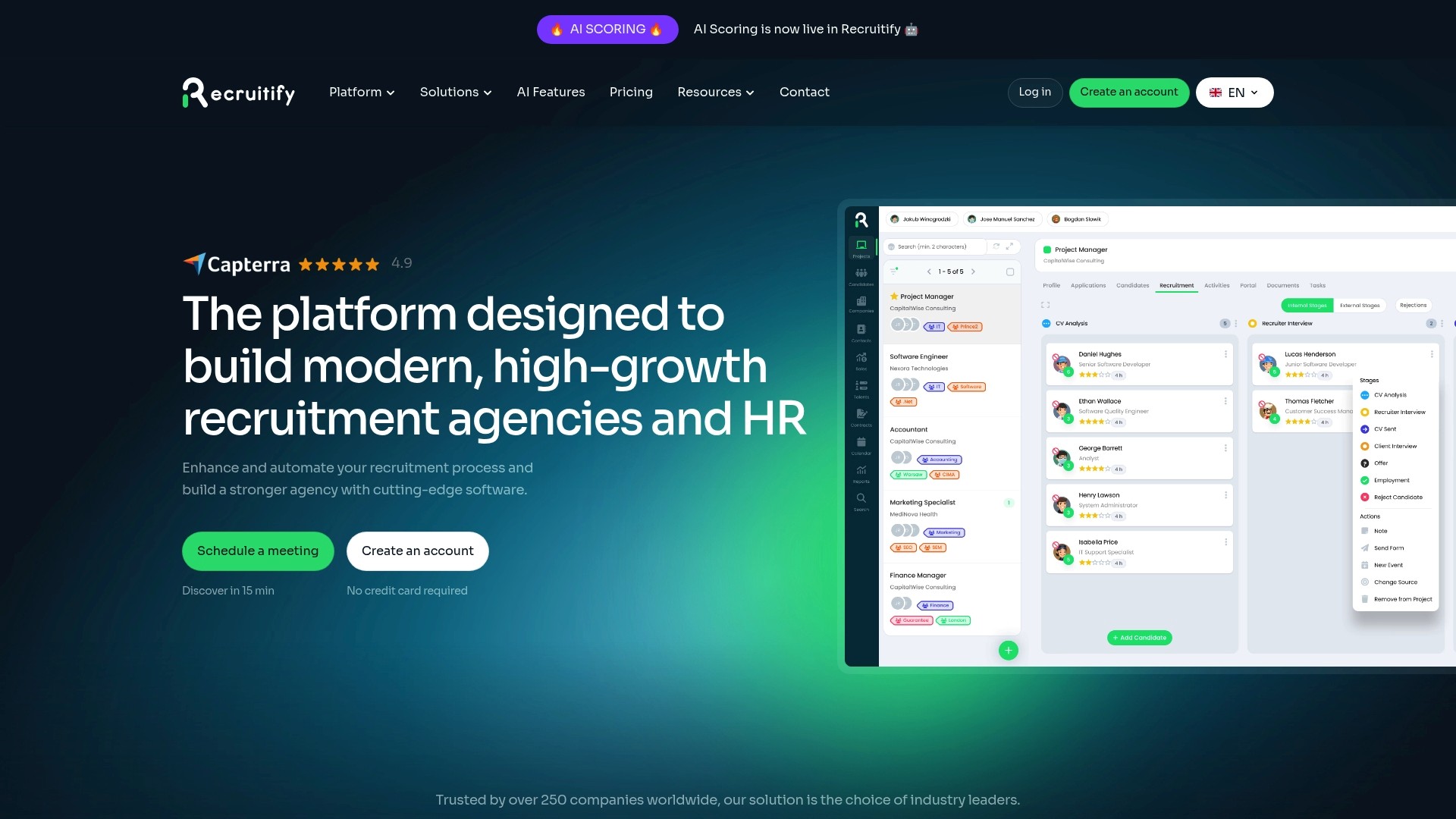
Recruitify combines AI-driven candidate discovery, multi-channel outreach, and human approval gates inside one platform that already syncs with your ATS, CRM, and calendar, so nothing gets built twice. Recruiters keep control over what goes out and when, while the busywork of finding and enriching candidate profiles happens in the background.
If you’re ready to test this on a real requisition rather than a hypothetical one, start with Recruitify’s core platform and scope a pilot around one repeatable role. Teams that want to see the automation and analytics layer specifically can go directly to the recruitment automation overview and request a walkthrough built around their own hiring data.
Sources
For deeper, vendor-neutral context, Gartner’s AI in HR resources and SHRM’s talent trends research cover governance and adoption benchmarking in more depth. On the Recruitify blog, AI candidate scoring and the Screening Agent breakdown expand on agent design and explainable scoring.
Recommended


News & Updates
Stay up-to-date with the latest innovations, features, and tips about Recruitify!
By providing your email address within the newsletter sign-up form, you confirm its processing to send marketing information regarding the Administrator’s products and services. The Administrator of your personal data processed for the abovementioned purposes is Recruitify Spółka z o.o., based in Warsaw, Poland (KRS 0000709889). For more information on the principles of personal data processing and the rights of data subjects, please check the Privacy Policy.

Last updated:
Keep Recruiters in Charge: Sourcing Automation With Human Approval Gates
Recruitment Process
The Recruitify Team
Keep Recruiters in Charge: Sourcing Automation With Human Approval Gates
Sourcing automation applies AI to the repetitive parts of finding and engaging candidates, including discovery, outreach, and scheduling, so recruiters spend less time on manual searches and more time on conversations that close roles. Teams hiring at scale or filling repetitive requisitions see the fastest payoff: quicker outreach, higher-quality response rates, and hours returned to recruiters each week. For most talent acquisition teams, adopting it now, through a scoped pilot rather than a full rollout, is the right move.
TL;DR:
Sourcing automation primarily covers candidate discovery, outreach, and scheduling tasks that recruiters previously handled manually, leading to increased throughput for high-volume hiring.
Effective integration with ATS, CRM, calendar, and email systems is crucial for automation tools to avoid creating additional manual work and to ensure seamless candidate data flow.
Key performance indicators for pilots include candidates sourced per week, reply rates, and time saved, with faster ROI expected in roles with clean, high-volume requisitions.
AI-assisted tools suggest or draft actions while human oversight remains; agentic platforms can automate entire workflows but are better suited for organizations with predictable, high-volume requisitions.
Building custom tools is rarely necessary unless facing specialized compliance or proprietary data challenges, while waiting is advisable if hiring volume is too low for meaningful results.
Table of Contents
What Sourcing Automation Actually Covers
Why Sourcing Automation Matters: Benefits and the KPIs to Track
AI-Assisted vs. Agentic Sourcing: Which Type Fits Your Team?
How to Choose a Sourcing Automation Approach
Rolling Out Sourcing Automation Without Losing Control
How Recruitify Approaches Sourcing Automation in Practice
When to Buy, Build, or Wait on Sourcing Automation
See Sourcing Automation Working Inside Your Own Pipeline
Sources
What Sourcing Automation Actually Covers
Sourcing automation is not the same as posting a job on a board or letting an ATS log applicants. It sits earlier in the funnel, handling the work recruiters used to do by hand before a candidate ever applies: searching talent pools, finding contact information, and starting outreach sequences. Sourcing automation tools typically automate repetitive tasks including candidate discovery, outreach sequences, and interview scheduling, which frees recruiters to focus on the human-centric parts of the job, like screening calls and closing conversations.
In practice, this looks like software that scans talent pools and public profiles for candidates matching a role’s criteria, enriches those profiles with verified contact details, and fires off personalized outreach on a schedule you control. Some platforms also handle rediscovery, meaning they resurface silver-medalist candidates from past searches instead of letting that sourcing work go to waste.
A sourcing automation product typically needs to connect with:
Your applicant tracking system, so sourced candidates flow directly into open requisitions
A CRM, to track engagement history and avoid re-contacting the same person twice
Calendar tools, for automated interview scheduling once a candidate responds
Your email or messaging provider, to send outreach under your own domain and reputation
If a tool can’t integrate cleanly with these four systems, it becomes another disconnected tab your team has to manage manually, which defeats the point.
Why Sourcing Automation Matters: Benefits and the KPIs to Track
The case for automating candidate sourcing comes down to three things: more candidates reached per week, faster replies, and recruiter hours freed up for higher-value work. Sourcing automation tools reduce the manual burden of repetitive discovery and outreach tasks, and that reduction shows up directly in throughput numbers once a team tracks them.
Sourcing automation shifts recruiter effort from search to conversation. Instead of spending a morning building a candidate list, a recruiter reviews a pre-qualified shortlist and starts talking. That shift is the actual ROI driver, not the automation itself.
To prove out a pilot or justify a renewal, track a small set of KPIs rather than everything the platform reports:
Candidates sourced per week, per recruiter
Outreach reply rate (a strong early signal of message quality and targeting)
Time saved per role, measured against a manual baseline before rollout
Time-to-hire changes, though this metric moves slower and needs a few full hiring cycles to read accurately
SHRM’s talent trends research points to time saved and recruiter productivity as the metrics HR organizations most often use to measure AI impact, which lines up with what pilot teams should watch first.
Realistic ROI depends heavily on role complexity, data quality, and how deeply the tool integrates with your existing stack. A high-volume warehouse hiring program with clean requisition data will see automation pay off relatively quickly. A specialized executive search with thin talent pools and inconsistent job descriptions will see a slower, messier return, and that gap is worth setting expectations around before you pilot anything.
AI-Assisted vs. Agentic Sourcing: Which Type Fits Your Team?
Not all sourcing automation works the same way, and the distinction matters more than most vendor pitches let on. AI-assisted tools help with individual tasks: they suggest candidates, draft outreach messages, or auto-schedule a call, but a recruiter still initiates and approves each step. Agentic, or end-to-end, automation runs entire workflows with far less human triggering. Agentic sourcing platforms can execute end-to-end workflows from intake through candidate engagement, with human decision gates built in rather than a human starting every action.
That distinction is real, not just marketing language, and it suits different levels of organizational readiness. AI-assisted tools fit teams still building trust in automated outputs or handling varied, lower-volume roles. Agentic tools fit teams with high-volume, repeatable requisitions where the workflow itself is predictable enough to hand off, with oversight, to an autonomous agent.
Whichever type you evaluate, the feature checklist looks similar:
Candidate graph coverage: how broad and current is the underlying talent data?
Contact lookup accuracy: does it find working emails and numbers, or stale ones?
Multi-channel sequenced outreach: can it coordinate email, messaging, and follow-ups on a timed cadence?
CRM/ATS sync: does data flow both directions in near real time?
Scoring and explainability: can the tool show why it ranked a candidate a certain way?
Audit trails: is there a record of every automated action taken on a candidate?
Human-in-the-loop gates: can a recruiter pause, override, or approve before an action fires?
Reporting: does it surface the KPIs that actually matter to your team?
High-volume hiring leans harder on multi-channel outreach and CRM sync, since the win there is scale. Specialized or executive hiring leans harder on scoring explainability and human override controls, since a wrong automated move costs more relationship capital.
Pro Tip: Ask any vendor to show you a candidate’s full activity trail, not just the final score. If they can’t produce one in the demo, assume the audit trail doesn’t exist in production either.
How to Choose a Sourcing Automation Approach
Evaluating sourcing automation software works best as a structured comparison, not a gut reaction to a slick demo. Weigh each option against these criteria: data sources and coverage, integration depth, quality control processes, explainability of candidate scoring, security and compliance posture, configurability, pricing model, and the level of support included.
Analyst frameworks for AI in HR consistently flag explainability, governance, and auditability as the criteria that separate durable vendor choices from tools that create compliance headaches later. Treat those three as non-negotiable line items, not nice-to-haves.
During a demo or procurement call, bring a specific list of questions rather than letting the vendor drive the conversation:
How often does the candidate data refresh, and where does it come from?
Can a recruiter override or pause an automated action before it goes out?
Is there an audit log showing every action the system took, and who can access it?
What outreach deliverability rate have similar clients seen, and over what time window?
How is candidate scoring calculated, and can that logic be explained in plain language?
What happens to candidate data if we cancel the contract?
How is pricing structured: per seat, per candidate sourced, or a flat platform fee?
What’s the actual onboarding timeline before we see production use?
Can outreach templates be customized per role, or are they fixed?
What support is included after go-live, and what costs extra?
A few answers should send you looking elsewhere. Watch for these red flags:
Closed or unclear data sources with no explanation of where candidate profiles come from
No option for a human to override or approve an automated action
Missing or thin audit trails for outreach and scoring decisions
Canned outreach templates that can’t be customized to your employer brand or role specifics
Any one of these on its own is a caution flag. Two or more together usually means the platform wasn’t built with recruiter oversight in mind.
Rolling Out Sourcing Automation Without Losing Control
A pilot is the right way to introduce sourcing automation, and it works best when scoped tightly instead of applied across every open role at once. Start with a repeatable role type, something you hire for often enough to generate a real data set, and run the pilot for a moderate duration to gather sufficient data. Longer than that and you lose momentum; shorter and you won’t see enough hiring cycles to trust the results.
Set success metrics before the pilot starts, not after. Decide in advance what “working” looks like: a target reply rate, a time-saved figure per role, or a minimum number of qualified candidates surfaced per week.
Governance matters as much as the metrics. Successful adoption balances autonomous agent activity with human oversight at defined decision gates, which is what keeps candidate experience intact while the automation runs. Build in:
Clear approval thresholds for when a recruiter must sign off before an action fires
Candidate experience standards, so automated outreach still reads as personal and on-brand
A consent and data-sourcing policy that’s explicit about where enriched contact data comes from
Role complexity should shape how much autonomy you grant. Practitioner guidance on calibrating automation by role type suggests near-full automation works for routine, high-volume roles, while senior or specialist hires need tighter human review at every stage. Budget time for internal training too. A tool is only as good as the team’s confidence in overriding it when something looks off.
Pro Tip: Run your pilot on a role your team already knows well. If the automated shortlist looks off to an experienced recruiter’s eye, that’s more useful signal than any dashboard metric.
How Recruitify Approaches Sourcing Automation in Practice
Recruitify builds sourcing automation around the same principle this guide has argued for: automation should extend recruiter judgment, not replace it. The platform’s 24/7 Sourcing Agent runs continuous candidate discovery and outreach inside the same environment as your CRM and ATS, so sourced candidates land directly in the right pipeline instead of a separate tool you have to reconcile manually.
Human decision gates sit throughout the workflow, letting recruiters review, adjust, or approve outreach before it goes out at scale. Recruitify is trusted by numerous companies, and its automation and analytics features are built to surface the same KPIs covered above: candidates sourced, reply rates, and time saved per role.
A practical pilot template using Recruitify’s project templates might cover:
One high-volume role type, tracked over a moderate time frame
Weekly reply-rate and time-saved reporting
A defined approval gate before outreach expands past 50 candidates
When to Buy, Build, or Wait on Sourcing Automation
Buy a sourcing automation platform when you’re hiring repeatedly for similar roles, your ATS and CRM are ready to integrate, and you can define success metrics before you start. That’s the profile where a pilot proves itself fast.
Build custom tooling only when you have unusual compliance requirements or proprietary candidate data that off-the-shelf platforms can’t handle well. That’s a narrow case, and most teams overestimate how often it applies to them.
Wait when hiring volume is too low to generate meaningful data, your candidate records are inconsistent or duplicated, or nobody on the team owns the rollout. Automating a messy process just automates the mess faster.
- Recruitify Team
See Sourcing Automation Working Inside Your Own Pipeline
Reading about sourcing automation only gets you so far. The real test is watching sourced candidates flow into your existing pipeline without a separate tool to manage, reconcile, or babysit.
Recruitify combines AI-driven candidate discovery, multi-channel outreach, and human approval gates inside one platform that already syncs with your ATS, CRM, and calendar, so nothing gets built twice. Recruiters keep control over what goes out and when, while the busywork of finding and enriching candidate profiles happens in the background.
If you’re ready to test this on a real requisition rather than a hypothetical one, start with Recruitify’s core platform and scope a pilot around one repeatable role. Teams that want to see the automation and analytics layer specifically can go directly to the recruitment automation overview and request a walkthrough built around their own hiring data.
Sources
For deeper, vendor-neutral context, Gartner’s AI in HR resources and SHRM’s talent trends research cover governance and adoption benchmarking in more depth. On the Recruitify blog, AI candidate scoring and the Screening Agent breakdown expand on agent design and explainable scoring.
Recommended
News & Updates
Stay up-to-date with the latest innovations, features, and tips about Recruitify!
By providing your email address within the newsletter sign-up form, you confirm its processing to send marketing information regarding the Administrator’s products and services. The Administrator of your personal data processed for the abovementioned purposes is Recruitify Spółka z o.o., based in Warsaw, Poland (KRS 0000709889). For more information on the principles of personal data processing and the rights of data subjects, please check the Privacy Policy.
Last updated:
Keep Recruiters in Charge: Sourcing Automation With Human Approval Gates
Recruitment Process
The Recruitify Team
Keep Recruiters in Charge: Sourcing Automation With Human Approval Gates
Sourcing automation applies AI to the repetitive parts of finding and engaging candidates, including discovery, outreach, and scheduling, so recruiters spend less time on manual searches and more time on conversations that close roles. Teams hiring at scale or filling repetitive requisitions see the fastest payoff: quicker outreach, higher-quality response rates, and hours returned to recruiters each week. For most talent acquisition teams, adopting it now, through a scoped pilot rather than a full rollout, is the right move.
TL;DR:
Sourcing automation primarily covers candidate discovery, outreach, and scheduling tasks that recruiters previously handled manually, leading to increased throughput for high-volume hiring.
Effective integration with ATS, CRM, calendar, and email systems is crucial for automation tools to avoid creating additional manual work and to ensure seamless candidate data flow.
Key performance indicators for pilots include candidates sourced per week, reply rates, and time saved, with faster ROI expected in roles with clean, high-volume requisitions.
AI-assisted tools suggest or draft actions while human oversight remains; agentic platforms can automate entire workflows but are better suited for organizations with predictable, high-volume requisitions.
Building custom tools is rarely necessary unless facing specialized compliance or proprietary data challenges, while waiting is advisable if hiring volume is too low for meaningful results.
Table of Contents
What Sourcing Automation Actually Covers
Why Sourcing Automation Matters: Benefits and the KPIs to Track
AI-Assisted vs. Agentic Sourcing: Which Type Fits Your Team?
How to Choose a Sourcing Automation Approach
Rolling Out Sourcing Automation Without Losing Control
How Recruitify Approaches Sourcing Automation in Practice
When to Buy, Build, or Wait on Sourcing Automation
See Sourcing Automation Working Inside Your Own Pipeline
Sources
What Sourcing Automation Actually Covers
Sourcing automation is not the same as posting a job on a board or letting an ATS log applicants. It sits earlier in the funnel, handling the work recruiters used to do by hand before a candidate ever applies: searching talent pools, finding contact information, and starting outreach sequences. Sourcing automation tools typically automate repetitive tasks including candidate discovery, outreach sequences, and interview scheduling, which frees recruiters to focus on the human-centric parts of the job, like screening calls and closing conversations.
In practice, this looks like software that scans talent pools and public profiles for candidates matching a role’s criteria, enriches those profiles with verified contact details, and fires off personalized outreach on a schedule you control. Some platforms also handle rediscovery, meaning they resurface silver-medalist candidates from past searches instead of letting that sourcing work go to waste.
A sourcing automation product typically needs to connect with:
Your applicant tracking system, so sourced candidates flow directly into open requisitions
A CRM, to track engagement history and avoid re-contacting the same person twice
Calendar tools, for automated interview scheduling once a candidate responds
Your email or messaging provider, to send outreach under your own domain and reputation
If a tool can’t integrate cleanly with these four systems, it becomes another disconnected tab your team has to manage manually, which defeats the point.
Why Sourcing Automation Matters: Benefits and the KPIs to Track
The case for automating candidate sourcing comes down to three things: more candidates reached per week, faster replies, and recruiter hours freed up for higher-value work. Sourcing automation tools reduce the manual burden of repetitive discovery and outreach tasks, and that reduction shows up directly in throughput numbers once a team tracks them.
Sourcing automation shifts recruiter effort from search to conversation. Instead of spending a morning building a candidate list, a recruiter reviews a pre-qualified shortlist and starts talking. That shift is the actual ROI driver, not the automation itself.
To prove out a pilot or justify a renewal, track a small set of KPIs rather than everything the platform reports:
Candidates sourced per week, per recruiter
Outreach reply rate (a strong early signal of message quality and targeting)
Time saved per role, measured against a manual baseline before rollout
Time-to-hire changes, though this metric moves slower and needs a few full hiring cycles to read accurately
SHRM’s talent trends research points to time saved and recruiter productivity as the metrics HR organizations most often use to measure AI impact, which lines up with what pilot teams should watch first.
Realistic ROI depends heavily on role complexity, data quality, and how deeply the tool integrates with your existing stack. A high-volume warehouse hiring program with clean requisition data will see automation pay off relatively quickly. A specialized executive search with thin talent pools and inconsistent job descriptions will see a slower, messier return, and that gap is worth setting expectations around before you pilot anything.
AI-Assisted vs. Agentic Sourcing: Which Type Fits Your Team?
Not all sourcing automation works the same way, and the distinction matters more than most vendor pitches let on. AI-assisted tools help with individual tasks: they suggest candidates, draft outreach messages, or auto-schedule a call, but a recruiter still initiates and approves each step. Agentic, or end-to-end, automation runs entire workflows with far less human triggering. Agentic sourcing platforms can execute end-to-end workflows from intake through candidate engagement, with human decision gates built in rather than a human starting every action.
That distinction is real, not just marketing language, and it suits different levels of organizational readiness. AI-assisted tools fit teams still building trust in automated outputs or handling varied, lower-volume roles. Agentic tools fit teams with high-volume, repeatable requisitions where the workflow itself is predictable enough to hand off, with oversight, to an autonomous agent.
Whichever type you evaluate, the feature checklist looks similar:
Candidate graph coverage: how broad and current is the underlying talent data?
Contact lookup accuracy: does it find working emails and numbers, or stale ones?
Multi-channel sequenced outreach: can it coordinate email, messaging, and follow-ups on a timed cadence?
CRM/ATS sync: does data flow both directions in near real time?
Scoring and explainability: can the tool show why it ranked a candidate a certain way?
Audit trails: is there a record of every automated action taken on a candidate?
Human-in-the-loop gates: can a recruiter pause, override, or approve before an action fires?
Reporting: does it surface the KPIs that actually matter to your team?
High-volume hiring leans harder on multi-channel outreach and CRM sync, since the win there is scale. Specialized or executive hiring leans harder on scoring explainability and human override controls, since a wrong automated move costs more relationship capital.
Pro Tip: Ask any vendor to show you a candidate’s full activity trail, not just the final score. If they can’t produce one in the demo, assume the audit trail doesn’t exist in production either.
How to Choose a Sourcing Automation Approach
Evaluating sourcing automation software works best as a structured comparison, not a gut reaction to a slick demo. Weigh each option against these criteria: data sources and coverage, integration depth, quality control processes, explainability of candidate scoring, security and compliance posture, configurability, pricing model, and the level of support included.
Analyst frameworks for AI in HR consistently flag explainability, governance, and auditability as the criteria that separate durable vendor choices from tools that create compliance headaches later. Treat those three as non-negotiable line items, not nice-to-haves.
During a demo or procurement call, bring a specific list of questions rather than letting the vendor drive the conversation:
How often does the candidate data refresh, and where does it come from?
Can a recruiter override or pause an automated action before it goes out?
Is there an audit log showing every action the system took, and who can access it?
What outreach deliverability rate have similar clients seen, and over what time window?
How is candidate scoring calculated, and can that logic be explained in plain language?
What happens to candidate data if we cancel the contract?
How is pricing structured: per seat, per candidate sourced, or a flat platform fee?
What’s the actual onboarding timeline before we see production use?
Can outreach templates be customized per role, or are they fixed?
What support is included after go-live, and what costs extra?
A few answers should send you looking elsewhere. Watch for these red flags:
Closed or unclear data sources with no explanation of where candidate profiles come from
No option for a human to override or approve an automated action
Missing or thin audit trails for outreach and scoring decisions
Canned outreach templates that can’t be customized to your employer brand or role specifics
Any one of these on its own is a caution flag. Two or more together usually means the platform wasn’t built with recruiter oversight in mind.
Rolling Out Sourcing Automation Without Losing Control
A pilot is the right way to introduce sourcing automation, and it works best when scoped tightly instead of applied across every open role at once. Start with a repeatable role type, something you hire for often enough to generate a real data set, and run the pilot for a moderate duration to gather sufficient data. Longer than that and you lose momentum; shorter and you won’t see enough hiring cycles to trust the results.
Set success metrics before the pilot starts, not after. Decide in advance what “working” looks like: a target reply rate, a time-saved figure per role, or a minimum number of qualified candidates surfaced per week.
Governance matters as much as the metrics. Successful adoption balances autonomous agent activity with human oversight at defined decision gates, which is what keeps candidate experience intact while the automation runs. Build in:
Clear approval thresholds for when a recruiter must sign off before an action fires
Candidate experience standards, so automated outreach still reads as personal and on-brand
A consent and data-sourcing policy that’s explicit about where enriched contact data comes from
Role complexity should shape how much autonomy you grant. Practitioner guidance on calibrating automation by role type suggests near-full automation works for routine, high-volume roles, while senior or specialist hires need tighter human review at every stage. Budget time for internal training too. A tool is only as good as the team’s confidence in overriding it when something looks off.
Pro Tip: Run your pilot on a role your team already knows well. If the automated shortlist looks off to an experienced recruiter’s eye, that’s more useful signal than any dashboard metric.
How Recruitify Approaches Sourcing Automation in Practice
Recruitify builds sourcing automation around the same principle this guide has argued for: automation should extend recruiter judgment, not replace it. The platform’s 24/7 Sourcing Agent runs continuous candidate discovery and outreach inside the same environment as your CRM and ATS, so sourced candidates land directly in the right pipeline instead of a separate tool you have to reconcile manually.
Human decision gates sit throughout the workflow, letting recruiters review, adjust, or approve outreach before it goes out at scale. Recruitify is trusted by numerous companies, and its automation and analytics features are built to surface the same KPIs covered above: candidates sourced, reply rates, and time saved per role.
A practical pilot template using Recruitify’s project templates might cover:
One high-volume role type, tracked over a moderate time frame
Weekly reply-rate and time-saved reporting
A defined approval gate before outreach expands past 50 candidates
When to Buy, Build, or Wait on Sourcing Automation
Buy a sourcing automation platform when you’re hiring repeatedly for similar roles, your ATS and CRM are ready to integrate, and you can define success metrics before you start. That’s the profile where a pilot proves itself fast.
Build custom tooling only when you have unusual compliance requirements or proprietary candidate data that off-the-shelf platforms can’t handle well. That’s a narrow case, and most teams overestimate how often it applies to them.
Wait when hiring volume is too low to generate meaningful data, your candidate records are inconsistent or duplicated, or nobody on the team owns the rollout. Automating a messy process just automates the mess faster.
- Recruitify Team
See Sourcing Automation Working Inside Your Own Pipeline
Reading about sourcing automation only gets you so far. The real test is watching sourced candidates flow into your existing pipeline without a separate tool to manage, reconcile, or babysit.
Recruitify combines AI-driven candidate discovery, multi-channel outreach, and human approval gates inside one platform that already syncs with your ATS, CRM, and calendar, so nothing gets built twice. Recruiters keep control over what goes out and when, while the busywork of finding and enriching candidate profiles happens in the background.
If you’re ready to test this on a real requisition rather than a hypothetical one, start with Recruitify’s core platform and scope a pilot around one repeatable role. Teams that want to see the automation and analytics layer specifically can go directly to the recruitment automation overview and request a walkthrough built around their own hiring data.
Sources
For deeper, vendor-neutral context, Gartner’s AI in HR resources and SHRM’s talent trends research cover governance and adoption benchmarking in more depth. On the Recruitify blog, AI candidate scoring and the Screening Agent breakdown expand on agent design and explainable scoring.
Recommended
News & Updates
Stay up-to-date with the latest innovations, features, and tips about Recruitify!
By providing your email address within the newsletter sign-up form, you confirm its processing to send marketing information regarding the Administrator’s products and services. The Administrator of your personal data processed for the abovementioned purposes is Recruitify Spółka z o.o., based in Warsaw, Poland (KRS 0000709889). For more information on the principles of personal data processing and the rights of data subjects, please check the Privacy Policy.

Discover More

Recruitment Process
Stack Overflow Sourcing: 3 Steps Recruiters Use to Qualify Developers
Assess developer skills through Stack Overflow tags, answers, and GitHub activity, then follow three steps to qualify candidates and scale outreach.
12 Oct 2026
Discover More

Recruitment Process
Candidate Reactivation for Agencies: Compliant Templates That Scale
Candidate reactivation helps agencies reach past candidates through triggers, templates, CRM and ATS automation, and a compliance checklist.
11 Oct 2026
Discover More

Recruitment Process
Pipeline Forecasting for Recruiting: 8 Steps to Trust the Numbers
Recruiting pipeline forecasting predicts fill dates and hiring odds from pipeline data. See the inputs, limits, and eight steps for a reliable forecast.
10 Oct 2026
Discover More
Recruitment Process
Stack Overflow Sourcing: 3 Steps Recruiters Use to Qualify Developers
Assess developer skills through Stack Overflow tags, answers, and GitHub activity, then follow three steps to qualify candidates and scale outreach.
12 Oct 2026
Discover More
Recruitment Process
Candidate Reactivation for Agencies: Compliant Templates That Scale
Candidate reactivation helps agencies reach past candidates through triggers, templates, CRM and ATS automation, and a compliance checklist.
11 Oct 2026
Discover More