Last updated:
Stack Overflow Sourcing: 3 Steps Recruiters Use to Qualify Developers

Recruitment Process

Iwo Paliszewski
We recommend using Stack Overflow as a complementary evidence source alongside GitHub rather than as a standalone hiring channel. Start with a tag-based search on Stack Overflow, then check top answers and recent activity to confirm the depth of a candidate’s expertise. This combined approach gives us stronger proof of skill than a resume alone.
TL;DR:
The 2026 survey found that 68.6% of respondents used Stack Overflow and 69.5% used GitHub, so sourcing on one platform misses developers.
Review commit history, pull requests, tests, continuous integration, and credential handling; activity volume alone cannot show whether a repository is maintained or professionally managed.
Use a qualification call to confirm current skills and availability, then request a short code walkthrough; public profiles cannot establish either reliably.
Give public activity more weight for specialist roles and open source work; do not rule out managers or developers whose work stays proprietary.
RecruitifyFind Relevant Candidates FasterRecruitify.ai combines X-RAY Search and Boolean tools with contextual matching to help IT recruitment teams source and assess candidate fit.Explore Recruitify.ai
Table of Contents
What Stack Overflow and GitHub reveal about a developer
Why Stack Overflow belongs in your sourcing mix
How to source candidates from Stack Overflow and GitHub
A three-step outreach and qualification workflow
How Recruitify.ai turns these workflows into a repeatable system
When Stack Overflow signals are worth trusting most
Put this sourcing workflow into practice with Recruitify.ai
FAQ
Sources
What Stack Overflow and GitHub reveal about a developer
Stack Overflow is a community-driven question and answer site where developers earn reputation points, badges, and recognition through tags tied to specific technologies. According to Stack Overflow’s own documentation, profiles display votes, accepted answers, reputation scores, and activity history, information that functions as a public record of how someone approaches technical problems. GitHub works differently: it is a code hosting and collaboration platform where repositories, commits, pull requests, and release histories show how a developer builds and maintains software over time.
Together, these signals tell us a lot about problem-solving style, communication, and consistency. They do not tell us everything.
Stack Overflow shows how someone explains technical concepts and whether their answers hold up under community scrutiny.
GitHub shows how someone writes, tests, and maintains code across real projects.
Neither platform confirms employment status, availability, or whether a profile reflects a candidate’s full professional history.
Why Stack Overflow belongs in your sourcing mix
Platform evidence adds a layer of verification that resumes and interviews alone cannot provide. A candidate who has written a detailed, well-received answer to a hard technical question has demonstrated something a cover letter cannot: real-time problem-solving under public review. Cross-referencing that answer with a related GitHub repository gives even more confidence.
Accepted answers and high-vote posts indicate that peers, not just the author, found the solution sound.
In-depth, well-documented answers often reveal communication skills that matter for team-based roles.
Cross-posted code samples let us check whether a Stack Overflow explanation matches real working code elsewhere.
According to the 2026 Stack Overflow Developer Survey, roughly 68.6% of respondents reported using Stack Overflow and about 69.5% reported using GitHub, meaning a sourcing strategy built around only one of these platforms misses a meaningful share of active developers.
That said, contact information is rarely available directly on profiles, contribution patterns can be biased toward developers who enjoy public writing, and a quiet profile does not mean a weak candidate. Public activity is a signal, not a verdict.
How to source candidates from Stack Overflow and GitHub
Sourcing on these platforms works best as a structured process rather than casual browsing. Here is a sequence that holds up across most technical roles.
Search by tag on Stack Overflow. Start with the specific technology or framework tied to the open role, such as a language tag or a framework tag, and sort by highest score to surface the most respected contributors.
Filter by accepted answers and reputation. A high reputation score combined with multiple accepted answers in your target tag suggests consistent, peer-validated expertise.
Check the About section and linked profiles. Many Stack Overflow users link to a GitHub account or personal site, which lets you move from a Q&A signal to a code signal in one step.
Explore Collectives for niche communities. Stack Overflow Collectives group contributors around specific tools and companies, which can narrow a search to a smaller, more relevant pool.
Consider data dump access for bulk analysis. Stack Exchange offers quarterly data dumps for eligible users, which supports larger-scale pattern analysis when used within the platform’s access rules.
Search GitHub by language and topic. Use GitHub’s topic and language filters to find repositories that match the technical profile you need, then look at who maintains and contributes to them.
Review commit history and pull requests. Frequent, well-described commits and thoughtful pull request discussions tell us more about a developer’s habits than a single polished repository.
Check for tests, CI configuration, and dependency maintenance. According to GitHub’s Octoverse reporting, repository-level signals like test coverage and continuous integration usage are meaningful indicators of professional-quality work, not just activity volume.
Look at secret handling and security hygiene. Public reporting noted 39 million secrets leaked across GitHub in 2024, which makes a candidate’s handling of credentials and dependencies a useful quality marker, not a minor detail.
Build generic Boolean or X-ray search strings. A pattern like
site:stackoverflow.com "[tag]" "accepted answer"orsite:github.com "[language]" "pull request"helps you scan broadly before narrowing to individual profiles.
Pro Tip: Prioritize recency over volume. A candidate with five thoughtful, recent contributions usually tells you more than one with two hundred posts from several years ago.
One rule applies across every tactic here: never attempt to harvest private contact data in ways that violate Stack Overflow’s or GitHub’s terms of service. Public profile browsing is standard practice; scraping personal information outside platform permissions is not.

A three-step outreach and qualification workflow
Sourcing only matters if it leads to a real conversation. We find a short, structured workflow converts platform research into qualified pipeline faster than ad hoc messaging.
Run a two-to-five minute quality check first. Confirm recent activity, look for at least one accepted answer or actively maintained repository, and skip profiles that show no activity in the past year or two.
Send a specific, context-led first message. Reference the exact answer or repository that caught your attention and explain briefly why it is relevant to the role, rather than sending a generic template.
Use a qualification call to verify what the profile cannot show. Confirm current skills, ask for a short code walk-through or repository tour, and check availability along with permission to share their information with a client. For deeper guidance on this stage, our verification process guide covers what to confirm before moving a candidate forward.
How Recruitify.ai turns these workflows into a repeatable system
Manually running tag searches, cross-referencing GitHub activity, and tracking outreach across spreadsheets does not scale once you are sourcing for multiple roles at once. Our platform brings these steps into one workspace.
Contextual Matching AI evaluates candidates against project requirements and returns a ranked shortlist instead of a raw list of profiles.
The X-RAY and Boolean search engine generates advanced search strings automatically, cutting the manual work described in the tactics above.
The AI CV parser extracts structured candidate data from any format in seconds and flags duplicates against your existing database.
GDPR consent management keeps a full audit trail as candidate data moves from sourcing through outreach.
These features connect directly to the AI recruitment capabilities we built for exactly this kind of high-volume technical sourcing.
When Stack Overflow signals are worth trusting most
Stack Overflow contributions carry the most predictive weight for specialist technical roles and for developers who actively maintain open-source work, where the evidence of skill is public and checkable. They carry far less weight for managerial candidates or developers whose entire career sits inside closed, proprietary enterprise systems, where there is simply nothing public to review. The practical rule: let platform activity guide who you contact first, never who you rule out entirely.
- Recruitify Team
Put this sourcing workflow into practice with Recruitify.ai
Running tag searches, cross-checking GitHub repositories, and tracking outreach by hand works for a handful of candidates but breaks down at scale. Our platform combines contextual AI matching, an X-RAY Boolean engine, and automated CV parsing into one system, so sourcing from Stack Overflow and GitHub turns into a shortlist instead of a spreadsheet.
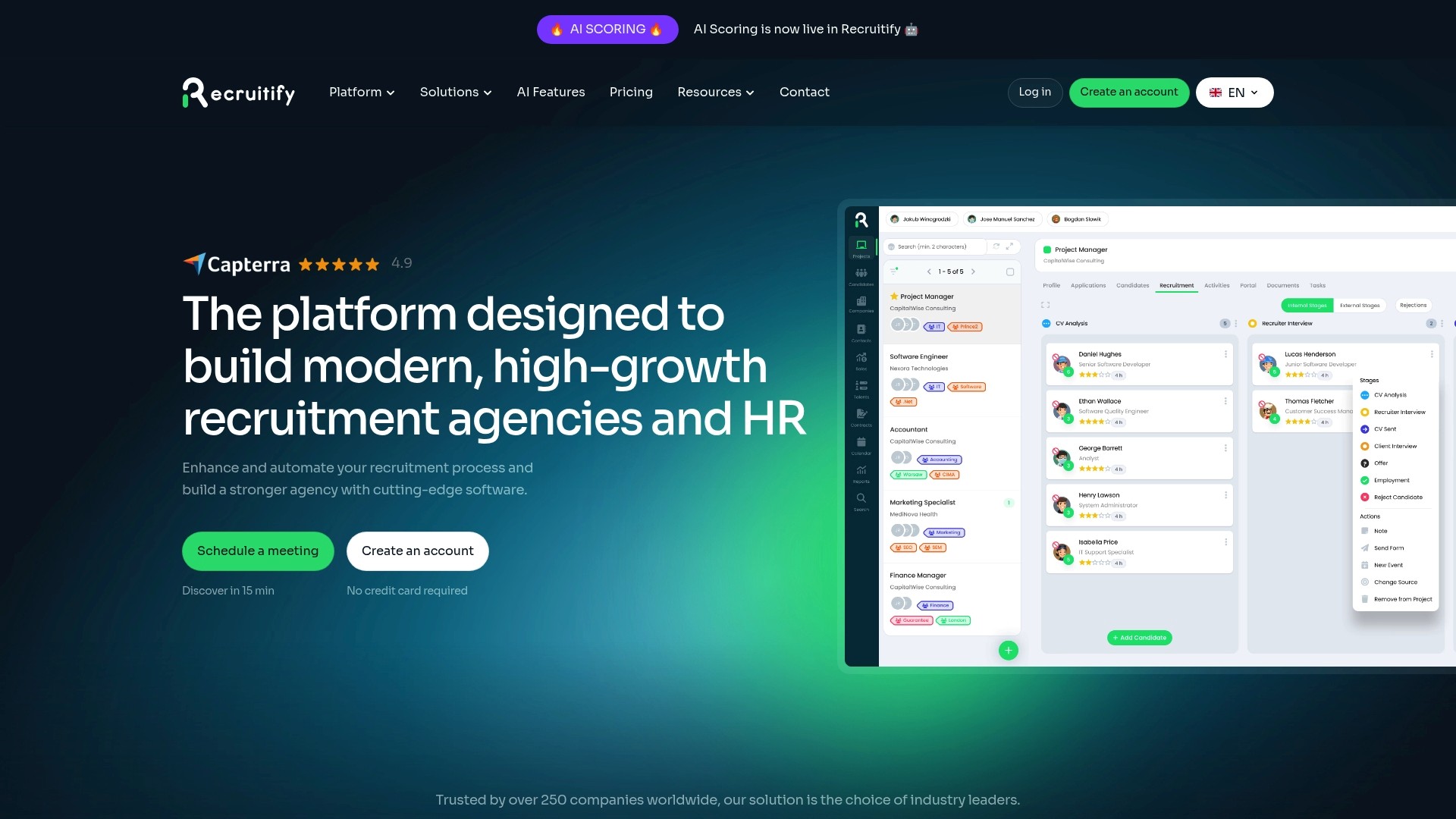
Our pricing page lists the HR Team plan at 69 EUR per month per user and the Recruitment Agencies plan at 79 EUR per month per user, with Enterprise pricing available on request. Book a demo to see how your sourcing workflow fits into the system.
FAQ
Is Stack Overflow still used by developers?
Yes. The 2026 Stack Overflow Developer Survey found that approximately 68.6% of respondents reported using the platform, alongside about 69.5% who reported using GitHub. This makes Stack Overflow a continued, active source of developer activity worth including in a sourcing strategy.
What is Stack Overflow?
Stack Overflow is a public question and answer community for software developers, where users earn reputation and badges by posting and voting on technical questions and answers. Profiles display tags, votes, accepted answers, and activity history, which together act as public contribution signals rather than a formal resume.
What kind of website is Stack Overflow?
Stack Overflow is a community-curated knowledge platform organized around tagged technical questions and answers, not a job board or social network in the traditional sense. It also offers Collectives, which group contributors around specific tools or companies, and quarterly data dumps for eligible users running larger analyses.
How does GitHub activity complement Stack Overflow research?
GitHub shows how a developer builds and maintains real code through commits, pull requests, and repository history, while Stack Overflow shows how they explain and solve isolated technical problems. Reviewing both together, including test coverage and security practices, gives a fuller picture than either platform alone.
What should recruiters check before relying on a public profile?
Check recency of activity, the depth of accepted answers or documentation, and whether repositories show ongoing maintenance rather than a single abandoned project. Public profiles are a strong starting signal, but confirming availability and current skills still requires a direct conversation.
Sources
How do I access a data dump for a Stack Exchange site? - Help Center - Stack Overflow
GitHub expands security tools after 39 million secrets leaked in 2024 - BleepingComputer
Recommended
A Fresh Challenge in Recruitment: From Sourcing to Verification
Plan Integrations First: 3 Recruiting Tech Stack Architectures
Tech Tips for Modern Recruiters #1: How to Harness Automation to Save Time and Boost Productivity
Why hiring managers and recruiters often mean different things by “good candidate”


News & Updates
Stay up-to-date with the latest innovations, features, and tips about Recruitify!
By providing your email address within the newsletter sign-up form, you confirm its processing to send marketing information regarding the Administrator’s products and services. The Administrator of your personal data processed for the abovementioned purposes is Recruitify Spółka z o.o., based in Warsaw, Poland (KRS 0000709889). For more information on the principles of personal data processing and the rights of data subjects, please check the Privacy Policy.

Last updated:
Stack Overflow Sourcing: 3 Steps Recruiters Use to Qualify Developers
Recruitment Process
Iwo Paliszewski
We recommend using Stack Overflow as a complementary evidence source alongside GitHub rather than as a standalone hiring channel. Start with a tag-based search on Stack Overflow, then check top answers and recent activity to confirm the depth of a candidate’s expertise. This combined approach gives us stronger proof of skill than a resume alone.
TL;DR:
The 2026 survey found that 68.6% of respondents used Stack Overflow and 69.5% used GitHub, so sourcing on one platform misses developers.
Review commit history, pull requests, tests, continuous integration, and credential handling; activity volume alone cannot show whether a repository is maintained or professionally managed.
Use a qualification call to confirm current skills and availability, then request a short code walkthrough; public profiles cannot establish either reliably.
Give public activity more weight for specialist roles and open source work; do not rule out managers or developers whose work stays proprietary.
RecruitifyFind Relevant Candidates FasterRecruitify.ai combines X-RAY Search and Boolean tools with contextual matching to help IT recruitment teams source and assess candidate fit.Explore Recruitify.ai
Table of Contents
What Stack Overflow and GitHub reveal about a developer
Why Stack Overflow belongs in your sourcing mix
How to source candidates from Stack Overflow and GitHub
A three-step outreach and qualification workflow
How Recruitify.ai turns these workflows into a repeatable system
When Stack Overflow signals are worth trusting most
Put this sourcing workflow into practice with Recruitify.ai
FAQ
Sources
What Stack Overflow and GitHub reveal about a developer
Stack Overflow is a community-driven question and answer site where developers earn reputation points, badges, and recognition through tags tied to specific technologies. According to Stack Overflow’s own documentation, profiles display votes, accepted answers, reputation scores, and activity history, information that functions as a public record of how someone approaches technical problems. GitHub works differently: it is a code hosting and collaboration platform where repositories, commits, pull requests, and release histories show how a developer builds and maintains software over time.
Together, these signals tell us a lot about problem-solving style, communication, and consistency. They do not tell us everything.
Stack Overflow shows how someone explains technical concepts and whether their answers hold up under community scrutiny.
GitHub shows how someone writes, tests, and maintains code across real projects.
Neither platform confirms employment status, availability, or whether a profile reflects a candidate’s full professional history.
Why Stack Overflow belongs in your sourcing mix
Platform evidence adds a layer of verification that resumes and interviews alone cannot provide. A candidate who has written a detailed, well-received answer to a hard technical question has demonstrated something a cover letter cannot: real-time problem-solving under public review. Cross-referencing that answer with a related GitHub repository gives even more confidence.
Accepted answers and high-vote posts indicate that peers, not just the author, found the solution sound.
In-depth, well-documented answers often reveal communication skills that matter for team-based roles.
Cross-posted code samples let us check whether a Stack Overflow explanation matches real working code elsewhere.
According to the 2026 Stack Overflow Developer Survey, roughly 68.6% of respondents reported using Stack Overflow and about 69.5% reported using GitHub, meaning a sourcing strategy built around only one of these platforms misses a meaningful share of active developers.
That said, contact information is rarely available directly on profiles, contribution patterns can be biased toward developers who enjoy public writing, and a quiet profile does not mean a weak candidate. Public activity is a signal, not a verdict.
How to source candidates from Stack Overflow and GitHub
Sourcing on these platforms works best as a structured process rather than casual browsing. Here is a sequence that holds up across most technical roles.
Search by tag on Stack Overflow. Start with the specific technology or framework tied to the open role, such as a language tag or a framework tag, and sort by highest score to surface the most respected contributors.
Filter by accepted answers and reputation. A high reputation score combined with multiple accepted answers in your target tag suggests consistent, peer-validated expertise.
Check the About section and linked profiles. Many Stack Overflow users link to a GitHub account or personal site, which lets you move from a Q&A signal to a code signal in one step.
Explore Collectives for niche communities. Stack Overflow Collectives group contributors around specific tools and companies, which can narrow a search to a smaller, more relevant pool.
Consider data dump access for bulk analysis. Stack Exchange offers quarterly data dumps for eligible users, which supports larger-scale pattern analysis when used within the platform’s access rules.
Search GitHub by language and topic. Use GitHub’s topic and language filters to find repositories that match the technical profile you need, then look at who maintains and contributes to them.
Review commit history and pull requests. Frequent, well-described commits and thoughtful pull request discussions tell us more about a developer’s habits than a single polished repository.
Check for tests, CI configuration, and dependency maintenance. According to GitHub’s Octoverse reporting, repository-level signals like test coverage and continuous integration usage are meaningful indicators of professional-quality work, not just activity volume.
Look at secret handling and security hygiene. Public reporting noted 39 million secrets leaked across GitHub in 2024, which makes a candidate’s handling of credentials and dependencies a useful quality marker, not a minor detail.
Build generic Boolean or X-ray search strings. A pattern like
site:stackoverflow.com "[tag]" "accepted answer"orsite:github.com "[language]" "pull request"helps you scan broadly before narrowing to individual profiles.
Pro Tip: Prioritize recency over volume. A candidate with five thoughtful, recent contributions usually tells you more than one with two hundred posts from several years ago.
One rule applies across every tactic here: never attempt to harvest private contact data in ways that violate Stack Overflow’s or GitHub’s terms of service. Public profile browsing is standard practice; scraping personal information outside platform permissions is not.
A three-step outreach and qualification workflow
Sourcing only matters if it leads to a real conversation. We find a short, structured workflow converts platform research into qualified pipeline faster than ad hoc messaging.
Run a two-to-five minute quality check first. Confirm recent activity, look for at least one accepted answer or actively maintained repository, and skip profiles that show no activity in the past year or two.
Send a specific, context-led first message. Reference the exact answer or repository that caught your attention and explain briefly why it is relevant to the role, rather than sending a generic template.
Use a qualification call to verify what the profile cannot show. Confirm current skills, ask for a short code walk-through or repository tour, and check availability along with permission to share their information with a client. For deeper guidance on this stage, our verification process guide covers what to confirm before moving a candidate forward.
How Recruitify.ai turns these workflows into a repeatable system
Manually running tag searches, cross-referencing GitHub activity, and tracking outreach across spreadsheets does not scale once you are sourcing for multiple roles at once. Our platform brings these steps into one workspace.
Contextual Matching AI evaluates candidates against project requirements and returns a ranked shortlist instead of a raw list of profiles.
The X-RAY and Boolean search engine generates advanced search strings automatically, cutting the manual work described in the tactics above.
The AI CV parser extracts structured candidate data from any format in seconds and flags duplicates against your existing database.
GDPR consent management keeps a full audit trail as candidate data moves from sourcing through outreach.
These features connect directly to the AI recruitment capabilities we built for exactly this kind of high-volume technical sourcing.
When Stack Overflow signals are worth trusting most
Stack Overflow contributions carry the most predictive weight for specialist technical roles and for developers who actively maintain open-source work, where the evidence of skill is public and checkable. They carry far less weight for managerial candidates or developers whose entire career sits inside closed, proprietary enterprise systems, where there is simply nothing public to review. The practical rule: let platform activity guide who you contact first, never who you rule out entirely.
- Recruitify Team
Put this sourcing workflow into practice with Recruitify.ai
Running tag searches, cross-checking GitHub repositories, and tracking outreach by hand works for a handful of candidates but breaks down at scale. Our platform combines contextual AI matching, an X-RAY Boolean engine, and automated CV parsing into one system, so sourcing from Stack Overflow and GitHub turns into a shortlist instead of a spreadsheet.
Our pricing page lists the HR Team plan at 69 EUR per month per user and the Recruitment Agencies plan at 79 EUR per month per user, with Enterprise pricing available on request. Book a demo to see how your sourcing workflow fits into the system.
FAQ
Is Stack Overflow still used by developers?
Yes. The 2026 Stack Overflow Developer Survey found that approximately 68.6% of respondents reported using the platform, alongside about 69.5% who reported using GitHub. This makes Stack Overflow a continued, active source of developer activity worth including in a sourcing strategy.
What is Stack Overflow?
Stack Overflow is a public question and answer community for software developers, where users earn reputation and badges by posting and voting on technical questions and answers. Profiles display tags, votes, accepted answers, and activity history, which together act as public contribution signals rather than a formal resume.
What kind of website is Stack Overflow?
Stack Overflow is a community-curated knowledge platform organized around tagged technical questions and answers, not a job board or social network in the traditional sense. It also offers Collectives, which group contributors around specific tools or companies, and quarterly data dumps for eligible users running larger analyses.
How does GitHub activity complement Stack Overflow research?
GitHub shows how a developer builds and maintains real code through commits, pull requests, and repository history, while Stack Overflow shows how they explain and solve isolated technical problems. Reviewing both together, including test coverage and security practices, gives a fuller picture than either platform alone.
What should recruiters check before relying on a public profile?
Check recency of activity, the depth of accepted answers or documentation, and whether repositories show ongoing maintenance rather than a single abandoned project. Public profiles are a strong starting signal, but confirming availability and current skills still requires a direct conversation.
Sources
How do I access a data dump for a Stack Exchange site? - Help Center - Stack Overflow
GitHub expands security tools after 39 million secrets leaked in 2024 - BleepingComputer
Recommended
A Fresh Challenge in Recruitment: From Sourcing to Verification
Plan Integrations First: 3 Recruiting Tech Stack Architectures
Tech Tips for Modern Recruiters #1: How to Harness Automation to Save Time and Boost Productivity
Why hiring managers and recruiters often mean different things by “good candidate”
News & Updates
Stay up-to-date with the latest innovations, features, and tips about Recruitify!
By providing your email address within the newsletter sign-up form, you confirm its processing to send marketing information regarding the Administrator’s products and services. The Administrator of your personal data processed for the abovementioned purposes is Recruitify Spółka z o.o., based in Warsaw, Poland (KRS 0000709889). For more information on the principles of personal data processing and the rights of data subjects, please check the Privacy Policy.

Discover More

Recruitment Process
Candidate Reactivation for Agencies: Compliant Templates That Scale
Candidate reactivation helps agencies reach past candidates through triggers, templates, CRM and ATS automation, and a compliance checklist.
11 Oct 2026
Discover More

Recruitment Process
Pipeline Forecasting for Recruiting: 8 Steps to Trust the Numbers
Recruiting pipeline forecasting predicts fill dates and hiring odds from pipeline data. See the inputs, limits, and eight steps for a reliable forecast.
10 Oct 2026
Discover More

Innovations
60 - 90 Day Pilot to Turn Hiring Signals Into Staffing Lead Generation
Run a 60 - 90 day pilot to convert hiring signals into qualified conversations. Use LinkedIn, targeted outbound, and ATS/CRM automation to measure cost per...
9 Oct 2026
Discover More
Recruitment Process
Candidate Reactivation for Agencies: Compliant Templates That Scale
Candidate reactivation helps agencies reach past candidates through triggers, templates, CRM and ATS automation, and a compliance checklist.
11 Oct 2026
Discover More
Recruitment Process
Pipeline Forecasting for Recruiting: 8 Steps to Trust the Numbers
Recruiting pipeline forecasting predicts fill dates and hiring odds from pipeline data. See the inputs, limits, and eight steps for a reliable forecast.
10 Oct 2026
Discover More