
Last updated:
Shortlists in Days With Signal Driven Talent Pools for Recruiters

Recruitment Process

The Recruitify Team
A talent pool search finds prequalified, consented candidates already sitting in your own database, so you can build a shortlist in days instead of weeks. It works because the pool is segmented by recurring role and tagged with real signals, not buried in a static resume archive. Recruiters who search well rather than source cold cut time to first interview and lower cost per hire on repeat positions.
Maintaining a talent pool that covers 25 to 40 percent of recurring roles can reduce your cost per hire by up to 40 percent and improve reply rates with prior-context candidates.
Segmenting candidates by role family and critical skills, rather than job titles, ensures the pool remains useful and searchable for months after the initial sourcing.
Regularly refreshing candidate data every six months and deleting inactive records after roughly two years helps maintain compliance and data accuracy.
Search effectiveness improves significantly when layering filters like recent job changes, public activity, and certifications over role family and critical skills.
Automating consent management, stale record flagging, and audit trail logging preserves legal compliance and prevents the pool from becoming outdated or noncompliant.
RecruitifyTurn Your Talent Pool Into PlacementsRecruitify helps IT recruitment agencies search existing candidate assets, automate workflows, and create scored shortlists from one operational ecosystem.Explore Recruitify
Table of Contents
What Is a Talent Pool Search, and How Is It Different From an ATS Search?
Why Talent Pools Matter: Where the Time and Cost Savings Show Up
Five Practical Steps to Build a Talent Pool That Gets Used
How Do You Search a Talent Pool Effectively?
How Do You Keep a Talent Pool Compliant and Fresh?
What Metrics Actually Show Whether a Pool Is Working?
Strategies for Engaging and Nurturing Passive Candidates
What Legal Rules Beyond GDPR Apply to Talent Pooling?
How Automation Keeps a Talent Pool Alive Instead of Stale
How Recruitify Helps You Operationalize a Talent Pool Search
Sources
FAQ
What Is a Talent Pool Search, and How Is It Different From an ATS Search?
A talent pool is a curated, consented group of candidates you can search and reactivate for recurring roles. It typically includes four member types: runner-up finalists from past processes, employee referrals, alumni who left on good terms, and passive candidates sourced proactively because they matched a role family you hire for often.
That is a different animal from an applicant tracking system search or a raw resume database. An ATS search pulls whoever applied to a specific requisition, consent status unclear, tagging inconsistent, and half the records years stale. A talent pool is built for reuse: every profile carries explicit consent to be contacted again, a last-touch date, and a role-family tag rather than a job title.
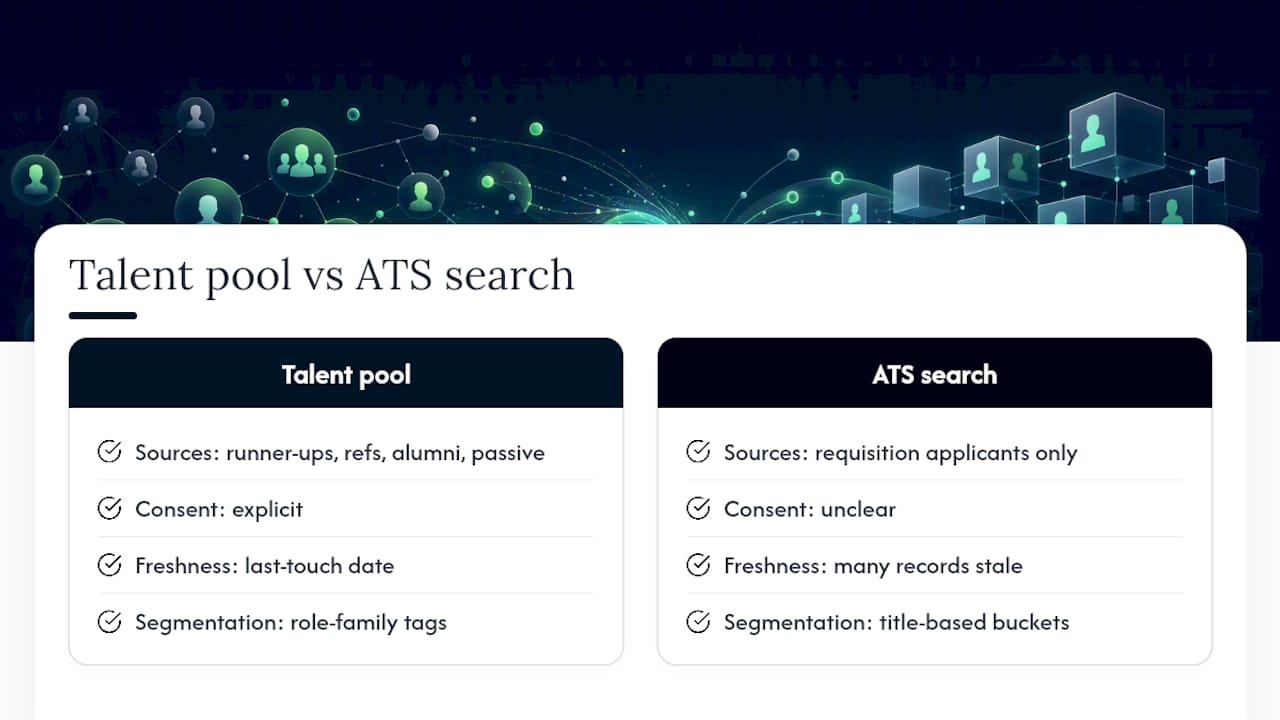
Title-based buckets break down fast because job titles vary wildly between companies. “Senior Backend Engineer” at one firm means something different at another. Segmenting by job family (backend engineering, DevOps/SRE, data platform) instead of title keeps the pool searchable months after the original role closed, and it is the structural choice that separates a pool people actually use from one that quietly rots.
Why Talent Pools Matter: Where the Time and Cost Savings Show Up
The payback shows up fastest on roles you fill more than once a year. Cold sourcing means starting from zero: writing a new Boolean string, posting again, waiting for applications to trickle in. A searchable pool skips most of that, because the candidates who almost got the last job, or who raised a hand for it, are already tagged and reachable.
The numbers behind it: a well-maintained talent pool can fill 25 to 40 percent of recurring roles and cut cost per hire by roughly 30 to 40 percent when combined with signal-based activation and continuous feeding, according to industry sourcing research.
Reply rates on pool candidates also tend to beat cold outreach, since these people have prior context with your agency or company. Prioritize building a pool when you hire the same three to five role families repeatedly, when a niche skill set makes cold sourcing painfully slow, or when your team’s headcount can’t scale to match rising requisition volume.
Five Practical Steps to Build a Talent Pool That Gets Used
Most talent pools fail not because recruiters don’t collect candidates, but because nobody built a system to keep the pool current and searchable. Here is a five-step process that avoids that trap.
Pick 3 to 5 recurring role segments and attach a reference brief. Choose the job families you hire for most (say, backend engineering, project management, DevOps) and write a short reference brief for each: core skills, seniority range, typical location or remote policy.
Feed the pool continuously, not in one sourcing sprint. Capture silver-medal finalists from closed roles, referrals, contacts from events and conferences, and passives surfaced through AI sourcing tools. Employee referrals in particular convert at notably higher rates and tend to stay longer, which makes them worth prioritizing as a feed source.
Organize with consistent tagging. Every profile needs role family, critical skills, seniority, location, last-contact date, and consent status recorded the same way every time. Inconsistent tagging is the single fastest way a pool turns back into an unsearchable resume dump.
Nurture on a signal-driven cadence, and refresh data roughly every six months. Practitioner guidance on pool maintenance recommends this refresh interval to keep contact details, skills, and consent status current.
Activate on the right signal and channel when a role opens. A recent job change, a new certification, or renewed public activity is a better trigger than a blanket quarterly email blast.
Pro Tip: Aim for 100 to 300 qualified profiles per recurring role segment. That range is roughly what industry benchmarks suggest is needed to reliably produce interviews and hires at scale, without so much volume that the pool becomes unmanageable.
How Do You Search a Talent Pool Effectively?
Search around the segment, not the title. A query built on job family plus critical skills plus a last-contact window (say, “backend engineering, Kubernetes, contacted within 12 months”) surfaces a tighter, more relevant list than a title match ever will, because it reflects how the pool was actually tagged.
Layer in signal-based filters on top of that base query. Recruiters are increasingly moving away from pure title searches toward filtering on signals like a recent job change or visible public contributions, since those signals predict receptiveness far better than a static job title ever could. Practical filters worth building into your search routine:
Recent job change (within the last 3 to 6 months)
Visible portfolio or code repository activity
Conference speaking or attendance in your niche
Skill endorsements or certifications added recently
When your internal pool comes up short, rediscovery through external Boolean and X-ray search techniques (searching public profiles indexed on job boards and social platforms with targeted operators) extends your reach without starting from zero. Combine that external pass with internal indexing so any rediscovered candidate gets folded straight back into the pool instead of living in a separate spreadsheet.
AI match scores, where available, give you a fast first cut: a candidate scored against a role’s tech stack and requirements tells you where to spend outreach effort first. Treat the score as a starting point, not a verdict, and run three hygiene checks before you reach out: dedupe against existing outreach, confirm consent status is current, and check the last-contact date so you don’t message someone twice in the same month.
Pro Tip: Build your outreach shortlist to 5 to 10 names before you start writing messages. Fewer than five limits your options if two people go quiet; more than ten spreads your attention too thin to personalize each message.
How Do You Keep a Talent Pool Compliant and Fresh?
Retention discipline is what keeps a talent pool from becoming a legal liability disguised as a database. Storage-limitation guidance from data protection regulators recommends reviewing retention at set intervals and deleting or anonymizing records once there’s no ongoing justification to keep them, rather than holding data indefinitely on the assumption it might be useful someday, per the ICO’s storage limitation principle.
A practical governance routine looks like this:
Refresh candidate data every six months; flag anything untouched for review.
Anonymize or delete records after roughly two years when active consent is absent.
Run pseudonymisation on records you want to keep for analytics but don’t need identifiable. An ICO case study on pseudonymising employee data documents concrete steps: stripping direct identifiers, generalizing ages into bands, hashing indirect identifiers, and testing for k-anonymity before analytics teams touch the data.
Log consent status and keep an audit trail on every contact attempt.
Governance checkpoint: the ICO recommends running a Data Protection Impact Assessment at the procurement stage for any AI recruitment tool, with data minimization and clear storage limits built into the vendor contract before you sign, not added after.
Automate the boring parts. Flagging stale records, maintaining consent logs, and generating audit trails by hand is exactly the kind of task that quietly stops happening under deadline pressure, which is when compliance gaps open up.
What Metrics Actually Show Whether a Pool Is Working?
Four numbers tell you almost everything you need to know about pool health, and all four are trackable inside a standard ATS or CRM without custom reporting.
Share of hires from pool: the percentage of filled roles that came from the pool rather than fresh sourcing.
Time to first pool interview: how fast a search-to-interview cycle runs for a pool candidate versus a cold one.
Reply rate on reactivation outreach: a direct read on whether your nurture cadence and messaging are landing.
Pool coverage per recurring role: whether each job family segment has enough live, consented profiles to draw from.
For recurring roles, treat a rising share-of-hires-from-pool figure across the first two years as your main success signal, alongside a shrinking time-to-first-interview. Review these four metrics monthly for the first two quarters after launch, then quarterly once the pool stabilizes.
Strategies for Engaging and Nurturing Passive Candidates
Passive candidates, people not actively job hunting, need a different rhythm than active applicants. Treat them as long-term relationships rather than transactions, and the reply rates follow.
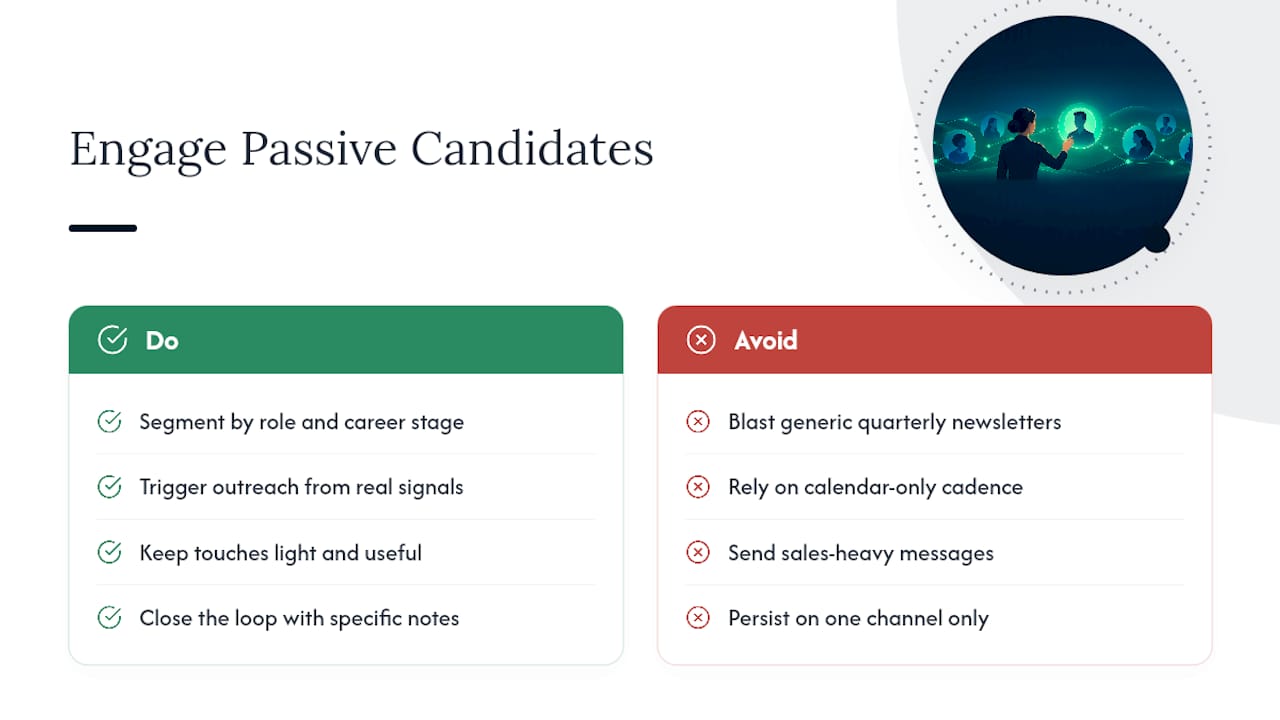
Segment nurture content the same way you segment the pool: by role family and by what stage of career interest each person shows. A senior engineer three years into a role wants different content than someone who just left a company in a public layoff.
A short, signal-driven reactivation cadence multiplies reply rates compared with a generic quarterly newsletter blasted to the whole pool. Trigger outreach off something real: a job change, a new certification, a company acquisition, rather than an arbitrary calendar date.
Keep touches light and useful rather than sales-heavy. Share a relevant market insight, congratulate a promotion you spotted, or forward an opening that genuinely matches their stated interests. Candidates who feel like a name on a list disengage fast; candidates who feel recognized stay responsive for years.
Multichannel contact beats single-channel persistence. Email still works, but a message on a professional network or a follow-up after a conference conversation often lands better with candidates who ignore recruiter email by default. Track which channel gets a response for each segment and lean into it rather than defaulting to whatever channel is easiest for your team to manage.
Finally, close the loop even when there’s no role. A short note explaining that someone wasn’t a fit this round but stays in your pool for future openings, sent with genuine specificity rather than a form letter, is often the single message that keeps a passive candidate warm for the next opening.
What Legal Rules Beyond GDPR Apply to Talent Pooling?
GDPR governs consent and retention, but it isn’t the only compliance layer that matters once you’re actively searching and contacting people from a pool. In the United States, Equal Employment Opportunity Commission (EEOC) rules apply the moment a pool search becomes part of an actual hiring decision, meaning the criteria used to filter or rank candidates need to avoid disparate impact on protected classes just as they would in any other selection process.
That has a direct implication for signal-based sourcing: filtering on signals like “recent job change” or “conference attendance” needs review to ensure it doesn’t systematically exclude candidates from groups protected under EEOC guidelines, particularly when those signals correlate with access to networks or events that aren’t equally available to everyone.
Several US states, along with jurisdictions in the EU, have separate rules governing automated decision-making in hiring, including disclosure requirements when an AI system scores or ranks candidates. If your pool search relies on AI match scoring, check whether local law requires you to disclose that to candidates or to allow them to contest a score.
Data residency rules add another layer for agencies operating across borders: where the pool’s data physically sits, and which country’s law governs a breach, can differ from where the candidates or the hiring company are located. Build a simple compliance checklist per jurisdiction you operate in rather than assuming one region’s rules cover them all.
How Automation Keeps a Talent Pool Alive Instead of Stale
Most talent pools die from neglect, not from bad intent. A recruiter builds a spreadsheet with good intentions, fills it for a month, then moves on to the next fire, and six months later nobody remembers who’s in it or whether those people still want to hear from the agency. We think the real fix isn’t more discipline. It’s removing the manual steps that discipline was supposed to cover.
Contextual matching AI changes what a search actually returns. Instead of a keyword hit on “Python,” a well-built matching engine understands relationships within a candidate’s tech stack and returns a shortlist with a percentage match score against the actual role requirements, which is a meaningfully different output than a flat keyword list. Intelligent indexing does something similar for database value: it resurfaces candidates who applied two years ago and got buried, turning a database agencies already paid to build into a source of new placements instead of a sunk cost.
Consent management and audit trails matter just as much as the matching layer, because a fast search that can’t prove consent is a liability, not an asset. A system built to log every consent event and retention action from the start removes the manual compliance burden that causes most pools to quietly decay.
- Recruitify Team
How Recruitify Helps You Operationalize a Talent Pool Search
Recruitify consolidates the pieces this article just walked through, indexing, AI match scoring, and GDPR consent tracking, into one system instead of a patchwork of spreadsheets and separate tools. The Contextual Matching AI scores candidates against real role requirements rather than keyword overlap, and intelligent indexing resurfaces silver-medal candidates from your existing database instead of leaving them buried in old requisitions.
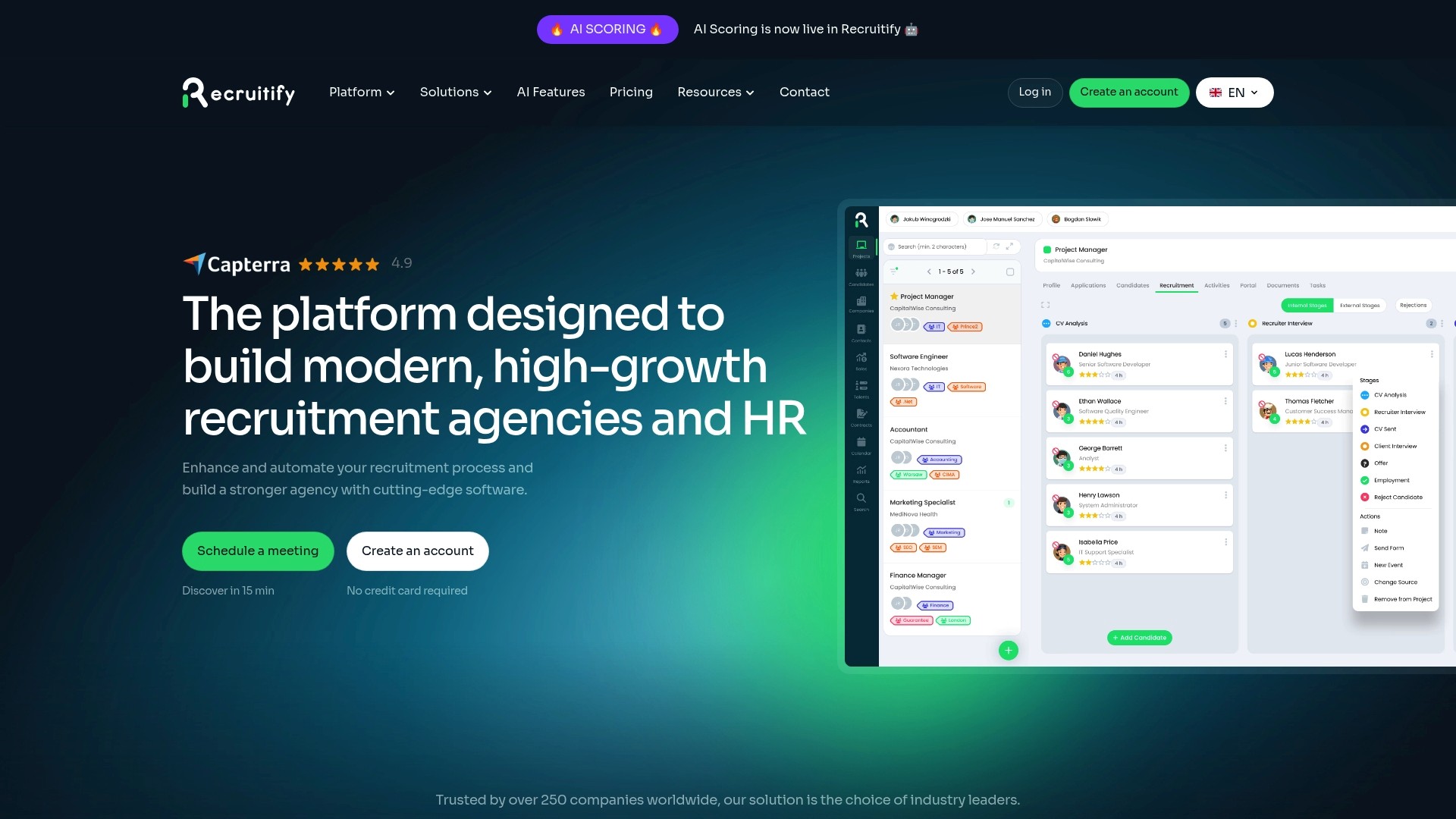
The platform’s GDPR consent management module keeps a full audit trail on every record, so retention reviews and DPIA questions have a documented answer instead of a guess. If you run recurring searches across multiple role families, the recruitment projects module ties reference briefs directly to your pool segments, which is the exact structure this article recommends for keeping search accurate.
Recruitify’s plans start at $69 per user, per month for HR teams and $79 per user, per month for recruitment agencies, with enterprise pricing available on request. Pilot the system on one recurring role family first. See how much faster a signal-based search produces a shortlist compared to your current process, then decide whether to expand from there.
Sources
TrueCalling - How to Build a Talent Pool and Activate It in 2026 (5-Step Method)
ICO case study - Pseudonymising employee data for recruitment analytics
FAQ
What Is Talent Pooling and How Does It Work?
Talent pooling means building a searchable, consented database of prequalified candidates, runner-ups, referrals, alumni, and sourced passives, organized by recurring role rather than title. Recruiters search the pool using segment, skill, and signal filters to build a shortlist quickly instead of sourcing cold each time a role opens.
What Does It Mean to Be Placed in a Talent Pool?
Being placed in a talent pool means a recruiter or company keeps your profile on file, with your consent, for future openings that match your skills and experience. It usually happens after you apply to a role you weren’t selected for, or after a recruiter identifies you as a strong fit for roles the company hires for repeatedly.
How Do You Join a Talent Pool?
You typically join a talent pool by applying to a role (even if not selected), through an employee referral, or by being sourced directly by a recruiter based on your public profile or portfolio activity. Some companies also let candidates opt in directly through a careers page, agreeing to be contacted about future matching roles.
Is Recruitify a Legitimate Company for Managing a Talent Pool?
Recruitify is a B2B software platform built specifically for IT recruitment agencies and HR teams, combining an ATS, CRM, and contracting module with AI-driven candidate matching and GDPR consent tracking. Pricing and plan details are published on the Recruitify pricing page, with plans for HR teams, agencies, and enterprise customers.
How Often Should You Refresh a Talent Pool?
Refresh candidate data roughly every six months to keep contact details, skills, and consent status current, and review records for deletion or anonymization after about two years without active consent, based on storage limitation guidance from the ICO. A pool that never gets refreshed drifts into an unusable resume archive within a year or two.
Recommended


News & Updates
Stay up-to-date with the latest innovations, features, and tips about Recruitify!
By providing your email address within the newsletter sign-up form, you confirm its processing to send marketing information regarding the Administrator’s products and services. The Administrator of your personal data processed for the abovementioned purposes is Recruitify Spółka z o.o., based in Warsaw, Poland (KRS 0000709889). For more information on the principles of personal data processing and the rights of data subjects, please check the Privacy Policy.

Last updated:
Shortlists in Days With Signal Driven Talent Pools for Recruiters
Recruitment Process
The Recruitify Team
A talent pool search finds prequalified, consented candidates already sitting in your own database, so you can build a shortlist in days instead of weeks. It works because the pool is segmented by recurring role and tagged with real signals, not buried in a static resume archive. Recruiters who search well rather than source cold cut time to first interview and lower cost per hire on repeat positions.
Maintaining a talent pool that covers 25 to 40 percent of recurring roles can reduce your cost per hire by up to 40 percent and improve reply rates with prior-context candidates.
Segmenting candidates by role family and critical skills, rather than job titles, ensures the pool remains useful and searchable for months after the initial sourcing.
Regularly refreshing candidate data every six months and deleting inactive records after roughly two years helps maintain compliance and data accuracy.
Search effectiveness improves significantly when layering filters like recent job changes, public activity, and certifications over role family and critical skills.
Automating consent management, stale record flagging, and audit trail logging preserves legal compliance and prevents the pool from becoming outdated or noncompliant.
RecruitifyTurn Your Talent Pool Into PlacementsRecruitify helps IT recruitment agencies search existing candidate assets, automate workflows, and create scored shortlists from one operational ecosystem.Explore Recruitify
Table of Contents
What Is a Talent Pool Search, and How Is It Different From an ATS Search?
Why Talent Pools Matter: Where the Time and Cost Savings Show Up
Five Practical Steps to Build a Talent Pool That Gets Used
How Do You Search a Talent Pool Effectively?
How Do You Keep a Talent Pool Compliant and Fresh?
What Metrics Actually Show Whether a Pool Is Working?
Strategies for Engaging and Nurturing Passive Candidates
What Legal Rules Beyond GDPR Apply to Talent Pooling?
How Automation Keeps a Talent Pool Alive Instead of Stale
How Recruitify Helps You Operationalize a Talent Pool Search
Sources
FAQ
What Is a Talent Pool Search, and How Is It Different From an ATS Search?
A talent pool is a curated, consented group of candidates you can search and reactivate for recurring roles. It typically includes four member types: runner-up finalists from past processes, employee referrals, alumni who left on good terms, and passive candidates sourced proactively because they matched a role family you hire for often.
That is a different animal from an applicant tracking system search or a raw resume database. An ATS search pulls whoever applied to a specific requisition, consent status unclear, tagging inconsistent, and half the records years stale. A talent pool is built for reuse: every profile carries explicit consent to be contacted again, a last-touch date, and a role-family tag rather than a job title.
Title-based buckets break down fast because job titles vary wildly between companies. “Senior Backend Engineer” at one firm means something different at another. Segmenting by job family (backend engineering, DevOps/SRE, data platform) instead of title keeps the pool searchable months after the original role closed, and it is the structural choice that separates a pool people actually use from one that quietly rots.
Why Talent Pools Matter: Where the Time and Cost Savings Show Up
The payback shows up fastest on roles you fill more than once a year. Cold sourcing means starting from zero: writing a new Boolean string, posting again, waiting for applications to trickle in. A searchable pool skips most of that, because the candidates who almost got the last job, or who raised a hand for it, are already tagged and reachable.
The numbers behind it: a well-maintained talent pool can fill 25 to 40 percent of recurring roles and cut cost per hire by roughly 30 to 40 percent when combined with signal-based activation and continuous feeding, according to industry sourcing research.
Reply rates on pool candidates also tend to beat cold outreach, since these people have prior context with your agency or company. Prioritize building a pool when you hire the same three to five role families repeatedly, when a niche skill set makes cold sourcing painfully slow, or when your team’s headcount can’t scale to match rising requisition volume.
Five Practical Steps to Build a Talent Pool That Gets Used
Most talent pools fail not because recruiters don’t collect candidates, but because nobody built a system to keep the pool current and searchable. Here is a five-step process that avoids that trap.
Pick 3 to 5 recurring role segments and attach a reference brief. Choose the job families you hire for most (say, backend engineering, project management, DevOps) and write a short reference brief for each: core skills, seniority range, typical location or remote policy.
Feed the pool continuously, not in one sourcing sprint. Capture silver-medal finalists from closed roles, referrals, contacts from events and conferences, and passives surfaced through AI sourcing tools. Employee referrals in particular convert at notably higher rates and tend to stay longer, which makes them worth prioritizing as a feed source.
Organize with consistent tagging. Every profile needs role family, critical skills, seniority, location, last-contact date, and consent status recorded the same way every time. Inconsistent tagging is the single fastest way a pool turns back into an unsearchable resume dump.
Nurture on a signal-driven cadence, and refresh data roughly every six months. Practitioner guidance on pool maintenance recommends this refresh interval to keep contact details, skills, and consent status current.
Activate on the right signal and channel when a role opens. A recent job change, a new certification, or renewed public activity is a better trigger than a blanket quarterly email blast.
Pro Tip: Aim for 100 to 300 qualified profiles per recurring role segment. That range is roughly what industry benchmarks suggest is needed to reliably produce interviews and hires at scale, without so much volume that the pool becomes unmanageable.
How Do You Search a Talent Pool Effectively?
Search around the segment, not the title. A query built on job family plus critical skills plus a last-contact window (say, “backend engineering, Kubernetes, contacted within 12 months”) surfaces a tighter, more relevant list than a title match ever will, because it reflects how the pool was actually tagged.
Layer in signal-based filters on top of that base query. Recruiters are increasingly moving away from pure title searches toward filtering on signals like a recent job change or visible public contributions, since those signals predict receptiveness far better than a static job title ever could. Practical filters worth building into your search routine:
Recent job change (within the last 3 to 6 months)
Visible portfolio or code repository activity
Conference speaking or attendance in your niche
Skill endorsements or certifications added recently
When your internal pool comes up short, rediscovery through external Boolean and X-ray search techniques (searching public profiles indexed on job boards and social platforms with targeted operators) extends your reach without starting from zero. Combine that external pass with internal indexing so any rediscovered candidate gets folded straight back into the pool instead of living in a separate spreadsheet.
AI match scores, where available, give you a fast first cut: a candidate scored against a role’s tech stack and requirements tells you where to spend outreach effort first. Treat the score as a starting point, not a verdict, and run three hygiene checks before you reach out: dedupe against existing outreach, confirm consent status is current, and check the last-contact date so you don’t message someone twice in the same month.
Pro Tip: Build your outreach shortlist to 5 to 10 names before you start writing messages. Fewer than five limits your options if two people go quiet; more than ten spreads your attention too thin to personalize each message.
How Do You Keep a Talent Pool Compliant and Fresh?
Retention discipline is what keeps a talent pool from becoming a legal liability disguised as a database. Storage-limitation guidance from data protection regulators recommends reviewing retention at set intervals and deleting or anonymizing records once there’s no ongoing justification to keep them, rather than holding data indefinitely on the assumption it might be useful someday, per the ICO’s storage limitation principle.
A practical governance routine looks like this:
Refresh candidate data every six months; flag anything untouched for review.
Anonymize or delete records after roughly two years when active consent is absent.
Run pseudonymisation on records you want to keep for analytics but don’t need identifiable. An ICO case study on pseudonymising employee data documents concrete steps: stripping direct identifiers, generalizing ages into bands, hashing indirect identifiers, and testing for k-anonymity before analytics teams touch the data.
Log consent status and keep an audit trail on every contact attempt.
Governance checkpoint: the ICO recommends running a Data Protection Impact Assessment at the procurement stage for any AI recruitment tool, with data minimization and clear storage limits built into the vendor contract before you sign, not added after.
Automate the boring parts. Flagging stale records, maintaining consent logs, and generating audit trails by hand is exactly the kind of task that quietly stops happening under deadline pressure, which is when compliance gaps open up.
What Metrics Actually Show Whether a Pool Is Working?
Four numbers tell you almost everything you need to know about pool health, and all four are trackable inside a standard ATS or CRM without custom reporting.
Share of hires from pool: the percentage of filled roles that came from the pool rather than fresh sourcing.
Time to first pool interview: how fast a search-to-interview cycle runs for a pool candidate versus a cold one.
Reply rate on reactivation outreach: a direct read on whether your nurture cadence and messaging are landing.
Pool coverage per recurring role: whether each job family segment has enough live, consented profiles to draw from.
For recurring roles, treat a rising share-of-hires-from-pool figure across the first two years as your main success signal, alongside a shrinking time-to-first-interview. Review these four metrics monthly for the first two quarters after launch, then quarterly once the pool stabilizes.
Strategies for Engaging and Nurturing Passive Candidates
Passive candidates, people not actively job hunting, need a different rhythm than active applicants. Treat them as long-term relationships rather than transactions, and the reply rates follow.
Segment nurture content the same way you segment the pool: by role family and by what stage of career interest each person shows. A senior engineer three years into a role wants different content than someone who just left a company in a public layoff.
A short, signal-driven reactivation cadence multiplies reply rates compared with a generic quarterly newsletter blasted to the whole pool. Trigger outreach off something real: a job change, a new certification, a company acquisition, rather than an arbitrary calendar date.
Keep touches light and useful rather than sales-heavy. Share a relevant market insight, congratulate a promotion you spotted, or forward an opening that genuinely matches their stated interests. Candidates who feel like a name on a list disengage fast; candidates who feel recognized stay responsive for years.
Multichannel contact beats single-channel persistence. Email still works, but a message on a professional network or a follow-up after a conference conversation often lands better with candidates who ignore recruiter email by default. Track which channel gets a response for each segment and lean into it rather than defaulting to whatever channel is easiest for your team to manage.
Finally, close the loop even when there’s no role. A short note explaining that someone wasn’t a fit this round but stays in your pool for future openings, sent with genuine specificity rather than a form letter, is often the single message that keeps a passive candidate warm for the next opening.
What Legal Rules Beyond GDPR Apply to Talent Pooling?
GDPR governs consent and retention, but it isn’t the only compliance layer that matters once you’re actively searching and contacting people from a pool. In the United States, Equal Employment Opportunity Commission (EEOC) rules apply the moment a pool search becomes part of an actual hiring decision, meaning the criteria used to filter or rank candidates need to avoid disparate impact on protected classes just as they would in any other selection process.
That has a direct implication for signal-based sourcing: filtering on signals like “recent job change” or “conference attendance” needs review to ensure it doesn’t systematically exclude candidates from groups protected under EEOC guidelines, particularly when those signals correlate with access to networks or events that aren’t equally available to everyone.
Several US states, along with jurisdictions in the EU, have separate rules governing automated decision-making in hiring, including disclosure requirements when an AI system scores or ranks candidates. If your pool search relies on AI match scoring, check whether local law requires you to disclose that to candidates or to allow them to contest a score.
Data residency rules add another layer for agencies operating across borders: where the pool’s data physically sits, and which country’s law governs a breach, can differ from where the candidates or the hiring company are located. Build a simple compliance checklist per jurisdiction you operate in rather than assuming one region’s rules cover them all.
How Automation Keeps a Talent Pool Alive Instead of Stale
Most talent pools die from neglect, not from bad intent. A recruiter builds a spreadsheet with good intentions, fills it for a month, then moves on to the next fire, and six months later nobody remembers who’s in it or whether those people still want to hear from the agency. We think the real fix isn’t more discipline. It’s removing the manual steps that discipline was supposed to cover.
Contextual matching AI changes what a search actually returns. Instead of a keyword hit on “Python,” a well-built matching engine understands relationships within a candidate’s tech stack and returns a shortlist with a percentage match score against the actual role requirements, which is a meaningfully different output than a flat keyword list. Intelligent indexing does something similar for database value: it resurfaces candidates who applied two years ago and got buried, turning a database agencies already paid to build into a source of new placements instead of a sunk cost.
Consent management and audit trails matter just as much as the matching layer, because a fast search that can’t prove consent is a liability, not an asset. A system built to log every consent event and retention action from the start removes the manual compliance burden that causes most pools to quietly decay.
- Recruitify Team
How Recruitify Helps You Operationalize a Talent Pool Search
Recruitify consolidates the pieces this article just walked through, indexing, AI match scoring, and GDPR consent tracking, into one system instead of a patchwork of spreadsheets and separate tools. The Contextual Matching AI scores candidates against real role requirements rather than keyword overlap, and intelligent indexing resurfaces silver-medal candidates from your existing database instead of leaving them buried in old requisitions.
The platform’s GDPR consent management module keeps a full audit trail on every record, so retention reviews and DPIA questions have a documented answer instead of a guess. If you run recurring searches across multiple role families, the recruitment projects module ties reference briefs directly to your pool segments, which is the exact structure this article recommends for keeping search accurate.
Recruitify’s plans start at $69 per user, per month for HR teams and $79 per user, per month for recruitment agencies, with enterprise pricing available on request. Pilot the system on one recurring role family first. See how much faster a signal-based search produces a shortlist compared to your current process, then decide whether to expand from there.
Sources
TrueCalling - How to Build a Talent Pool and Activate It in 2026 (5-Step Method)
ICO case study - Pseudonymising employee data for recruitment analytics
FAQ
What Is Talent Pooling and How Does It Work?
Talent pooling means building a searchable, consented database of prequalified candidates, runner-ups, referrals, alumni, and sourced passives, organized by recurring role rather than title. Recruiters search the pool using segment, skill, and signal filters to build a shortlist quickly instead of sourcing cold each time a role opens.
What Does It Mean to Be Placed in a Talent Pool?
Being placed in a talent pool means a recruiter or company keeps your profile on file, with your consent, for future openings that match your skills and experience. It usually happens after you apply to a role you weren’t selected for, or after a recruiter identifies you as a strong fit for roles the company hires for repeatedly.
How Do You Join a Talent Pool?
You typically join a talent pool by applying to a role (even if not selected), through an employee referral, or by being sourced directly by a recruiter based on your public profile or portfolio activity. Some companies also let candidates opt in directly through a careers page, agreeing to be contacted about future matching roles.
Is Recruitify a Legitimate Company for Managing a Talent Pool?
Recruitify is a B2B software platform built specifically for IT recruitment agencies and HR teams, combining an ATS, CRM, and contracting module with AI-driven candidate matching and GDPR consent tracking. Pricing and plan details are published on the Recruitify pricing page, with plans for HR teams, agencies, and enterprise customers.
How Often Should You Refresh a Talent Pool?
Refresh candidate data roughly every six months to keep contact details, skills, and consent status current, and review records for deletion or anonymization after about two years without active consent, based on storage limitation guidance from the ICO. A pool that never gets refreshed drifts into an unusable resume archive within a year or two.
Recommended
News & Updates
Stay up-to-date with the latest innovations, features, and tips about Recruitify!
By providing your email address within the newsletter sign-up form, you confirm its processing to send marketing information regarding the Administrator’s products and services. The Administrator of your personal data processed for the abovementioned purposes is Recruitify Spółka z o.o., based in Warsaw, Poland (KRS 0000709889). For more information on the principles of personal data processing and the rights of data subjects, please check the Privacy Policy.
Last updated:
Shortlists in Days With Signal Driven Talent Pools for Recruiters
Recruitment Process
The Recruitify Team
A talent pool search finds prequalified, consented candidates already sitting in your own database, so you can build a shortlist in days instead of weeks. It works because the pool is segmented by recurring role and tagged with real signals, not buried in a static resume archive. Recruiters who search well rather than source cold cut time to first interview and lower cost per hire on repeat positions.
Maintaining a talent pool that covers 25 to 40 percent of recurring roles can reduce your cost per hire by up to 40 percent and improve reply rates with prior-context candidates.
Segmenting candidates by role family and critical skills, rather than job titles, ensures the pool remains useful and searchable for months after the initial sourcing.
Regularly refreshing candidate data every six months and deleting inactive records after roughly two years helps maintain compliance and data accuracy.
Search effectiveness improves significantly when layering filters like recent job changes, public activity, and certifications over role family and critical skills.
Automating consent management, stale record flagging, and audit trail logging preserves legal compliance and prevents the pool from becoming outdated or noncompliant.
RecruitifyTurn Your Talent Pool Into PlacementsRecruitify helps IT recruitment agencies search existing candidate assets, automate workflows, and create scored shortlists from one operational ecosystem.Explore Recruitify
Table of Contents
What Is a Talent Pool Search, and How Is It Different From an ATS Search?
Why Talent Pools Matter: Where the Time and Cost Savings Show Up
Five Practical Steps to Build a Talent Pool That Gets Used
How Do You Search a Talent Pool Effectively?
How Do You Keep a Talent Pool Compliant and Fresh?
What Metrics Actually Show Whether a Pool Is Working?
Strategies for Engaging and Nurturing Passive Candidates
What Legal Rules Beyond GDPR Apply to Talent Pooling?
How Automation Keeps a Talent Pool Alive Instead of Stale
How Recruitify Helps You Operationalize a Talent Pool Search
Sources
FAQ
What Is a Talent Pool Search, and How Is It Different From an ATS Search?
A talent pool is a curated, consented group of candidates you can search and reactivate for recurring roles. It typically includes four member types: runner-up finalists from past processes, employee referrals, alumni who left on good terms, and passive candidates sourced proactively because they matched a role family you hire for often.
That is a different animal from an applicant tracking system search or a raw resume database. An ATS search pulls whoever applied to a specific requisition, consent status unclear, tagging inconsistent, and half the records years stale. A talent pool is built for reuse: every profile carries explicit consent to be contacted again, a last-touch date, and a role-family tag rather than a job title.
Title-based buckets break down fast because job titles vary wildly between companies. “Senior Backend Engineer” at one firm means something different at another. Segmenting by job family (backend engineering, DevOps/SRE, data platform) instead of title keeps the pool searchable months after the original role closed, and it is the structural choice that separates a pool people actually use from one that quietly rots.
Why Talent Pools Matter: Where the Time and Cost Savings Show Up
The payback shows up fastest on roles you fill more than once a year. Cold sourcing means starting from zero: writing a new Boolean string, posting again, waiting for applications to trickle in. A searchable pool skips most of that, because the candidates who almost got the last job, or who raised a hand for it, are already tagged and reachable.
The numbers behind it: a well-maintained talent pool can fill 25 to 40 percent of recurring roles and cut cost per hire by roughly 30 to 40 percent when combined with signal-based activation and continuous feeding, according to industry sourcing research.
Reply rates on pool candidates also tend to beat cold outreach, since these people have prior context with your agency or company. Prioritize building a pool when you hire the same three to five role families repeatedly, when a niche skill set makes cold sourcing painfully slow, or when your team’s headcount can’t scale to match rising requisition volume.
Five Practical Steps to Build a Talent Pool That Gets Used
Most talent pools fail not because recruiters don’t collect candidates, but because nobody built a system to keep the pool current and searchable. Here is a five-step process that avoids that trap.
Pick 3 to 5 recurring role segments and attach a reference brief. Choose the job families you hire for most (say, backend engineering, project management, DevOps) and write a short reference brief for each: core skills, seniority range, typical location or remote policy.
Feed the pool continuously, not in one sourcing sprint. Capture silver-medal finalists from closed roles, referrals, contacts from events and conferences, and passives surfaced through AI sourcing tools. Employee referrals in particular convert at notably higher rates and tend to stay longer, which makes them worth prioritizing as a feed source.
Organize with consistent tagging. Every profile needs role family, critical skills, seniority, location, last-contact date, and consent status recorded the same way every time. Inconsistent tagging is the single fastest way a pool turns back into an unsearchable resume dump.
Nurture on a signal-driven cadence, and refresh data roughly every six months. Practitioner guidance on pool maintenance recommends this refresh interval to keep contact details, skills, and consent status current.
Activate on the right signal and channel when a role opens. A recent job change, a new certification, or renewed public activity is a better trigger than a blanket quarterly email blast.
Pro Tip: Aim for 100 to 300 qualified profiles per recurring role segment. That range is roughly what industry benchmarks suggest is needed to reliably produce interviews and hires at scale, without so much volume that the pool becomes unmanageable.
How Do You Search a Talent Pool Effectively?
Search around the segment, not the title. A query built on job family plus critical skills plus a last-contact window (say, “backend engineering, Kubernetes, contacted within 12 months”) surfaces a tighter, more relevant list than a title match ever will, because it reflects how the pool was actually tagged.
Layer in signal-based filters on top of that base query. Recruiters are increasingly moving away from pure title searches toward filtering on signals like a recent job change or visible public contributions, since those signals predict receptiveness far better than a static job title ever could. Practical filters worth building into your search routine:
Recent job change (within the last 3 to 6 months)
Visible portfolio or code repository activity
Conference speaking or attendance in your niche
Skill endorsements or certifications added recently
When your internal pool comes up short, rediscovery through external Boolean and X-ray search techniques (searching public profiles indexed on job boards and social platforms with targeted operators) extends your reach without starting from zero. Combine that external pass with internal indexing so any rediscovered candidate gets folded straight back into the pool instead of living in a separate spreadsheet.
AI match scores, where available, give you a fast first cut: a candidate scored against a role’s tech stack and requirements tells you where to spend outreach effort first. Treat the score as a starting point, not a verdict, and run three hygiene checks before you reach out: dedupe against existing outreach, confirm consent status is current, and check the last-contact date so you don’t message someone twice in the same month.
Pro Tip: Build your outreach shortlist to 5 to 10 names before you start writing messages. Fewer than five limits your options if two people go quiet; more than ten spreads your attention too thin to personalize each message.
How Do You Keep a Talent Pool Compliant and Fresh?
Retention discipline is what keeps a talent pool from becoming a legal liability disguised as a database. Storage-limitation guidance from data protection regulators recommends reviewing retention at set intervals and deleting or anonymizing records once there’s no ongoing justification to keep them, rather than holding data indefinitely on the assumption it might be useful someday, per the ICO’s storage limitation principle.
A practical governance routine looks like this:
Refresh candidate data every six months; flag anything untouched for review.
Anonymize or delete records after roughly two years when active consent is absent.
Run pseudonymisation on records you want to keep for analytics but don’t need identifiable. An ICO case study on pseudonymising employee data documents concrete steps: stripping direct identifiers, generalizing ages into bands, hashing indirect identifiers, and testing for k-anonymity before analytics teams touch the data.
Log consent status and keep an audit trail on every contact attempt.
Governance checkpoint: the ICO recommends running a Data Protection Impact Assessment at the procurement stage for any AI recruitment tool, with data minimization and clear storage limits built into the vendor contract before you sign, not added after.
Automate the boring parts. Flagging stale records, maintaining consent logs, and generating audit trails by hand is exactly the kind of task that quietly stops happening under deadline pressure, which is when compliance gaps open up.
What Metrics Actually Show Whether a Pool Is Working?
Four numbers tell you almost everything you need to know about pool health, and all four are trackable inside a standard ATS or CRM without custom reporting.
Share of hires from pool: the percentage of filled roles that came from the pool rather than fresh sourcing.
Time to first pool interview: how fast a search-to-interview cycle runs for a pool candidate versus a cold one.
Reply rate on reactivation outreach: a direct read on whether your nurture cadence and messaging are landing.
Pool coverage per recurring role: whether each job family segment has enough live, consented profiles to draw from.
For recurring roles, treat a rising share-of-hires-from-pool figure across the first two years as your main success signal, alongside a shrinking time-to-first-interview. Review these four metrics monthly for the first two quarters after launch, then quarterly once the pool stabilizes.
Strategies for Engaging and Nurturing Passive Candidates
Passive candidates, people not actively job hunting, need a different rhythm than active applicants. Treat them as long-term relationships rather than transactions, and the reply rates follow.
Segment nurture content the same way you segment the pool: by role family and by what stage of career interest each person shows. A senior engineer three years into a role wants different content than someone who just left a company in a public layoff.
A short, signal-driven reactivation cadence multiplies reply rates compared with a generic quarterly newsletter blasted to the whole pool. Trigger outreach off something real: a job change, a new certification, a company acquisition, rather than an arbitrary calendar date.
Keep touches light and useful rather than sales-heavy. Share a relevant market insight, congratulate a promotion you spotted, or forward an opening that genuinely matches their stated interests. Candidates who feel like a name on a list disengage fast; candidates who feel recognized stay responsive for years.
Multichannel contact beats single-channel persistence. Email still works, but a message on a professional network or a follow-up after a conference conversation often lands better with candidates who ignore recruiter email by default. Track which channel gets a response for each segment and lean into it rather than defaulting to whatever channel is easiest for your team to manage.
Finally, close the loop even when there’s no role. A short note explaining that someone wasn’t a fit this round but stays in your pool for future openings, sent with genuine specificity rather than a form letter, is often the single message that keeps a passive candidate warm for the next opening.
What Legal Rules Beyond GDPR Apply to Talent Pooling?
GDPR governs consent and retention, but it isn’t the only compliance layer that matters once you’re actively searching and contacting people from a pool. In the United States, Equal Employment Opportunity Commission (EEOC) rules apply the moment a pool search becomes part of an actual hiring decision, meaning the criteria used to filter or rank candidates need to avoid disparate impact on protected classes just as they would in any other selection process.
That has a direct implication for signal-based sourcing: filtering on signals like “recent job change” or “conference attendance” needs review to ensure it doesn’t systematically exclude candidates from groups protected under EEOC guidelines, particularly when those signals correlate with access to networks or events that aren’t equally available to everyone.
Several US states, along with jurisdictions in the EU, have separate rules governing automated decision-making in hiring, including disclosure requirements when an AI system scores or ranks candidates. If your pool search relies on AI match scoring, check whether local law requires you to disclose that to candidates or to allow them to contest a score.
Data residency rules add another layer for agencies operating across borders: where the pool’s data physically sits, and which country’s law governs a breach, can differ from where the candidates or the hiring company are located. Build a simple compliance checklist per jurisdiction you operate in rather than assuming one region’s rules cover them all.
How Automation Keeps a Talent Pool Alive Instead of Stale
Most talent pools die from neglect, not from bad intent. A recruiter builds a spreadsheet with good intentions, fills it for a month, then moves on to the next fire, and six months later nobody remembers who’s in it or whether those people still want to hear from the agency. We think the real fix isn’t more discipline. It’s removing the manual steps that discipline was supposed to cover.
Contextual matching AI changes what a search actually returns. Instead of a keyword hit on “Python,” a well-built matching engine understands relationships within a candidate’s tech stack and returns a shortlist with a percentage match score against the actual role requirements, which is a meaningfully different output than a flat keyword list. Intelligent indexing does something similar for database value: it resurfaces candidates who applied two years ago and got buried, turning a database agencies already paid to build into a source of new placements instead of a sunk cost.
Consent management and audit trails matter just as much as the matching layer, because a fast search that can’t prove consent is a liability, not an asset. A system built to log every consent event and retention action from the start removes the manual compliance burden that causes most pools to quietly decay.
- Recruitify Team
How Recruitify Helps You Operationalize a Talent Pool Search
Recruitify consolidates the pieces this article just walked through, indexing, AI match scoring, and GDPR consent tracking, into one system instead of a patchwork of spreadsheets and separate tools. The Contextual Matching AI scores candidates against real role requirements rather than keyword overlap, and intelligent indexing resurfaces silver-medal candidates from your existing database instead of leaving them buried in old requisitions.
The platform’s GDPR consent management module keeps a full audit trail on every record, so retention reviews and DPIA questions have a documented answer instead of a guess. If you run recurring searches across multiple role families, the recruitment projects module ties reference briefs directly to your pool segments, which is the exact structure this article recommends for keeping search accurate.
Recruitify’s plans start at $69 per user, per month for HR teams and $79 per user, per month for recruitment agencies, with enterprise pricing available on request. Pilot the system on one recurring role family first. See how much faster a signal-based search produces a shortlist compared to your current process, then decide whether to expand from there.
Sources
TrueCalling - How to Build a Talent Pool and Activate It in 2026 (5-Step Method)
ICO case study - Pseudonymising employee data for recruitment analytics
FAQ
What Is Talent Pooling and How Does It Work?
Talent pooling means building a searchable, consented database of prequalified candidates, runner-ups, referrals, alumni, and sourced passives, organized by recurring role rather than title. Recruiters search the pool using segment, skill, and signal filters to build a shortlist quickly instead of sourcing cold each time a role opens.
What Does It Mean to Be Placed in a Talent Pool?
Being placed in a talent pool means a recruiter or company keeps your profile on file, with your consent, for future openings that match your skills and experience. It usually happens after you apply to a role you weren’t selected for, or after a recruiter identifies you as a strong fit for roles the company hires for repeatedly.
How Do You Join a Talent Pool?
You typically join a talent pool by applying to a role (even if not selected), through an employee referral, or by being sourced directly by a recruiter based on your public profile or portfolio activity. Some companies also let candidates opt in directly through a careers page, agreeing to be contacted about future matching roles.
Is Recruitify a Legitimate Company for Managing a Talent Pool?
Recruitify is a B2B software platform built specifically for IT recruitment agencies and HR teams, combining an ATS, CRM, and contracting module with AI-driven candidate matching and GDPR consent tracking. Pricing and plan details are published on the Recruitify pricing page, with plans for HR teams, agencies, and enterprise customers.
How Often Should You Refresh a Talent Pool?
Refresh candidate data roughly every six months to keep contact details, skills, and consent status current, and review records for deletion or anonymization after about two years without active consent, based on storage limitation guidance from the ICO. A pool that never gets refreshed drifts into an unusable resume archive within a year or two.
Recommended
News & Updates
Stay up-to-date with the latest innovations, features, and tips about Recruitify!
By providing your email address within the newsletter sign-up form, you confirm its processing to send marketing information regarding the Administrator’s products and services. The Administrator of your personal data processed for the abovementioned purposes is Recruitify Spółka z o.o., based in Warsaw, Poland (KRS 0000709889). For more information on the principles of personal data processing and the rights of data subjects, please check the Privacy Policy.

Discover More

Recruitment Process
Cut Apply Time to 90 Seconds: Mobile Recruiting Strategy for TA Teams
Mobile recruiting strategy for TA teams: cut apply time under 90 seconds, track device level metrics, and fix your funnel in three sprints.
25 Sept 2026
Discover More

Applicant Tracking System
Cut Screening Time 70%: Six Phase Remote Hiring Process for HR Teams
Redesign your remote hiring process with an async first six phase workflow, practical templates, and automation that can cut screening time 70%.
23 Sept 2026
Discover More

Recruitment Process
Recruiters: Build a Talent Pool That Fills Roles in 90 Days
Build a skills first talent pool in 90 days: assign an owner, set searchable fields, track consent, and nurture candidates from one ATS+CRM.
22 Sept 2026
Discover More
Recruitment Process
Cut Apply Time to 90 Seconds: Mobile Recruiting Strategy for TA Teams
Mobile recruiting strategy for TA teams: cut apply time under 90 seconds, track device level metrics, and fix your funnel in three sprints.
25 Sept 2026
Discover More
Applicant Tracking System
Cut Screening Time 70%: Six Phase Remote Hiring Process for HR Teams
Redesign your remote hiring process with an async first six phase workflow, practical templates, and automation that can cut screening time 70%.
23 Sept 2026
Discover More