
Last updated:
44 Day Benchmark: Time to Hire Targets and 90 Day Plan for Recruiters

Acquiring Talent

The Recruitify Team
The global median time to hire sits at 44 days, according to AMS and The Josh Bersin Company. That measures from candidate application to accepted offer, not from job requisition, which is the more common but less precise time-to-fill metric. If your average runs longer, pull a stage-level report before changing anything else. The single longest stage, usually application review to recruiter screen, is almost always where the fix belongs.
TL;DR:
Most delays occur during application review and recruiter screening, which can add up to seven or more days if not streamlined.
Technical, engineering, and executive roles tend to have longer hiring cycles, averaging 50 to 60 days, unlike retail and hospitality roles that close in under 25 days.
Benchmark data shows a global median time to hire of 44 days, but industry-specific and role-specific variances can be significantly higher or lower.
Automating stages like resume screening and interview scheduling can cut hiring times substantially without reducing candidate quality.
Running stage-level reports before making process changes helps identify bottlenecks and ensure speed improvements do not harm offer-acceptance rates or long-term retention.
Table of Contents
Time to Hire Benchmark Snapshot: Global Median and Ranges
How to Calculate Time to Hire (Formula and Examples)
Time to Hire by Industry, Role, and Seniority
Where Time to Hire Actually Gets Lost
How to Reduce Time to Hire Without Sacrificing Quality
How to Judge a Time to Hire Benchmark Report
What Recruitify Sees Across Integrated Hiring Workflows
Realistic Targets and a 90-Day Roadmap
Where to Find Deeper Time to Hire Data
Why Benchmarks Alone Won’t Fix Your Hiring Speed
Sources
FAQ
Time to Hire Benchmark Snapshot: Global Median and Ranges
A single national or global number rarely tells the whole story, but it gives you a starting line. The 44-day global median from AMS and Josh Bersin is the most widely cited figure in the industry right now. It sits close to SHRM’s 2026 finding of a 39-day median time-to-fill for nonexecutive roles and 45 days for executive positions. The numbers diverge slightly because time-to-hire and time-to-fill measure different starting points, but the range they describe, roughly 40 to 45 days for a typical role, is a useful anchor.
Industry and role change that number substantially. According to Getraffi:
Tech and engineering roles: 50 to 62 days, driven by technical assessments and multi-round panel interviews.
Energy, defense, and other regulated sectors: often 45 to 55 days, largely due to clearance and compliance steps.
Retail and hospitality: 18 to 25 days, reflecting high-volume, lower-friction hiring.
Statistic Callout: If your organization hires primarily technical talent and your time-to-hire sits near the 44-day global median, you’re actually outperforming the specialized peer group you should be benchmarked against. Context determines whether a number is good or bad.
Percentile context matters more than most reports admit. A role sitting at the 25th percentile for its sector is competitive enough to win top candidates before a rival closes them; a role parked at the 75th percentile is bleeding offers to faster-moving competitors, regardless of what the raw number says.
How to Calculate Time to Hire (Formula and Examples)
Time to hire is the number of calendar days between when a candidate applies and when they accept an offer. Indeed’s guidance draws the clearest line here: time-to-hire starts at candidate application, while time-to-fill starts when the requisition opens or the job posts. Mixing up the two starting points is the most common measurement error HR teams make.
Pull the application date and offer-acceptance date for every closed requisition in your measurement window.
Subtract application date from acceptance date for each hire.
Average the results across all hires in that period, or use a median if your data has outliers (a single VP search that took 120 days will skew a small average badly).
In Excel or Google Sheets, this is simply
=AVERAGE(offer_date_range - application_date_range)across your dataset.
Example: a candidate applies on March 3 and accepts an offer on April 16. That’s 44 days, sitting exactly on the global median. For sourced candidates who never formally “applied,” use the date of first substantive outreach. For rehires or candidates re-entering a later stage after a prior rejection, restart the clock at the point they re-enter the active pipeline, not their original application date.
Time to Hire by Industry, Role, and Seniority
Benchmarks only mean something when you compare against the right peer group. Comparing a specialized cybersecurity search against a retail benchmark will make you think you have a crisis when you don’t.
Technical and engineering roles typically run 50 to 62 days because of coding assessments, take-home projects, and multiple technical interview rounds.
Retail, hospitality, and high-volume roles close in 18 to 25 days, since the process usually involves one interview and minimal negotiation.
Executive and senior leadership roles trend closer to SHRM’s 45-day median for executive positions, and often longer, since board or C-suite approvals add extra rounds.
Nonexecutive corporate roles land near the 39-day SHRM median, sitting comfortably below the global average.
Company size adds another layer. Larger organizations tend to run longer processes because of approval chains and compensation-committee sign-off, while smaller agencies and startups can often move faster simply because fewer people need to say yes. When you set your own target, pick the benchmark that matches your industry, your role family, and your seniority tier, not the nearest headline number. A 44-day median is meaningless if you’re filling warehouse roles that should close in three weeks.
Where Time to Hire Actually Gets Lost
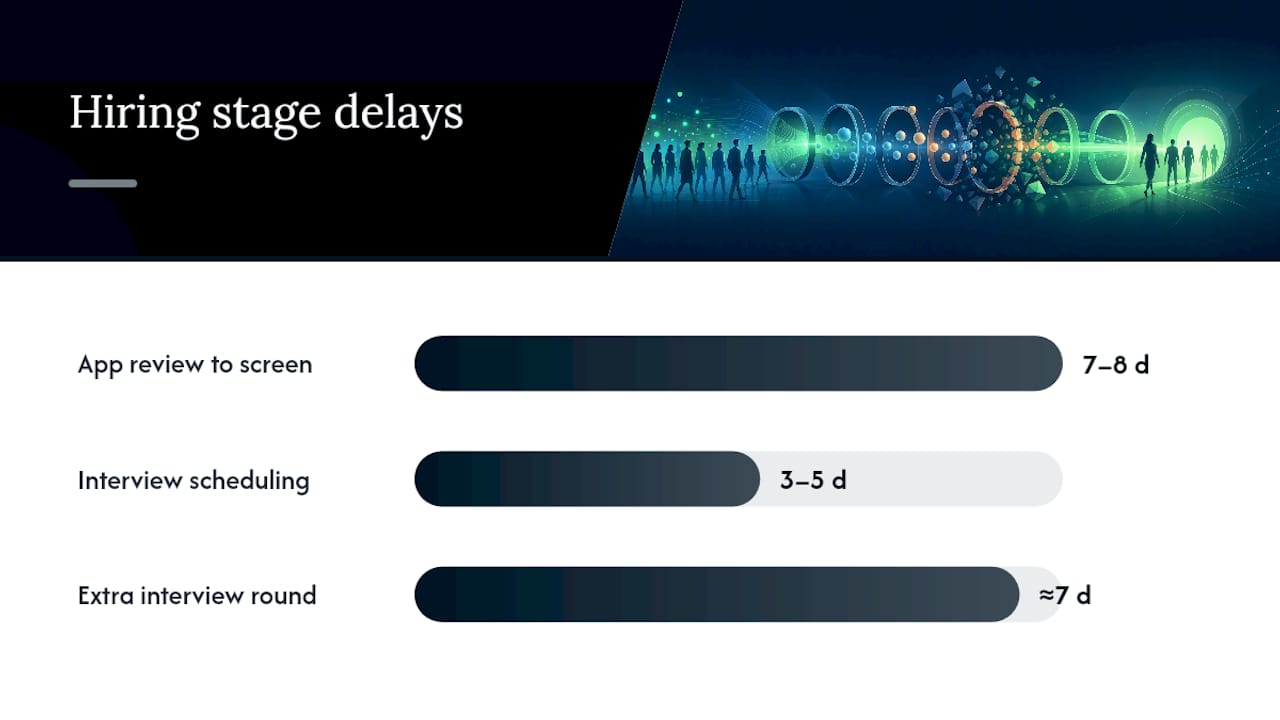
Most of the delay in a slow hiring process concentrates in a handful of predictable stages, not evenly across the whole pipeline. Benchmark analyses consistently point to application review and initial recruiter screening as the single longest stage, often averaging 7 to 8 days on its own.
Application review to recruiter screen: commonly 7 to 8 days, largely because resumes sit in a queue waiting for manual review.
Interview scheduling: frequently adds 3 to 5 days per round when coordination happens by email instead of automated calendar tools.
Multi-stage interview loops: each additional round can add a week or more, especially when panelists are hard to align.
Offer approval: internal sign-off chains, especially for compensation exceptions, routinely add several days that never show up in candidate-facing communication.
Run a stage-duration report in your applicant tracking system before touching anything else. Most systems can break total time-to-hire into segments, and that breakdown almost always reveals one or two stages responsible for the majority of the delay.
Pro Tip: Don’t average your stage data across every requisition type at once. A stage-level report that blends executive searches with entry-level hires will hide the real bottleneck behind a misleadingly smooth number.
How to Reduce Time to Hire Without Sacrificing Quality
Cutting time-to-hire only pays off if you don’t trade it for weaker hires. Prioritize tactics by where your stage-level data shows the delay, not by whichever tactic sounds most impressive in a vendor pitch.
Automate application triage. Manual resume review is the biggest single bottleneck. AI-assisted sourcing has been linked to cutting first-contact-to-accepted-offer timelines from roughly 41 days to 28 days in some cohorts, a meaningful drop tied directly to faster candidate triage.
Standardize shortlisting criteria. Structured scoring against defined requirements cuts the back-and-forth debate that stalls recruiter-to-hiring-manager handoffs.
Integrate scheduling tools. Removing manual email coordination for interviews typically shaves several days off each round.
Set hiring manager SLAs. A 48-hour turnaround requirement on feedback keeps candidates from going cold mid-process.
Build talent pipelines ahead of need. Warm candidates from prior searches convert faster than cold outreach.
Speed up offer approval workflows. Pre-approved compensation bands remove the internal sign-off delay that rarely reaches candidates but always costs days.
Test one change at a time using a cohort pilot, roughly 90 days on a single role family, and measure both time-to-hire and offer-acceptance rate together. Speed without acceptance is a false win.
Pro Tip: If a tactic speeds up time-to-hire but offer-acceptance rate drops, you’ve likely cut a stage candidates valued, like a chance to meet the team. Track both metrics side by side, every time.
How to Judge a Time to Hire Benchmark Report
Not every benchmark report deserves equal trust. Sample size, date range, and segmentation determine whether a number applies to your situation or just looks authoritative.
Check the sample size and whether it’s broken out by industry, role, and region, not just reported as one blended average.
Confirm the date range; hiring speed shifts with labor-market conditions, and a report using older churn data may not reflect current conditions.
Look for transparent methodology describing how time-to-hire was defined and measured, since sources that blend it with time-to-fill produce misleading comparisons.
Prefer industry-specific data over a single national median whenever your hiring is concentrated in a specialized field.
What Recruitify Sees Across Integrated Hiring Workflows
Administrative drag, not interview scarcity, is usually the real driver behind a bloated time-to-hire number. Platform automation is built around eliminating exactly the manual steps that stack days onto the stages benchmark data flags most often.
A significant reduction in administrative tasks across the workflow, from initial candidate contact through contract generation, directly compresses the application-review and offer stages.
AI CV parsing extracts structured candidate data rapidly and flags duplicates automatically, cutting the manual triage time that typically adds 7 to 8 days at the recruiter-screen stage.
Contextual matching scores applications against project requirements, reducing the shortlisting debate that slows the hiring-manager handoff.
A unified sales and recruitment pipeline removes the spreadsheet handoffs between client approval and candidate progression, tightening the offer-approval stage.
Statistic Callout: A 70% cut in administrative workload doesn’t automatically translate into a 70% cut in time-to-hire, since interview scheduling and candidate decision time are outside the platform’s control. But when the bottleneck sits in application review or offer paperwork, as it does for most organizations, automation removes the exact delay a stage-level report would flag. Pilot any workflow change on one role before rolling it out agency-wide.
Realistic Targets and a 90-Day Roadmap
Set targets by peer group, not the blended global figure: retail and hospitality around 20 days, corporate nonexecutive roles near 39, technical and engineering roles closer to 50 to 60.
Days 1 to 30: Baseline your current time-to-hire by stage using your ATS reporting.
Days 31 to 60: Pilot one intervention, such as automated triage, on a single role family.
Days 61 to 90: Measure time-to-hire, offer-acceptance rate, and a quality-of-hire proxy (90-day retention or manager satisfaction score) before scaling further.
Track candidate NPS, offer-acceptance rate, and a quality-of-hire proxy alongside time-to-hire so speed gains never come at the cost of who you’re actually hiring.
Where to Find Deeper Time to Hire Data
For organization-wide benchmarking, SHRM’s recruiting datasets are the standard reference. For role-level segmentation and industry ranges, consult Getraffi.ai’s aggregated collection. For regional labor-market context, BLS JOLTS data adds useful color.
Why Benchmarks Alone Won’t Fix Your Hiring Speed
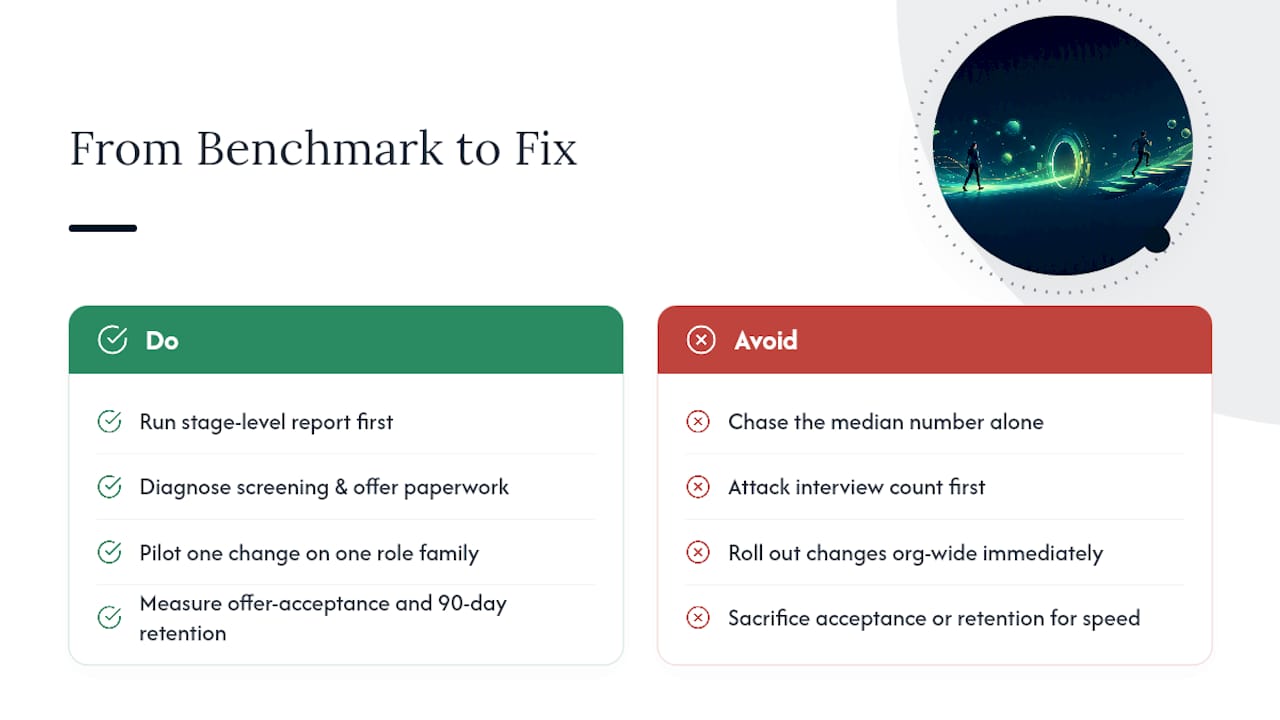
The conventional advice on time-to-hire treats the 44-day median as a scoreboard, something to beat in isolation. That misses the point. A benchmark only tells you whether you have a problem; it says nothing about where the problem lives. Recruitify’s Team view, built from watching how administrative drag compounds across application review, shortlisting, and offer approval, is that most organizations chasing a lower number attack the wrong stage entirely, usually interview count, when the data almost always points to recruiter screening or offer paperwork instead.
The gap between “we track time-to-hire” and “we know why our time-to-hire is what it is” is where most hiring teams stall. Run the stage-level report before you touch process. Pilot one change on one role family before rolling it out everywhere. And never let a faster number arrive at the expense of offer-acceptance rate or 90-day retention, because a quick bad hire costs more than a slow good one ever will.
- Recruitify Team
Sources
FAQ
What Is the 80/20 Rule in Interviewing?
The 80/20 rule in interviewing suggests that roughly 80% of a hire’s success can be predicted from 20% of the interview signals, typically structured, job-relevant questions rather than open-ended rapport-building conversation.
What Is the 3-Month Rule for Jobs?
The 3-month rule commonly refers to the idea that most new hires reveal whether they’re a strong fit within their first 90 days, which is why many organizations tie onboarding reviews and quality-of-hire assessments to that window.
What Are the 5 C’s of Hiring?
Definitions vary across sources, but a common version includes competence, character, chemistry, culture fit, and commitment as the traits hiring managers weigh most when evaluating a final candidate.
How Is Time to Hire Different From Time to Fill?
Time to hire measures from candidate application to offer acceptance, while time to fill measures from job requisition posting to the same acceptance point, making time-to-fill the longer of the two metrics.
Recommended


News & Updates
Stay up-to-date with the latest innovations, features, and tips about Recruitify!
By providing your email address within the newsletter sign-up form, you confirm its processing to send marketing information regarding the Administrator’s products and services. The Administrator of your personal data processed for the abovementioned purposes is Recruitify Spółka z o.o., based in Warsaw, Poland (KRS 0000709889). For more information on the principles of personal data processing and the rights of data subjects, please check the Privacy Policy.

Last updated:
44 Day Benchmark: Time to Hire Targets and 90 Day Plan for Recruiters
Acquiring Talent
The Recruitify Team
The global median time to hire sits at 44 days, according to AMS and The Josh Bersin Company. That measures from candidate application to accepted offer, not from job requisition, which is the more common but less precise time-to-fill metric. If your average runs longer, pull a stage-level report before changing anything else. The single longest stage, usually application review to recruiter screen, is almost always where the fix belongs.
TL;DR:
Most delays occur during application review and recruiter screening, which can add up to seven or more days if not streamlined.
Technical, engineering, and executive roles tend to have longer hiring cycles, averaging 50 to 60 days, unlike retail and hospitality roles that close in under 25 days.
Benchmark data shows a global median time to hire of 44 days, but industry-specific and role-specific variances can be significantly higher or lower.
Automating stages like resume screening and interview scheduling can cut hiring times substantially without reducing candidate quality.
Running stage-level reports before making process changes helps identify bottlenecks and ensure speed improvements do not harm offer-acceptance rates or long-term retention.
Table of Contents
Time to Hire Benchmark Snapshot: Global Median and Ranges
How to Calculate Time to Hire (Formula and Examples)
Time to Hire by Industry, Role, and Seniority
Where Time to Hire Actually Gets Lost
How to Reduce Time to Hire Without Sacrificing Quality
How to Judge a Time to Hire Benchmark Report
What Recruitify Sees Across Integrated Hiring Workflows
Realistic Targets and a 90-Day Roadmap
Where to Find Deeper Time to Hire Data
Why Benchmarks Alone Won’t Fix Your Hiring Speed
Sources
FAQ
Time to Hire Benchmark Snapshot: Global Median and Ranges
A single national or global number rarely tells the whole story, but it gives you a starting line. The 44-day global median from AMS and Josh Bersin is the most widely cited figure in the industry right now. It sits close to SHRM’s 2026 finding of a 39-day median time-to-fill for nonexecutive roles and 45 days for executive positions. The numbers diverge slightly because time-to-hire and time-to-fill measure different starting points, but the range they describe, roughly 40 to 45 days for a typical role, is a useful anchor.
Industry and role change that number substantially. According to Getraffi:
Tech and engineering roles: 50 to 62 days, driven by technical assessments and multi-round panel interviews.
Energy, defense, and other regulated sectors: often 45 to 55 days, largely due to clearance and compliance steps.
Retail and hospitality: 18 to 25 days, reflecting high-volume, lower-friction hiring.
Statistic Callout: If your organization hires primarily technical talent and your time-to-hire sits near the 44-day global median, you’re actually outperforming the specialized peer group you should be benchmarked against. Context determines whether a number is good or bad.
Percentile context matters more than most reports admit. A role sitting at the 25th percentile for its sector is competitive enough to win top candidates before a rival closes them; a role parked at the 75th percentile is bleeding offers to faster-moving competitors, regardless of what the raw number says.
How to Calculate Time to Hire (Formula and Examples)
Time to hire is the number of calendar days between when a candidate applies and when they accept an offer. Indeed’s guidance draws the clearest line here: time-to-hire starts at candidate application, while time-to-fill starts when the requisition opens or the job posts. Mixing up the two starting points is the most common measurement error HR teams make.
Pull the application date and offer-acceptance date for every closed requisition in your measurement window.
Subtract application date from acceptance date for each hire.
Average the results across all hires in that period, or use a median if your data has outliers (a single VP search that took 120 days will skew a small average badly).
In Excel or Google Sheets, this is simply
=AVERAGE(offer_date_range - application_date_range)across your dataset.
Example: a candidate applies on March 3 and accepts an offer on April 16. That’s 44 days, sitting exactly on the global median. For sourced candidates who never formally “applied,” use the date of first substantive outreach. For rehires or candidates re-entering a later stage after a prior rejection, restart the clock at the point they re-enter the active pipeline, not their original application date.
Time to Hire by Industry, Role, and Seniority
Benchmarks only mean something when you compare against the right peer group. Comparing a specialized cybersecurity search against a retail benchmark will make you think you have a crisis when you don’t.
Technical and engineering roles typically run 50 to 62 days because of coding assessments, take-home projects, and multiple technical interview rounds.
Retail, hospitality, and high-volume roles close in 18 to 25 days, since the process usually involves one interview and minimal negotiation.
Executive and senior leadership roles trend closer to SHRM’s 45-day median for executive positions, and often longer, since board or C-suite approvals add extra rounds.
Nonexecutive corporate roles land near the 39-day SHRM median, sitting comfortably below the global average.
Company size adds another layer. Larger organizations tend to run longer processes because of approval chains and compensation-committee sign-off, while smaller agencies and startups can often move faster simply because fewer people need to say yes. When you set your own target, pick the benchmark that matches your industry, your role family, and your seniority tier, not the nearest headline number. A 44-day median is meaningless if you’re filling warehouse roles that should close in three weeks.
Where Time to Hire Actually Gets Lost
Most of the delay in a slow hiring process concentrates in a handful of predictable stages, not evenly across the whole pipeline. Benchmark analyses consistently point to application review and initial recruiter screening as the single longest stage, often averaging 7 to 8 days on its own.
Application review to recruiter screen: commonly 7 to 8 days, largely because resumes sit in a queue waiting for manual review.
Interview scheduling: frequently adds 3 to 5 days per round when coordination happens by email instead of automated calendar tools.
Multi-stage interview loops: each additional round can add a week or more, especially when panelists are hard to align.
Offer approval: internal sign-off chains, especially for compensation exceptions, routinely add several days that never show up in candidate-facing communication.
Run a stage-duration report in your applicant tracking system before touching anything else. Most systems can break total time-to-hire into segments, and that breakdown almost always reveals one or two stages responsible for the majority of the delay.
Pro Tip: Don’t average your stage data across every requisition type at once. A stage-level report that blends executive searches with entry-level hires will hide the real bottleneck behind a misleadingly smooth number.
How to Reduce Time to Hire Without Sacrificing Quality
Cutting time-to-hire only pays off if you don’t trade it for weaker hires. Prioritize tactics by where your stage-level data shows the delay, not by whichever tactic sounds most impressive in a vendor pitch.
Automate application triage. Manual resume review is the biggest single bottleneck. AI-assisted sourcing has been linked to cutting first-contact-to-accepted-offer timelines from roughly 41 days to 28 days in some cohorts, a meaningful drop tied directly to faster candidate triage.
Standardize shortlisting criteria. Structured scoring against defined requirements cuts the back-and-forth debate that stalls recruiter-to-hiring-manager handoffs.
Integrate scheduling tools. Removing manual email coordination for interviews typically shaves several days off each round.
Set hiring manager SLAs. A 48-hour turnaround requirement on feedback keeps candidates from going cold mid-process.
Build talent pipelines ahead of need. Warm candidates from prior searches convert faster than cold outreach.
Speed up offer approval workflows. Pre-approved compensation bands remove the internal sign-off delay that rarely reaches candidates but always costs days.
Test one change at a time using a cohort pilot, roughly 90 days on a single role family, and measure both time-to-hire and offer-acceptance rate together. Speed without acceptance is a false win.
Pro Tip: If a tactic speeds up time-to-hire but offer-acceptance rate drops, you’ve likely cut a stage candidates valued, like a chance to meet the team. Track both metrics side by side, every time.
How to Judge a Time to Hire Benchmark Report
Not every benchmark report deserves equal trust. Sample size, date range, and segmentation determine whether a number applies to your situation or just looks authoritative.
Check the sample size and whether it’s broken out by industry, role, and region, not just reported as one blended average.
Confirm the date range; hiring speed shifts with labor-market conditions, and a report using older churn data may not reflect current conditions.
Look for transparent methodology describing how time-to-hire was defined and measured, since sources that blend it with time-to-fill produce misleading comparisons.
Prefer industry-specific data over a single national median whenever your hiring is concentrated in a specialized field.
What Recruitify Sees Across Integrated Hiring Workflows
Administrative drag, not interview scarcity, is usually the real driver behind a bloated time-to-hire number. Platform automation is built around eliminating exactly the manual steps that stack days onto the stages benchmark data flags most often.
A significant reduction in administrative tasks across the workflow, from initial candidate contact through contract generation, directly compresses the application-review and offer stages.
AI CV parsing extracts structured candidate data rapidly and flags duplicates automatically, cutting the manual triage time that typically adds 7 to 8 days at the recruiter-screen stage.
Contextual matching scores applications against project requirements, reducing the shortlisting debate that slows the hiring-manager handoff.
A unified sales and recruitment pipeline removes the spreadsheet handoffs between client approval and candidate progression, tightening the offer-approval stage.
Statistic Callout: A 70% cut in administrative workload doesn’t automatically translate into a 70% cut in time-to-hire, since interview scheduling and candidate decision time are outside the platform’s control. But when the bottleneck sits in application review or offer paperwork, as it does for most organizations, automation removes the exact delay a stage-level report would flag. Pilot any workflow change on one role before rolling it out agency-wide.
Realistic Targets and a 90-Day Roadmap
Set targets by peer group, not the blended global figure: retail and hospitality around 20 days, corporate nonexecutive roles near 39, technical and engineering roles closer to 50 to 60.
Days 1 to 30: Baseline your current time-to-hire by stage using your ATS reporting.
Days 31 to 60: Pilot one intervention, such as automated triage, on a single role family.
Days 61 to 90: Measure time-to-hire, offer-acceptance rate, and a quality-of-hire proxy (90-day retention or manager satisfaction score) before scaling further.
Track candidate NPS, offer-acceptance rate, and a quality-of-hire proxy alongside time-to-hire so speed gains never come at the cost of who you’re actually hiring.
Where to Find Deeper Time to Hire Data
For organization-wide benchmarking, SHRM’s recruiting datasets are the standard reference. For role-level segmentation and industry ranges, consult Getraffi.ai’s aggregated collection. For regional labor-market context, BLS JOLTS data adds useful color.
Why Benchmarks Alone Won’t Fix Your Hiring Speed
The conventional advice on time-to-hire treats the 44-day median as a scoreboard, something to beat in isolation. That misses the point. A benchmark only tells you whether you have a problem; it says nothing about where the problem lives. Recruitify’s Team view, built from watching how administrative drag compounds across application review, shortlisting, and offer approval, is that most organizations chasing a lower number attack the wrong stage entirely, usually interview count, when the data almost always points to recruiter screening or offer paperwork instead.
The gap between “we track time-to-hire” and “we know why our time-to-hire is what it is” is where most hiring teams stall. Run the stage-level report before you touch process. Pilot one change on one role family before rolling it out everywhere. And never let a faster number arrive at the expense of offer-acceptance rate or 90-day retention, because a quick bad hire costs more than a slow good one ever will.
- Recruitify Team
Sources
FAQ
What Is the 80/20 Rule in Interviewing?
The 80/20 rule in interviewing suggests that roughly 80% of a hire’s success can be predicted from 20% of the interview signals, typically structured, job-relevant questions rather than open-ended rapport-building conversation.
What Is the 3-Month Rule for Jobs?
The 3-month rule commonly refers to the idea that most new hires reveal whether they’re a strong fit within their first 90 days, which is why many organizations tie onboarding reviews and quality-of-hire assessments to that window.
What Are the 5 C’s of Hiring?
Definitions vary across sources, but a common version includes competence, character, chemistry, culture fit, and commitment as the traits hiring managers weigh most when evaluating a final candidate.
How Is Time to Hire Different From Time to Fill?
Time to hire measures from candidate application to offer acceptance, while time to fill measures from job requisition posting to the same acceptance point, making time-to-fill the longer of the two metrics.
Recommended
News & Updates
Stay up-to-date with the latest innovations, features, and tips about Recruitify!
By providing your email address within the newsletter sign-up form, you confirm its processing to send marketing information regarding the Administrator’s products and services. The Administrator of your personal data processed for the abovementioned purposes is Recruitify Spółka z o.o., based in Warsaw, Poland (KRS 0000709889). For more information on the principles of personal data processing and the rights of data subjects, please check the Privacy Policy.
Last updated:
44 Day Benchmark: Time to Hire Targets and 90 Day Plan for Recruiters
Acquiring Talent
The Recruitify Team
The global median time to hire sits at 44 days, according to AMS and The Josh Bersin Company. That measures from candidate application to accepted offer, not from job requisition, which is the more common but less precise time-to-fill metric. If your average runs longer, pull a stage-level report before changing anything else. The single longest stage, usually application review to recruiter screen, is almost always where the fix belongs.
TL;DR:
Most delays occur during application review and recruiter screening, which can add up to seven or more days if not streamlined.
Technical, engineering, and executive roles tend to have longer hiring cycles, averaging 50 to 60 days, unlike retail and hospitality roles that close in under 25 days.
Benchmark data shows a global median time to hire of 44 days, but industry-specific and role-specific variances can be significantly higher or lower.
Automating stages like resume screening and interview scheduling can cut hiring times substantially without reducing candidate quality.
Running stage-level reports before making process changes helps identify bottlenecks and ensure speed improvements do not harm offer-acceptance rates or long-term retention.
Table of Contents
Time to Hire Benchmark Snapshot: Global Median and Ranges
How to Calculate Time to Hire (Formula and Examples)
Time to Hire by Industry, Role, and Seniority
Where Time to Hire Actually Gets Lost
How to Reduce Time to Hire Without Sacrificing Quality
How to Judge a Time to Hire Benchmark Report
What Recruitify Sees Across Integrated Hiring Workflows
Realistic Targets and a 90-Day Roadmap
Where to Find Deeper Time to Hire Data
Why Benchmarks Alone Won’t Fix Your Hiring Speed
Sources
FAQ
Time to Hire Benchmark Snapshot: Global Median and Ranges
A single national or global number rarely tells the whole story, but it gives you a starting line. The 44-day global median from AMS and Josh Bersin is the most widely cited figure in the industry right now. It sits close to SHRM’s 2026 finding of a 39-day median time-to-fill for nonexecutive roles and 45 days for executive positions. The numbers diverge slightly because time-to-hire and time-to-fill measure different starting points, but the range they describe, roughly 40 to 45 days for a typical role, is a useful anchor.
Industry and role change that number substantially. According to Getraffi:
Tech and engineering roles: 50 to 62 days, driven by technical assessments and multi-round panel interviews.
Energy, defense, and other regulated sectors: often 45 to 55 days, largely due to clearance and compliance steps.
Retail and hospitality: 18 to 25 days, reflecting high-volume, lower-friction hiring.
Statistic Callout: If your organization hires primarily technical talent and your time-to-hire sits near the 44-day global median, you’re actually outperforming the specialized peer group you should be benchmarked against. Context determines whether a number is good or bad.
Percentile context matters more than most reports admit. A role sitting at the 25th percentile for its sector is competitive enough to win top candidates before a rival closes them; a role parked at the 75th percentile is bleeding offers to faster-moving competitors, regardless of what the raw number says.
How to Calculate Time to Hire (Formula and Examples)
Time to hire is the number of calendar days between when a candidate applies and when they accept an offer. Indeed’s guidance draws the clearest line here: time-to-hire starts at candidate application, while time-to-fill starts when the requisition opens or the job posts. Mixing up the two starting points is the most common measurement error HR teams make.
Pull the application date and offer-acceptance date for every closed requisition in your measurement window.
Subtract application date from acceptance date for each hire.
Average the results across all hires in that period, or use a median if your data has outliers (a single VP search that took 120 days will skew a small average badly).
In Excel or Google Sheets, this is simply
=AVERAGE(offer_date_range - application_date_range)across your dataset.
Example: a candidate applies on March 3 and accepts an offer on April 16. That’s 44 days, sitting exactly on the global median. For sourced candidates who never formally “applied,” use the date of first substantive outreach. For rehires or candidates re-entering a later stage after a prior rejection, restart the clock at the point they re-enter the active pipeline, not their original application date.
Time to Hire by Industry, Role, and Seniority
Benchmarks only mean something when you compare against the right peer group. Comparing a specialized cybersecurity search against a retail benchmark will make you think you have a crisis when you don’t.
Technical and engineering roles typically run 50 to 62 days because of coding assessments, take-home projects, and multiple technical interview rounds.
Retail, hospitality, and high-volume roles close in 18 to 25 days, since the process usually involves one interview and minimal negotiation.
Executive and senior leadership roles trend closer to SHRM’s 45-day median for executive positions, and often longer, since board or C-suite approvals add extra rounds.
Nonexecutive corporate roles land near the 39-day SHRM median, sitting comfortably below the global average.
Company size adds another layer. Larger organizations tend to run longer processes because of approval chains and compensation-committee sign-off, while smaller agencies and startups can often move faster simply because fewer people need to say yes. When you set your own target, pick the benchmark that matches your industry, your role family, and your seniority tier, not the nearest headline number. A 44-day median is meaningless if you’re filling warehouse roles that should close in three weeks.
Where Time to Hire Actually Gets Lost
Most of the delay in a slow hiring process concentrates in a handful of predictable stages, not evenly across the whole pipeline. Benchmark analyses consistently point to application review and initial recruiter screening as the single longest stage, often averaging 7 to 8 days on its own.
Application review to recruiter screen: commonly 7 to 8 days, largely because resumes sit in a queue waiting for manual review.
Interview scheduling: frequently adds 3 to 5 days per round when coordination happens by email instead of automated calendar tools.
Multi-stage interview loops: each additional round can add a week or more, especially when panelists are hard to align.
Offer approval: internal sign-off chains, especially for compensation exceptions, routinely add several days that never show up in candidate-facing communication.
Run a stage-duration report in your applicant tracking system before touching anything else. Most systems can break total time-to-hire into segments, and that breakdown almost always reveals one or two stages responsible for the majority of the delay.
Pro Tip: Don’t average your stage data across every requisition type at once. A stage-level report that blends executive searches with entry-level hires will hide the real bottleneck behind a misleadingly smooth number.
How to Reduce Time to Hire Without Sacrificing Quality
Cutting time-to-hire only pays off if you don’t trade it for weaker hires. Prioritize tactics by where your stage-level data shows the delay, not by whichever tactic sounds most impressive in a vendor pitch.
Automate application triage. Manual resume review is the biggest single bottleneck. AI-assisted sourcing has been linked to cutting first-contact-to-accepted-offer timelines from roughly 41 days to 28 days in some cohorts, a meaningful drop tied directly to faster candidate triage.
Standardize shortlisting criteria. Structured scoring against defined requirements cuts the back-and-forth debate that stalls recruiter-to-hiring-manager handoffs.
Integrate scheduling tools. Removing manual email coordination for interviews typically shaves several days off each round.
Set hiring manager SLAs. A 48-hour turnaround requirement on feedback keeps candidates from going cold mid-process.
Build talent pipelines ahead of need. Warm candidates from prior searches convert faster than cold outreach.
Speed up offer approval workflows. Pre-approved compensation bands remove the internal sign-off delay that rarely reaches candidates but always costs days.
Test one change at a time using a cohort pilot, roughly 90 days on a single role family, and measure both time-to-hire and offer-acceptance rate together. Speed without acceptance is a false win.
Pro Tip: If a tactic speeds up time-to-hire but offer-acceptance rate drops, you’ve likely cut a stage candidates valued, like a chance to meet the team. Track both metrics side by side, every time.
How to Judge a Time to Hire Benchmark Report
Not every benchmark report deserves equal trust. Sample size, date range, and segmentation determine whether a number applies to your situation or just looks authoritative.
Check the sample size and whether it’s broken out by industry, role, and region, not just reported as one blended average.
Confirm the date range; hiring speed shifts with labor-market conditions, and a report using older churn data may not reflect current conditions.
Look for transparent methodology describing how time-to-hire was defined and measured, since sources that blend it with time-to-fill produce misleading comparisons.
Prefer industry-specific data over a single national median whenever your hiring is concentrated in a specialized field.
What Recruitify Sees Across Integrated Hiring Workflows
Administrative drag, not interview scarcity, is usually the real driver behind a bloated time-to-hire number. Platform automation is built around eliminating exactly the manual steps that stack days onto the stages benchmark data flags most often.
A significant reduction in administrative tasks across the workflow, from initial candidate contact through contract generation, directly compresses the application-review and offer stages.
AI CV parsing extracts structured candidate data rapidly and flags duplicates automatically, cutting the manual triage time that typically adds 7 to 8 days at the recruiter-screen stage.
Contextual matching scores applications against project requirements, reducing the shortlisting debate that slows the hiring-manager handoff.
A unified sales and recruitment pipeline removes the spreadsheet handoffs between client approval and candidate progression, tightening the offer-approval stage.
Statistic Callout: A 70% cut in administrative workload doesn’t automatically translate into a 70% cut in time-to-hire, since interview scheduling and candidate decision time are outside the platform’s control. But when the bottleneck sits in application review or offer paperwork, as it does for most organizations, automation removes the exact delay a stage-level report would flag. Pilot any workflow change on one role before rolling it out agency-wide.
Realistic Targets and a 90-Day Roadmap
Set targets by peer group, not the blended global figure: retail and hospitality around 20 days, corporate nonexecutive roles near 39, technical and engineering roles closer to 50 to 60.
Days 1 to 30: Baseline your current time-to-hire by stage using your ATS reporting.
Days 31 to 60: Pilot one intervention, such as automated triage, on a single role family.
Days 61 to 90: Measure time-to-hire, offer-acceptance rate, and a quality-of-hire proxy (90-day retention or manager satisfaction score) before scaling further.
Track candidate NPS, offer-acceptance rate, and a quality-of-hire proxy alongside time-to-hire so speed gains never come at the cost of who you’re actually hiring.
Where to Find Deeper Time to Hire Data
For organization-wide benchmarking, SHRM’s recruiting datasets are the standard reference. For role-level segmentation and industry ranges, consult Getraffi.ai’s aggregated collection. For regional labor-market context, BLS JOLTS data adds useful color.
Why Benchmarks Alone Won’t Fix Your Hiring Speed
The conventional advice on time-to-hire treats the 44-day median as a scoreboard, something to beat in isolation. That misses the point. A benchmark only tells you whether you have a problem; it says nothing about where the problem lives. Recruitify’s Team view, built from watching how administrative drag compounds across application review, shortlisting, and offer approval, is that most organizations chasing a lower number attack the wrong stage entirely, usually interview count, when the data almost always points to recruiter screening or offer paperwork instead.
The gap between “we track time-to-hire” and “we know why our time-to-hire is what it is” is where most hiring teams stall. Run the stage-level report before you touch process. Pilot one change on one role family before rolling it out everywhere. And never let a faster number arrive at the expense of offer-acceptance rate or 90-day retention, because a quick bad hire costs more than a slow good one ever will.
- Recruitify Team
Sources
FAQ
What Is the 80/20 Rule in Interviewing?
The 80/20 rule in interviewing suggests that roughly 80% of a hire’s success can be predicted from 20% of the interview signals, typically structured, job-relevant questions rather than open-ended rapport-building conversation.
What Is the 3-Month Rule for Jobs?
The 3-month rule commonly refers to the idea that most new hires reveal whether they’re a strong fit within their first 90 days, which is why many organizations tie onboarding reviews and quality-of-hire assessments to that window.
What Are the 5 C’s of Hiring?
Definitions vary across sources, but a common version includes competence, character, chemistry, culture fit, and commitment as the traits hiring managers weigh most when evaluating a final candidate.
How Is Time to Hire Different From Time to Fill?
Time to hire measures from candidate application to offer acceptance, while time to fill measures from job requisition posting to the same acceptance point, making time-to-fill the longer of the two metrics.
Recommended
News & Updates
Stay up-to-date with the latest innovations, features, and tips about Recruitify!
By providing your email address within the newsletter sign-up form, you confirm its processing to send marketing information regarding the Administrator’s products and services. The Administrator of your personal data processed for the abovementioned purposes is Recruitify Spółka z o.o., based in Warsaw, Poland (KRS 0000709889). For more information on the principles of personal data processing and the rights of data subjects, please check the Privacy Policy.

Discover More

Applicant Tracking System
Contractor Onboarding Checklist for IT Staffing Agencies
A contractor onboarding checklist for agencies and HR teams: classification, US tax forms, GDPR, least-privilege access and gates that stop work before approval.
20 Oct 2026
Discover More

Acquiring Talent
Boolean Search Strings: Operators, Examples and Templates
Learn how to write Boolean search strings for recruiting: operators, LinkedIn and Google X-ray examples, developer templates and mistakes to avoid.
19 Oct 2026
Discover More

Recruitment Process
Recruiter Productivity Metrics: 3 Measures That Expose Funnel Leaks
Choose recruiter productivity metrics that expose funnel leaks, track hiring quality and candidate experience, and show where stage delays hurt results.
18 Oct 2026
Discover More
Applicant Tracking System
Contractor Onboarding Checklist for IT Staffing Agencies
A contractor onboarding checklist for agencies and HR teams: classification, US tax forms, GDPR, least-privilege access and gates that stop work before approval.
20 Oct 2026
Discover More
Acquiring Talent
Boolean Search Strings: Operators, Examples and Templates
Learn how to write Boolean search strings for recruiting: operators, LinkedIn and Google X-ray examples, developer templates and mistakes to avoid.
19 Oct 2026
Discover More